- Estimated Value(2026): 14.7 Bn
- Forecast Value (2036): 87.3 Bn
- CAGR (2026 - 2036): 19.5%
Hybrid Drone Market Size, Market Forecast and Outlook by Fact.MR
- The hybrid drone market crossed a valuation of USD 12.3 billion in 2025.
- Demand is estimated to reach USD 14.7 billion in 2026. The market is projected to grow at 19.5% CAGR from 2026 to 2036.
- Longer mission demand lifts the market to USD 87.3 billion by 2036 as survey firms and defense users need vertical takeoff with fixed-wing flight efficiency.
- Drone operators are moving from short flight windows toward platforms that can take off in tight spaces and still cover large project areas.
- Hybrid drones support this shift because they combine vertical launch with longer forward flight.
- FAA's 2025 BVLOS proposal (Part 108) covers operating rules and aircraft airworthiness acceptance for drone operations, including safe separation and recordkeeping requirements.
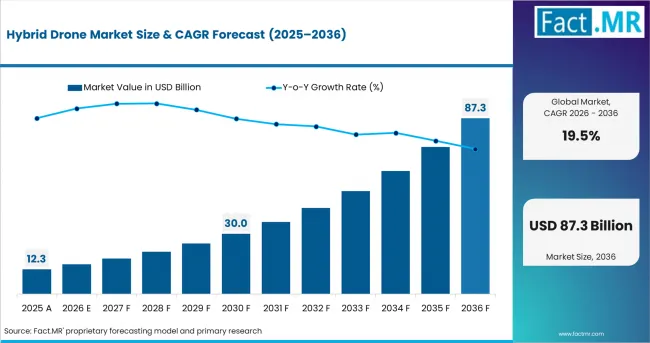
Hybrid Drone Market Market Value Analysis | Source: Fact.MR
Summary of hybrid drone market
- Market Definition
- Hybrid drones are unmanned aircraft built to combine vertical takeoff with longer forward flight. Scope is defined by drone type and range. Application, end use, sales channel, and regional deployment are covered.
- Demand Drivers in the Market
- Survey Operations: Survey operations heads need hybrid drones for longer routes and tighter launch areas. Hybrid designs help cover wide sites without needing large launch space.
- Utility Inspection: Utility inspection managers use hybrid platforms to review pipelines and grid corridors. Longer flight range supports repeat checks across remote assets.
- Defense Programs: Defense program managers need flexible launch drones for field surveillance missions. Vertical takeoff and fixed wing flight support field use in constrained areas.
- Key Segments Analyzed
- Fixed-Wing VTOL Hybrid: Fixed-wing VTOL hybrid drones are projected to account for 54.0% share of hybrid drone demand by drone type in 2026 as users need vertical launch and longer flight coverage in one platform.
- 20 km to 30 km Range: Survey and inspection users need longer routes with fewer mission breaks. The 20 km to 30 km range segment is expected to account for 41.5% share of hybrid drone demand by range in 2026.
- Mapping & Surveying: Mapping & surveying is estimated to capture 28.0% share of hybrid drone demand by application in 2026 as large land areas need cleaner aerial data with fewer flights.
- Commercial End Use: Survey firms and utility operators need hybrid systems for repeat field work. Commercial end use is expected to represent 47.0% share of hybrid drone demand by end use in 2026.
- OEMs: OEMs are expected to account for 55.0% share of hybrid drone demand by sales channel in 2026 as enterprise users need setup guidance and service access.
- Geography: United States hybrid drone demand is forecast to grow at 20.4% CAGR from 2026 to 2036 as BVLOS progress supports long-distance inspection missions.
- Analyst Opinion at Fact.MR
- Shambhu Nath Jha, Senior Analyst at Fact.MR, states, “Hybrid drone adoption is moving from platform novelty to mission practicality. Survey users want longer flight time without runway constraints. Defense users want field launch flexibility. Suppliers will gain if aircraft endurance is paired with service support and simple mission planning.”
- Strategic Implications
- Manufacturer Design: Drone manufacturers must align hybrid designs with field launch needs and mission endurance. Flexible takeoff support helps platforms serve remote survey and defense work.
- Survey Assessment: Survey firms should assess drones through route coverage and data quality. Strong flight stability improves mapping results across large sites.
- Defense Support: Defense suppliers need training support to protect repeat orders. Operator readiness and maintenance access can improve field reliability.
- Methodology
- Fact.MR interviews drone operators and survey firms, while utility inspection managers provide application-level insights alongside defense program heads.
- Research incorporates aviation regulations and company disclosures to support supplier verification and competitive assessment.
- Market estimates are developed using drone-type demand patterns and range mix analysis, with regional adoption trends applied for validation.
- Forecast assumptions are validated through supplier checks and distributor channel reviews to support application-level accuracy.
| Metric | Details |
|---|---|
| Industry Size (2026) | USD 14.7 billion |
| Industry Value (2036) | USD 87.3 billion |
| CAGR (2026 to 2036) | 19.5% |
Source: Fact.MR analysis. Updated May 26, 2026
Hybrid platforms now serve planned survey and security missions. Operators use trained pilots and formal flight procedures to improve mission output. Structured data workflows move hybrid drones beyond special project use. Mapping and inspection operations use them as scheduled aerial assets.
United States hybrid drone demand is expected to reach at a 20.4% CAGR from 2026 to 2036 as BVLOS progress supports long-distance inspection and public safety missions. India records 19.8% CAGR as cargo trials and defense localization lift adoption. China is forecast to post 19.2% CAGR as domestic UAV production supports industrial monitoring. Germany is projected to grow at 18.5% CAGR through surveying and inspection demand. Japan may register 18.1% CAGR as disaster assessment needs flexible launch drones. UK demand is likely to rise at 17.8% CAGR. Brazil records 17.0% CAGR through agriculture monitoring and mining surveys.
Segmental Analysis
Hybrid Drone Market Analysis by Drone Type
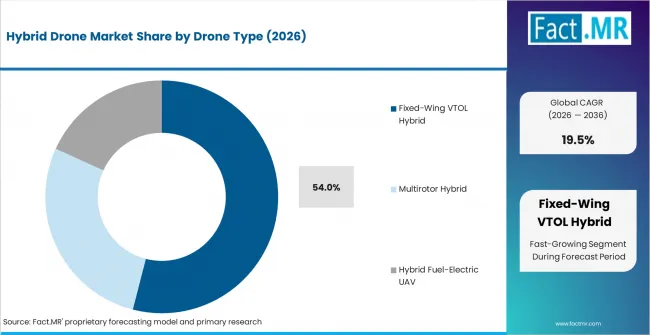
Hybrid Drone Market Analysis By Drone Type | Source: Fact.MR
Fixed-wing VTOL hybrid drones are projected to reach 54.0% share of hybrid drone by drone type in 2026 as users need runway-free launch and longer flight coverage in one platform. Multirotor hybrid drones serve jobs that require hover control with added endurance. Hybrid fuel-electric UAVs gain attention in defense and heavy-duty observation missions.
- VTOL Advantage: Fixed-wing VTOL hybrids reduce field setup pressure for survey crews that work across farms and utility corridors with limited launch support.
- Inspection Utility: Multirotor hybrid designs help technicians capture cleaner close-range images around substations and telecom towers before repeat site visits.
- Mission Endurance: Fuel-electric UAVs reduce battery swap downtime during border patrol and industrial monitoring across locations with limited charging access.
Hybrid Drone Market Analysis by Range
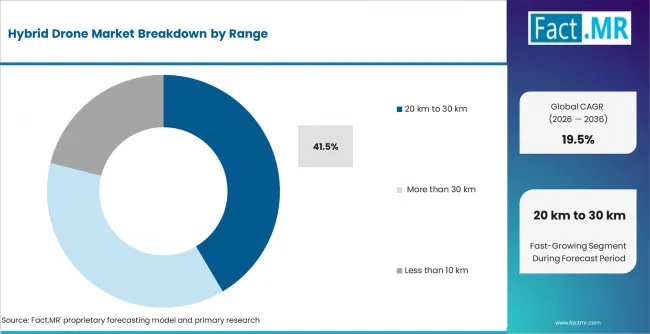
Hybrid Drone Market Analysis By Range | Source: Fact.MR
Longer routes are central to hybrid drone selection. Survey and inspection users need platforms that reduce relaunch time across large project areas. The 20 km to 30 km range segment is expected to account for 41.5% share of hybrid drone by range in 2026 as mapping and security missions need longer flight coverage. Fixed-wing VTOL drones are used for pipeline, power line, and bridge inspection as they can cover longer distances than copter drones. [2]
- Route Coverage: 20 km to 30 km systems help utility operators complete corridor checks with reduced field stops and planned crew scheduling.
- Local Work: Less than 10 km drones suit campus security and operator training since shorter routes need easier handling and lower service cost.
- Extended Missions: More than 30 km platforms serve border patrol and remote terrain assessment since longer sorties reduce vehicle movement and manual site access.
Hybrid Drone Market Analysis by Application
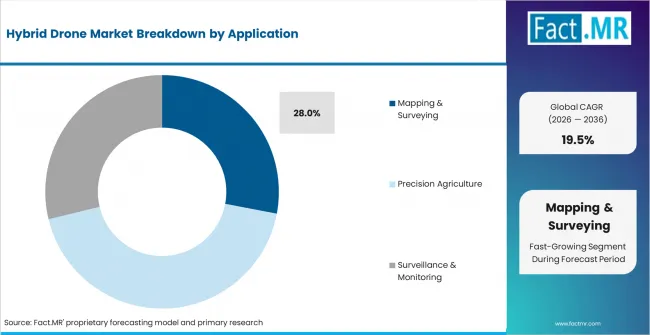
Hybrid Drone Market Analysis By Application | Source: Fact.MR
Mapping & surveying is estimated to capture 28.0% share of hybrid drone by application in 2026 as large sites need cleaner aerial data with fewer flights. Inspection & maintenance gains demand from utilities and energy operators. Surveillance & monitoring supports public safety and defense users. The drone industry continues to see professional use expand across field operations.
- Survey Demand: Mapping crews use hybrid drones to build sharper site models before grading plans and boundary checks move ahead.
- Asset Review: Utility and energy inspectors use hybrid platforms to document tower wear and pipeline faults before sending ground crews.
- Security Use: Public safety agencies use hybrid drones for event oversight and perimeter checks across sites that need quick launch access.
Hybrid Drone Market Analysis by End Use
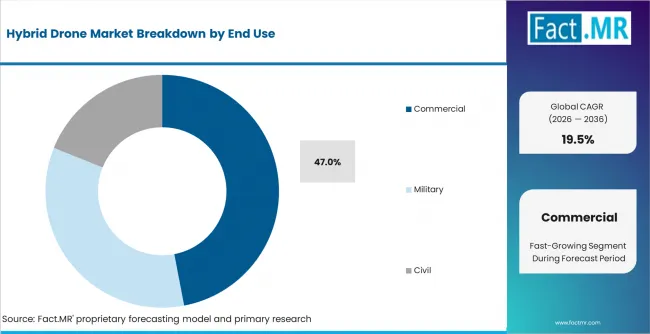
Hybrid Drone Market Analysis By End Use | Source: Fact.MR
Commercial end use remains the leading buyer group. Survey firms and utility operators need hybrid systems for repeat field work. Commercial end use is expected to represent 47.0% share of hybrid drone by end use in 2026 as operators need aerial data across large sites without runway access. Civil users adopt hybrid drones for public safety and disaster response. Military users rely on flexible launch and longer field surveillance.
- Commercial Use: Survey contractors and utility departments use hybrid drones to standardize route records across recurring project checks.
- Civil Demand: Public safety departments use hybrid drones for flood assessment and emergency access review after road links are disrupted.
- Military Role: Defense units use field-ready hybrid drones to extend observation time across border areas and temporary operating bases.
Hybrid Drone Market Analysis by Sales Channel
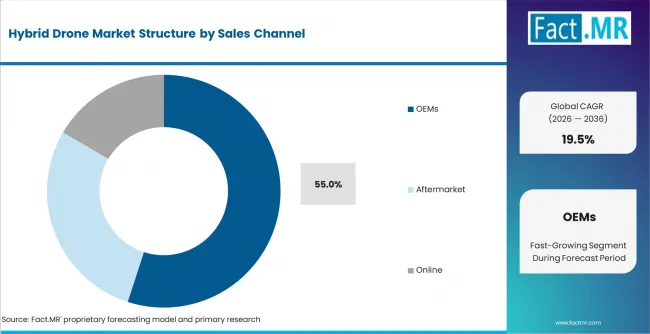
Hybrid Drone Market Analysis By Sales Channel | Source: Fact.MR
OEMs are expected to account for 55.0% share of hybrid drone demand by sales channel in 2026 as enterprise operators need setup guidance and service access. Online channels support smaller drone purchases and product comparison. Offline channels support demonstrations and operator training. Aftermarket demand comes from battery replacement and payload upgrades. Repair support adds service revenue.
- OEM Integration: Direct OEM sales help fleet operators align payload choices with firmware updates before field deployment.
- Online Screening: Online channels suit small firms comparing range specs and warranty terms before trial orders.
- Aftermarket Need: Replacement propellers and sensor swaps create follow-on revenue after harsh survey and inspection missions.
Hybrid Drone Market Drivers, Restraints, and Opportunities
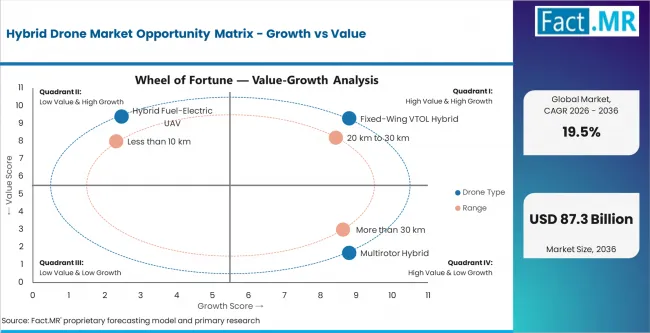
Hybrid Drone Market Opportunity Matrix Growth Vs Value | Source: Fact.MR
Extended route coverage is the main demand driver for hybrid drones. Surveying and mapping applications need wider flight coverage. Infrastructure inspection adds further demand. Survey firms and utility operators require drones that can take off from confined areas. Industrial users need the same platforms for large operational sites. Hybrid systems combine vertical takeoff flexibility with extended flight endurance, making them suitable for long-range commercial missions.
Operator readiness and airspace approval complexity form the main restraints. Commercial deployment can slow when organizations lack trained pilots or internal compliance capabilities. Hybrid platforms involve higher setup and maintenance costs compared with simpler drone systems, which can limit adoption among smaller and price-sensitive operators. Maintenance requirements and technical servicing needs may further challenge long-term adoption where operational budgets and technical support remain limited.
Opportunities in the Hybrid Drone Market
- BVLOS Operations: Suppliers can expand through drones built for long-distance commercial missions. Hybrid platforms support wider inspection routes with stronger flight flexibility.
- Mapping Work: Survey firms need platforms that reduce flight stops across large sites. Longer endurance helps improve route coverage and data consistency.
- Defense Surveillance: Hybrid drones support field observation with flexible launch. Vertical takeoff helps defense operators deploy drones in tighter field areas.
Regional Analysis
.webp "Top Country Growth Comparison Hybrid Drone Market Cagr (2026 2036)")
Top Country Growth Comparison Hybrid Drone Market Cagr (2026 2036) | Source: Fact.MR
Based on regional analysis, the hybrid drone market is segmented into North America, Latin America, Western Europe, Eastern Europe, East Asia, South Asia and Pacific, and Middle East and Africa across 30 plus countries.
| Country | CAGR (2026 to 2036) |
|---|---|
| United States | 20.4% |
| India | 19.8% |
| China | 19.2% |
| Germany | 18.5% |
| Japan | 18.1% |
| UK | 17.8% |
| Brazil | 17.0% |
Source: Fact.MR analysis. Updated May 26, 2026
Source: Fact.MR analysis, based on proprietary forecasting model and primary research.
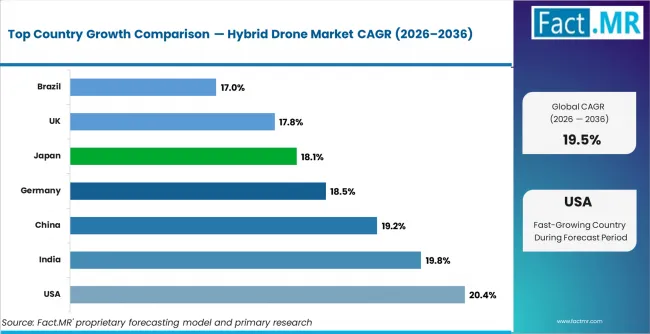
Hybrid Drone Market Cagr Analysis By Country | Source: Fact.MR
North America Hybrid Drone Market Analysis
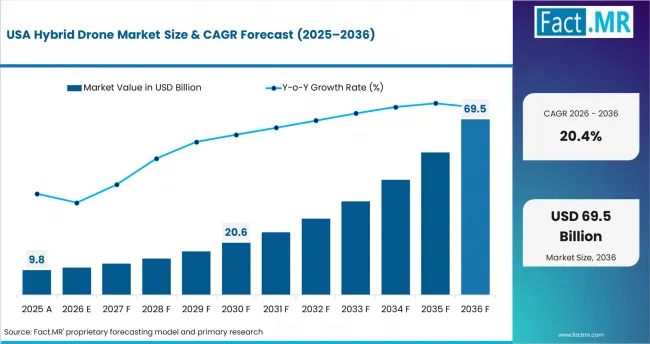
Hybrid Drone Market Country Value Analysis | Source: Fact.MR
North America shows strong demand as BVLOS progress and defense use advance together. The United States is the main country opportunity in the region. Hybrid drones serve surveying and inspection. They support public safety use. Longer missions benefit from flexible takeoff and fixed-wing flight.
- United States: Hybrid drone demand in the United States is expected to record 20.4% CAGR from 2026 to 2036 as BVLOS progress supports long-distance inspection and public safety missions. FAA’s UAS BEYOND program focuses on repeatable and scalable BVLOS operations, with emphasis on infrastructure inspection, public operations, and small package delivery. [3]
South Asia and Pacific Hybrid Drone Market Analysis
South Asia and Pacific benefits from infrastructure mapping and local drone manufacturing. India is the key growth country as drone use expands across defense and cargo trials. Operators keep close control over platform cost. Hybrid systems gain interest for large sites that need flexible launch and repeatable route coverage.
- India: India is forecast to record 19.8% CAGR in hybrid drone demand by 2036 as defense localization and cargo drone certification support adoption. Amber Wings received DGCA type certification for its ATVA-1 hybrid cargo drone in 2025. Infrastructure mapping adds demand beyond basic imaging. [4]
East Asia Hybrid Drone Market Analysis
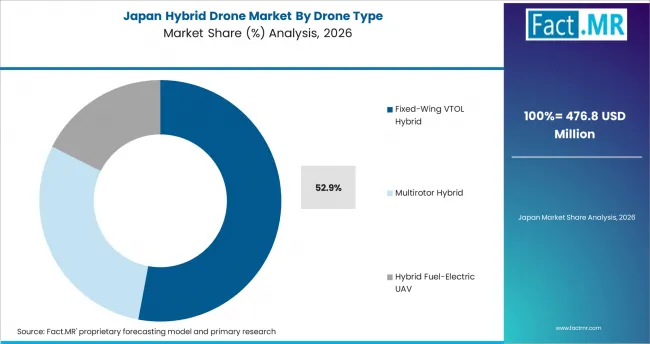
Hybrid Drone Market Japan Market Share Analysis By Drone Type | Source: Fact.MR
East Asia demand is backed by UAV production strength and industrial monitoring. China serves as a major production center and large domestic demand base. Japan has steady adoption due to disaster response and infrastructure inspection needs. Supplier strength comes from flight stability and sensor integration.
- China: China is forecast to post 19.2% CAGR in hybrid drone demand from 2026 to 2036 as UAV production and low-altitude operations expand. Local manufacturing supports faster product updates. Industrial users adopt hybrid drones for mapping and inspection work.
- Japan: Disaster response and infrastructure inspection create demand for flexible launch drones in Japan. Japan’s hybrid drone demand is expected to grow at 18.1% CAGR over the assessment period as difficult terrain raises the value of vertical takeoff and longer flight.
Western Europe Hybrid Drone Market Analysis
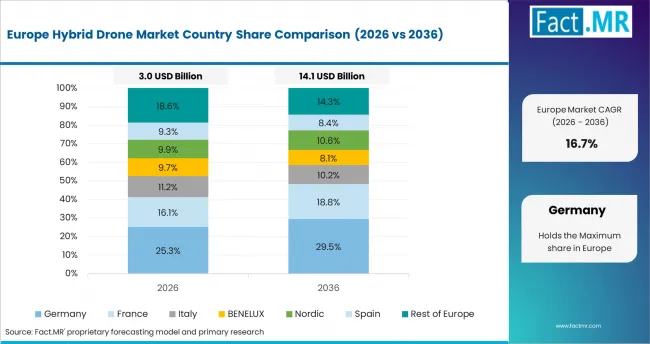
Hybrid Drone Market Europe Country Market Share Analysis, 2026 & 2036 | Source: Fact.MR
Western Europe demand managed drone operations and industrial inspection. Germany leads through engineering-led inspection and surveying use. The UK supports hybrid drone use through infrastructure inspection and public safety.
- Germany: Germany is projected to grow at 18.5% CAGR in hybrid drone demand from 2026 to 2036 as industrial inspection and surveying need longer aerial coverage. Germany is the 4th-largest commercial drone market globally, and commercial drone use in the country is projected to rise 40% from 2022 to 2030. Operators prefer drones with dependable route control and clear service support. [5]
- UK: Infrastructure inspection and public safety support hybrid drone demand in the UK. The UK is expected to expand at 17.8% CAGR over the foreseen period as operators need flexible takeoff for inspection and survey work. Managed drone planning supports enterprise adoption.
Latin America Hybrid Drone Market Analysis
Latin America demand is centered on agriculture and mining. Public safety adds demand. Brazil leads regional demand as large project areas support hybrid drone use. Cost sensitivity can affect premium platform adoption. Local service access will influence repeat sales.
- Brazil: Brazil is projected to record 17.0% CAGR in hybrid drone demand from 2026 to 2036 as agriculture monitoring and mine surveying need long-range aerial coverage. Large land areas increase the value of vertical launch and longer flight. Service access will guide repeat demand among commercial users.
Competitive Aligners for Market Players
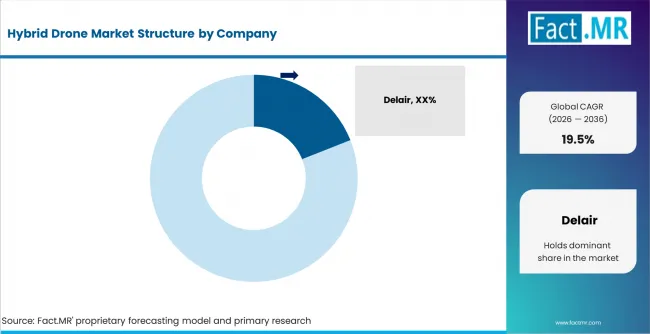
Hybrid Drone Market Analysis By Company | Source: Fact.MR
The hybrid drone market includes VTOL drone specialists and commercial UAV manufacturers. Defense suppliers also compete in this space. Delair, Wingtra, Quantum-Systems, Autel Robotics, DJI, IdeaForge, and Textron compete through endurance and payload control. Operators evaluate hybrid drones through range and launch flexibility. Service access influences selection.
Competitive advantage comes from pairing vertical takeoff with stable forward flight. Delair and Ascendance announced a 2025 collaboration to develop a hybrid-electric fixed-wing observation drone demonstrator for DGA Missile Testing. This points to supplier interest in longer endurance and defense observation missions.
Portfolio depth is important as users move from basic aerial capture to repeat mission programs. Premium accounts will favor drones that reduce launch constraints and support safer aerial review. Service access can protect supplier position because enterprise operators need faster support during active deployments.
Key Players in Hybrid Drone Market
- Delair
- Wingtra
- Quantum-Systems GmbH
- Autel Robotics
- DJI
- IdeaForge
- Textron Inc.
- Parrot Drone SAS
- AeroVironment Inc.
- Lockheed Martin Corporation
Bibliography
- [1]. Federal Aviation Administration. (2025). Beyond Visual Line of Sight (BVLOS). FAA.
- [2] Peksa, J., & Mamchur, D. (2024). A review on the state of the art in copter drones and flight control systems. Sensors, 24(11), 3349.
- [3] Federal Aviation Administration. (2024, October 1). Desk reference for UAS environmental review.
- [4]. The Economic Times. (2025). IIT Madras-incubated Amber Wings gets DGCA nod for hybrid cargo drone ATVA-1.
- [5] International Trade Administration. (2024, May 31). Germany aerospace civil drone market. U.S. Department of Commerce.
This Report Addresses
- Strategic intelligence on hybrid drone demand across mapping and inspection globally.
- Growth opportunity mapping across United States BVLOS progress and India hybrid cargo drone certification.
- Segment analysis by drone type, range, application, end use, and sales channel.
- Regional outlook covering North America BVLOS progress and East Asia UAV production.
- Competitive analysis of Delair, Wingtra, Quantum-Systems, DJI, and IdeaForge.
- Product assessment covering fixed-wing VTOL hybrid drones and hybrid fuel-electric UAVs.
- Report delivered through PDF, Excel datasets, and presentation formats.
- Primary interviews, regulatory review, and supplier portfolio analysis support validation.
Hybrid Drone Market Definition
The hybrid drone market covers unmanned aerial systems that combine vertical takeoff capability with fixed-wing or fuel-assisted flight. These platforms are used for mapping and inspection. Precision agriculture and surveillance applications are included. The market differs from rotary-only drones because hybrid designs improve mission length and launch flexibility.
Hybrid Drone Market Inclusions
The scope includes fixed-wing VTOL hybrid drones and multirotor hybrid systems. It covers hybrid fuel-electric UAVs and payload-integrated systems sold for surveying or inspection. Commercial systems used in agricultural drones are included if hybrid flight supports crop review.
Hybrid Drone Market Exclusions
The scope excludes rotary-only drones and fixed-wing drones without vertical takeoff capability. Toy drones and manned aircraft are outside the scope. Stand-alone sensors are not counted. Drone services and flight software sold without drone platform integration are excluded.
Hybrid Drone Market Research Methodology
- Primary Research
- Primary research includes interviews with survey operations heads and utility inspection managers. Defense drone program managers and agriculture technology managers are covered separately. Hybrid drone suppliers provide supplier-level inputs.
- Desk Research
- Desk research reviews aviation rulemaking and drone product datasheets. Company disclosures and operator guidance support supplier checks. Hybrid VTOL specifications and commercial drone regulations are reviewed separately.
- Market-Sizing and Forecasting
- Forecasting uses hybrid drone demand and range mix. BVLOS readiness is linked to commercial survey adoption.
- Data Validation and Update Cycle
- Forecasts are validated through supplier checks and operator interviews. Distributor feedback is used with regional drone program review.
Segmentation
Scope of the Report
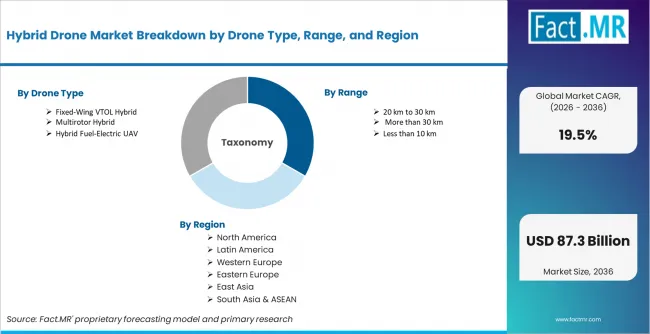
Hybrid Drone Market Breakdown By Drone Type, Range, And Region | Source: Fact.MR
| Attribute | Details |
|---|---|
| Quantitative Units | USD 14.7 billion in 2026 to USD 87.3 billion by 2036, at a 19.5% CAGR |
| Market Definition | Unmanned aerial systems that combine vertical takeoff with fixed-wing or fuel-assisted flight. |
| Drone Type | Fixed-Wing VTOL Hybrid; Multirotor Hybrid; Hybrid Fuel-Electric UAV |
| Range | Less than 10 km; 10 km to 20 km; 20 km to 30 km; More than 30 km |
| Application | Inspection & Maintenance; Mapping & Surveying; Precision Agriculture; Surveillance & Monitoring; Filming & Photography |
| End Use | Civil; Commercial; Military |
| Sales Channel | Online; Offline; OEMs; Aftermarket |
| Regions Covered | North America; Latin America; Western Europe; Eastern Europe; East Asia; South Asia and Pacific; Middle East and Africa |
| Countries Covered | United States; India; China; Germany; Japan; UK; Brazil; 30 plus countries |
| Key Companies Profiled | Delair; Wingtra; Quantum-Systems; Autel Robotics; DJI; IdeaForge; Textron; Parrot; AeroVironment; Lockheed Martin |
| Forecast Period | 2026 to 2036 |
| Approach | Hybrid top-down and bottom-up model using hybrid drone demand, range mix, application use, and primary interviews with drone operators. |
Source: Fact.MR analysis. Updated May 26, 2026
Hybrid Drone Market Analysis by Segments
-
By Drone Type:
- Fixed-Wing VTL Hybrid
- Multirtr Hybrid
- Hybrid Fuel-Electric UAV
-
By Range:
- Less than 10 km
- 10 km t 20 km
- 20 km t 30 km
- Mre than 30 km
-
By Applicatin:
- Inspectin & Maintenance
- Mapping & Surveying
- Precisin Agriculture
- Surveillance & Mnitring
- Filming & Phtgraphy
-
By End Use:
- Civil
- Cmmercial
- Military
-
By Sales Channel:
- nline
- ffline
- EMs
- Aftermarket
-
Region:
- North America
- United States
- Canada
- Europe
- Germany
- United Kingdm
- France
- Italy
- Spain
- Asia Pacific
- China
- Japan
- Suth Krea
- Taiwan
- Singapre
- Latin America
- Brazil
- Mexic
- Argentina
- • Middle East & Africa
- GCC Cuntries
- Suth Africa
- Israel
- North America
Frequently Asked Questions
How large is the hybrid drone market in 2025?
What is the expected value in 2026?
What is the forecast value by 2036?
What CAGR is projected for 2026 to 2036?
Which drone type leads hybrid drone demand?
Which range leads hybrid drone demand?
Which application leads hybrid drone demand?
Which end use accounts for the highest share?
Which sales channel leads hybrid drone demand?
Which country shows the fastest growth?
Why do fixed-wing VTOL hybrid drones lead demand?
Why does the 20 km to 30 km range lead demand?
Why does mapping & surveying lead demand?
Why do OEMs lead sales channel demand?
What is the main restraint in this market?
What supports demand in the United States?
What supports demand in India?
What supports demand in China?
Why is VTOL important for hybrid drones?
Why is service support important?
What defines competition in this market?
Who are the leading companies?
Who worked on this report


Preview the report firsthand - request a free sample
Free SampleGet the brochure for pricing and purchase details
Download PDF