- Market Value (2025): USD 782.5 Mn
- Estimated Value (2026): USD 824.0 Mn
- Forecast Value (2036): USD 1381.0 Mn
- CAGR (2026-2036): 5.3%
What is the 3-Methoxy-3-Methyl-1-Butanol Market forecast to be worth by 2036?
USD 824.0 million in 2026 to USD 1381.0 million by 2036 at a 5.3% CAGR.
- Worth USD 782.5 million in 2025, the 3-methoxy-3-methyl-1-butanol market draws most of its revenue from household and industrial cleaning formulations.
- Revenue will advance from USD 824.0 million in 2026 to USD 1381.0 million by 2036 as cleaner, ink and electronics formulators widen their use of water-compatible solvents.
- A 5.3% CAGR reflects steady reformulation away from harsher glycol ethers, paired with rising demand for high-purity grades in precision cleaning.
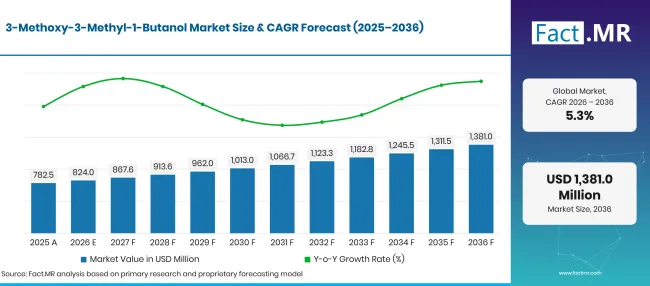
3 Methoxy 3 Methyl 1 Butanol Market Forecast Global | Source: Fact.MR
| Year | Basis | Market Value (USD million) |
|---|---|---|
| 2025 | Actual | 782.5 |
| 2026 | Estimate | 824.0 |
| 2036 | Forecast | 1381.0 |
| CAGR 2026 to 2036 | Forecast period | 5.3% |
Source: Fact.MR analysis. Updated Nov 2, 2026
What are the defining numbers behind 3-Methoxy-3-Methyl-1-Butanol Market growth?
The 2026 to 2036 period adds USD 557.0 million in new value, led by cleaning solvents and high-purity grades.
- Demand Drivers in the Market
- Safer-ingredient screening is steering cleaner formulators toward low-toxicity solvents. The U.S. Environmental Protection Agency added 18 chemicals to its Safer Chemical Ingredients List in July 2025, taking the list to 983 chemicals [1]. Brands seeking Safer Choice certification draw on this list when they pick solvents and co-solvents.
- Value-added chemistry is gaining weight as bulk volumes soften. Eurostat reports that EU sold production of chemicals and chemical products fell 1.4% in 2025 at constant prices [2]. Producers and blenders are responding by shifting their mix toward functional ingredients such as MMB that earn a premium in finished formulations.
- Export demand for European chemistry remains firm. EU chemical exports reached EUR 48.6 billion in June 2026, up 7.8% on a year earlier, according to Eurostat estimates published by the European Commission [3]. Specialty solvents travel with this trade as blenders supply cleaner and coating makers abroad.
- Electronics processing is opening a second route to market. MMB serves in resist removers, printed circuit board cleaners and color filter resists, where stability across the pH range protects sensitive surfaces. Precision users also need low residue, which favors the higher purity grades.
- Printing and coatings add steady repeat volume. Ink makers use MMB in blanket cleaners and fountain solutions, where a slow evaporation rate keeps presses running cleanly. The solvent also does less damage to plastic parts than many glycol ethers, which helps in mixed-material equipment.
- Key Segments Analyzed
- By Application: Solvents will hold 38.5% in 2026, since cleaner and degreaser makers rely on MMB to dissolve oily soils in water-based blends.
- By Purity: Above 99% will command 65.4% of 2026 value, as electronics, fragrance and pharmaceutical users specify tight impurity limits.
- Analyst Opinion at Fact.MR
- Shambhu Nath Jha, Principal Consultant at Fact.MR, states, “MMB has moved from a niche cleaning additive to a solvent that formulators reach for when they need water compatibility without the odor of glycol ethers. Over the next ten years, electronics cleaning and eco-labelled household products will pull demand toward purer grades and certified supply. Producers that can document biodegradability and sustainable feedstock will hold a pricing edge with brand owners.”
- Strategic Implications
- Manufacturers should publish full technical files on biodegradability, pH stability and plastic compatibility, since cleaner brands now screen solvents against safer-ingredient lists before trials begin.
- Distributors should build stock of high-purity grades close to electronics and fragrance clusters, where short lead times win repeat orders.
- Cleaner and ink formulators should test MMB as a co-solvent in concentrated alkaline blends, where a small dose can lift oily-soil removal and keep the product clear.
- Investors should track mass-balance certification and feedstock pricing among producers, because these two factors will shape margins on isoprene-based solvents.
The five-country spread runs 2.1 points from top to bottom. Germany leads at 6.1%, with a broad specialty chemicals base that buys functional solvents for cleaning and coatings. Brazil follows at 5.6% as industrial output edges upward and household cleaning volumes grow. A further 0.6-point step separates Brazil from the United States at 5.0%, a mature market where safer-ingredient programs drive reformulation. The United Kingdom trails at 4.5% while its chemical output recovers slowly. Japan closes the range at 4.0%, with demand tied more to electronics processing than to household products.
How does the 3-Methoxy-3-Methyl-1-Butanol Market break down by segment?
Solvents will lead Application at 38.5%; Above 99% will head Purity at 65.4% in 2026.
Which Application leads?
Solvents take 38.5% of 2026 revenue.
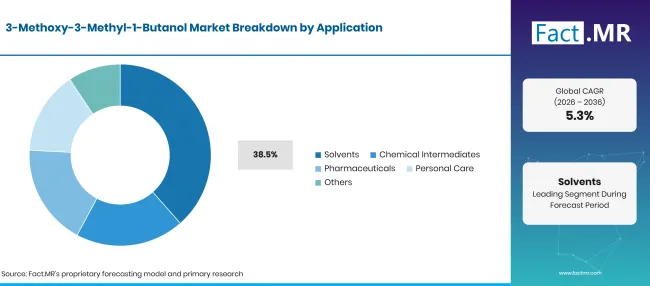
3 Methoxy 3 Methyl 1 Butanol Market Breakdown Application | Source: Fact.MR
| Application | Share (2026) |
|---|---|
| Solvents (Leading segment) | 38.5% |
| Other segments combined | 61.5%* |
| Total | 100.0% |
Source: Fact.MR analysis. Updated Nov 2, 2026
Household cleaners and industrial degreasers use MMB to cut oily soils while keeping the formula fully water-based. That role links the segment directly to industrial cleaning chemicals, where water-borne systems keep gaining share. Eco-label demand supports the trend, with 8,284 hard surface cleaning products certified under the EU Ecolabel as of October 2025 [4]. Each of those products needs solvents that pass the scheme’s toxicity and biodegradability criteria. Chemical intermediates, pharmaceuticals and personal care use smaller volumes with narrower specifications. MMB also works as a hydrotrope, a role shared with other hydrotrope ingredients that keep concentrated formulas stable. The EU Ecolabel reached 116,692 products and services in March 2026, with cleaning products ranking second by licence count [5]. This keeps solvent use ahead of the other applications through 2036.
What supports Above 99% within Purity?
Above 99% accounts for 65.4% of 2026 value.
| Purity | Share (2026) |
|---|---|
| Above 99% (Leading segment) | 65.4% |
| Other segments combined | 34.6%* |
| Total | 100.0% |
Source: Fact.MR analysis. Updated Nov 2, 2026
Electronics, fragrance and pharmaceutical buyers pay a premium for grades with tightly controlled impurities. Resist removers and circuit board cleaners leave no room for residues, and air freshener makers need a solvent that evaporates fully without clouding. Kuraray secured ISCC PLUS certification for MMB made at its Kashima plant in February 2026, adding a sustainability credential that high-purity buyers increasingly request [6]. Grades between 98% and 99% serve general cleaning and ink blends, where cost carries more weight than trace impurity limits. Grades below 98% go mainly into industrial degreasing and metal cleaning chemicals, where performance tolerances are wider. Catalog suppliers also sell research quantities at about 98%, which supports lab-scale formulation work.
What is accelerating 3-Methoxy-3-Methyl-1-Butanol Market adoption, and what is holding it back?
Safer-ingredient lists, eco-label growth and electronics cleaning needs are pulling formulators toward MMB. Its water compatibility and mild odor make reformulation simpler in cleaners and inks. Growth is restrained by cheaper glycol ethers that formulators already know well. Feedstock and logistics costs also push prices up, and new applications need lengthy qualification before volumes follow.
Drivers Impact Analysis
| DRIVER | (~) % IMPACT ON CAGR | GEOGRAPHIC RELEVANCE | IMPACT TIMELINE |
|---|---|---|---|
| Wider use of water-compatible solvents in household and industrial cleaners | +1.6% | Global | Short term (<=2 years) |
| Safer-ingredient screening and eco-label demand favoring low-toxicity solvents | +1.1% | North America, Western Europe | Medium term (2-4 years) |
| Growth in printing ink, blanket cleaner and coating formulations | +0.7% | East Asia, Western Europe | Medium term (2-4 years) |
| Rising need for residue-free cleaning in electronics processing | +0.6% | East Asia, North America | Long term (>=4 years) |
Source: Fact.MR analysis. Updated Nov 2, 2026
Opportunity Impact Analysis
| OPPORTUNITY | (~) % IMPACT ON CAGR | GEOGRAPHIC RELEVANCE | IMPACT TIMELINE |
|---|---|---|---|
| High-purity grades for resist removers and circuit board cleaners | +0.8% | East Asia, North America | Long term (>=4 years) |
| Mass-balance certified supply for brand owners with sustainability targets | +0.5% | Western Europe, North America | Medium term (2-4 years) |
| Concentrated and refill cleaning formats using hydrotropic solvents | +0.4% | Global | Medium term (2-4 years) |
| Fragrance carrier use in reed diffusers and room sprays | +0.2% | Global | Short term (<=2 years) |
Source: Fact.MR analysis. Updated Nov 2, 2026
Restraints Impact Analysis
| RESTRAINT | (~) % IMPACT ON CAGR | GEOGRAPHIC RELEVANCE | IMPACT TIMELINE |
|---|---|---|---|
| Competition from established, lower-cost glycol ether solvents | -0.6% | Global | Short term (<=2 years) |
| Feedstock and logistics cost pressure on isoprene-based chemicals | -0.4% | Global | Short term (<=2 years) |
| Lengthy qualification for electronics and pharmaceutical uses | -0.2% | East Asia, North America, Western Europe | Medium term (2-4 years) |
| Concentrated supply base with few large-scale producers | -0.1% | Global | Long term (>=4 years) |
Source: Fact.MR analysis. Updated Nov 2, 2026
Which countries are scaling the 3-Methoxy-3-Methyl-1-Butanol Market through 2036?
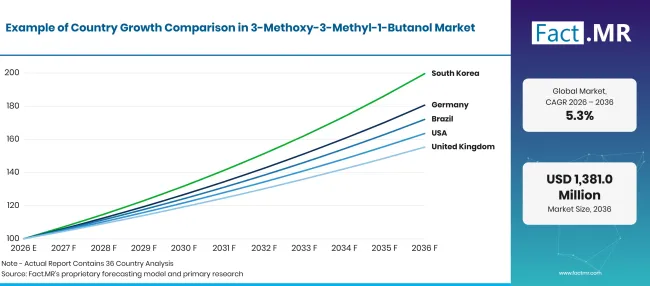
3 Methoxy 3 Methyl 1 Butanol Market Growth Index | Source: Fact.MR
| Country | CAGR (2026 to 2036) |
|---|---|
| Germany | 6.1% |
| Brazil | 5.6% |
| United States | 5.0% |
| United Kingdom | 4.5% |
| Japan | 4.0% |
Source: Fact.MR analysis. Updated Nov 2, 2026
What supports 3-methoxy-3-methyl-1-butanol adoption in Germany?
6.1% CAGR, backed by a deep specialty chemicals and formulation base.
German formulators of cleaners, coatings and adhesives form a dense customer base for functional solvents. Industrial activity firmed in 2026, with Destatis reporting that output in energy-intensive branches rose 2.9% in May 2026 against May 2025 [7]. That recovery supports restocking of specialty ingredients. German eco-label buyers also favor biodegradable co-solvents in household products. Automotive coating and car care suppliers add a further outlet, using MMB in shampoos and flux formulations.
How is Brazil developing demand?
5.6% CAGR, as industrial output and cleaning volumes edge upward.
Brazil’s industrial production grew 0.6% in 2025, its third straight annual gain, according to IBGE data reported by Agência Gov [8]. Intermediate goods output rose 1.5% over the same year. Local cleaning product makers serve a large consumer base and are moving toward water-based formulas. That shift opens space for imported specialty solvents such as MMB.
What is supporting United States adoption?
5.0% CAGR, driven by safer-ingredient reformulation in cleaning brands.
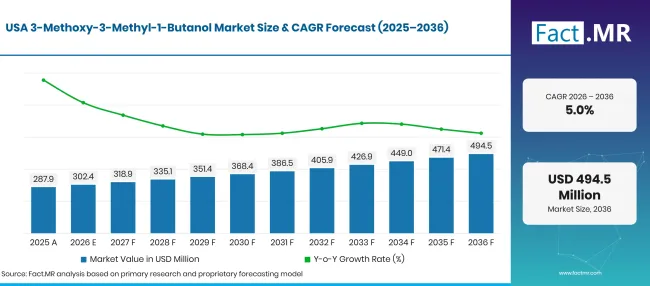
3 Methoxy 3 Methyl 1 Butanol Market Forecast Usa | Source: Fact.MR
The U.S. Census Bureau’s Annual Integrated Economic Survey, released in September 2026, puts chemical manufacturing shipments at USD 918.2 billion [9]. Soap, cleaning compound and ink producers within that base buy solvents in volume. Safer Choice certified brands add a steady pull toward low-toxicity co-solvents. Domestic electronics production creates a smaller niche for high-purity grades.
How is the United Kingdom scaling demand?
4.5% CAGR, reflecting a slow recovery in chemical output.
Office for National Statistics data show that UK output of chemicals and chemical products fell 1.5% in 2025 [10]. That weaker base tempers volume growth for specialty solvents. Demand still comes from contract cleaning, household brands and printing firms that want lower-odor ingredients. UK buyers often source high-purity grades through European distribution hubs. Contract cleaners serving hospitals, offices and food plants form the steadiest outlet, since their tenders increasingly ask for eco-labelled products.
How does Japan perform?
4.0% CAGR, owing to electronics processing over household demand.
Japan is home to MMB’s main producer, so supply is close at hand for domestic users. METI data show electronic parts and devices production rose 3.4% month on month in September 2026 [11]. Resist removers and circuit board cleaners for that sector need the high-purity grades. Household cleaner demand is mature, which keeps overall growth below the other four countries. Japanese ink and coating makers still buy steady volumes, and local air freshener brands use MMB as a fragrance carrier that evaporates without residue.
Who leads the 3-Methoxy-3-Methyl-1-Butanol Market?
Competition falls into two tiers with distinct roles. Kuraray is the integrated producer, making MMB from its isoprene chain at the Kashima plant and selling it to cleaner, ink and electronics formulators worldwide. In February 2026 Kuraray obtained ISCC PLUS certification for seven isoprene chemical products at Kashima, MMB among them [6].
In April 2026 it raised prices for its isoprene chemicals by about 20% on average, with MMB in the list and feedstock and logistics costs cited as the cause [12]. The second tier consists of catalog and research suppliers. Tokyo Chemical Industry, Merck KGaA, Chem-Impex International, BLD Pharmatech and Ambeed list the compound for laboratory and pilot use, mostly at about 98% purity. These firms compete on availability, documentation and fast delivery in small packs. Their role is to seed new formulations that may later move to bulk supply from the producer. Over the forecast period, buyers will weigh certified supply security and consistent purity above list price.
Which companies are the key providers?
Key companies in the 3-Methoxy-3-Methyl-1-Butanol Market include Kuraray, Tokyo Chemical Industry, Merck KGaA, Chem-Impex International, BLD Pharmatech and Ambeed.
- Kuraray Co., Ltd.
- Tokyo Chemical Industry Co., Ltd.
- Merck KGaA
- Chem-Impex International, Inc.
- BLD Pharmatech Ltd.
- Ambeed, Inc.
Bibliography
- [1] U.S. Environmental Protection Agency. (2025, July 21). EPA Adds 18 Chemicals to Safer Chemical Ingredients List.
- [2] Eurostat. (2026, August 24). EU industrial production rebounds in 2025.
- [3] European Commission. (2026, August 19). Eurostat data show chemicals driving EU trade surplus in June 2026.
- [4] European Commission. (2025, October 9). EU Ecolabel hits record numbers as green opportunities for businesses and consumers grow.
- [5] European Commission. (2026, May 4). EU Ecolabel uptake continues to grow, reinforcing its role in sustainable consumption.
- [6] Kuraray Co., Ltd. (2026, February 24). Kuraray Acquires ISCC PLUS Certification for Seven Isoprene Chemical Products Produced at Kashima Plant.
- [7] Statistisches Bundesamt (Destatis). (2026, July 7). Produktion im Mai 2026: +0,9 % zum Vormonat.
- [8] Agência Gov. (2026, February 3). IBGE: indústria fecha 2025 com alta de 0,6% e tem terceiro ano seguido de crescimento.
- [9] U.S. Census Bureau. (2026, September 3). Census Bureau Releases New Annual Integrated Economic Survey Data.
- [10] Office for National Statistics. (2026, October 15). 20: Manufacture of Chemicals and Chemical Products: CVM: annual and monthly growth.
- [11] Ministry of Economy, Trade and Industry. (2026, October 30). Indices of Industrial Production for September 2026 (Preliminary Report).
- [12] Kuraray Co., Ltd. (2026, April 6). Price Revisions for Isoprene Chemicals products.
This Report Answers
- How much MMB revenue will each application and purity grade generate between 2026 and 2036?
- Why do solvent uses in cleaners and degreasers keep the lead within Application?
- What makes buyers in electronics and fragrance pay for grades above 99% purity?
- Where do Germany, Brazil, the United States, the United Kingdom and Japan differ in demand drivers?
- Which producers and catalog suppliers offer MMB, and on what basis do they compete?
- Which restraints, from glycol ether competition to feedstock costs, will slow uptake?
What does the 3-Methoxy-3-Methyl-1-Butanol Market cover?
This study values global sales of 3-methoxy-3-methyl-1-butanol, a solvent also known as MMB with CAS number 56539-66-3. Revenue is measured at the producer and first-distributor level in USD million.
End uses include household cleaners, industrial degreasers, air fresheners, printing inks, coatings and electronics cleaning fluids. The study tracks these by application, purity grade and end-user industry across seven regions.
What is included in the scope?
Commercial sales of MMB in all purity grades, from technical material to grades above 99%.
Volumes sold into surface cleaning products, degreasers and air fresheners.
Use as a co-solvent in printing ink formulations, blanket cleaners and fountain solutions.
MMB sold for multi-surface disinfectant cleaners, resist removers and circuit board cleaners.
What is excluded from the scope?
MMB acetate and other MMB derivatives, which are sold as separate products.
Other glycol ethers and conventional alcohol solvents, even where they compete for the same use.
The value of finished cleaners, inks, coatings and drug products that contain MMB.
In-house captive use of MMB by a producer that is not sold on the open market.
How Was the Analysis Built?
The analysis draws on 120+ sources, 35+ company portfolios, 25+ countries, and more than 20 industry interviews.
- Primary Research: Primary research includes discussions with manufacturers, service providers, technology developers, distributors, end users, and subject-matter experts. These conversations examine purchasing priorities, product adoption, operational challenges, approval requirements, competitive positioning, and the factors that influence wider market acceptance.
- Desk Research: Desk research covers government statistics, regulatory publications, company filings, trade data, technical studies, industry associations, standards, public policy, and other authoritative sources. Every source used in the analysis is documented in the bibliography.
- Market Sizing and Forecasting: Market estimates combine historical performance, demand indicators, pricing and volume trends, segment shares, company participation, country-level growth, adoption patterns, investment activity, and barriers to market expansion.
- Data Validation and Update Cycle: Findings are validated by comparing primary interviews with public data, company activity, regulatory changes, trade patterns, and industry developments. Regular updates review new product launches, capacity changes, partnerships, approvals, and shifts in commercial adoption.
Segmentation
What is the report’s scope and coverage?
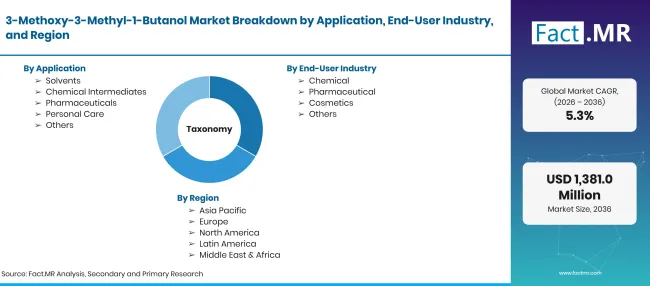
3 Methoxy 3 Methyl 1 Butanol Market Taxonomy | Source: Fact.MR
| Attribute | Details |
|---|---|
| Quantitative Units | USD million in 2026 to USD million by 2036 at CAGR |
| Market Definition | 3-Methoxy-3-methyl-1-butanol (MMB, CAS 56539-66-3), a water-miscible alcohol ether solvent used in cleaning, printing, coating, electronics and fragrance formulations. |
| Application | Solvents; Chemical Intermediates; Pharmaceuticals; Personal Care; Others |
| Purity | Above 99%; 98% to 99%; Below 98% |
| End-User Industry | Chemical; Pharmaceutical; Cosmetics; Others |
| Regions Covered | North America; Latin America; Western Europe; Eastern Europe; East Asia; South Asia & Pacific; Middle East & Africa |
| Countries Covered | Germany; Brazil; United States; United Kingdom; Japan |
| Companies Profiled | Kuraray Co., Ltd.; Tokyo Chemical Industry Co., Ltd.; Merck KGaA; Chem-Impex International, Inc.; BLD Pharmatech Ltd.; Ambeed, Inc. |
| Forecast Period | 2026 to 2036 |
| Approach | Bottom-up build from producer capacity and formulation demand in cleaning, printing and electronics, checked against chemical output data by country. |
Source: Fact.MR analysis. Updated Nov 2, 2026
How is the market segmented?
-
By Application
- Solvents
- Chemical Intermediates
- Pharmaceuticals
- Personal Care
- Others
-
By Purity
- Above 99%
- 98% to 99%
- Below 98%
-
By End-User Industry
- Chemical
- Pharmaceutical
- Cosmetics
- Others
-
By Region
- North America
- Latin America
- Western Europe
- Eastern Europe
- East Asia
- South Asia & Pacific
- Middle East & Africa
Frequently Asked Questions
How large is the 3-methoxy-3-methyl-1-butanol market in 2026?
What growth rate will the 3-methoxy-3-methyl-1-butanol market record?
Which application leads?
Which purity grade leads?
Which country will grow quickest?
Who are the main companies?
What holds the market back?
Who worked on this report


Preview the report firsthand - request a free sample
Free SampleGet the brochure for pricing and purchase details
Download PDF