- Base Value(2025): 3.10 Bn
- Estimated Value(2026): 3.25 Bn
- Forecast Value (2036): 5.19 Bn
- CAGR (2026 - 2036): 4.80%
Automotive Whiplash Protection System Market Size, Market Forecast and Outlook By Fact.MR
The automotive whiplash protection system market was valued at USD 3.10 billion in 2025, projected to reach USD 3.25 billion in 2026, and is forecast to expand to USD 5.19 billion by 2036 at a 4.80% CAGR. Mandatory inclusion of active head restraint systems in new vehicle crash test protocols, as defined by Euro NCAP and NHTSA, is sustaining demand across passenger and commercial vehicle assembly lines. Insurance industry requirements linking premium adjustments to occupant safety ratings motivate automakers to specify advanced whiplash mitigation across model variants.
The absolute dollar opportunity between 2026 and 2036 amounts to approximately USD 1.94 billion. Growth is incremental, reflecting a mature safety component category where regulatory mandates create a baseline procurement floor. System costs are influenced by actuator material prices and assembly complexity. Fact.MR analysts note that the integration of electronically controlled pro-active systems, which use pre-crash sensor data to adjust headrest position before impact, represents the primary value migration within this market.
All major regional markets reflect differentiated deployment parameters. China leads the pace with a 6.8% CAGR, followed by India at 6.5%, South Korea registers 5.3%, Japan registers 4.8%, Germany registers 4.5%, USA registers 4.2%, and UK expands at a 3.9% trajectory.
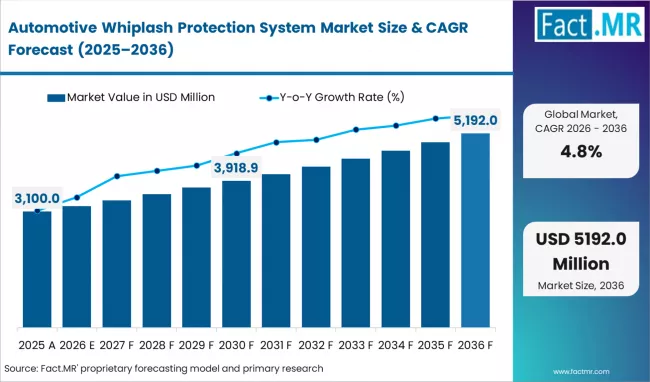
Automotive Whiplash Protection System Market Market Value Analysis | Source: Fact.MR
Automotive Whiplash Protection System Market Key Takeaways
| Metric | Details |
|---|---|
| Industry Size (2026) | USD 3.25 billion |
| Industry Value (2036) | USD 5.19 billion |
| CAGR (2026 to 2036) | 4.80% |
Source: Fact.MR analysis. Updated Mar 23, 2026
Automotive Whiplash Protection System Market Definition
Automotive whiplash protection systems are vehicle safety mechanisms designed to limit cervical spine injury during rear-impact collisions. These systems include reactive head restraints that move forward upon impact, pro-active head restraints that adjust position before collision contact, and pyrotechnic or spring-loaded devices that reposition the headrest within milliseconds of a crash event.
Automotive Whiplash Protection System Market Inclusions
The report covers reactive head restraint systems, pro-active head restraints, pendulum-based systems, spring-activated mechanisms, and pyrotechnic head restraint devices installed in passenger and commercial vehicles. Market sizing spans OEM and aftermarket sales channels across global regions for 2026 to 2036.
Automotive Whiplash Protection System Market Exclusions
Standard non-adjustable headrests without active or reactive whiplash mitigation technology are excluded. Airbag systems, seatbelt pre-tensioners, and other restraint systems not specifically designed for whiplash injury prevention fall outside the analytical boundary.
Automotive Whiplash Protection System Market Research Methodology
- Primary Research: Analysts engaged with procurement directors, product engineers, and supply chain leads across the automotive whiplash protection system value chain to map adoption triggers and specification thresholds.
- Desk Research: Data collection aggregated regulatory filings, standards ratification records, trade body publications, and corporate annual reports from allowed source categories.
- Market-Sizing and Forecasting: Baseline values derive from a hybrid top-down and bottom-up aggregation, applying region-specific adoption curves to project demand velocity through 2036.
- Data Validation and Update Cycle: Projections undergo cross-validation against publicly reported financial guidance, regulatory compliance databases, and independent industry association benchmarks.
Summary of Automotive Whiplash Protection System Market
- Automotive Whiplash Protection System Market Definition
- Automotive whiplash protection systems are occupant safety devices that reposition the head restraint during or immediately before a rear-end collision to limit cervical spine hyperextension and reduce injury severity.
- Demand Drivers in the Market
- Mandatory crash test protocols under Euro NCAP and NHTSA evaluate active head restraint performance, compelling automakers to specify compliant whiplash protection systems to achieve target safety ratings.
- Insurance industry premium structures that reward vehicles with higher occupant protection scores incentivize fleet purchasers and individual buyers to select models equipped with advanced whiplash mitigation technology.
- Expanding vehicle production volumes in China, India, and South Korea, coupled with harmonization of local crash safety standards with global benchmarks, generate incremental system installation demand.
- Key Segments Analyzed in the Fact.MR Report
- Pro-Active Head Restraints: 27.0% share in 2026, reflecting the dominant configuration within the system type category across global markets.
- Passenger Vehicles: 81.0% share in 2026, as the leading sub-segment within vehicle type segmentation.
- China: 6.8% compound growth, representing the fastest-expanding national market within the forecast period.
- Analyst Opinion at Fact.MR
- Whiplash protection system procurement is increasingly governed by crash test rating algorithms rather than standalone safety feature marketing. Automakers that fail to achieve maximum occupant protection scores face measurable sales penalties in markets where safety ratings directly influence buyer decisions. The migration from reactive mechanical systems to electronically controlled pro-active configurations represents the primary margin opportunity, but requires sensor integration capabilities that add cost and complexity to the seat assembly process. Tier-1 suppliers that cannot bundle whiplash protection with broader occupant restraint packages risk losing specification authority to competitors offering integrated safety modules.
- Strategic Implications / Executive Takeaways
- Seat system engineering directors must integrate electronically controlled pro-active head restraints into standard seat module architectures to meet evolving Euro NCAP and NHTSA scoring methodologies.
- Tier-1 suppliers should develop bundled occupant restraint packages combining whiplash protection, seatbelt pre-tensioners, and airbag systems to capture specification authority during vehicle platform bidding cycles.
- Regional market entry teams targeting India and China must ensure product specifications align with local crash test harmonization timelines to qualify for OEM integration before production ramp-up deadlines.
Shifts in the Automotive Whiplash Protection System Market from (2021 to 2025) and Future Trends (2026 to 2036)
From 2021 to 2026 the automotive whiplash protection system market has undergone many transformations influenced by increase in consumer awareness and strict government regulations as these systems were included in luxury vehicles due to their high costs as the advancements in technology and an increased focus on vehicle safety leads to their integration into more economical automobiles. The COVID-19 pandemic temporarily decrease the market growth as a result of disruptions in the automotive supply chain and a decline in vehicle sales.
| Market Shift | 2021 to 2026 |
|---|---|
| Regulatory Landscape | Stricter safety regulations and standards for automotive seating systems, including whiplash protection. |
| Technological Advancements | Improved whiplash protection systems with energy-absorbing materials and adjustable headrests. |
| Industry-Specific Demand | Increased demand due to consumer awareness of safety features and rising accident rates. |
| Sustainability & Circular Economy | Use of recycled materials for seat components and headrests in line with automotive sustainability initiatives. |
| Production & Supply Chain | Supply chain disruptions due to the COVID-19 pandemic. Increased focus on global suppliers for seat safety components. |
| Market Growth Drivers | Consumer demand for safer vehicles, stricter regulations, and increased focus on vehicle safety technology. |
Source: Fact.MR analysis. Updated Mar 23, 2026
| Market Shift | 2026 to 2036 |
|---|---|
| Regulatory Landscape | Expansion of global regulations focused on advanced safety features in vehicles, with mandatory whiplash protection in all vehicles. |
| Technological Advancements | Integration of AI and machine learning for real-time adaptation of whiplash protection systems based on individual passenger data. |
| Industry-Specific Demand | Demand driven by automakers focusing on enhanced safety features and autonomous vehicle design. |
| Sustainability & Circular Economy | Circular design principles, including recyclable whiplash protection components, integrated into the vehicle lifecycle. |
| Production & Supply Chain | Advanced manufacturing techniques utilizing 3D printing for precise parts and localized production to minimize carbon footprint. |
| Market Growth Drivers | Evolution of safety standards for autonomous vehicles, sustained consumer interest in vehicle safety, and greater investment in research and development for safety technologies. |
Source: Fact.MR analysis. Updated Mar 23, 2026
The period from 2026 to 2036 of the automotive whiplash protection system market shows significant growth due to continuous technological advancements and the evolution of safety standards as the future developments are expected to include the creation of intelligent seat systems and active head restraints that are capable of predicting and reacting to collision forces with greater efficacy.
The incorporation of sensors and innovative materials will improve the functionality and effectiveness of these systems as the consumer inclination shift towards safer and more technologically advanced vehicles as the market persist in its expansion presenting substantial growth opportunities in emerging economies where the awareness of vehicle safety is increasing.
Country-Wise Outlook
.webp "Top Country Growth Comparison Automotive Whiplash Protection System Market Cagr (2026 2036)")
Top Country Growth Comparison Automotive Whiplash Protection System Market Cagr (2026 2036) | Source: Fact.MR
United States (U.S.) Market Outlook
The automotive whiplash protection system market in the US is influenced by strict safety rules and regulations is set by the National Highway Traffic Safety Administration (NHTSA) and increasing consumer awareness regarding vehicle safety from 2020 to 2024 as the demand for advanced safety features such as whiplash protection systems has increased due to rising traffic accidents and increased focus on occupant safety as the manufacturers have integrated energy absorbing materials and adjustable headrests into their vehicles to comply with regulatory standards.
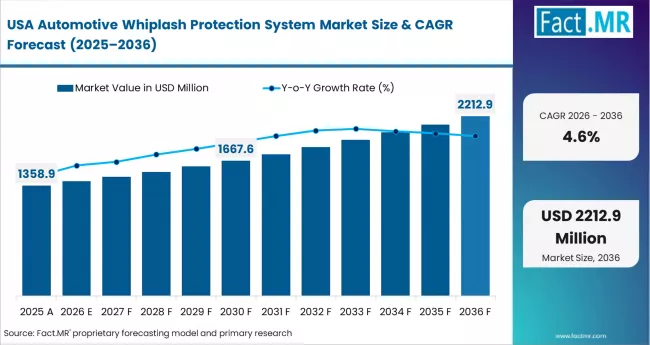
Automotive Whiplash Protection System Market Country Value Analysis | Source: Fact.MR
| Year | U.S. Attributes |
|---|---|
| Market Value (2026) | USD 623.2 Mn |
| CAGR (2026 to 2036) | 6.6% |
| Market value (2036) | USD 1,184 Mn |
Source: Fact.MR analysis. Updated Mar 23, 2026
The introduction of AI driven systems for real time monitoring and adaptation based on passenger needs will drive further advancements also the rising consumer preference for premium vehicles with advanced safety systems will strengthen the market growth while there is a strong push for sustainability as the automakers are likely to prioritize efficient manufacturing processes such as 3D printing for producing seat components.
China Market Outlook
China’s automotive whiplash protection system market is experiencing rapid growth due to the country's booming automotive industry and rising consumer demand for vehicle safety features. The market was further forced by increasing awareness of road safety among the Chinese population along with an improving middle class who increasingly prefers higher end vehicles with enhanced safety features as the demand for whiplash protection systems in China is expected to increase significantly is driven by the country’s growing focus on autonomous and electric vehicles.
| Year | U.S. Attributes |
|---|---|
| Market Value (2026) | USD 406.4 Mn |
| CAGR (2026 to 2036) | 6.8% |
| Market value (2036) | USD 787.5 Mn |
Source: Fact.MR analysis. Updated Mar 23, 2026
The government initiatives and regulations focused on occupant safety in autonomous vehicles will likely play a significant role in shaping market growth as China is investing heavily in AI and smart manufacturing is enabling manufacturers to produce advanced whiplash protection systems. The move towards environmentally conscious production in incorporating recyclable materials in seating and headrest components as it align with China's broader sustainability goals.
India Market Outlook
The automotive whiplash protection system market growth in India is still in its early stages but is expected to grow rapidly over the next decade as the market was impacted by rising awareness about road safety and increasing vehicle sales especially in urban areas. However the adoption of advanced safety features includes whiplash protection systems it has been relatively slow due to cost sensitivity and regulatory lag compared to more developed countries.
| Year | U.S. Attributes |
|---|---|
| Market Value (2026) | USD 272.8 Mn |
| CAGR (2026 to 2036) | 7.3% |
| Market value (2036) | USD 552.5 Mn |
Source: Fact.MR analysis. Updated Mar 23, 2026
India’s government is expected to strengthen safety regulations in encouraging automakers to integrate advanced safety systems such as whiplash protection into their vehicles. In particular, manufacturers of mid-range and luxury vehicles will likely lead the market as consumer demand for safer and more feature rich vehicles rises with the global automotive market shifting toward electric and autonomous vehicles India will also benefit from these trends as the government pushes for strict safety measures for emerging vehicle categories.
Category-Wise Analysis
Reactive Head Restraint-RHR - By System Type
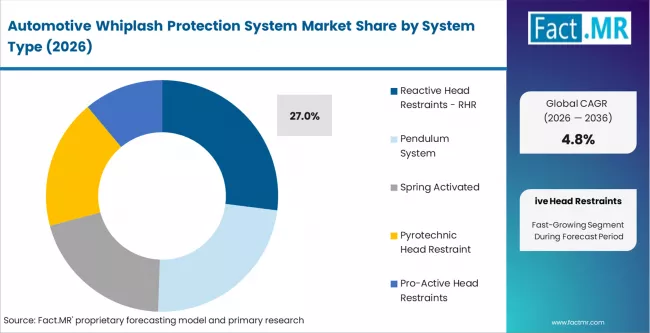
Automotive Whiplash Protection System Market Analysis By System Type | Source: Fact.MR
Reactive Head Restraints (RHR) is an important part of contemporary vehicle whiplash prevention systems as it is designed to decrease the likelihood of neck injuries during rear end collisions as the RHRs are passive mechanisms that adjust the headrest's position automatically in response to an accident.
So when a collision occurs the headrest shifts forward or upward to restrict the head’s backward movement and reduce the risk of whiplash. This reactive motion is generally occurs by a spring loaded mechanism or an integrated motor system that activates immediately as the vehicle undergoes sudden deceleration or backward movement.
The main advantage of RHRs is their capacity to provide prompt protection without necessitating intervention from the driver or passenger unlike active systems that require manual adjustments the RHRs automatically react during a crash to align the headrest with the occupant's head so the decreasing likelihood of cervical spine injuries. The system functions in conjunction with other vehicle safety elements such as airbags and seatbelts to deliver comprehensive occupant safety.
RHR technology has developed over the years with manufacturers focus on enhancing the speed and efficiency of headrest movement. The increased emphasis on safety and growing awareness regarding the significance of head protection in rear impact collisions have made RHRs a standard feature across numerous vehicles.
Passenger Vehicles - By Vehicle Type
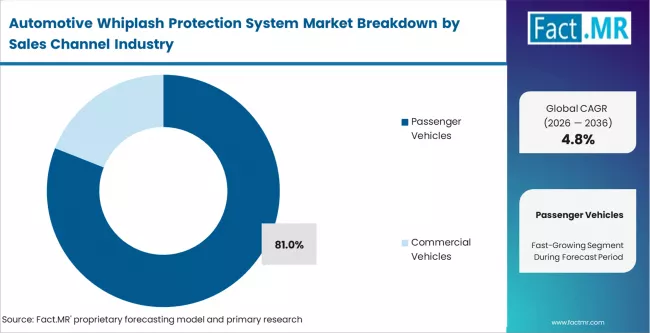
Automotive Whiplash Protection System Market Analysis By Vehicle Type | Source: Fact.MR
Passenger vehicles has the largest portion of the automotive whiplash protection system market due to a growing demand for advanced safety features it includes whiplash protection systems. The consumers have become increasingly safety oriented as seeking vehicles that offer improved occupant protection.
The need for whiplash protection in passenger vehicles is mainly due to regulations from safety organizations such as the National Highway Traffic Safety Administration (NHTSA) in the U. S. and the European New Car Assessment Programme (Euro NCAP) which made compulsory for certain vehicles to implement advanced headrest technologies.
Passenger vehicles such as sedans, SUVs and hatchbacks are using more RHRs to safeguard against rear end collisions in the most prevalent accident types on the road with an increasing focus on vehicle safety the automakers are adding whiplash protection systems to their standard safety packages also the technological advancements such as AI driven systems and improved materials are expanding the effectiveness of RHRs in passenger vehicles by making them more capable of reducing injuries during rear impacts.
The market for whiplash protection systems in passenger vehicles is expected to experience significant growth due to rising consumer demand for safer vehicles and more strict safety regulations as the global automotive industry transitions toward electric and autonomous vehicles the new safety challenges are expected to necessitate further innovation in whiplash protection for both conventional and next generation passenger vehicles.
Competitive Analysis
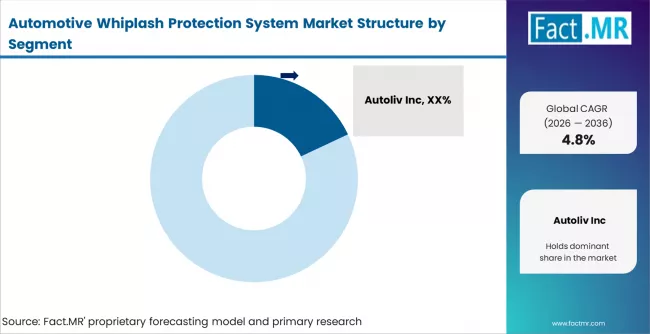
Automotive Whiplash Protection System Market Analysis By Company | Source: Fact.MR
The automotive whiplash protection system market is experiencing significant growth as the market include rising vehicle safety regulations, increasing consumer demand for advanced safety features, higher awareness of road safety and technological advancements in headrest systems.
The market is highly competitive with key players such as Autoliv Inc, TAKATA Corporation, Robert Bosch GMBH, Delphi Automotive Plc, ZF Friedrichshafen AG, Continental AG, GRAMMER AG, Lear Corporation, Hyundai Mobis Co.Ltd, Ningbo Jpyson Electronic Corp. and other companies (combined) also contribute to the industry's growth and competition.
Market Share Analysis by Company
| Company | Market Share (%) |
|---|---|
| Top 5 Players | ~52-63% |
| Tier II Players | ~16-25% |
| Other Players | ~45-55% |
Source: Fact.MR analysis. Updated Mar 23, 2026
Key Company Offerings and Activities
| Company | Key Offerings and Activities |
|---|---|
| Autoliv Inc | Offers reactive head restraints, advanced safety systems, seatbelt technologies and airbags it focus on R&D for innovative safety solutions and global partnerships with OEMs. |
| TAKATA Corporation | Provides whiplash protection systems, airbags and advanced occupant safety solutions. Focused on mergers, acquisitions (now part of Key Safety Systems), and development of passive safety technologies. |
| Robert Bosch GMBH | Develops reactive head restraints, advanced seat safety systems and electronic safety technologies. Invests in AI-driven automotive safety solutions and sensor technologies, collaborating with OEMs. |
| Delphi Automotive Plc | Provides advanced head restraint systems, safety components and seating systems it focuses on R&D, collaborations with automakers, and expanding their global footprint for safety solutions. |
| ZF Friedrichshafen AG | Offers whiplash protection systems, adaptive seat systems, and advanced driver assistance systems (ADAS). Expands safety solutions for premium and commercial vehicles, and invests in autonomous vehicle technologies. |
| Continental AG | Provides active and passive headrest systems, seat safety components and integrated vehicle safety solutions. Focuses on innovations in vehicle safety and sustainable mobility, collaborating with automotive giants. |
| GRAMMER AG | Offers seating systems, headrest and whiplash protection systems, and interior components for commercial and passenger vehicles. Develops ergonomic seating systems, with a strong presence in the commercial vehicle market. |
| Lear Corporation | Provides advanced seat systems, head restraint technologies, and seating safety solutions. Integrates innovative safety features into seating systems and collaborates with automakers globally. |
| Hyundai Mobis Co.Ltd | Provides whiplash protection systems, advanced seating technologies, and automotive safety components. Focuses on safety system integration for Hyundai and Kia, expanding offerings for global automakers. |
| Ningbo Jpyson Electronic Corp | Provides automotive safety components, whiplash protection headrests, and electronic seating solutions. Expands market presence in Asia and produces cost-effective safety systems, with a growing customer base in emerging markets. |
Source: Fact.MR analysis. Updated Mar 23, 2026
Autoliv Inc
Autoliv Inc. is a prominent global leader in the market of automotive safety systems as it specializes in a department of safety technologies such as whiplash protection systems. The company's main components has reactive head restraints, airbags, seatbelt technologies and advanced seat systems it is all designed to increase occupant protection during collisions.
The Autoliv’s new methods focuses on the development of passive safety systems that autonomously adjust to impact conditions by increasing the effectiveness of whiplash protection. The company’s dedication to research and development has lead it at the frontier of safety advancements in the automotive industry. The Autoliv collaborates with major OEMs globally by promising that its systems are encompassing both luxury and mainstream models while maintaining a commitment to safety, innovation and sustainability.
TAKATA Corporation
TAKATA Corporation is now a part of Key Safety Systems it has been a significant contributor to the automotive safety systems sector as the organization's dedication to deliver high quality safety solutions it has whiplash protection systems, airbags and advanced occupant safety technologies as the TAKATA's has the whiplash protection systems are made to reduce the neck and spine injuries during rear end collisions through the application of reactive head restraint systems and energy absorbing materials as the company has difficulties in the past including safety recalls so TAKATA's promise to increase automotive safety via technology and the testing has solidified its role in the industry.
TAKATA has established strong partnership with automakers globally as it provides safety systems. The company's continuous research and development is designed to expand the frontiers of safety innovations by ensuring that its products consistently satisfy the changing requirements of the global automotive market.
Robert Bosch GMBH
Robert Bosch GMBH is a renowned supplier of automotive safety technologies with a strong portfolio that includes advanced whiplash protection systems. The Bosch’s focus on innovation and safety is reflected in its development of reactive head restraint systems and electronic safety technologies by integrating AI and sensor based solutions, as Bosch enhances the effectiveness of its safety systems, in providing real time adaptation to impact scenarios.
The company’s expertise in automotive electronics also contributes to the advancement of passive safety systems like whiplash protection where Bosch is working to optimize seat designs and improve headrest functionality. Bosch has established itself as a key player in the automotive safety market through strategic collaborations with leading automakers and a commitment to global research and development.
Bibliography
- Euro NCAP. (2024). Assessment protocol: Adult occupant protection, whiplash test procedure version 9.1. European New Car Assessment Programme.
- National Highway Traffic Safety Administration. (2024). Federal Motor Vehicle Safety Standard No. 202a: Head restraints. NHTSA.
- International Organization for Standardization. (2024). ISO 10784: Road vehicles, head restraints in rear impacts, measurement of geometric properties. ISO.
- Swedish National Road and Transport Research Institute. (2024). Whiplash injury reduction: A review of active head restraint effectiveness. VTI.
- Global NCAP. (2024). Safer cars for India: 2024 results and technology adoption analysis. Global NCAP.
- Insurance Institute for Highway Safety. (2024). Status report: Head restraint geometry and whiplash protection ratings, volume 59. IIHS.
This bibliography is provided for reader reference. The full Fact.MR report contains the complete reference list with primary research documentation.
This Report Addresses
- Market sizing and quantitative forecast metrics detailing global and regional expenditure on automotive whiplash protection system through 2036.
- Segmentation analysis evaluating adoption patterns across system type, vehicle type, sales channel categories and their respective sub-segments.
- Regional deployment intelligence comparing growth trajectories, regulatory environments, and competitive dynamics across North America, Europe, Asia Pacific, Latin America, and the Middle East & Africa.
- Regulatory compliance assessment analyzing how safety, environmental, or performance standards shape procurement specifications and product development priorities.
- Competitive landscape evaluation tracking market structure, supplier positioning, and integration strategies among leading industry participants.
- Strategic investment guidance defining the procurement specifications, technology transitions, and capacity allocation decisions required for market positioning through the forecast period.
- Supply chain risk analysis identifying material sourcing constraints, manufacturing concentration vulnerabilities, and logistics dependencies affecting market participants.
- Custom data delivery formats encompassing interactive dashboards, raw Excel datasets, and comprehensive PDF narrative reports.
Segmentation
Automotive Whiplash Protection System Market Segmentation Analysis
The automotive whiplash protection system market is categorized based on type, vehicle type and region. In terms of type the market is classified into headrest, backrest and others with the headrest segment anticipated to lead the market in terms of revenue other than regarding vehicle type the market is categorized into passenger vehicles and commercial vehicles with passenger vehicles representing the largest market share as geographically the market is divided into North America, Europe, Asia-Pacific, Latin America and the Middle East and Africa as each region offers distinct growth opportunities and challenges it is shaped by factors such as economic conditions, regulatory frameworks and consumer preferences.
Scope of the Report
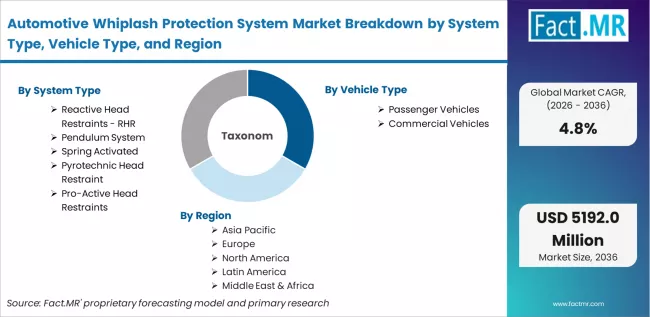
Automotive Whiplash Protection System Market Breakdown By System Type, Vehicle Type, And Region | Source: Fact.MR
| Metric | Value |
|---|---|
| Quantitative Units | USD 3.25 billion to USD 5.19 billion, at a CAGR of 4.80% |
| Market Definition | Automotive whiplash protection systems are occupant safety devices that reposition the head restraint during or immediately before a rear-end collision to limit cervical spine hyperextension and reduce injury severity. |
| System Type Segmentation | Reactive Head Restraints (RHR), Pendulum System, Spring Activated, Pyrotechnic Head Restraint, Pro-Active Head Restraints |
| Vehicle Type Segmentation | Passenger Vehicles, Commercial Vehicles |
| Sales Channel Segmentation | OEM, Aftermarket |
| Regions Covered | North America, Latin America, Europe, East Asia, South Asia, Oceania, Middle East & Africa |
| Countries Covered | India, China, USA, Canada, UK, Germany, Japan, and 40 plus countries |
| Key Companies Profiled | Autoliv Inc, TAKATA Corporation, Key Safety Systems, Robert Bosch GMBH, Delphi Automotive Plc, ZF Friedrichshafen AG, Continental AG, GRAMMER AG, Lear Corporation, Hyundai Mobis Co. Ltd, Ningbo Jpyson Electronic Corp |
| Forecast Period | 2026 to 2036 |
| Approach | Forecasting models apply a hybrid top-down and bottom-up methodology, cross-validated against primary research and public industry filings. |
Source: Fact.MR analysis. Updated Mar 23, 2026
Segmentation of Automotive Whiplash Protection System Market
-
By System Type :
- Reactive Head Restraints - RHR
- Pendulum System
- Spring Activated
- Pyrotechnic Head Restraint
- Pro-Active Head Restraints
-
By Vehicle Type :
- Passenger Vehicles
- Commercial Vehicles
-
By Sales Channel :
- OEM
- Aftermarket
-
By Region :
- North America
- Latin America
- Western Europe
- Eastern Europe
- East Asia
- South Asia & Pacific
- Middle East & Africa
Frequently Asked Questions
How large is the automotive whiplash protection system market in 2026?
What will the automotive whiplash protection system market size be by 2036?
What is the expected CAGR for the automotive whiplash protection system market between 2026 and 2036?
Which system type segment is poised to lead in 2026?
Which country is the fastest-growing market?
What is the scope of this automotive whiplash protection system market report?
What methodology does Fact.MR use for this forecast?
Which companies are profiled in this report?
Who worked on this report


Preview the report firsthand - request a free sample
Free SampleGet the brochure for pricing and purchase details
Download PDF