Automotive Ceramics Market (2026 - 2036)
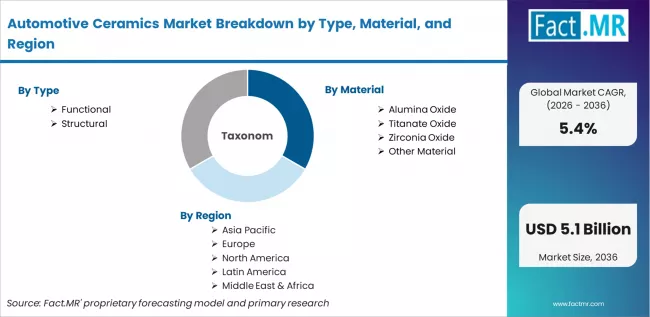
Automotive Ceramics Market is segmented by Type (Functional, Structural), Material (Alumina Oxide, Titanate Oxide, Zirconia Oxide, Other Material), Application (Engine Parts, Exhaust Systems, Electronics, Other Applications), and Region. Forecast for 2026 to 2036.
Core Findings
Automotive Ceramics Market Size, Market Forecast and Outlook By Fact.MR
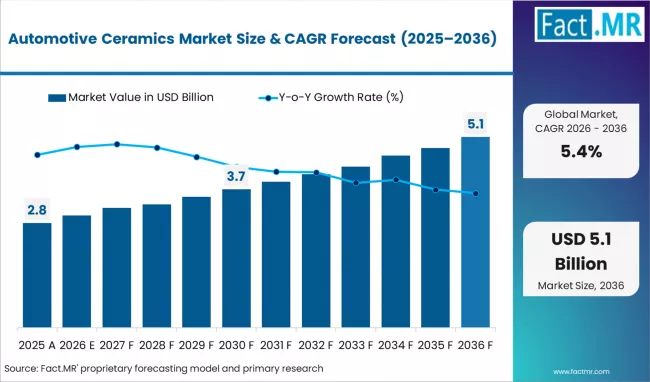
The automotive ceramics market was valued at USD 2.84 billion in 2025, projected to reach USD 2.99 billion in 2026, and is forecast to expand to USD 5.06 billion by 2036 at a 5.40% CAGR. Increasing thermal management requirements in turbocharged and electrified powertrains are generating steady procurement of ceramic components rated for operating temperatures above 1,000 degrees Celsius. Stringent emission norms in Europe and North America mandate ceramic catalytic converter substrates as a compliance standard for both gasoline and diesel exhaust treatment.
The absolute dollar opportunity between 2026 and 2036 amounts to approximately USD 2.07 billion. This incremental expansion reflects the material's specialized role in high-temperature and high-wear automotive environments. Supply chain concentration in alumina oxide processing, particularly in Japan and Germany, introduces cost sensitivity to energy price volatility. Based on Fact.MR's report, the transition toward electrified powertrains creates parallel demand for ceramic insulators in battery management systems and power electronics modules.
All major regional markets reflect differentiated deployment parameters. India leads the pace with a 7.3% CAGR, followed by China at 7.0%, South Korea registers 6.2%, Japan registers 5.5%, Germany registers 5.1%, USA registers 4.8%, and UK expands at a 4.5% trajectory.
Automotive Ceramics Market Key Takeaways
| Metric | Details |
|---|---|
| Industry Size (2026) | USD 2.99 billion |
| Industry Value (2036) | USD 5.06 billion |
| CAGR (2026 to 2036) | 5.40% |
Automotive Ceramics Market Definition
Automotive ceramics are advanced non-metallic inorganic materials engineered for use in vehicle components where high thermal resistance, electrical insulation, or mechanical hardness is required. Common applications include engine parts such as spark plug insulators and turbocharger housings, exhaust system catalytic converter substrates, and electronic sensor elements within powertrain control modules.
Automotive Ceramics Market Inclusions
The report covers functional and structural ceramic components used in passenger and commercial vehicles. Coverage includes alumina oxide, titanate oxide, zirconia oxide, and specialty ceramic materials. Market sizing spans engine parts, exhaust systems, and electronics applications across global regions for 2026 to 2036.
Automotive Ceramics Market Exclusions
Glass components, standard metal alloys used alongside ceramics, and ceramic materials intended exclusively for aerospace or industrial furnace applications are excluded. Decorative ceramic elements with no functional automotive role fall outside the analytical scope.
Automotive Ceramics Market Research Methodology
- Primary Research: Analysts engaged with procurement directors, product engineers, and supply chain leads across the automotive ceramics value chain to map adoption triggers and specification thresholds.
- Desk Research: Data collection aggregated regulatory filings, standards ratification records, trade body publications, and corporate annual reports from allowed source categories.
- Market-Sizing and Forecasting: Baseline values derive from a hybrid top-down and bottom-up aggregation, applying region-specific adoption curves to project demand velocity through 2036.
- Data Validation and Update Cycle: Projections undergo cross-validation against publicly reported financial guidance, regulatory compliance databases, and independent industry association benchmarks.
Summary of Automotive Ceramics Market
- Automotive Ceramics Market Definition
- Automotive ceramics are engineered inorganic compounds processed for deployment in vehicle subsystems where metallic alternatives cannot meet thermal, electrical, or wear-resistance performance thresholds.
- Demand Drivers in the Market
- Stringent exhaust emission norms in Europe and North America mandate ceramic-substrate catalytic converters as compliance components in every new gasoline and diesel vehicle rolling off the assembly line.
- Increasing turbocharger adoption in downsized engines generates demand for ceramic thermal barrier coatings and insulating components rated for sustained operating temperatures above 900 degrees Celsius.
- Electrified powertrain architectures require ceramic insulators within battery management modules and power electronics housings to prevent electrical discharge at high voltage operating conditions.
- Key Segments Analyzed in the Fact.MR Report
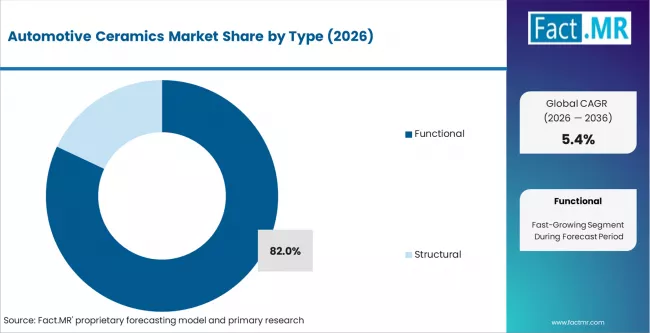
- Functional: 82.0% share in 2026, reflecting the dominant configuration within the type category across global markets.
- Alumina Oxide: 58.0% share in 2026, as the leading sub-segment within material segmentation.
- India: 7.3% compound growth, representing the fastest-expanding national market within the forecast period.
- Analyst Opinion at Fact.MR
- The automotive ceramics sector faces a bifurcated demand pattern: conventional combustion-related applications such as catalytic converter substrates provide a stable procurement floor, while emerging electrification applications in battery insulation and power electronics introduce a parallel growth vector. Manufacturers that remain dependent on a single application category risk revenue concentration as powertrain transitions accelerate unevenly across regions. Alumina oxide dominance reflects manufacturing cost advantages, but zirconia-based alternatives are gaining specification traction in high-stress thermal cycling environments. Capital allocation toward flexible production lines capable of serving both legacy and electrified vehicle platforms will separate market leaders from those locked into declining application segments.
- Strategic Implications / Executive Takeaways
- Production planners must invest in flexible manufacturing lines capable of processing both alumina oxide and zirconia oxide substrates to serve combustion and electrified vehicle platforms simultaneously.
- R&D directors should allocate resources toward ceramic insulation solutions for high-voltage battery packs and power electronics, positioning for the next demand wave beyond exhaust system applications.
- Supply chain managers must diversify alumina oxide sourcing beyond concentrated Japanese and German processing facilities to mitigate single-region energy cost exposure.
Which Emerging Trends Are Driving Demand for Automotive Ceramics?
Increasing Deployment of Electronics Nudging Automotive Ceramics Demand
As technological advancements penetrate the global automotive industry, manufacturers are incorporating numerous electronic systems to streamline overall driving experiences for vehicle owners. Electronic systems such as in-car entertainment systems, radio, ignition, telematics and computers are becoming increasingly mainstream.
Modern electric cars rely on power electronics for the main propulsion motor control, as well as managing the battery system. Future autonomous cars will rely on powerful computer systems, an array of sensors, networking, and satellite navigation, all of which will require electronics. Hence, sales of automotive ceramics are bound to incline significantly.
Implementation of Strict Vehicle Emission Norms Catalyzing Demand for Automotive Ceramics
As greenhouse gas emission levels increase at an alarming rate, governments worldwide are attempting to rein in these harmful emissions, majority of which are generated from excessive automotive usage. In an effort reduce greenhouse gases, emission control regulations are becoming stringent, prompting vehicle manufacturers to introduce fuel-efficient automobiles.
For instance, the European Union is actively endorsing the Euro 6 emission standard since 2014. For a diesel car to be Euro 6 compliant, it should not emit more than 80 mg/km of NOx gases, while a petrol car can emit no more than 60 mg/km. From 2025, the Euro 7 standards would be applicable. Such tough legislations are compelling auto manufacturers to incorporate automotive ceramics and enhance vehicular performance.
Which Challenges are Hampering Automotive Ceramics Market sales?
High Costs May Hamper the Market Growth
Although the automotive ceramics market has numerous end-uses, there are some obstacles that likely pose a challenge to market growth during the forecasting.
The high cost of solutions, as compared to plastic as well as metal alternatives may restrain the development of the global automotive ceramics industry in coming years. However, the increasing demand from the automotive electronics application segment is most likely to bode well for the expansion of the global automotive ceramics market over the forecast period of 2022 to 2032
Comparative View of Auto Infotainment Markets
Automotive Ceramics Market :
| Attributes | Automotive Ceramics Market |
|---|---|
| Growth Factor | Increasing demand for electronics applications in vehicles are likely to drive the market over the course of the forecast period. |
| Opportunity | Increasing utilization of the ceramic materials in development and manufacturing of glow plugs, electronic fuel pumps, sealing and insulation rings, spark plugs, high pressure pumps, and valves are likely to positively influence market growth over the projection period. |
Automotive Plastics Market :
| Attributes | Automotive Plastics Market |
|---|---|
| Growth Factor | The huge demand for automobiles, improved vehicle design capabilities and the growing importance for weight reduction and emission control are some of the factors that drive the growth of the automotive plastics market. |
| Opportunity | Increasing demand in manufacturing electrical components, interior and exterior furnishings, power trains, under the hood components, chassis and other such critical automotive parts are major factor expected to fuel revenue growth of the market in the near future. |
Ceramic Coatings Market :
| Attributes | Ceramic Coatings Market |
|---|---|
| Growth Factor | Increasing application in automotive to drive the demand for ceramic coating market during the forecast period. |
| Opportunity | The growing demand for ceramic coatings in developing nations like India, China, Indonesia, and Brazil is anticipated to accelerate the ceramic coating market growth. |
Country-wise Analysis
How Lucrative is the U.S Market for Automotive Ceramics?
Technological Advancement in Automotive Leads to Market Growth in US
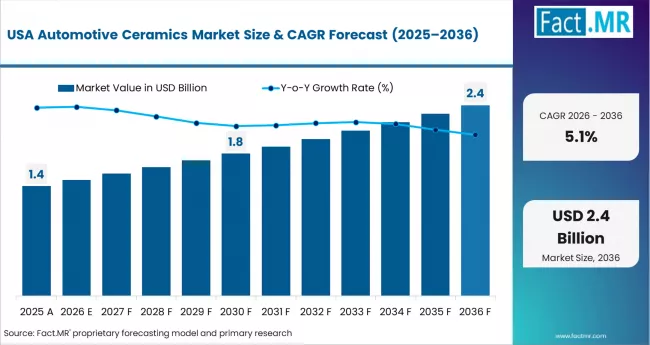
As per Fact.MR, the automotive ceramics industry forecast for the U.S appears bright, surpassing US$ 465 Million in 2022, accounting for almost 32% revenue. A series of anticipated positive developments in automotive technology is likely to drive future expansion in the region.
Some of these developments include the introduction of self-driving vehicles, enhanced connectivity, electrification, shared mobility and artificial intelligence to name a few, which are motivating the establishment of numerous start-up companies, which are expected to invest heavily in high grade automotive ceramics for their manufacturing processes.
What are the Prospects for Future Automotive Ceramics Sales across China?
Presence of Numerous Major Automotive Ceramic Manufacturers in The Region Drive the Market Growth
China is forecast to register heightened sales of automotive ceramics, expanding at over 8.2% CAGR through 2032. As per Fact.MR’s automotive ceramics industry research, a valuation exceeding US$ 540 Million by 2032-end is projected for the Chinese market.
The International Trade Administration estimates that China continues to remain the world’s largest vehicle market, both in terms of annual sales and manufacturing output, with domestic production likely to reach 35 Million units by 2025. Hence, manufacturers are augmenting in high-grade ceramics for numerous automotive internal and external components.
Category-wise Insights
By Type of Ceramics Which Is the Most Prominent Segment in the Automotive Ceramics Market?
Demand for Functional Ceramics is high among other types
By type, functional automotive ceramics demand is projected to grow at over 5.2% CAGR by 2032, surpassing US$ 1.3 Billion. Automotive ceramics are experience high usage across engine & exhaust systems, electronics, internal parts and a host of other functionalities.
Manufacturers such as Advanced Ceramic Materials (ACM) offer a broad range of functional ceramics for automotive brakes, shock absorbers and engines respectively. The company manufactures ceramics from carbon fibers and zirconia.
By Material Which Segment Generates the High Revenue in The Automotive Ceramics Market?
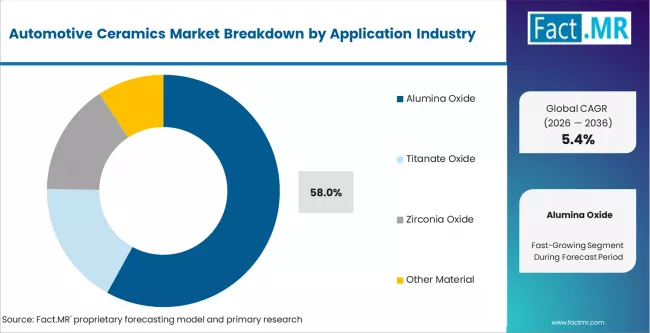
Alumina Oxide Automotive Ceramics Remain Most Preferred
As per Fact.MR’s automative ceramics industry survey, sales of alumina oxide ceramics are anticipated to remain dominant. The segment accounted for more than 40.6% revenue in 2022.
Alumina oxide ceramics are the most widely used material, as it possesses superb characteristics, including high electrical insulation, enhanced mechanical strength and high wear & mechanical resistance. Moreover, alumina oxide ceramics help reduce fuel consumption by over 30%.
Based On Application, Which Segment Accounts for Maximum Automotive Ceramics Market Growth?
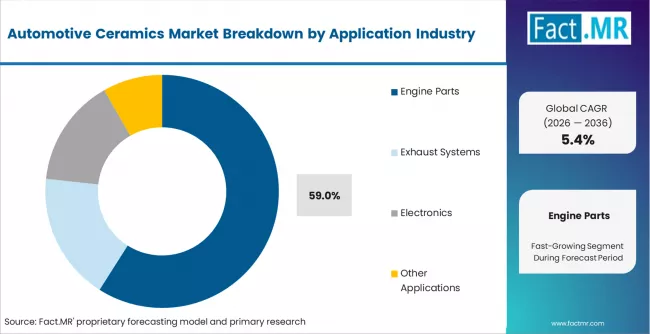
Automotive Electronics is the heaviest application segment
Fact.MR’s automotive ceramics sales forecast anticipates a healthy growth trajectory across the electronics segment, expanding at almost 5.2% CAGR until 2032.
Automotive engineers and designers use ceramic electronic substrates and components to provide better reliability, environmental performance, engines, transmission, chassis, safety, driver assistance, passenger comfort, and infotainment systems and modules.
Start-Ups for Automotive Ceramics Market
Some key startups in the automotive ceramics industry include Calix Ceramics solution, Astro Met Inc., Anoop ceramics, NGK Technologies India, Vinkayauto, Tecera, Otto Chemie Pvt. Ltd., among others.
- Astro Met Inc. - Manufacturer of high-purity components for wear and corrosive applications including alumina. Types include zirconia-toughened alumina, alumina-aluminum oxide cement and alumina ceramic. Used for wear, corrosion, thermal and electrical applications.
Bibliography
- American Ceramic Society. (2024). Advanced ceramics in automotive applications: State of the industry report 2024. ACerS.
- European Ceramic Industry Association. (2024). Cerame-Unie position paper: Advanced ceramics for zero-emission vehicles. Cerame-Unie.
- International Organization for Standardization. (2024). ISO 20507: Fine ceramics (advanced ceramics, advanced technical ceramics), vocabulary. ISO.
- Japan Fine Ceramics Association. (2024). Market survey of fine ceramics industry in Japan, fiscal year 2023. JFCA.
- United States Department of Energy. (2024). Vehicle Technologies Office annual progress report: Advanced materials and manufacturing. DOE.
- European Commission, Directorate-General for Internal Market. (2024). EU Critical Raw Materials Act: Implications for advanced ceramic supply chains. EC.
This bibliography is provided for reader reference. The full Fact.MR report contains the complete reference list with primary research documentation.
This Report Addresses
- Market sizing and quantitative forecast metrics detailing global and regional expenditure on automotive ceramics through 2036.
- Segmentation analysis evaluating adoption patterns across type, material, application categories and their respective sub-segments.
- Regional deployment intelligence comparing growth trajectories, regulatory environments, and competitive dynamics across North America, Europe, Asia Pacific, Latin America, and the Middle East & Africa.
- Regulatory compliance assessment analyzing how safety, environmental, or performance standards shape procurement specifications and product development priorities.
- Competitive landscape evaluation tracking market structure, supplier positioning, and integration strategies among leading industry participants.
- Strategic investment guidance defining the procurement specifications, technology transitions, and capacity allocation decisions required for market positioning through the forecast period.
- Supply chain risk analysis identifying material sourcing constraints, manufacturing concentration vulnerabilities, and logistics dependencies affecting market participants.
- Custom data delivery formats encompassing interactive dashboards, raw Excel datasets, and comprehensive PDF narrative reports.
Scope of the Report

| Metric | Value |
|---|---|
| Quantitative Units | USD 2.99 billion to USD 5.06 billion, at a CAGR of 5.40% |
| Market Definition | Automotive ceramics are engineered inorganic compounds processed for deployment in vehicle subsystems where metallic alternatives cannot meet thermal, electrical, or wear-resistance performance thresholds. |
| Type Segmentation | Functional, Structural |
| Material Segmentation | Alumina Oxide, Titanate Oxide, Zirconia Oxide, Other Material |
| Application Segmentation | Engine Parts, Exhaust Systems, Electronics, Other Applications |
| Regions Covered | North America, Latin America, Europe, East Asia, South Asia, Oceania, Middle East & Africa |
| Countries Covered | India, China, USA, Canada, UK, Germany, Japan, and 40 plus countries |
| Key Companies Profiled | 3M Company, CeramTec GmbH, CoorsTek Inc., Corning Inc., Dyson Technical Ceramics Ltd., Elan Technology, IBIDEN Co. Ltd., Kyocera Corporation, McDanel Advanced Ceramic Technologies LLC, Morgan Advanced Materials Plc., NGK Insulators Ltd., Saint Gobain Performance Ceramics & Refractories |
| Forecast Period | 2026 to 2036 |
| Approach | Forecasting models apply a hybrid top-down and bottom-up methodology, cross-validated against primary research and public industry filings. |
Key Segments Covered in Automotive Ceramics Market Study
-
By Type :
- Functional
- Structural
-
By Material :
- Alumina Oxide
- Titanate Oxide
- Zirconia Oxide
- Other Material
-
By Application :
- Engine Parts
- Exhaust Systems
- Electronics
- Other Applications
-
By Region :
- North America
- Europe
- East Asia
- South Asia
- Oceania
- Latin America
- Middle East & Africa
Table of Content
- Executive Summary
- Global Market Outlook
- Demand to side Trends
- Supply to side Trends
- Technology Roadmap Analysis
- Analysis and Recommendations
- Market Overview
- Market Coverage / Taxonomy
- Market Definition / Scope / Limitations
- Research Methodology
- Chapter Orientation
- Analytical Lens and Working Hypotheses
- Market Structure, Signals, and Trend Drivers
- Benchmarking and Cross-market Comparability
- Market Sizing, Forecasting, and Opportunity Mapping
- Research Design and Evidence Framework
- Desk Research Programme (Secondary Evidence)
- Company Annual and Sustainability Reports
- Peer-reviewed Journals and Academic Literature
- Corporate Websites, Product Literature, and Technical Notes
- Earnings Decks and Investor Briefings
- Statutory Filings and Regulatory Disclosures
- Technical White Papers and Standards Notes
- Trade Journals, Industry Magazines, and Analyst Briefs
- Conference Proceedings, Webinars, and Seminar Materials
- Government Statistics Portals and Public Data Releases
- Press Releases and Reputable Media Coverage
- Specialist Newsletters and Curated Briefings
- Sector Databases and Reference Repositories
- Fact.MR Internal Proprietary Databases and Historical Market Datasets
- Subscription Datasets and Paid Sources
- Social Channels, Communities, and Digital Listening Inputs
- Additional Desk Sources
- Expert Input and Fieldwork (Primary Evidence)
- Primary Modes
- Qualitative Interviews and Expert Elicitation
- Quantitative Surveys and Structured Data Capture
- Blended Approach
- Why Primary Evidence is Used
- Field Techniques
- Interviews
- Surveys
- Focus Groups
- Observational and In-context Research
- Social and Community Interactions
- Stakeholder Universe Engaged
- C-suite Leaders
- Board Members
- Presidents and Vice Presidents
- R&D and Innovation Heads
- Technical Specialists
- Domain Subject-matter Experts
- Scientists
- Physicians and Other Healthcare Professionals
- Governance, Ethics, and Data Stewardship
- Research Ethics
- Data Integrity and Handling
- Primary Modes
- Tooling, Models, and Reference Databases
- Desk Research Programme (Secondary Evidence)
- Data Engineering and Model Build
- Data Acquisition and Ingestion
- Cleaning, Normalisation, and Verification
- Synthesis, Triangulation, and Analysis
- Quality Assurance and Audit Trail
- Market Background
- Market Dynamics
- Drivers
- Restraints
- Opportunity
- Trends
- Scenario Forecast
- Demand in Optimistic Scenario
- Demand in Likely Scenario
- Demand in Conservative Scenario
- Opportunity Map Analysis
- Product Life Cycle Analysis
- Supply Chain Analysis
- Investment Feasibility Matrix
- Value Chain Analysis
- PESTLE and Porter’s Analysis
- Regulatory Landscape
- Regional Parent Market Outlook
- Production and Consumption Statistics
- Import and Export Statistics
- Market Dynamics
- Global Market Analysis 2021 to 2025 and Forecast, 2026 to 2036
- Historical Market Size Value (USD Million) Analysis, 2021 to 2025
- Current and Future Market Size Value (USD Million) Projections, 2026 to 2036
- Y to o to Y Growth Trend Analysis
- Absolute $ Opportunity Analysis
- Global Market Pricing Analysis 2021 to 2025 and Forecast 2026 to 2036
- Global Market Analysis 2021 to 2025 and Forecast 2026 to 2036, By Type
- Introduction / Key Findings
- Historical Market Size Value (USD Million) Analysis By Type, 2021 to 2025
- Current and Future Market Size Value (USD Million) Analysis and Forecast By Type, 2026 to 2036
- Functional
- Structural
- Functional
- Y to o to Y Growth Trend Analysis By Type, 2021 to 2025
- Absolute $ Opportunity Analysis By Type, 2026 to 2036
- Global Market Analysis 2021 to 2025 and Forecast 2026 to 2036, By Material
- Introduction / Key Findings
- Historical Market Size Value (USD Million) Analysis By Material, 2021 to 2025
- Current and Future Market Size Value (USD Million) Analysis and Forecast By Material, 2026 to 2036
- Alumina Oxide
- Titanate Oxide
- Zirconia Oxide
- Other Material
- Alumina Oxide
- Y to o to Y Growth Trend Analysis By Material, 2021 to 2025
- Absolute $ Opportunity Analysis By Material, 2026 to 2036
- Global Market Analysis 2021 to 2025 and Forecast 2026 to 2036, By Application
- Introduction / Key Findings
- Historical Market Size Value (USD Million) Analysis By Application, 2021 to 2025
- Current and Future Market Size Value (USD Million) Analysis and Forecast By Application, 2026 to 2036
- Engine Parts
- Exhaust Systems
- Electronics
- Other Applications
- Engine Parts
- Y to o to Y Growth Trend Analysis By Application, 2021 to 2025
- Absolute $ Opportunity Analysis By Application, 2026 to 2036
- Global Market Analysis 2021 to 2025 and Forecast 2026 to 2036, By Region
- Introduction
- Historical Market Size Value (USD Million) Analysis By Region, 2021 to 2025
- Current Market Size Value (USD Million) Analysis and Forecast By Region, 2026 to 2036
- North America
- Latin America
- Western Europe
- Eastern Europe
- East Asia
- South Asia and Pacific
- Middle East & Africa
- Market Attractiveness Analysis By Region
- North America Market Analysis 2021 to 2025 and Forecast 2026 to 2036, By Country
- Historical Market Size Value (USD Million) Trend Analysis By Market Taxonomy, 2021 to 2025
- Market Size Value (USD Million) Forecast By Market Taxonomy, 2026 to 2036
- By Country
- USA
- Canada
- Mexico
- By Type
- By Material
- By Application
- By Country
- Market Attractiveness Analysis
- By Country
- By Type
- By Material
- By Application
- Key Takeaways
- Latin America Market Analysis 2021 to 2025 and Forecast 2026 to 2036, By Country
- Historical Market Size Value (USD Million) Trend Analysis By Market Taxonomy, 2021 to 2025
- Market Size Value (USD Million) Forecast By Market Taxonomy, 2026 to 2036
- By Country
- Brazil
- Chile
- Rest of Latin America
- By Type
- By Material
- By Application
- By Country
- Market Attractiveness Analysis
- By Country
- By Type
- By Material
- By Application
- Key Takeaways
- Western Europe Market Analysis 2021 to 2025 and Forecast 2026 to 2036, By Country
- Historical Market Size Value (USD Million) Trend Analysis By Market Taxonomy, 2021 to 2025
- Market Size Value (USD Million) Forecast By Market Taxonomy, 2026 to 2036
- By Country
- Germany
- UK
- Italy
- Spain
- France
- Nordic
- BENELUX
- Rest of Western Europe
- By Type
- By Material
- By Application
- By Country
- Market Attractiveness Analysis
- By Country
- By Type
- By Material
- By Application
- Key Takeaways
- Eastern Europe Market Analysis 2021 to 2025 and Forecast 2026 to 2036, By Country
- Historical Market Size Value (USD Million) Trend Analysis By Market Taxonomy, 2021 to 2025
- Market Size Value (USD Million) Forecast By Market Taxonomy, 2026 to 2036
- By Country
- Russia
- Poland
- Hungary
- Balkan & Baltic
- Rest of Eastern Europe
- By Type
- By Material
- By Application
- By Country
- Market Attractiveness Analysis
- By Country
- By Type
- By Material
- By Application
- Key Takeaways
- East Asia Market Analysis 2021 to 2025 and Forecast 2026 to 2036, By Country
- Historical Market Size Value (USD Million) Trend Analysis By Market Taxonomy, 2021 to 2025
- Market Size Value (USD Million) Forecast By Market Taxonomy, 2026 to 2036
- By Country
- China
- Japan
- South Korea
- By Type
- By Material
- By Application
- By Country
- Market Attractiveness Analysis
- By Country
- By Type
- By Material
- By Application
- Key Takeaways
- South Asia and Pacific Market Analysis 2021 to 2025 and Forecast 2026 to 2036, By Country
- Historical Market Size Value (USD Million) Trend Analysis By Market Taxonomy, 2021 to 2025
- Market Size Value (USD Million) Forecast By Market Taxonomy, 2026 to 2036
- By Country
- India
- ASEAN
- Australia & New Zealand
- Rest of South Asia and Pacific
- By Type
- By Material
- By Application
- By Country
- Market Attractiveness Analysis
- By Country
- By Type
- By Material
- By Application
- Key Takeaways
- Middle East & Africa Market Analysis 2021 to 2025 and Forecast 2026 to 2036, By Country
- Historical Market Size Value (USD Million) Trend Analysis By Market Taxonomy, 2021 to 2025
- Market Size Value (USD Million) Forecast By Market Taxonomy, 2026 to 2036
- By Country
- Kingdom of Saudi Arabia
- Other GCC Countries
- Turkiye
- South Africa
- Other African Union
- Rest of Middle East & Africa
- By Type
- By Material
- By Application
- By Country
- Market Attractiveness Analysis
- By Country
- By Type
- By Material
- By Application
- Key Takeaways
- Key Countries Market Analysis
- USA
- Pricing Analysis
- Market Share Analysis, 2025
- By Type
- By Material
- By Application
- Canada
- Pricing Analysis
- Market Share Analysis, 2025
- By Type
- By Material
- By Application
- Mexico
- Pricing Analysis
- Market Share Analysis, 2025
- By Type
- By Material
- By Application
- Brazil
- Pricing Analysis
- Market Share Analysis, 2025
- By Type
- By Material
- By Application
- Chile
- Pricing Analysis
- Market Share Analysis, 2025
- By Type
- By Material
- By Application
- Germany
- Pricing Analysis
- Market Share Analysis, 2025
- By Type
- By Material
- By Application
- UK
- Pricing Analysis
- Market Share Analysis, 2025
- By Type
- By Material
- By Application
- Italy
- Pricing Analysis
- Market Share Analysis, 2025
- By Type
- By Material
- By Application
- Spain
- Pricing Analysis
- Market Share Analysis, 2025
- By Type
- By Material
- By Application
- France
- Pricing Analysis
- Market Share Analysis, 2025
- By Type
- By Material
- By Application
- India
- Pricing Analysis
- Market Share Analysis, 2025
- By Type
- By Material
- By Application
- ASEAN
- Pricing Analysis
- Market Share Analysis, 2025
- By Type
- By Material
- By Application
- Australia & New Zealand
- Pricing Analysis
- Market Share Analysis, 2025
- By Type
- By Material
- By Application
- China
- Pricing Analysis
- Market Share Analysis, 2025
- By Type
- By Material
- By Application
- Japan
- Pricing Analysis
- Market Share Analysis, 2025
- By Type
- By Material
- By Application
- South Korea
- Pricing Analysis
- Market Share Analysis, 2025
- By Type
- By Material
- By Application
- Russia
- Pricing Analysis
- Market Share Analysis, 2025
- By Type
- By Material
- By Application
- Poland
- Pricing Analysis
- Market Share Analysis, 2025
- By Type
- By Material
- By Application
- Hungary
- Pricing Analysis
- Market Share Analysis, 2025
- By Type
- By Material
- By Application
- Kingdom of Saudi Arabia
- Pricing Analysis
- Market Share Analysis, 2025
- By Type
- By Material
- By Application
- Turkiye
- Pricing Analysis
- Market Share Analysis, 2025
- By Type
- By Material
- By Application
- South Africa
- Pricing Analysis
- Market Share Analysis, 2025
- By Type
- By Material
- By Application
- USA
- Market Structure Analysis
- Competition Dashboard
- Competition Benchmarking
- Market Share Analysis of Top Players
- By Regional
- By Type
- By Material
- By Application
- Competition Analysis
- Competition Deep Dive
- 3M Company
- Overview
- Product Portfolio
- Profitability by Market Segments (Product/Age /Sales Channel/Region)
- Sales Footprint
- Strategy Overview
- Marketing Strategy
- Product Strategy
- Channel Strategy
- CeramTec GmbH
- CoorsTek Inc.
- Corning Inc.
- Dyson Technical Ceramics Ltd.
- Elan Technology
- IBIDEN Co. Ltd.
- Kyocera Corporation
- McDanel Advanced Ceramic Technologies LLC
- Morgan Advanced Materials Plc.
- NGK Insulators Ltd.
- Saint Gobain Performance Ceramics & Refractories
- 3M Company
- Competition Deep Dive
- Assumptions & Acronyms Used
List Of Table
- Table 1: Global Market Value (USD Million) Forecast by Region, 2021 to 2036
- Table 2: Global Market Value (USD Million) Forecast by Type, 2021 to 2036
- Table 3: Global Market Value (USD Million) Forecast by Material, 2021 to 2036
- Table 4: Global Market Value (USD Million) Forecast by Application, 2021 to 2036
- Table 5: North America Market Value (USD Million) Forecast by Country, 2021 to 2036
- Table 6: North America Market Value (USD Million) Forecast by Type, 2021 to 2036
- Table 7: North America Market Value (USD Million) Forecast by Material, 2021 to 2036
- Table 8: North America Market Value (USD Million) Forecast by Application, 2021 to 2036
- Table 9: Latin America Market Value (USD Million) Forecast by Country, 2021 to 2036
- Table 10: Latin America Market Value (USD Million) Forecast by Type, 2021 to 2036
- Table 11: Latin America Market Value (USD Million) Forecast by Material, 2021 to 2036
- Table 12: Latin America Market Value (USD Million) Forecast by Application, 2021 to 2036
- Table 13: Western Europe Market Value (USD Million) Forecast by Country, 2021 to 2036
- Table 14: Western Europe Market Value (USD Million) Forecast by Type, 2021 to 2036
- Table 15: Western Europe Market Value (USD Million) Forecast by Material, 2021 to 2036
- Table 16: Western Europe Market Value (USD Million) Forecast by Application, 2021 to 2036
- Table 17: Eastern Europe Market Value (USD Million) Forecast by Country, 2021 to 2036
- Table 18: Eastern Europe Market Value (USD Million) Forecast by Type, 2021 to 2036
- Table 19: Eastern Europe Market Value (USD Million) Forecast by Material, 2021 to 2036
- Table 20: Eastern Europe Market Value (USD Million) Forecast by Application, 2021 to 2036
- Table 21: East Asia Market Value (USD Million) Forecast by Country, 2021 to 2036
- Table 22: East Asia Market Value (USD Million) Forecast by Type, 2021 to 2036
- Table 23: East Asia Market Value (USD Million) Forecast by Material, 2021 to 2036
- Table 24: East Asia Market Value (USD Million) Forecast by Application, 2021 to 2036
- Table 25: South Asia and Pacific Market Value (USD Million) Forecast by Country, 2021 to 2036
- Table 26: South Asia and Pacific Market Value (USD Million) Forecast by Type, 2021 to 2036
- Table 27: South Asia and Pacific Market Value (USD Million) Forecast by Material, 2021 to 2036
- Table 28: South Asia and Pacific Market Value (USD Million) Forecast by Application, 2021 to 2036
- Table 29: Middle East & Africa Market Value (USD Million) Forecast by Country, 2021 to 2036
- Table 30: Middle East & Africa Market Value (USD Million) Forecast by Type, 2021 to 2036
- Table 31: Middle East & Africa Market Value (USD Million) Forecast by Material, 2021 to 2036
- Table 32: Middle East & Africa Market Value (USD Million) Forecast by Application, 2021 to 2036
List Of Figures
- Figure 1: Global Market Pricing Analysis
- Figure 2: Global Market Value (USD Million) Forecast 2021 to 2036
- Figure 3: Global Market Value Share and BPS Analysis by Type, 2026 and 2036
- Figure 4: Global Market Y-o-Y Growth Comparison by Type, 2026 to 2036
- Figure 5: Global Market Attractiveness Analysis by Type
- Figure 6: Global Market Value Share and BPS Analysis by Material, 2026 and 2036
- Figure 7: Global Market Y-o-Y Growth Comparison by Material, 2026 to 2036
- Figure 8: Global Market Attractiveness Analysis by Material
- Figure 9: Global Market Value Share and BPS Analysis by Application, 2026 and 2036
- Figure 10: Global Market Y-o-Y Growth Comparison by Application, 2026 to 2036
- Figure 11: Global Market Attractiveness Analysis by Application
- Figure 12: Global Market Value (USD Million) Share and BPS Analysis by Region, 2026 and 2036
- Figure 13: Global Market Y-o-Y Growth Comparison by Region, 2026 to 2036
- Figure 14: Global Market Attractiveness Analysis by Region
- Figure 15: North America Market Incremental Dollar Opportunity, 2026 to 2036
- Figure 16: Latin America Market Incremental Dollar Opportunity, 2026 to 2036
- Figure 17: Western Europe Market Incremental Dollar Opportunity, 2026 to 2036
- Figure 18: Eastern Europe Market Incremental Dollar Opportunity, 2026 to 2036
- Figure 19: East Asia Market Incremental Dollar Opportunity, 2026 to 2036
- Figure 20: South Asia and Pacific Market Incremental Dollar Opportunity, 2026 to 2036
- Figure 21: Middle East & Africa Market Incremental Dollar Opportunity, 2026 to 2036
- Figure 22: North America Market Value Share and BPS Analysis by Country, 2026 and 2036
- Figure 23: North America Market Value Share and BPS Analysis by Type, 2026 and 2036
- Figure 24: North America Market Y-o-Y Growth Comparison by Type, 2026 to 2036
- Figure 25: North America Market Attractiveness Analysis by Type
- Figure 26: North America Market Value Share and BPS Analysis by Material, 2026 and 2036
- Figure 27: North America Market Y-o-Y Growth Comparison by Material, 2026 to 2036
- Figure 28: North America Market Attractiveness Analysis by Material
- Figure 29: North America Market Value Share and BPS Analysis by Application, 2026 and 2036
- Figure 30: North America Market Y-o-Y Growth Comparison by Application, 2026 to 2036
- Figure 31: North America Market Attractiveness Analysis by Application
- Figure 32: Latin America Market Value Share and BPS Analysis by Country, 2026 and 2036
- Figure 33: Latin America Market Value Share and BPS Analysis by Type, 2026 and 2036
- Figure 34: Latin America Market Y-o-Y Growth Comparison by Type, 2026 to 2036
- Figure 35: Latin America Market Attractiveness Analysis by Type
- Figure 36: Latin America Market Value Share and BPS Analysis by Material, 2026 and 2036
- Figure 37: Latin America Market Y-o-Y Growth Comparison by Material, 2026 to 2036
- Figure 38: Latin America Market Attractiveness Analysis by Material
- Figure 39: Latin America Market Value Share and BPS Analysis by Application, 2026 and 2036
- Figure 40: Latin America Market Y-o-Y Growth Comparison by Application, 2026 to 2036
- Figure 41: Latin America Market Attractiveness Analysis by Application
- Figure 42: Western Europe Market Value Share and BPS Analysis by Country, 2026 and 2036
- Figure 43: Western Europe Market Value Share and BPS Analysis by Type, 2026 and 2036
- Figure 44: Western Europe Market Y-o-Y Growth Comparison by Type, 2026 to 2036
- Figure 45: Western Europe Market Attractiveness Analysis by Type
- Figure 46: Western Europe Market Value Share and BPS Analysis by Material, 2026 and 2036
- Figure 47: Western Europe Market Y-o-Y Growth Comparison by Material, 2026 to 2036
- Figure 48: Western Europe Market Attractiveness Analysis by Material
- Figure 49: Western Europe Market Value Share and BPS Analysis by Application, 2026 and 2036
- Figure 50: Western Europe Market Y-o-Y Growth Comparison by Application, 2026 to 2036
- Figure 51: Western Europe Market Attractiveness Analysis by Application
- Figure 52: Eastern Europe Market Value Share and BPS Analysis by Country, 2026 and 2036
- Figure 53: Eastern Europe Market Value Share and BPS Analysis by Type, 2026 and 2036
- Figure 54: Eastern Europe Market Y-o-Y Growth Comparison by Type, 2026 to 2036
- Figure 55: Eastern Europe Market Attractiveness Analysis by Type
- Figure 56: Eastern Europe Market Value Share and BPS Analysis by Material, 2026 and 2036
- Figure 57: Eastern Europe Market Y-o-Y Growth Comparison by Material, 2026 to 2036
- Figure 58: Eastern Europe Market Attractiveness Analysis by Material
- Figure 59: Eastern Europe Market Value Share and BPS Analysis by Application, 2026 and 2036
- Figure 60: Eastern Europe Market Y-o-Y Growth Comparison by Application, 2026 to 2036
- Figure 61: Eastern Europe Market Attractiveness Analysis by Application
- Figure 62: East Asia Market Value Share and BPS Analysis by Country, 2026 and 2036
- Figure 63: East Asia Market Value Share and BPS Analysis by Type, 2026 and 2036
- Figure 64: East Asia Market Y-o-Y Growth Comparison by Type, 2026 to 2036
- Figure 65: East Asia Market Attractiveness Analysis by Type
- Figure 66: East Asia Market Value Share and BPS Analysis by Material, 2026 and 2036
- Figure 67: East Asia Market Y-o-Y Growth Comparison by Material, 2026 to 2036
- Figure 68: East Asia Market Attractiveness Analysis by Material
- Figure 69: East Asia Market Value Share and BPS Analysis by Application, 2026 and 2036
- Figure 70: East Asia Market Y-o-Y Growth Comparison by Application, 2026 to 2036
- Figure 71: East Asia Market Attractiveness Analysis by Application
- Figure 72: South Asia and Pacific Market Value Share and BPS Analysis by Country, 2026 and 2036
- Figure 73: South Asia and Pacific Market Value Share and BPS Analysis by Type, 2026 and 2036
- Figure 74: South Asia and Pacific Market Y-o-Y Growth Comparison by Type, 2026 to 2036
- Figure 75: South Asia and Pacific Market Attractiveness Analysis by Type
- Figure 76: South Asia and Pacific Market Value Share and BPS Analysis by Material, 2026 and 2036
- Figure 77: South Asia and Pacific Market Y-o-Y Growth Comparison by Material, 2026 to 2036
- Figure 78: South Asia and Pacific Market Attractiveness Analysis by Material
- Figure 79: South Asia and Pacific Market Value Share and BPS Analysis by Application, 2026 and 2036
- Figure 80: South Asia and Pacific Market Y-o-Y Growth Comparison by Application, 2026 to 2036
- Figure 81: South Asia and Pacific Market Attractiveness Analysis by Application
- Figure 82: Middle East & Africa Market Value Share and BPS Analysis by Country, 2026 and 2036
- Figure 83: Middle East & Africa Market Value Share and BPS Analysis by Type, 2026 and 2036
- Figure 84: Middle East & Africa Market Y-o-Y Growth Comparison by Type, 2026 to 2036
- Figure 85: Middle East & Africa Market Attractiveness Analysis by Type
- Figure 86: Middle East & Africa Market Value Share and BPS Analysis by Material, 2026 and 2036
- Figure 87: Middle East & Africa Market Y-o-Y Growth Comparison by Material, 2026 to 2036
- Figure 88: Middle East & Africa Market Attractiveness Analysis by Material
- Figure 89: Middle East & Africa Market Value Share and BPS Analysis by Application, 2026 and 2036
- Figure 90: Middle East & Africa Market Y-o-Y Growth Comparison by Application, 2026 to 2036
- Figure 91: Middle East & Africa Market Attractiveness Analysis by Application
- Figure 92: Global Market - Tier Structure Analysis
- Figure 93: Global Market - Company Share Analysis
- Frequently Asked Questions -
How large is the automotive ceramics market in 2026?
The automotive ceramics market is estimated to be valued at USD 2.99 billion in 2026.
What will the automotive ceramics market size be by 2036?
The automotive ceramics market is projected to reach USD 5.06 billion by 2036.
What is the expected CAGR for the automotive ceramics market between 2026 and 2036?
The automotive ceramics market is expected to grow at a CAGR of 5.40% between 2026 and 2036.
Which type segment is poised to lead in 2026?
Functional accounts for 82.0% of type share in 2026, making it the leading sub-segment within this category.
Which country is the fastest-growing market?
India is projected to grow at a CAGR of 7.3% during 2026 to 2036, representing the fastest compound expansion among countries analyzed.
What is the scope of this automotive ceramics market report?
The report covers market sizing, segmentation by type, material, application, regional analysis across 40 plus countries, competitive landscape evaluation, and regulatory impact assessment for 2026 to 2036.
What methodology does Fact.MR use for this forecast?
Fact.MR applies a hybrid top-down and bottom-up methodology, cross-validated against primary research interviews, public financial disclosures, and independent industry association data.
Which companies are profiled in this report?
Companies profiled include 3M Company, CeramTec GmbH, CoorsTek Inc., Corning Inc., Dyson Technical Ceramics Ltd., and others. The full list is available in the scope of the report section.