- Market Value (2025): USD 0.8 Bn
- Estimated Value (2026): USD 0.9 Bn
- Forecast Value (2036): USD 2.1 Bn
- CAGR (2026-2036): 8.8%
What is the Crescent Ultrasonic Cleansers Market forecast to be worth by 2036?
USD 0.9 Billion in 2026 to USD 2.1 billion by 2036, at an 8.8% CAGR.
- The market was worth approximately USD 0.8 Billion in 2025.
- Demand is projected to increase from USD 0.9 Billion in 2026 to USD 2.1 billion by 2036.
- The market is forecast to record an 8.8% CAGR from 2026 to 2036 as industrial, healthcare, electronics, and automotive users increase the use of controlled ultrasonic cleaning steps.
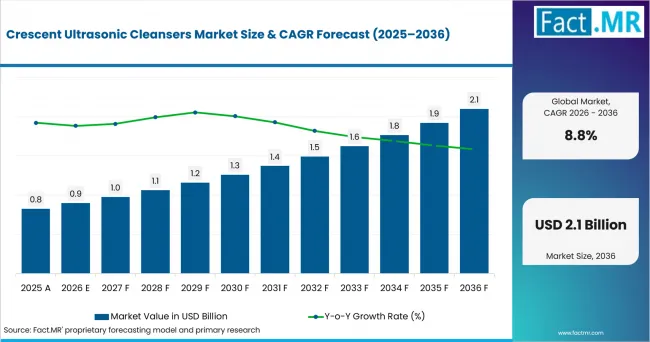
Crescent Ultrasonic Cleansers Market Value Analysis | Source: Fact.MR
What are the defining numbers behind Crescent Ultrasonic Cleansers Market growth?
USD 1.2 billion of absolute opportunity is expected between 2026 and 2036.
- Demand Drivers in the Market
- Healthcare reprocessing keeps ultrasonic cleaning relevant for intricate reusable instruments. The CDC places ultrasonic cleaners among common mechanical cleaning methods, while U.S. FDA reprocessing guidance emphasizes that reusable-device cleaning instructions need scientific validation and clear operating steps before disinfection or sterilization.
- Precision manufacturing creates a second demand base. NASA PRC-5001 requires special processes such as ultrasonic cleaning to be controlled by documented procedures and calls for ultrasonic equipment to be tested and maintained according to manufacturer instructions. This supports systems that can deliver repeatable cycles rather than simple open-loop agitation.
- Cleaning chemistry is becoming a process variable rather than an afterthought. A 2025 International Dental Journal study found that cleaning performance varied by detergent chemistry, temperature, and contact time, with ultrasonic agitation generally outperforming static cleaning. That same optimization logic is relevant to industrial cleaning chemicals used with ultrasonic equipment.
- Key Segments Analyzed
- By Product: Industrial Ultrasonic Cleaners lead with a 64.1% share in 2026, reflecting the need for larger baths, durable transducers, repeatable throughput, and compatibility with production-line cleaning loads.
- By Application: Industrial Cleaning Applications lead with a 41.8% share in 2026 because component degreasing, tool cleaning, and residue removal are recurring production requirements rather than occasional maintenance tasks.
- By End Use: Industrial Manufacturing leads with a 57.3% share in 2026 as heavy and precision engineering operations use controlled cleaning before inspection, assembly, coating, bonding, or final quality checks.
- By Technology: Ultrasonic Cavitation Technology leads with a 52.6% share in 2026 because cavitation remains the core mechanism for reaching immersed surfaces and fine geometries without direct brushing.
- By Formulation: Water Based Cleaning Systems lead with a 38.9% share in 2026, supported by compatibility with aqueous cavitation, lower flammability concerns, and the ability to tune detergency through neutral, alkaline, or enzymatic formulations.
- By Distribution Channel: Direct Industrial Sales lead with a 66.4% share in 2026 because buyers commonly need tank sizing, process trials, chemistry guidance, installation, service, and validation support before production deployment.
- Analyst Opinion at Fact.MR
- Shambhu Nath Jha, Principal Consultant at Fact.MR, states, "Ultrasonic cleaning purchases are increasingly being judged as process-control decisions, not just equipment purchases. Buyers want repeatable cavitation, predictable chemistry performance, traceable cycles, and service support that keeps cleaning quality stable across shifts. Suppliers that can connect tank design, frequency, temperature, loading, and validation into one operating method will be better positioned in industrial and regulated applications."
- Strategic Implications
- Equipment suppliers should demonstrate cleaning uniformity across the usable tank volume and document how frequency, power, loading, and temperature affect delicate versus heavily soiled parts.
- Healthcare-focused suppliers should support documented operating procedures, routine performance checks, chemistry compatibility, and validation records rather than relying on nominal cycle time as the main selling point.
- Industrial suppliers should package application trials with contamination type, substrate, bath chemistry, rinse, drying, and cleanliness verification so customers can compare total process performance.
- Digital control and data logging should be treated as quality features. NHS guidance for dental decontamination calls for procurement consideration of cycle records, temperature, ultrasonic activity, electrical demand, and failure indication in ultrasonic equipment.
How does the Crescent Ultrasonic Cleansers Market break down by segment?
The market is segmented by Product, Application, End Use, Technology, Formulation, and Distribution Channel.
Why does Industrial Ultrasonic Cleaners lead Product?
Industrial Ultrasonic Cleaners lead Product with a 64.1% share in 2026.
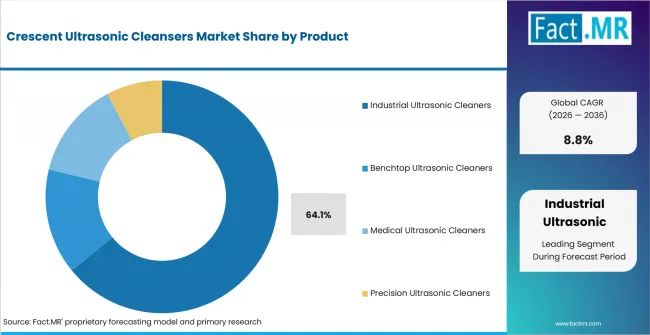
Crescent Ultrasonic Cleansers Market Analysis By Product | Source: Fact.MR
Industrial systems concentrate value in larger tanks, higher-duty transducer assemblies, temperature control, filtration, baskets, lifting aids, and process integration. These features matter when plants clean repeated batches of machined, stamped, molded, or assembled parts rather than a small number of laboratory items. The related precision cleaning requirement is especially relevant when visible cleanliness alone is insufficient and residues must be controlled before sensitive downstream steps.
NASA PRC-5001 separates rough cleaning from precision cleaning and requires documented control of special processes such as ultrasonic cleaning. That framing supports industrial systems that can reproduce a validated process window and be maintained against defined performance criteria.
Large Tank Ultrasonic Systems and Multi Frequency Industrial Cleaners address different duty cycles within this category. Large tanks support throughput and awkward geometries, while multi-frequency systems give operators more room to balance aggressive soil removal against the risk of damaging delicate surfaces or features.
Why does Industrial Cleaning Applications lead Application?
Industrial Cleaning Applications lead Application with a 41.8% share in 2026.
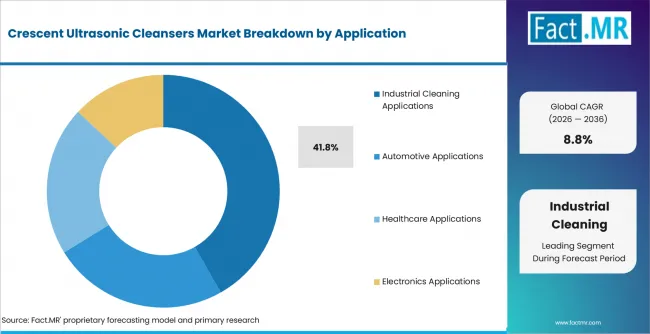
Crescent Ultrasonic Cleansers Market Analysis By Application | Source: Fact.MR
Manufacturing component cleaning occurs at multiple points in a production route: after machining, before coating, before bonding, before inspection, during maintenance, and before remanufacturing. This recurring use pattern creates more cleaning cycles per installed system than one-off maintenance applications.
The market also intersects with pre-treatment cleaning where contamination control directly affects the quality of downstream surface preparation. Ultrasonic equipment is attractive when oils, fines, polishing compounds, and trapped debris have to be removed from recesses or assemblies that are difficult to clean uniformly by spray or manual wiping alone.
Manufacturing Component Cleaning and Tool Cleaning Operations therefore represent practical, repeat-demand subsegments. Tooling, fixtures, nozzles, dies, and precision components can all accumulate residues that alter fit, surface finish, heat transfer, coating behavior, or inspection results if cleaning is inconsistent.
Why does Industrial Manufacturing lead End Use?
Industrial Manufacturing leads End Use with a 57.3% share in 2026.
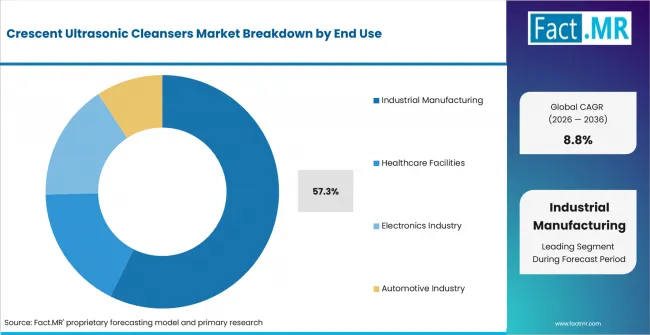
Crescent Ultrasonic Cleansers Market Analysis By End Use | Source: Fact.MR
Industrial plants can justify ultrasonic cleaning when the process reduces manual scrubbing, improves access to complex geometry, or standardizes a cleaning step across operators. The business case is strongest when cleanliness affects yield, rework, inspection, coating adhesion, assembly quality, or equipment uptime.
Heavy Engineering Industries tend to value tank capacity, durability, lifting, heating, and strong soil-removal performance. Precision Engineering Industries place more weight on particle control, substrate compatibility, repeatable cycle parameters, rinsing, and cleanliness verification. Both needs favor engineered systems over simple benchtop baths.
NASA process controls provide a useful benchmark for this end-use logic: special cleaning should be documented, equipment should be maintained, and precision-cleaned hardware should be protected after verification. Industrial buyers with demanding quality systems increasingly evaluate ultrasonic cleaning in the same process-oriented way.
Why does Ultrasonic Cavitation Technology lead Technology?
Ultrasonic Cavitation Technology leads Technology with a 52.6% share in 2026.
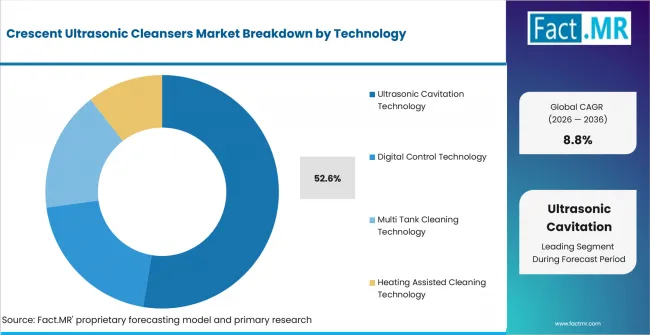
Crescent Ultrasonic Cleansers Market Analysis By Technology | Source: Fact.MR
Cavitation is the mechanism that differentiates ultrasonic cleaning from static soaking. Acoustic energy creates and collapses microscopic bubbles in the liquid, producing localized cleaning action at immersed surfaces and in geometries that are difficult to reach mechanically. The CDC describes this mechanism as cavitation and implosion that disrupt bonds holding particulate matter to surfaces.
High Frequency Cavitation Systems are suited to delicate components and finer contamination where a less aggressive bubble-collapse profile can be useful. Low Frequency Cavitation Systems are better aligned with heavier soils and robust parts when stronger mechanical cleaning action is acceptable. Selection is therefore application-specific rather than a simple preference for more power.
Digital Control Technology complements, rather than replaces, cavitation. NHS procurement guidance notes that ultrasonic cleaners may operate at a single frequency, across a range, or with controls that adjust frequency to loading conditions. It also highlights data logging of cycle time, temperature, ultrasonic activity, and failure indication, which supports the shift toward measurable process control.
Why does Water Based Cleaning Systems lead Formulation?
Water Based Cleaning Systems lead Formulation with a 38.9% share in 2026.
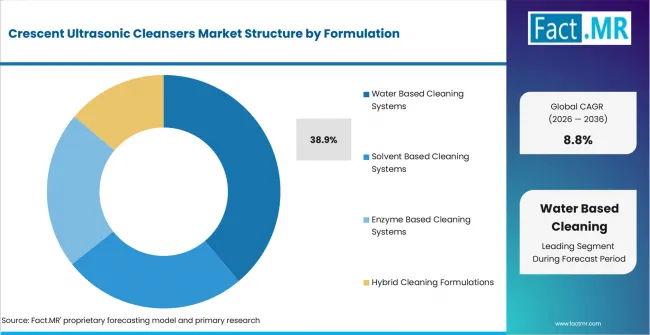
Crescent Ultrasonic Cleansers Market Analysis By Formulation | Source: Fact.MR
Aqueous systems are naturally compatible with the liquid-bath operation of ultrasonic cleaners and can be tuned with neutral detergents, alkaline builders, surfactants, corrosion inhibitors, or enzymes. The CDC notes that neutral or near-neutral detergents are commonly used for instrument cleaning because they provide material compatibility and soil removal, while enzymes can assist with protein-based soils.
The 2025 International Dental Journal study by Seneviratne and colleagues reinforces the importance of chemistry selection. In controlled testing, performance varied across products, and ultrasonic agitation generally improved cleaning over static conditions. Enzymatic products performed well against organic bioburden, while temperature and contact time also changed results.
The U.S. Environmental Protection Agency Safer Choice Standard provides ingredient and product criteria that can inform lower-hazard cleaning product selection. In industrial procurement, that encourages suppliers to show that aqueous or enzyme-based formulations can meet cleaning performance needs without creating avoidable handling, emissions, or compatibility burdens.
Why does Direct Industrial Sales lead Distribution Channel?
Direct Industrial Sales lead Distribution Channel with a 66.4% share in 2026.
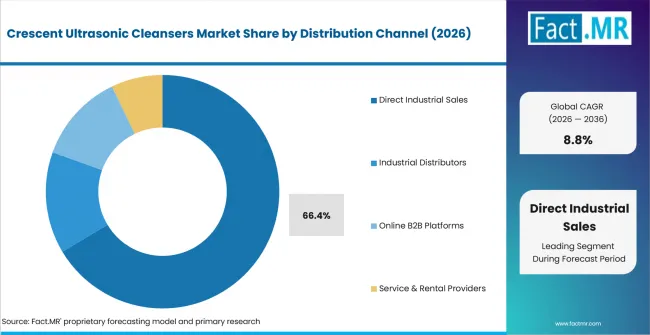
Crescent Ultrasonic Cleansers Market Analysis By Distribution Channel | Source: Fact.MR
Ultrasonic cleaning performance depends on more than the equipment model. Buyers often need application trials, tank sizing, baskets or fixtures, frequency selection, chemistry, heat settings, rinse and drying steps, filtration, and maintenance plans. These variables make direct technical selling more valuable than a purely transactional equipment purchase.
OEM Equipment Sales support new manufacturing lines and regulated reprocessing setups where the cleaner is specified as part of a broader process. Enterprise Sales Channels become important when multi-site users want common recipes, service coverage, spare parts, and documentation across several plants or facilities.
Industrial distributors, online B2B platforms, and service or rental providers remain important for standard systems and replacement demand. Their role is strongest where the application is already known, while direct sales are favored when process qualification and after-sales support materially influence adoption.
What is accelerating Crescent Ultrasonic Cleansers Market adoption, and what is holding it back?
Adoption is being accelerated by repeatable precision-cleaning requirements, regulated instrument reprocessing, and higher process-control expectations; the main opportunity is smarter multi-frequency and chemistry-optimized systems, while validation cost, compatibility risk, and maintenance discipline remain key restraints.
| Driver | (~) % Impact on CAGR | Geographic Relevance | Impact Timeline |
|---|---|---|---|
| Repeatable component cleanliness requirements | +1.7% | Global | Short term (<= 2 years) |
| Healthcare reprocessing and documented cleaning protocols | +1.4% | USA, UK, Brazil, Germany | Short term (<= 2 years) |
| Electronics and precision component complexity | +1.1% | Japan, USA, Germany | Medium term (2-4 years) |
| Digital cycle control and cleaning verification | +0.8% | Global | Medium term (2-4 years) |
| Opportunity | (~) % Impact on CAGR | Geographic Relevance | Impact Timeline |
|---|---|---|---|
| Multi-frequency and smart-sensor upgrades | +1.0% | Germany, Japan, USA, UK | Medium term (2-4 years) |
| High-throughput multi-tank cleaning cells | +0.9% | Germany, USA, Japan, Brazil | Long term (>= 4 years) |
| Aqueous and enzyme process optimization | +0.8% | Global | Short term (<= 2 years) |
| Restraint | (~) % Impact on CAGR | Geographic Relevance | Impact Timeline |
|---|---|---|---|
| Capital cost and validation burden | -0.8% | Global | Short term (<= 2 years) |
| Material and chemistry compatibility risk | -0.6% | Healthcare and precision manufacturing hubs | Medium term (2-4 years) |
| Maintenance and operator discipline gaps | -0.5% | Global | Medium term (2-4 years) |
The main commercial opportunity lies in systems that make ultrasonic cleaning easier to qualify and monitor. Multi-frequency control, temperature stability, automated dosing, tank filtration, cycle logging, ultrasonic-activity sensing, and fault detection can reduce the gap between laboratory cleaning trials and reliable day-to-day production performance. The principal restraint is process sensitivity. A cleaner can be correctly specified yet still underperform when the bath is overloaded, chemistry is exhausted, temperature is wrong, parts shadow each other, dissolved gases are not controlled, or transducer performance drifts. Regulated users face the added cost of validating instructions and documenting that the cleaning step remains effective.
Which countries are scaling the Crescent Ultrasonic Cleansers Market through 2036?
- Germany is being supported by machinery, electronics, optical-product, and automotive manufacturing activity, where component cleanliness can influence assembly, coating, bonding, and inspection quality.
- Brazil combines industrial modernization with explicit healthcare reprocessing rules that recognize ultrasonic washers for complex reusable medical products.
- USA demand is tied to a broad installed base of manufacturing and healthcare facilities, with durable-goods and electronics production creating recurring component-cleaning workloads.
- UK adoption is reinforced by formal dental decontamination guidance that specifies operating, maintenance, testing, and data-recording expectations for ultrasonic cleaners.
- Japan is supported by production machinery, electronics, and device manufacturing, where quality control and fine-component handling favor repeatable low-contact cleaning methods.
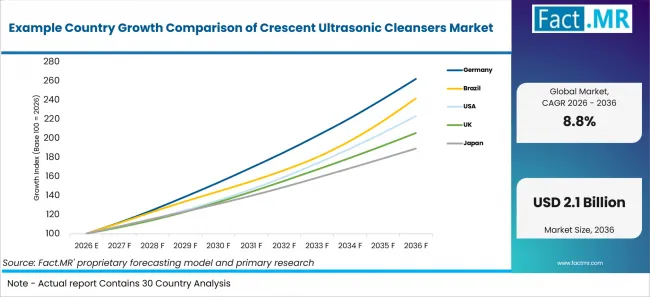
Example Country Growth Comparison Of Crescent Ultrasonic Cleansers Market | Source: Fact.MR
Country CAGR (2026-2036)
| Country | CAGR (2026-2036) |
|---|---|
| Germany | 10.12% |
| Brazil | 9.24% |
| USA | 8.36% |
| UK | 7.48% |
| Japan | 6.6% |
What is driving Germany's growth through 2036?
Germany is projected to expand at a 10.12% CAGR from 2026 to 2036.
Germany has a dense base of machinery, electronics, optical-product, and vehicle manufacturing where cleaning often precedes assembly, coating, bonding, measurement, or refurbishment. These applications favor systems that can clean fine features without abrasive contact and can be integrated with controlled production routines.
Destatis reported that June 2026 manufacturing orders rose 3.1% month on month. Machinery and equipment orders increased 12.7%, computer, electronic and optical products increased 22.7%, and automotive orders increased 3.8%. Those sectors are directly relevant to component-cleaning workloads and to demand for repeatable industrial cleaning cells.
VDA reported that Germany produced 1.67 million electric passenger cars in 2025, 23% more than in 2024, with electric models accounting for about 40% of domestic passenger-car production. The shift toward electronics-rich powertrains increases the variety of metal, electronic, cooling, and precision components that require controlled cleaning during production and service.
What is driving Brazil's growth through 2036?
Brazil is projected to expand at a 9.24% CAGR from 2026 to 2036.
Healthcare regulation provides a concrete use case. ANVISA RDC No. 15 defines an ultrasonic washer as automated cleaning equipment that uses cavitation in an aqueous solution. For complex medical products in Class II central material and sterilization operations, the rule requires manual cleaning to be followed by automated cleaning in an ultrasonic washer or another proven-equivalent system, with additional requirements for small-lumen devices.
Industrial demand is broadening at the same time. IBGE reported that Brazilian industrial production was up 1.4% in the first five months of 2026. In May, pharmochemical and pharmaceutical output increased 13.1% from April, motor vehicles 4.1%, chemicals 3.1%, basic metals 2.3%, and machinery and equipment 1.2%. Growth across these process-intensive sectors creates more opportunities for component and tooling cleaning.
The result is a two-track market: regulated medical reprocessing supports smaller and specialized systems, while automotive, metalworking, chemical, and machinery facilities support larger industrial configurations. Local service coverage and application support will remain important because bath chemistry, water quality, loading, and maintenance practices differ by site.
What is driving USA's growth through 2036?
USA is projected to expand at an 8.36% CAGR from 2026 to 2036.
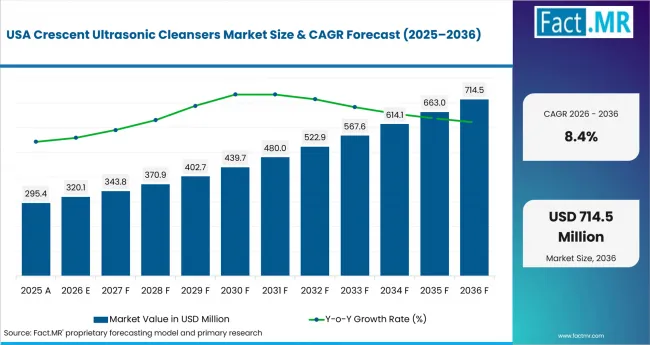
Crescent Ultrasonic Cleansers Market Country Value Analysis | Source: Fact.MR
U.S. demand spans both industrial and healthcare use. The Federal Reserve reported that manufacturing output increased 0.2% in July 2026 and manufacturing output excluding motor vehicles and parts increased 0.4%. The same release showed manufacturing capacity utilization at 76.0%, indicating a large operating asset base that generates recurring cleaning, maintenance, and process-preparation needs.
Electronics adds a precision-cleaning angle. The U.S. Census Bureau reported that June 2026 durable-goods orders increased 0.3%, while computers and electronic products rose 3.1% to USD 31.1 billion. More electronic production means more boards, housings, connectors, fixtures, and process hardware that may require residue and particulate removal without aggressive mechanical contact.
Healthcare provides another installed-base driver. FDA guidance requires scientifically validated reprocessing instructions for reusable devices, and the CDC includes ultrasonic cleaners among common mechanical cleaning methods. This regulatory and clinical context supports demand for device cleaning systems that can operate within documented reprocessing procedures.
What is driving UK's growth through 2036?
UK is projected to expand at a 7.48% CAGR from 2026 to 2036.
NHS England guidance gives ultrasonic cleaning a defined role in primary-care dental decontamination. It states that well-maintained ultrasonic cleaners enhance debris removal and can serve as an additional cleaning stage before washer-disinfection, especially for instruments with hinges or intricate parts.
The same guidance makes procurement more technical. It asks users to consider tank capacity, single- or multi-frequency operation, detergent control, data logging, temperature, ultrasonic activity, fault indication, fluid-level sensing, and ongoing maintenance. These requirements favor professional systems with traceability and service support rather than low-specification baths.
Industrial demand is also present. The Office for National Statistics reported that UK manufacturing output grew 1.2% in March 2026, with transport equipment up 2.0%, basic pharmaceutical products up 2.1%, and basic metals up 2.1%. Those sectors create recurring requirements for cleaning components, instruments, tooling, and production hardware.
What is driving Japan's growth through 2036?
Japan is projected to expand at a 6.6% CAGR from 2026 to 2036.
Japan combines precision production with a strong electronics base. METI reported that May 2026 industrial production increased 0.5% month on month and its production forecast expected June growth, with production machinery, general-purpose machinery, and electrical and information electronics among the industries contributing to the planned increase.
JEITA reported that 2025 Japanese production of industrial electronic equipment increased 1.5% from the previous year, electric measuring instrumentation increased 2.5%, electronic components and devices increased 4.9%, and electronic boards increased 14.7%. These categories depend on controlled manufacturing environments where residue and particle management can affect downstream quality.
METI also continued to revise Japanese Industrial Standards in June 2026 as part of the national framework for product quality, performance, and test methods. That quality culture favors cleaning systems that can be specified, tested, maintained, and documented against repeatable operating criteria, particularly in precision and electronics applications.
Who Leads the Crescent Ultrasonic Cleansers Market?
Shenzhen Heng Xian Qiang Technology Co. Snowtree Group Co.Ltd., Guangzhou Skyrann Electronics Tech. Co.Ltd
Competitive differentiation in this market centers on tank architecture, transducer reliability, frequency options, heat control, cycle programming, chemistry compatibility, filtration, data logging, service coverage, and application support. Buyers in regulated or precision environments also assess how easily a supplier can support testing, maintenance, and documented operating procedures.
Which companies are the key providers?
Key Companies includes Shenzhen Heng Xian Qiang Technology Co. Ltd; Snowtree Group Co. Ltd.; Guangzhou Skyrann Electronics Tech. Co. Ltd; Dongguan Achievement Rubber & Plastic Co. Ltd; Beijing HYE Technology Co. Ltd
- Shenzhen Heng Xian Qiang Technology Co.ltd
- Snowtree Group Co.Ltd.
- Guangzhou Skyrann Electronics Tech. Co.Ltd
- Dongguan Achievement Rubber & Plastic Co.ltd
- Beijing HYE Technology Co.Ltd
Bibliography
- Centers for Disease Control and Prevention. (2023). Cleaning. National Center for Emerging and Zoonotic Infectious Diseases.
- U.S. Food and Drug Administration. (2015). Reprocessing Medical Devices in Health Care Settings: Validation Methods and Labeling. U.S. Department of Health and Human Services.
- National Aeronautics and Space Administration. (2020). Process Specification for Cleaning of Hardware, PRC-5001. Lyndon B. Johnson Space Center.
- Seneviratne, C. J., Khan, S. A., Zachar, J., Yang, Z., Kiran, R., and Walsh, L. J. (2025). Efficacy of Ultrasonic Cleaning Products With Various Disinfection Chemistries on Dental Instruments Contaminated With Bioburden. International Dental Journal.
- U.S. Environmental Protection Agency. (2024). Safer Choice Standard and Criteria. U.S. Environmental Protection Agency.
- German Federal Statistical Office. (2026). New orders in manufacturing in June 2026: +3.1% on the previous month. Destatis.
- German Association of the Automotive Industry. (2026). New record: 40% electric share of passenger car production in 2025. VDA.
- Brazilian Health Regulatory Agency. (2012). RDC No. 15 of March 15, 2012. Ministry of Health, Brazil.
- Brazilian Institute of Geography and Statistics. (2026). Industrial production changes -0.2% in May. IBGE.
- Board of Governors of the Federal Reserve System. (2026). Industrial Production and Capacity Utilization - G.17. Federal Reserve Board.
- U.S. Census Bureau. (2026). Monthly Advance Report on Durable Goods Manufacturers' Shipments, Inventories and Orders. U.S. Department of Commerce.
- NHS England. (2013). Health Technical Memorandum 01-05: Decontamination in primary care dental practices. Department of Health.
- Office for National Statistics. (2026). Index of Production, UK: March 2026. UK Statistics Authority.
- Ministry of Economy, Trade and Industry. (2026). Indices of Industrial Production. Government of Japan.
- Japan Electronics and Information Technology Industries Association. (2026). December 2025 Production by the Japanese Electronics Industry. JEITA.
- Ministry of Economy, Trade and Industry. (2026). New Establishment and Revision of the Japanese Industrial Standards (JIS), June 2026. Government of Japan.
This Report Answers
- How ultrasonic cleaning demand differs across industrial, healthcare, electronics, and automotive applications.
- Why tank size, frequency, cavitation behavior, temperature, and loading practice affect cleaning performance.
- How water-based, solvent-based, enzyme-based, and hybrid formulations shape process design and compatibility.
- Why digital controls, data logging, ultrasonic-activity monitoring, and maintenance records are becoming more important.
- How direct industrial sales, distributors, digital procurement channels, and service providers serve different purchasing situations.
- How manufacturing activity, healthcare reprocessing requirements, and quality standards influence adoption across Germany, Brazil, USA, UK, and Japan.
- Which supplier capabilities matter when buyers need repeatable cleaning, process documentation, and after-sales support.
What does the Crescent Ultrasonic Cleansers Market cover?
The market covers ultrasonic cleaning equipment and controlled cleaning-system configurations used to remove particulate contamination, oils, machining residues, polishing compounds, process films, biological soils, and other removable contaminants from components, tooling, reusable instruments, and precision items through acoustic cavitation in a liquid medium.
Coverage includes industrial, benchtop, medical, and precision ultrasonic cleaners, together with the application, end-use, technology, formulation, and distribution-channel classifications defined below. Formulation coverage refers to the cleaning chemistry used within the ultrasonic process rather than unrelated stand-alone chemical demand.
What is included in the scope?
- Industrial ultrasonic cleaning systems, including large-tank and multi-frequency configurations.
- Benchtop systems used in laboratories, professional technical environments, and controlled small-batch cleaning.
- Medical ultrasonic systems for dental and surgical-instrument cleaning steps within applicable reprocessing workflows.
- Precision ultrasonic cleaners for micro-components, optical components, electronics, and other sensitive parts.
- Cavitation, digital-control, multi-tank, and heating-assisted ultrasonic cleaning configurations.
- Water-based, solvent-based, enzyme-based, and hybrid cleaning formulations when used as part of the defined ultrasonic cleaning process.
- Direct industrial, distributor, online B2B, and service or rental channels for in-scope systems.
What is excluded from the scope?
- Diagnostic ultrasound, imaging systems, ultrasonic therapy devices, and skin-care or cosmetic ultrasound devices.
- Non-ultrasonic spray washers, pressure washers, manual sinks, and other cleaning equipment without in-scope ultrasonic cleaning functionality.
- Standalone sterilizers and disinfectors where ultrasonic cleaning is not part of the defined system.
- General household jewelry baths and low-value consumer devices not used in the defined industrial, laboratory, healthcare, electronics, or automotive settings.
- Cleaning chemicals sold for unrelated applications without a defined ultrasonic cleaning use case.
How Was the Analysis Built?
Fact.MR built the analysis using more than 120 public and industry sources, reviews of 35+ company portfolios, country-level assessment across 25+ markets, and more than 20 interviews with stakeholders involved in equipment selection, process engineering, procurement, service, validation, and distribution.
- Primary Research
- Interviews with manufacturing engineers, plant maintenance teams, reprocessing specialists, laboratory users, equipment distributors, service technicians, and procurement managers were used to understand buying triggers, performance expectations, maintenance practices, qualification steps, and channel preferences.
- Desk Research
- Desk research covered manufacturing indicators, healthcare reprocessing regulations, technical cleaning guidance, product standards, peer-reviewed evidence, public industrial statistics, and supplier-facing technical documentation. Priority was given to government agencies, regulators, standards-oriented bodies, peer-reviewed research, and recognized industry associations.
- Market Sizing and Forecasting
- Market sizing applied a bottom-up structure across product classes, application intensity, end-use adoption, technology mix, formulation choice, distribution model, replacement demand, and new-installation activity. Forecasts were tested against manufacturing output, regulated reprocessing requirements, electronics activity, and changes in process-control expectations.
- Data Validation and Update Cycle
- The model was cross-checked against country growth patterns, segment leadership, supplier positioning, technical adoption factors, and external industrial indicators. Annual updates incorporate changes in manufacturing activity, healthcare guidance, standards, supplier portfolios, and equipment-control requirements.
What is the report's scope and coverage?
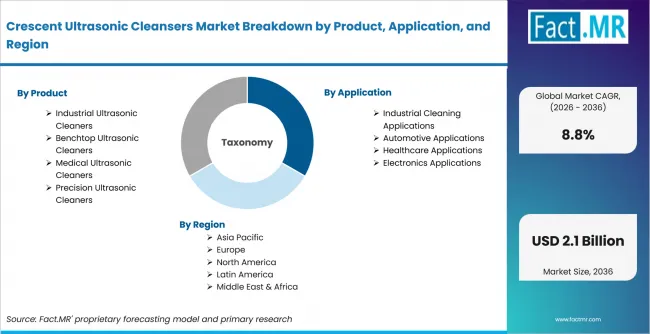
Crescent Ultrasonic Cleansers Market Breakdown By Product, Application, And Region | Source: Fact.MR
| Attribute | Details |
|---|---|
| Quantitative Units | USD billion |
| Market Definition | Ultrasonic cleaning equipment and controlled cleaning systems using acoustic cavitation to remove contamination from industrial components, reusable instruments, electronics, automotive parts, and precision items. |
| Product | Industrial Ultrasonic Cleaners; Benchtop Ultrasonic Cleaners; Medical Ultrasonic Cleaners; Precision Ultrasonic Cleaners |
| Application | Industrial Cleaning Applications; Automotive Applications; Healthcare Applications; Electronics Applications |
| End Use | Industrial Manufacturing; Healthcare Facilities; Electronics Industry; Automotive Industry |
| Technology | Ultrasonic Cavitation Technology; Digital Control Technology; Multi Tank Cleaning Technology; Heating Assisted Cleaning Technology |
| Formulation | Water Based Cleaning Systems; Solvent Based Cleaning Systems; Enzyme Based Cleaning Systems; Hybrid Cleaning Formulations |
| Distribution Channel | Direct Industrial Sales; Industrial Distributors; Online B2B Platforms; Service & Rental Providers |
| Countries Covered | Germany; Brazil; USA; UK; Japan |
| Key Companies Profiled | Shenzhen Heng Xian Qiang Technology Co.ltd; Snowtree Group Co.Ltd.; Guangzhou Skyrann Electronics Tech. Co.Ltd; Dongguan Achievement Rubber & Plastic Co.ltd; Beijing HYE Technology Co.Ltd |
| Forecast Period | 2026 to 2036 |
| Market Value, 2026 | USD 0.9 billion |
| Market Value, 2036 | USD 2.1 billion |
| CAGR, 2026-2036 | 8.8% |
| Absolute Opportunity | USD 1.2 billion |
| Approach | Bottom-up assessment by product, application, end use, technology, formulation, distribution channel, country demand conditions, replacement activity, and new installations. |
How is the market segmented?
-
By Product:
- Industrial Ultrasonic Cleaners
- Large Tank Ultrasonic Systems
- Multi Frequency Industrial Cleaners
- Benchtop Ultrasonic Cleaners
- Compact Laboratory Cleaners
- Professional Lab Cleaners
- Medical Ultrasonic Cleaners
- Dental Ultrasonic Systems
- Surgical Instrument Cleaners
- Precision Ultrasonic Cleaners
- Micro Component Cleaners
- Optical Component Cleaners
- Industrial Ultrasonic Cleaners
-
By Application:
- Industrial Cleaning Applications
- Manufacturing Component Cleaning
- Tool Cleaning Operations
- Automotive Applications
- Engine Component Cleaning
- Transmission Component Cleaning
- Healthcare Applications
- Hospital Instrument Cleaning
- Dental Clinic Cleaning
- Electronics Applications
- PCB Cleaning Processes
- Semiconductor Applications
- Industrial Cleaning Applications
-
By End Use:
- Industrial Manufacturing
- Heavy Engineering Industries
- Precision Engineering Industries
- Healthcare Facilities
- Hospitals
- Dental Clinics
- Electronics Industry
- Semiconductor Manufacturers
- Consumer Electronics Manufacturers
- Automotive Industry
- OEM Manufacturers
- Aftermarket Service Centers
- Industrial Manufacturing
-
By Technology:
- Ultrasonic Cavitation Technology
- High Frequency Cavitation Systems
- Low Frequency Cavitation Systems
- Digital Control Technology
- Programmable Cleaning Systems
- Smart Sensor Integration Systems
- Multi Tank Cleaning Technology
- Sequential Cleaning Systems
- Continuous Flow Systems
- Heating Assisted Cleaning Technology
- Thermal Ultrasonic Systems
- Ultrasonic Cavitation Technology
-
By Formulation:
- Water Based Cleaning Systems
- Aqueous Cleaning Formulations
- Neutral pH Cleaning Systems
- Solvent Based Cleaning Systems
- Organic Solvent Systems
- Specialty Solvent Systems
- Enzyme Based Cleaning Systems
- Bio Cleaning Formulations
- Eco Friendly Enzyme Systems
- Hybrid Cleaning Formulations
- Multi Phase Cleaning Systems
- Advanced Reactive Formulations
- Water Based Cleaning Systems
-
By Distribution Channel:
- Direct Industrial Sales
- OEM Equipment Sales
- Enterprise Sales Channels
- Industrial Distributors
- Regional Equipment Distributors
- Specialty Equipment Distributors
- Online B2B Platforms
- Digital Procurement Portals
- Manufacturer Direct Platforms
- Service & Rental Providers
- Equipment Leasing Services
- Maintenance Service Providers
- Direct Industrial Sales
-
By Region:
- North America
- Latin America
- Western Europe
- Eastern Europe
- East Asia
- South Asia and Pacific
- Middle East & Africa