- Base Value(2026): 18.6 Bn
- Estimated Value(2026): 18.6 Bn
- Forecast Value (2036): 32.4 Bn
- CAGR (2026 - 2036): 5.7%
Foaming Cleansers and Body Washes Market Forecast and Outlook 2026 to 2036
Foaming cleansers and body washes market is projected at USD 18.6 billion in 2026, growing to USD 32.4 billion by 2036, reflecting a 5.7% CAGR.
Foaming Cleansers and Body Washes Market Key Takeaways
- Foaming Cleansers and Body Washes Market Value (2026): USD 18.6 billion
- Foaming Cleansers and Body Washes Forecast Value (2036): USD 32.4 billion
- Foaming Cleansers and Body Washes Forecast CAGR (2026-2036): 5.7%
- Foaming Cleansers and Body Washes Leading Product Type: Foaming facial cleansers
- Foaming Cleansers and Body Washes Leading Skin Type: Normal skin
- Foaming Cleansers and Body Washes Key Growth Regions: China, India, Germany, Brazil, USA
- Foaming Cleansers and Body Washes Top Players: L’Oréal, Unilever, Procter & Gamble, Johnson & Johnson, Beiersdorf, Estée Lauder Companies, Shiseido, Amorepacific
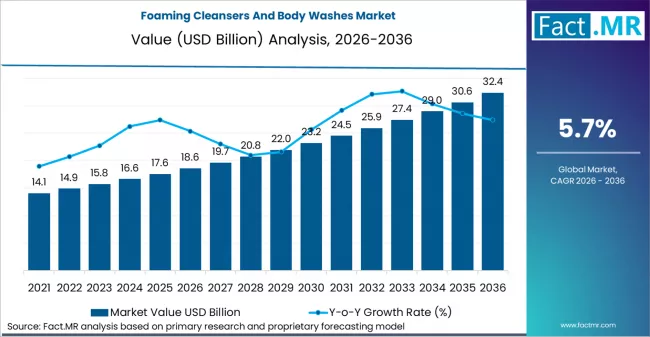
Foaming Cleansers And Body Washes Market Market Value Analysis | Source: Fact.MR
As per Fact.MR, Growth is linked to wider adoption of clinically validated foaming formats across institutional buyers, mass retail, and online platforms. Demand reflects procurement priorities such as predictable batch output, repeatable formulations, and coordinated multi-region distribution. Water-activated cleansers and air-foam delivery systems are altering refill frequency, packaging design, and per-use consumption. Portfolio consolidation following recent acquisitions increased dermatologist-led brand presence within premium cleansing categories, while eco-efficiency targets in major portfolios influence supplier selection and material specifications. Vincent Warnery, CEO of Beiersdorf, noted:
“We want to be the undisputed authority in skin care. Success is no coincidence: it is driven by our strong brands, our innovative strength, and our exceptional international teams. We are focusing on our strong brands, delivering breakthrough innovations and expanding into new markets, categories, and channels.”
Growth increasingly reflects demand for barrier-supporting formulations that can be manufactured at scale and distributed without regional reformulation.
Foaming Cleansers and Body Washes Market
| Metric | Value |
|---|---|
| Market Value (2026) | USD 18.6 billion |
| Forecast Value (2036) | USD 32.4 billion |
| Forecast CAGR (2026-2036) | 5.7% |
Source: Fact.MR analysis. Updated Feb 2, 2026
Category
| Category | Segments |
|---|---|
| Product Type | Foaming facial cleansers; Foaming body washes; Medicated foaming cleansers; Organic and natural foaming cleansers |
| Skin Type | Normal skin; Dry skin; Oily skin; Sensitive skin; Combination skin |
| Distribution Channel | Supermarkets and hypermarkets; Specialty stores; Online retail; Pharmacies and drug stores |
| End User | Women; Men; Unisex |
| Region | North America; Europe; Asia Pacific; Latin America; Middle East & Africa |
Source: Fact.MR analysis. Updated Feb 2, 2026
Segmental Analysis
By Product Category, Why Does the Market Prioritize All-Purpose Cleaners?
All-purpose cleaners account for 46% share due to high purchase frequency across household and multi-channel retail demand. Market growth is driven by predictable procurement cycles, high turnover, and operational efficiency in distribution and inventory management. Suppliers benefit from scalable production, standardized logistics workflows, and recurring orders. Expansion is reinforced by urban density, daily usage patterns, and widespread availability across outlets. Segment dominance is determined by structural market drivers such as repeatable purchasing, supply chain integration, and channel penetration, rather than the specific formulation of individual products. Purchase frequency and distribution reach explain category dominance more than formulation differentiation.
By Pack Size Class, Why Do Sachets (<100 ml) Represent the Largest Segment?
Sachets represent 51% share, supported by low unit pricing and frequent repurchase across retail and e-commerce channels. Demand is concentrated across retail, e-commerce, and multi-outlet channels that require predictable inventory replenishment and operational efficiency. Suppliers benefit from repeatable production runs, scalable distribution, and streamlined logistics. Segment prominence arises from structural market factors including procurement consistency, supply chain efficiency, and repeatable usage. Adoption is driven by consumption patterns and workflow optimization rather than individual product features. Sachets remain the highest-volume packaging format across both urban and semi-urban retail networks.
Country/Region
| Country/Region | Driver | Restraint | Trend |
|---|---|---|---|
| USA | Sustainability shift and P&G waterless “Cleansing Melts” launches → expands adoption of waterless foaming cleansers | High material and compliance costs for waterless formats → limits small brand participation | Growth in premium, waterless cleansing formats |
| India | Quick commerce expansion in 2024 and Unilever launches of Aroma/Serum foaming variants → enables rapid urban penetration | Smaller distributors struggle with compliance and supply chain integration → slows nationwide reach | Increased availability of urban-targeted, ready-to-deliver foaming products |
| EU | Implementing Decision 2025/1175 mandates INCI glossary and allergen labeling → drives consumer trust | Reformulation and CapEx for compliance → forces withdrawal of non-compliant stock | Growth of compliant, premium foaming washes post-2025 |
| UAE | Luxury and halal certification requirements → incentivize localized premium product launches | High certification and import compliance costs → limits non-certified imports | Emergence of culturally tailored foaming cleansers in retail and e-commerce |
| Brazil | Biodiversity ingredient sourcing initiatives → drives launches of differentiated, natural foaming cleansers | Complex import and ingredient regulations → increases reformulation costs for multinational brands | Expansion of eco-conscious, locally sourced foaming wash lines |
Source: Fact.MR analysis. Updated Feb 2, 2026
Analysis of the Foaming Cleansers and Body Washes Market by Key Country
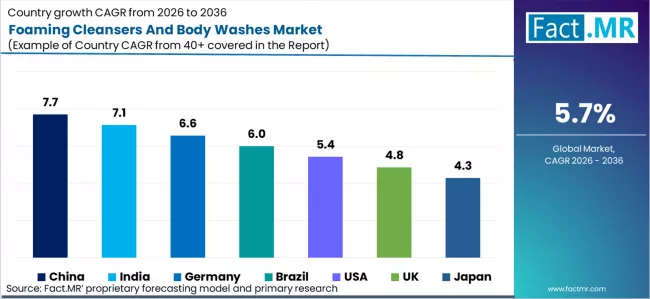
Foaming Cleansers And Body Washes Market Cagr Analysis By Country | Source: Fact.MR
| Country | CAGR (2026-2036) |
|---|---|
| China | 7.7% |
| India | 7.1% |
| Germany | 6.6% |
| Brazil | 6.0% |
| USA | 5.4% |
| UK | 4.8% |
| Japan | 4.3% |
Source: Fact.MR analysis. Updated Feb 2, 2026
The report covers an in-depth analysis of 40+ countries; top-performing countries are highlighted below.
How Is Demand for the Foaming Cleansers and Body Washes Market Evolving in China?
Demand for the foaming cleansers and body washes market in China is projected at 7.7% CAGR through 2036. Recent regulatory changes under the Great Formula Reset reduced approval uncertainty for domestic and multinational brands. Rising disposable incomes and wellness-focused lifestyles drive premium and mid-tier segment growth. Automation and digital traceability in logistics streamline distribution and reduce operational friction. E-commerce penetration accelerates market access to secondary cities. Market expansion is driven by increasing consumer awareness, regulatory alignment, and efficient supply chain integration rather than individual product modifications. Brands with faster regulatory clearance and nationwide logistics expanded shelf presence more quickly.
What Is the Growth in Adoption of the Foaming Cleansers and Body Washes Market in India?
Growth in adoption of the foaming cleansers and body washes market in India is 7.1% CAGR through 2036. Urbanization, rising hygiene awareness, and implementation of the 2025 Cosmetics Amendment Rules contribute to stronger market penetration. Retail modernization and e-commerce expansion allow high-frequency replenishment, supporting broad distribution. Clearer compliance requirements supported premium positioning, particularly in urban retail and pharmacy channels. Operational focus centers on supply chain efficiency, regional distribution, and market coverage. The combination of regulatory alignment, urban consumption patterns, and growing wellness orientation shapes the market trajectory, creating a competitive landscape where agile and compliant firms establish leadership.
How Is the Foaming Cleansers and Body Washes Market Shaping in Germany?
The foaming cleansers and body washes market in Germany grows at 6.6% CAGR through 2036. Packaging regulations and waste reduction mandates increased demand for lower-volume formats and compliant materials. Consumers increasingly demand transparency and functional quality, influencing market adoption. Logistics optimization, including warehouse automation and standardized product flows, improves operational throughput. Regulatory alignment and process efficiency define market participation and competitiveness. Expansion is concentrated in urban centers with high retail density, supported by professional distribution networks. Compliance, eco-efficiency, and operational consistency allow firms to maintain market share, while innovation in brand positioning and wellness alignment drives consumer engagement across the national market.
What Is the Outlook on the Foaming Cleansers and Body Washes Market in Brazil?
Outlook on the foaming cleansers and body washes market in Brazil shows 5.8% CAGR through 2036. Regulatory mandates for recycling and sustainable operations influence production and distribution practices. Market growth is shaped by urbanization, increasing hygiene awareness, and the rising premium and wellness-oriented segments. Standardized supply chains improve coverage and operational efficiency, reducing transport and handling bottlenecks. Firms focus on compliance, operational reliability, and strategic distribution across urban and regional retail channels. Adoption trends favor companies that integrate market regulation, efficient logistics, and consumer demand insights, enabling sustained growth and competitive advantage within the national market.
How Is the Foaming Cleansers and Body Washes Market Expanding in the United States?
The foaming cleansers and body washes market in the United States grows at 5.4% CAGR through 2036. Rising demand in personal care and wellness-driven routines drives market penetration across retail and professional channels. Supply chains increasingly leverage automation, digital inventory tracking, and regional distribution networks to ensure efficiency and timely product availability. Operational emphasis lies on regulatory compliance, scalability, and consistency rather than expanding production facilities. Premium and mid-tier segments benefit from consumer focus on performance and hygiene. Market leadership is determined by companies that combine operational efficiency with regulatory alignment and agility in meeting evolving consumer and retail demands.
What Are the Growth Trends in the Foaming Cleansers and Body Washes Market in the United Kingdom?
Growth trends in the foaming cleansers and body washes market in the United Kingdom reach 4.8% CAGR through 2036. Sustainability and packaging efficiency regulations influence distribution and manufacturing practices. Consumer preferences for functional, wellness-oriented products drive adoption in urban and e-commerce channels. Logistics and supply chain optimization enhance operational efficiency while ensuring consistent product availability. Regulatory compliance and standardization shape competitiveness among market players. Expansion is primarily driven by evolving consumer behavior, operational agility, and adherence to national standards rather than individual product innovation. Firms that integrate efficiency, compliance, and market intelligence consolidate market share.
How Is the Foaming Cleansers and Body Washes Market Developing in Japan?
The foaming cleansers and body washes market in Japan grows at 4.3% CAGR through 2036. Regulatory standards for product safety and environmental compliance influence operational practices and market entry. Urban population centers drive consumption, while efficient logistics and distribution networks facilitate coverage across retail and e-commerce channels. Operational improvements focus on compliance, quality assurance, and process consistency. Wellness-oriented consumer demand encourages premium adoption and supports market segmentation. Market expansion is driven by regulatory alignment, operational efficiency, and evolving lifestyle preferences. Firms that integrate agility, quality, and compliance achieve leadership in a competitive national market.
How Are Power Players Reshaping the Competitive Landscape of Foaming Cleansers and Body Washes Between 2024 and 2026?
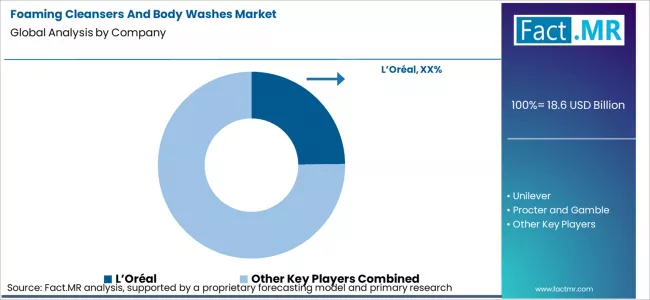
Foaming Cleansers And Body Washes Market Analysis By Company | Source: Fact.MR
During 2024, category growth relied largely on price increases and incremental volume gains, with growth largely supported by price adjustments and incremental packaging innovation. L’Oréal’s late 2024 acquisition of Gowoonsesang Cosmetics (Dr. G) enabled dominance in the derma-foam segment, reinforcing its Longevity Science initiative and creating clinically substantiated claims that strengthened dermatologist endorsement. Beiersdorf leveraged the Epicelline® breakthrough to re-energise NIVEA, positioning it as a functional skin-care brand with measurable dermatological benefits. Unilever pivoted toward product superiority, implementing a 30% reduction in virgin plastic by 2026, which compelled suppliers and competitors to adopt sustainable, high-performance body wash formats. Shiseido shifted from a prestige-oriented portfolio to medicalized wellness post-2024 following the Dr. Dennis Gross acquisition, emphasizing clinical validation and active ingredient efficacy. By 2026, purchasing decisions increasingly favor clinically substantiated performance over brand positioning. The compliance moat now determines market access, as safety substantiation under MoCRA/CPSR and transparent, sustainable supply chains constitute barriers that manufacturing scale alone cannot overcome. Fact.MR observes a bifurcation into ultra-medicalized and eco-functional segments, signalling differentiated competitive strategies.
Recent Developments
Beiersdorf: Expansion into the Indian Market with High-Efficacy Ingredients (2025-2026). Beiersdorf has significantly strengthened its global footprint by launching its dermatological brand, Eucerin, in India as of late 2024 and early 2025. This expansion specifically focuses on products containing their patented ingredient, Thiamidol, aimed at addressing hyperpigmentation - a key concern in the cleansing and treatment market. This move is part of their "Win with Care" strategy to dominate the premium skincare and therapeutic cleansing segments. Source: Beiersdorf Official Press Release (February 2025)
L’Oréal: Breakthrough "Beauty Tech" and Skin Longevity Innovations (2026). At CES 2026, L’Oréal introduced new technologies that bridge the gap between hardware and topical skincare. While the group continues to lead in "skinification" (adding active ingredients like Glycolic and Hyaluronic acid to foaming cleansers), they are now integrating Infrared and LED technology into daily routines. Their new focus on "Beauty Longevity" aims to transition the cleansing category from simple dirt removal to a preventive, anti-aging ritual. Source: L’Oréal Groupe - CES 2026 Innovation Update
Amorepacific: "AI-First" Strategy and Premium Cleansing Growth (2025-2026). Amorepacific has committed to a "Create New Beauty" vision, aiming to become one of the top three global premium skincare companies. A major development in 2025 was the rollout of generative AI tools (like "Wanna-Beauty AI") to help consumers select personalized foaming cleansers based on real-time skin analysis. Additionally, their U.S. sales surged by over 80% in 2025, driven by the high demand for specialized "powder-to-foam" and "oil-to-milk" cleansers from brands like Sulwhasoo and Laneige. Source: Personal Care Insights - Amorepacific Global Strategy
Key Players in Foaming Cleansers and Body Washes Market
- L’Oréal
- Unilever
- Procter and Gamble
- Johnson and Johnson
- Beiersdorf
- Estée Lauder Companies
- Shiseido Company
- Amorepacific Corporation
References
- European Union. (2023). Regulation (EU) 2023/988 on general product safety. Official Journal of the European Union.
- European Union. (2025). Regulation (EU) 2025/40 of the European Parliament and of the Council on packaging and packaging waste. Official Journal of the European Union.
- United Nations Economic Commission for Europe. (2023). Globally Harmonized System of Classification and Labelling of Chemicals (GHS), 10th revised edition. United Nations.
- European Commission. (2024). Commission Implementing Decision (EU) 2024/197 on the glossary of common ingredient names for cosmetic products. Official Journal of the European Union.
Segmentation
Scope of the Report
| Items | Values |
|---|---|
| Quantitative Units (2026) | USD billion |
| Product Type | Foaming facial cleansers, Foaming body washes, Medicated foaming cleansers, Organic and natural foaming cleansers |
| Skin Type | Normal skin, Dry skin, Oily skin, Sensitive skin, Combination skin |
| Distribution Channel | Supermarkets and hypermarkets, Specialty stores, Online retail, Pharmacies and drug stores |
| End User | Women, Men, Unisex |
| Regions Covered | Asia Pacific, Europe, North America, Latin America, Middle East & Africa |
| Countries Covered | China, Japan, South Korea, India, Australia & New Zealand, ASEAN, Rest of Asia Pacific, Germany, United Kingdom, France, Italy, Spain, Nordic, BENELUX, Rest of Europe, United States, Canada, Mexico, Brazil, Chile, Rest of Latin America, Kingdom of Saudi Arabia, Other GCC Countries, Turkey, South Africa, Other African Union, Rest of Middle East & Africa |
| Key Companies Profiled | L’Oréal, Unilever, Procter and Gamble, Johnson and Johnson, Beiersdorf, Estée Lauder Companies, Shiseido Company, Amorepacific Corporation |
| Additional Attributes | Dollar by sales by product type, skin type, distribution channel, and end user; standardized formulation consistency, batch traceability, and regulatory compliance; packaging designed for hygiene, moisture resistance, and retail display; scalable production and multi-region distribution; operational improvements via automated filling, labeling, and e-commerce fulfillment; premium and functional eco-conscious formulations with waterless or dermatologically validated variants; sustainability and material efficiency considerations integrated into supply chain; high-volume repeatable procurement and standardized logistics flows ensure operational efficiency and minimized product loss. |
Source: Fact.MR analysis. Updated Feb 2, 2026
Foaming Cleansers and Body Washes Market Segmentation
-
Product Type :
- Foaming facial cleansers
- Foaming body washes
- Medicated foaming cleansers
- Organic and natural foaming cleansers
-
Skin Type :
- Normal skin
- Dry skin
- Oily skin
- Sensitive skin
- Combination skin
-
Distribution Channel :
- Supermarkets and hypermarkets
- Specialty stores
- Online retail
- Pharmacies and drug stores
-
End User :
- Women
- Men
- Unisex
-
Region :
- Asia Pacific
- China
- Japan
- South Korea
- India
- Australia & New Zealand
- ASEAN
- Rest of Asia Pacific
- Europe
- Germany
- United Kingdom
- France
- Italy
- Spain
- Nordic
- BENELUX
- Rest of Europe
- North America
- United States
- Canada
- Mexico
- Latin America
- Brazil
- Chile
- Rest of Latin America
- Middle East & Africa
- Kingdom of Saudi Arabia
- Other GCC Countries
- Turkey
- South Africa
- Other African Union
- Rest of Middle East & Africa
- Asia Pacific
Frequently Asked Questions
How big is the foaming cleansers and body washes market in 2026?
What will be the size of foaming cleansers and body washes market in 2036?
How much will be the foaming cleansers and body washes market growth between 2026 and 2036?
What are the key product types in the foaming cleansers and body washes market?
Which skin type segment to contribute significant share in the foaming cleansers and body washes market in 2026?
Who worked on this report


Preview the report firsthand - request a free sample
Free SampleGet the brochure for pricing and purchase details
Download PDF