Powdered Facial Cleansers Market (2026 - 2036)

Powdered Facial Cleansers Market Size and Share Forecast Outlook 2026 to 2036

Core Findings

    Powdered Facial Cleansers Market Forecast and Outlook 2026 to 2036

    The global demand for powdered facial cleansers is set for substantial expansion, with market value projected to rise from USD 3.0 billion in 2026 to approximately USD 5.3 billion by 2036, representing a CAGR of 5.9%.

    Key Takeaways from the Powdered Facial Cleansers Market

    • Powdered Facial Cleansers Market Value (2026): USD 3.0 billion
    • Powdered Facial Cleansers Market Forecast Value (2036): USD 5.3 billion
    • Powdered Facial Cleansers Market Forecast CAGR (2026-2036): 5.9%
    • Leading Product Type: Exfoliating Powder Cleansers (34.80%)
    • Leading Market Participants: L’Oréal S.A., Unilever PLC, Procter & Gamble (P&G), Estée Lauder Companies Inc., Johnson & Johnson Services, Inc., Shiseido Company, Limited, Beiersdorf AG, Amorepacific Corporation, Kao Corporation, Colgate-Palmolive Company, Coty Inc., Revlon, Inc., Mary Kay Inc., Avon Products, Inc., Natura & Co., Clarins Group
    • Key Growth Regions: Asia Pacific, North America, Europe
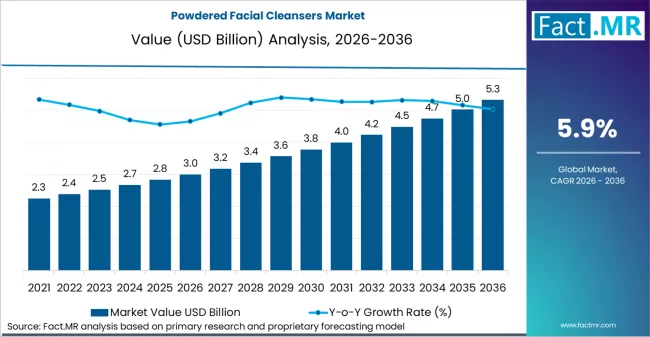
    Powdered Facial Cleansers Market Market Value Analysis

    As an industry leader recently noted during a 2025 innovation summit, "The transition to powder isn't just a sustainability play; it’s a potency play. By removing water, we are delivering the highest possible concentration of active enzymes directly to the skin's surface at the moment of activation." While traditional liquid cleansers maintain a larger volume, powder formats are gaining rapid strategic traction as brands prioritize high-margin, waterless delivery systems that align with global "Zero-Waste" and travel-convenience trends.

    Powder cleansers operate at the critical intersection of preservative-free stability, anhydrous efficiency, and bespoke skincare. These solid-state formulations allow for the inclusion of delicate enzymes and probiotics that would typically destabilize in aqueous environments. As global skincare routines shift toward "Skinimalism" and precision care, powdered cleansers are moving from niche specialty products to mainstream daily essentials, particularly as consumer’s demand more transparent, "concentrated-only" ingredient lists.

    Powdered Facial Cleansers Market

    Metric Value
    Estimated Value in (2026E) USD 3.0 billion
    Forecast Value in (2036F) USD 5.3 billion
    Forecast CAGR (2026 to 2036) 5.9 %

    Category 

    Category Segments
    Product Type Exfoliating, Hydrating, and Brightening
    Skin Type Combination, Oily, Dry, Sensitive, and Normal
    Application Personal Daily Skincare, Professional/Salon Use, and Travel/On-the-Go Kits
    End User Women, Men, and Unisex
    Distribution Channel Online Retail, Supermarkets/Hypermarkets, Specialty Beauty Stores, and Pharmacies/Drugstores
    Region North America; Europe; Asia Pacific; Latin America; Middle East & Africa

    Segmental analysis

    How is demand for controlled, low-irritation exfoliation positioning exfoliating powder cleansers as the leading format in the Powdered Facial Cleansers Market?
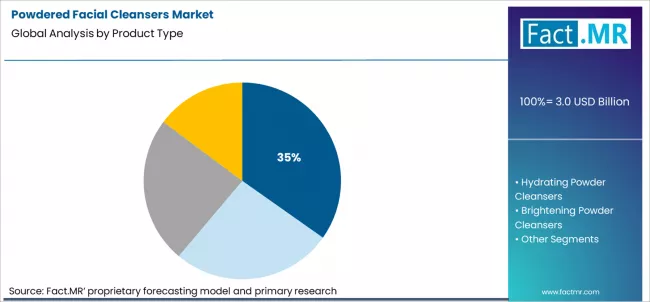
    Powdered Facial Cleansers Market Analysis By Product Type

    Exfoliating powder cleansers account for 34.8% of the Powdered Facial Cleansers Market because they align with a structural shift away from abrasive mechanical scrubs toward precision resurfacing. Brand launches and formulation disclosures show consistent investment in enzyme-based micro-exfoliation systems that activate only upon contact with water, reducing over-exfoliation risk. This format allows consumers to modulate intensity daily, supporting frequent use rather than episodic treatment. Dermatology-led positioning around barrier safety and post-procedure maintenance further reinforces adoption. The ability to deliver visible radiance without fixed abrasiveness has made exfoliating powders the preferred vehicle for “instant glow” claims that can be safely integrated into daily routines.

    Why does combination skin represent a disproportionately strong demand driver for powdered facial cleansers?
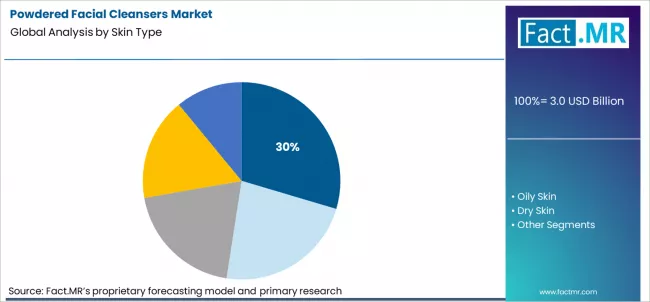
    Powdered Facial Cleansers Market Analysis By Skin Type

    Combination skin holds 29.6% share because powdered cleansers resolve the structural limitations of fixed-viscosity liquids. Consumer behavior indicates growing resistance to multi-cleanser routines that address oil and dryness separately. Powder formats enable localized customization within a single product, allowing higher concentration on sebaceous zones and lighter dilution on dry areas. This flexibility reduces regimen complexity while maintaining efficacy. Brand education across digital platforms has normalized this adaptive usage, positioning powder cleansers as functional solutions for fluctuating skin conditions rather than one-size-fits-all cleansers.

    Market Dynamics

    • Drivers: A primary force shaping the powdered facial cleansers market is the move toward anhydrous potency. As consumers become more ingredient-literate, tolerance for water-heavy formulas padded with stabilizers is declining. Powder cleansers directly answer this skepticism by delivering concentrated actives that remain inert until use. The result is higher active integrity, fewer formulation compromises, and a format that aligns clean labels with performance credibility particularly appealing in skin-barrier-focused routines where over processing is actively avoided. Sustainability reinforces this shift. Pressure to reduce packaging waste and transport emissions has elevated lightweight formats from niche to strategic. Compared with liquids, powders dramatically reduce shipping mass and allow for plastic-free or paper-based packaging systems. This improves compliance with tightening packaging regulations while lowering logistics costs, making sustainability a structural advantage rather than a marketing claim.
    • Restraints: Adoption is tempered by convenience trade-offs. Mixing powder with water introduces friction for consumers conditioned to one-step pumps. This barrier is most pronounced in mass-market segments, where speed and habit outweigh perceived formulation benefits. Climate sensitivity presents a second constraint. Exposure to bathroom humidity can compromise powder integrity, causing clumping or premature activation. Addressing this risk requires moisture-resistant packaging and desiccant solutions, increasing production complexity and pushing price points higher particularly challenging for entry-level brands.
    • Key Trend: Ritualized Precision Cleansing Powdered cleansers are increasingly framed as intentional skincare rituals rather than passive hygiene products. Brands emphasize adjustable intensity, compatibility with skin cycling, and post-procedure safety, repositioning cleansing as a controlled treatment step. This reframing supports higher engagement, slower consumption cycles, and greater perceived expertise turning cleansing into an active act of skin management instead of a background routine.

    Analysis of the Powdered Facial Cleansers Market by Key Country
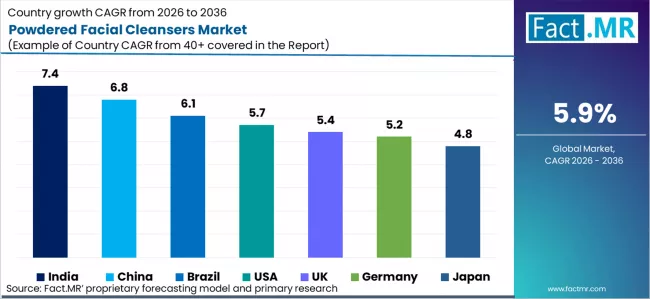
    Powdered Facial Cleansers Market Cagr Analysis By Country

    Country CAGR 2026 to 2036
    India 7.4%
    China 6.8%
    Brazil 6.1%
    USA 5.7%
    UK 5.4%
    Germany 5.2%
    Japan 4.8%

    Q1. Why does India emerge as the fastest-expanding market for powdered facial cleansers?

    With an expected 7.4% CAGR through 2036, India is set to lead growth as climatic and infrastructural conditions actively undermine liquid cleanser performance. Persistent humidity, widespread hard-water exposure in urban centers, and rapid dermatology-led consumer education have intensified demand for stable, waterless cleansing formats. Recent launches by Skinvest and Lotus Herbals validate the pivot toward powder-to-foam dermaceutical solutions that preserve actives such as Vitamin C and enzymes. As powders increasingly signal clinical reliability and long-term efficacy, adoption is accelerating beyond niche skincare into mainstream urban routines.

    Q2. What structural forces support China’s above-global growth trajectory in this market?

    China is projected to expand at a 6.8% CAGR, supported by a digitally amplified shift toward ingredient transparency and customization. Platforms like Xiaohongshu have transformed consumers into formulation-literate buyers who actively seek enzyme-activated, freshly mixed products capable of addressing pollution-induced barrier stress. The integration of Guochao branding into high-performance powders further reinforces domestic trust and cultural alignment. Combined with regulatory preferences for stable, low-preservative formats, powdered cleansers are increasingly positioned as the optimal solution for China’s urban skincare needs.

    Q3. Why is Brazil outpacing mature markets despite its historical reliance on liquid cleansers?

    Brazil is expected to grow at around 6.3% annually, driven less by trend adoption and more by regulatory compulsion. Amendments to the National Solid Waste Policy (PNRS) in 2025 have tightened requirements around reverse logistics and eliminated solid waste imports, forcing brands to redesign packaging and refill systems. Unilever’s Dove regenerative face care launch illustrates how multinationals are adapting by favoring anhydrous, refill-friendly formats. Powdered cleansers benefit directly from this shift, as they align with locally sourced refills and lower logistics burden, creating competitive pressure across the category.

    Q4. How does the USA maintain steady growth in a mature powdered cleansers landscape?

    In the United States, growth is tracking close to the global average at approximately 5.9% CAGR, sustained by lifestyle-driven rather than regulatory demand. Frequent travel, fitness-centric routines, and TSA restrictions have increased preference for spill-proof, portable skincare formats. Olay’s Cleansing Melts exemplify this transition, repositioning powdered cleansers as premium, single-dose solutions with higher margins and reduced preservative reliance. While overall market expansion is moderate, powders are steadily replacing traditional liquid volumes within existing routines.

    Q5. What explains Germany’s controlled but resilient growth outlook?

    Germany is forecast to expand at about 5.4% per year, reflecting a compliance-led rather than experimentation-led adoption curve. Strict EU chemical regulations and Germany’s Net Zero 2045 roadmap are accelerating the shift away from synthetic stabilizers commonly used in liquid cleansers.

    Beiersdorf’s strategic pivot toward water-reduced and biodegradable formulations confirms that powdered cleansers are moving into the mainstream. Growth remains measured, but structurally secure, supported by strong consumer trust in scientifically validated and environmentally aligned products.

    Q6. Why does Japan record slower growth despite be an early adopter of powder cleansing formats?

    Japan’s market is advancing at a more modest 4.9% CAGR, largely due to saturation rather than lack of demand. Enzymatic wash powders and compact, anhydrous formats are already deeply embedded in daily skincare rituals, limiting incremental expansion. Shiseido Beauty Wellness’ focus on holistic, inside-out anhydrous beauty reinforces category leadership without materially expanding usage frequency. As a result, Japan remains a benchmark market for format maturity rather than a high-growth contributor.

    Competitive Landscape Evolution of the Powdered Facial Cleansers Market
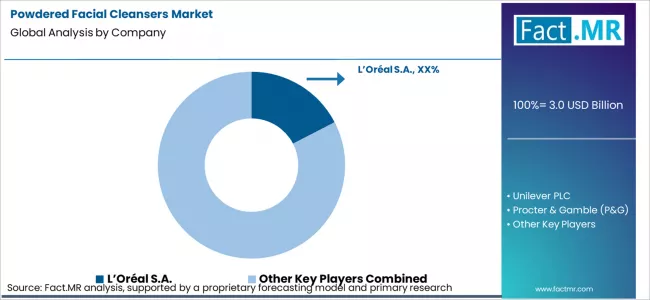
    Powdered Facial Cleansers Market Analysis By Company

    Competition in the powdered facial cleansers market has moved from peripheral experimentation to format-led strategic focus. In 2024, powder cleansers were largely positioned as niche or eco-adjacent alternatives, often marketed toward travel convenience, sustainability-conscious consumers, or minimalist routines. Most brands treated powders as complementary offerings rather than central cleansing SKUs, with liquids retaining dominance due to established consumer habits and perceived ease of use. Investment in powder formulations during this phase was limited, and claims typically centered on mild exfoliation or reduced packaging rather than clinical performance.

    In 2025, competitive dynamics shifted decisively. Major skincare manufacturers started integrating powdered cleansers into core facial cleansing lines, supported by advancements in enzyme stabilization, surfactant activation, and barrier-safe exfoliation systems. Formulation efforts moved beyond basic anhydrous positioning toward performance parity and in some cases superiority relative to liquid cleansers. This transition was reinforced by the commercial advantages of powders, including higher active concentration per unit weight, longer shelf stability, and greater control over dosing at the point of use.

    External pressures have further accelerated this repositioning. Tighter preservative regulations, rising packaging compliance costs, and increased scrutiny of water-heavy formulations have made powdered formats operationally attractive. At the same time, consumer behavior has shifted toward customizable cleansing intensity and routine simplification, both of which favor powder-based systems.

    Key Players in Powdered Facial Cleansers Market

    • L’Oréal S.A.
    • Unilever PLC
    • Procter & Gamble (P&G)
    • Estée Lauder Companies Inc.
    • Johnson & Johnson Services, Inc.
    • Shiseido Company, Limited
    • Beiersdorf AG
    • Amorepacific Corporation
    • Kao Corporation
    • Colgate-Palmolive Company
    • Coty Inc.
    • Revlon, Inc.
    • Mary Kay Inc.
    • Avon Products, Inc.
    • Natura & Co.
    • Clarins Group

    Scope of Report

    Items Values
    Quantitative Units (2026) USD 3.0 Billion
    Product Type Exfoliating, Hydrating, and Brightening
    Skin Type Combination, Oily, Dry, Sensitive, and Normal
    Application Personal Daily Skincare, Professional/Salon Use, and Travel/On-the-Go Kits
    End User Women, Men, and Unisex
    Distribution Channel Online Retail, Supermarkets/Hypermarkets, Specialty Beauty Stores, and Pharmacies/Drugstores
    Regions Covered North America, Europe, Asia Pacific, Latin America, Middle East & Africa
    Countries Covered U.S., Canada, Germany, Italy, UK, France, Japan, Australia, and other countries
    Key Companies Profiled L’Oréal S.A., Unilever PLC, Procter & Gamble (P&G), Estée Lauder Companies Inc., Johnson & Johnson Services, Inc., Shiseido Company, Limited, Beiersdorf AG, Amorepacific Corporation, Kao Corporation, Colgate-Palmolive Company, Coty Inc., Revlon, Inc., Mary Kay Inc., Avon Products, Inc., Natura & Co., Clarins Group
    Additional Attributes Dollar revenue in the powdered facial cleansers market is segmented by product type, formulation profile, exfoliation intensity, distribution channel, price tier, and region. Regional demand patterns are shaped by growing adoption of water-activated and anhydrous cleansing formats, rising emphasis on barrier-safe exfoliation and concentrated actives, premiumization of daily cleansing routines, and broader availability through e-commerce, dermatology-led beauty retailers, and travel-oriented retail channels.

    Powdered Facial Cleansers Market by Segments 

    • Product Type :

      • Exfoliating Powder Cleansers
      • Hydrating Powder Cleansers
      • Brightening Powder Cleansers
      • Other Specialized Types
    • Skin Type :

      • Combination Skin
      • Oily Skin
      • Dry Skin
      • Sensitive Skin
      • Normal Skin
    • Application :

      • Personal Daily Skincare
      • Professional / Salon Use
      • Travel / On-the-Go Kits
      • Other Special Uses
    • End User :

      • Women
      • Men
      • Unisex
    • Distribution Channel :

      • Online Retailers
      • Supermarkets & Hypermarkets
      • Drugstores & Pharmacies
      • Specialty Beauty Stores
    • Region :

      • Asia Pacific
        • Japan
        • South Korea
        • China
        • Australia
        • New Zealand
        • Rest of Asia Pacific
      • North America
        • United States
        • Canada
        • Mexico
      • Europe
        • France
        • Italy
        • Spain
        • Norway
        • UK
        • Rest of Europe
      • Latin America
        • Chile
        • Peru
        • Argentina
        • Rest of Latin America

    Bibliography

    • European Commission. 2022. Cosmetic products regulation (EC) No 1223/2009: Ingredient safety, labeling, and compliance requirements for cosmetic products. Brussels: European Union.
    • International Federation of Societies of Cosmetic Chemists (IFSCC). 2024. Advances in anhydrous and powder-based facial cleanser formulation science. IFSCC Monograph Series.
    • International Organization for Standardization (ISO). 2023. Cosmetics and personal care products: Safety assessment and formulation standards for solid and waterless facial cleansing products. ISO Technical Report. Geneva: ISO.
    • Journal of Cosmetic Science. 2024. Enzyme-based exfoliation systems and skin barrier compatibility in powder facial cleansers. Journal of Cosmetic Science 75(3): 181-194.
    • Mintel Group Ltd. 2025. Global facial cleansing trends: Waterless formats and premiumization dynamics. London: Mintel.
    • Personal Care Products Council. 2023. Premium skincare consumption and the rise of concentrated, waterless beauty formats. Washington, DC: PCPC.

    Table of Content

    1. Executive Summary
      • Global Market Outlook
      • Demand to side Trends
      • Supply to side Trends
      • Technology Roadmap Analysis
      • Analysis and Recommendations
    2. Market Overview
      • Market Coverage / Taxonomy
      • Market Definition / Scope / Limitations
    3. Research Methodology
      • Chapter Orientation
      • Analytical Lens and Working Hypotheses
        • Market Structure, Signals, and Trend Drivers
        • Benchmarking and Cross-market Comparability
        • Market Sizing, Forecasting, and Opportunity Mapping
      • Research Design and Evidence Framework
        • Desk Research Programme (Secondary Evidence)
          • Company Annual and Sustainability Reports
          • Peer-reviewed Journals and Academic Literature
          • Corporate Websites, Product Literature, and Technical Notes
          • Earnings Decks and Investor Briefings
          • Statutory Filings and Regulatory Disclosures
          • Technical White Papers and Standards Notes
          • Trade Journals, Industry Magazines, and Analyst Briefs
          • Conference Proceedings, Webinars, and Seminar Materials
          • Government Statistics Portals and Public Data Releases
          • Press Releases and Reputable Media Coverage
          • Specialist Newsletters and Curated Briefings
          • Sector Databases and Reference Repositories
          • FMR Internal Proprietary Databases and Historical Market Datasets
          • Subscription Datasets and Paid Sources
          • Social Channels, Communities, and Digital Listening Inputs
          • Additional Desk Sources
        • Expert Input and Fieldwork (Primary Evidence)
          • Primary Modes
            • Qualitative Interviews and Expert Elicitation
            • Quantitative Surveys and Structured Data Capture
            • Blended Approach
          • Why Primary Evidence is Used
          • Field Techniques
            • Interviews
            • Surveys
            • Focus Groups
            • Observational and In-context Research
            • Social and Community Interactions
          • Stakeholder Universe Engaged
            • C-suite Leaders
            • Board Members
            • Presidents and Vice Presidents
            • R&D and Innovation Heads
            • Technical Specialists
            • Domain Subject-matter Experts
            • Scientists
            • Physicians and Other Healthcare Professionals
          • Governance, Ethics, and Data Stewardship
            • Research Ethics
            • Data Integrity and Handling
        • Tooling, Models, and Reference Databases
      • Opportunity
      • Trends
    4. Scenario Forecast
      • Demand in Optimistic Scenario
      • Demand in Likely Scenario
      • Demand in Conservative Scenario
    5. Opportunity Map Analysis
    6. Product Life Cycle Analysis
    7. Supply Chain Analysis
    8. Investment Feasibility Matrix
    9. Value Chain Analysis
    10. PESTLE and Porter’s Analysis
    11. Regulatory Landscape
    12. Regional Parent Market Outlook
    13. Production and Consumption Statistics
    14. Import and Export Statistics
    15. Global Market Analysis 2021 to 2025 and Forecast, 2026 to 2036
      • Historical Market Size Value (USD Million) Analysis, 2021 to 2025
      • Current and Future Market Size Value (USD Million) Projections, 2026 to 2036
        • Y to o to Y Growth Trend Analysis
        • Absolute $ Opportunity Analysis
    16. Global Market Pricing Analysis 2021 to 2025 and Forecast 2026 to 2036
    17. Global Market Analysis 2021 to 2025 and Forecast 2026 to 2036, By Product Type
      • Introduction / Key Findings
      • Historical Market Size Value (USD Million) Analysis By Product Type, 2021 to 2025
      • Current and Future Market Size Value (USD Million) Analysis and Forecast By Product Type, 2026 to 2036
        • Exfoliating Powder Cleansers
        • Hydrating Powder Cleansers
        • Brightening Powder Cleansers
        • Other Specialized Types
      • Y to o to Y Growth Trend Analysis By Product Type, 2021 to 2025
      • Absolute $ Opportunity Analysis By Product Type, 2026 to 2036
    18. Global Market Analysis 2021 to 2025 and Forecast 2026 to 2036, By Skin Type
      • Introduction / Key Findings
      • Historical Market Size Value (USD Million) Analysis By Skin Type, 2021 to 2025
      • Current and Future Market Size Value (USD Million) Analysis and Forecast By Skin Type, 2026 to 2036
        • Combination Skin
        • Oily Skin
        • Dry Skin
        • Sensitive Skin
        • Normal Skin
      • Y to o to Y Growth Trend Analysis By Skin Type, 2021 to 2025
      • Absolute $ Opportunity Analysis By Skin Type, 2026 to 2036
    19. Global Market Analysis 2021 to 2025 and Forecast 2026 to 2036, By Distribution Channel
      • Introduction / Key Findings
      • Historical Market Size Value (USD Million) Analysis By Distribution Channel, 2021 to 2025
      • Current and Future Market Size Value (USD Million) Analysis and Forecast By Distribution Channel, 2026 to 2036
        • Online Retail
        • Supermarkets / Hypermarkets
        • Specialty Beauty Stores
        • Pharmacies / Drugstores
        • Other Channels
      • Y to o to Y Growth Trend Analysis By Distribution Channel, 2021 to 2025
      • Absolute $ Opportunity Analysis By Distribution Channel, 2026 to 2036
    20. Global Market Analysis 2021 to 2025 and Forecast 2026 to 2036, By End-User
      • Introduction / Key Findings
      • Historical Market Size Value (USD Million) Analysis By End-User, 2021 to 2025
      • Current and Future Market Size Value (USD Million) Analysis and Forecast By End-User, 2026 to 2036
        • Women
        • Men
        • Unisex
      • Y to o to Y Growth Trend Analysis By End-User, 2021 to 2025
      • Absolute $ Opportunity Analysis By End-User, 2026 to 2036
    21. Global Market Analysis 2021 to 2025 and Forecast 2026 to 2036, By Application / Usage
      • Introduction / Key Findings
      • Historical Market Size Value (USD Million) Analysis By Application / Usage, 2021 to 2025
      • Current and Future Market Size Value (USD Million) Analysis and Forecast By Application / Usage, 2026 to 2036
        • Personal Daily Skincare
        • Professional / Salon Use
        • Travel / On-the-Go Kits
        • Other Special Uses
      • Y to o to Y Growth Trend Analysis By Application / Usage, 2021 to 2025
      • Absolute $ Opportunity Analysis By Application / Usage, 2026 to 2036
    22. Global Market Analysis 2021 to 2025 and Forecast 2026 to 2036, By Region
      • Introduction
      • Historical Market Size Value (USD Million) Analysis By Region, 2021 to 2025
      • Current Market Size Value (USD Million) Analysis and Forecast By Region, 2026 to 2036
        • North America
        • Latin America
        • Western Europe
        • Eastern Europe
        • East Asia
        • South Asia and Pacific
        • Middle East & Africa
      • Market Attractiveness Analysis By Region
    23. North America Market Analysis 2021 to 2025 and Forecast 2026 to 2036, By Country
      • Historical Market Size Value (USD Million) Trend Analysis By Market Taxonomy, 2021 to 2025
      • Market Size Value (USD Million) Forecast By Market Taxonomy, 2026 to 2036
        • By Country
          • USA
          • Canada
          • Mexico
        • By Product Type
        • By Skin Type
        • By Distribution Channel
        • By End-User
        • By Application / Usage
      • Market Attractiveness Analysis
        • By Country
        • By Product Type
        • By Skin Type
        • By Distribution Channel
        • By End-User
        • By Application / Usage
      • Key Takeaways
    24. Latin America Market Analysis 2021 to 2025 and Forecast 2026 to 2036, By Country
      • Historical Market Size Value (USD Million) Trend Analysis By Market Taxonomy, 2021 to 2025
      • Market Size Value (USD Million) Forecast By Market Taxonomy, 2026 to 2036
        • By Country
          • Brazil
          • Chile
          • Rest of Latin America
        • By Product Type
        • By Skin Type
        • By Distribution Channel
        • By End-User
        • By Application / Usage
      • Market Attractiveness Analysis
        • By Country
        • By Product Type
        • By Skin Type
        • By Distribution Channel
        • By End-User
        • By Application / Usage
      • Key Takeaways
    25. Western Europe Market Analysis 2021 to 2025 and Forecast 2026 to 2036, By Country
      • Historical Market Size Value (USD Million) Trend Analysis By Market Taxonomy, 2021 to 2025
      • Market Size Value (USD Million) Forecast By Market Taxonomy, 2026 to 2036
        • By Country
          • Germany
          • UK
          • Italy
          • Spain
          • France
          • Nordic
          • BENELUX
          • Rest of Western Europe
        • By Product Type
        • By Skin Type
        • By Distribution Channel
        • By End-User
        • By Application / Usage
      • Market Attractiveness Analysis
        • By Country
        • By Product Type
        • By Skin Type
        • By Distribution Channel
        • By End-User
        • By Application / Usage
      • Key Takeaways
    26. Eastern Europe Market Analysis 2021 to 2025 and Forecast 2026 to 2036, By Country
      • Historical Market Size Value (USD Million) Trend Analysis By Market Taxonomy, 2021 to 2025
      • Market Size Value (USD Million) Forecast By Market Taxonomy, 2026 to 2036
        • By Country
          • Russia
          • Poland
          • Hungary
          • Balkan & Baltic
          • Rest of Eastern Europe
        • By Product Type
        • By Skin Type
        • By Distribution Channel
        • By End-User
        • By Application / Usage
      • Market Attractiveness Analysis
        • By Country
        • By Product Type
        • By Skin Type
        • By Distribution Channel
        • By End-User
        • By Application / Usage
      • Key Takeaways
    27. East Asia Market Analysis 2021 to 2025 and Forecast 2026 to 2036, By Country
      • Historical Market Size Value (USD Million) Trend Analysis By Market Taxonomy, 2021 to 2025
      • Market Size Value (USD Million) Forecast By Market Taxonomy, 2026 to 2036
        • By Country
          • China
          • Japan
          • South Korea
        • By Product Type
        • By Skin Type
        • By Distribution Channel
        • By End-User
        • By Application / Usage
      • Market Attractiveness Analysis
        • By Country
        • By Product Type
        • By Skin Type
        • By Distribution Channel
        • By End-User
        • By Application / Usage
      • Key Takeaways
    28. South Asia and Pacific Market Analysis 2021 to 2025 and Forecast 2026 to 2036, By Country
      • Historical Market Size Value (USD Million) Trend Analysis By Market Taxonomy, 2021 to 2025
      • Market Size Value (USD Million) Forecast By Market Taxonomy, 2026 to 2036
        • By Country
          • India
          • ASEAN
          • Australia & New Zealand
          • Rest of South Asia and Pacific
        • By Product Type
        • By Skin Type
        • By Distribution Channel
        • By End-User
        • By Application / Usage
      • Market Attractiveness Analysis
        • By Country
        • By Product Type
        • By Skin Type
        • By Distribution Channel
        • By End-User
        • By Application / Usage
      • Key Takeaways
    29. Middle East & Africa Market Analysis 2021 to 2025 and Forecast 2026 to 2036, By Country
      • Historical Market Size Value (USD Million) Trend Analysis By Market Taxonomy, 2021 to 2025
      • Market Size Value (USD Million) Forecast By Market Taxonomy, 2026 to 2036
        • By Country
          • Kingdom of Saudi Arabia
          • Other GCC Countries
          • Turkiye
          • South Africa
          • Other African Union
          • Rest of Middle East & Africa
        • By Product Type
        • By Skin Type
        • By Distribution Channel
        • By End-User
        • By Application / Usage
      • Market Attractiveness Analysis
        • By Country
        • By Product Type
        • By Skin Type
        • By Distribution Channel
        • By End-User
        • By Application / Usage
      • Key Takeaways
    30. Key Countries Market Analysis
      • USA
        • Pricing Analysis
        • Market Share Analysis, 2025
          • By Product Type
          • By Skin Type
          • By Distribution Channel
          • By End-User
          • By Application / Usage
      • Canada
        • Pricing Analysis
        • Market Share Analysis, 2025
          • By Product Type
          • By Skin Type
          • By Distribution Channel
          • By End-User
          • By Application / Usage
      • Mexico
        • Pricing Analysis
        • Market Share Analysis, 2025
          • By Product Type
          • By Skin Type
          • By Distribution Channel
          • By End-User
          • By Application / Usage
      • Brazil
        • Pricing Analysis
        • Market Share Analysis, 2025
          • By Product Type
          • By Skin Type
          • By Distribution Channel
          • By End-User
          • By Application / Usage
      • Chile
        • Pricing Analysis
        • Market Share Analysis, 2025
          • By Product Type
          • By Skin Type
          • By Distribution Channel
          • By End-User
          • By Application / Usage
      • Germany
        • Pricing Analysis
        • Market Share Analysis, 2025
          • By Product Type
          • By Skin Type
          • By Distribution Channel
          • By End-User
          • By Application / Usage
      • UK
        • Pricing Analysis
        • Market Share Analysis, 2025
          • By Product Type
          • By Skin Type
          • By Distribution Channel
          • By End-User
          • By Application / Usage
      • Italy
        • Pricing Analysis
        • Market Share Analysis, 2025
          • By Product Type
          • By Skin Type
          • By Distribution Channel
          • By End-User
          • By Application / Usage
      • Spain
        • Pricing Analysis
        • Market Share Analysis, 2025
          • By Product Type
          • By Skin Type
          • By Distribution Channel
          • By End-User
          • By Application / Usage
      • France
        • Pricing Analysis
        • Market Share Analysis, 2025
          • By Product Type
          • By Skin Type
          • By Distribution Channel
          • By End-User
          • By Application / Usage
      • India
        • Pricing Analysis
        • Market Share Analysis, 2025
          • By Product Type
          • By Skin Type
          • By Distribution Channel
          • By End-User
          • By Application / Usage
      • ASEAN
        • Pricing Analysis
        • Market Share Analysis, 2025
          • By Product Type
          • By Skin Type
          • By Distribution Channel
          • By End-User
          • By Application / Usage
      • Australia & New Zealand
        • Pricing Analysis
        • Market Share Analysis, 2025
          • By Product Type
          • By Skin Type
          • By Distribution Channel
          • By End-User
          • By Application / Usage
      • China
        • Pricing Analysis
        • Market Share Analysis, 2025
          • By Product Type
          • By Skin Type
          • By Distribution Channel
          • By End-User
          • By Application / Usage
      • Japan
        • Pricing Analysis
        • Market Share Analysis, 2025
          • By Product Type
          • By Skin Type
          • By Distribution Channel
          • By End-User
          • By Application / Usage
      • South Korea
        • Pricing Analysis
        • Market Share Analysis, 2025
          • By Product Type
          • By Skin Type
          • By Distribution Channel
          • By End-User
          • By Application / Usage
      • Russia
        • Pricing Analysis
        • Market Share Analysis, 2025
          • By Product Type
          • By Skin Type
          • By Distribution Channel
          • By End-User
          • By Application / Usage
      • Poland
        • Pricing Analysis
        • Market Share Analysis, 2025
          • By Product Type
          • By Skin Type
          • By Distribution Channel
          • By End-User
          • By Application / Usage
      • Hungary
        • Pricing Analysis
        • Market Share Analysis, 2025
          • By Product Type
          • By Skin Type
          • By Distribution Channel
          • By End-User
          • By Application / Usage
      • Kingdom of Saudi Arabia
        • Pricing Analysis
        • Market Share Analysis, 2025
          • By Product Type
          • By Skin Type
          • By Distribution Channel
          • By End-User
          • By Application / Usage
      • Turkiye
        • Pricing Analysis
        • Market Share Analysis, 2025
          • By Product Type
          • By Skin Type
          • By Distribution Channel
          • By End-User
          • By Application / Usage
      • South Africa
        • Pricing Analysis
        • Market Share Analysis, 2025
          • By Product Type
          • By Skin Type
          • By Distribution Channel
          • By End-User
          • By Application / Usage
    31. Market Structure Analysis
      • Competition Dashboard
      • Competition Benchmarking
      • Market Share Analysis of Top Players
        • By Regional
        • By Product Type
        • By Skin Type
        • By Distribution Channel
        • By End-User
        • By Application / Usage
    32. Competition Analysis
      • Competition Deep Dive
        • L’Oréal S.A.
          • Overview
          • Product Portfolio
          • Profitability by Market Segments (Product/Age /Sales Channel/Region)
          • Sales Footprint
          • Strategy Overview
            • Marketing Strategy
            • Product Strategy
            • Channel Strategy
        • Unilever PLC
        • Procter & Gamble (P&G)
        • Estée Lauder Companies Inc.
        • Johnson & Johnson Services, Inc.
        • Shiseido Company, Limited
        • Beiersdorf AG
        • Amorepacific Corporation
        • Kao Corporation
        • Colgate-Palmolive Company
        • Coty Inc.
        • Revlon, Inc.
        • Mary Kay Inc.
        • Avon Products, Inc.
        • Natura & Co.
        • Clarins Group
    33. Assumptions & Acronyms Used

    List Of Table

    • Table 1: Global Market Value (USD Million) Forecast by Region, 2021 to 2036
    • Table 2: Global Market Value (USD Million) Forecast by Product Type, 2021 to 2036
    • Table 3: Global Market Value (USD Million) Forecast by Skin Type, 2021 to 2036
    • Table 4: Global Market Value (USD Million) Forecast by Distribution Channel, 2021 to 2036
    • Table 5: Global Market Value (USD Million) Forecast by End-User, 2021 to 2036
    • Table 6: Global Market Value (USD Million) Forecast by Application / Usage, 2021 to 2036
    • Table 7: North America Market Value (USD Million) Forecast by Country, 2021 to 2036
    • Table 8: North America Market Value (USD Million) Forecast by Product Type, 2021 to 2036
    • Table 9: North America Market Value (USD Million) Forecast by Skin Type, 2021 to 2036
    • Table 10: North America Market Value (USD Million) Forecast by Distribution Channel, 2021 to 2036
    • Table 11: North America Market Value (USD Million) Forecast by End-User, 2021 to 2036
    • Table 12: North America Market Value (USD Million) Forecast by Application / Usage, 2021 to 2036
    • Table 13: Latin America Market Value (USD Million) Forecast by Country, 2021 to 2036
    • Table 14: Latin America Market Value (USD Million) Forecast by Product Type, 2021 to 2036
    • Table 15: Latin America Market Value (USD Million) Forecast by Skin Type, 2021 to 2036
    • Table 16: Latin America Market Value (USD Million) Forecast by Distribution Channel, 2021 to 2036
    • Table 17: Latin America Market Value (USD Million) Forecast by End-User, 2021 to 2036
    • Table 18: Latin America Market Value (USD Million) Forecast by Application / Usage, 2021 to 2036
    • Table 19: Western Europe Market Value (USD Million) Forecast by Country, 2021 to 2036
    • Table 20: Western Europe Market Value (USD Million) Forecast by Product Type, 2021 to 2036
    • Table 21: Western Europe Market Value (USD Million) Forecast by Skin Type, 2021 to 2036
    • Table 22: Western Europe Market Value (USD Million) Forecast by Distribution Channel, 2021 to 2036
    • Table 23: Western Europe Market Value (USD Million) Forecast by End-User, 2021 to 2036
    • Table 24: Western Europe Market Value (USD Million) Forecast by Application / Usage, 2021 to 2036
    • Table 25: Eastern Europe Market Value (USD Million) Forecast by Country, 2021 to 2036
    • Table 26: Eastern Europe Market Value (USD Million) Forecast by Product Type, 2021 to 2036
    • Table 27: Eastern Europe Market Value (USD Million) Forecast by Skin Type, 2021 to 2036
    • Table 28: Eastern Europe Market Value (USD Million) Forecast by Distribution Channel, 2021 to 2036
    • Table 29: Eastern Europe Market Value (USD Million) Forecast by End-User, 2021 to 2036
    • Table 30: Eastern Europe Market Value (USD Million) Forecast by Application / Usage, 2021 to 2036
    • Table 31: East Asia Market Value (USD Million) Forecast by Country, 2021 to 2036
    • Table 32: East Asia Market Value (USD Million) Forecast by Product Type, 2021 to 2036
    • Table 33: East Asia Market Value (USD Million) Forecast by Skin Type, 2021 to 2036
    • Table 34: East Asia Market Value (USD Million) Forecast by Distribution Channel, 2021 to 2036
    • Table 35: East Asia Market Value (USD Million) Forecast by End-User, 2021 to 2036
    • Table 36: East Asia Market Value (USD Million) Forecast by Application / Usage, 2021 to 2036
    • Table 37: South Asia and Pacific Market Value (USD Million) Forecast by Country, 2021 to 2036
    • Table 38: South Asia and Pacific Market Value (USD Million) Forecast by Product Type, 2021 to 2036
    • Table 39: South Asia and Pacific Market Value (USD Million) Forecast by Skin Type, 2021 to 2036
    • Table 40: South Asia and Pacific Market Value (USD Million) Forecast by Distribution Channel, 2021 to 2036
    • Table 41: South Asia and Pacific Market Value (USD Million) Forecast by End-User, 2021 to 2036
    • Table 42: South Asia and Pacific Market Value (USD Million) Forecast by Application / Usage, 2021 to 2036
    • Table 43: Middle East & Africa Market Value (USD Million) Forecast by Country, 2021 to 2036
    • Table 44: Middle East & Africa Market Value (USD Million) Forecast by Product Type, 2021 to 2036
    • Table 45: Middle East & Africa Market Value (USD Million) Forecast by Skin Type, 2021 to 2036
    • Table 46: Middle East & Africa Market Value (USD Million) Forecast by Distribution Channel, 2021 to 2036
    • Table 47: Middle East & Africa Market Value (USD Million) Forecast by End-User, 2021 to 2036
    • Table 48: Middle East & Africa Market Value (USD Million) Forecast by Application / Usage, 2021 to 2036

    List Of Figures

    • Figure 1: Global Market Pricing Analysis
    • Figure 2: Global Market Value (USD Million) Forecast 2021 to 2036
    • Figure 3: Global Market Value Share and BPS Analysis by Product Type, 2026 and 2036
    • Figure 4: Global Market Y to o to Y Growth Comparison by Product Type, 2026 to 2036
    • Figure 5: Global Market Attractiveness Analysis by Product Type
    • Figure 6: Global Market Value Share and BPS Analysis by Skin Type, 2026 and 2036
    • Figure 7: Global Market Y to o to Y Growth Comparison by Skin Type, 2026 to 2036
    • Figure 8: Global Market Attractiveness Analysis by Skin Type
    • Figure 9: Global Market Value Share and BPS Analysis by Distribution Channel, 2026 and 2036
    • Figure 10: Global Market Y to o to Y Growth Comparison by Distribution Channel, 2026 to 2036
    • Figure 11: Global Market Attractiveness Analysis by Distribution Channel
    • Figure 12: Global Market Value Share and BPS Analysis by End-User, 2026 and 2036
    • Figure 13: Global Market Y to o to Y Growth Comparison by End-User, 2026 to 2036
    • Figure 14: Global Market Attractiveness Analysis by End-User
    • Figure 15: Global Market Value Share and BPS Analysis by Application / Usage, 2026 and 2036
    • Figure 16: Global Market Y to o to Y Growth Comparison by Application / Usage, 2026 to 2036
    • Figure 17: Global Market Attractiveness Analysis by Application / Usage
    • Figure 18: Global Market Value (USD Million) Share and BPS Analysis by Region, 2026 and 2036
    • Figure 19: Global Market Y to o to Y Growth Comparison by Region, 2026 to 2036
    • Figure 20: Global Market Attractiveness Analysis by Region
    • Figure 21: North America Market Incremental Dollar Opportunity, 2026 to 2036
    • Figure 22: Latin America Market Incremental Dollar Opportunity, 2026 to 2036
    • Figure 23: Western Europe Market Incremental Dollar Opportunity, 2026 to 2036
    • Figure 24: Eastern Europe Market Incremental Dollar Opportunity, 2026 to 2036
    • Figure 25: East Asia Market Incremental Dollar Opportunity, 2026 to 2036
    • Figure 26: South Asia and Pacific Market Incremental Dollar Opportunity, 2026 to 2036
    • Figure 27: Middle East & Africa Market Incremental Dollar Opportunity, 2026 to 2036
    • Figure 28: North America Market Value Share and BPS Analysis by Country, 2026 and 2036
    • Figure 29: North America Market Value Share and BPS Analysis by Product Type, 2026 and 2036
    • Figure 30: North America Market Y to o to Y Growth Comparison by Product Type, 2026 to 2036
    • Figure 31: North America Market Attractiveness Analysis by Product Type
    • Figure 32: North America Market Value Share and BPS Analysis by Skin Type, 2026 and 2036
    • Figure 33: North America Market Y to o to Y Growth Comparison by Skin Type, 2026 to 2036
    • Figure 34: North America Market Attractiveness Analysis by Skin Type
    • Figure 35: North America Market Value Share and BPS Analysis by Distribution Channel, 2026 and 2036
    • Figure 36: North America Market Y to o to Y Growth Comparison by Distribution Channel, 2026 to 2036
    • Figure 37: North America Market Attractiveness Analysis by Distribution Channel
    • Figure 38: North America Market Value Share and BPS Analysis by End-User, 2026 and 2036
    • Figure 39: North America Market Y to o to Y Growth Comparison by End-User, 2026 to 2036
    • Figure 40: North America Market Attractiveness Analysis by End-User
    • Figure 41: North America Market Value Share and BPS Analysis by Application / Usage, 2026 and 2036
    • Figure 42: North America Market Y to o to Y Growth Comparison by Application / Usage, 2026 to 2036
    • Figure 43: North America Market Attractiveness Analysis by Application / Usage
    • Figure 44: Latin America Market Value Share and BPS Analysis by Country, 2026 and 2036
    • Figure 45: Latin America Market Value Share and BPS Analysis by Product Type, 2026 and 2036
    • Figure 46: Latin America Market Y to o to Y Growth Comparison by Product Type, 2026 to 2036
    • Figure 47: Latin America Market Attractiveness Analysis by Product Type
    • Figure 48: Latin America Market Value Share and BPS Analysis by Skin Type, 2026 and 2036
    • Figure 49: Latin America Market Y to o to Y Growth Comparison by Skin Type, 2026 to 2036
    • Figure 50: Latin America Market Attractiveness Analysis by Skin Type
    • Figure 51: Latin America Market Value Share and BPS Analysis by Distribution Channel, 2026 and 2036
    • Figure 52: Latin America Market Y to o to Y Growth Comparison by Distribution Channel, 2026 to 2036
    • Figure 53: Latin America Market Attractiveness Analysis by Distribution Channel
    • Figure 54: Latin America Market Value Share and BPS Analysis by End-User, 2026 and 2036
    • Figure 55: Latin America Market Y to o to Y Growth Comparison by End-User, 2026 to 2036
    • Figure 56: Latin America Market Attractiveness Analysis by End-User
    • Figure 57: Latin America Market Value Share and BPS Analysis by Application / Usage, 2026 and 2036
    • Figure 58: Latin America Market Y to o to Y Growth Comparison by Application / Usage, 2026 to 2036
    • Figure 59: Latin America Market Attractiveness Analysis by Application / Usage
    • Figure 60: Western Europe Market Value Share and BPS Analysis by Country, 2026 and 2036
    • Figure 61: Western Europe Market Value Share and BPS Analysis by Product Type, 2026 and 2036
    • Figure 62: Western Europe Market Y to o to Y Growth Comparison by Product Type, 2026 to 2036
    • Figure 63: Western Europe Market Attractiveness Analysis by Product Type
    • Figure 64: Western Europe Market Value Share and BPS Analysis by Skin Type, 2026 and 2036
    • Figure 65: Western Europe Market Y to o to Y Growth Comparison by Skin Type, 2026 to 2036
    • Figure 66: Western Europe Market Attractiveness Analysis by Skin Type
    • Figure 67: Western Europe Market Value Share and BPS Analysis by Distribution Channel, 2026 and 2036
    • Figure 68: Western Europe Market Y to o to Y Growth Comparison by Distribution Channel, 2026 to 2036
    • Figure 69: Western Europe Market Attractiveness Analysis by Distribution Channel
    • Figure 70: Western Europe Market Value Share and BPS Analysis by End-User, 2026 and 2036
    • Figure 71: Western Europe Market Y to o to Y Growth Comparison by End-User, 2026 to 2036
    • Figure 72: Western Europe Market Attractiveness Analysis by End-User
    • Figure 73: Western Europe Market Value Share and BPS Analysis by Application / Usage, 2026 and 2036
    • Figure 74: Western Europe Market Y to o to Y Growth Comparison by Application / Usage, 2026 to 2036
    • Figure 75: Western Europe Market Attractiveness Analysis by Application / Usage
    • Figure 76: Eastern Europe Market Value Share and BPS Analysis by Country, 2026 and 2036
    • Figure 77: Eastern Europe Market Value Share and BPS Analysis by Product Type, 2026 and 2036
    • Figure 78: Eastern Europe Market Y to o to Y Growth Comparison by Product Type, 2026 to 2036
    • Figure 79: Eastern Europe Market Attractiveness Analysis by Product Type
    • Figure 80: Eastern Europe Market Value Share and BPS Analysis by Skin Type, 2026 and 2036
    • Figure 81: Eastern Europe Market Y to o to Y Growth Comparison by Skin Type, 2026 to 2036
    • Figure 82: Eastern Europe Market Attractiveness Analysis by Skin Type
    • Figure 83: Eastern Europe Market Value Share and BPS Analysis by Distribution Channel, 2026 and 2036
    • Figure 84: Eastern Europe Market Y to o to Y Growth Comparison by Distribution Channel, 2026 to 2036
    • Figure 85: Eastern Europe Market Attractiveness Analysis by Distribution Channel
    • Figure 86: Eastern Europe Market Value Share and BPS Analysis by End-User, 2026 and 2036
    • Figure 87: Eastern Europe Market Y to o to Y Growth Comparison by End-User, 2026 to 2036
    • Figure 88: Eastern Europe Market Attractiveness Analysis by End-User
    • Figure 89: Eastern Europe Market Value Share and BPS Analysis by Application / Usage, 2026 and 2036
    • Figure 90: Eastern Europe Market Y to o to Y Growth Comparison by Application / Usage, 2026 to 2036
    • Figure 91: Eastern Europe Market Attractiveness Analysis by Application / Usage
    • Figure 92: East Asia Market Value Share and BPS Analysis by Country, 2026 and 2036
    • Figure 93: East Asia Market Value Share and BPS Analysis by Product Type, 2026 and 2036
    • Figure 94: East Asia Market Y to o to Y Growth Comparison by Product Type, 2026 to 2036
    • Figure 95: East Asia Market Attractiveness Analysis by Product Type
    • Figure 96: East Asia Market Value Share and BPS Analysis by Skin Type, 2026 and 2036
    • Figure 97: East Asia Market Y to o to Y Growth Comparison by Skin Type, 2026 to 2036
    • Figure 98: East Asia Market Attractiveness Analysis by Skin Type
    • Figure 99: East Asia Market Value Share and BPS Analysis by Distribution Channel, 2026 and 2036
    • Figure 100: East Asia Market Y to o to Y Growth Comparison by Distribution Channel, 2026 to 2036
    • Figure 101: East Asia Market Attractiveness Analysis by Distribution Channel
    • Figure 102: East Asia Market Value Share and BPS Analysis by End-User, 2026 and 2036
    • Figure 103: East Asia Market Y to o to Y Growth Comparison by End-User, 2026 to 2036
    • Figure 104: East Asia Market Attractiveness Analysis by End-User
    • Figure 105: East Asia Market Value Share and BPS Analysis by Application / Usage, 2026 and 2036
    • Figure 106: East Asia Market Y to o to Y Growth Comparison by Application / Usage, 2026 to 2036
    • Figure 107: East Asia Market Attractiveness Analysis by Application / Usage
    • Figure 108: South Asia and Pacific Market Value Share and BPS Analysis by Country, 2026 and 2036
    • Figure 109: South Asia and Pacific Market Value Share and BPS Analysis by Product Type, 2026 and 2036
    • Figure 110: South Asia and Pacific Market Y to o to Y Growth Comparison by Product Type, 2026 to 2036
    • Figure 111: South Asia and Pacific Market Attractiveness Analysis by Product Type
    • Figure 112: South Asia and Pacific Market Value Share and BPS Analysis by Skin Type, 2026 and 2036
    • Figure 113: South Asia and Pacific Market Y to o to Y Growth Comparison by Skin Type, 2026 to 2036
    • Figure 114: South Asia and Pacific Market Attractiveness Analysis by Skin Type
    • Figure 115: South Asia and Pacific Market Value Share and BPS Analysis by Distribution Channel, 2026 and 2036
    • Figure 116: South Asia and Pacific Market Y to o to Y Growth Comparison by Distribution Channel, 2026 to 2036
    • Figure 117: South Asia and Pacific Market Attractiveness Analysis by Distribution Channel
    • Figure 118: South Asia and Pacific Market Value Share and BPS Analysis by End-User, 2026 and 2036
    • Figure 119: South Asia and Pacific Market Y to o to Y Growth Comparison by End-User, 2026 to 2036
    • Figure 120: South Asia and Pacific Market Attractiveness Analysis by End-User
    • Figure 121: South Asia and Pacific Market Value Share and BPS Analysis by Application / Usage, 2026 and 2036
    • Figure 122: South Asia and Pacific Market Y to o to Y Growth Comparison by Application / Usage, 2026 to 2036
    • Figure 123: South Asia and Pacific Market Attractiveness Analysis by Application / Usage
    • Figure 124: Middle East & Africa Market Value Share and BPS Analysis by Country, 2026 and 2036
    • Figure 125: Middle East & Africa Market Value Share and BPS Analysis by Product Type, 2026 and 2036
    • Figure 126: Middle East & Africa Market Y to o to Y Growth Comparison by Product Type, 2026 to 2036
    • Figure 127: Middle East & Africa Market Attractiveness Analysis by Product Type
    • Figure 128: Middle East & Africa Market Value Share and BPS Analysis by Skin Type, 2026 and 2036
    • Figure 129: Middle East & Africa Market Y to o to Y Growth Comparison by Skin Type, 2026 to 2036
    • Figure 130: Middle East & Africa Market Attractiveness Analysis by Skin Type
    • Figure 131: Middle East & Africa Market Value Share and BPS Analysis by Distribution Channel, 2026 and 2036
    • Figure 132: Middle East & Africa Market Y to o to Y Growth Comparison by Distribution Channel, 2026 to 2036
    • Figure 133: Middle East & Africa Market Attractiveness Analysis by Distribution Channel
    • Figure 134: Middle East & Africa Market Value Share and BPS Analysis by End-User, 2026 and 2036
    • Figure 135: Middle East & Africa Market Y to o to Y Growth Comparison by End-User, 2026 to 2036
    • Figure 136: Middle East & Africa Market Attractiveness Analysis by End-User
    • Figure 137: Middle East & Africa Market Value Share and BPS Analysis by Application / Usage, 2026 and 2036
    • Figure 138: Middle East & Africa Market Y to o to Y Growth Comparison by Application / Usage, 2026 to 2036
    • Figure 139: Middle East & Africa Market Attractiveness Analysis by Application / Usage
    • Figure 140: Global Market - Tier Structure Analysis
    • Figure 141: Global Market - Company Share Analysis

    - FAQs -

    How big is the powdered facial cleansers market in 2026?

    The global powdered facial cleansers market is estimated to be valued at USD 3.0 billion in 2026.

    What will be the size of powdered facial cleansers market in 2036?

    The market size for the powdered facial cleansers market is projected to reach USD 5.3 billion by 2036.

    How much will be the powdered facial cleansers market growth between 2026 and 2036?

    The powdered facial cleansers market is expected to grow at a 5.9% CAGR between 2026 and 2036.

    What are the key product types in the powdered facial cleansers market?

    The key product types in powdered facial cleansers market are exfoliating powder cleansers, hydrating powder cleansers, brightening powder cleansers and other specialized types.

    Which skin type segment to contribute significant share in the powdered facial cleansers market in 2026?

    In terms of skin type, combination skin segment to command 29.6% share in the powdered facial cleansers market in 2026.

    Powdered Facial Cleansers Market