- Base Value(2025): 67.31 Bn
- Estimated Value(2026): 70.68 Bn
- Forecast Value (2036): 125.38 Bn
- CAGR (2026 - 2036): 5.9%
Exhaust System Market Size, Market Forecast and Outlook By Fact.MR
The global exhaust system market was valued at USD 67.31 billion in 2025, projected to reach USD 70.68 billion in 2026, and is forecast to expand to USD 125.38 billion by 2036 at a 5.9% CAGR. Passenger cars account for 64.7% of the vehicle type segment in 2026, anchored by their production volume dominance and the concentration of catalytic converter value in the passenger car emission control system whose precious metal loading requirements are determined by increasingly stringent tailpipe emission limits. Gasoline powertrain exhaust systems command 58.3% of the fuel type segment, reflecting both the global passenger car production mix where gasoline direct injection engines represent the majority of new vehicle output and the higher catalytic converter precious metal content required for gasoline exhaust treatment relative to diesel aftertreatment configurations.
The absolute dollar expansion of USD 54.70 billion over the forecast period reflects the substantial per-system value increases driven by tightening emission standards that require additional aftertreatment components in each successive regulatory tier. Euro 7, China 7, and US Tier 4 limits mandate particle filters for gasoline engines, additional SCR catalyst stages for diesel, and on-board diagnostic monitoring systems that add engineering complexity and material cost to each exhaust system assembly well beyond what inflation accounts for. OEM channels account for 71.6% of sales, consistent with exhaust systems as safety and emission regulation compliance components whose type approval validation requirements establish supplier relationships across full vehicle model production cycles with aftermarket replacement driven primarily by component damage or corrosion failure in mature vehicle fleets.
Japan leads country growth at 7.6% CAGR through 2036, driven by domestic automotive manufacturer investment in advanced exhaust aftertreatment systems for hybrid and mild hybrid powertrain configurations that require precisely tuned exhaust gas recirculation and catalyst light-off management systems. China follows at 6.8% CAGR, where China 6b emission standard implementation is requiring higher-specification catalytic converter and particulate filter content across the large domestic vehicle production base, increasing per-system value substantially above previous China 5 era specifications. The United States advances at 5.9% CAGR, supported by ongoing SULEV and LEV III compliance requirements sustaining high precious metal catalyst loading specifications. India registers 4.6% CAGR, driven by BS VI Phase 2 real driving emission compliance requirements expanding aftertreatment system content in domestic vehicle production.
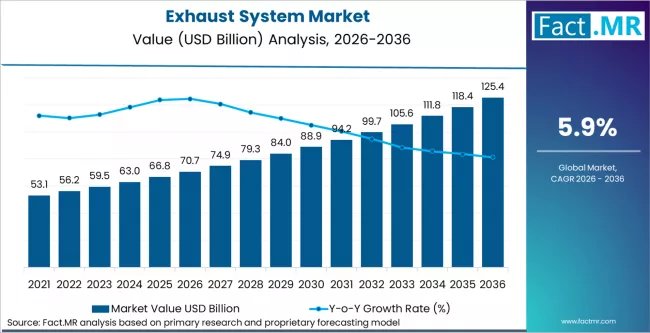
Exhaust System Market Market Value Analysis | Source: Fact.MR
Exhaust System Market Key Takeaways
| Metric | Details |
|---|---|
| Industry Size (2026) | USD 70.68 Billion |
| Industry Value (2036) | USD 125.38 Billion |
| CAGR (2026-2036) | 5.9% |
Source: Fact.MR analysis. Updated Mar 11, 2026
Exhaust System Market Definition
The exhaust system market encompasses the complete set of components that manage combustion gas flow from the engine cylinder head through the vehicle underbody to the atmosphere, including exhaust manifolds and headers, front pipes and flexible sections, catalytic converter assemblies, diesel particulate filter and gasoline particulate filter units, selective catalytic reduction catalyst and urea dosing systems, muffler and silencer assemblies, and tailpipe outlet sections. The scope covers complete exhaust system assemblies and major components supplied to vehicle manufacturers through OEM programmes and the aftermarket replacement channel.
Exhaust System Market Inclusions
Market scope includes exhaust manifold and turbocharger outlet pipe assemblies, three-way catalytic converter and diesel oxidation catalyst units, diesel particulate filter and gasoline particulate filter assemblies, selective catalytic reduction catalyst and AdBlue urea injection system modules, exhaust gas recirculation valve and cooler assemblies, resonator and muffler silencer boxes, and stainless steel and aluminised steel tailpipe outlet assemblies. Geographic analysis covers North America, Latin America, Europe, East Asia, South Asia, Oceania, and Middle East and Africa. Forecast scope spans 2026 to 2036 with segment breakdowns by vehicle type, fuel type, sales channel, and region.
Exhaust System Market Exclusions
Battery electric vehicle thermal management exhaust pathways, hydrogen fuel cell vehicle water vapour exhaust systems, diesel engine urea fluid storage tank assemblies classified as fuel system components, industrial stationary engine exhaust systems, marine vessel exhaust systems, and aviation gas turbine exhaust nozzle components fall outside this market scope. Performance racing exhaust systems manufactured without road vehicle homologation for track-only use are also excluded.
Exhaust System Market Research Methodology
- Primary Research: Fact.MR analysts conducted interviews with exhaust system engineering managers at vehicle OEMs, aftertreatment product development directors at tier-one exhaust system manufacturers, and precious metal procurement specialists at catalytic converter suppliers to validate emission regulation compliance specification requirements, gasoline particulate filter adoption timelines, and precious metal loading trends across passenger car and commercial vehicle exhaust system programmes.
- Desk Research: Secondary research aggregated emission regulation documentation from EU Euro 7, US EPA LEV III and SULEV, China 6b, and India BS VI Phase 2 standards, precious metal commodity price data from platinum group metal market publications, corporate product development announcements from listed exhaust system manufacturers, and vehicle production statistics from automotive industry associations.
- Market-Sizing and Forecasting: Baseline market values derive from a bottom-up aggregation of exhaust system unit volumes by vehicle type and fuel category, multiplied by average system prices across gasoline, diesel, and hybrid emission control configurations. Emission regulation tightening content additions were modelled as per-system value uplift applied at regulation implementation dates across each regional market in the forecast.
- Data Validation and Update Cycle: Segment forecasts are cross-validated against revenue disclosures from publicly listed exhaust system manufacturers and vehicle production data from automotive associations. Annual updates incorporate actual emission regulation implementation dates and precious metal price movements that influence catalytic converter system values.
Summary of Exhaust System Market
- Exhaust System Market Definition
- The exhaust system market covers the integrated assembly of components managing combustion gas flow, treatment, and noise attenuation from engine outlet to atmosphere, including catalytic converters, particulate filters, SCR systems, and muffler assemblies for passenger and commercial vehicles supplied through OEM and aftermarket channels.
- Demand Drivers in the Market
- Euro 7 and China 6b Emission Standards Mandating Gasoline Particulate Filter Addition: The introduction of gasoline particulate filter requirements under Euro 7 and China 6b regulations for direct injection gasoline engines is adding a new aftertreatment component to the exhaust system bill of materials across the large gasoline vehicle production base, increasing per-system assembly value and precious metal coating requirements beyond the three-way catalytic converter configurations that previously constituted the complete gasoline emission control system in most passenger car programmes.
- Hybrid Powertrain Exhaust System Complexity Increasing Per-Unit Engineering Value: Mild hybrid, full hybrid, and plug-in hybrid vehicle exhaust systems require more sophisticated catalyst light-off and temperature management than equivalent pure internal combustion alternatives, as the extended periods of engine-off operation in hybrid driving cycles allow catalysts to cool below operating temperature and require faster relight strategies and higher precious metal loading configurations to maintain emission compliance across the full range of hybrid operating modes that regulatory test cycles evaluate.
- Aftermarket Corrosion and Damage Replacement Cycle Providing Structural Revenue: The mandatory periodic replacement of exhaust system components due to corrosion-driven failure in markets with high road salt usage, and damage replacement from road debris impact events in all markets, generates consistent aftermarket revenue from the global vehicle parc that is structurally independent of new vehicle production volumes and sustains exhaust system manufacturer revenue through periods of new vehicle production cyclicality.
- Key Segments Analyzed in the Fact.MR Report
- Passenger Cars Vehicle Type: Commands 64.7% share in 2026, representing the largest exhaust system demand segment through production volume dominance and the concentration of catalytic converter precious metal value in the passenger car emission control system where progressively tightening NOx, CO, HC, and particulate emission limits are continuously increasing aftertreatment system content and per-unit assembly value across regulatory upgrade cycles.
- Gasoline Fuel Type: Holds 58.3% share in 2026, reflecting the global passenger car production majority in gasoline direct injection and port fuel injection configurations whose three-way catalytic converter and emerging gasoline particulate filter aftertreatment requirements constitute the largest single product category within the exhaust system market by aggregate revenue value.
- OEM Sales Channel: Accounts for 71.6% of 2026 market value, reflecting exhaust system specification as an emission regulation compliance component validated through type approval testing with vehicle-specific geometry and aftertreatment integration requirements that establish OEM supply relationships across full model production lifecycles.
- Analyst Opinion at Fact.MR
- Fact.MR analysis indicates that the exhaust system market is in a period of elevated per-system value growth driven by regulatory-mandated aftertreatment content additions that are offsetting the volume headwind created by the progressive electrification of the passenger car fleet, creating a market where revenue growth is outpacing unit volume growth across the forecast period. The introduction of gasoline particulate filters as a mandatory component for Euro 7 and China 6b compliance represents the most significant per-system value addition since the original catalytic converter mandate, adding a technically complex coated filter substrate, associated backpressure management calibration requirements, and regeneration cycle management software to the gasoline passenger car exhaust system configuration. Exhaust system suppliers who have invested in gasoline particulate filter coating and substrate capabilities ahead of the Euro 7 implementation timeline are positioned to capture the supply nominations that will generate revenue across the full production lifecycle of Euro 7 compliant vehicle platforms. The longer-term structural question is the pace of battery electric vehicle adoption displacement of internal combustion vehicles, which will progressively reduce the total exhaust system serviceable vehicle population, but the regulatory-driven per-system value escalation in the remaining internal combustion fleet is expected to substantially offset unit volume reductions through 2036.
- Strategic Implications / Executive Takeaways
- Gasoline Particulate Filter Manufacturing Capability Investment: Exhaust system manufacturers should invest in catalytic substrate coating, filter housing fabrication, and regeneration calibration capability for gasoline particulate filter systems to secure OEM programme nominations for Euro 7 and China 6b compliant vehicle platforms, as GPF supply is a technically differentiated category where early capability investment and OEM qualification experience create durable competitive advantages over late entrant suppliers attempting to qualify for established programme volumes.
- Hybrid Exhaust System Thermal Management Engineering Specialisation: Suppliers should develop specialised engineering capability for hybrid vehicle exhaust system catalyst light-off optimisation and temperature management under engine-off duty cycles, as the growing hybrid vehicle production share is creating demand for exhaust system configurations whose thermal management requirements differ fundamentally from conventional internal combustion alternatives and require dedicated engineering investment to solve reliably within OEM emission compliance validation frameworks.
- Precious Metal Recovery Programme Development for Aftermarket Channel: Exhaust system manufacturers operating in the aftermarket replacement channel should develop formalised catalytic converter precious metal recovery programmes that return platinum group metal content value from worn catalyst units, as rising palladium and rhodium prices are making precious metal recovery an increasingly significant revenue stream that improves the economics of aftermarket exhaust system supply and creates a circular supply chain advantage over competitors without organised recovery infrastructure.
What is the Demand Outlook for Exhaust Systems Worldwide?
“Market Driven Innovations in Exhaust Systems Such as GPFs, DPFs, and SCR and Stringent Pollution Regulations”
Innovations in exhaust systems, including gasoline particulate filters (GPFs), diesel particulate filters (DPFs), and selective catalytic reduction (SCR), significantly enhance emission control efficiency, driving market growth. SCR technology reduces nitrogen oxide (NOx) emissions by utilizing a urea-based solution to convert them into harmless nitrogen and water.
DPFs effectively remove particulate matter (PM) from diesel engine exhaust, preventing hazardous particles from being released into the atmosphere. Similarly, GPFs capture gasoline engine soot and particle pollution. These advanced technologies are essential to meet increasingly strict pollution regulations worldwide, ensuring compliance with environmental standards while simultaneously improving fuel efficiency and engine performance.
What Do Exhaust System Manufacturers Need to Keep an Eye On?
“Need for High-Quality Materials to Stand Harsh Environments and High Production Costs”
Manufacturers of exhaust systems face a significant hurdle in meeting the demand for high-performance materials that can endure extreme temperatures and harsh conditions. These materials must be heat-resistant, robust, and efficient in managing emissions. The complexity of designing and manufacturing these intricate systems exacerbates the challenge, requiring advanced engineering and specialized production methods.
In the exhaust systems market, manufacturers encounter difficulty balancing performance, durability, and cost-effectiveness due to these factors, which not only escalate production costs but also impede the expansion of the exhaust system market size.
Country-wise Insights
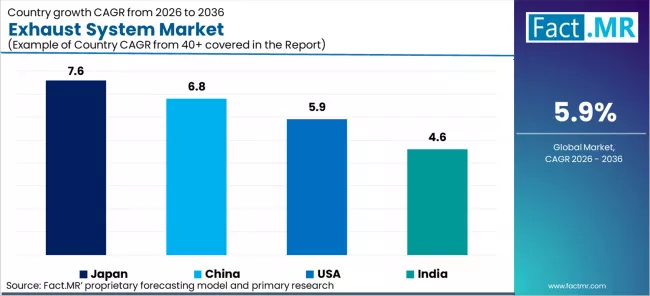
Exhaust System Market Cagr Analysis By Country | Source: Fact.MR
East Asia is poised to hold 29.1% of the global exhaust system market share in 2026 due to increasing sales of vehicles. The market in North America is forecasted to expand at a 6.1% CAGR from 2026 to 2036, driven by the presence of well-established companies in the region.
How is the Market Faring in the United States?
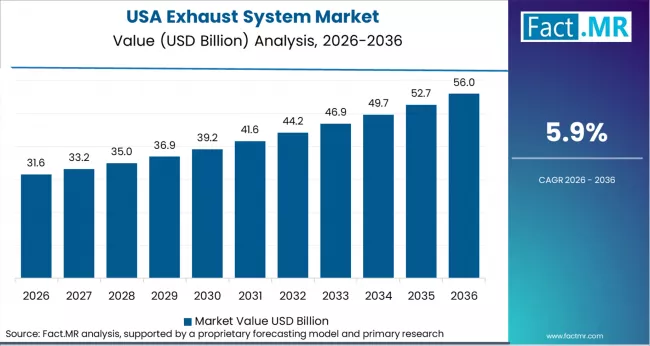
Exhaust System Market Country Value Analysis | Source: Fact.MR
“High Need for Exhaust System Replacements in Older Vehicles”
| Attribute | United States |
|---|---|
| Market Value (2026E) | US$ 14.77 Billion |
| Growth Rate (2026 to 2036) | 5.9% CAGR |
| Projected Value (2036F) | US$ 26.15 Billion |
Source: Fact.MR analysis. Updated Mar 11, 2026
The United States automotive market, a key player globally, effectively manages the demand for both new vehicles and a large fleet of older cars still in operation. This dynamic sustains a continuous need for exhaust systems from original equipment manufacturers (OEMs) and the aftermarket.
New cars require the latest exhaust systems to comply with stringent emission standards, while replacements are essential for older vehicles to maintain performance and legal compliance. Consequently, the market in the United States is growing due to this dual demand for both new and older vehicles.
Why is Japan the Center of Attraction for Exhaust System Producers?
“Stringent Emission Regulations and Increased Production of Electric and Hybrid Vehicles”
| Attribute | Japan |
|---|---|
| Market Value (2026E) | US$ 4.7 Billion |
| Growth Rate (2026 to 2036) | 7.6% CAGR |
| Projected Value (2036F) | US$ 9.74 Billion |
Source: Fact.MR analysis. Updated Mar 11, 2026
Demand for exhaust systems in Japan is increasing at a significant pace, driven by stringent emission regulations aimed at minimizing environmental impact and air pollution. Japan's automotive industry, known for its production of electric and hybrid vehicles, contributes significantly to this demand for specialized exhaust systems.
In Japan, there is a growing preference for high-performance exhaust systems that enhance engine efficiency and reduce emissions, aligning with the market's strong emphasis on sustainability and fuel efficiency. Additionally, Japan's aging car fleet necessitates continuous aftermarket replacement parts, further boosting the demand for exhaust systems.
Category-wise Insights
The market is segmented into passenger cars and commercial vehicles based on vehicle type. The passenger vehicle segment is estimated to account for 61.6% of revenue share in 2024.
What Makes Exhaust Systems Critical for Diesel-Powered Vehicles?
“High Production of NOx and Particulate Matter from Diesel Vehicles”
| Attribute | Diesel |
|---|---|
| Segment Value (2024E) | US$ 34.37 Billion |
| Growth Rate (2024 to 2034) | 5.3% CAGR |
| Projected Value (2034F) | US$ 57.61 Billion |
Source: Fact.MR analysis. Updated Mar 11, 2026
Exhaust systems are crucial for diesel-powered vehicles primarily due to the emissions they generate. When diesel engines replace gasoline engines, they produce higher levels of nitrogen oxides (NOx) and particulate matter (PM). Advanced exhaust systems are necessary for diesel vehicles to comply with stringent global emission regulations.
Selective catalytic reduction (SCR) systems and diesel particulate filters (DPF) are integral components of these advanced exhaust systems. SCR systems use a catalyst to convert harmful NOx into nitrogen and water vapor, significantly reducing emissions. Meanwhile, DPFs capture and eliminate PM pollutants from diesel engine exhaust.
Efficient exhaust systems are essential for diesel vehicles to minimize their environmental impact and ensure compliance with emissions regulations worldwide.
Why Do OEMs Account for Higher Revenue Streams?
“Integrated Supply Chains and Economies of Scale”
| Attribute | OEMs |
|---|---|
| Segment Value (2024E) | US$ 44.87 Billion |
| Growth Rate (2024 to 2034) | 6.2% CAGR |
| Projected Value (2034F) | US$ 81.5 Billion |
Source: Fact.MR analysis. Updated Mar 11, 2026
Because of high vehicle production volumes and regulatory mandates, OEMs sell substantial quantities of exhaust systems. To meet stringent global emission standards, OEMs must install compliant exhaust systems in new vehicles. Demand for OEM exhaust systems correlates directly with vehicle production rates.
Through integrated supply chains and economies of scale during assembly, OEMs ensure seamless compliance with emissions regulations and optimal system performance. The significant sales volumes of OEM exhaust systems stem largely from this integrated supply chain and bulk purchasing advantages.
Competitive Landscape
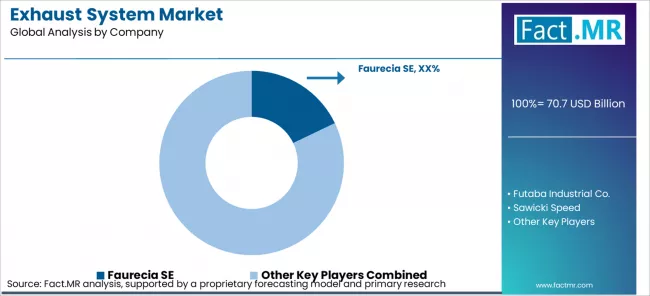
Exhaust System Market Analysis By Company | Source: Fact.MR
Key players in the exhaust system industry are maintaining their position in competition by using unique features, materials, and designs. This helps them to meet the needs of various clients such as OEMs and aftermarket, by offering customized items that fulfill specific vehicle standards.
By strengthening their relationships with aftermarket distributors and service providers, manufacturers are boosting their income from replacement parts and maintenance services.
- In September 2023, a new exhaust system designed especially for the Indian Challenger and Pursuit was released by the United States-based Sawicki Speed, a high-performance exhaust expert. The brand's Mid-Length and Shorty models are compatible with the new Full-Length exhaust system.
- In September 2023, with the introduction of a Slip-On Line (Titanium) for the Honda XL750 Transalp and a Slip-On Line (Carbon) for the Honda CB750 Hornet, Akrapovic expanded its selection of Honda replacement exhausts by two.
- In July 2023, Milltek Sport, a United Kingdom-based company renowned for its high-performance exhaust systems across various vehicles, introduced an enhanced exhaust system for BMW's exhilarating M2 Coupe, pushing the boundaries of the new model's capabilities even further.
- In May 2021, Futaba Industrial Co., Ltd expressed plans to participate in the Automotive Engineering Exposition 2021 Online. The company plans to exhibit exhaust and vehicle components that reduce emissions, increase fuel efficiency, and reduce weight in support of SDGs (Sustainable Development Goals).
- In November 2021, Faurecia announced plans to acquire Hella, a German supplier specialized in the production of lighting and electronics automotive products in a US$ 7.27 billion deal. Together, the companies will become the 7th largest automotive supplier and will be well suited to take on new challenges such as autonomous driving, electric mobility, and the cockpit of the future.
Fact.MR provides detailed information about the price points of key manufacturers of exhaust systems positioned across the world, sales growth, production capacity, and speculative technological expansion, in this updated market report.
Bibliography
- European Commission, Directorate-General for Climate Action. (2024, June). Euro 7 Regulation (EU) 2024/1257: Emission Limit Values and Aftertreatment System Requirements for Light and Heavy Duty Vehicles Including Gasoline Particulate Filter Mandates. European Commission.
- United States Environmental Protection Agency. (2024, March). LEV III and SULEV Standards: Catalytic Aftertreatment System Performance Requirements and Precious Metal Loading Guidelines for Gasoline Vehicles. U.S. EPA.
- Government of China, Ministry of Ecology and Environment. (2024, January). China 6b Emission Standards: Gasoline Direct Injection Particulate Filter Requirements and Real Driving Emission Compliance Specifications. MEE China.
- Government of India, Ministry of Road Transport and Highways. (2024, April). Bharat Stage VI Phase 2: Real Driving Emission Compliance Requirements for Catalytic Converter and Particulate Filter Systems. MoRTH.
- SAE International. (2024, February). SAE J1297: Exhaust System Components - Performance and Durability Test Methods for Catalytic Converter and Particulate Filter Assemblies. SAE International.
- United Nations Economic Commission for Europe. (2024, March). UNECE Regulation No. 83 Rev.7: Uniform Provisions Concerning the Approval of Vehicles with Regard to the Emission of Pollutants. UNECE.
This bibliography is provided for reader reference. The full Fact.MR report contains the complete reference list with primary research documentation.
This Report Addresses
- Market sizing and quantitative forecast metrics: detailing precise revenue projections, absolute dollar growth, and compound annual growth rates across major exhaust system segments and geographies through 2036.
- Segmentation analysis: mapping the adoption velocity of leading product, technology, and end-use categories and evaluating structural factors driving segment share transitions over the forecast period.
- Regional deployment intelligence: comparing growth dynamics in high-momentum Asia Pacific and emerging markets against the mature replacement and upgrade demand patterns prevalent in European and North American industry hubs.
- Regulatory compliance assessment: analyzing how evolving product safety standards, environmental directives, and sector-specific mandates are reshaping procurement decisions, material specifications, and supplier qualification criteria.
- Competitive posture evaluation: tracking consolidation trends, platform integration strategies, technology differentiation investments, and the resulting competitive dynamics among established market players and emerging challengers.
- Capital project strategic guidance: defining the procurement specifications, investment thresholds, and performance benchmarks required to support next-generation product adoption and facility modernization programs.
- Supply chain vulnerability analysis: identifying sourcing concentration risks, logistics bottlenecks, raw material price dependencies, and geographic exposure scenarios that affect market participant cost structures.
- Custom data delivery formats: encompassing interactive dashboards, raw Excel datasets, and comprehensive PDF narrative reports tailored for executive decision-making and analyst reference applications.
Segmentation
Scope of the Report
| Metric | Value |
|---|---|
| Quantitative Units | USD 70.68 billion to USD 125.38 billion, at a CAGR of 5.9% |
| Market Definition | Integrated assembly of components managing combustion gas flow, treatment, and noise attenuation from engine outlet to atmosphere, including catalytic converters, particulate filters, SCR systems, and muffler assemblies for passenger and commercial vehicles. |
| Vehicle Type Segmentation | Passenger Cars, LCVs, HCVs |
| Fuel Type Segmentation | Gasoline, Diesel, Hybrid |
| Sales Channel Segmentation | OEMs, Aftermarket |
| Regions Covered | North America, Latin America, Europe, East Asia, South Asia, Oceania, Middle East and Africa |
| Countries Covered | Japan, China, USA, India, and 40 plus countries |
| Key Companies Profiled | Faurecia SE, Futaba Industrial Co., Friedrich Boysen GmbH and Co. KG, Eberspacher, Tenneco Automotive Pvt. Ltd., Yutaka Giken Co. Ltd., Benteler International AG, Sejong Industrial Co. Ltd. |
| Forecast Period | 2026 to 2036 |
| Approach | Bottom-up aggregation of exhaust system units by vehicle type and fuel category with emission regulation tightening content addition per-system value uplift modeling |
Source: Fact.MR analysis. Updated Mar 11, 2026
Segmentation of Exhaust System Market Research
-
By Vehicle Type:
- Passenger Cars
- Commercial Vehicles
-
By Fuel:
- Diesel
- Gasoline
-
By Sales Channel:
- OEMs
- Aftermarket
-
By Region:
- North America
- Western Europe
- Eastern Europe
- Latin America
- East Asia
- South Asia & Pacific
- Middle East & Africa
Frequently Asked Questions
How large is the exhaust system market in 2026?
What will the exhaust system market size be by 2036?
What is the expected CAGR between 2026 and 2036?
Which vehicle type leads the market in 2026?
Which fuel type segment holds the largest share?
Why does the OEM channel account for 71.6% of sales?
What is driving Japan's leading 7.6% CAGR?
How do Euro 7 and China 6b standards increase per-system value?
What is excluded from the scope of this report?
Who worked on this report


Preview the report firsthand - request a free sample
Free SampleGet the brochure for pricing and purchase details
Download PDF