3D Dental Scanners Market Size, Share, Growth and Forecast (2026 - 2036)
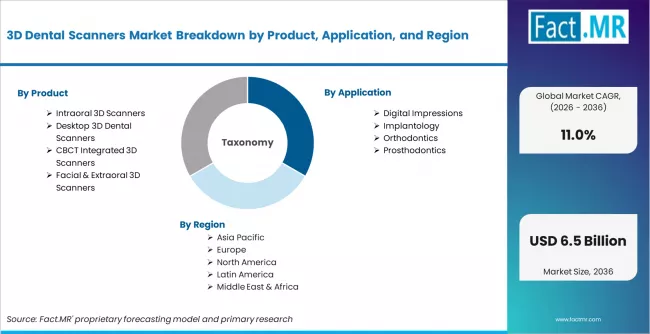
3D Dental Scanners Market is segmented by Product (Intraoral 3D Scanners, Desktop 3D Dental Scanners, CBCT Integrated 3D Scanners, Facial & Extraoral 3D Scanners), Application (Digital Impressions, Implantology, Orthodontics, Prosthodontics), End Use (Dental Clinics, Dental Laboratories, Hospitals, Academic & Research Institutes), and Region, with forecasts covering the period from 2026 to 2036.
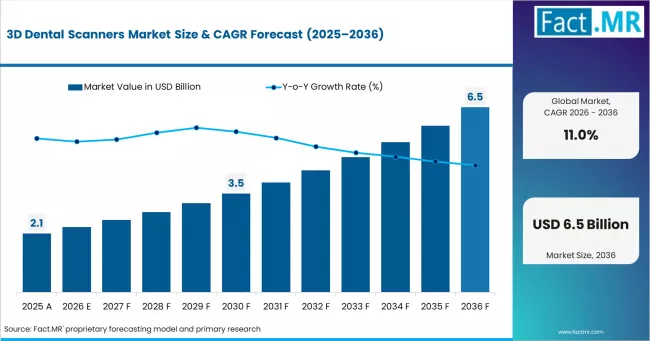
According to Fact.MR estimates, the global 3d dental scanners market market was valued at USD 2.1 billion in 2025. The market is projected to reach USD 2.3 billion in 2026 and is expected to grow to USD 6.5 billion by 2036, expanding at a CAGR of 11.0%. Intraoral 3D Scanners is anticipated to account for 49.0% of the product segment in 2026, while Digital Impressions is expected to remain the leading application with around 43.0% share.
3D Dental Scanners Market Analysis and Forecast by Fact.MR
According to Fact.MR estimates, the global 3d dental scanners market market was valued at USD 2.1 billion in 2025. The market is projected to reach USD 2.3 billion in 2026 and is expected to grow to USD 6.5 billion by 2036, expanding at a CAGR of 11.0%. Intraoral 3D Scanners is anticipated to account for 49.0% of the product segment in 2026, while Digital Impressions is expected to remain the leading application with around 43.0% share.

Summary of 3D Dental Scanners Market
- Market Snapshot
- The 3d dental scanners market was valued at USD 2.05 billion in 2025.
- By 2036, the 3D Dental Scanners Market is expected to be worth USD 6.47 billion.
- From 2026 to 2036, the market is projected to expand at a CAGR of 11.0%.
- The market is projected to create an incremental opportunity of USD 4.19 billion between 2026 and 2036.
- In 2026, intraoral 3D scanners are expected to account for 49% of the product segment, driven by the accelerating shift from physical impressions to digital workflows.
- China (14.85%) and India (13.75%) are two of the fastest growing markets in the world.
- Demand and Growth Drivers
- Demand is shaped by the accelerating shift from conventional dental impressions to digital chairside workflows, which improve clinical efficiency and patient comfort.
- Growth reflects the expansion of clear aligner orthodontic treatment globally, where 3D scanning is essential to aligner planning and workflow.
- Adoption is increasing due to rising implantology procedure volumes and growing use of guided implant surgery protocols that require precise digital 3D data.
- Product and Segment View
- Intraoral 3D scanners lead the product segment with a 49% share in 2026, supported by broad adoption in private dental practices and orthodontic clinics.
- Digital impressions hold 43% of the application segment, anchored by their use across crown and bridge, orthodontic, and prosthodontic workflows.
- Dental clinics account for 57% of end-use demand, while dental laboratories, multi-specialty clinics, and CAD/CAM dental labs form secondary channels.
- Geography and Competitive Outlook
- North America remains the largest regional market, supported by high digital dentistry adoption, broad clear aligner use, and well-established CAD/CAM dental lab networks.
- Asia Pacific is the fastest-growing region, led by China where expanding private dental chains, rising orthodontic demand, and domestic manufacturing are all supporting scanner adoption.
- The competitive field is led by Align Technology Inc. with an estimated 26% share, followed by 3Shape AS, DENTSPLY SIRONA Inc., Carestream Dental LLC, and Medit Corp.
- Analyst Opinion
- 3D dental scanners have moved beyond early-adopter practices to become a standard productivity tool in modern dentistry, and the commercial economics reflect this shift. The category is structurally attractive because scanner adoption unlocks downstream revenue across clear aligners, guided implant surgery, and same-day chairside restorations, which creates strong ecosystem lock-in for platform vendors. The commercial lever that matters most is software and workflow integration, because scanners increasingly compete as ecosystem gateways rather than standalone hardware. Players that combine accurate hardware with strong clear aligner integration, implant planning software, and open lab connectivity will capture premium positioning, while commodity scanner suppliers without ecosystem depth face rapid price erosion as Chinese manufacturers build competitive value-tier alternatives.
Why is 3D Dental Scanners Market Growing?
- Growth reflects the accelerating shift from conventional impressions to digital chairside workflows across private dental practices globally.
- Demand is shaped by clear aligner treatment expansion, which has created a large and growing addressable market for scanner-based orthodontic planning.
- Adoption is increasing due to expanding implantology procedure volumes and the growing use of guided implant surgery protocols.
The demand base rests on the ongoing transformation of dental practice workflows from analog impressions and physical models to fully digital capture, design, and manufacturing chains. Intraoral scanners eliminate the patient discomfort of silicone and alginate impressions, reduce clinical time for crown and bridge workflows, and enable direct digital transmission of impression data to dental labs. These workflow benefits combined with declining scanner prices are driving accelerating penetration in private practice segments.
The second structural driver is clear aligner orthodontic treatment expansion. Companies such as Align Technology and SmileDirectClub have built substantial clear aligner businesses that depend on scanner-based treatment planning, which creates both direct scanner demand and ecosystem pull for scanners compatible with major aligner platforms. As clear aligner case volumes continue growing globally, scanner placements in orthodontic and general practice settings expand in parallel.
The third driver is implantology growth and guided surgery adoption. Modern implant placement increasingly uses digital planning with 3D scanner data merged with CBCT imagery to design surgical guides, which improves placement accuracy and clinical outcomes. As implant procedure volumes grow with aging populations globally, demand for integrated scanner and planning workflows expands meaningfully across specialty clinics and dental laboratories.
Segment-wise Analysis of 3D Dental Scanners Market
- Intraoral 3D scanners lead the product segment with 49% share in 2026, anchored by broad private practice adoption and clear aligner workflow integration.
- Wireless intraoral scanners represent the fastest-growing product sub-segment, driven by workflow flexibility and declining price points.
- Digital impressions hold 43% of the application segment, followed by orthodontics and implantology as secondary use cases.
The segmentation view shows a category where intraoral scanners dominate volume while desktop lab scanners serve CAD/CAM lab and specialty production workflows. Competitive advantage rests on scanning accuracy, software ecosystem depth, and workflow integration with clear aligner and implant planning platforms. Growth over the forecast period is expected to tilt toward wireless intraoral scanners and integrated chairside systems as practices consolidate workflows and reduce cord-based constraints.
Why Do Intraoral 3D Scanners Lead the Product Segment?
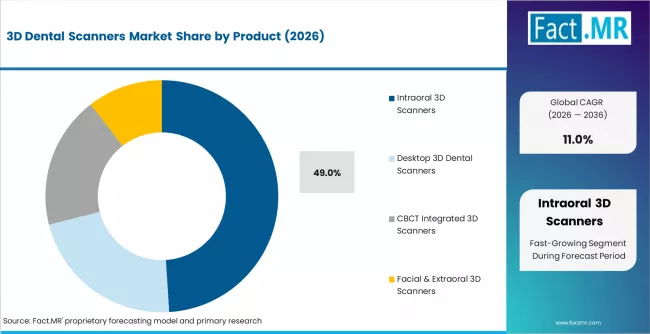
Intraoral 3D scanners lead the product segment because they replace the highest-volume workflow in dentistry: dental impressions. Crown and bridge procedures, orthodontic consultations, implant planning, and prosthetic fabrication all traditionally required physical impressions, and intraoral scanners now serve as the digital replacement across all these workflows. This breadth of use cases combined with the large installed base of private dental practices globally creates the largest demand pool in the category.
The segment leadership is reinforced by strong ecosystem pull from clear aligner manufacturers, which require scanner-based treatment planning and have negotiated compatibility partnerships with major scanner platforms. Align Technology's iTero scanners hold the leading share in part because of their integration with Invisalign treatment workflows, while 3Shape and other platforms compete through open compatibility with multiple aligner and lab software systems.
Why are Wireless Intraoral Scanners the Fastest-Growing Sub-Segment?
Wireless intraoral scanners are the fastest-growing sub-segment because they remove cord-based constraints in clinical operatories, support multi-operatory sharing, and improve patient positioning flexibility. Recent wireless models from Medit, 3Shape, and other platform vendors have improved battery life, scanning accuracy, and image processing speed to a level where they match corded performance for most clinical use cases, which has accelerated market adoption.
Growth within wireless scanners is being lifted by declining price points and improved workflow ergonomics. Multi-operatory practices can share a single wireless scanner across several chairs, which improves capital efficiency relative to dedicated corded units. As wireless accuracy continues matching or exceeding corded performance, the functional justification for cord-based systems weakens, which supports sustained migration to wireless platforms.
Key Growth Drivers, Constraints, and Market Scope
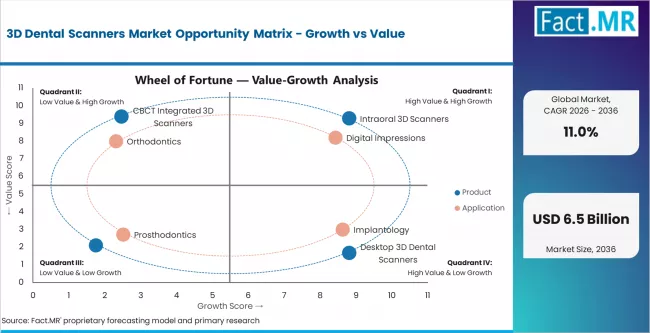
- Digital dentistry workflow adoption and clear aligner expansion are the structural demand foundations.
- Implantology growth and guided surgery protocol adoption are the key compositional shifts driving premium growth.
- Scanner price points, workflow disruption during transition, and software subscription costs remain the leading constraints.
The market scope is shaped by the combination of accelerating scanner penetration in private practice and premium growth in integrated implant planning and clear aligner workflows. Competitive advantage sits in scanning accuracy, software ecosystem depth, and clear aligner and implant planning platform integration.
Growth Drivers
The primary driver is the ongoing digital dentistry workflow transformation across private practices globally, which is moving impressions, design, and manufacturing from analog to digital chains. A second driver is clear aligner treatment expansion, which creates direct scanner demand and ecosystem pull for compatible platforms. A third driver is implantology growth and guided surgery protocol adoption, which supports demand for integrated scanner and planning workflows. These three forces combine to deliver a double-digit CAGR with premium uplift from software ecosystem revenue.
Constraints
The leading constraint is scanner price point. Premium intraoral scanners cost USD 20,000 to USD 40,000 plus software subscription fees, which creates adoption barriers particularly in price-sensitive emerging markets and smaller private practices. A second constraint is workflow disruption during transition. Practices moving from analog to digital workflows require staff training, process redesign, and capital investment, which slows adoption pace. A third constraint is software subscription costs. Many scanner platforms charge recurring subscription fees for planning software, case management, and cloud storage, which adds to total cost of ownership and creates ongoing budget impact for practices.
Opportunities
The strongest opportunity lies in emerging market penetration, particularly in China and India, where expanding private dental chains, rising orthodontic demand, and growing middle-class spending on elective dentistry all support scanner adoption. A second opportunity is integrated workflow platforms that combine scanning, planning, and manufacturing into unified subscription offerings, which can capture more of the total customer lifetime value. A third opportunity is specialty scanner segments for orthodontic-specific, implant-specific, and prosthetic-specific use cases, which can support premium pricing through targeted feature sets.
Regional Outlook Across Key Markets
.webp)
- China leads country-level growth at 14.85% CAGR, supported by expanding private dental chains, rising orthodontic demand, and growing domestic scanner manufacturing.
- India follows at 13.75%, driven by private dental network expansion, rising clear aligner adoption, and growing implant procedure volumes.
- North America remains the largest regional pool by absolute value, with the USA at 10.45% supported by high digital dentistry adoption and broad clear aligner use.
- European demand is led by Germany at 12.65% and the UK at 9.35%, with both countries showing strong clear aligner and implant planning workflow adoption.
Country CAGR Table
| Country | CAGR (%) |
|---|---|
| China | 14.85% |
| India | 13.75% |
| Germany | 12.65% |
| Brazil | 11.55% |
| USA | 10.45% |
| UK | 9.35% |
| Japan | 8.25% |
Source: Fact.MR analysis, based on proprietary forecasting model and primary research.
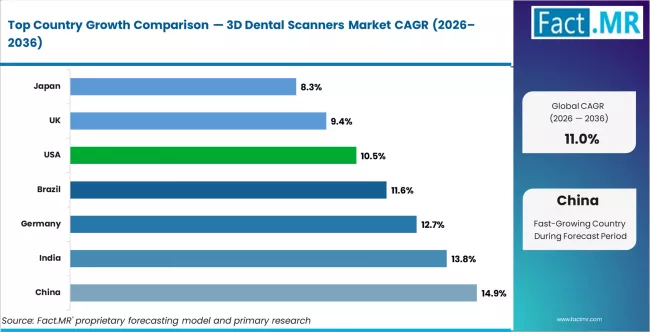
Regional dynamics split into three profiles. Asia Pacific leads on growth rate, pulled by private dental chain expansion and rising consumer spending on elective dentistry. Europe grows at strong double-digit rates driven by mature digital dentistry adoption and active clear aligner market presence. North America remains the largest dollar market, anchored by high scanner penetration and broad clear aligner adoption across both orthodontic and general practice segments.
United States
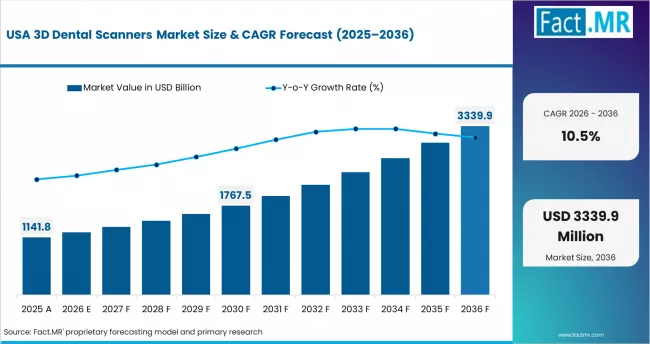
The United States anchors global demand through its high digital dentistry adoption, large clear aligner market, and established CAD/CAM dental lab networks. Align Technology Inc., 3Shape AS, DENTSPLY SIRONA Inc., and Carestream Dental LLC compete actively across private practice channels, while Medit Corp., Dental Wings, and other platforms have built meaningful share positions. Corporate dental chains such as Heartland Dental and Aspen Dental accelerate scanner deployment through standardized procurement.
- High clear aligner adoption drives strong iTero and compatible scanner demand.
- Mature CAD/CAM dental lab networks support desktop scanner placements.
- Corporate dental chains accelerate scanner deployment through standardized procurement.
Canada
Canada represents a steady growth market shaped by provincial dental service patterns, private practice concentration in urban areas, and cross-border distribution relationships with US scanner manufacturers. Corporate dental chains such as dentalcorp and Dental Choice drive concentrated scanner procurement, while academic dental programs at University of Toronto, McGill, and UBC drive institutional scanner adoption.
- Corporate dental chains drive concentrated scanner procurement across urban markets.
- Academic dental programs support institutional scanner adoption.
- Cross-border distribution relationships with US manufacturers support product availability.
United Kingdom
The United Kingdom market is shaped by the mix of NHS and private dental practice segments, with private practices driving the majority of scanner adoption. Clear aligner adoption has accelerated across UK private practices, while corporate dental chains such as Bupa Dental Care, {my}dentist, and Rodericks Dental Partners support scanner standardization across their networks. The NHS segment adoption is slower but growing as contract renewals incorporate digital workflow requirements.
- Private dental practices lead scanner adoption, supported by clear aligner growth.
- Corporate dental chains support scanner standardization across networks.
- NHS segment adoption is slower but growing with digital workflow requirements.
Germany
Germany leads European growth on the strength of mature digital dentistry adoption, established CAD/CAM dental lab networks, and active clear aligner market presence. DENTSPLY SIRONA Inc. and KaVo Dental GmbH have strong home-country operations supporting the German scanner market, while 3Shape AS and Align Technology Inc. also compete actively. German academic dental programs and major private dental chains drive consistent demand for both chairside and desktop scanners.
- Mature digital dentistry adoption supports broad scanner deployment.
- Established CAD/CAM lab networks drive desktop scanner demand.
- Home-country operations of DENTSPLY SIRONA and KaVo Dental anchor the German market.
China
China is the fastest-growing country in the forecast, driven by expanding private dental chains, rising orthodontic demand, and growing domestic scanner manufacturing capability. Private dental chains such as Arrail Dental and Jinshui Dental are expanding rapidly across tier-1 and tier-2 cities, while clear aligner adoption has accelerated dramatically among urban middle-class consumers. Domestic scanner manufacturers are also building value-tier competition against imported premium brands.
- Private dental chain expansion drives concentrated scanner procurement.
- Rising clear aligner demand among urban middle class accelerates scanner adoption.
- Domestic manufacturing capability creates value-tier competition in mid-market segments.
India
India represents a strong growth market driven by private dental network expansion, rising clear aligner adoption, and growing implant procedure volumes. Clove Dental, Axiss Dental, Apollo White Dental, and other corporate dental chains are expanding across metropolitan markets and adopting standardized digital workflows. Clear aligner adoption has accelerated among urban professionals, while implantology growth supports demand for integrated scanner and planning platforms.
- Corporate dental chain expansion drives concentrated scanner procurement.
- Rising clear aligner adoption among urban professionals accelerates scanner demand.
- Growing implant procedure volumes support integrated scanner and planning workflow adoption.
Competitive Benchmarking and Company Positioning
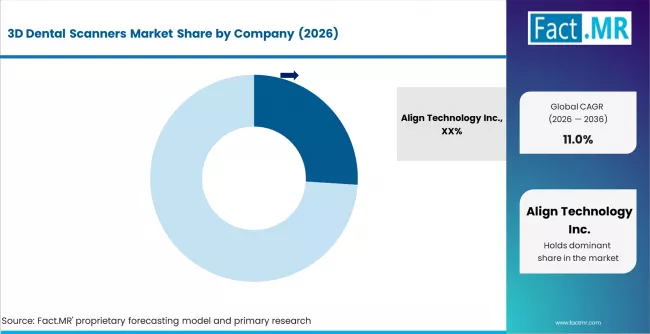
- Align Technology Inc. leads with an estimated 26% share, supported by its iTero scanner platform and Invisalign ecosystem integration.
- 3Shape AS, DENTSPLY SIRONA Inc., Carestream Dental LLC, and Medit Corp. compete through differentiated scanner portfolios and lab and planning software ecosystems.
- Specialty players such as Densys, AGE Solutions Srl, Amann Girrbach AG, and Condor Technologies NV hold focused positions in specific geographies and application segments.
The competitive field is moderately concentrated, with Align Technology Inc. commanding a strong share position through its iTero intraoral scanner platform and its tight integration with Invisalign clear aligner workflows. Align's scale reach, clear aligner ecosystem depth, and direct-to-practice channel model create meaningful competitive advantages that reinforce its position across orthodontic and general practice segments.
3Shape AS holds a strong position particularly in European markets and among CAD/CAM dental labs, supported by its open ecosystem approach that allows integration with multiple aligner, implant, and lab platforms. DENTSPLY SIRONA Inc. competes through its Primescan platform integrated with CEREC chairside restoration workflows, while Carestream Dental LLC and Medit Corp. compete through value-tier scanner platforms and software ecosystems. 3M and KaVo Dental GmbH maintain positions through specialty product portfolios and established channel relationships.
Strategic priorities across the field include expanding software ecosystem capabilities, deepening clear aligner and implant planning integrations, and investing in AI-based imaging software for automated scan processing. Scaled manufacturers with integrated platform ecosystems will capture the bulk of forecast period growth, while specialty scanner hardware players without strong software ecosystems face pricing pressure from Chinese value-tier competition.
Competitive Analysis
Competitive positioning rests on three dimensions: scanning accuracy and speed, software ecosystem depth, and clear aligner and implant planning workflow integration. Align Technology Inc. leads through iTero platform integration with Invisalign, while 3Shape AS leads through open ecosystem breadth. DENTSPLY SIRONA Inc. competes through chairside CAD/CAM integration, and Medit Corp. has built strong positions through value-tier pricing and open software compatibility.
Second-tier competitors maintain relevance through specialized scanner designs, focused application strategies, or regional market concentration. Chinese and Korean manufacturers are building capability in mid-tier scanner segments, particularly for domestic markets. The gap between platform-level ecosystem companies and specialty hardware manufacturers continues to widen as software subscription revenue becomes an increasingly important component of total category economics.
Benchmarking Table
| Company | Scale Reach | Scanner Portfolio | Software Ecosystem | Aligner Integration |
|---|---|---|---|---|
| Align Technology Inc. | Global | Focused | Strong | Strong (Invisalign) |
| 3Shape AS | Global | Broad | Strong | Open (Multi) |
| DENTSPLY SIRONA Inc. | Global | Broad | Strong | Medium |
| Carestream Dental LLC | Global | Medium | Medium | Medium |
| Medit Corp. | Global | Medium | Medium | Open (Multi) |
| 3M | Global | Focused | Medium | Medium |
| KaVo Dental GmbH | Regional | Medium | Medium | Medium |
Recent Developments
- In 2025, Align Technology Inc. continued expanding its iTero Lumina scanner platform with upgraded imaging capabilities and improved Invisalign workflow integration.
- In 2025, 3Shape AS advanced its TRIOS scanner portfolio through wireless platform upgrades and expanded software ecosystem partnerships.
- In 2026, Medit Corp. strengthened its i-Series scanner platform through expanded clinical software capabilities and broader aligner partner compatibility.
Leading Companies Shaping 3D Dental Scanners Market
-
Major Players
- Align Technology Inc.
- 3Shape AS
- DENTSPLY SIRONA Inc.
- Carestream Dental LLC
- Medit Corp.
- 3M
- KaVo Dental GmbH
- Hexagon AB
-
Emerging Players
- Condor Technologies NV
- Densys
- AGE Solutions Srl
- Amann Girrbach AG
- Aniwaa Pte. Ltd.
- Shining 3D
- Dental Wings
- Planmeca Oy
Sources and Research References
- United States Food and Drug Administration (FDA) - 510(k) Clearance Database for Dental Imaging Devices
- American Dental Association (ADA) - Clinical Practice Guidelines on Digital Dentistry
- World Health Organization (WHO) - Global Oral Health Publications
- International Organization for Standardization (ISO) - Dental Scanning Accuracy Standards
- Align Technology Inc. - Annual Report and iTero Platform Disclosures
- 3Shape AS - TRIOS Scanner Platform Portfolio Updates
- Primary interviews with dentists, orthodontists, prosthodontists, dental lab owners, and scanner manufacturers
This bibliography is provided for reader reference and is not exhaustive. The full report contains the complete reference list and detailed citations.
Key Questions This Report Addresses
- What is the current and future size of the 3D dental scanners market?
- How fast is the market expected to grow between 2026 and 2036?
- Which product segment is likely to lead the market by 2026?
- Which application segment will account for the highest demand by 2026?
- How is clear aligner expansion reshaping scanner demand patterns?
- Why are China and India emerging as the fastest-growing markets?
- Which countries are projected to show the fastest growth through 2036?
- Who are the key companies active in the 3D dental scanners market?
- How is wireless scanner technology changing the competitive dynamics?
3D Dental Scanners Market Definition
The 3D dental scanners market covers optical and imaging devices used to digitally capture the three-dimensional geometry of teeth, gums, jaws, and related oral structures for clinical diagnostic, restorative, orthodontic, and prosthetic applications. This includes intraoral scanners used chairside, desktop lab scanners used for impression and model digitization, CBCT-integrated 3D scanners, and facial and extraoral 3D scanners. The market spans dental clinics, private dental practices, multi-specialty clinics, CAD/CAM dental labs, hospitals, dental departments, oral surgery units, prosthetic fabrication units, and academic and research institutes across primary use cases including digital impressions, implantology, orthodontics, and prosthodontics.
3D Dental Scanners Market Inclusions
The scope includes intraoral 3D scanners across handheld intraoral scanners, wireless intraoral scanners, and chairside digital impression systems, desktop 3D dental scanners including lab-based model scanners and high-precision CAD/CAM scanners, CBCT-integrated 3D scanners including 3D imaging and scanning systems and hybrid diagnostic scanners, and facial and extraoral 3D scanners including facial mapping systems and jaw motion tracking scanners. It covers applications across digital impressions, crown and bridge procedures, orthodontic aligner planning, implantology, implant planning and placement, surgical guide design, orthodontics, teeth alignment monitoring, clear aligner workflow, prosthodontics, dental restoration design, and full mouth reconstruction. Coverage spans dental clinics, private dental practices, multi-specialty clinics, dental laboratories, CAD/CAM dental labs, prosthetic fabrication units, hospitals, dental departments, oral surgery units, academic and research institutes, dental universities, and training and simulation centers from 2026 to 2036.
3D Dental Scanners Market Exclusions
The scope excludes conventional 2D dental imaging equipment such as panoramic radiography and intraoral X-ray systems used without 3D reconstruction capability. It also excludes CBCT machines sold as standalone imaging systems without integrated 3D scanning workflow, dental CAD/CAM milling machines sold without integrated scanners, and general-purpose industrial 3D scanners not configured for dental applications. Dental imaging software sold as standalone platforms without scanner integration and conventional alginate impression materials are outside the scope.
3D Dental Scanners Market Research Methodology
- Primary Research: Interviews with dentists, orthodontists, prosthodontists, dental lab owners, and scanner manufacturers to validate adoption patterns, pricing dynamics, and workflow integration trends.
- Desk Research: Review of FDA 510(k) clearances, CE mark filings, ISO standards for dental scanning accuracy, dental society clinical guidelines, and published clinical comparison studies.
- Market Sizing: Demand-side model built on dental practice counts, scanner penetration rates, per-unit pricing across product tiers, replacement cycles, and clear aligner case volumes, triangulated with top-down shipment disclosures from listed manufacturers.
- Data Validation: Cross-validation across primary interviews, regulatory filings, dental association publications, and clear aligner manufacturer case volume data, with sensitivity analysis on emerging market scanner penetration rates.
Scope of Analysis

| Parameter | Details |
|---|---|
| Quantitative Units | USD 2.28 billion to USD 6.47 billion, at a CAGR of 11.0% |
| Market Definition | The 3D dental scanners market covers optical and imaging devices used to digitally capture the three-dimensional geometry of teeth, gums, jaws, and related oral structures for clinical diagnostic, restorative, orthodontic, and prosthetic applications, spanning intraoral, desktop lab, CBCT-integrated, and facial and extraoral scanners. |
| Regions Covered | North America, Latin America, Europe, East Asia, South Asia and Pacific, Middle East and Africa |
| Countries Covered | USA, Canada, UK, Germany, China, India, Brazil, Japan, 30 plus countries |
| Key Companies | Align Technology Inc., 3Shape AS, DENTSPLY SIRONA Inc., Carestream Dental LLC, Medit Corp., 3M, KaVo Dental GmbH, Hexagon AB |
| Forecast Period | 2026 to 2036 |
| Approach | Hybrid demand-side and top-down methodology built on dental practice counts, scanner penetration rates, per-unit pricing across product tiers, replacement cycles, clear aligner case volumes, and primary interviews across dentists, orthodontists, prosthodontists, and dental lab owners |
Market Segmentation Analysis
-
3D Dental Scanners Market Market Segmented by Product:
- Intraoral 3D Scanners
- Handheld Intraoral Scanners
- Wireless Intraoral Scanners
- Chairside Digital Impression Systems
- Handheld Intraoral Scanners
- Desktop 3D Dental Scanners
- Lab-Based Model Scanners
- High-Precision CAD/CAM Scanners
- Lab-Based Model Scanners
- CBCT Integrated 3D Scanners
- 3D Imaging & Scanning Systems
- Hybrid Diagnostic Scanners
- 3D Imaging & Scanning Systems
- Facial & Extraoral 3D Scanners
- Facial Mapping Systems
- Jaw Motion Tracking Scanners
- Facial Mapping Systems
- Intraoral 3D Scanners
-
3D Dental Scanners Market Market Segmented by Application:
- Digital Impressions
- Crown & Bridge Procedures
- Orthodontic Aligner Planning
- Crown & Bridge Procedures
- Implantology
- Implant Planning & Placement
- Surgical Guide Design
- Implant Planning & Placement
- Orthodontics
- Teeth Alignment Monitoring
- Clear Aligner Workflow
- Teeth Alignment Monitoring
- Prosthodontics
- Dental Restoration Design
- Full Mouth Reconstruction
- Dental Restoration Design
- Digital Impressions
-
3D Dental Scanners Market Market Segmented by End Use:
- Dental Clinics
- Private Dental Practices
- Multi-Specialty Clinics
- Private Dental Practices
- Dental Laboratories
- CAD/CAM Dental Labs
- Prosthetic Fabrication Units
- CAD/CAM Dental Labs
- Hospitals
- Dental Departments
- Oral Surgery Units
- Dental Departments
- Academic & Research Institutes
- Dental Universities
- Training & Simulation Centers
- Dental Universities
- Dental Clinics
-
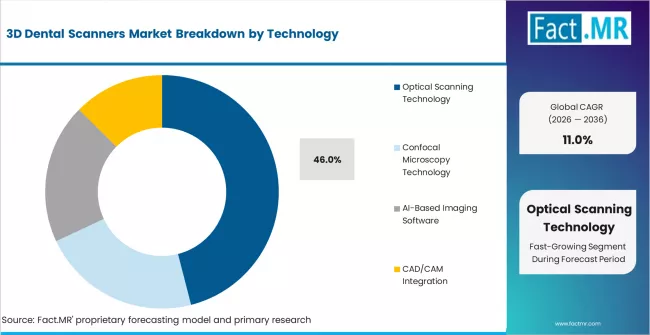
3D Dental Scanners Market Market Segmented by Technology:
- Optical Scanning Technology
- Structured Light Scanning
- Laser Triangulation Systems
- Structured Light Scanning
- Confocal Microscopy Technology
- High-Precision Optical Capture
- Depth Scanning Systems
- High-Precision Optical Capture
- AI-Based Imaging Software
- Automated Scan Processing
- Real-Time 3D Model Generation
- Automated Scan Processing
- CAD/CAM Integration
- Digital Workflow Systems
- Chairside Design & Manufacturing
- Digital Workflow Systems
- Optical Scanning Technology
-
3D Dental Scanners Market Market Segmented by Distribution Channel:
- Direct Sales
- Dental Equipment Manufacturers
- Clinic Procurement Contracts
- Dental Equipment Manufacturers
- Specialty Distributors
- Dental Equipment Suppliers
- Regional Dental Vendors
- Dental Equipment Suppliers
- Online Sales
- B2B Dental Platforms
- E-Procurement Systems
- B2B Dental Platforms
- Direct Sales
-
3D Dental Scanners Market Market Segmented by Packaging:
- Device Kits
- Scanner with Software Bundles
- Chairside Setup Kits
- Scanner with Software Bundles
- Protective Packaging
- Shock Resistant Cases
- Transport Safety Kits
- Shock Resistant Cases
- Bulk Packaging
- Laboratory Equipment Packaging
- Institutional Supply Kits
- Laboratory Equipment Packaging
- Device Kits
-
3D Dental Scanners Market Market by Region:
- North America
- USA
- Canada
- Mexico
- Latin America
- Brazil
- Chile
- Rest of Latin America
- Western Europe
- Germany
- UK
- Italy
- Spain
- France
- Nordic
- BENELUX
- Rest of Western Europe
- Eastern Europe
- Russia
- Poland
- Hungary
- Balkan & Baltic
- Rest of Eastern Europe
- East Asia
- China
- Japan
- South Korea
- South Asia and Pacific
- India
- ASEAN
- Australia & New Zealand
- Rest of South Asia and Pacific
- Middle East & Africa
- Kingdom of Saudi Arabia
- Other GCC Countries
- Turkiye
- South Africa
- Other African Union
- Rest of Middle East & Africa
- North America
- Frequently Asked Questions -
How big is the 3D dental scanners market in 2026?
The global 3D dental scanners market is estimated to be valued at USD 2.28 billion in 2026.
What will be the size of the 3D dental scanners market in 2036?
The market size is projected to reach USD 6.47 billion by 2036.
How much will the 3D dental scanners market grow between 2026 and 2036?
The market is expected to grow at an 11.0% CAGR between 2026 and 2036.
Which product segment is expected to lead the market in 2026?
Intraoral 3D scanners are expected to lead the product segment with a 49% share in 2026.
Which country is the fastest-growing market?
China is the fastest-growing country in the forecast, projected to grow at a 14.85% CAGR through 2036.
Why is India a key growth market?
India is projected to grow at a 13.75% CAGR, driven by private dental network expansion, rising clear aligner adoption, and growing implant procedure volumes.
What does the 3D dental scanners market cover?
The market covers optical and imaging devices used to digitally capture the three-dimensional geometry of teeth, gums, jaws, and related oral structures for clinical diagnostic, restorative, orthodontic, and prosthetic applications, spanning intraoral, desktop lab, CBCT-integrated, and facial and extraoral scanners.
How is the market forecast estimated and validated?
The forecast is built on a hybrid demand-side and top-down model using dental practice counts, scanner penetration rates, per-unit pricing across product tiers, replacement cycles, clear aligner case volumes, and primary interviews across dentists, orthodontists, prosthodontists, and dental lab owners.
Table of Content
- Executive Summary
- Global Market Outlook
- Demand to side Trends
- Supply to side Trends
- Technology Roadmap Analysis
- Analysis and Recommendations
- Market Overview
- Market Coverage / Taxonomy
- Market Definition / Scope / Limitations
- Research Methodology
- Chapter Orientation
- Analytical Lens and Working Hypotheses
- Market Structure, Signals, and Trend Drivers
- Benchmarking and Cross-market Comparability
- Market Sizing, Forecasting, and Opportunity Mapping
- Research Design and Evidence Framework
- Desk Research Programme (Secondary Evidence)
- Company Annual and Sustainability Reports
- Peer-reviewed Journals and Academic Literature
- Corporate Websites, Product Literature, and Technical Notes
- Earnings Decks and Investor Briefings
- Statutory Filings and Regulatory Disclosures
- Technical White Papers and Standards Notes
- Trade Journals, Industry Magazines, and Analyst Briefs
- Conference Proceedings, Webinars, and Seminar Materials
- Government Statistics Portals and Public Data Releases
- Press Releases and Reputable Media Coverage
- Specialist Newsletters and Curated Briefings
- Sector Databases and Reference Repositories
- Fact.MR Internal Proprietary Databases and Historical Market Datasets
- Subscription Datasets and Paid Sources
- Social Channels, Communities, and Digital Listening Inputs
- Additional Desk Sources
- Expert Input and Fieldwork (Primary Evidence)
- Primary Modes
- Qualitative Interviews and Expert Elicitation
- Quantitative Surveys and Structured Data Capture
- Blended Approach
- Why Primary Evidence is Used
- Field Techniques
- Interviews
- Surveys
- Focus Groups
- Observational and In-context Research
- Social and Community Interactions
- Stakeholder Universe Engaged
- C-suite Leaders
- Board Members
- Presidents and Vice Presidents
- R&D and Innovation Heads
- Technical Specialists
- Domain Subject-matter Experts
- Scientists
- Physicians and Other Healthcare Professionals
- Governance, Ethics, and Data Stewardship
- Research Ethics
- Data Integrity and Handling
- Primary Modes
- Tooling, Models, and Reference Databases
- Desk Research Programme (Secondary Evidence)
- Data Engineering and Model Build
- Data Acquisition and Ingestion
- Cleaning, Normalisation, and Verification
- Synthesis, Triangulation, and Analysis
- Quality Assurance and Audit Trail
- Market Background
- Market Dynamics
- Drivers
- Restraints
- Opportunity
- Trends
- Scenario Forecast
- Demand in Optimistic Scenario
- Demand in Likely Scenario
- Demand in Conservative Scenario
- Opportunity Map Analysis
- Product Life Cycle Analysis
- Supply Chain Analysis
- Investment Feasibility Matrix
- Value Chain Analysis
- PESTLE and Porter’s Analysis
- Regulatory Landscape
- Regional Parent Market Outlook
- Production and Consumption Statistics
- Import and Export Statistics
- Market Dynamics
- Global Market Analysis 2021 to 2025 and Forecast, 2026 to 2036
- Historical Market Size Value (USD Million) Analysis, 2021 to 2025
- Current and Future Market Size Value (USD Million) Projections, 2026 to 2036
- Y to o to Y Growth Trend Analysis
- Absolute $ Opportunity Analysis
- Global Market Pricing Analysis 2021 to 2025 and Forecast 2026 to 2036
- Global Market Analysis 2021 to 2025 and Forecast 2026 to 2036, By Product
- Introduction / Key Findings
- Historical Market Size Value (USD Million) Analysis By Product , 2021 to 2025
- Current and Future Market Size Value (USD Million) Analysis and Forecast By Product , 2026 to 2036
- Intraoral 3D Scanners
- Handheld Intraoral Scanners
- _Wireless Intraoral Scanners
- _Chairside Digital Impression Systems
- Desktop 3D Dental Scanners
- Lab-Based Model Scanners
- _High-Precision CAD/CAM Scanners
- CBCT Integrated 3D Scanners
- 3D Imaging & Scanning Systems
- _Hybrid Diagnostic Scanners
- Facial & Extraoral 3D Scanners
- Facial Mapping Systems
- _Jaw Motion Tracking Scanners
- Intraoral 3D Scanners
- Y to o to Y Growth Trend Analysis By Product , 2021 to 2025
- Absolute $ Opportunity Analysis By Product , 2026 to 2036
- Global Market Analysis 2021 to 2025 and Forecast 2026 to 2036, By Application
- Introduction / Key Findings
- Historical Market Size Value (USD Million) Analysis By Application, 2021 to 2025
- Current and Future Market Size Value (USD Million) Analysis and Forecast By Application, 2026 to 2036
- Digital Impressions
- Crown & Bridge Procedures
- _Orthodontic Aligner Planning
- Implantology
- Implant Planning & Placement
- _Surgical Guide Design
- Orthodontics
- Teeth Alignment Monitoring
- _Clear Aligner Workflow
- Prosthodontics
- Dental Restoration Design
- _Full Mouth Reconstruction
- Digital Impressions
- Y to o to Y Growth Trend Analysis By Application, 2021 to 2025
- Absolute $ Opportunity Analysis By Application, 2026 to 2036
- Global Market Analysis 2021 to 2025 and Forecast 2026 to 2036, By End Use
- Introduction / Key Findings
- Historical Market Size Value (USD Million) Analysis By End Use, 2021 to 2025
- Current and Future Market Size Value (USD Million) Analysis and Forecast By End Use, 2026 to 2036
- Dental Clinics
- Private Dental Practices
- _Multi-Specialty Clinics
- Dental Laboratories
- CAD/CAM Dental Labs
- _Prosthetic Fabrication Value (USD Million)s
- Hospitals
- Dental Departments
- _Oral Surgery Value (USD Million)s
- Academic & Research Institutes
- Dental Universities
- _Training & Simulation Centers
- Dental Clinics
- Y to o to Y Growth Trend Analysis By End Use, 2021 to 2025
- Absolute $ Opportunity Analysis By End Use, 2026 to 2036
- Global Market Analysis 2021 to 2025 and Forecast 2026 to 2036, By Technology
- Introduction / Key Findings
- Historical Market Size Value (USD Million) Analysis By Technology, 2021 to 2025
- Current and Future Market Size Value (USD Million) Analysis and Forecast By Technology, 2026 to 2036
- Optical Scanning Technology
- Structured Light Scanning
- _Laser Triangulation Systems
- Confocal Microscopy Technology
- High-Precision Optical Capture
- _Depth Scanning Systems
- AI-Based Imaging Software
- Automated Scan Processing
- _Real-Time 3D Model Generation
- CAD/CAM Integration
- Digital Workflow Systems
- _Chairside Design & Manufacturing
- Optical Scanning Technology
- Y to o to Y Growth Trend Analysis By Technology, 2021 to 2025
- Absolute $ Opportunity Analysis By Technology, 2026 to 2036
- Global Market Analysis 2021 to 2025 and Forecast 2026 to 2036, By Distribution Channel
- Introduction / Key Findings
- Historical Market Size Value (USD Million) Analysis By Distribution Channel, 2021 to 2025
- Current and Future Market Size Value (USD Million) Analysis and Forecast By Distribution Channel, 2026 to 2036
- Direct Sales
- Dental Equipment Manufacturers
- _Clinic Procurement Contracts
- Specialty Distributors
- Dental Equipment Suppliers
- _Regional Dental Vendors
- Online Sales
- B2B Dental Platforms
- _E-Procurement Systems
- Direct Sales
- Y to o to Y Growth Trend Analysis By Distribution Channel, 2021 to 2025
- Absolute $ Opportunity Analysis By Distribution Channel, 2026 to 2036
- Global Market Analysis 2021 to 2025 and Forecast 2026 to 2036, By Packaging
- Introduction / Key Findings
- Historical Market Size Value (USD Million) Analysis By Packaging, 2021 to 2025
- Current and Future Market Size Value (USD Million) Analysis and Forecast By Packaging, 2026 to 2036
- Device Kits
- Scanner with Software Bundles
- _Chairside Setup Kits
- Protective Packaging
- Shock Resistant Cases
- _Transport Safety Kits
- Bulk Packaging
- Laboratory Equipment Packaging
- _Institutional Supply Kits
- Device Kits
- Y to o to Y Growth Trend Analysis By Packaging, 2021 to 2025
- Absolute $ Opportunity Analysis By Packaging, 2026 to 2036
- Global Market Analysis 2021 to 2025 and Forecast 2026 to 2036, By Region
- Introduction
- Historical Market Size Value (USD Million) Analysis By Region, 2021 to 2025
- Current Market Size Value (USD Million) Analysis and Forecast By Region, 2026 to 2036
- North America
- Latin America
- Western Europe
- Eastern Europe
- East Asia
- South Asia and Pacific
- Middle East & Africa
- Market Attractiveness Analysis By Region
- North America Market Analysis 2021 to 2025 and Forecast 2026 to 2036, By Country
- Historical Market Size Value (USD Million) Trend Analysis By Market Taxonomy, 2021 to 2025
- Market Size Value (USD Million) Forecast By Market Taxonomy, 2026 to 2036
- By Country
- USA
- Canada
- Mexico
- By Product
- By Application
- By End Use
- By Technology
- By Distribution Channel
- By Packaging
- By Country
- Market Attractiveness Analysis
- By Country
- By Product
- By Application
- By End Use
- By Technology
- By Distribution Channel
- By Packaging
- Key Takeaways
- Latin America Market Analysis 2021 to 2025 and Forecast 2026 to 2036, By Country
- Historical Market Size Value (USD Million) Trend Analysis By Market Taxonomy, 2021 to 2025
- Market Size Value (USD Million) Forecast By Market Taxonomy, 2026 to 2036
- By Country
- Brazil
- Chile
- Rest of Latin America
- By Product
- By Application
- By End Use
- By Technology
- By Distribution Channel
- By Packaging
- By Country
- Market Attractiveness Analysis
- By Country
- By Product
- By Application
- By End Use
- By Technology
- By Distribution Channel
- By Packaging
- Key Takeaways
- Western Europe Market Analysis 2021 to 2025 and Forecast 2026 to 2036, By Country
- Historical Market Size Value (USD Million) Trend Analysis By Market Taxonomy, 2021 to 2025
- Market Size Value (USD Million) Forecast By Market Taxonomy, 2026 to 2036
- By Country
- Germany
- UK
- Italy
- Spain
- France
- Nordic
- BENELUX
- Rest of Western Europe
- By Product
- By Application
- By End Use
- By Technology
- By Distribution Channel
- By Packaging
- By Country
- Market Attractiveness Analysis
- By Country
- By Product
- By Application
- By End Use
- By Technology
- By Distribution Channel
- By Packaging
- Key Takeaways
- Eastern Europe Market Analysis 2021 to 2025 and Forecast 2026 to 2036, By Country
- Historical Market Size Value (USD Million) Trend Analysis By Market Taxonomy, 2021 to 2025
- Market Size Value (USD Million) Forecast By Market Taxonomy, 2026 to 2036
- By Country
- Russia
- Poland
- Hungary
- Balkan & Baltic
- Rest of Eastern Europe
- By Product
- By Application
- By End Use
- By Technology
- By Distribution Channel
- By Packaging
- By Country
- Market Attractiveness Analysis
- By Country
- By Product
- By Application
- By End Use
- By Technology
- By Distribution Channel
- By Packaging
- Key Takeaways
- East Asia Market Analysis 2021 to 2025 and Forecast 2026 to 2036, By Country
- Historical Market Size Value (USD Million) Trend Analysis By Market Taxonomy, 2021 to 2025
- Market Size Value (USD Million) Forecast By Market Taxonomy, 2026 to 2036
- By Country
- China
- Japan
- South Korea
- By Product
- By Application
- By End Use
- By Technology
- By Distribution Channel
- By Packaging
- By Country
- Market Attractiveness Analysis
- By Country
- By Product
- By Application
- By End Use
- By Technology
- By Distribution Channel
- By Packaging
- Key Takeaways
- South Asia and Pacific Market Analysis 2021 to 2025 and Forecast 2026 to 2036, By Country
- Historical Market Size Value (USD Million) Trend Analysis By Market Taxonomy, 2021 to 2025
- Market Size Value (USD Million) Forecast By Market Taxonomy, 2026 to 2036
- By Country
- India
- ASEAN
- Australia & New Zealand
- Rest of South Asia and Pacific
- By Product
- By Application
- By End Use
- By Technology
- By Distribution Channel
- By Packaging
- By Country
- Market Attractiveness Analysis
- By Country
- By Product
- By Application
- By End Use
- By Technology
- By Distribution Channel
- By Packaging
- Key Takeaways
- Middle East & Africa Market Analysis 2021 to 2025 and Forecast 2026 to 2036, By Country
- Historical Market Size Value (USD Million) Trend Analysis By Market Taxonomy, 2021 to 2025
- Market Size Value (USD Million) Forecast By Market Taxonomy, 2026 to 2036
- By Country
- Kingdom of Saudi Arabia
- Other GCC Countries
- Turkiye
- South Africa
- Other African Union
- Rest of Middle East & Africa
- By Product
- By Application
- By End Use
- By Technology
- By Distribution Channel
- By Packaging
- By Country
- Market Attractiveness Analysis
- By Country
- By Product
- By Application
- By End Use
- By Technology
- By Distribution Channel
- By Packaging
- Key Takeaways
- Key Countries Market Analysis
- USA
- Pricing Analysis
- Market Share Analysis, 2025
- By Product
- By Application
- By End Use
- By Technology
- By Distribution Channel
- By Packaging
- Canada
- Pricing Analysis
- Market Share Analysis, 2025
- By Product
- By Application
- By End Use
- By Technology
- By Distribution Channel
- By Packaging
- Mexico
- Pricing Analysis
- Market Share Analysis, 2025
- By Product
- By Application
- By End Use
- By Technology
- By Distribution Channel
- By Packaging
- Brazil
- Pricing Analysis
- Market Share Analysis, 2025
- By Product
- By Application
- By End Use
- By Technology
- By Distribution Channel
- By Packaging
- Chile
- Pricing Analysis
- Market Share Analysis, 2025
- By Product
- By Application
- By End Use
- By Technology
- By Distribution Channel
- By Packaging
- Germany
- Pricing Analysis
- Market Share Analysis, 2025
- By Product
- By Application
- By End Use
- By Technology
- By Distribution Channel
- By Packaging
- UK
- Pricing Analysis
- Market Share Analysis, 2025
- By Product
- By Application
- By End Use
- By Technology
- By Distribution Channel
- By Packaging
- Italy
- Pricing Analysis
- Market Share Analysis, 2025
- By Product
- By Application
- By End Use
- By Technology
- By Distribution Channel
- By Packaging
- Spain
- Pricing Analysis
- Market Share Analysis, 2025
- By Product
- By Application
- By End Use
- By Technology
- By Distribution Channel
- By Packaging
- France
- Pricing Analysis
- Market Share Analysis, 2025
- By Product
- By Application
- By End Use
- By Technology
- By Distribution Channel
- By Packaging
- India
- Pricing Analysis
- Market Share Analysis, 2025
- By Product
- By Application
- By End Use
- By Technology
- By Distribution Channel
- By Packaging
- ASEAN
- Pricing Analysis
- Market Share Analysis, 2025
- By Product
- By Application
- By End Use
- By Technology
- By Distribution Channel
- By Packaging
- Australia & New Zealand
- Pricing Analysis
- Market Share Analysis, 2025
- By Product
- By Application
- By End Use
- By Technology
- By Distribution Channel
- By Packaging
- China
- Pricing Analysis
- Market Share Analysis, 2025
- By Product
- By Application
- By End Use
- By Technology
- By Distribution Channel
- By Packaging
- Japan
- Pricing Analysis
- Market Share Analysis, 2025
- By Product
- By Application
- By End Use
- By Technology
- By Distribution Channel
- By Packaging
- South Korea
- Pricing Analysis
- Market Share Analysis, 2025
- By Product
- By Application
- By End Use
- By Technology
- By Distribution Channel
- By Packaging
- Russia
- Pricing Analysis
- Market Share Analysis, 2025
- By Product
- By Application
- By End Use
- By Technology
- By Distribution Channel
- By Packaging
- Poland
- Pricing Analysis
- Market Share Analysis, 2025
- By Product
- By Application
- By End Use
- By Technology
- By Distribution Channel
- By Packaging
- Hungary
- Pricing Analysis
- Market Share Analysis, 2025
- By Product
- By Application
- By End Use
- By Technology
- By Distribution Channel
- By Packaging
- Kingdom of Saudi Arabia
- Pricing Analysis
- Market Share Analysis, 2025
- By Product
- By Application
- By End Use
- By Technology
- By Distribution Channel
- By Packaging
- Turkiye
- Pricing Analysis
- Market Share Analysis, 2025
- By Product
- By Application
- By End Use
- By Technology
- By Distribution Channel
- By Packaging
- South Africa
- Pricing Analysis
- Market Share Analysis, 2025
- By Product
- By Application
- By End Use
- By Technology
- By Distribution Channel
- By Packaging
- USA
- Market Structure Analysis
- Competition Dashboard
- Competition Benchmarking
- Market Share Analysis of Top Players
- By Regional
- By Product
- By Application
- By End Use
- By Technology
- By Distribution Channel
- By Packaging
- Competition Analysis
- Competition Deep Dive
- Align Technology Inc.
- Overview
- Product Portfolio
- Profitability by Market Segments (Product/Age /Sales Channel/Region)
- Sales Footprint
- Strategy Overview
- Marketing Strategy
- Product Strategy
- Channel Strategy
- 3Shape AS
- Carestream Dental LLC
- DENTSPLY SIRONA Inc.
- Condor Technologies NV
- Densys
- 3M
- AGE Solutions Srl
- Amann Girrbach AG
- Aniwaa Pte. Ltd.
- Hexagon AB
- KaVo Dental GmbH
- Medit Corp.
- Align Technology Inc.
- Competition Deep Dive
- Assumptions & Acronyms Used
List Of Table
- Table 1: Global Market Value (USD Million) Forecast by Region, 2021 to 2036
- Table 2: Global Market Value (USD Million) Forecast by Product , 2021 to 2036
- Table 3: Global Market Value (USD Million) Forecast by Application, 2021 to 2036
- Table 4: Global Market Value (USD Million) Forecast by End Use, 2021 to 2036
- Table 5: Global Market Value (USD Million) Forecast by Technology, 2021 to 2036
- Table 6: Global Market Value (USD Million) Forecast by Distribution Channel, 2021 to 2036
- Table 7: Global Market Value (USD Million) Forecast by Packaging, 2021 to 2036
- Table 8: North America Market Value (USD Million) Forecast by Country, 2021 to 2036
- Table 9: North America Market Value (USD Million) Forecast by Product , 2021 to 2036
- Table 10: North America Market Value (USD Million) Forecast by Application, 2021 to 2036
- Table 11: North America Market Value (USD Million) Forecast by End Use, 2021 to 2036
- Table 12: North America Market Value (USD Million) Forecast by Technology, 2021 to 2036
- Table 13: North America Market Value (USD Million) Forecast by Distribution Channel, 2021 to 2036
- Table 14: North America Market Value (USD Million) Forecast by Packaging, 2021 to 2036
- Table 15: Latin America Market Value (USD Million) Forecast by Country, 2021 to 2036
- Table 16: Latin America Market Value (USD Million) Forecast by Product , 2021 to 2036
- Table 17: Latin America Market Value (USD Million) Forecast by Application, 2021 to 2036
- Table 18: Latin America Market Value (USD Million) Forecast by End Use, 2021 to 2036
- Table 19: Latin America Market Value (USD Million) Forecast by Technology, 2021 to 2036
- Table 20: Latin America Market Value (USD Million) Forecast by Distribution Channel, 2021 to 2036
- Table 21: Latin America Market Value (USD Million) Forecast by Packaging, 2021 to 2036
- Table 22: Western Europe Market Value (USD Million) Forecast by Country, 2021 to 2036
- Table 23: Western Europe Market Value (USD Million) Forecast by Product , 2021 to 2036
- Table 24: Western Europe Market Value (USD Million) Forecast by Application, 2021 to 2036
- Table 25: Western Europe Market Value (USD Million) Forecast by End Use, 2021 to 2036
- Table 26: Western Europe Market Value (USD Million) Forecast by Technology, 2021 to 2036
- Table 27: Western Europe Market Value (USD Million) Forecast by Distribution Channel, 2021 to 2036
- Table 28: Western Europe Market Value (USD Million) Forecast by Packaging, 2021 to 2036
- Table 29: Eastern Europe Market Value (USD Million) Forecast by Country, 2021 to 2036
- Table 30: Eastern Europe Market Value (USD Million) Forecast by Product , 2021 to 2036
- Table 31: Eastern Europe Market Value (USD Million) Forecast by Application, 2021 to 2036
- Table 32: Eastern Europe Market Value (USD Million) Forecast by End Use, 2021 to 2036
- Table 33: Eastern Europe Market Value (USD Million) Forecast by Technology, 2021 to 2036
- Table 34: Eastern Europe Market Value (USD Million) Forecast by Distribution Channel, 2021 to 2036
- Table 35: Eastern Europe Market Value (USD Million) Forecast by Packaging, 2021 to 2036
- Table 36: East Asia Market Value (USD Million) Forecast by Country, 2021 to 2036
- Table 37: East Asia Market Value (USD Million) Forecast by Product , 2021 to 2036
- Table 38: East Asia Market Value (USD Million) Forecast by Application, 2021 to 2036
- Table 39: East Asia Market Value (USD Million) Forecast by End Use, 2021 to 2036
- Table 40: East Asia Market Value (USD Million) Forecast by Technology, 2021 to 2036
- Table 41: East Asia Market Value (USD Million) Forecast by Distribution Channel, 2021 to 2036
- Table 42: East Asia Market Value (USD Million) Forecast by Packaging, 2021 to 2036
- Table 43: South Asia and Pacific Market Value (USD Million) Forecast by Country, 2021 to 2036
- Table 44: South Asia and Pacific Market Value (USD Million) Forecast by Product , 2021 to 2036
- Table 45: South Asia and Pacific Market Value (USD Million) Forecast by Application, 2021 to 2036
- Table 46: South Asia and Pacific Market Value (USD Million) Forecast by End Use, 2021 to 2036
- Table 47: South Asia and Pacific Market Value (USD Million) Forecast by Technology, 2021 to 2036
- Table 48: South Asia and Pacific Market Value (USD Million) Forecast by Distribution Channel, 2021 to 2036
- Table 49: South Asia and Pacific Market Value (USD Million) Forecast by Packaging, 2021 to 2036
- Table 50: Middle East & Africa Market Value (USD Million) Forecast by Country, 2021 to 2036
- Table 51: Middle East & Africa Market Value (USD Million) Forecast by Product , 2021 to 2036
- Table 52: Middle East & Africa Market Value (USD Million) Forecast by Application, 2021 to 2036
- Table 53: Middle East & Africa Market Value (USD Million) Forecast by End Use, 2021 to 2036
- Table 54: Middle East & Africa Market Value (USD Million) Forecast by Technology, 2021 to 2036
- Table 55: Middle East & Africa Market Value (USD Million) Forecast by Distribution Channel, 2021 to 2036
- Table 56: Middle East & Africa Market Value (USD Million) Forecast by Packaging, 2021 to 2036
List Of Figures
- Figure 1: Global Market Pricing Analysis
- Figure 2: Global Market Value (USD Million) Forecast 2021-2036
- Figure 3: Global Market Value Share and BPS Analysis by Product, 2026 and 2036
- Figure 4: Global Market Y-o-Y Growth Comparison by Product, 2026 to 2036
- Figure 5: Global Market Attractiveness Analysis by Product
- Figure 6: Global Market Value Share and BPS Analysis by Application, 2026 and 2036
- Figure 7: Global Market Y-o-Y Growth Comparison by Application, 2026 to 2036
- Figure 8: Global Market Attractiveness Analysis by Application
- Figure 9: Global Market Value Share and BPS Analysis by End Use, 2026 and 2036
- Figure 10: Global Market Y-o-Y Growth Comparison by End Use, 2026 to 2036
- Figure 11: Global Market Attractiveness Analysis by End Use
- Figure 12: Global Market Value Share and BPS Analysis by Technology, 2026 and 2036
- Figure 13: Global Market Y-o-Y Growth Comparison by Technology, 2026 to 2036
- Figure 14: Global Market Attractiveness Analysis by Technology
- Figure 15: Global Market Value Share and BPS Analysis by Distribution Channel, 2026 and 2036
- Figure 16: Global Market Y-o-Y Growth Comparison by Distribution Channel, 2026 to 2036
- Figure 17: Global Market Attractiveness Analysis by Distribution Channel
- Figure 18: Global Market Value Share and BPS Analysis by Packaging, 2026 and 2036
- Figure 19: Global Market Y-o-Y Growth Comparison by Packaging, 2026 to 2036
- Figure 20: Global Market Attractiveness Analysis by Packaging
- Figure 21: Global Market Value (USD Million) Share and BPS Analysis by Region, 2026 and 2036
- Figure 22: Global Market Y-o-Y Growth Comparison by Region, 2026 to 2036
- Figure 23: Global Market Attractiveness Analysis by Region
- Figure 24: North America Market Incremental Dollar Opportunity, 2026 to 2036
- Figure 25: Latin America Market Incremental Dollar Opportunity, 2026 to 2036
- Figure 26: Western Europe Market Incremental Dollar Opportunity, 2026 to 2036
- Figure 27: Eastern Europe Market Incremental Dollar Opportunity, 2026 to 2036
- Figure 28: East Asia Market Incremental Dollar Opportunity, 2026 to 2036
- Figure 29: South Asia and Pacific Market Incremental Dollar Opportunity, 2026 to 2036
- Figure 30: Middle East & Africa Market Incremental Dollar Opportunity, 2026 to 2036
- Figure 31: North America Market Value Share and BPS Analysis by Country, 2026 and 2036
- Figure 32: North America Market Value Share and BPS Analysis by Product, 2026 and 2036
- Figure 33: North America Market Y-o-Y Growth Comparison by Product, 2026 to 2036
- Figure 34: North America Market Attractiveness Analysis by Product
- Figure 35: North America Market Value Share and BPS Analysis by Application, 2026 and 2036
- Figure 36: North America Market Y-o-Y Growth Comparison by Application, 2026 to 2036
- Figure 37: North America Market Attractiveness Analysis by Application
- Figure 38: North America Market Value Share and BPS Analysis by End Use, 2026 and 2036
- Figure 39: North America Market Y-o-Y Growth Comparison by End Use, 2026 to 2036
- Figure 40: North America Market Attractiveness Analysis by End Use
- Figure 41: North America Market Value Share and BPS Analysis by Technology, 2026 and 2036
- Figure 42: North America Market Y-o-Y Growth Comparison by Technology, 2026 to 2036
- Figure 43: North America Market Attractiveness Analysis by Technology
- Figure 44: North America Market Value Share and BPS Analysis by Distribution Channel, 2026 and 2036
- Figure 45: North America Market Y-o-Y Growth Comparison by Distribution Channel, 2026 to 2036
- Figure 46: North America Market Attractiveness Analysis by Distribution Channel
- Figure 47: North America Market Value Share and BPS Analysis by Packaging, 2026 and 2036
- Figure 48: North America Market Y-o-Y Growth Comparison by Packaging, 2026 to 2036
- Figure 49: North America Market Attractiveness Analysis by Packaging
- Figure 50: Latin America Market Value Share and BPS Analysis by Country, 2026 and 2036
- Figure 51: Latin America Market Value Share and BPS Analysis by Product, 2026 and 2036
- Figure 52: Latin America Market Y-o-Y Growth Comparison by Product, 2026 to 2036
- Figure 53: Latin America Market Attractiveness Analysis by Product
- Figure 54: Latin America Market Value Share and BPS Analysis by Application, 2026 and 2036
- Figure 55: Latin America Market Y-o-Y Growth Comparison by Application, 2026 to 2036
- Figure 56: Latin America Market Attractiveness Analysis by Application
- Figure 57: Latin America Market Value Share and BPS Analysis by End Use, 2026 and 2036
- Figure 58: Latin America Market Y-o-Y Growth Comparison by End Use, 2026 to 2036
- Figure 59: Latin America Market Attractiveness Analysis by End Use
- Figure 60: Latin America Market Value Share and BPS Analysis by Technology, 2026 and 2036
- Figure 61: Latin America Market Y-o-Y Growth Comparison by Technology, 2026 to 2036
- Figure 62: Latin America Market Attractiveness Analysis by Technology
- Figure 63: Latin America Market Value Share and BPS Analysis by Distribution Channel, 2026 and 2036
- Figure 64: Latin America Market Y-o-Y Growth Comparison by Distribution Channel, 2026 to 2036
- Figure 65: Latin America Market Attractiveness Analysis by Distribution Channel
- Figure 66: Latin America Market Value Share and BPS Analysis by Packaging, 2026 and 2036
- Figure 67: Latin America Market Y-o-Y Growth Comparison by Packaging, 2026 to 2036
- Figure 68: Latin America Market Attractiveness Analysis by Packaging
- Figure 69: Western Europe Market Value Share and BPS Analysis by Country, 2026 and 2036
- Figure 70: Western Europe Market Value Share and BPS Analysis by Product, 2026 and 2036
- Figure 71: Western Europe Market Y-o-Y Growth Comparison by Product, 2026 to 2036
- Figure 72: Western Europe Market Attractiveness Analysis by Product
- Figure 73: Western Europe Market Value Share and BPS Analysis by Application, 2026 and 2036
- Figure 74: Western Europe Market Y-o-Y Growth Comparison by Application, 2026 to 2036
- Figure 75: Western Europe Market Attractiveness Analysis by Application
- Figure 76: Western Europe Market Value Share and BPS Analysis by End Use, 2026 and 2036
- Figure 77: Western Europe Market Y-o-Y Growth Comparison by End Use, 2026 to 2036
- Figure 78: Western Europe Market Attractiveness Analysis by End Use
- Figure 79: Western Europe Market Value Share and BPS Analysis by Technology, 2026 and 2036
- Figure 80: Western Europe Market Y-o-Y Growth Comparison by Technology, 2026 to 2036
- Figure 81: Western Europe Market Attractiveness Analysis by Technology
- Figure 82: Western Europe Market Value Share and BPS Analysis by Distribution Channel, 2026 and 2036
- Figure 83: Western Europe Market Y-o-Y Growth Comparison by Distribution Channel, 2026 to 2036
- Figure 84: Western Europe Market Attractiveness Analysis by Distribution Channel
- Figure 85: Western Europe Market Value Share and BPS Analysis by Packaging, 2026 and 2036
- Figure 86: Western Europe Market Y-o-Y Growth Comparison by Packaging, 2026 to 2036
- Figure 87: Western Europe Market Attractiveness Analysis by Packaging
- Figure 88: Eastern Europe Market Value Share and BPS Analysis by Country, 2026 and 2036
- Figure 89: Eastern Europe Market Value Share and BPS Analysis by Product, 2026 and 2036
- Figure 90: Eastern Europe Market Y-o-Y Growth Comparison by Product, 2026 to 2036
- Figure 91: Eastern Europe Market Attractiveness Analysis by Product
- Figure 92: Eastern Europe Market Value Share and BPS Analysis by Application, 2026 and 2036
- Figure 93: Eastern Europe Market Y-o-Y Growth Comparison by Application, 2026 to 2036
- Figure 94: Eastern Europe Market Attractiveness Analysis by Application
- Figure 95: Eastern Europe Market Value Share and BPS Analysis by End Use, 2026 and 2036
- Figure 96: Eastern Europe Market Y-o-Y Growth Comparison by End Use, 2026 to 2036
- Figure 97: Eastern Europe Market Attractiveness Analysis by End Use
- Figure 98: Eastern Europe Market Value Share and BPS Analysis by Technology, 2026 and 2036
- Figure 99: Eastern Europe Market Y-o-Y Growth Comparison by Technology, 2026 to 2036
- Figure 100: Eastern Europe Market Attractiveness Analysis by Technology
- Figure 101: Eastern Europe Market Value Share and BPS Analysis by Distribution Channel, 2026 and 2036
- Figure 102: Eastern Europe Market Y-o-Y Growth Comparison by Distribution Channel, 2026 to 2036
- Figure 103: Eastern Europe Market Attractiveness Analysis by Distribution Channel
- Figure 104: Eastern Europe Market Value Share and BPS Analysis by Packaging, 2026 and 2036
- Figure 105: Eastern Europe Market Y-o-Y Growth Comparison by Packaging, 2026 to 2036
- Figure 106: Eastern Europe Market Attractiveness Analysis by Packaging
- Figure 107: East Asia Market Value Share and BPS Analysis by Country, 2026 and 2036
- Figure 108: East Asia Market Value Share and BPS Analysis by Product, 2026 and 2036
- Figure 109: East Asia Market Y-o-Y Growth Comparison by Product, 2026 to 2036
- Figure 110: East Asia Market Attractiveness Analysis by Product
- Figure 111: East Asia Market Value Share and BPS Analysis by Application, 2026 and 2036
- Figure 112: East Asia Market Y-o-Y Growth Comparison by Application, 2026 to 2036
- Figure 113: East Asia Market Attractiveness Analysis by Application
- Figure 114: East Asia Market Value Share and BPS Analysis by End Use, 2026 and 2036
- Figure 115: East Asia Market Y-o-Y Growth Comparison by End Use, 2026 to 2036
- Figure 116: East Asia Market Attractiveness Analysis by End Use
- Figure 117: East Asia Market Value Share and BPS Analysis by Technology, 2026 and 2036
- Figure 118: East Asia Market Y-o-Y Growth Comparison by Technology, 2026 to 2036
- Figure 119: East Asia Market Attractiveness Analysis by Technology
- Figure 120: East Asia Market Value Share and BPS Analysis by Distribution Channel, 2026 and 2036
- Figure 121: East Asia Market Y-o-Y Growth Comparison by Distribution Channel, 2026 to 2036
- Figure 122: East Asia Market Attractiveness Analysis by Distribution Channel
- Figure 123: East Asia Market Value Share and BPS Analysis by Packaging, 2026 and 2036
- Figure 124: East Asia Market Y-o-Y Growth Comparison by Packaging, 2026 to 2036
- Figure 125: East Asia Market Attractiveness Analysis by Packaging
- Figure 126: South Asia and Pacific Market Value Share and BPS Analysis by Country, 2026 and 2036
- Figure 127: South Asia and Pacific Market Value Share and BPS Analysis by Product, 2026 and 2036
- Figure 128: South Asia and Pacific Market Y-o-Y Growth Comparison by Product, 2026 to 2036
- Figure 129: South Asia and Pacific Market Attractiveness Analysis by Product
- Figure 130: South Asia and Pacific Market Value Share and BPS Analysis by Application, 2026 and 2036
- Figure 131: South Asia and Pacific Market Y-o-Y Growth Comparison by Application, 2026 to 2036
- Figure 132: South Asia and Pacific Market Attractiveness Analysis by Application
- Figure 133: South Asia and Pacific Market Value Share and BPS Analysis by End Use, 2026 and 2036
- Figure 134: South Asia and Pacific Market Y-o-Y Growth Comparison by End Use, 2026 to 2036
- Figure 135: South Asia and Pacific Market Attractiveness Analysis by End Use
- Figure 136: South Asia and Pacific Market Value Share and BPS Analysis by Technology, 2026 and 2036
- Figure 137: South Asia and Pacific Market Y-o-Y Growth Comparison by Technology, 2026 to 2036
- Figure 138: South Asia and Pacific Market Attractiveness Analysis by Technology
- Figure 139: South Asia and Pacific Market Value Share and BPS Analysis by Distribution Channel, 2026 and 2036
- Figure 140: South Asia and Pacific Market Y-o-Y Growth Comparison by Distribution Channel, 2026 to 2036
- Figure 141: South Asia and Pacific Market Attractiveness Analysis by Distribution Channel
- Figure 142: South Asia and Pacific Market Value Share and BPS Analysis by Packaging, 2026 and 2036
- Figure 143: South Asia and Pacific Market Y-o-Y Growth Comparison by Packaging, 2026 to 2036
- Figure 144: South Asia and Pacific Market Attractiveness Analysis by Packaging
- Figure 145: Middle East & Africa Market Value Share and BPS Analysis by Country, 2026 and 2036
- Figure 146: Middle East & Africa Market Value Share and BPS Analysis by Product, 2026 and 2036
- Figure 147: Middle East & Africa Market Y-o-Y Growth Comparison by Product, 2026 to 2036
- Figure 148: Middle East & Africa Market Attractiveness Analysis by Product
- Figure 149: Middle East & Africa Market Value Share and BPS Analysis by Application, 2026 and 2036
- Figure 150: Middle East & Africa Market Y-o-Y Growth Comparison by Application, 2026 to 2036
- Figure 151: Middle East & Africa Market Attractiveness Analysis by Application
- Figure 152: Middle East & Africa Market Value Share and BPS Analysis by End Use, 2026 and 2036
- Figure 153: Middle East & Africa Market Y-o-Y Growth Comparison by End Use, 2026 to 2036
- Figure 154: Middle East & Africa Market Attractiveness Analysis by End Use
- Figure 155: Middle East & Africa Market Value Share and BPS Analysis by Technology, 2026 and 2036
- Figure 156: Middle East & Africa Market Y-o-Y Growth Comparison by Technology, 2026 to 2036
- Figure 157: Middle East & Africa Market Attractiveness Analysis by Technology
- Figure 158: Middle East & Africa Market Value Share and BPS Analysis by Distribution Channel, 2026 and 2036
- Figure 159: Middle East & Africa Market Y-o-Y Growth Comparison by Distribution Channel, 2026 to 2036
- Figure 160: Middle East & Africa Market Attractiveness Analysis by Distribution Channel
- Figure 161: Middle East & Africa Market Value Share and BPS Analysis by Packaging, 2026 and 2036
- Figure 162: Middle East & Africa Market Y-o-Y Growth Comparison by Packaging, 2026 to 2036
- Figure 163: Middle East & Africa Market Attractiveness Analysis by Packaging
- Figure 164: Global Market - Tier Structure Analysis
- Figure 165: Global Market - Company Share Analysis