- Base Value(2025): 530 Mn
- Estimated Value(2026): 716 Mn
- Forecast Value (2036): 10140 Mn
- CAGR (2026 - 2036): 30.4%
3D-Printed Food Market Size, Market Forecast and Outlook By Fact.MR
In 2025, the 3D-Printed Food market was valued at USD 530 million. Based on Fact MR analysis, demand for 3D-printed food products is estimated to grow to USD 716 million in 2026 and USD 10,140 million by 2036. FMR projects a CAGR of 30.4% during the forecast period.
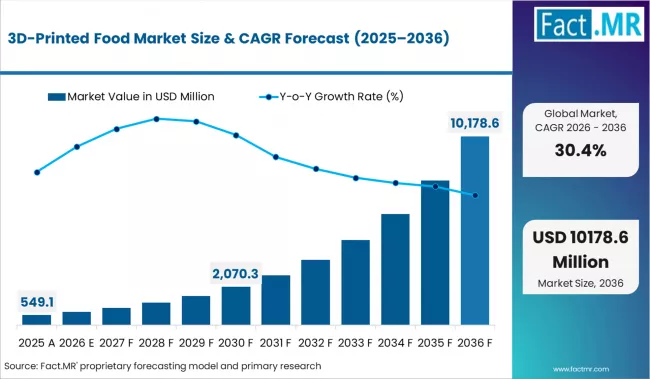
3d Printed Food Market Market Value Analysis | Source: Fact.MR
Summary of 3D-Printed Food Market
- Market Definition
- The market includes food products manufactured using additive manufacturing processes that deposit edible materials layer by layer to create structured shapes, textures, and portion-controlled formulations. Printable materials include chocolate, dough, carbohydrate gels, protein pastes, dairy formulations, and alternative protein matrices. These technologies enable controlled ingredient distribution, customized geometry, and reproducible food design suitable for commercial foodservice, healthcare nutrition, and specialty food production environments.
- Demand Drivers
- Increasing demand for customized nutrition solutions with controlled ingredient composition and portion precision
- Expansion of digital food fabrication technologies supporting structured design and repeatable production formats
- Rising application in healthcare nutrition for texture modified foods and controlled nutrient delivery systems
- Growth in premium foodservice environments adopting automated plating and geometric food presentation techniques
- Key Segments Analyzed
- Technology Type: Extrusion based printing accounts for approximately 46% share due to compatibility with semi-solid edible materials
- End User: Commercial foodservice represents nearly 51% share supported by adoption across restaurants and hospitality kitchens
- Application: Bakery, confectionery, and customized nutrition foods demonstrate relatively high deployment of additive manufacturing methods
- Geography: Asia Pacific shows relatively higher growth supported by investment in automated food production technologies
- Analyst Opinion at Fact MR
- Shambhu Nath Jha, Principal Consultant, Fact MR, opines, "In this updated edition of the 3D-Printed Food Market report, industry participants will observe increased commercialization of additive manufacturing technologies supporting customized nutrition and structured food design. Extrusion based printing systems enable controlled deposition of edible materials for precision shaping and portion management. Companies that strengthen printable ingredient formulation capabilities and improve production throughput efficiency are expected to maintain competitive positioning through 2036."
- Strategic Implications Executive Takeaways
- Expand printable ingredient formulation development supporting stable viscosity and structural integrity across layered food constructs
- Strengthen digital workflow integration enabling design customization and repeatable geometry production
- Improve equipment throughput performance supporting commercial scalability across foodservice environments
- Monitor regulatory classification frameworks influencing commercialization of additive manufactured food products
- Methodology
- Primary interviews conducted with food technology developers, ingredient formulation specialists, research institutions, and commercial kitchen operators
- Desk research based on food engineering publications, additive manufacturing datasets, company reports, and technology commercialization studies
- Market sizing derived using a hybrid approach combining bottom up production analysis with top down demand assessment across digital food manufacturing applications
- Data validation performed through cross verification with food technology datasets and internal peer review aligned with Fact MR standards
3D-Printed Food Market
| Metric | Details |
|---|---|
| Industry Size (2026E) | USD 716 million |
| Industry Value (2036F) | USD 10,140 million |
| CAGR (2026 to 2036) | 30.4% |
Source: Fact.MR analysis. Updated Mar 27, 2026
An increase of USD 9,424 million indicates highly transformational expansion, reflecting rapid commercialization of digital food fabrication across personalized nutrition, healthcare diets, and premium culinary applications. Growth is supported by advances in printable ingredient formulations and customization capabilities, while structural constraints persist due to high equipment costs, limited production speed, regulatory classification complexity, and consumer acceptance variability related to perceived processing novelty.
China leads with a projected CAGR of 32.5%, supported by rapid adoption of automated food fabrication technologies across customized nutrition and institutional catering applications. The United States follows with a CAGR of 29.8%, driven by increasing integration of digital food production systems across foodservice innovation programs. Japan records a CAGR of 28.4%, reflecting strong development of precision portion design technologies for healthcare and elderly nutrition applications. Germany shows a CAGR of 27.6%, supported by growing use of additive manufacturing methods across specialty confectionery and functional food categories. The United Kingdom records the slowest growth at 26.9%, reflecting a relatively mature innovation environment where adoption is linked to gradual commercialization cycles. Mature markets generate a significant share of replacement demand as equipment upgrades and material compatibility improvements shape adoption of structured food printing technologies across specialized production environments.
Segmental Analysis
3D-Printed Food Market Analysis by End User
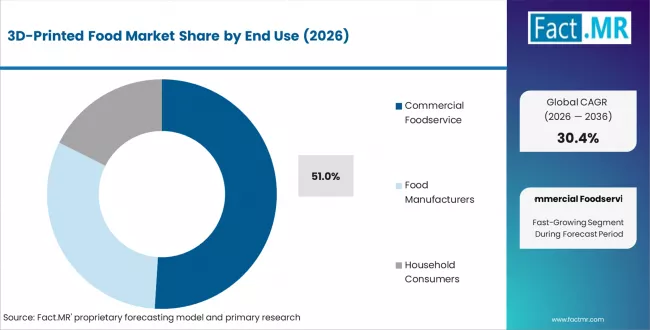
3d Printed Food Market Analysis By End Use | Source: Fact.MR
- Market Overview: Based on Fact MR assessment, commercial foodservice is projected to account for 51% share of the 3D-printed food market in 2026. Deployment of additive food manufacturing systems is concentrated across restaurants, specialty dessert outlets, catering services, and hospitality kitchens requiring customized food structure formation. Foodservice operators utilize programmable food printing systems to produce geometrically complex shapes using chocolate, dough, purees, and protein-based printable pastes. Demand is supported by requirement for portion control precision, repeatable design patterns, and standardized plating aesthetics aligned with structured menu presentation formats across premium dining environments.
- Demand Drivers:
- Customization Capability: Commercial kitchens utilize digital food design templates enabling controlled portion geometry and uniform product appearance across repeated production cycles.
- Operational Efficiency Requirements: Automated extrusion systems support reduction of manual shaping time associated with decorative food preparation tasks across bakery and dessert applications.
- Menu Differentiation Strategy: Foodservice operators incorporate printed edible structures enabling standardized presentation formats supporting themed dining experiences and event catering services.
3D-Printed Food Market Analysis by Technology Type
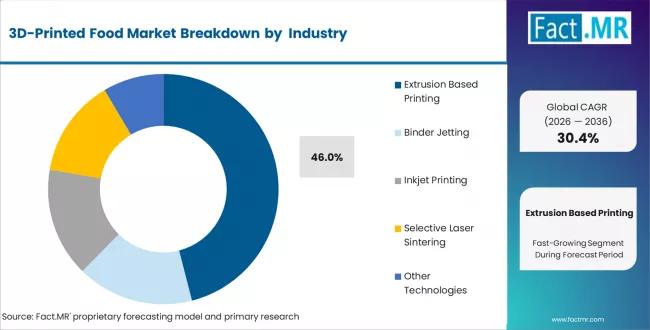
3d Printed Food Market Analysis By Technology Type | Source: Fact.MR
- Market Overview: Extrusion-based printing technology is estimated to hold 46% share of the 3D-printed food market in 2026, supported by compatibility with viscous edible materials including chocolate pastes, dough formulations, vegetable purees, and protein gels. Layer-by-layer deposition enables structured shaping of semi-solid food materials through controlled nozzle movement guided by digital design software. Extrusion systems are configured for temperature control and viscosity management enabling stable deposition across multi-layer food constructs requiring dimensional accuracy and shape retention.
- Demand Drivers:
- Material Handling Compatibility: Extrusion printing systems process shear-sensitive edible pastes enabling controlled layer formation across printable food matrices.
- Process Repeatability: Digital control of deposition parameters supports consistent geometry output across batch production cycles used in bakery and confectionery applications.
- Equipment Adaptability: Extrusion-based food printers support integration into commercial kitchen workflows requiring compact equipment footprint and programmable recipe settings.
Key Dynamics
3D-Printed Food Market Drivers, Restraints, and Opportunities
Fact MR analysis indicates that the 3D-printed food market developed from additive manufacturing technologies adapted for controlled deposition of edible materials. Early experimentation focused on extrusion-based printing of chocolate, dough, and sugar pastes where programmable design enabled customized shapes and portion control. The current market valuation reflects growing use in research kitchens, specialized food service applications, and nutrition-focused product development where formulation precision is required. Demand persists because 3D food printing allows structured layering of ingredients to create customized textures, shapes, and portion-specific nutritional profiles.
A structural shift is occurring as conventional food manufacturing processes compete with digitally controlled production systems that prioritize customization rather than high-volume output. Traditional mass-produced foods remain dominant due to lower production costs and established processing infrastructure. 3D-printed food requires specialized printers, ingredient cartridges, and formulation adjustments to ensure print stability and texture consistency. These systems involve higher production costs and slower output rates compared with conventional processing methods. Even with limited production volumes, higher pricing associated with customized food structures supports gradual market value expansion.
- Customized Nutrition Design: Food developers use 3D printing systems to produce personalized food structures with controlled ingredient distribution and portion composition.
- Food Technology Regulation: Standards such as European Food Safety Authority novel food regulation and U.S. Food and Drug Administration food processing guidelines influence approval pathways.
- Europe Research Adoption: The Netherlands, Germany, and Spain maintain active research programs exploring additive manufacturing technologies for food production applications.
Regional Analysis
The 3D-printed food market is assessed across North America, Europe, Asia Pacific, Latin America, and Middle East & Africa, segmented by country-level adoption of additive food manufacturing, customized nutrition solutions, and automated food production technologies. Regional demand reflects food innovation investment, research commercialization, and advanced culinary processing applications. The full report offers market attractiveness analysis.
.webp "Top Country Growth Comparison 3d Printed Food Market Cagr (2026 2036)")
Top Country Growth Comparison 3d Printed Food Market Cagr (2026 2036) | Source: Fact.MR
| Country | CAGR (2026-2036) |
|---|---|
| China | 32.5% |
| United States | 29.8% |
| Germany | 27.6% |
| Japan | 28.4% |
| United Kingdom | 26.9% |
Source: Fact.MR analysis. Updated Mar 27, 2026
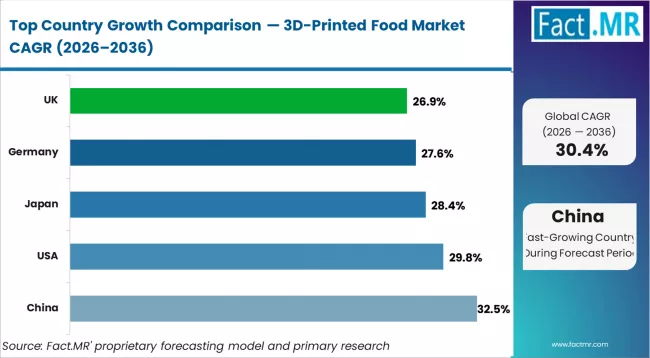
3d Printed Food Market Cagr Analysis By Country | Source: Fact.MR
Source: Fact MR analysis, based on proprietary forecasting model and primary research
North America
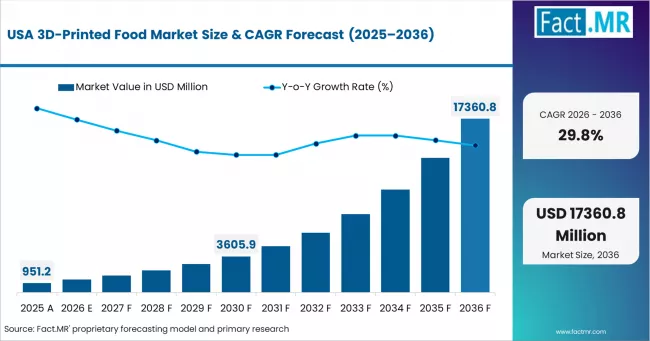
3d Printed Food Market Country Value Analysis | Source: Fact.MR
North America functions as the additive food manufacturing innovation and research commercialization hub, supported by strong investment in food technology and automated production systems. 3D Systems Corporation supports additive manufacturing solutions for food applications. Stratasys Ltd. strengthens precision printing technologies. Natural Machines expands commercial food printer deployment.
- United States: Demand for 3D-printed food in United States is projected to rise at 29.8% CAGR through 2036. Growth is supported by FDA food manufacturing technology frameworks (updated 2022), guiding additive food processing methods. 3D Systems Corporation expanded additive manufacturing capabilities for food production (March 2023), supporting market expansion.
Europe
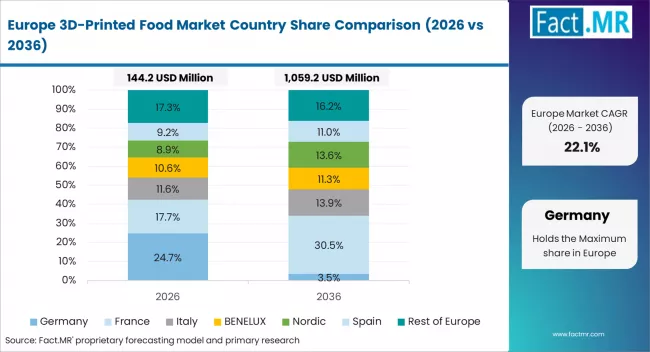
3d Printed Food Market Europe Country Market Share Analysis, 2026 & 2036 | Source: Fact.MR
Europe operates as the research-driven food technology and advanced manufacturing base, shaped by strong academic collaboration and structured food safety standards. Natural Machines leads in commercial food printer development. byFlow expands customized food production technologies. BASF SE supports ingredient material innovation.
- Germany: Demand for 3D-printed food in Germany is projected to rise at 27.6% CAGR through 2036. EU food innovation frameworks (European Commission, updated 2022) support additive manufacturing applications. byFlow expanded 3D food printing technology deployment (February 2023), supporting commercialization.
- United Kingdom: Demand for 3D-printed food in United Kingdom is projected to rise at 26.9% CAGR through 2036. The UK Research and Innovation programmes (updated 2021) support food technology research initiatives. Natural Machines expanded 3D food printer commercialization activities (January 2023), supporting market growth.
Asia Pacific
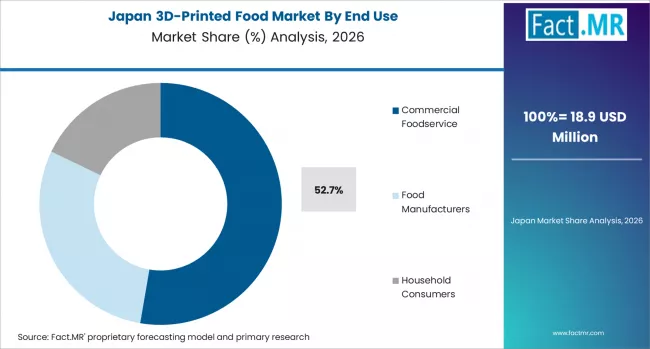
3d Printed Food Market Japan Market Share Analysis By End Use | Source: Fact.MR
Asia Pacific serves as the high-growth food technology development and automated food production market, supported by strong investment in robotics and digital manufacturing. TNO supports 3D food printing research collaborations. Panasonic Corporation strengthens automated food production technologies. Anrich3D expands additive food manufacturing solutions.
- China: Demand for 3D-printed food in China is projected to rise at 32.5% CAGR through 2036. The Made in China 2025 initiative (State Council, ongoing) supports advanced manufacturing technologies. Anrich3D expanded additive food manufacturing systems (April 2023), supporting market growth.
- Japan: Demand for 3D-printed food in Japan is projected to rise at 28.4% CAGR through 2036. The Society 5.0 initiative (Cabinet Office, updated 2021) supports automation and digital production technologies. Panasonic Corporation expanded automated food production technologies (May 2023), supporting industry development.
Fact MR's analysis of 3D-printed food market in global regions consists of country-wise assessment that includes China, United States, Germany, Japan, and United Kingdom. Readers can find additive manufacturing trends, food technology innovation patterns, regulatory developments, and competitive positioning across key markets.
Competitive Landscape
Competitive Structure and Buyer Dynamics in the 3D-Printed Food Market
The competitive structure of the 3D-Printed Food Market is moderately fragmented, with technology developers, food manufacturers, and research organizations participating in product innovation and commercialization. Companies such as 3D Systems, Natural Machines, byFlow, and TNO maintain strong positions through development of food grade printing technologies and formulation expertise. These firms supply 3D food printers and ingredient cartridges used for customized food production across hospitality, healthcare, and specialty nutrition applications. Additional participants including Barilla, Redefine Meat, BeeHex, Choc Edge, Print2Taste, Open Meals, Modern Meadow, and Nourished contribute through ingredient innovation, alternative protein development, and customized nutrition solutions. Competition is primarily influenced by printing precision, ingredient stability, scalability of production, and compatibility with diverse food formulations.
Several companies maintain structural advantages through proprietary printing technologies and specialized ingredient development capabilities. Firms such as Natural Machines and byFlow benefit from integrated hardware and software platforms designed specifically for food printing applications. 3D Systems maintains advantages through established additive manufacturing expertise adapted for edible materials. Redefine Meat and Modern Meadow maintain differentiation through development of structured alternative protein formulations compatible with printing processes. Food service providers and research institutions often evaluate multiple technology vendors to ensure flexibility across applications. Procurement decisions assess equipment reliability, ingredient compatibility, and regulatory compliance. This purchasing behavior moderates supplier pricing leverage across the market. Companies with patented printing technologies and scalable ingredient formulations retain moderate negotiating influence within emerging customized food production environments.
Key Players of the 3D-Printed Food Market
- Natural Machines
- byFlow
- 3D Systems
- TNO
- Barilla
- BeeHex
- Choc Edge
- Print2Taste
- Redefine Meat
- Modern Meadow
- Open Meals
- Nourished
Bibliographies
- [1] Frontiers in Nutrition / PMC. (2025, January 24). Advances in 3D food printing technology: Innovation and applications in personalized nutrition and customized textures. Frontiers in Nutrition, 12, 11811361. Retrieved March 24, 2026.
- [2] U.S. Food and Drug Administration. (2024). Technical considerations for 3D-printed medical products and food-contact material frameworks. U.S. FDA. Retrieved March 24, 2026.
- [3] TNO (Netherlands Organization for Applied Scientific Research). (2024, September 2). 3D printed food: The future of personalised nutrition. TNO Insights. Retrieved March 24, 2026.
- [4] Food and Bioprocess Technology / PMC. (2024, August 13). A narrative review: 3D bioprinting of cultured muscle meat and structured plant-based "meat-like" products. Food and Bioprocess Technology, 17(7), 1-15. Retrieved March 24, 2026.
- [5] ETH Zürich / Research Collection. (2024, June 4). Consumer acceptance of cultured, plant-based, 3D-printed meat and fish alternatives. ETH Research Collection. Retrieved March 24, 2026.
This Report Addresses
- Market size estimation and revenue forecasts for the 3D-Printed Food Market from 2026 to 2036, supported by additive food manufacturing adoption trends and digital food fabrication commercialization benchmarks.
- Growth opportunity mapping across extrusion-based printing, binder jetting, inkjet printing, selective laser sintering, and other additive manufacturing technologies applied to bakery, confectionery, customized nutrition foods, dairy products, snacks, and alternative protein structures.
- Segment and regional revenue forecasts covering ingredient categories, technology types, application areas, end users, and major innovation markets including China, United States, Japan, Germany, and United Kingdom.
- Competition strategy assessment of leading companies such as Natural Machines, byFlow, 3D Systems, TNO, and Print2Taste, including digital food production capability benchmarking and ingredient formulation compatibility assessment.
- Regulatory impact analysis covering European Food Safety Authority novel food frameworks, U.S. Food and Drug Administration food manufacturing guidance, and global food technology safety validation standards influencing commercialization pathways.
- Market report delivery in PDF, Excel, PPT, and interactive dashboard formats designed for food technology investment strategy, additive manufacturing adoption planning, and customized nutrition product development evaluation.
- Supply chain vulnerability assessments examining equipment cost barriers, printable ingredient formulation stability, limited production throughput, regulatory classification complexity, and consumer acceptance variability influencing commercialization pace.
3D-Printed Food Market Definition
The 3D-Printed Food Market includes food products created using additive manufacturing technologies that deposit edible materials layer by layer to form customized shapes and textures. These foods are produced using ingredients such as chocolate, dough, pureed vegetables, proteins, and sugar based formulations processed through specialized 3D food printers. The technology allows control over portion size, ingredient distribution, and product design. 3D printed foods are used in restaurants, research environments, healthcare nutrition applications, and specialty food production. The primary function of 3D printed food is to enable customized food design and controlled ingredient structuring through digital manufacturing processes.
3D-Printed Food Market Inclusions
This report covers global and regional market sizes for 3D printed food with forecast analysis for the study period. The market is segmented by ingredient type including carbohydrate based materials, protein based materials, sauces, chocolate, and other edible formulations. Application segments include bakery products, confectionery items, customized nutrition, and specialty food preparation. End users include food manufacturers, restaurants, research institutions, and healthcare nutrition providers. The report also evaluates pricing trends, production patterns, and selected trade flow analysis across emerging food technology markets.
3D-Printed Food Market Exclusions
The report excludes conventional food manufacturing methods that do not use additive manufacturing processes. 3D printing hardware equipment used for industrial manufacturing of non food items is not included. The scope also excludes traditional bakery and confectionery products produced through standard processing techniques. General kitchen appliances and cooking equipment are outside the defined market scope, as the analysis focuses strictly on food products produced using 3D printing technology.
3D-Printed Food Market Research Methodology
- Primary Research: Interviews were conducted with food technology developers, ingredient suppliers, research institutions, and specialty food producers.
- Desk Research: Public information was collected from food technology publications, company reports, research databases, and trade statistics.
- Market-Sizing and Forecasting: A hybrid model combining bottom up production analysis with top down demand assessment across emerging food technology sectors was applied.
- Data Validation and Update Cycle: Findings were cross verified using multiple industry data sources and expert inputs, with periodic updates conducted as new market information becomes available.
Segmentation
Report Scope
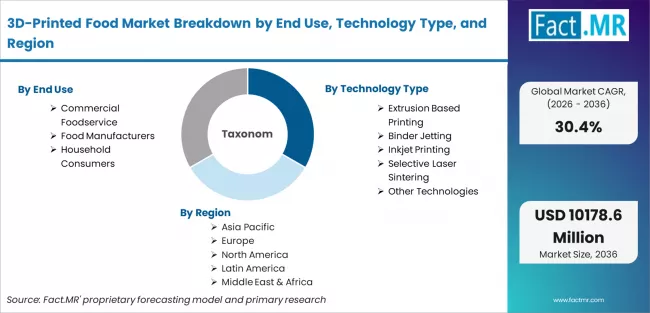
3d Printed Food Market Breakdown By End Use, Technology Type, And Region | Source: Fact.MR
| Metric | Value |
|---|---|
| Quantitative Units | USD 716 million (2026) to USD 10,140 million (2036), at a CAGR of 30.4% |
| Market Definition | The 3D-printed food market includes global production and commercialization of food products manufactured using additive manufacturing technologies that deposit edible materials layer-by-layer to create customized shapes, textures, and nutrient compositions. |
| Ingredient Type Segmentation | Carbohydrates, Proteins, Chocolate & confectionery materials, Dairy ingredients, Alternative proteins |
| Technology Type Segmentation | Extrusion-based printing, Binder jetting, Inkjet printing, Selective laser sintering, Other technologies |
| Application Segmentation | Bakery & confectionery, Customized nutrition foods, Meat & seafood alternatives, Dairy products, Snacks & savory foods |
| End User Segmentation | Commercial foodservice, Food manufacturers, Household consumers |
| Regions Covered | North America, Latin America, Europe, East Asia, South Asia, Oceania, Middle East and Africa |
| Countries Covered | United States, Canada, Mexico, Brazil, Argentina, Germany, France, United Kingdom, Italy, Spain, Netherlands, Israel, China, Japan, South Korea, Singapore, Australia, and 40+ countries |
| Key Companies Profiled | Natural Machines, byFlow, 3D Systems, TNO, Barilla, BeeHex, Choc Edge, Print2Taste, Redefine Meat, Modern Meadow, Open Meals, Nourished |
| Forecast Period | 2026 to 2036 |
| Approach | Hybrid top-down and bottom-up market estimation based on additive manufacturing adoption in food production, ingredient formulation demand mapping, equipment deployment analysis, commercialization trends in customized nutrition, and validation through primary interviews with food technology developers, ingredient suppliers, and commercial foodservice operators. |
Source: Fact.MR analysis. Updated Mar 27, 2026
3D-Printed Food Market Key Segments
-
Ingredient Type :
- Carbohydrates
- Proteins
- Chocolate and Confectionery Materials
- Dairy Ingredients
- Alternative Proteins
-
Technology Type :
- Extrusion Based Printing
- Binder Jetting
- Inkjet Printing
- Selective Laser Sintering
- Other Technologies
-
Application :
- Bakery and Confectionery
- Customized Nutrition Foods
- Meat and Seafood Alternatives
- Dairy Products
- Snacks and Savory Foods
-
End User :
- Commercial Foodservice
- Food Manufacturers
- Household Consumers
-
Region :
- North America
- USA
- Canada
- Mexico
- Europe
- Germany
- UK
- France
- Italy
- Spain
- Nordic Countries
- BENELUX
- Rest of Europe
- Asia Pacific
- China
- Japan
- South Korea
- India
- Australia
- Rest of Asia Pacific
- Latin America
- Brazil
- Argentina
- Rest of Latin America
- Middle East and Africa
- Kingdom of Saudi Arabia
- United Arab Emirates
- South Africa
- Rest of Middle East and Africa
- Other Regions
- Oceania
- Central Asia
- Other Markets
- North America
Frequently Asked Questions
How large is the demand for 3D-Printed Food in the global market in 2026?
What will be the market size of the 3D-Printed Food market by 2036?
What is the expected demand growth for the 3D-Printed Food market between 2026 and 2036?
Which company is identified as a leading technology provider in the 3D-Printed Food market?
Which end user segment is projected to dominate 3D-Printed Food adoption by 2026?
Why is commercial foodservice an important end user segment for 3D-Printed Food technologies?
What is driving demand for 3D-Printed Food technology in China?
What is the growth outlook for the 3D-Printed Food market in China?
Why is the United States an important market for 3D-Printed Food solutions?
What is the growth outlook for the 3D-Printed Food market in the United States?
How is demand for 3D-Printed Food evolving in Germany?
What is the growth outlook for the 3D-Printed Food market in Germany?
What is the growth outlook for the 3D-Printed Food market in Japan?
How is the United Kingdom positioned in the 3D-Printed Food market?
What is the growth outlook for the 3D-Printed Food market in the United Kingdom?
What is 3D-Printed Food and what is it mainly used for?
What does the 3D-Printed Food market include in this report?
What applications are included in the scope of the 3D-Printed Food market?
What is excluded from the scope of the 3D-Printed Food market report?
What does market forecast mean in the 3D-Printed Food market report?
How is the 3D-Printed Food market forecast developed in this report?
What does primary validation indicate in the 3D-Printed Food market analysis?
Who worked on this report


Preview the report firsthand - request a free sample
Free SampleGet the brochure for pricing and purchase details
Download PDF