
- Market Value (2025): USD 148.7 Mn
- Estimated Value (2026): USD 160.0 Mn
- Forecast Value (2036): USD 332.9 Mn
- CAGR (2026-2036): 7.6%
Pea Protein Flour Texturizers Market Forecast and Outlook 2026 to 2036
The pea protein flour texturizers market is projected to grow from USD 160.0 million in 2026 to USD 332.9 million by 2036. This corresponds to a CAGR of 7.6% over the forecast period.
The market for pea protein flour texturizers is expanding as makers of meat alternatives, snacks, pasta, batters and bakery products use minimally processed pea flours to bind water, build bite and add protein with a short label. Flour manufacturers are offering fine-milled, heat-treated, enzyme-treated and extrusion-grade flours made by dry milling and air classification, which use far less water and energy than wet-extracted isolates. For example, GFI Europe reported in June 2026 that tofu, tempeh and seitan sales volumes rose by almost 30% in both Germany and the Netherlands in 2025, which may reflect interest in less processed foods.
Market Highlights for the Pea Protein Flour Texturizers Market
- Sales of pea protein flour texturizers stood at USD 148.7 million in 2025
- Pea Protein Flour Texturizers Market Value (2026): USD 160.0 million
- Pea Protein Flour Texturizers Market Forecast Value (2036): USD 332.9 million
- Pea Protein Flour Texturizers Market Forecast CAGR (2026-2036): 7.6%
- Leading Product Type: Fine-milled pea flour (29.5%)
- Key Market Participants: Roquette, Cosucra, Puris, Ingredion, Vestkorn
- Key Growth Countries: Italy, United Kingdom, United States, Germany, France
In June 2026, GFI Europe reported that Europe's plant-based food retail market grew as prices became more competitive, although good taste remained the key to repeat purchase. Demand for pea protein flour texturizers is growing as brands lower costs with less refined ingredients while improving texture. Food ingredient firms are positioning dry-fractionated flours as affordable, low-footprint building blocks.
Pea Protein Flour Texturizers Market
| Metric | Value |
|---|---|
| Estimated Value in (2026) | USD 160.0 million |
| Forecast Value in (2036) | USD 332.9 million |
| Forecast CAGR (2026 to 2036) | 7.6% |
Source: Fact.MR analysis.
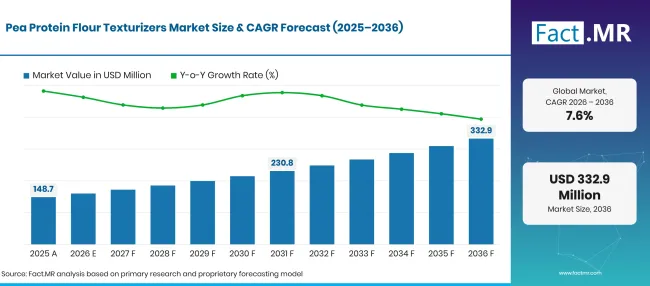
Pea Protein Flour Texturizers Forecast Global | Source: Fact.MR
Category
| Category | Segments |
|---|---|
| Product Type | Fine-milled pea flour, Extrusion-grade pea flour, Heat-treated pea flour, Enzyme-treated pea flour, Native pea protein flour |
| Product Form | Dry powder, Custom premix, Liquid concentrate, Granule and agglomerate, Encapsulated |
| Application | Savory and other, Dairy and alternatives, Bakery and confectionery, Beverages, Nutrition and supplements |
| Buyer Type | Ingredient blender, Contract formulator, Food manufacturer, Beverage producer, Nutrition brand |
| Region | Italy; United Kingdom; United States; Germany; France |
Source: Fact.MR analysis. Updated Nov 24, 2026
Segmental Analysis
Why does fine-milled pea flour lead product demand in the Pea Protein Flour Texturizers Market?
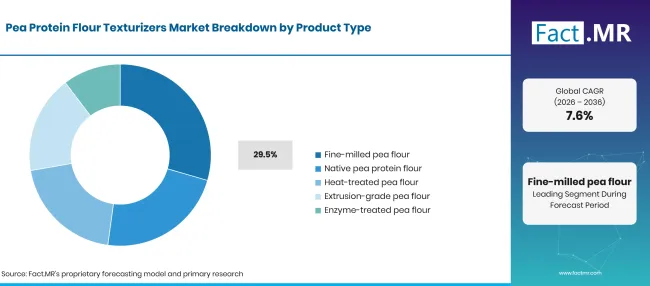
Pea Protein Flour Texturizers Breakdown Product Type | Source: Fact.MR
Fine-milled pea flour accounts for 29.5% of revenue in 2026, approximately USD 47.2 million, as its controlled particle size supports uniform hydration in batters, pasta and bakery formulations. Fine milling also supports subsequent protein fractionation. Food processors are selecting grades with consistent texture and water absorption. Suppliers are improving milling precision to meet different formulation requirements.
How is dry powder leading form demand in the Pea Protein Flour Texturizers Market?
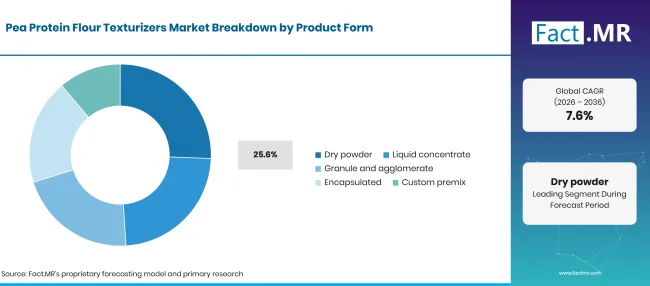
Pea Protein Flour Texturizers Breakdown Product Form | Source: Fact.MR
Dry powder represents 25.6% of revenue in 2026, valued at approximately USD 41.0 million, reflecting its suitability for conventional dry ingredient handling systems. Bakeries and extrusion facilities can incorporate pea flour into existing blending operations. Suppliers are developing heat-treated powders with improved microbial quality. Powder flowability, storage stability and consistent mixing performance influence purchasing decisions.
Why do savory applications lead demand in the Pea Protein Flour Texturizers Market?
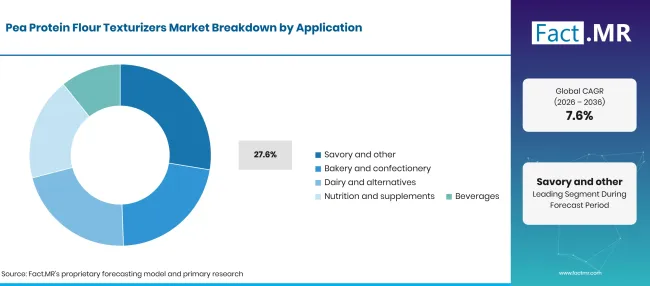
Pea Protein Flour Texturizers Breakdown Application | Source: Fact.MR
Savory and other applications hold 27.6% of revenue in 2026, equivalent to approximately USD 44.2 million, as pea flour contributes binding and texture to snacks, soups and meat alternatives. Manufacturers adjust protein and starch composition for extrusion performance. Ingredient developers are refining savory formulations where pea-based texturizers compete with textured soy protein.
How are ingredient blenders leading buyer demand in the Pea Protein Flour Texturizers Market?
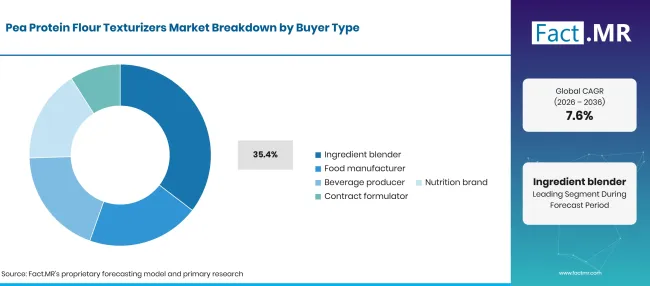
Pea Protein Flour Texturizers Breakdown Buyer Type | Source: Fact.MR
Ingredient blenders account for 35.4% of revenue in 2026, approximately USD 56.6 million, as premix manufacturers combine pea flour with starches, fibers and complementary pulse ingredients. Blending helps maintain consistent texture despite differences in raw material characteristics. Suppliers are developing customized binder and batter systems for food processors, alongside formulations incorporating fiber-protein blends.
Pea Protein Flour Texturizers Market-Drivers, Restraints & Trends
Drivers
The market for pea protein flour texturizers is expanding as plant-based sales volumes recover in Europe. For example, GFI Europe reported in June 2026 that plant-based meat was France's fastest-growing plant-based category, with volume up 16.8% as prices fell, and that 31% of households in Germany and the UK bought plant-based meat in 2025. Growth in plant-based meat sales may create opportunities for pea flour suppliers serving meat-alternative producers. Actual pea flour demand will depend on formulation choices and ingredient costs.
Restraints
Demand for pea protein flour texturizers is constrained by flavor limits and uneven growth of the plant-based sector. The Good Food Institute reported in April 2026 that global retail sales of plant-based meat, seafood, milk, yogurt, ice cream and cheese grew 3% in 2025 to USD 28.9 billion, including inflation, while plant-based meat and seafood sales rose about 8%. Flour manufacturers must reduce pea off-notes through heat and enzyme treatment.
Trend
Dry Fractionation for Lower Footprint. Demand for air-classified pea flours is rising as brands measure the carbon and water footprint of ingredients.
Trend
Clean-Label Binders. Demand for binders that replace methylcellulose and modified starch is rising in meat alternatives and coated foods. Suppliers are combining functional pea flours with fibers. In August 2026, HHS and USDA submitted the first proposed federal definition of ultra-processed foods for final review.
Pea Protein Flour Texturizers Market Analysis by Key Country
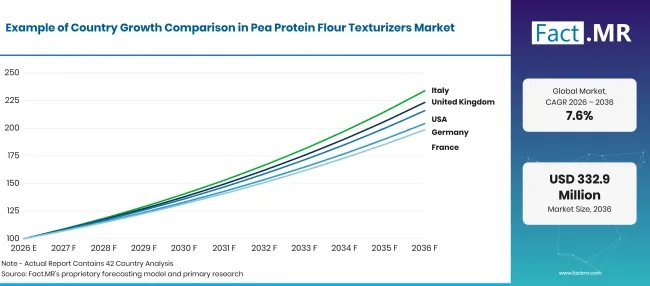
Pea Protein Flour Texturizers Growth Index | Source: Fact.MR
| Country | CAGR (2026-2036) |
|---|---|
| Italy | 8.9% |
| United Kingdom | 8.4% |
| United States | 8.0% |
| Germany | 7.4% |
| France | 7.1% |
Source: Fact.MR analysis.
What is driving pea protein flour texturizers demand in Italy?
Italian food manufacturers are developing pulse-based ingredients for meat alternatives, bakery products and blended food applications.
Demand for pea protein flour texturizers in Italy is projected to grow at an 8.9% CAGR, the fastest among the five key countries, as pasta, bakery and plant-based producers add pulse flours.
How is plant-based retail supporting pea protein flour texturizers sales in the United Kingdom?
Sales of pea protein flour texturizers in the United Kingdom are projected to grow at an 8.4% CAGR. GFI Europe reported that 31% of UK households bought plant-based meat in 2025, although UK plant-based sales volume contracted that year.
UK advertising limits on less healthy foods have applied since 5 January 2026, which may encourage reformulation. Dry-milling specialists are serving UK meat-alternative and snack producers.
What is shaping pea protein flour texturizers demand in the United States?
Demand for pea protein flour texturizers in the United States is projected to grow at an 8.0% CAGR as snack, pasta and bakery brands raise protein content with simple ingredients.
In August 2026, HHS and USDA submitted the first proposed federal definition of ultra-processed foods for final review. Companies such as Puris and Ingredion are serving U.S. food manufacturers.
How is the plant-based market shaping pea protein flour texturizers sales in Germany?
Sales of pea protein flour texturizers in Germany are projected to grow at a 7.4% CAGR as the German plant-based market focuses on price.
GFI Europe said in June 2026 that private-label plant-based milk in Germany is now cheaper than private-label dairy milk, and that 31% of German households bought plant-based meat in 2025. Ingredient producers are serving German private-label meat-alternative producers.
Why is growth slower for pea protein flour texturizers in France?
Demand for pea protein flour texturizers in France is projected to grow at a 7.1% CAGR, the slowest among the five countries, as France is already a major pea protein producer with a mature supply base.
GFI Europe reported in June 2026 that plant-based meat sales volume in France rose 16.8% in 2025 as prices fell. Food ingredient firms are competing with established isolates.
Competitive Landscape for Pea Protein Flour Texturizers Market
Pea protein flour texturizer suppliers are competing through ingredient processing methods, formulation flexibility and the ability to balance protein content with texture performance. Ingredion offers HOMECRAFT pulse flours for bakery and other food applications, while Cosucra supplies pea protein, starch and fiber ingredients that support binding and moisture retention. Roquette focuses on textured pea proteins and specialized plant protein applications, while PURIS participates in the broader pea protein supply chain.
Recent developments highlight greater attention to sensory quality and ingredient combinations that help manufacturers manage formulation costs. Cosucra continues to promote complementary pea protein, starch and fiber ingredients for texture and affordability. GFI Europe's June 2026 retail analysis also identified improved pricing and taste as important factors in plant-based food sales.
Recent Developments
- In February 2026, Roquette launched NUTRALYS Pea 850F, a pea protein isolate offering improved taste neutrality, emulsification, and solubility to support cleaner formulations across plant-based beverages, dairy alternatives, and specialized nutrition products.
- In October 2024, Ingredion launched VITESSENCE Pea 200 D, a pea protein isolate featuring improved dispersibility, solubility, and neutral flavor to support smooth-textured nutritional beverages and ready-to-mix plant protein formulations.
Key Players in Pea Protein Flour Texturizers Market
Key companies operating in the market include Roquette, Cosucra, Puris, Ingredion, and Vestkorn.
- Roquette
- Cosucra
- Puris
- Ingredion
- Vestkorn
Bibliography
- EU CAP Network. (2025, December 3). Production of protein crops under climate change. European Commission.
- Eurostat. (2026, September 28). Dry pulses and protein crops for the production of grain by area, production and humidity (Dataset tag00094).
- GFI Europe. (2026, June 9). Europe’s plant-based food retail market grows as prices become more competitive, but good taste remains key. GFI Europe.
- Good Food Institute. (2026). 2026 state of the industry: Plant-based meat, seafood, eggs, dairy, and ingredients. Good Food Institute.
- Kogar, N. M., Gertner, D., & Bess, A. (2026). Technical summary: Plant-based meat techno-economic analysis. Good Food Institute.
- Ingredion Incorporated. (2024, October 24). Ingredion launches VITESSENCE Pea 200 D, shaking up drinking experiences in nutritional beverages.
- Istat. (2026, September 30). L’agricoltura italiana cambia pelle: tra efficienza, sostenibilità e nuove abitudini alimentari.
- Roquette. (2026, February 23). Launch of breakthrough clean-tasting pea protein isolate.
- Roquette. (2026, September 24). Strategic transformation supports Roquette’s H1 2026 performance. Roquette.
- U.S. Department of Health and Human Services. (2026, August 10). Secretary Kennedy announces landmark food policy reforms to advance President Trump’s MAHA agenda. U.S. Department of Health and Human Services.
- European Commission. (2026, July 7). Reducing the plant protein deficit of the EU. Directorate-General for Agriculture and Rural Development.
- U.S. Department of Agriculture, Economic Research Service. (2025, December 18). Vegetables and pulses outlook: December 2025. U.S. Department of Agriculture
Segmentation
Scope of Report
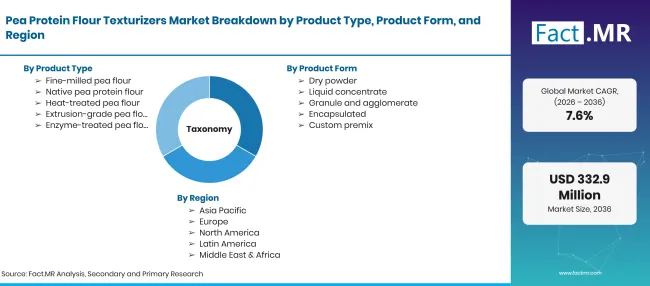
Pea Protein Flour Texturizers Taxonomy | Source: Fact.MR
| Items | Values |
|---|---|
| Quantitative Units (2026) | USD 160.0 Million |
| Product Type | Fine-milled pea flour, Extrusion-grade pea flour, Heat-treated pea flour, Enzyme-treated pea flour, Native pea protein flour |
| Product Form | Dry powder, Custom premix, Liquid concentrate, Granule and agglomerate, Encapsulated |
| Application | Savory and other, Dairy and alternatives, Bakery and confectionery, Beverages, Nutrition and supplements |
| Buyer Type | Ingredient blender, Contract formulator, Food manufacturer, Beverage producer, Nutrition brand |
| Regions Covered | North America, Latin America, Europe, Asia Pacific, Middle East & Africa |
| Countries Covered | Italy, United Kingdom, United States, Germany, France, and other countries |
| Key Companies Profiled | Roquette, Cosucra, Puris, Ingredion, Vestkorn |
| Additional Attributes | Dollar revenue in the Pea Protein Flour Texturizers Market is segmented by product type (fine-milled, extrusion-grade, heat-treated, enzyme-treated, native pea protein flour), product form, application, buyer type and region. |
Source: Fact.MR analysis. Updated Nov 24, 2026
Pea Protein Flour Texturizers Market by Segments
-
Product Type
- Fine-milled pea flour
- Extrusion-grade pea flour
- Heat-treated pea flour
- Enzyme-treated pea flour
- Native pea protein flour
-
Product Form
- Dry powder
- Custom premix
- Liquid concentrate
- Granule and agglomerate
- Encapsulated
-
Application
- Savory and other
- Dairy and alternatives
- Bakery and confectionery
- Beverages
- Nutrition and supplements
-
Buyer Type
- Ingredient blender
- Contract formulator
- Food manufacturer
- Beverage producer
- Nutrition brand
-
Region:
- North America
- United States
- Canada
- Mexico
- Europe
- Germany
- United Kingdom
- France
- Italy
- Spain
- Rest of Europe
- Asia Pacific
- China
- India
- Japan
- South Korea
- Australia
- Rest of Asia Pacific
- Latin America
- Brazil
- Argentina
- Rest of Latin America
- Middle East & Africa
- GCC Countries
- South Africa
- Rest of Middle East & Africa
- North America
Table of Contents
Key Takeaways
- Market Size and CAGR
- Top Growth Driver
- Fastest Growing Segment
- Leading Region
- Key Companies
- Emerging Opportunities

