
- Market Value (2025): USD 173.8 Mn
- Estimated Value (2026): USD 190.0 Mn
- Forecast Value (2036): USD 462.3 Mn
- CAGR (2026-2036): 9.3%
Soluble Wheat Fibers Market Forecast and Outlook 2026 to 2036
The soluble wheat fibers market is projected to grow from USD 190.0 million in 2026 to USD 462.3 million by 2036. Demand for soluble wheat fibers is likely to grow at a CAGR of 9.3% over the forecast period.
Demand for soluble wheat fibers is rising as food and drink makers add fiber and cut sugar in yogurts, beverages, cereal bars and bakery products without changing taste or texture. Suppliers of soluble wheat fibers are offering wheat dextrins, resistant wheat dextrins, arabinoxylans and blends that dissolve clear, tolerate heat and acid, and are well tolerated in the gut.
Key Takeaways from the Soluble Wheat Fibers Market
- Sales of soluble wheat fibers stood at USD 173.8 million in 2025
- Soluble Wheat Fibers Market Value (2026): USD 190.0 million
- Soluble Wheat Fibers Market Forecast Value (2036): USD 462.3 million
- Soluble Wheat Fibers Market Forecast CAGR (2026-2036): 9.3%
- Leading Product Type: Wheat fiber blends (27.1%)
- Key Market Participants: Roquette, COMET, Cargill, BIOVEN INGREDIENTS, J. Rettenmaier & Söhne (JRS)
- Key Growth Countries: New Zealand, Germany, Japan, France, United Kingdom
In August 2026, Innova Market Insights reported rising claims about high protein and high fiber in Japanese functional food and drink launches. Demand for soluble wheat fibers is growing as fiber becomes a main reformulation tool alongside protein. Similar positioning is projected to support sales of soluble wheat fibers across Oceania, Europe and Japan.
Soluble Wheat Fibers Market
| Metric | Value |
|---|---|
| Estimated Value in (2026) | USD 190.0 million |
| Forecast Value in (2036) | USD 462.3 million |
| Forecast CAGR (2026 to 2036) | 9.3% |
Source: Fact.MR analysis.
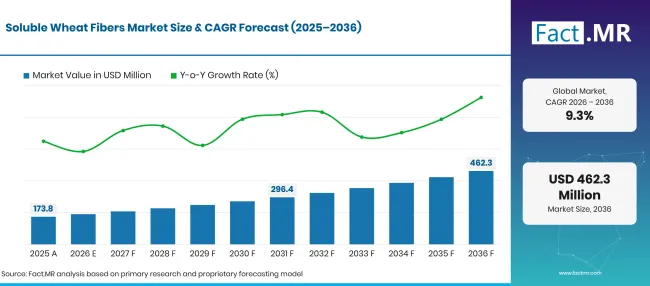
Soluble Wheat Fibers Forecast Global | Source: Fact.MR
Category
| Category | Segments |
|---|---|
| Product Type | Wheat fiber blends, Resistant wheat dextrin, Wheat dextrin, Soluble arabinoxylan, Wheat-derived oligosaccharides |
| Product Form | Liquid concentrate, Encapsulated, Dry powder, Granule and agglomerate, Custom premix |
| Application | Dairy and alternatives, Beverages, Savory and other, Bakery and confectionery, Nutrition and supplements |
| Buyer Type | Food manufacturer, Beverage producer, Contract formulator, Ingredient blender, Nutrition brand |
| Region | New Zealand; Germany; Japan; France; United Kingdom |
Source: Fact.MR analysis. Updated Nov 24, 2026
Segmental Analysis
Why do wheat fiber blends lead product demand in the Soluble Wheat Fibers Market?
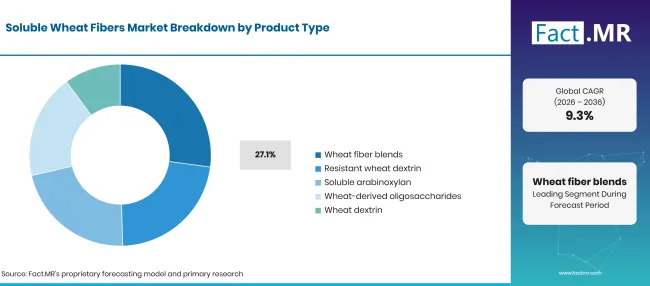
Soluble Wheat Fibers Breakdown Product Type | Source: Fact.MR
Wheat fiber blends account for 27.1% of revenue in 2026, approximately USD 51.5 million, as food manufacturers combine soluble wheat dextrin with complementary fibers and bulking ingredients. These combinations help adjust sweetness, solids content and digestive tolerance in reduced-sugar foods. Suppliers are developing application-specific blends for bakery and nutrition products alongside fiber-forward formulations.
How is liquid concentrate leading form demand in the Soluble Wheat Fibers Market?
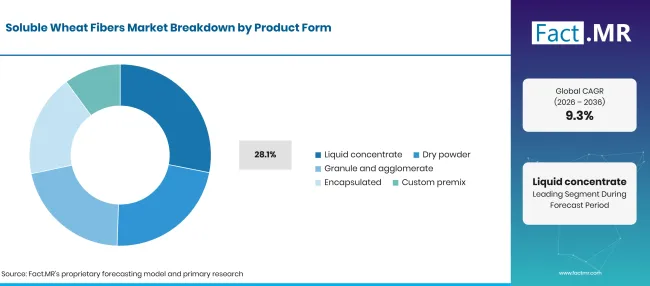
Soluble Wheat Fibers Breakdown Product Form | Source: Fact.MR
Liquid concentrate represents 28.1% of revenue in 2026, valued at approximately USD 53.4 million, as syrup-based fibers integrate directly into liquid ingredient handling systems. Beverage and dairy processors benefit from controlled pumping and uniform mixing. Manufacturers are offering wheat-derived resistant dextrin syrups that support fiber enrichment. Formulators assess solids concentration, viscosity and compatibility with existing processing equipment.
Why do dairy and alternatives lead application demand in the Soluble Wheat Fibers Market?
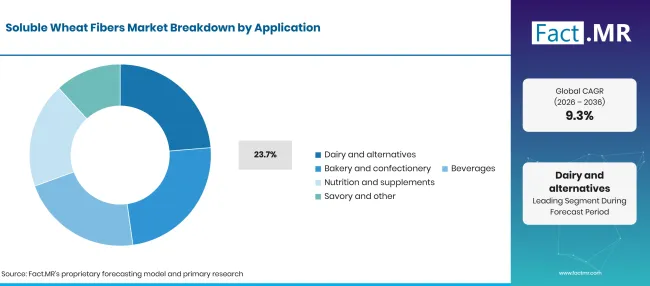
Soluble Wheat Fibers Breakdown Application | Source: Fact.MR
Dairy and alternatives hold 23.7% of revenue in 2026, equivalent to approximately USD 45.0 million, reflecting interest in fiber-enriched yogurts, dairy beverages and plant-based desserts. Wheat dextrin can contribute dietary fiber while influencing texture and water retention. Ingredient developers are adjusting concentrations to suit fermentation and processing requirements. Product performance depends on viscosity, flavor and stability during storage.
How are food manufacturers leading buyer demand in the Soluble Wheat Fibers Market?
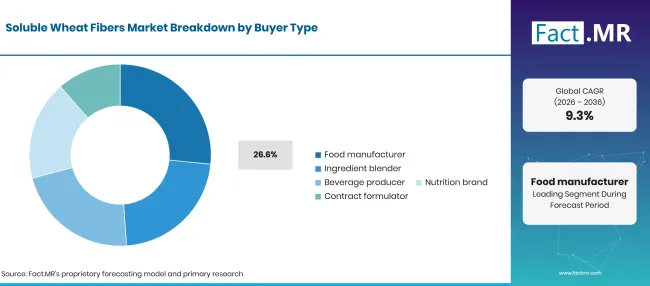
Soluble Wheat Fibers Breakdown Buyer Type | Source: Fact.MR
Food manufacturers account for 26.6% of revenue in 2026, approximately USD 50.5 million, as packaged food producers incorporate soluble wheat fibers into cereals, biscuits and nutrition bars. Direct sourcing enables closer control over ingredient specifications and production consistency. Suppliers provide formulation assistance and traceability documentation. Purchasing teams also compare wheat-derived ingredients with other prebiotic fiber options.
Soluble Wheat Fibers Market-Drivers, Restraints & Trends
Drivers
Demand for soluble wheat fibers is rising as front-of-pack labeling and advertising rules reward higher fiber and lower sugar. For example, in February 2026, Australian and New Zealand food ministers asked FSANZ to prepare a proposal to make the Health Star Rating mandatory, consultation on proposal P1067 followed in mid-2026, and a second consultation opened on 28 October 2026.
Restraints
Demand for soluble wheat fibers is constrained by competition from corn, chicory and tapioca fibers and by wheat's allergen status. For example, the U.S. FDA issued a request for information on gluten labeling and cross-contact in January 2026. It focuses on rye, barley and oats, because wheat is already a major food allergen that must be declared. Wheat's allergen status is projected to steer some gluten-free brands toward other fibers.
Trend
Fiber for Sugar Reduction Demand for fibers that replace sugar's bulk is rising in bars, cereals and dairy. Suppliers are pairing soluble wheat fiber with high-intensity sweeteners.
Trend
Gut Health Positioning In August 2026, Innova Market Insights reported that standard fiber and inulin were the leading fiber ingredients in Japanese functional launches, that resistant dextrin, soy fiber and oligosaccharides were increasing, and that fiber and prebiotic use was rising particularly in dairy and cereals. Demand for digestive health claims is rising. Similar positioning is projected to drive sales of soluble wheat fibers.
Soluble Wheat Fibers Market Analysis by Key Country
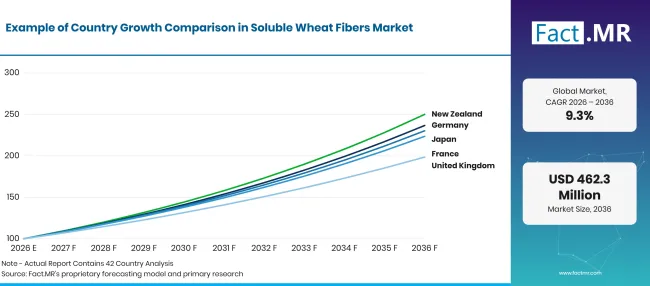
Soluble Wheat Fibers Growth Index | Source: Fact.MR
| Country | CAGR (2026-2036) |
|---|---|
| New Zealand | 9.6% |
| Germany | 9.0% |
| Japan | 8.7% |
| France | 8.4% |
| United Kingdom | 7.1% |
Source: Fact.MR analysis.
What is driving soluble wheat fibers demand in New Zealand?
Demand for soluble wheat fibers in New Zealand is forecast to rise at a 9.6% CAGR through 2036, the fastest among the five countries.
Food manufacturers are reviewing product formulations as Health Star Rating requirements receive greater regulatory attention. In October 2026, FSANZ opened another consultation on making the rating system mandatory. Dairy processors and cereal manufacturers may use soluble fibers to improve nutritional profiles while maintaining product texture. Export-oriented suppliers will consider fiber content, labeling compliance and ingredient performance when developing new formulations.
How is reformulation supporting soluble wheat fibers sales in Germany?
Sales of soluble wheat fibers in Germany are forecast to advance at a 9.0% CAGR through 2036, supported by food manufacturers seeking higher-value formulations.
In October 2026, the German Food and Drink Industries Federation reported that industry sales declined 2.3% during the first half of the year, despite modest volume growth. This environment is encouraging producers to examine ingredient costs and product differentiation. Bakery, cereal and dairy manufacturers are evaluating soluble wheat fibers for sugar reduction and fiber enrichment while maintaining familiar taste and texture.
What is shaping soluble wheat fibers demand in Japan?
Demand for soluble wheat fibers in Japan is likely to increase at an 8.7% CAGR through 2036 as manufacturers develop fiber-enriched beverages, yogurts and functional foods.
Consumer interest in digestive health creates opportunities for ingredients that can be incorporated without substantially changing product taste. Japanese food manufacturers are placing greater emphasis on ingredient quality, accurate fiber declarations and traceability when developing functional food products. Ingredient suppliers are working on formulation stability, fiber concentration and documentation to serve manufacturers developing products with nutritional positioning.
How is the bakery sector shaping soluble wheat fibers sales in France?
Sales of soluble wheat fibers in France are set to expand at an 8.4% CAGR through 2036, reflecting opportunities across bakery, confectionery and processed dairy applications.
French ingredient manufacturer Roquette supplies NUTRIOSE soluble fibers derived from wheat and corn, offering formulation options for food processors. Bakery manufacturers can incorporate wheat-derived dextrin into biscuits, breads and snack products to increase fiber content. Local ingredient expertise supports product development, while purchasing teams focus on ingredient solubility, processing tolerance, flavor consistency and compatibility with existing manufacturing equipment.
Why is growth slower for soluble wheat fibers in the United Kingdom?
Demand for soluble wheat fibers in the United Kingdom is forecast to increase at a 7.1% CAGR through 2036, the slowest among the five countries.
New advertising restrictions for identifiable less healthy foods took effect in January 2026, adding pressure on manufacturers to review product formulations. Established reformulation programs are directing attention toward targeted improvements in biscuits, cereals and snacks.
Competitive Landscape for Soluble Wheat Fibers Market
The soluble wheat fibers market is shaped by suppliers' ability to convert wheat-derived carbohydrates into functional ingredients suited to different food processing conditions. Roquette maintains a direct presence through its NUTRIOSE wheat dextrin portfolio, offering powder and liquid grades for fiber enrichment and partial sugar replacement. Cargill and BIOVEN INGREDIENTS participate in the broader grain processing and specialty ingredient sector, while J. RETTENMAIER & SÖHNE (JRS) supplies plant-based functional fibers through its VITACEL portfolio.
Since 2025, competitive developments have highlighted portfolio consolidation and greater demand for ingredients that support nutritional reformulation. Roquette's liquid NUTRIOSE wheat fiber grades offer a different competitive approach through direct incorporation into food processing lines.
Recent Developments
- In October 2025, Roquette presented its expanded Health and Pharma Solutions portfolio at SupplySide Global, featuring NUTRIOSE soluble fibers alongside plant proteins and nutritional excipients for functional food and supplement formulations.
- In October 2024, COMET partnered with Givaudan to expand distribution of Arrabina, its upcycled wheat-derived prebiotic fiber, strengthening access to functional ingredients for digestive health applications across food, beverage, and nutritional markets.
Key Players in Soluble Wheat Fibers Market
Key companies operating in the market include Roquette, COMET, Cargill, BIOVEN INGREDIENTS, and J. Rettenmaier & Söhne (JRS).
- Roquette
- COMET
- Cargill
- BIOVEN INGREDIENTS
- J. Rettenmaier & Söhne (JRS)
Bibliography
- Bundesvereinigung der Deutschen Ernährungsindustrie. (2026, October 28). Halbjahresbilanz der Ernährungsindustrie 1/2026. Berlin: BVE.
- Bundesvereinigung der Deutschen Ernährungsindustrie. (2026, July 9). Ernährungsindustrie.2026. Berlin: BVE.
- COMET. (2024, October). Givaudan joins forces with COMET to expand its gut-friendly fibre offering with natural, upcycled fibre Arrabina®.
- Food Standards Australia New Zealand. (2026, April 21). P1067 – Health Star Rating System. Canberra: FSANZ.
- Food Standards Australia New Zealand. (2026, May 8). Call for comment on the Health Star Rating system. Canberra: FSANZ.
- Mackay, S., Shields, E., & Taptiklis, E. (2026, June 19). Making Health Star Ratings on foods mandatory – a big plus for public health. Public Health Communication Centre.
- Consumer Affairs Agency. (2026). For informed food choices. Government of Japan.
- Roquette. (2025). SupplySide Global 2025: Together, we create a new era of health and nutrition.
- Roquette. (2026, September 24). Strategic transformation supports Roquette’s H1 2026 performance. Lille: Roquette.
- Food Standards Australia New Zealand. (2026, October 28). Second public consultation on the Health Star Rating system. Canberra: FSANZ.
Segmentation
Scope of Report
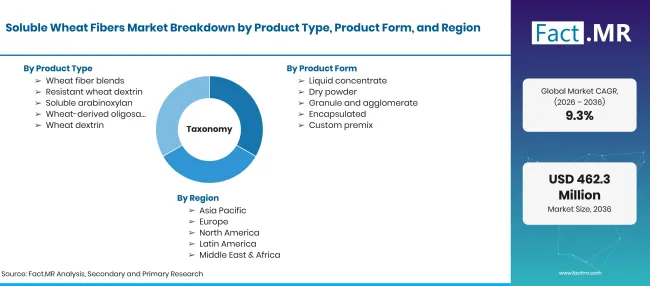
Soluble Wheat Fibers Taxonomy | Source: Fact.MR
| Items | Values |
|---|---|
| Quantitative Units (2026) | USD 190.0 Million |
| Product Type | Wheat fiber blends, Resistant wheat dextrin, Wheat dextrin, Soluble arabinoxylan, Wheat-derived oligosaccharides |
| Product Form | Liquid concentrate, Encapsulated, Dry powder, Granule and agglomerate, Custom premix |
| Application | Dairy and alternatives, Beverages, Savory and other, Bakery and confectionery, Nutrition and supplements |
| Buyer Type | Food manufacturer, Beverage producer, Contract formulator, Ingredient blender, Nutrition brand |
| Regions Covered | North America, Latin America, Europe, Asia Pacific, Middle East & Africa |
| Countries Covered | New Zealand, Germany, Japan, France, United Kingdom, and other countries |
| Key Companies Profiled | Roquette, COMET, Cargill, BIOVEN INGREDIENTS, J. Rettenmaier & Söhne (JRS) |
| Additional Attributes | Dollar revenue in the Soluble Wheat Fibers Market is segmented by product type (wheat fiber blends, resistant wheat dextrin, wheat dextrin, soluble arabinoxylan, oligosaccharides), product form, application, buyer type and region. |
Source: Fact.MR analysis. Updated Nov 24, 2026
Soluble Wheat Fibers Market by Segments
-
Product Type
- Wheat fiber blends
- Resistant wheat dextrin
- Wheat dextrin
- Soluble arabinoxylan
- Wheat-derived oligosaccharides
-
Product Form
- Liquid concentrate
- Encapsulated
- Dry powder
- Granule and agglomerate
- Custom premix
-
Application
- Dairy and alternatives
- Beverages
- Savory and other
- Bakery and confectionery
- Nutrition and supplements
-
Buyer Type
- Food manufacturer
- Beverage producer
- Contract formulator
- Ingredient blender
- Nutrition brand
-
Region:
- North America
- United States
- Canada
- Mexico
- Europe
- Germany
- United Kingdom
- France
- Italy
- Spain
- Rest of Europe
- Asia Pacific
- China
- India
- Japan
- South Korea
- Australia and New Zealand
- Rest of Asia Pacific
- Latin America
- Brazil
- Argentina
- Rest of Latin America
- Middle East & Africa
- GCC Countries
- South Africa
- Rest of Middle East & Africa
- North America
Table of Contents
Key Takeaways
- Market Size and CAGR
- Top Growth Driver
- Fastest Growing Segment
- Leading Region
- Key Companies
- Emerging Opportunities

