Trace Moisture Generator Market Size, Share, Growth and Forecast (2026 - 2036)
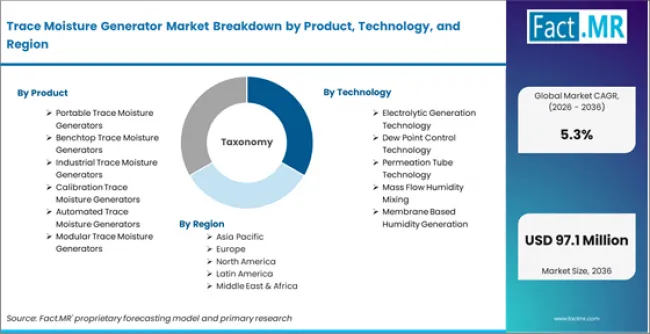
Trace Moisture Generator Market is segmented by Product (Portable Trace Moisture Generators, Benchtop Trace Moisture Generators, Industrial Trace Moisture Generators, Calibration Trace Moisture Generators, Automated Trace Moisture Generators, Modular Trace Moisture Generators), Technology (Electrolytic Generation Technology, Dew Point Control Technology, Permeation Tube Technology, Mass Flow Humidity Mixing, Membrane Based Humidity Generation), Application (Analytical Instrument Calibration, Industrial Process Control, Environmental Testing, Research and Development, Semiconductor Manufacturing), and Region, with forecasts covering the period from 2026 to 2036.
Trace Moisture Generator Market Analysis and Forecast by Fact.MR
- The global trace moisture generator market is estimated at USD 57.915 million in 2026 and is forecast to expand at a CAGR of 5.3% to reach USD 97.068 million by 2036.
- Trace moisture generators are precision instruments that produce controlled humidity levels at parts-per-million and parts-per-billion concentrations for calibrating moisture analyzers, dew point hygrometers, and process monitoring instruments.
- The market serves analytical laboratories, oil and gas refineries, pharmaceutical manufacturers, and semiconductor fabrication facilities.
- Electrolytic and dew point control technologies dominate, with portable field units and benchtop laboratory models representing the primary product configurations.
- Growing regulatory stringency on gas purity specifications and expanding calibration interval requirements are the primary demand drivers.
Summary of the Trace Moisture Generator Market
- Market Snapshot
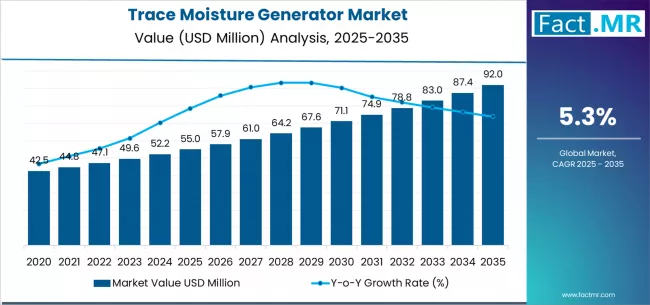
- In 2025, the global Trace Moisture Generator Market was valued at approximately USD 55.0 million.
- The market is estimated to reach USD 57.915 million in 2026 and is projected to attain USD 97.068 million by 2036.
- The trace moisture generator market is likely to expand at a CAGR of 5.3% during the forecast period.
- The market is anticipated to create an absolute dollar opportunity of USD 39.153 million between 2026 and 2036.
- Oil and Gas Industry accounts for 28.7% of the end use segment share in 2026.
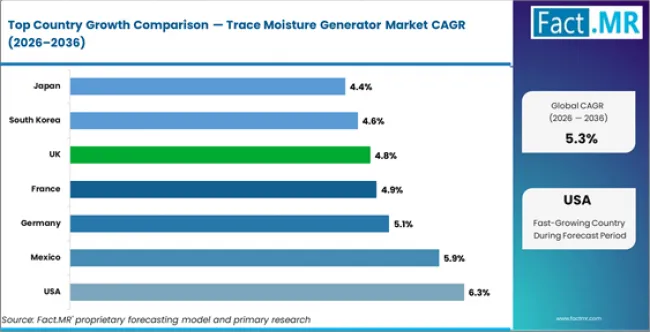
- USA (6.3%) and Mexico (5.9%) are the key growth markets during the forecast period.
- Demand and Growth Drivers
- Oil and gas refinery process monitoring requires calibrated moisture measurement to prevent catalyst poisoning, corrosion, and hydrate formation, generating recurring demand for trace moisture generators used to validate inline analyzers.
- Natural gas pipeline moisture specifications mandated by transmission operators and regulators require periodic calibration of custody transfer moisture analyzers, creating structured procurement for portable field calibration generators.
- Semiconductor fabrication process gas purity requirements are tightening moisture detection limits to sub-ppb levels, driving demand for ultra-high-precision trace moisture generators used in cleanroom instrument calibration.
- Pharmaceutical manufacturing GMP compliance requires validated moisture measurement in lyophilization, packaging atmosphere control, and raw material testing, generating laboratory calibration equipment procurement.
- Accreditation standards for calibration laboratories, including ISO 17025, are expanding the market by requiring traceable moisture generation equipment for instrument verification at regular intervals.
- Product and Segment View
- Portable trace moisture generators account for 34.8% of the product segment in 2026, reflecting strong demand from field calibration operations in oil and gas and industrial process environments.
- Oil and gas represents 28.7% of end-use demand in 2026, with refinery and pipeline moisture monitoring generating the primary calibration equipment procurement channel.
- Electrolytic generation technology holds 37.6% of the technology segment, providing coulometric moisture generation with traceable accuracy for laboratory and industrial calibration.
- Key segmentation includes:
- Product: Portable Generators, Battery Operated, Handheld Field Units, Benchtop Generators, Laboratory Grade
- Technology: Electrolytic Generation, Coulometric, Dew Point Control, Humidity Regulation
- Application: Analytical Calibration, Gas Chromatography, Industrial Process Control, Petrochemical Monitoring
- End Use: Oil and Gas, Pharmaceutical, Semiconductor, Power Generation
- These systems enable:
- Precision moisture generation at parts-per-million and parts-per-billion concentrations for calibrating analytical instruments against traceable standards
- Field-portable calibration enabling on-site verification of pipeline, refinery, and process moisture analyzers without laboratory transport
- Ultra-high-purity moisture generation for semiconductor and pharmaceutical cleanroom instrument calibration at sub-ppb detection limits
- Geography and Competitive Outlook
- North America holds dominant value, with the U.S. at USD 21.376 million in 2026, supported by extensive oil and gas refinery infrastructure, pipeline moisture specification requirements, and semiconductor fabrication calibration demand.
- Europe shows growth led by Germany (5.1%) and France (4.9%), supported by EU pharmaceutical GMP requirements, chemical process calibration standards, and growing semiconductor calibration needs.
- Mexico (5.9%) is the second-fastest-growing market, reflecting oil and gas processing infrastructure expansion and growing industrial calibration requirements.
- Key companies include Kin-Tek Laboratories, Inc., Environics Oy, MKS Instruments, Inc., Systech Illinois, Inc., Thermo Fisher Scientific Inc. (Calibration Lines).
- Analyst Opinion
- Shambhu Nath Jha, Principal Consultant at Fact.MR, says 'The trace moisture generator market operates at the intersection of metrology, process quality, and regulatory compliance. Growth is concentrated in applications where moisture measurement accuracy directly affects product quality, safety, or contractual compliance. Oil and gas custody transfer and semiconductor process control represent the highest-value calibration requirements. Manufacturers providing NIST-traceable, multi-range generators with field portability and automated calibration routines are positioned to capture the growing demand for efficient, reliable moisture calibration.'
Key Growth Drivers, Constraints, and Opportunities
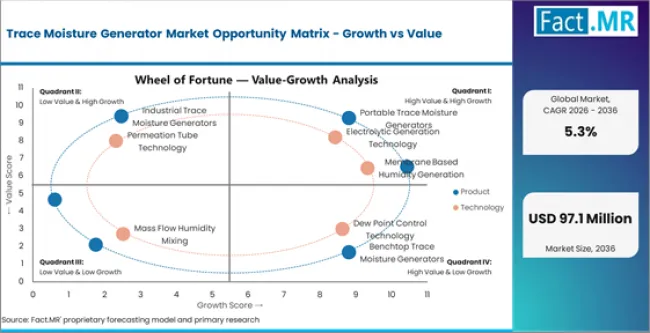
Key Factors Driving Growth
- Oil and gas refinery process monitoring requires traceable moisture calibration to prevent catalyst degradation, pipeline corrosion, and gas hydrate formation, creating recurring procurement tied to calibration interval schedules and regulatory audit requirements.
- Semiconductor fabrication node shrinkage is tightening process gas moisture specifications to sub-ppb levels, driving demand for ultra-high-precision generators capable of producing controlled humidity at detection limits below current instrument capabilities.
- ISO 17025 laboratory accreditation expansion is increasing the number of calibration facilities required to maintain traceable moisture generation equipment, broadening the institutional customer base beyond direct process users.
Key Market Constraints
- Small total addressable market limits production scale economies, keeping unit costs elevated and restricting competitive entry to specialized metrology instrument manufacturers with established calibration expertise.
- Long instrument replacement cycles of 10 to 15 years for benchtop generators reduce replacement demand, with the majority of procurement driven by new laboratory and facility establishment rather than equipment obsolescence.
- Technical complexity of sub-ppb moisture generation creates development barriers that limit the field to a small number of established manufacturers with deep metrology and gas handling expertise.
Key Opportunity Areas
- Semiconductor capacity expansion in the United States, Europe, and Asia is creating new calibration facility requirements where trace moisture generators are specified as essential metrology equipment during fab commissioning.
- Hydrogen economy development is creating emerging calibration requirements for moisture measurement in hydrogen production, storage, and distribution, where trace moisture affects fuel cell performance and pipeline integrity.
- Automated calibration systems that combine moisture generation with instrument verification and certificate documentation are creating higher-value product configurations that improve calibration laboratory efficiency and throughput.
Segment-wise Analysis of the Trace Moisture Generator Market
- Portable generators hold 34.8% of the product segment, serving field calibration in oil and gas and industrial applications.
- Oil and gas accounts for 28.7% of end-use demand, with refinery and pipeline calibration as primary procurement channels.
- Fixed installations represent 41.3% of the installation segment, serving permanent calibration laboratory and process monitoring positions.
The trace moisture generator market is segmented by product type, technology, application, end use, installation type, and region. Portable units lead by volume for field applications. Benchtop generators serve laboratory calibration at higher accuracy tiers.
Which Product Segment Dominates the Trace Moisture Generator Market?
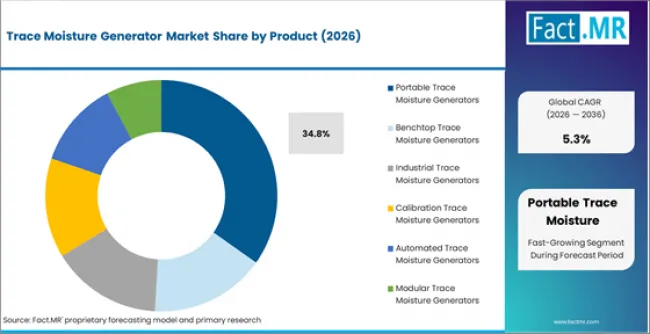
Portable trace moisture generators account for 34.8% in 2026, reflecting strong field calibration demand in oil and gas pipeline, refinery, and industrial process environments where on-site instrument verification eliminates the cost and delay of laboratory transport.
Benchtop laboratory generators serve higher-precision calibration requirements in semiconductor, pharmaceutical, and accredited calibration facilities. These units command higher unit values because of wider measurement range coverage and tighter accuracy specifications.
Which End-Use Segment Dominates the Trace Moisture Generator Market?
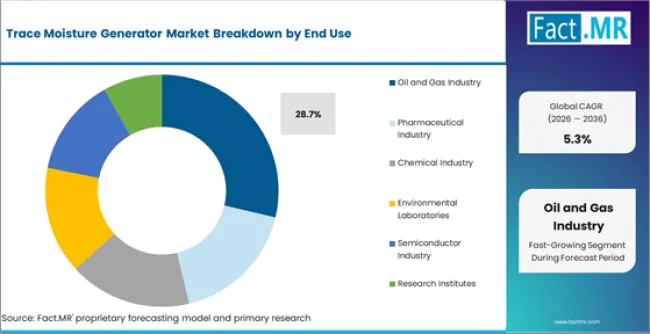
Oil and gas leads with 28.7% share in 2026, driven by refinery process monitoring calibration, pipeline custody transfer moisture verification, and natural gas quality specification compliance.
Pharmaceutical and semiconductor end uses represent the fastest-growing categories, with GMP validation requirements and process gas purity specifications driving demand for higher-precision calibration at increasingly stringent moisture detection limits.
Which Product Trend is Shaping the Next Phase of Growth in the Trace Moisture Generator Market?
Automated calibration systems that combine precision moisture generation with instrument verification, data logging, and calibration certificate documentation are the product trend reshaping the market. These integrated platforms reduce calibration cycle time, minimize operator error, and generate traceable records required for regulatory audit compliance. Calibration laboratories seeking to improve throughput and documentation quality are specifying automated systems over standalone generators.
This trend is creating a premium product tier that commands 40 to 60 percent price premiums over manual generators while improving calibration laboratory productivity. Manufacturers with software development capability for automated calibration routines and certificate generation are capturing specification wins in pharmaceutical, semiconductor, and accredited laboratory segments where documentation requirements are most demanding.
Regional Outlook Across Key Markets
.webp)
- The U.S. leads at 6.3%, supported by the largest concentration of oil and gas refinery infrastructure, semiconductor fabrication facilities, and accredited calibration laboratories globally.
- Mexico (5.9%) reflects oil and gas processing expansion and growing industrial calibration requirements in Pemex refinery operations and expanding manufacturing quality systems.
- Germany (5.1%) grows on pharmaceutical GMP calibration requirements, chemical process monitoring, and semiconductor calibration demand from European fab expansion.
CAGR Table
| Country | CAGR (%) |
|---|---|
| USA | 6.3% |
| Mexico | 5.9% |
| Germany | 5.1% |
| France | 4.9% |
| UK | 4.8% |
| South Korea | 4.6% |
| Japan | 4.4% |
Source: Fact MR (FMR) analysis, based on proprietary forecasting model and primary research.
Market Outlook for Trace Moisture Generators in the United States
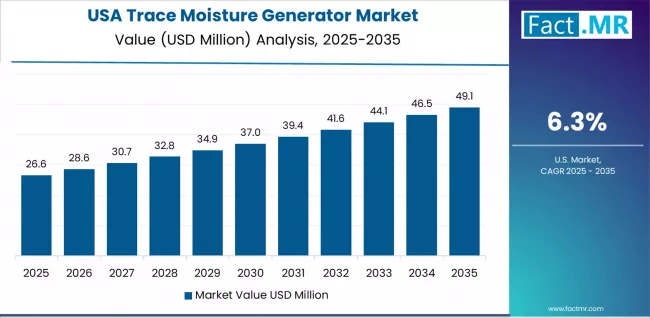
The largest refinery infrastructure globally and expanding semiconductor fabrication under the CHIPS Act are primary demand drivers at 6.3% CAGR. NIST-traceable calibration requirements and API standards for custody transfer moisture measurement create structured procurement cycles.
- CHIPS Act semiconductor fab expansion is creating new calibration facility requirements specifying trace moisture generators during commissioning.
- API custody transfer standards mandate periodic moisture analyzer calibration, generating recurring portable generator procurement for pipeline operations.
Trace Moisture Generator Demand Trends in Mexico
Pemex refinery operations and expanding natural gas processing infrastructure are driving demand at 5.9% CAGR. Growing industrial quality system adoption in manufacturing is also generating calibration laboratory equipment procurement.
- Refinery process monitoring and natural gas specification compliance generate recurring calibration equipment demand.
- Manufacturing quality certification programs are establishing calibration laboratory requirements that include trace moisture generation capability.
Germany Trace Moisture Generator Market Demand Analysis
Pharmaceutical GMP validation and chemical process calibration requirements shape demand at 5.1% CAGR. DIN and EU calibration standards mandate traceable moisture generation for instrument verification in regulated manufacturing environments.
- Pharmaceutical GMP compliance requires validated trace moisture calibration for lyophilization and packaging atmosphere monitoring instruments.
- European semiconductor expansion creates calibration facility procurement for process gas moisture verification equipment.
France Trace Moisture Generator Growth Outlook
Pharmaceutical production and nuclear energy process monitoring calibration requirements support demand at 4.9% CAGR. France's nuclear energy infrastructure creates specialized moisture calibration needs for process gas monitoring in reactor cooling and safety systems.
- Nuclear process gas monitoring requires specialized moisture calibration for reactor cooling and containment atmosphere instruments.
- Pharmaceutical production GMP compliance generates laboratory calibration equipment procurement for moisture-sensitive process monitoring.
Japan Trace Moisture Generator Opportunity
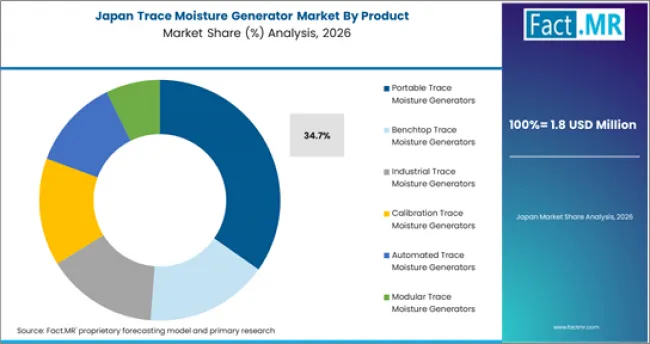
Semiconductor fabrication purity requirements and established metrology culture support demand at 4.4% CAGR. Japanese semiconductor and electronics manufacturers maintain rigorous calibration schedules that generate structured replacement and upgrade procurement.
- Semiconductor process gas purity specifications at advanced fabrication nodes require sub-ppb moisture calibration capability.
- Established metrology culture in Japanese manufacturing ensures regular calibration schedule compliance and equipment modernization.
Competitive Benchmarking and Company Positioning
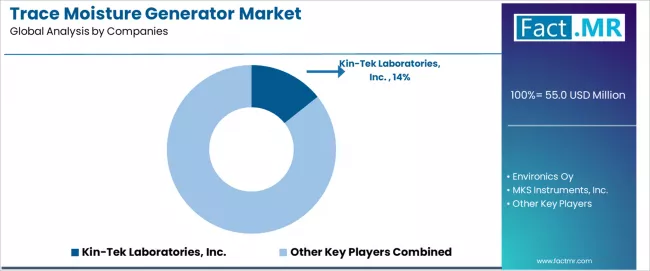
Trace Moisture Generator Market Analysis By Company
- Kin-Tek Laboratories holds the leading position with approximately 14.0% share, supported by established moisture generation expertise, NIST-traceable standards, and a broad product range covering field portable through laboratory benchtop configurations.
- Environics Oy and MKS Instruments compete through precision gas generation and mixing capability applicable to trace moisture applications, with strength in semiconductor and specialty gas calibration.
- AMETEK, Teledyne API, and Thermo Fisher Scientific participate through calibration product lines within broader analytical instrument portfolios, leveraging installed analyzer customer bases for calibration equipment cross-selling.
The landscape is concentrated among approximately 8 to 10 meaningful participants, reflecting the niche technical requirements. Kin-Tek leads in dedicated moisture generation through purpose-built portable and laboratory instruments with NIST-traceable accuracy.
Environics Oy and Systech Illinois compete in European and international markets with precision humidity generation systems. MKS Instruments and Horiba serve semiconductor calibration through broader analytical instrument portfolios.
Strategic priorities include developing automated calibration platforms, expanding sub-ppb moisture generation capability for advanced semiconductor applications, strengthening accredited laboratory channel relationships, and advancing hydrogen economy calibration applications.
Key Companies in the Trace Moisture Generator Market
- Kin-Tek Laboratories, Inc., Environics Oy, MKS Instruments, Inc., Systech Illinois, Inc. are among the leading players in the trace moisture generator market globally, supported by strong brand visibility, broad service portfolios, and growing positions in managed energy solutions.
- Thermo Fisher Scientific Inc. (Calibration Lines), Gasmet Technologies Oy, AMETEK, Inc. (Calibration Products), Teledyne API hold established positions across specific service segments, end-use categories, and regional markets, supported by specialized capabilities and established commercial relationships.
- TSI Incorporated, Horiba, Ltd. continue to compete through focused offerings, technology partnerships, and regional service networks.
Recent Industry Developments
- Kin-Tek Laboratories, Product Enhancement, Automated Calibration Platform (2025)
- Kin-Tek continued enhancement of its trace moisture generator platform with automated calibration routines and digital certificate documentation, supporting growing demand from accredited calibration laboratories seeking improved throughput and regulatory compliance.
- MKS Instruments, Market Expansion, Semiconductor Calibration (2025)
- MKS Instruments expanded deployment of its precision gas calibration systems to semiconductor fabrication facilities commissioning advanced process nodes, supporting sub-ppb moisture calibration requirements for process gas quality verification.
- Environics Oy, Technology Development, Multi-Range Moisture Generation (2025)
- Environics Oy advanced its multi-range trace moisture generator technology supporting calibration across wider humidity ranges in a single instrument, addressing pharmaceutical and industrial calibration facilities requiring versatile measurement capability.
Leading Companies Shaping the Trace Moisture Generator Market
- Kin-Tek Laboratories, Inc.
- Environics Oy
- MKS Instruments, Inc.
- Systech Illinois, Inc.
- Thermo Fisher Scientific Inc. (Calibration Lines)
- Gasmet Technologies Oy
- AMETEK, Inc. (Calibration Products)
- Teledyne API
- TSI Incorporated
- Horiba, Ltd.
Sources and Research References
- Kin-Tek Laboratories. Trace moisture generator platform and automated calibration developments.
- MKS Instruments. Semiconductor calibration and precision gas generation systems.
- Environics Oy. Multi-range moisture generation technology.
- NIST. Traceable humidity and moisture calibration standards.
- API. Custody transfer moisture measurement standards for oil and gas.
- Primary interviews across manufacturers, calibration laboratories, refinery operators, and instrument distributors.
- This bibliography is provided for reader reference and is not exhaustive.
Key Questions This Report Addresses
- What is the current and future size of the Trace Moisture Generator Market?
- How fast is the Trace Moisture Generator Market expected to grow between 2026 and 2036?
- Which product type leads by 2026?
- Which end-use accounts for the highest demand?
- What drives demand for trace moisture generators?
- How are semiconductor purity requirements influencing the market?
- Why is the USA the leading market?
- How are automated calibration platforms shaping competition?
- Which countries show fastest growth?
- Who are key companies in the Trace Moisture Generator Market?
- How does Fact.MR validate the forecast?
Trace Moisture Generator Market Definition
The trace moisture generator market covers precision instruments producing controlled humidity at ppm and ppb concentrations for calibrating moisture analyzers, dew point instruments, and process monitoring equipment.
Trace Moisture Generator Market Inclusions
- The scope covers global and regional forecasts for 2026 to 2036 across product type, technology, application, end use, installation type, and region.
- It includes analysis based on oil and gas processing activity, semiconductor capacity, pharmaceutical production, and calibration laboratory accreditation trends.
- The report includes pricing across portable and benchtop generator categories.
- It covers technology trends, competitive landscape, and manufacturer capabilities.
Trace Moisture Generator Market Exclusions
- The scope excludes general-purpose humidity chambers, climate test chambers, and environmental simulation equipment not designed for trace-level moisture generation.
- It excludes moisture analyzers and dew point instruments themselves, covering only the generation equipment used for their calibration.
- The report excludes custom one-off research apparatus and moisture standards materials without active generation capability.
Trace Moisture Generator Market Research Methodology
- The methodology combines secondary research, primary interviews, and forecast modelling.
- It draws on 70+ secondary sources and benchmarks 25+ company product portfolios.
- Market sizing covers 25+ countries through a demand-side model.
- Key inputs include refinery capacity, semiconductor fab counts, pharmaceutical production volume, and calibration laboratory accreditation data.
- The model cross-checks with manufacturer shipments and calibration service provider activity.
- Primary validation includes 15+ interviews across generator manufacturers, calibration laboratories, refinery operators, and instrument distributors.
- Final estimates go through end-use-reconciliation and sensitivity testing.
Scope of Analysis

| Parameter | Details |
|---|---|
| Quantitative Units | USD 57.915 million to USD 97.068 million, at a CAGR of 5.3% |
| Market Definition | The trace moisture generator market covers precision instruments producing controlled humidity for calibrating moisture analyzers and process instruments in oil and gas, pharmaceutical, semiconductor, and laboratory applications. |
| Regions Covered | North America, Latin America, Europe, East Asia, South Asia and Pacific, Middle East and Africa |
| Countries Covered | USA, Mexico, Germany, France, UK, South Korea, Japan, 30 plus countries |
| Key Companies | Kin-Tek Laboratories, Inc., Environics Oy, MKS Instruments, Inc., Systech Illinois, Inc., Thermo Fisher Scientific Inc. (Calibration Lines), Gasmet Technologies Oy, AMETEK, Inc. (Calibration Products), Teledyne API, TSI Incorporated, Horiba, Ltd. |
| Forecast Period | 2026 to 2036 |
| Approach | Hybrid demand-side and top-down methodology built on refinery capacity, semiconductor fab counts, pharmaceutical production data, calibration laboratory accreditation, and primary interviews across manufacturers, calibration labs, and end users |
Trace Moisture Generator Market Segmentation
-
Trace Moisture Generator Market Segmented by Product:
- Portable Trace Moisture Generators
- Battery Operated Portable Generators
- Handheld Field Moisture Generators
- Benchtop Trace Moisture Generators
- Laboratory Grade Benchtop Units
- High Precision Analytical Systems
- Industrial Trace Moisture Generators
- Continuous Process Generators
- In Line Moisture Generation Systems
- Calibration Trace Moisture Generators
- Standard Calibration Units
- High Accuracy Reference Generators
- Automated Trace Moisture Generators
- Programmable Moisture Control Systems
- Smart Sensor Integrated Generators
- Modular Trace Moisture Generators
- Scalable System Configurations
- Customizable Industrial Modules
- Portable Trace Moisture Generators
-
Trace Moisture Generator Market Segmented by Technology:
- Electrolytic Generation Technology
- Coulometric Moisture Generation
- Precision Electrolysis Systems
- Dew Point Control Technology
- Advanced Humidity Regulation Systems
- Low ppm Moisture Control Systems
- Permeation Tube Technology
- Controlled Vapor Permeation
- Calibrated Gas Humidity Injection
- Mass Flow Humidity Mixing
- Gas Mixing Based Generation
- Accurate Flow Ratio Control Systems
- Membrane Based Humidity Generation
- Polymer Membrane Systems
- Selective Vapor Transmission Systems
- Electrolytic Generation Technology
-
Trace Moisture Generator Market Segmented by Application:
- Analytical Instrument Calibration
- Gas Chromatography Calibration
- Infrared Spectroscopy Calibration
- Industrial Process Control
- Petrochemical Process Monitoring
- Pharmaceutical Manufacturing Control
- Environmental Testing
- Air Quality Monitoring Systems
- Climate Chamber Calibration
- Research and Development
- Material Science Labs
- Chemical Analysis Research
- Semiconductor Manufacturing
- Clean Room Humidity Control
- Precision Fabrication Environments
- Analytical Instrument Calibration
-
Trace Moisture Generator Market Segmented by End Use:
- Oil and Gas Industry
- Refinery Process Monitoring
- Natural Gas Quality Control
- Pharmaceutical Industry
- Drug Manufacturing Quality Control
- Biotech Lab Calibration
- Chemical Industry
- Bulk Chemical Production Facilities
- Specialty Chemical Plants
- Environmental Laboratories
- Government Testing Agencies
- Private Environmental Labs
- Semiconductor Industry
- Chip Manufacturing Plants
- Electronics Fabrication Units
- Research Institutes
- University Laboratories
- Industrial R&D Centers
- Oil and Gas Industry
-
Trace Moisture Generator Market Segmented by Installation Type:
- Fixed Installation
- Industrial Inline Systems
- Centralized Moisture Control Units
- Portable Installation
- Field Calibration Units
- On Site Testing Equipment
- Laboratory Installation
- Bench Mounted Analytical Systems
- High Precision Lab Instruments
- Fixed Installation
-
Trace Moisture Generator Market by Region:
- North America
- USA
- Canada
- Mexico
- Latin America
- Brazil
- Chile
- Rest of Latin America
- Western Europe
- Germany
- UK
- Italy
- Spain
- France
- Nordic
- BENELUX
- Rest of Western Europe
- Eastern Europe
- Russia
- Poland
- Hungary
- Balkan & Baltic
- Rest of Eastern Europe
- East Asia
- China
- Japan
- South Korea
- South Asia and Pacific
- India
- ASEAN
- Australia & New Zealand
- Rest of South Asia and Pacific
- Middle East & Africa
- Kingdom of Saudi Arabia
- Other GCC Countries
- Turkiye
- South Africa
- Other African Union
- Rest of Middle East & Africa
- North America
- Frequently Asked Questions -
How big is the trace moisture generator market in 2026?
The global trace moisture generator market is estimated to be valued at USD 57.9 million in 2026.
What will be the size of trace moisture generator market in 2036?
The market size for the trace moisture generator market is projected to reach USD 97.1 million by 2036.
How much will be the trace moisture generator market growth between 2026 and 2036?
The trace moisture generator market is expected to grow at a 5.3% CAGR between 2026 and 2036.
What are the key product types in the trace moisture generator market?
The key product types in trace moisture generator market are portable trace moisture generators, _battery operated portable generators, _handheld field moisture generators, benchtop trace moisture generators, _laboratory grade benchtop units, _high precision analytical systems, industrial trace moisture generators, _continuous process generators, _in line moisture generation systems, calibration trace moisture generators, _standard calibration units, _high accuracy reference generators, automated trace moisture generators, _programmable moisture control systems, _smart sensor integrated generators, modular trace moisture generators, _scalable system configurations and _customizable industrial modules.
Which technology segment is expected to contribute significant share in the trace moisture generator market in 2026?
In terms of technology, electrolytic generation technology segment is expected to command 37.6% share in the trace moisture generator market in 2026.
Table of Content
- Executive Summary
- Global Market Outlook
- Demand to side Trends
- Supply to side Trends
- Technology Roadmap Analysis
- Analysis and Recommendations
- Market Overview
- Market Coverage / Taxonomy
- Market Definition / Scope / Limitations
- Research Methodology
- Chapter Orientation
- Analytical Lens and Working Hypotheses
- Market Structure, Signals, and Trend Drivers
- Benchmarking and Cross-market Comparability
- Market Sizing, Forecasting, and Opportunity Mapping
- Research Design and Evidence Framework
- Desk Research Programme (Secondary Evidence)
- Company Annual and Sustainability Reports
- Peer-reviewed Journals and Academic Literature
- Corporate Websites, Product Literature, and Technical Notes
- Earnings Decks and Investor Briefings
- Statutory Filings and Regulatory Disclosures
- Technical White Papers and Standards Notes
- Trade Journals, Industry Magazines, and Analyst Briefs
- Conference Proceedings, Webinars, and Seminar Materials
- Government Statistics Portals and Public Data Releases
- Press Releases and Reputable Media Coverage
- Specialist Newsletters and Curated Briefings
- Sector Databases and Reference Repositories
- Fact.MR Internal Proprietary Databases and Historical Market Datasets
- Subscription Datasets and Paid Sources
- Social Channels, Communities, and Digital Listening Inputs
- Additional Desk Sources
- Expert Input and Fieldwork (Primary Evidence)
- Primary Modes
- Qualitative Interviews and Expert Elicitation
- Quantitative Surveys and Structured Data Capture
- Blended Approach
- Why Primary Evidence is Used
- Field Techniques
- Interviews
- Surveys
- Focus Groups
- Observational and In-context Research
- Social and Community Interactions
- Stakeholder Universe Engaged
- C-suite Leaders
- Board Members
- Presidents and Vice Presidents
- R&D and Innovation Heads
- Technical Specialists
- Domain Subject-matter Experts
- Scientists
- Physicians and Other Healthcare Professionals
- Governance, Ethics, and Data Stewardship
- Research Ethics
- Data Integrity and Handling
- Primary Modes
- Tooling, Models, and Reference Databases
- Desk Research Programme (Secondary Evidence)
- Data Engineering and Model Build
- Data Acquisition and Ingestion
- Cleaning, Normalisation, and Verification
- Synthesis, Triangulation, and Analysis
- Quality Assurance and Audit Trail
- Market Background
- Market Dynamics
- Drivers
- Restraints
- Opportunity
- Trends
- Scenario Forecast
- Demand in Optimistic Scenario
- Demand in Likely Scenario
- Demand in Conservative Scenario
- Opportunity Map Analysis
- Product Life Cycle Analysis
- Supply Chain Analysis
- Investment Feasibility Matrix
- Value Chain Analysis
- PESTLE and Porter’s Analysis
- Regulatory Landscape
- Regional Parent Market Outlook
- Production and Consumption Statistics
- Import and Export Statistics
- Market Dynamics
- Global Market Analysis 2021 to 2025 and Forecast, 2026 to 2036
- Historical Market Size Value (USD Million) Analysis, 2021 to 2025
- Current and Future Market Size Value (USD Million) Projections, 2026 to 2036
- Y to o to Y Growth Trend Analysis
- Absolute $ Opportunity Analysis
- Global Market Pricing Analysis 2021 to 2025 and Forecast 2026 to 2036
- Global Market Analysis 2021 to 2025 and Forecast 2026 to 2036, By Product
- Introduction / Key Findings
- Historical Market Size Value (USD Million) Analysis By Product, 2021 to 2025
- Current and Future Market Size Value (USD Million) Analysis and Forecast By Product, 2026 to 2036
- Portable Trace Moisture Generators
- Battery Operated Portable Generators
- Handheld Field Moisture Generators
- Benchtop Trace Moisture Generators
- Laboratory Grade Benchtop Value (USD Million)s
- High Precision Analytical Systems
- Industrial Trace Moisture Generators
- Continuous Process Generators
- In Line Moisture Generation Systems
- Calibration Trace Moisture Generators
- Standard Calibration Value (USD Million)s
- High Accuracy Reference Generators
- Automated Trace Moisture Generators
- Programmable Moisture Control Systems
- Smart Sensor Integrated Generators
- Modular Trace Moisture Generators
- Scalable System Configurations
- Customizable Industrial Modules
- Portable Trace Moisture Generators
- Y to o to Y Growth Trend Analysis By Product, 2021 to 2025
- Absolute $ Opportunity Analysis By Product, 2026 to 2036
- Global Market Analysis 2021 to 2025 and Forecast 2026 to 2036, By Technology
- Introduction / Key Findings
- Historical Market Size Value (USD Million) Analysis By Technology, 2021 to 2025
- Current and Future Market Size Value (USD Million) Analysis and Forecast By Technology, 2026 to 2036
- Electrolytic Generation Technology
- Coulometric Moisture Generation
- Precision Electrolysis Systems
- Dew Point Control Technology
- Advanced Humidity Regulation Systems
- Low ppm Moisture Control Systems
- Permeation Tube Technology
- Controlled Vapor Permeation
- Calibrated Gas Humidity Injection
- Mass Flow Humidity Mixing
- Gas Mixing Based Generation
- Accurate Flow Ratio Control Systems
- Membrane Based Humidity Generation
- Polymer Membrane Systems
- Selective Vapor Transmission Systems
- Electrolytic Generation Technology
- Y to o to Y Growth Trend Analysis By Technology, 2021 to 2025
- Absolute $ Opportunity Analysis By Technology, 2026 to 2036
- Global Market Analysis 2021 to 2025 and Forecast 2026 to 2036, By Application
- Introduction / Key Findings
- Historical Market Size Value (USD Million) Analysis By Application, 2021 to 2025
- Current and Future Market Size Value (USD Million) Analysis and Forecast By Application, 2026 to 2036
- Analytical Instrument Calibration
- Gas Chromatography Calibration
- Infrared Spectroscopy Calibration
- Industrial Process Control
- Petrochemical Process Monitoring
- Pharmaceutical Manufacturing Control
- Environmental Testing
- Air Quality Monitoring Systems
- Climate Chamber Calibration
- Research and Development
- Material Science Labs
- Chemical Analysis Research
- Semiconductor Manufacturing
- Clean Room Humidity Control
- Precision Fabrication Environments
- Analytical Instrument Calibration
- Y to o to Y Growth Trend Analysis By Application, 2021 to 2025
- Absolute $ Opportunity Analysis By Application, 2026 to 2036
- Global Market Analysis 2021 to 2025 and Forecast 2026 to 2036, By End Use
- Introduction / Key Findings
- Historical Market Size Value (USD Million) Analysis By End Use, 2021 to 2025
- Current and Future Market Size Value (USD Million) Analysis and Forecast By End Use, 2026 to 2036
- Oil and Gas Industry
- Refinery Process Monitoring
- Natural Gas Quality Control
- Pharmaceutical Industry
- Drug Manufacturing Quality Control
- Biotech Lab Calibration
- Chemical Industry
- Bulk Chemical Production Facilities
- Specialty Chemical Plants
- Environmental Laboratories
- Government Testing Agencies
- Private Environmental Labs
- Semiconductor Industry
- Chip Manufacturing Plants
- Electronics Fabrication Value (USD Million)s
- Research Institutes
- University Laboratories
- Industrial R&D Centers
- Oil and Gas Industry
- Y to o to Y Growth Trend Analysis By End Use, 2021 to 2025
- Absolute $ Opportunity Analysis By End Use, 2026 to 2036
- Global Market Analysis 2021 to 2025 and Forecast 2026 to 2036, By Installation Type
- Introduction / Key Findings
- Historical Market Size Value (USD Million) Analysis By Installation Type, 2021 to 2025
- Current and Future Market Size Value (USD Million) Analysis and Forecast By Installation Type, 2026 to 2036
- Fixed Installation
- Industrial Inline Systems
- Centralized Moisture Control Value (USD Million)s
- Portable Installation
- Field Calibration Value (USD Million)s
- On Site Testing Equipment
- Laboratory Installation
- Bench Mounted Analytical Systems
- High Precision Lab Instruments
- Fixed Installation
- Y to o to Y Growth Trend Analysis By Installation Type, 2021 to 2025
- Absolute $ Opportunity Analysis By Installation Type, 2026 to 2036
- Global Market Analysis 2021 to 2025 and Forecast 2026 to 2036, By Region
- Introduction
- Historical Market Size Value (USD Million) Analysis By Region, 2021 to 2025
- Current Market Size Value (USD Million) Analysis and Forecast By Region, 2026 to 2036
- North America
- Latin America
- Western Europe
- Eastern Europe
- East Asia
- South Asia and Pacific
- Middle East & Africa
- Market Attractiveness Analysis By Region
- North America Market Analysis 2021 to 2025 and Forecast 2026 to 2036, By Country
- Historical Market Size Value (USD Million) Trend Analysis By Market Taxonomy, 2021 to 2025
- Market Size Value (USD Million) Forecast By Market Taxonomy, 2026 to 2036
- By Country
- USA
- Canada
- Mexico
- By Product
- By Technology
- By Application
- By End Use
- By Installation Type
- By Country
- Market Attractiveness Analysis
- By Country
- By Product
- By Technology
- By Application
- By End Use
- By Installation Type
- Key Takeaways
- Latin America Market Analysis 2021 to 2025 and Forecast 2026 to 2036, By Country
- Historical Market Size Value (USD Million) Trend Analysis By Market Taxonomy, 2021 to 2025
- Market Size Value (USD Million) Forecast By Market Taxonomy, 2026 to 2036
- By Country
- Brazil
- Chile
- Rest of Latin America
- By Product
- By Technology
- By Application
- By End Use
- By Installation Type
- By Country
- Market Attractiveness Analysis
- By Country
- By Product
- By Technology
- By Application
- By End Use
- By Installation Type
- Key Takeaways
- Western Europe Market Analysis 2021 to 2025 and Forecast 2026 to 2036, By Country
- Historical Market Size Value (USD Million) Trend Analysis By Market Taxonomy, 2021 to 2025
- Market Size Value (USD Million) Forecast By Market Taxonomy, 2026 to 2036
- By Country
- Germany
- UK
- Italy
- Spain
- France
- Nordic
- BENELUX
- Rest of Western Europe
- By Product
- By Technology
- By Application
- By End Use
- By Installation Type
- By Country
- Market Attractiveness Analysis
- By Country
- By Product
- By Technology
- By Application
- By End Use
- By Installation Type
- Key Takeaways
- Eastern Europe Market Analysis 2021 to 2025 and Forecast 2026 to 2036, By Country
- Historical Market Size Value (USD Million) Trend Analysis By Market Taxonomy, 2021 to 2025
- Market Size Value (USD Million) Forecast By Market Taxonomy, 2026 to 2036
- By Country
- Russia
- Poland
- Hungary
- Balkan & Baltic
- Rest of Eastern Europe
- By Product
- By Technology
- By Application
- By End Use
- By Installation Type
- By Country
- Market Attractiveness Analysis
- By Country
- By Product
- By Technology
- By Application
- By End Use
- By Installation Type
- Key Takeaways
- East Asia Market Analysis 2021 to 2025 and Forecast 2026 to 2036, By Country
- Historical Market Size Value (USD Million) Trend Analysis By Market Taxonomy, 2021 to 2025
- Market Size Value (USD Million) Forecast By Market Taxonomy, 2026 to 2036
- By Country
- China
- Japan
- South Korea
- By Product
- By Technology
- By Application
- By End Use
- By Installation Type
- By Country
- Market Attractiveness Analysis
- By Country
- By Product
- By Technology
- By Application
- By End Use
- By Installation Type
- Key Takeaways
- South Asia and Pacific Market Analysis 2021 to 2025 and Forecast 2026 to 2036, By Country
- Historical Market Size Value (USD Million) Trend Analysis By Market Taxonomy, 2021 to 2025
- Market Size Value (USD Million) Forecast By Market Taxonomy, 2026 to 2036
- By Country
- India
- ASEAN
- Australia & New Zealand
- Rest of South Asia and Pacific
- By Product
- By Technology
- By Application
- By End Use
- By Installation Type
- By Country
- Market Attractiveness Analysis
- By Country
- By Product
- By Technology
- By Application
- By End Use
- By Installation Type
- Key Takeaways
- Middle East & Africa Market Analysis 2021 to 2025 and Forecast 2026 to 2036, By Country
- Historical Market Size Value (USD Million) Trend Analysis By Market Taxonomy, 2021 to 2025
- Market Size Value (USD Million) Forecast By Market Taxonomy, 2026 to 2036
- By Country
- Kingdom of Saudi Arabia
- Other GCC Countries
- Turkiye
- South Africa
- Other African Union
- Rest of Middle East & Africa
- By Product
- By Technology
- By Application
- By End Use
- By Installation Type
- By Country
- Market Attractiveness Analysis
- By Country
- By Product
- By Technology
- By Application
- By End Use
- By Installation Type
- Key Takeaways
- Key Countries Market Analysis
- USA
- Pricing Analysis
- Market Share Analysis, 2025
- By Product
- By Technology
- By Application
- By End Use
- By Installation Type
- Canada
- Pricing Analysis
- Market Share Analysis, 2025
- By Product
- By Technology
- By Application
- By End Use
- By Installation Type
- Mexico
- Pricing Analysis
- Market Share Analysis, 2025
- By Product
- By Technology
- By Application
- By End Use
- By Installation Type
- Brazil
- Pricing Analysis
- Market Share Analysis, 2025
- By Product
- By Technology
- By Application
- By End Use
- By Installation Type
- Chile
- Pricing Analysis
- Market Share Analysis, 2025
- By Product
- By Technology
- By Application
- By End Use
- By Installation Type
- Germany
- Pricing Analysis
- Market Share Analysis, 2025
- By Product
- By Technology
- By Application
- By End Use
- By Installation Type
- UK
- Pricing Analysis
- Market Share Analysis, 2025
- By Product
- By Technology
- By Application
- By End Use
- By Installation Type
- Italy
- Pricing Analysis
- Market Share Analysis, 2025
- By Product
- By Technology
- By Application
- By End Use
- By Installation Type
- Spain
- Pricing Analysis
- Market Share Analysis, 2025
- By Product
- By Technology
- By Application
- By End Use
- By Installation Type
- France
- Pricing Analysis
- Market Share Analysis, 2025
- By Product
- By Technology
- By Application
- By End Use
- By Installation Type
- India
- Pricing Analysis
- Market Share Analysis, 2025
- By Product
- By Technology
- By Application
- By End Use
- By Installation Type
- ASEAN
- Pricing Analysis
- Market Share Analysis, 2025
- By Product
- By Technology
- By Application
- By End Use
- By Installation Type
- Australia & New Zealand
- Pricing Analysis
- Market Share Analysis, 2025
- By Product
- By Technology
- By Application
- By End Use
- By Installation Type
- China
- Pricing Analysis
- Market Share Analysis, 2025
- By Product
- By Technology
- By Application
- By End Use
- By Installation Type
- Japan
- Pricing Analysis
- Market Share Analysis, 2025
- By Product
- By Technology
- By Application
- By End Use
- By Installation Type
- South Korea
- Pricing Analysis
- Market Share Analysis, 2025
- By Product
- By Technology
- By Application
- By End Use
- By Installation Type
- Russia
- Pricing Analysis
- Market Share Analysis, 2025
- By Product
- By Technology
- By Application
- By End Use
- By Installation Type
- Poland
- Pricing Analysis
- Market Share Analysis, 2025
- By Product
- By Technology
- By Application
- By End Use
- By Installation Type
- Hungary
- Pricing Analysis
- Market Share Analysis, 2025
- By Product
- By Technology
- By Application
- By End Use
- By Installation Type
- Kingdom of Saudi Arabia
- Pricing Analysis
- Market Share Analysis, 2025
- By Product
- By Technology
- By Application
- By End Use
- By Installation Type
- Turkiye
- Pricing Analysis
- Market Share Analysis, 2025
- By Product
- By Technology
- By Application
- By End Use
- By Installation Type
- South Africa
- Pricing Analysis
- Market Share Analysis, 2025
- By Product
- By Technology
- By Application
- By End Use
- By Installation Type
- USA
- Market Structure Analysis
- Competition Dashboard
- Competition Benchmarking
- Market Share Analysis of Top Players
- By Regional
- By Product
- By Technology
- By Application
- By End Use
- By Installation Type
- Competition Analysis
- Competition Deep Dive
- Kin-Tek Laboratories, Inc.
- Overview
- Product Portfolio
- Profitability by Market Segments (Product/Age /Sales Channel/Region)
- Sales Footprint
- Strategy Overview
- Marketing Strategy
- Product Strategy
- Channel Strategy
- Environics Oy
- MKS Instruments, Inc.
- Systech Illinois, Inc.
- Thermo Fisher Scientific Inc. (Calibration Lines)
- Gasmet Technologies Oy
- AMETEK, Inc. (Calibration Products)
- Teledyne API
- TSI Incorporated
- Horiba, Ltd.
- Kin-Tek Laboratories, Inc.
- Competition Deep Dive
- Assumptions & Acronyms Used
List Of Table
- Table 1: Global Market Value (USD Million) Forecast by Region, 2021 to 2036
- Table 2: Global Market Value (USD Million) Forecast by Product, 2021 to 2036
- Table 3: Global Market Value (USD Million) Forecast by Technology, 2021 to 2036
- Table 4: Global Market Value (USD Million) Forecast by Application, 2021 to 2036
- Table 5: Global Market Value (USD Million) Forecast by End Use, 2021 to 2036
- Table 6: Global Market Value (USD Million) Forecast by Installation Type, 2021 to 2036
- Table 7: North America Market Value (USD Million) Forecast by Country, 2021 to 2036
- Table 8: North America Market Value (USD Million) Forecast by Product, 2021 to 2036
- Table 9: North America Market Value (USD Million) Forecast by Technology, 2021 to 2036
- Table 10: North America Market Value (USD Million) Forecast by Application, 2021 to 2036
- Table 11: North America Market Value (USD Million) Forecast by End Use, 2021 to 2036
- Table 12: North America Market Value (USD Million) Forecast by Installation Type, 2021 to 2036
- Table 13: Latin America Market Value (USD Million) Forecast by Country, 2021 to 2036
- Table 14: Latin America Market Value (USD Million) Forecast by Product, 2021 to 2036
- Table 15: Latin America Market Value (USD Million) Forecast by Technology, 2021 to 2036
- Table 16: Latin America Market Value (USD Million) Forecast by Application, 2021 to 2036
- Table 17: Latin America Market Value (USD Million) Forecast by End Use, 2021 to 2036
- Table 18: Latin America Market Value (USD Million) Forecast by Installation Type, 2021 to 2036
- Table 19: Western Europe Market Value (USD Million) Forecast by Country, 2021 to 2036
- Table 20: Western Europe Market Value (USD Million) Forecast by Product, 2021 to 2036
- Table 21: Western Europe Market Value (USD Million) Forecast by Technology, 2021 to 2036
- Table 22: Western Europe Market Value (USD Million) Forecast by Application, 2021 to 2036
- Table 23: Western Europe Market Value (USD Million) Forecast by End Use, 2021 to 2036
- Table 24: Western Europe Market Value (USD Million) Forecast by Installation Type, 2021 to 2036
- Table 25: Eastern Europe Market Value (USD Million) Forecast by Country, 2021 to 2036
- Table 26: Eastern Europe Market Value (USD Million) Forecast by Product, 2021 to 2036
- Table 27: Eastern Europe Market Value (USD Million) Forecast by Technology, 2021 to 2036
- Table 28: Eastern Europe Market Value (USD Million) Forecast by Application, 2021 to 2036
- Table 29: Eastern Europe Market Value (USD Million) Forecast by End Use, 2021 to 2036
- Table 30: Eastern Europe Market Value (USD Million) Forecast by Installation Type, 2021 to 2036
- Table 31: East Asia Market Value (USD Million) Forecast by Country, 2021 to 2036
- Table 32: East Asia Market Value (USD Million) Forecast by Product, 2021 to 2036
- Table 33: East Asia Market Value (USD Million) Forecast by Technology, 2021 to 2036
- Table 34: East Asia Market Value (USD Million) Forecast by Application, 2021 to 2036
- Table 35: East Asia Market Value (USD Million) Forecast by End Use, 2021 to 2036
- Table 36: East Asia Market Value (USD Million) Forecast by Installation Type, 2021 to 2036
- Table 37: South Asia and Pacific Market Value (USD Million) Forecast by Country, 2021 to 2036
- Table 38: South Asia and Pacific Market Value (USD Million) Forecast by Product, 2021 to 2036
- Table 39: South Asia and Pacific Market Value (USD Million) Forecast by Technology, 2021 to 2036
- Table 40: South Asia and Pacific Market Value (USD Million) Forecast by Application, 2021 to 2036
- Table 41: South Asia and Pacific Market Value (USD Million) Forecast by End Use, 2021 to 2036
- Table 42: South Asia and Pacific Market Value (USD Million) Forecast by Installation Type, 2021 to 2036
- Table 43: Middle East & Africa Market Value (USD Million) Forecast by Country, 2021 to 2036
- Table 44: Middle East & Africa Market Value (USD Million) Forecast by Product, 2021 to 2036
- Table 45: Middle East & Africa Market Value (USD Million) Forecast by Technology, 2021 to 2036
- Table 46: Middle East & Africa Market Value (USD Million) Forecast by Application, 2021 to 2036
- Table 47: Middle East & Africa Market Value (USD Million) Forecast by End Use, 2021 to 2036
- Table 48: Middle East & Africa Market Value (USD Million) Forecast by Installation Type, 2021 to 2036
List Of Figures
- Figure 1: Global Market Pricing Analysis
- Figure 2: Global Market Value (USD Million) Forecast 2021 to 2036
- Figure 3: Global Market Value Share and BPS Analysis by Product, 2026 and 2036
- Figure 4: Global Market Y-o-Y Growth Comparison by Product, 2026 to 2036
- Figure 5: Global Market Attractiveness Analysis by Product
- Figure 6: Global Market Value Share and BPS Analysis by Technology, 2026 and 2036
- Figure 7: Global Market Y-o-Y Growth Comparison by Technology, 2026 to 2036
- Figure 8: Global Market Attractiveness Analysis by Technology
- Figure 9: Global Market Value Share and BPS Analysis by Application, 2026 and 2036
- Figure 10: Global Market Y-o-Y Growth Comparison by Application, 2026 to 2036
- Figure 11: Global Market Attractiveness Analysis by Application
- Figure 12: Global Market Value Share and BPS Analysis by End Use, 2026 and 2036
- Figure 13: Global Market Y-o-Y Growth Comparison by End Use, 2026 to 2036
- Figure 14: Global Market Attractiveness Analysis by End Use
- Figure 15: Global Market Value Share and BPS Analysis by Installation Type, 2026 and 2036
- Figure 16: Global Market Y-o-Y Growth Comparison by Installation Type, 2026 to 2036
- Figure 17: Global Market Attractiveness Analysis by Installation Type
- Figure 18: Global Market Value (USD Million) Share and BPS Analysis by Region, 2026 and 2036
- Figure 19: Global Market Y-o-Y Growth Comparison by Region, 2026 to 2036
- Figure 20: Global Market Attractiveness Analysis by Region
- Figure 21: North America Market Incremental Dollar Opportunity, 2026 to 2036
- Figure 22: Latin America Market Incremental Dollar Opportunity, 2026 to 2036
- Figure 23: Western Europe Market Incremental Dollar Opportunity, 2026 to 2036
- Figure 24: Eastern Europe Market Incremental Dollar Opportunity, 2026 to 2036
- Figure 25: East Asia Market Incremental Dollar Opportunity, 2026 to 2036
- Figure 26: South Asia and Pacific Market Incremental Dollar Opportunity, 2026 to 2036
- Figure 27: Middle East & Africa Market Incremental Dollar Opportunity, 2026 to 2036
- Figure 28: North America Market Value Share and BPS Analysis by Country, 2026 and 2036
- Figure 29: North America Market Value Share and BPS Analysis by Product, 2026 and 2036
- Figure 30: North America Market Y-o-Y Growth Comparison by Product, 2026 to 2036
- Figure 31: North America Market Attractiveness Analysis by Product
- Figure 32: North America Market Value Share and BPS Analysis by Technology, 2026 and 2036
- Figure 33: North America Market Y-o-Y Growth Comparison by Technology, 2026 to 2036
- Figure 34: North America Market Attractiveness Analysis by Technology
- Figure 35: North America Market Value Share and BPS Analysis by Application, 2026 and 2036
- Figure 36: North America Market Y-o-Y Growth Comparison by Application, 2026 to 2036
- Figure 37: North America Market Attractiveness Analysis by Application
- Figure 38: North America Market Value Share and BPS Analysis by End Use, 2026 and 2036
- Figure 39: North America Market Y-o-Y Growth Comparison by End Use, 2026 to 2036
- Figure 40: North America Market Attractiveness Analysis by End Use
- Figure 41: North America Market Value Share and BPS Analysis by Installation Type, 2026 and 2036
- Figure 42: North America Market Y-o-Y Growth Comparison by Installation Type, 2026 to 2036
- Figure 43: North America Market Attractiveness Analysis by Installation Type
- Figure 44: Latin America Market Value Share and BPS Analysis by Country, 2026 and 2036
- Figure 45: Latin America Market Value Share and BPS Analysis by Product, 2026 and 2036
- Figure 46: Latin America Market Y-o-Y Growth Comparison by Product, 2026 to 2036
- Figure 47: Latin America Market Attractiveness Analysis by Product
- Figure 48: Latin America Market Value Share and BPS Analysis by Technology, 2026 and 2036
- Figure 49: Latin America Market Y-o-Y Growth Comparison by Technology, 2026 to 2036
- Figure 50: Latin America Market Attractiveness Analysis by Technology
- Figure 51: Latin America Market Value Share and BPS Analysis by Application, 2026 and 2036
- Figure 52: Latin America Market Y-o-Y Growth Comparison by Application, 2026 to 2036
- Figure 53: Latin America Market Attractiveness Analysis by Application
- Figure 54: Latin America Market Value Share and BPS Analysis by End Use, 2026 and 2036
- Figure 55: Latin America Market Y-o-Y Growth Comparison by End Use, 2026 to 2036
- Figure 56: Latin America Market Attractiveness Analysis by End Use
- Figure 57: Latin America Market Value Share and BPS Analysis by Installation Type, 2026 and 2036
- Figure 58: Latin America Market Y-o-Y Growth Comparison by Installation Type, 2026 to 2036
- Figure 59: Latin America Market Attractiveness Analysis by Installation Type
- Figure 60: Western Europe Market Value Share and BPS Analysis by Country, 2026 and 2036
- Figure 61: Western Europe Market Value Share and BPS Analysis by Product, 2026 and 2036
- Figure 62: Western Europe Market Y-o-Y Growth Comparison by Product, 2026 to 2036
- Figure 63: Western Europe Market Attractiveness Analysis by Product
- Figure 64: Western Europe Market Value Share and BPS Analysis by Technology, 2026 and 2036
- Figure 65: Western Europe Market Y-o-Y Growth Comparison by Technology, 2026 to 2036
- Figure 66: Western Europe Market Attractiveness Analysis by Technology
- Figure 67: Western Europe Market Value Share and BPS Analysis by Application, 2026 and 2036
- Figure 68: Western Europe Market Y-o-Y Growth Comparison by Application, 2026 to 2036
- Figure 69: Western Europe Market Attractiveness Analysis by Application
- Figure 70: Western Europe Market Value Share and BPS Analysis by End Use, 2026 and 2036
- Figure 71: Western Europe Market Y-o-Y Growth Comparison by End Use, 2026 to 2036
- Figure 72: Western Europe Market Attractiveness Analysis by End Use
- Figure 73: Western Europe Market Value Share and BPS Analysis by Installation Type, 2026 and 2036
- Figure 74: Western Europe Market Y-o-Y Growth Comparison by Installation Type, 2026 to 2036
- Figure 75: Western Europe Market Attractiveness Analysis by Installation Type
- Figure 76: Eastern Europe Market Value Share and BPS Analysis by Country, 2026 and 2036
- Figure 77: Eastern Europe Market Value Share and BPS Analysis by Product, 2026 and 2036
- Figure 78: Eastern Europe Market Y-o-Y Growth Comparison by Product, 2026 to 2036
- Figure 79: Eastern Europe Market Attractiveness Analysis by Product
- Figure 80: Eastern Europe Market Value Share and BPS Analysis by Technology, 2026 and 2036
- Figure 81: Eastern Europe Market Y-o-Y Growth Comparison by Technology, 2026 to 2036
- Figure 82: Eastern Europe Market Attractiveness Analysis by Technology
- Figure 83: Eastern Europe Market Value Share and BPS Analysis by Application, 2026 and 2036
- Figure 84: Eastern Europe Market Y-o-Y Growth Comparison by Application, 2026 to 2036
- Figure 85: Eastern Europe Market Attractiveness Analysis by Application
- Figure 86: Eastern Europe Market Value Share and BPS Analysis by End Use, 2026 and 2036
- Figure 87: Eastern Europe Market Y-o-Y Growth Comparison by End Use, 2026 to 2036
- Figure 88: Eastern Europe Market Attractiveness Analysis by End Use
- Figure 89: Eastern Europe Market Value Share and BPS Analysis by Installation Type, 2026 and 2036
- Figure 90: Eastern Europe Market Y-o-Y Growth Comparison by Installation Type, 2026 to 2036
- Figure 91: Eastern Europe Market Attractiveness Analysis by Installation Type
- Figure 92: East Asia Market Value Share and BPS Analysis by Country, 2026 and 2036
- Figure 93: East Asia Market Value Share and BPS Analysis by Product, 2026 and 2036
- Figure 94: East Asia Market Y-o-Y Growth Comparison by Product, 2026 to 2036
- Figure 95: East Asia Market Attractiveness Analysis by Product
- Figure 96: East Asia Market Value Share and BPS Analysis by Technology, 2026 and 2036
- Figure 97: East Asia Market Y-o-Y Growth Comparison by Technology, 2026 to 2036
- Figure 98: East Asia Market Attractiveness Analysis by Technology
- Figure 99: East Asia Market Value Share and BPS Analysis by Application, 2026 and 2036
- Figure 100: East Asia Market Y-o-Y Growth Comparison by Application, 2026 to 2036
- Figure 101: East Asia Market Attractiveness Analysis by Application
- Figure 102: East Asia Market Value Share and BPS Analysis by End Use, 2026 and 2036
- Figure 103: East Asia Market Y-o-Y Growth Comparison by End Use, 2026 to 2036
- Figure 104: East Asia Market Attractiveness Analysis by End Use
- Figure 105: East Asia Market Value Share and BPS Analysis by Installation Type, 2026 and 2036
- Figure 106: East Asia Market Y-o-Y Growth Comparison by Installation Type, 2026 to 2036
- Figure 107: East Asia Market Attractiveness Analysis by Installation Type
- Figure 108: South Asia and Pacific Market Value Share and BPS Analysis by Country, 2026 and 2036
- Figure 109: South Asia and Pacific Market Value Share and BPS Analysis by Product, 2026 and 2036
- Figure 110: South Asia and Pacific Market Y-o-Y Growth Comparison by Product, 2026 to 2036
- Figure 111: South Asia and Pacific Market Attractiveness Analysis by Product
- Figure 112: South Asia and Pacific Market Value Share and BPS Analysis by Technology, 2026 and 2036
- Figure 113: South Asia and Pacific Market Y-o-Y Growth Comparison by Technology, 2026 to 2036
- Figure 114: South Asia and Pacific Market Attractiveness Analysis by Technology
- Figure 115: South Asia and Pacific Market Value Share and BPS Analysis by Application, 2026 and 2036
- Figure 116: South Asia and Pacific Market Y-o-Y Growth Comparison by Application, 2026 to 2036
- Figure 117: South Asia and Pacific Market Attractiveness Analysis by Application
- Figure 118: South Asia and Pacific Market Value Share and BPS Analysis by End Use, 2026 and 2036
- Figure 119: South Asia and Pacific Market Y-o-Y Growth Comparison by End Use, 2026 to 2036
- Figure 120: South Asia and Pacific Market Attractiveness Analysis by End Use
- Figure 121: South Asia and Pacific Market Value Share and BPS Analysis by Installation Type, 2026 and 2036
- Figure 122: South Asia and Pacific Market Y-o-Y Growth Comparison by Installation Type, 2026 to 2036
- Figure 123: South Asia and Pacific Market Attractiveness Analysis by Installation Type
- Figure 124: Middle East & Africa Market Value Share and BPS Analysis by Country, 2026 and 2036
- Figure 125: Middle East & Africa Market Value Share and BPS Analysis by Product, 2026 and 2036
- Figure 126: Middle East & Africa Market Y-o-Y Growth Comparison by Product, 2026 to 2036
- Figure 127: Middle East & Africa Market Attractiveness Analysis by Product
- Figure 128: Middle East & Africa Market Value Share and BPS Analysis by Technology, 2026 and 2036
- Figure 129: Middle East & Africa Market Y-o-Y Growth Comparison by Technology, 2026 to 2036
- Figure 130: Middle East & Africa Market Attractiveness Analysis by Technology
- Figure 131: Middle East & Africa Market Value Share and BPS Analysis by Application, 2026 and 2036
- Figure 132: Middle East & Africa Market Y-o-Y Growth Comparison by Application, 2026 to 2036
- Figure 133: Middle East & Africa Market Attractiveness Analysis by Application
- Figure 134: Middle East & Africa Market Value Share and BPS Analysis by End Use, 2026 and 2036
- Figure 135: Middle East & Africa Market Y-o-Y Growth Comparison by End Use, 2026 to 2036
- Figure 136: Middle East & Africa Market Attractiveness Analysis by End Use
- Figure 137: Middle East & Africa Market Value Share and BPS Analysis by Installation Type, 2026 and 2036
- Figure 138: Middle East & Africa Market Y-o-Y Growth Comparison by Installation Type, 2026 to 2036
- Figure 139: Middle East & Africa Market Attractiveness Analysis by Installation Type
- Figure 140: Global Market - Tier Structure Analysis
- Figure 141: Global Market - Company Share Analysis