- Market Value (2025): USD 312.5 Mn
- Estimated Value (2026): USD 338.0 Mn
- Forecast Value (2036): USD 739.9 Mn
- CAGR (2026-2036): 8.2%
What is the Longevity Residential Design Market forecast to be worth by 2036?
USD 338.0 million in 2026 to USD 739.9 million by 2036 at an 8.2% CAGR.
- Worth USD 312.5 million in 2025, the longevity residential design market draws most of its value from private homes and premium developments.
- Revenue will grow from USD 338.0 million in 2026 to USD 739.9 million by 2036 as more developers add health features to project briefs and more homeowners fund retrofits that support ageing at home.
- An 8.2% CAGR reflects steady uptake across both new builds and renovations, with bundled packages easing coordination.
| Year | Basis | Market Value (USD million) |
|---|---|---|
| 2025 | Actual | 312.5 |
| 2026 | Estimate | 338.0 |
| 2036 | Forecast | 739.9 |
| CAGR 2026 to 2036 | Forecast period | 8.2% |
Source: Fact.MR analysis. Updated Nov 13, 2026
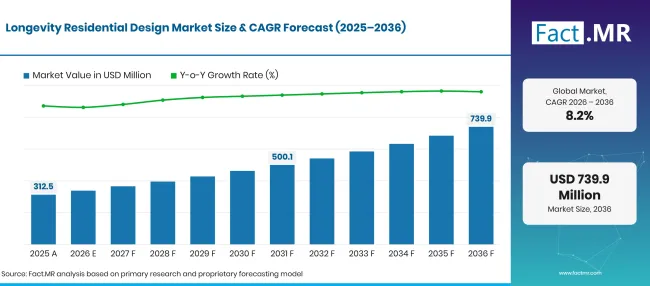
Longevity Residential Design Market Forecast Global | Source: Fact.MR
What are the defining numbers behind Longevity Residential Design Market growth?
The 2026 to 2036 period adds USD 401.9 million in new value, led by indoor environmental quality and homes planned for later life.
- Demand Drivers in the Market
- Indoor air quality is the first concern for many buyers, since people spend on average 90 percent of their time indoors, according to the U.S. Environmental Protection Agency. The agency names source control, ventilation and filtration as the main ways to improve it.
- Preventive wellness is reshaping what premium buyers ask for in a home. Circadian lighting, recovery rooms and movement spaces now shape the floor plan from the start.
- Population ageing widens the pool of households planning for independent living. WHO puts the number of people aged 60 and over at 1.4 billion by 2030, up from 1.1 billion in 2023. Accessible bathrooms and level thresholds help residents stay at home longer.
- Premium housing and hospitality projects use longevity features to stand out. Branded residences add wellness suites and air treatment for health-focused buyers.
- Connected health technology is entering the home, and secure design is becoming part of the brief. NIST guidance on telehealth smart home integration calls for least-privilege access, encrypted patient data and separating patient-owned devices from hospital-managed devices on the home network.
- Key Segments Analyzed
- By Longevity Residential Design Feature: Air / Water Health will hold 34.0% share in 2026, since filtration, ventilation and water treatment address conditions residents face every day.
- By Contract / Payment Model: Bundled Care Package will account for 26.5% of 2026 value, as one contract covering design, systems and follow-up support reduces coordination work for owners.
- By Delivery Channel: Employer Site will capture 29.3% in 2026, helped by employers that fund wellness infrastructure in staff housing and campus residences.
- By Service Beneficiary: Older Adults will represent 26.1% of 2026 demand, owing to their focus on accessible layouts and homes that support independent living.
- Analyst Opinion at Fact.MR
- Shambhu Nath Jha, Principal Consultant at Fact.MR, states, “Longevity residential design will win budget where firms can show measured gains in air, water and light quality and no longer sell wellness as a mood. Older adults and their families will stay the core buyers, yet employer housing and premium developments will widen the base over the next ten years. Providers that join architects, builders and health specialists under one contract will capture the bigger projects.”
- Strategic Implications
- Design firms should publish clear performance targets for ventilation, filtration and water treatment.
- Developers should fix circadian lighting circuits and step-free circulation at the concept stage, since these features cost far less to build in than to retrofit.
- Homeowners should compare bundled packages on what is included after installation, such as filter changes, sensor calibration and periodic reviews of the home.
- Employers funding staff housing should judge providers on how well they tailor spaces to different user groups.
South Korea leads the country set at 10.7%, a full point ahead of China at 9.7%, as a super-aged population meets a highly connected housing stock. The United States follows at 9.4%, only 0.3 points behind China. Japan records 8.3%, held back slightly by a shrinking housing market even though its population is among the oldest anywhere. Germany closes the set at 8.0%, where buyers move cautiously on premium wellness extras.
How does the Longevity Residential Design Market break down by segment?
Air / Water Health will lead Longevity Residential Design Feature at 34.0%; Bundled Care Package will head Contract / Payment Model at 26.5%; Employer Site will top Delivery Channel at 29.3%; Older Adults will hold Service Beneficiary at 26.1% in 2026.
Which Longevity Residential Design Feature leads?
Air / Water Health holds 34.0% of 2026 sales.
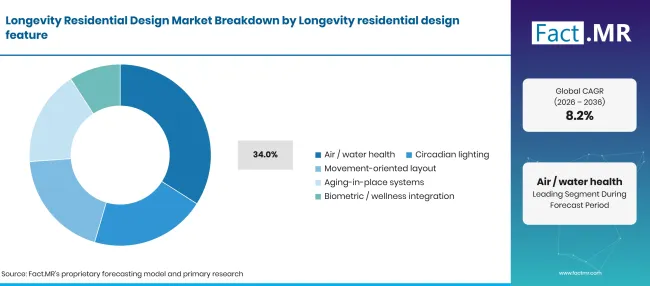
Longevity Residential Design Market Breakdown Longevity Residential Design Feature | Source: Fact.MR
| Longevity Residential Design Feature | Share (2026) |
|---|---|
| Air / Water Health (Leading segment) | 34.0% |
| Other segments combined | 66.0%* |
| Total | 100.0% |
Source: Fact.MR analysis. Updated Nov 13, 2026
Clean air and safe water are the features buyers can sense and test, which makes them the easiest health investment to justify. Projects combine whole-house filtration, balanced ventilation with heat recovery, moisture control and point-of-use water treatment. Many clients start with an air purifier before a ducted system. Circadian Lighting tunes color and intensity across the day to support sleep and alertness. Movement-Oriented Layout places stairs, routes and activity spaces to encourage daily motion. Aging-in-Place Systems cover grab-ready walls, wider doors and level showers, while Biometric / Wellness Integration links sensors and wellness devices with the home. Lighting work often relies on an LED lighting controller to run timed scenes.
What supports Bundled Care Package within Contract / Payment Model?
Bundled Care Package takes 26.5% of 2026 revenue.
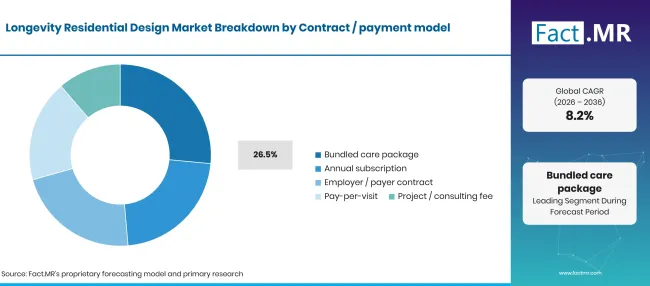
Longevity Residential Design Market Breakdown Contract Payment Model | Source: Fact.MR
| Contract / Payment Model | Share (2026) |
|---|---|
| Bundled Care Package (Leading segment) | 26.5% |
| Other segments combined | 73.5%* |
| Total | 100.0% |
Source: Fact.MR analysis. Updated Nov 13, 2026
Owners rarely want to manage an architect, an air quality engineer, a lighting designer and a wellness coach on separate contracts. A bundle gives them one point of contact, one price and a defined service period after the work is done. Providers gain repeat revenue after handover. Annual Subscription gives recurring access to reviews, upgrades and support. Employer / Payer Contract covers cases where an employer or another payer funds the work for eligible residents. Pay-per-Visit suits one-off assessments, and Project / Consulting Fee covers architecture, planning and specialist design charged by the job.
How does Delivery Channel shape demand?
Employer Site accounts for 29.3% of 2026 value.
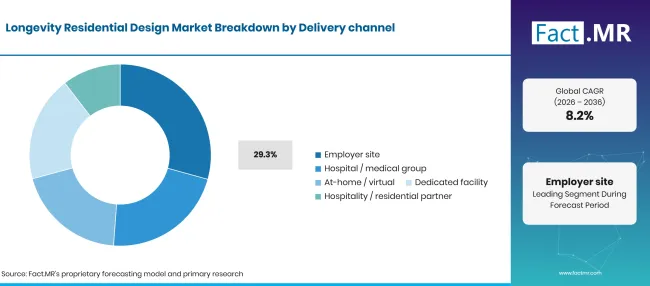
Longevity Residential Design Market Breakdown Delivery Channel | Source: Fact.MR
| Delivery Channel | Share (2026) |
|---|---|
| Employer Site (Leading segment) | 29.3% |
| Other segments combined | 70.7%* |
| Total | 100.0% |
Source: Fact.MR analysis. Updated Nov 13, 2026
Companies with staff housing, executive residences or campus living space treat healthy buildings as part of their benefits package. These projects are large and repeatable, which suits providers with one standard for many units. Hospital / Medical Group work links clinical teams with home design for patients recovering at home, and it often runs alongside geriatric care services for older patients. At-Home / Virtual delivery offers remote assessments and design reviews. Dedicated Facility covers purpose-built longevity centers, and Hospitality / Residential Partner work brings wellness operators into resort and branded residence projects.
Which Service Beneficiary leads?
Older Adults represent 26.1% of 2026 demand.
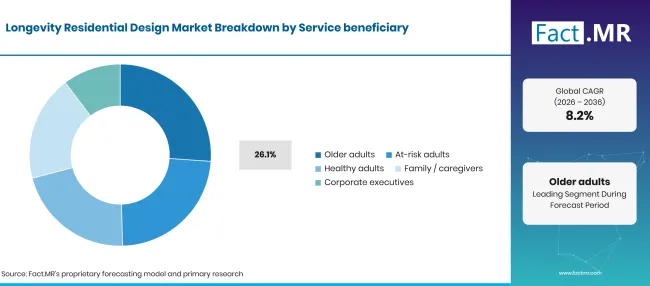
Longevity Residential Design Market Breakdown Service Beneficiary | Source: Fact.MR
| Service Beneficiary | Share (2026) |
|---|---|
| Older Adults (Leading segment) | 26.1% |
| Other segments combined | 73.9%* |
| Total | 100.0% |
Source: Fact.MR analysis. Updated Nov 13, 2026
Households in later life want to stay in familiar homes and avoid an early move into care. WHO estimates that about 15% of adults aged 70 and over live with a mental disorder, and loneliness affects about a quarter of older people. WHO Europe also stresses accessible and inclusive community-based care for older people with care needs. At-Risk Adults look for features that address allergies or poor sleep. Healthy Adults invest early to protect long-term wellbeing. Family / Caregivers seek homes that work for several generations and for a relative who needs help, and many pair layout changes with adaptable home furniture. Corporate Executives favor personalized recovery and performance spaces.
What is accelerating Longevity Residential Design Market adoption, and what is holding it back?
Interest in preventive health and a growing number of older households push buyers toward homes designed for long-term wellbeing. Growth faces limits from high installation and upkeep costs, a small pool of trained specialists, the effort of linking many systems and the lack of shared ways to measure health outcomes in the home.
Drivers Impact Analysis
| DRIVER | (~) % IMPACT ON CAGR | GEOGRAPHIC RELEVANCE | IMPACT TIMELINE |
|---|---|---|---|
| Increasing focus on indoor air and water quality in homes | +1.6% | Global | Short term (<=2 years) |
| Growing interest in preventive wellness and health-oriented home design | +1.3% | North America, Europe, Asia Pacific | Medium term (2-4 years) |
| Rising demand for aging-in-place systems and accessible layouts | +1.1% | Japan, Germany, South Korea, North America | Medium term (2-4 years) |
| Expansion of premium residential and hospitality wellness projects | +0.9% | North America, Middle East, Asia Pacific | Medium term (2-4 years) |
| Integration of biometric and wellness technologies into homes | +0.6% | North America, Europe, East Asia | Long term (>=4 years) |
Source: Fact.MR analysis. Updated Nov 13, 2026
Opportunity Impact Analysis
| OPPORTUNITY | (~) % IMPACT ON CAGR | GEOGRAPHIC RELEVANCE | IMPACT TIMELINE |
|---|---|---|---|
| Integrated air, water and indoor environmental health solutions | +1.3% | Global | Short term (<=2 years) |
| Bundled longevity residential design packages | +1.1% | North America, Europe, Asia Pacific | Medium term (2-4 years) |
| Circadian lighting and biometric wellness technologies in residential projects | +0.9% | North America, Europe, East Asia | Medium term (2-4 years) |
| Aging-in-place and multigenerational residential environments | +0.6% | Japan, Germany, South Korea | Long term (>=4 years) |
Source: Fact.MR analysis. Updated Nov 13, 2026
Restraints Impact Analysis
| RESTRAINT | (~) % IMPACT ON CAGR | GEOGRAPHIC RELEVANCE | IMPACT TIMELINE |
|---|---|---|---|
| High installation and maintenance costs of advanced home wellness systems | -0.7% | Global | Short term (<=2 years) |
| Limited availability of specialized longevity design professionals | -0.4% | Emerging markets | Medium term (2-4 years) |
| Technical complexity of integrating several home wellness systems | -0.3% | Global | Medium term (2-4 years) |
| Uncertain measurable long-term health outcomes and payback | -0.2% | Global | Long term (>=4 years) |
Source: Fact.MR analysis. Updated Nov 13, 2026
Which countries are scaling the Longevity Residential Design Market through 2036?
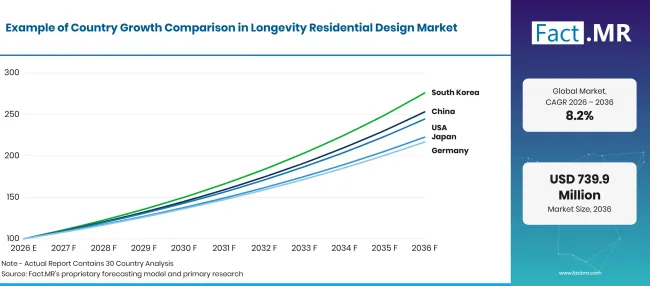
Longevity Residential Design Market Growth Index | Source: Fact.MR
| Country | CAGR (2026 to 2036) |
|---|---|
| South Korea | 10.7% |
| China | 9.7% |
| United States | 9.4% |
| Japan | 8.3% |
| Germany | 8.0% |
Source: Fact.MR analysis. Updated Nov 13, 2026
What supports South Korea’s adoption?
10.7% CAGR, driven by a super-aged population living in highly connected apartment housing.
Statistics Korea reports that the population aged 65 and over passed 10 million in 2025, lifting the aging rate to 20.3% and marking a super-aged society. The same review finds that 40.9% of adults aged 75 and over live alone. Connected apartments make sensors and smart lighting easy to add, and older residents living alone need homes that support safe, independent living.
How is China developing demand?
9.7% CAGR, backed by a vast older population and new premium housing built with smart home systems.
China’s 2025 population sample survey counted 321.22 million people aged 60 and over, or 22.86% of the population. Premium communities in major cities now market filtered fresh air, water purification and age-friendly design as standard features. Demand for a domestic water purifier supports whole-home water upgrades.
What is supporting United States adoption?
9.4% CAGR, helped by a mature wellness real estate culture and strong renovation spending for ageing at home.
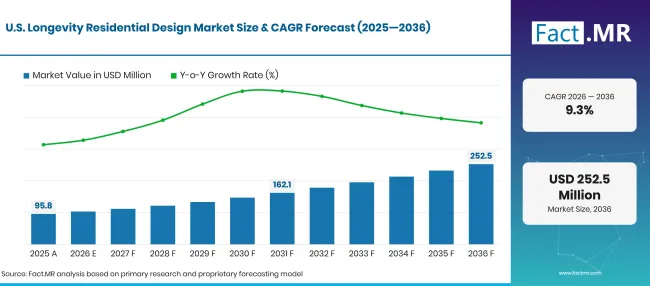
Longevity Residential Design Market Forecast Usa | Source: Fact.MR
The U.S. Census Bureau counted 61.2 million people aged 65 and over in 2024, up 13.0% since 2020, and older adults now outnumber children in 11 states. Homeowners fund renovations for level entries, accessible bathrooms and better ventilation so they can stay put.
What supports Japan’s adoption?
8.3% CAGR, reflecting demographic ageing and steady demand for barrier-free homes.
Japan’s Cabinet Office reports 36.24 million people aged 65 and over as of October 2024, equal to 29.3% of the total population. Barrier-free design is already familiar to builders, so growth centers on retrofits that add better lighting, safe bathrooms and home lifts.
How is Germany scaling demand?
8.0% CAGR, as strict building standards and an older population favor ventilation and accessibility upgrades.
Destatis reports that people aged 60 and over reached 31% of Germany’s population at the end of 2025. Germany’s established building technology sector makes ventilation with heat recovery and water quality systems easy to source. Buyers fund accessible layouts and indoor air upgrades first.
Who leads the Longevity Residential Design Market?
The field splits into three groups that compete on different strengths. Specialist longevity architects and advisors, such as MAVI, Vera Iconica Architecture and UHURU MGMT + LIVING, win on scientific design briefs and personal service for high-net-worth clients.
Vera Iconica Architecture markets its Longevity Home as a set of customizable components covering building biology, acoustics, lighting and non-toxic materials. Builders and design houses such as Blue Heron and Visionnaire bring health features into finished homes and interiors at scale, and Blue Heron links biophilic design at Lake Las Vegas with resident wellness and longevity. Product makers such as Aritco supply the hardware that keeps homes usable as mobility changes, and the company frames home lifts as part of longevity architecture that lets residents keep every floor in use. Competition will turn on proof of performance, after-sales support and the ability to bring many trades under one contract.
Which companies are the key providers?
Key companies in the Longevity Residential Design Market include MAVI, UHURU MGMT + LIVING, Vera Iconica Architecture, Blue Heron, Visionnaire and Aritco.
- MAVI
- UHURU MGMT + LIVING
- Vera Iconica Architecture
- Blue Heron
- Visionnaire
- Aritco
Bibliography
- Aritco. (2026, August). Designing Homes for Life: Why Longevity Architecture is the Future of Living Well.
- Blue Heron. (2026, July 22). Luxury New Homes at Lake Las Vegas.
- Cabinet Office, Government of Japan. (2025, June). Annual Report on the Ageing Society: Summary FY2025.
- Federal Statistical Office of Germany (Destatis). (2026, June 16). Bevölkerung Deutschlands sinkt im Jahr 2025 um 0,1 %.
- National Bureau of Statistics of China. (2026, May 22). Communiqué of the 1% National Population Sample Survey in 2025.
- National Institute of Standards and Technology. (2025, December 17). Mitigating Cybersecurity and Privacy Risks in Telehealth Smart Home Integration.
- Statistics Korea. (2026, January 20). Korean Social Trends 2025: Health and Care of the Late-Old.
- U.S. Census Bureau. (2025, June 26). Older Adults Outnumber Children in 11 States and Nearly Half of U.S. Counties.
- U.S. Environmental Protection Agency. (2026, June 23). Factsheet: What is Indoor Air Quality?.
- Vera Iconica Architecture. (2026, February 18). Longevity Home.
- World Health Organization. (2025, February 21). Ageing: Global population.
- World Health Organization. (2026, July 20). Mental health of older adults.
- World Health Organization Regional Office for Europe. (2025, June 16). Mapping community-based care and support for people with disabilities and older adults with care needs.
This Report Answers
- How much value longevity residential design will add between 2026 and 2036, and which feature, contract model, channel and beneficiary group lead each segment.
- Why indoor air and water quality carry more buyer spending than other health features in the home.
- Which payment models suit homeowners, employers and developers, and how bundles change the way projects are bought.
- Where South Korea, China, the United States, Japan and Germany differ in pace, and what explains the gaps.
- How specialist architects, builders and product makers compete for projects and what sets each group apart.
What does the Longevity Residential Design Market cover?
This market tracks revenue from design and integration services that build longevity and wellness principles into homes and residential communities. Work spans new builds, renovations and fit-outs.
Value is counted at the point of the design and integration contract, including bundled systems, subscriptions and consulting fees.
What is included in the scope?
Air and water health solutions, circadian lighting, movement-oriented layouts and aging-in-place systems delivered as part of a residential design brief.
Biometric and wellness integration where sensors and devices form part of a wider home design, including secure network planning.
Bundled care packages, annual subscriptions, employer or payer contracts, pay-per-visit services and project or consulting fees.
Delivery through employer sites, hospitals and medical groups, at-home and virtual channels, dedicated facilities and hospitality partners, including tunable LED lighting solutions specified for resort homes.
What is excluded from the scope?
Conventional construction, interior decoration and renovation without a defined health or longevity component.
Standalone diagnostic tests, health screening and clinical treatment not tied to a residential design solution.
Retail sales of consumer wellness devices, fitness equipment and health apps outside a home design package.
Ordinary property management and accommodation services that carry no specialized longevity features.
How Was the Analysis Built?
The analysis draws on 120+ sources, 35+ company portfolios, 25+ countries, and more than 20 industry interviews.
- Primary Research: Primary research includes discussions with manufacturers, service providers, technology developers, distributors, end users, and subject-matter experts. These conversations examine purchasing priorities, product adoption, operational challenges, approval requirements, competitive positioning, and the factors that influence wider market acceptance.
- Desk Research: Desk research covers government statistics, regulatory publications, company filings, trade data, technical studies, industry associations, standards, public policy, and other authoritative sources. Every source used in the analysis is documented in the bibliography.
- Market Sizing and Forecasting: Market estimates combine historical performance, demand indicators, pricing and volume trends, segment shares, company participation, country-level growth, adoption patterns, investment activity, and barriers to market expansion.
- Data Validation and Update Cycle: Findings are validated by comparing primary interviews with public data, company activity, regulatory changes, trade patterns, and industry developments. Regular updates review new product launches, capacity changes, partnerships, approvals, and shifts in commercial adoption.
Segmentation
What is the report’s scope and coverage?
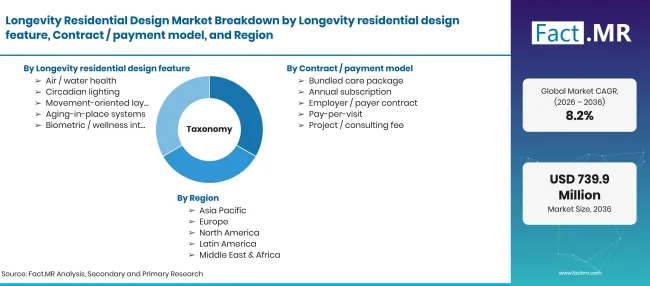
Longevity Residential Design Market Taxonomy | Source: Fact.MR
| Attribute | Details |
|---|---|
| Quantitative Units | USD million in 2026 to USD million by 2036 at CAGR |
| Market Definition | Residential design solutions that build longevity, preventive wellness, indoor environmental health, accessibility and health-oriented technology into homes and residential communities. |
| Longevity Residential Design Feature | Air / Water Health; Circadian Lighting; Movement-Oriented Layout; Aging-in-Place Systems; Biometric / Wellness Integration |
| Contract / Payment Model | Bundled Care Package; Annual Subscription; Employer / Payer Contract; Pay-per-Visit; Project / Consulting Fee |
| Delivery Channel | Employer Site; Hospital / Medical Group; At-Home / Virtual; Dedicated Facility; Hospitality / Residential Partner |
| Service Beneficiary | Older Adults; At-Risk Adults; Healthy Adults; Family / Caregivers; Corporate Executives |
| Regions Covered | North America; Latin America; Western Europe; Eastern Europe; East Asia; South Asia & Pacific; Middle East & Africa |
| Countries Covered | South Korea; China; United States; Japan; Germany |
| Companies Profiled | MAVI; UHURU MGMT + LIVING; Vera Iconica Architecture; Blue Heron; Visionnaire; Aritco |
| Forecast Period | 2026 to 2036 |
| Approach | Market values, segment leaders and country growth rates are assessed alongside provider portfolios, contract models and delivery channels for health-focused homes. |
Source: Fact.MR analysis. Updated Nov 13, 2026
How is the market segmented?
-
By Longevity Residential Design Feature
- Air / Water Health
- Circadian Lighting
- Movement-Oriented Layout
- Aging-in-Place Systems
- Biometric / Wellness Integration
-
By Contract / Payment Model
- Bundled Care Package
- Annual Subscription
- Employer / Payer Contract
- Pay-per-Visit
- Project / Consulting Fee
-
By Delivery Channel
- Employer Site
- Hospital / Medical Group
- At-Home / Virtual
- Dedicated Facility
- Hospitality / Residential Partner
-
By Service Beneficiary
- Older Adults
- At-Risk Adults
- Healthy Adults
- Family / Caregivers
- Corporate Executives
-
By Region
- North America
- Latin America
- Western Europe
- Eastern Europe
- East Asia
- South Asia & Pacific
- Middle East & Africa
Frequently Asked Questions
How large is the longevity residential design market in 2026?
What growth rate will the longevity residential design market record?
Which longevity residential design feature leads?
Which contract or payment model leads?
Which delivery channel leads?
Which service beneficiary leads?
Which country will grow quickest?
Who are the main companies?
What holds the market back?
Who worked on this report


Preview the report firsthand - request a free sample
Free SampleGet the brochure for pricing and purchase details
Download PDF