5-Hydroxymethylfurfural Market Size, Share, Growth and Forecast (2026 - 2036)

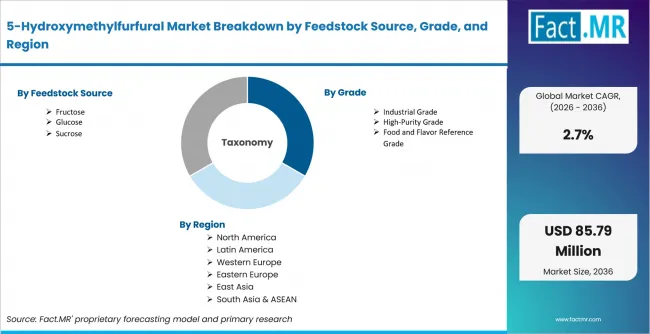
The 5-Hydroxymethylfurfural Market is analyzed by feedstock source, including fructose, glucose and sucrose, along with grade, production process, application, end-use industry, and region, forecast 2026 to 2036.

5-Hydroxymethylfurfural Market Size, Market Forecast and Outlook by Fact.MR

  • The 5-hydroxymethylfurfural market was valued at USD 64.0 million in 2025. Demand is expected to increase from USD 65.7 million in 2026 to USD 85.8 million by 2036.
  • The market is forecast to record 2.7% CAGR during 2026 to 2036 as bio-based chemical developers use HMF in FDCA and renewable polymer intermediates.
  • 5-hydroxymethylfurfural demand is becoming more application based. A 2025 RSC Advances study describes the conversion of 5-HMF into FDCA, a key monomer for next-generation biodegradable plastics.
  • Chemical developers need HMF routes that can move from laboratory work to repeatable production. This supports the role of HMF as a platform chemical for renewable material development.
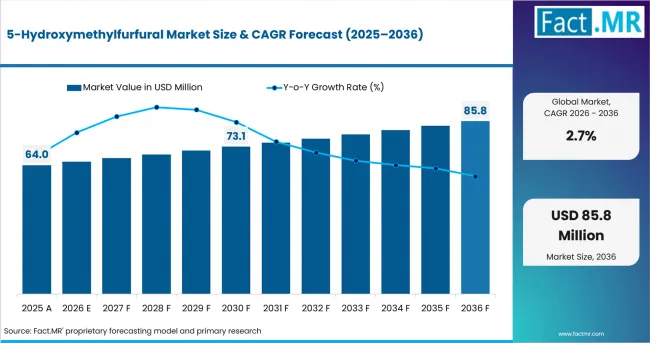
5 Hydroxymethylfurfural Market Value Analysis

Summary of 5-Hydroxymethylfurfural Market

  • Demand Drivers in the Market
    • Renewable Chemistry: Chemical developers use HMF as a platform molecule for furan-based intermediates.
    • FDCA Route: Polymer developers assess HMF-linked chemistry for FDCA and PEF value chains.
    • Purity Demand: Research and fine chemical users need controlled grades for synthesis and testing.
  • Key Segments Analyzed
    • By Feedstock Source: Fructose is expected to hold 44.0% share in 2026 because it offers a more established route for HMF formation.
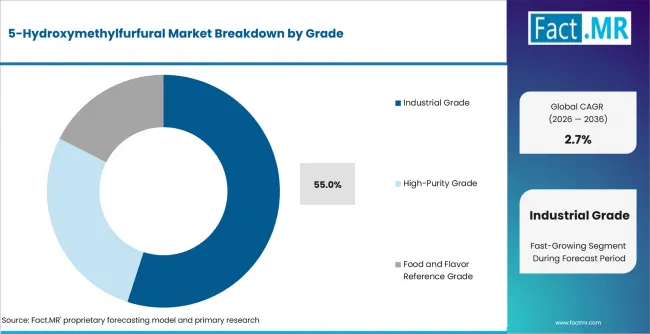
    • By Grade: Industrial grade leads because chemical conversion and intermediate production use larger volumes. The segment is likely to account for 55.0% share in 2026.
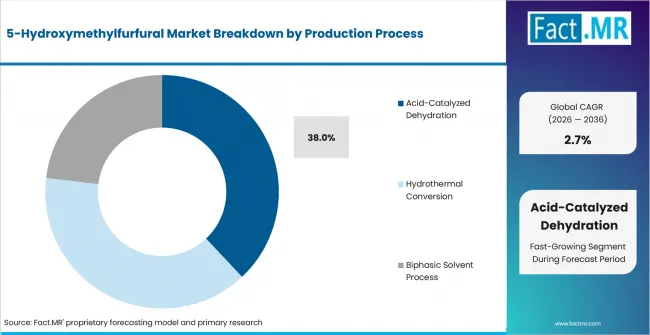
    • By Production Process: Acid-catalyzed dehydration is projected to hold 38.0% share in 2026 as sugar dehydration remains the main HMF production route.
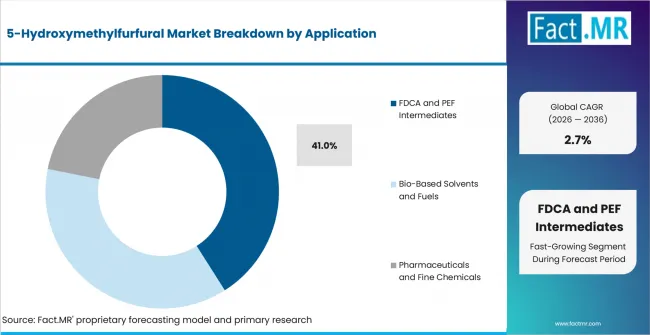
    • By Application: FDCA and PEF intermediates lead as renewable polyester development creates the strongest downstream pull. The segment is anticipated to capture 41.0% share in 2026.
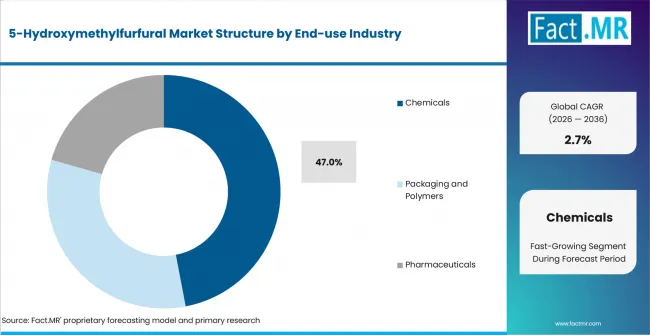
    • By End-use Industry: Chemicals are expected to hold 47.0% share in 2026 because HMF is mainly used as a specialty chemical intermediate.
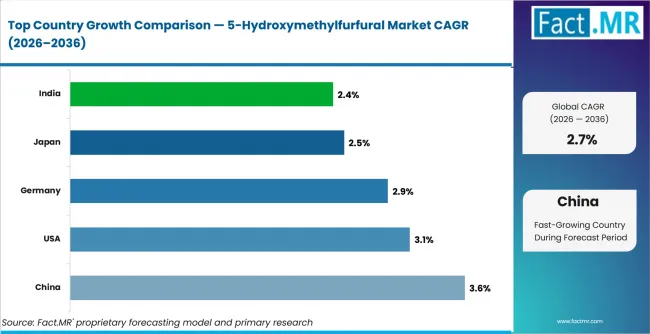
    • By Geography: China is projected to record 3.6% CAGR through 2036 as bio-based chemicals and specialty chemical production expand.
  • Analyst Opinion at Fact.MR
    • Shambhunath Jha, Principal Consultant at Fact.MR, states, “5-hydroxymethylfurfural is still moving through controlled scale-up. Interest is coming from FDCA and specialty chemistry. Suppliers that prove purity control and stable process economics will gain stronger customer access.”
  • Strategic Implications
    • Process Control: HMF producers need higher yield and purification discipline to reduce customer qualification delays.
    • Downstream Fit: Chemical firms should match HMF grade with FDCA or fine chemical requirements.
    • Partnership Route: Technology developers need application partners that can validate HMF-derived materials at commercial scale.
Metric Value
Industry Size 2026 USD 65.7 million
Industry Value 2036 USD 85.8 million
CAGR 2026 to 2036 2.7%

The market is still small because HMF commercialization depends on process yield and downstream approval. FDCA and PEF-related chemistry provides the strongest growth route. Food quality testing and research use create stable but smaller demand. Pharmaceutical and fine chemical applications need higher-purity material, which keeps grade control important.

China is projected to record 3.6% CAGR by 2036 as bio-based chemicals and specialty chemical production expand. The United States is likely to post 3.1% CAGR as renewable polymer and fine chemical programs support demand. Germany is expected to register 2.9% CAGR because specialty chemicals and polymer research sustain HMF use. Japan is forecast to advance at 2.5% CAGR through 2036 as high-purity chemical demand and food testing support purchases. India is set to record 2.4% CAGR as chemical research and bio-based material testing grow from a smaller base.

Segmental Analysis

5-Hydroxymethylfurfural Market Analysis by Feedstock Source
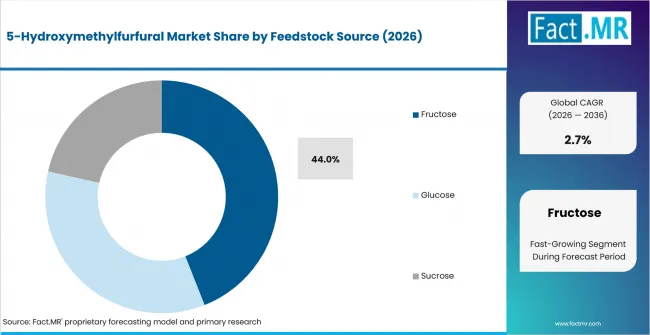
5 Hydroxymethylfurfural Market Analysis By Feedstock Source

Fructose is likely to hold 44.0% share in 2026 because it offers a clearer route for HMF production. Fructose dehydration is widely used in HMF process development because it gives better conversion than several other sugars. Glucose is gaining interest due to wider availability and lower cost, though conversion needs better process control. Sucrose can be used after hydrolysis. Cellulosic sugars support longer-term renewable feedstock planning. Mixed biomass hydrolysates may gain use once impurity control improves. Avantium’s YXY technology converts plant-based sugars into FDCA through its renewable polymer value chain. [2]

  • Fructose Route: Fructose supports cleaner HMF conversion in early commercial and pilot-scale production systems.
  • Glucose Access: Glucose offers wider feedstock availability but needs better conversion and purification control.
  • Cellulosic Path: Cellulosic sugars can improve renewable sourcing once hydrolysate impurities are managed effectively.

5-Hydroxymethylfurfural Market Analysis by Grade
5 Hydroxymethylfurfural Market Analysis By Grade

Industrial grade leads because chemical conversion and intermediate production use larger volumes. Chemical producers use this grade for FDCA routes and bio-based solvent development. The segment is likely to hold 55.0% share in 2026 as most commercial HMF use is chemical-processing oriented. High-purity grade serves fine chemicals and sensitive synthesis work. Food and flavor reference grade supports quality testing and controlled formulation work. Research grade serves universities and laboratories.

  • Industrial Use: Industrial grade supports higher-volume chemical conversion and renewable intermediate development.
  • Purity Control: High-purity material serves fine chemical synthesis and controlled laboratory workflows.
  • Research Demand: Research grade supports universities and application teams testing HMF-derived chemistry routes.

5-Hydroxymethylfurfural Market Analysis by Production Process
5 Hydroxymethylfurfural Market Analysis By Production Process

Acid-catalyzed dehydration is forecast to hold 38.0% share in 2026 because sugar dehydration is the main HMF production route. Producers use acid catalysts to convert hexose sugars into HMF under controlled reaction conditions. Hydrothermal conversion supports water-based processing and biomass feedstock routes. Biphasic solvent systems help reduce side reactions by moving HMF into a separate phase. Continuous-flow processing supports better heat control and process stability. Catalytic conversion routes connect HMF output with FDCA and other furan derivatives. A 2024 WIPO patent publication describes a two-stage continuous-flow process for HMF purification and selective oxidation toward FDCA. [3]

  • Dehydration Base: Acid-catalyzed routes remain central because hexose sugars can convert directly into HMF.
  • Flow Control: Continuous-flow systems improve heat management and help reduce unwanted side reactions.
  • FDCA Link: Catalytic routes connect HMF production with downstream oxidation into renewable polymer intermediates.

5-Hydroxymethylfurfural Market Analysis by Application
5 Hydroxymethylfurfural Market Analysis By Application

FDCA and PEF intermediates lead because renewable polyester development creates the strongest downstream pull. HMF can support routes toward FDCA, which is used in PEF chemistry. The segment is expected to contribute 41.0% share in 2026 as polymer companies need renewable monomer pathways. Bio-based solvents and fuels use HMF derivatives for energy and specialty solvent research. Pharmaceuticals and fine chemicals use HMF in selected synthesis work. Food quality testing uses HMF as a marker for heat processing and sugar degradation. Specialty resins and coatings are smaller outlets. Avantium announced in 2024 that the U.S. FDA accepted food-contact use of its PEF for packaging applications. [4]

  • Polymer Route: FDCA and PEF applications create the strongest demand pull for HMF-linked chemistry.
  • Testing Role: Food quality labs use HMF measurement to assess heat exposure and sugar degradation.
  • Fine Chemicals: Pharmaceutical and specialty users need controlled HMF grades for selective synthesis routes.

5-Hydroxymethylfurfural Market Analysis by End-use Industry
5 Hydroxymethylfurfural Market Analysis By End Use Industry

Chemicals are likely to hold 47.0% share in 2026 because HMF is mainly used as a specialty chemical intermediate. Chemical companies use HMF to make furan derivatives and renewable building blocks. Packaging and polymers follow because PEF development connects HMF chemistry with FDCA. Pharmaceuticals use higher-purity HMF in selected synthesis routes. Food and beverage testing uses HMF for analytical reference and quality control. Research institutes support early-stage work on new conversion pathways. End-use adoption depends on stable supply and downstream validation.

  • Chemical Intermediates: Chemical producers use HMF to develop furan derivatives and renewable building blocks.
  • Polymer Development: Packaging firms assess HMF-linked chemistry through FDCA and PEF commercialization pathways.
  • Analytical Use: Food laboratories use HMF standards to support heat-process and quality testing.

5-Hydroxymethylfurfural Market Drivers, Restraints, and Opportunities
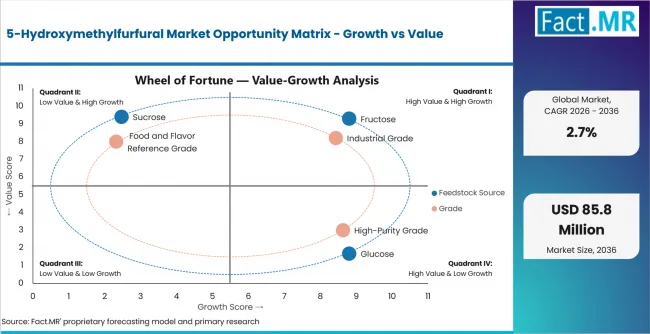
5 Hydroxymethylfurfural Market Opportunity Matrix Growth Vs Value

Renewable chemical development and FDCA-linked polymer commercialization are the main drivers for 5-hydroxymethylfurfural demand. EPC and Avantium announced in 2025 that they would collaborate to commercialize continuous PEF production technology. [5] HMF benefits from this direction because furan chemistry supports bio-based polyester value chains and specialty monomer development.

Scale and cost are the main restraints. HMF can degrade or form side products if reaction and purification conditions are poorly controlled. Higher-purity material costs more and limits wider use in price-sensitive applications. Commercial users need stable supply before qualifying HMF in production recipes. This slows the move from research demand to larger industrial use.

Opportunities in the 5-Hydroxymethylfurfural Market

  • FDCA Pathways: HMF suppliers can target polymer developers working on renewable polyester intermediates.
  • Continuous Processing: Producers can lower variability through better flow chemistry and purification systems.
  • Food Testing: Analytical suppliers can support labs that monitor HMF in heat-processed foods.

Regional Analysis

Based on regional analysis, the 5-hydroxymethylfurfural market is segmented into North America, Latin America, Western Europe, Eastern Europe, East Asia, South Asia and Pacific, and Middle East and Africa.

Top Country Growth Comparison 5 Hydroxymethylfurfural Market Cagr (2026 2036)

Country CAGR (2026 to 2036)
China 3.6%
United States 3.1%
Germany 2.9%
Japan 2.5%
India 2.4%

5 Hydroxymethylfurfural Market Cagr Analysis By Country

East Asia 5-Hydroxymethylfurfural Market Analysis
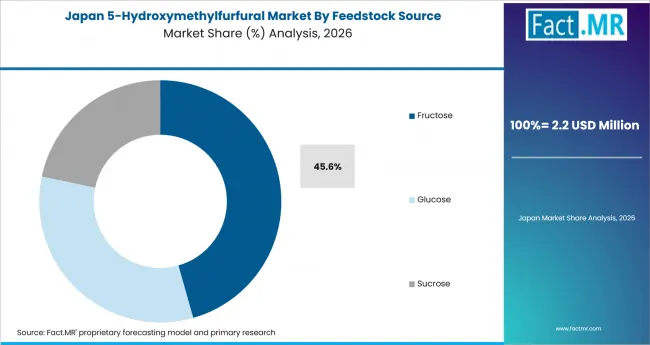
5 Hydroxymethylfurfural Market Japan Market Share Analysis By Feedstock Source

East Asia demand comes from specialty chemicals and analytical testing. China leads regional demand because it has a large chemical production base and rising bio-based material activity. Japan has steadier demand through high-purity chemicals and food testing. Regional adoption will rely on supply consistency and qualified application data.

  • China: China is likely to expand at 3.6% CAGR through 2036 as bio-based chemicals and specialty chemical production increase. Chemical producers can use HMF for furan derivatives and FDCA-linked development. Domestic research institutes are active in biomass conversion and catalytic chemistry. Food testing laboratories use HMF as an analytical reference. Scale-up economics will decide wider industrial use.
  • Japan: Japan has a more quality-focused HMF demand profile. Fine chemical users and food testing laboratories need consistent grades and documentation. The country is set to reach 2.5% CAGR by 2036 as high-purity chemical demand and food testing support purchases. Polymer research can support HMF-linked FDCA interest. Adoption is slower because large-scale production use is still limited.

North America 5-Hydroxymethylfurfural Market Analysis
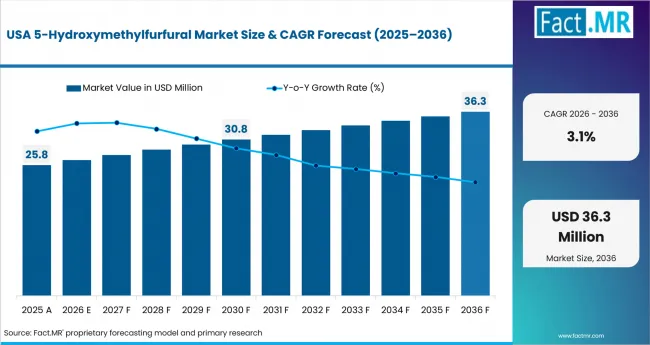
5 Hydroxymethylfurfural Market Country Value Analysis

North America demand is led by the United States because renewable polymer research and fine chemical development support HMF use. Universities and chemical firms work on biomass-derived intermediates. Food testing and pharmaceutical research add smaller but stable demand. Commercial adoption depends on cost and availability.

  • United States: The United States is forecast to rise at 3.1% CAGR through 2036 as renewable polymer and fine chemical programs support demand. Chemical developers use HMF in bio-based intermediate research and FDCA-linked pathways. Food laboratories use HMF testing for heat-processed products. Pharmaceutical and fine chemical users need high-purity grades for selective synthesis. Production cost limits wider use.

Western Europe 5-Hydroxymethylfurfural Market Analysis
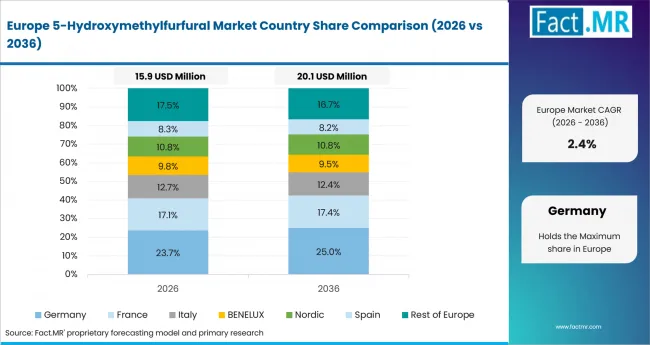
5 Hydroxymethylfurfural Market Europe Country Market Share Analysis, 2026 & 2036

Western Europe demand comes from renewable chemistry and specialty chemical research. Germany leads the regional view because chemical companies and research institutions continue to test bio-based intermediates. The Netherlands supports supply-chain relevance through Avantium’s FDCA and PEF activities.

  • Germany: Germany advances at 2.9% CAGR because specialty chemicals and polymer research sustain HMF use. Chemical firms use HMF for furan intermediates and renewable material testing. Universities and applied research institutes support catalytic conversion work. Packaging and polymer developers track FDCA and PEF commercialization. High production cost limits immediate bulk use.

South Asia 5-Hydroxymethylfurfural Market Analysis

South Asia demand starts from a smaller base because HMF use is still concentrated in research and analytical testing. India leads the regional outlook through chemical research and bio-based material testing.

  • India: India is expected to reach 2.4% CAGR through 2036 as chemical research and bio-based material testing expand from a smaller base. Pharmaceutical intermediates and fine chemical labs can use high-purity HMF in selective synthesis. Academic research supports biomass conversion work. Food testing laboratories use HMF as an analytical reference in heat-processed products. Wider industrial adoption will need lower production cost.

Competitive Aligners for Market Suppliers
5 Hydroxymethylfurfural Market Analysis By Company

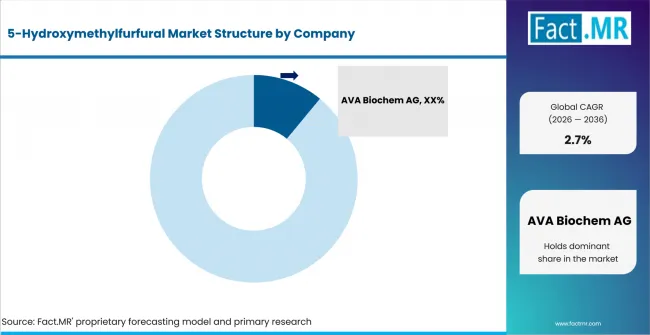
The 5-hydroxymethylfurfural market includes companies active in renewable chemicals and specialty reagent supply. AVA Biochem AG supports bio-based HMF supply for industrial use. Avantium N.V. is connected with furan chemistry through FDCA and PEF development. This work supports interest in HMF as a platform chemical for future bio-based materials.

Merck KGaA, Tokyo Chemical Industry Co., Ltd., and Carl Roth GmbH + Co. KG serve research users that need high-purity HMF in smaller packs. Product documentation and impurity control are important for laboratory work. Industrial users need stable technical grades before moving into pilot production.

Competition will rely on cost-efficient production and consistent material quality during the forecast period. HMF can degrade during processing, so suppliers must manage purity risk carefully. Companies that can serve research demand and industrial scale-up needs will be better placed.

Key Companies in 5-Hydroxymethylfurfural Market

  • AVA Biochem AG
  • Avantium N.V.
  • Merck KGaA
  • Tokyo Chemical Industry Co., Ltd.
  • Carl Roth GmbH + Co. KG

Bibliography

  • [1] Gujar, R. J., Thombe, R. T., & Dhindale, P. (2025, September 8). Selective and green conversion of 5-HMF to FDCA via enzymatic (laccase) and transition metal (MnO₂ and Co-Mn/AC) catalysis in an integrated system. RSC Advances, 15, 32337-32360.
  • [2] Avantium N.V. (2026, March 18). Annual report 2025. Avantium N.V.
  • [3] World Intellectual Property Organization. (2024, December 12). WO2024250101A1: Two-stage continuous-flow process for the preparation of 5-hydroxymethylfurfural and 2,5-furandicarboxylic acid. WIPO.
  • [4] Avantium N.V. (2024, October 8). FDA approves Avantium’s PEF for food contact applications in the United States. Avantium N.V.
  • [5] EPC Engineering & Technologies GmbH. (2025, February 5). EPC Engineering & Technologies and Avantium collaborate to commercialize continuous PEF production technology. EPC Engineering & Technologies GmbH.

This Report Addresses

  • Strategic intelligence on 5-hydroxymethylfurfural demand across feedstock source, grade, production process, application, and end-use industry.
  • Forecast mapping from USD 65.7 million in 2026 to USD 85.8 million by 2036.
  • Segment analysis covering fructose, industrial grade, acid-catalyzed dehydration, FDCA and PEF intermediates, and chemicals.
  • Regional outlook covering China, the United States, Germany, Japan, and India.
  • Competitive analysis of AVA Biochem AG, Avantium N.V., Merck KGaA, Tokyo Chemical Industry Co., Ltd., Carl Roth GmbH + Co. KG.
  • Grade assessment covering industrial grade, high-purity grade, food and flavor reference grade, research grade, and pharmaceutical intermediate grade.
  • Application assessment covering FDCA, PEF, bio-based solvents, pharmaceuticals, food testing, and specialty resins.
  • Primary interviews, supplier checks, official source review, and specialty chemical workflow validation support the forecast.

5-Hydroxymethylfurfural Market Definition

The 5-hydroxymethylfurfural market covers HMF and HMF-derived products used as renewable chemical intermediates. HMF is produced mainly from carbohydrate feedstocks through dehydration and related catalytic processes. The market differs from general furan chemical demand because HMF is valued as a platform molecule for FDCA and polymer intermediates.

5-Hydroxymethylfurfural Market Inclusions

The scope includes industrial-grade and pharmaceutical-intermediate-grade 5-hydroxymethylfurfural. It includes HMF made from fructose and mixed biomass hydrolysates. HMF used for FDCA and specialty chemicals is included.

5-Hydroxymethylfurfural Market Exclusions

The scope excludes furfural and other furan chemicals sold as separate commercial products. It excludes general biomass sugars when they are not converted into HMF. Laboratory samples are excluded when they are not tied to commercial application testing or qualified customer supply.

5-Hydroxymethylfurfural Market Research Methodology

  • Primary Research
    • Primary research includes interviews with bio-based chemical developers and specialty chemical distributors. It includes input from polymer research teams and chemical synthesis suppliers.
  • Desk Research
    • Desk research reviews company technology updates and product safety data. It covers HMF production routes and high-purity chemical references.
  • Market-Sizing and Forecasting
    • Forecasting uses feedstock source demand and grade movement. Production process adoption and end-use industry demand support the market assessment.
  • Data Validation and Update Cycle
    • Forecasts are validated through supplier checks and research customer feedback. HMF project activity and FDCA-linked commercialization signals help confirm market direction.

Scope of the Report

5 Hydroxymethylfurfural Market Breakdown By Feedstock Source, Grade, And Region

Attribute Details
Quantitative Units USD 65.7 million in 2026 to USD 85.8 million by 2036 at 2.7% CAGR
Market Definition HMF and HMF-derived products used as renewable chemical intermediates
Feedstock Source Fructose, Glucose, Sucrose, Cellulosic Sugars, Mixed Biomass Hydrolysates
Grade Industrial Grade, High-Purity Grade, Food and Flavor Reference Grade, Research Grade, Pharmaceutical Intermediate Grade
Production Process Acid-Catalyzed Dehydration, Hydrothermal Conversion, Biphasic Solvent Process, Continuous-Flow Processing, Catalytic Conversion-Linked Routes
Application FDCA and PEF Intermediates, Bio-Based Solvents and Fuels, Pharmaceuticals and Fine Chemicals, Food Quality Testing, Specialty Resins and Coatings
End-use Industry Chemicals, Packaging and Polymers, Pharmaceuticals, Food and Beverage Testing, Research Institutes
Regions Covered North America, Latin America, Western Europe, Eastern Europe, East Asia, South Asia and Pacific, Middle East and Africa
Countries Covered China, United States, Germany, Japan, India
Key Companies Profiled AVA Biochem AG, Avantium N.V., Merck KGaA, Tokyo Chemical Industry Co., Ltd., Carl Roth GmbH + Co. KG
Forecast Period 2026 to 2036
Approach Hybrid top-down and bottom-up approach using feedstock source demand, grade mix, process adoption, application movement, end-use industry demand, and regional validation

5-Hydroxymethylfurfural Market Analysis by Segments

  • By Feedstock Source:

    • Fructose
    • Glucose
    • Sucrose
    • Cellulosic Sugars
    • Mixed Biomass Hydrolysates
  • By Grade:

    • Industrial Grade
    • High-Purity Grade
    • Food and Flavor Reference Grade
    • Research Grade
    • Pharmaceutical Intermediate Grade
  • By Production Process:

    • Acid-Catalyzed Dehydration
    • Hydrothermal Conversion
    • Biphasic Solvent Process
    • Continuous-Flow Processing
    • Catalytic Conversion-Linked Routes
  • By Application:

    • FDCA and PEF Intermediates
    • Bio-Based Solvents and Fuels
    • Pharmaceuticals and Fine Chemicals
    • Food Quality Testing
    • Specialty Resins and Coatings
  • By End-use Industry:

    • Chemicals
    • Packaging and Polymers
    • Pharmaceuticals
    • Food and Beverage Testing
    • Research Institutes
  • Region:

    • North America
      • United States
      • Canada
    • Europe
      • Germany
      • United Kingdom
      • France
      • Italy
      • Spain
    • Asia Pacific
      • China
      • Japan
      • South Korea
      • Taiwan
      • Singapore
    • Latin America
      • Brazil
      • Mexico
      • Argentina
    • Middle East & Africa
      • GCC Countries
      • South Africa
      • Israel

- Frequently Asked Questions -

At what rate will 5-Hydroxymethylfurfural market grow from 2021 to 2031?

The 5-Hydroxymethylfurfural market is expected to grow at a 2.51% CAGR from 2021 to 2031

What is the expected market value for the 5-Hydroxymethylfurfural market in 2031?

By 2031-end, 5-Hydroxymethylfurfural sales are likely to reach US$ 96.80 Billion

Which are some leading players in the 5-Hydroxymethylfurfural market?

Merck, Zhejiang Sugar Energy Technology Co. Ltd., AVA Biochem, Penta Manufacturer, and Robinson Brothers are some leading 5-Hydroxymethylfurfural market players.

Table of Content

  1. Executive Summary
    • Global Market Outlook
    • Demand to side Trends
    • Supply to side Trends
    • Technology Roadmap Analysis
    • Analysis and Recommendations
  2. Market Overview
    • Market Coverage / Taxonomy
    • Market Definition / Scope / Limitations
  3. Research Methodology
    • Chapter Orientation
    • Analytical Lens and Working Hypotheses
      • Market Structure, Signals, and Trend Drivers
      • Benchmarking and Cross-market Comparability
      • Market Sizing, Forecasting, and Opportunity Mapping
    • Research Design and Evidence Framework
      • Desk Research Programme (Secondary Evidence)
        • Company Annual and Sustainability Reports
        • Peer-reviewed Journals and Academic Literature
        • Corporate Websites, Product Literature, and Technical Notes
        • Earnings Decks and Investor Briefings
        • Statutory Filings and Regulatory Disclosures
        • Technical White Papers and Standards Notes
        • Trade Journals, Industry Magazines, and Analyst Briefs
        • Conference Proceedings, Webinars, and Seminar Materials
        • Government Statistics Portals and Public Data Releases
        • Press Releases and Reputable Media Coverage
        • Specialist Newsletters and Curated Briefings
        • Sector Databases and Reference Repositories
        • Fact.MR Internal Proprietary Databases and Historical Market Datasets
        • Subscription Datasets and Paid Sources
        • Social Channels, Communities, and Digital Listening Inputs
        • Additional Desk Sources
      • Expert Input and Fieldwork (Primary Evidence)
        • Primary Modes
          • Qualitative Interviews and Expert Elicitation
          • Quantitative Surveys and Structured Data Capture
          • Blended Approach
        • Why Primary Evidence is Used
        • Field Techniques
          • Interviews
          • Surveys
          • Focus Groups
          • Observational and In-context Research
          • Social and Community Interactions
        • Stakeholder Universe Engaged
          • C-suite Leaders
          • Board Members
          • Presidents and Vice Presidents
          • R&D and Innovation Heads
          • Technical Specialists
          • Domain Subject-matter Experts
          • Scientists
          • Physicians and Other Healthcare Professionals
        • Governance, Ethics, and Data Stewardship
          • Research Ethics
          • Data Integrity and Handling
      • Tooling, Models, and Reference Databases
    • Data Engineering and Model Build
      • Data Acquisition and Ingestion
      • Cleaning, Normalisation, and Verification
      • Synthesis, Triangulation, and Analysis
    • Quality Assurance and Audit Trail
  4. Market Background
    • Market Dynamics
      • Drivers
      • Restraints
      • Opportunity
      • Trends
    • Scenario Forecast
      • Demand in Optimistic Scenario
      • Demand in Likely Scenario
      • Demand in Conservative Scenario
    • Opportunity Map Analysis
    • Product Life Cycle Analysis
    • Supply Chain Analysis
    • Investment Feasibility Matrix
    • Value Chain Analysis
    • PESTLE and Porter’s Analysis
    • Regulatory Landscape
    • Regional Parent Market Outlook
    • Production and Consumption Statistics
    • Import and Export Statistics
  5. Global Market Analysis 2021 to 2025 and Forecast, 2026 to 2036
    • Historical Market Size Value (USD Million) Analysis, 2021 to 2025
    • Current and Future Market Size Value (USD Million) Projections, 2026 to 2036
      • Y to o to Y Growth Trend Analysis
      • Absolute $ Opportunity Analysis
  6. Global Market Pricing Analysis 2021 to 2025 and Forecast 2026 to 2036
  7. Global Market Analysis 2021 to 2025 and Forecast 2026 to 2036, By Solution Type
    • Introduction / Key Findings
    • Historical Market Size Value (USD Million) Analysis By Solution Type , 2021 to 2025
    • Current and Future Market Size Value (USD Million) Analysis and Forecast By Solution Type , 2026 to 2036
      • Population Health Management
      • Care Management
      • Risk and Contract Management
    • Y to o to Y Growth Trend Analysis By Solution Type , 2021 to 2025
    • Absolute $ Opportunity Analysis By Solution Type , 2026 to 2036
  8. Global Market Analysis 2021 to 2025 and Forecast 2026 to 2036, By Deployment
    • Introduction / Key Findings
    • Historical Market Size Value (USD Million) Analysis By Deployment, 2021 to 2025
    • Current and Future Market Size Value (USD Million) Analysis and Forecast By Deployment, 2026 to 2036
      • Cloud-Based
      • On-Premise
      • Hybrid Deployment
    • Y to o to Y Growth Trend Analysis By Deployment, 2021 to 2025
    • Absolute $ Opportunity Analysis By Deployment, 2026 to 2036
  9. Global Market Analysis 2021 to 2025 and Forecast 2026 to 2036, By End User
    • Introduction / Key Findings
    • Historical Market Size Value (USD Million) Analysis By End User, 2021 to 2025
    • Current and Future Market Size Value (USD Million) Analysis and Forecast By End User, 2026 to 2036
      • Healthcare Providers
      • Payers
      • Accountable Care Organizations
    • Y to o to Y Growth Trend Analysis By End User, 2021 to 2025
    • Absolute $ Opportunity Analysis By End User, 2026 to 2036
  10. Global Market Analysis 2021 to 2025 and Forecast 2026 to 2036, By Application
    • Introduction / Key Findings
    • Historical Market Size Value (USD Million) Analysis By Application, 2021 to 2025
    • Current and Future Market Size Value (USD Million) Analysis and Forecast By Application, 2026 to 2036
      • Care Coordination
      • Claims and Contract Analytics
    • Y to o to Y Growth Trend Analysis By Application, 2021 to 2025
    • Absolute $ Opportunity Analysis By Application, 2026 to 2036
  11. Global Market Analysis 2021 to 2025 and Forecast 2026 to 2036, By Sales Channel
    • Introduction / Key Findings
    • Historical Market Size Value (USD Million) Analysis By Sales Channel, 2021 to 2025
    • Current and Future Market Size Value (USD Million) Analysis and Forecast By Sales Channel, 2026 to 2036
      • Direct Enterprise Sales
      • System Integrator Sales
      • Consulting-Led Implementation
    • Y to o to Y Growth Trend Analysis By Sales Channel, 2021 to 2025
    • Absolute $ Opportunity Analysis By Sales Channel, 2026 to 2036
  12. Global Market Analysis 2021 to 2025 and Forecast 2026 to 2036, By Region
    • Introduction
    • Historical Market Size Value (USD Million) Analysis By Region, 2021 to 2025
    • Current Market Size Value (USD Million) Analysis and Forecast By Region, 2026 to 2036
      • North America
      • Latin America
      • Western Europe
      • Eastern Europe
      • East Asia
      • South Asia and Pacific
      • Middle East & Africa
    • Market Attractiveness Analysis By Region
  13. North America Market Analysis 2021 to 2025 and Forecast 2026 to 2036, By Country
    • Historical Market Size Value (USD Million) Trend Analysis By Market Taxonomy, 2021 to 2025
    • Market Size Value (USD Million) Forecast By Market Taxonomy, 2026 to 2036
      • By Country
        • USA
        • Canada
        • Mexico
      • By Solution Type
      • By Deployment
      • By End User
      • By Application
      • By Sales Channel
    • Market Attractiveness Analysis
      • By Country
      • By Solution Type
      • By Deployment
      • By End User
      • By Application
      • By Sales Channel
    • Key Takeaways
  14. Latin America Market Analysis 2021 to 2025 and Forecast 2026 to 2036, By Country
    • Historical Market Size Value (USD Million) Trend Analysis By Market Taxonomy, 2021 to 2025
    • Market Size Value (USD Million) Forecast By Market Taxonomy, 2026 to 2036
      • By Country
        • Brazil
        • Chile
        • Rest of Latin America
      • By Solution Type
      • By Deployment
      • By End User
      • By Application
      • By Sales Channel
    • Market Attractiveness Analysis
      • By Country
      • By Solution Type
      • By Deployment
      • By End User
      • By Application
      • By Sales Channel
    • Key Takeaways
  15. Western Europe Market Analysis 2021 to 2025 and Forecast 2026 to 2036, By Country
    • Historical Market Size Value (USD Million) Trend Analysis By Market Taxonomy, 2021 to 2025
    • Market Size Value (USD Million) Forecast By Market Taxonomy, 2026 to 2036
      • By Country
        • Germany
        • UK
        • Italy
        • Spain
        • France
        • Nordic
        • BENELUX
        • Rest of Western Europe
      • By Solution Type
      • By Deployment
      • By End User
      • By Application
      • By Sales Channel
    • Market Attractiveness Analysis
      • By Country
      • By Solution Type
      • By Deployment
      • By End User
      • By Application
      • By Sales Channel
    • Key Takeaways
  16. Eastern Europe Market Analysis 2021 to 2025 and Forecast 2026 to 2036, By Country
    • Historical Market Size Value (USD Million) Trend Analysis By Market Taxonomy, 2021 to 2025
    • Market Size Value (USD Million) Forecast By Market Taxonomy, 2026 to 2036
      • By Country
        • Russia
        • Poland
        • Hungary
        • Balkan & Baltic
        • Rest of Eastern Europe
      • By Solution Type
      • By Deployment
      • By End User
      • By Application
      • By Sales Channel
    • Market Attractiveness Analysis
      • By Country
      • By Solution Type
      • By Deployment
      • By End User
      • By Application
      • By Sales Channel
    • Key Takeaways
  17. East Asia Market Analysis 2021 to 2025 and Forecast 2026 to 2036, By Country
    • Historical Market Size Value (USD Million) Trend Analysis By Market Taxonomy, 2021 to 2025
    • Market Size Value (USD Million) Forecast By Market Taxonomy, 2026 to 2036
      • By Country
        • China
        • Japan
        • South Korea
      • By Solution Type
      • By Deployment
      • By End User
      • By Application
      • By Sales Channel
    • Market Attractiveness Analysis
      • By Country
      • By Solution Type
      • By Deployment
      • By End User
      • By Application
      • By Sales Channel
    • Key Takeaways
  18. South Asia and Pacific Market Analysis 2021 to 2025 and Forecast 2026 to 2036, By Country
    • Historical Market Size Value (USD Million) Trend Analysis By Market Taxonomy, 2021 to 2025
    • Market Size Value (USD Million) Forecast By Market Taxonomy, 2026 to 2036
      • By Country
        • India
        • ASEAN
        • Australia & New Zealand
        • Rest of South Asia and Pacific
      • By Solution Type
      • By Deployment
      • By End User
      • By Application
      • By Sales Channel
    • Market Attractiveness Analysis
      • By Country
      • By Solution Type
      • By Deployment
      • By End User
      • By Application
      • By Sales Channel
    • Key Takeaways
  19. Middle East & Africa Market Analysis 2021 to 2025 and Forecast 2026 to 2036, By Country
    • Historical Market Size Value (USD Million) Trend Analysis By Market Taxonomy, 2021 to 2025
    • Market Size Value (USD Million) Forecast By Market Taxonomy, 2026 to 2036
      • By Country
        • Kingdom of Saudi Arabia
        • Other GCC Countries
        • Turkiye
        • South Africa
        • Other African Union
        • Rest of Middle East & Africa
      • By Solution Type
      • By Deployment
      • By End User
      • By Application
      • By Sales Channel
    • Market Attractiveness Analysis
      • By Country
      • By Solution Type
      • By Deployment
      • By End User
      • By Application
      • By Sales Channel
    • Key Takeaways
  20. Key Countries Market Analysis
    • USA
      • Pricing Analysis
      • Market Share Analysis, 2025
        • By Solution Type
        • By Deployment
        • By End User
        • By Application
        • By Sales Channel
    • Canada
      • Pricing Analysis
      • Market Share Analysis, 2025
        • By Solution Type
        • By Deployment
        • By End User
        • By Application
        • By Sales Channel
    • Mexico
      • Pricing Analysis
      • Market Share Analysis, 2025
        • By Solution Type
        • By Deployment
        • By End User
        • By Application
        • By Sales Channel
    • Brazil
      • Pricing Analysis
      • Market Share Analysis, 2025
        • By Solution Type
        • By Deployment
        • By End User
        • By Application
        • By Sales Channel
    • Chile
      • Pricing Analysis
      • Market Share Analysis, 2025
        • By Solution Type
        • By Deployment
        • By End User
        • By Application
        • By Sales Channel
    • Germany
      • Pricing Analysis
      • Market Share Analysis, 2025
        • By Solution Type
        • By Deployment
        • By End User
        • By Application
        • By Sales Channel
    • UK
      • Pricing Analysis
      • Market Share Analysis, 2025
        • By Solution Type
        • By Deployment
        • By End User
        • By Application
        • By Sales Channel
    • Italy
      • Pricing Analysis
      • Market Share Analysis, 2025
        • By Solution Type
        • By Deployment
        • By End User
        • By Application
        • By Sales Channel
    • Spain
      • Pricing Analysis
      • Market Share Analysis, 2025
        • By Solution Type
        • By Deployment
        • By End User
        • By Application
        • By Sales Channel
    • France
      • Pricing Analysis
      • Market Share Analysis, 2025
        • By Solution Type
        • By Deployment
        • By End User
        • By Application
        • By Sales Channel
    • India
      • Pricing Analysis
      • Market Share Analysis, 2025
        • By Solution Type
        • By Deployment
        • By End User
        • By Application
        • By Sales Channel
    • ASEAN
      • Pricing Analysis
      • Market Share Analysis, 2025
        • By Solution Type
        • By Deployment
        • By End User
        • By Application
        • By Sales Channel
    • Australia & New Zealand
      • Pricing Analysis
      • Market Share Analysis, 2025
        • By Solution Type
        • By Deployment
        • By End User
        • By Application
        • By Sales Channel
    • China
      • Pricing Analysis
      • Market Share Analysis, 2025
        • By Solution Type
        • By Deployment
        • By End User
        • By Application
        • By Sales Channel
    • Japan
      • Pricing Analysis
      • Market Share Analysis, 2025
        • By Solution Type
        • By Deployment
        • By End User
        • By Application
        • By Sales Channel
    • South Korea
      • Pricing Analysis
      • Market Share Analysis, 2025
        • By Solution Type
        • By Deployment
        • By End User
        • By Application
        • By Sales Channel
    • Russia
      • Pricing Analysis
      • Market Share Analysis, 2025
        • By Solution Type
        • By Deployment
        • By End User
        • By Application
        • By Sales Channel
    • Poland
      • Pricing Analysis
      • Market Share Analysis, 2025
        • By Solution Type
        • By Deployment
        • By End User
        • By Application
        • By Sales Channel
    • Hungary
      • Pricing Analysis
      • Market Share Analysis, 2025
        • By Solution Type
        • By Deployment
        • By End User
        • By Application
        • By Sales Channel
    • Kingdom of Saudi Arabia
      • Pricing Analysis
      • Market Share Analysis, 2025
        • By Solution Type
        • By Deployment
        • By End User
        • By Application
        • By Sales Channel
    • Turkiye
      • Pricing Analysis
      • Market Share Analysis, 2025
        • By Solution Type
        • By Deployment
        • By End User
        • By Application
        • By Sales Channel
    • South Africa
      • Pricing Analysis
      • Market Share Analysis, 2025
        • By Solution Type
        • By Deployment
        • By End User
        • By Application
        • By Sales Channel
  21. Market Structure Analysis
    • Competition Dashboard
    • Competition Benchmarking
    • Market Share Analysis of Top Players
      • By Regional
      • By Solution Type
      • By Deployment
      • By End User
      • By Application
      • By Sales Channel
  22. Competition Analysis
    • Competition Deep Dive
      • Epic Systems Corporation
        • Overview
        • Product Portfolio
        • Profitability by Market Segments (Product/Age /Sales Channel/Region)
        • Sales Footprint
        • Strategy Overview
          • Marketing Strategy
          • Product Strategy
          • Channel Strategy
      • Oracle Health, Oracle Corporation
      • Innovaccer Inc.
      • Health Catalyst, Inc.
      • Aledade, Inc.
      • Privia Health Group, Inc.
  23. Assumptions & Acronyms Used

List Of Table

  • Table 1: Global Market Value (USD Million) Forecast by Region, 2021 to 2036
  • Table 2: Global Market Value (USD Million) Forecast by Solution Type , 2021 to 2036
  • Table 3: Global Market Value (USD Million) Forecast by Deployment, 2021 to 2036
  • Table 4: Global Market Value (USD Million) Forecast by End User, 2021 to 2036
  • Table 5: Global Market Value (USD Million) Forecast by Application, 2021 to 2036
  • Table 6: Global Market Value (USD Million) Forecast by Sales Channel, 2021 to 2036
  • Table 7: North America Market Value (USD Million) Forecast by Country, 2021 to 2036
  • Table 8: North America Market Value (USD Million) Forecast by Solution Type , 2021 to 2036
  • Table 9: North America Market Value (USD Million) Forecast by Deployment, 2021 to 2036
  • Table 10: North America Market Value (USD Million) Forecast by End User, 2021 to 2036
  • Table 11: North America Market Value (USD Million) Forecast by Application, 2021 to 2036
  • Table 12: North America Market Value (USD Million) Forecast by Sales Channel, 2021 to 2036
  • Table 13: Latin America Market Value (USD Million) Forecast by Country, 2021 to 2036
  • Table 14: Latin America Market Value (USD Million) Forecast by Solution Type , 2021 to 2036
  • Table 15: Latin America Market Value (USD Million) Forecast by Deployment, 2021 to 2036
  • Table 16: Latin America Market Value (USD Million) Forecast by End User, 2021 to 2036
  • Table 17: Latin America Market Value (USD Million) Forecast by Application, 2021 to 2036
  • Table 18: Latin America Market Value (USD Million) Forecast by Sales Channel, 2021 to 2036
  • Table 19: Western Europe Market Value (USD Million) Forecast by Country, 2021 to 2036
  • Table 20: Western Europe Market Value (USD Million) Forecast by Solution Type , 2021 to 2036
  • Table 21: Western Europe Market Value (USD Million) Forecast by Deployment, 2021 to 2036
  • Table 22: Western Europe Market Value (USD Million) Forecast by End User, 2021 to 2036
  • Table 23: Western Europe Market Value (USD Million) Forecast by Application, 2021 to 2036
  • Table 24: Western Europe Market Value (USD Million) Forecast by Sales Channel, 2021 to 2036
  • Table 25: Eastern Europe Market Value (USD Million) Forecast by Country, 2021 to 2036
  • Table 26: Eastern Europe Market Value (USD Million) Forecast by Solution Type , 2021 to 2036
  • Table 27: Eastern Europe Market Value (USD Million) Forecast by Deployment, 2021 to 2036
  • Table 28: Eastern Europe Market Value (USD Million) Forecast by End User, 2021 to 2036
  • Table 29: Eastern Europe Market Value (USD Million) Forecast by Application, 2021 to 2036
  • Table 30: Eastern Europe Market Value (USD Million) Forecast by Sales Channel, 2021 to 2036
  • Table 31: East Asia Market Value (USD Million) Forecast by Country, 2021 to 2036
  • Table 32: East Asia Market Value (USD Million) Forecast by Solution Type , 2021 to 2036
  • Table 33: East Asia Market Value (USD Million) Forecast by Deployment, 2021 to 2036
  • Table 34: East Asia Market Value (USD Million) Forecast by End User, 2021 to 2036
  • Table 35: East Asia Market Value (USD Million) Forecast by Application, 2021 to 2036
  • Table 36: East Asia Market Value (USD Million) Forecast by Sales Channel, 2021 to 2036
  • Table 37: South Asia and Pacific Market Value (USD Million) Forecast by Country, 2021 to 2036
  • Table 38: South Asia and Pacific Market Value (USD Million) Forecast by Solution Type , 2021 to 2036
  • Table 39: South Asia and Pacific Market Value (USD Million) Forecast by Deployment, 2021 to 2036
  • Table 40: South Asia and Pacific Market Value (USD Million) Forecast by End User, 2021 to 2036
  • Table 41: South Asia and Pacific Market Value (USD Million) Forecast by Application, 2021 to 2036
  • Table 42: South Asia and Pacific Market Value (USD Million) Forecast by Sales Channel, 2021 to 2036
  • Table 43: Middle East & Africa Market Value (USD Million) Forecast by Country, 2021 to 2036
  • Table 44: Middle East & Africa Market Value (USD Million) Forecast by Solution Type , 2021 to 2036
  • Table 45: Middle East & Africa Market Value (USD Million) Forecast by Deployment, 2021 to 2036
  • Table 46: Middle East & Africa Market Value (USD Million) Forecast by End User, 2021 to 2036
  • Table 47: Middle East & Africa Market Value (USD Million) Forecast by Application, 2021 to 2036
  • Table 48: Middle East & Africa Market Value (USD Million) Forecast by Sales Channel, 2021 to 2036

List Of Figures

  • Figure 1: Global Market Pricing Analysis
  • Figure 2: Global Market Value (USD Million) Forecast 2021-2036
  • Figure 3: Global Market Value Share and BPS Analysis by Solution Type, 2026 and 2036
  • Figure 4: Global Market Y-o-Y Growth Comparison by Solution Type,2026 to 2036
  • Figure 5: Global Market Attractiveness Analysis by Solution Type
  • Figure 6: Global Market Value Share and BPS Analysis by Deployment, 2026 and 2036
  • Figure 7: Global Market Y-o-Y Growth Comparison by Deployment,2026 to 2036
  • Figure 8: Global Market Attractiveness Analysis by Deployment
  • Figure 9: Global Market Value Share and BPS Analysis by End User, 2026 and 2036
  • Figure 10: Global Market Y-o-Y Growth Comparison by End User,2026 to 2036
  • Figure 11: Global Market Attractiveness Analysis by End User
  • Figure 12: Global Market Value Share and BPS Analysis by Application, 2026 and 2036
  • Figure 13: Global Market Y-o-Y Growth Comparison by Application,2026 to 2036
  • Figure 14: Global Market Attractiveness Analysis by Application
  • Figure 15: Global Market Value Share and BPS Analysis by Sales Channel, 2026 and 2036
  • Figure 16: Global Market Y-o-Y Growth Comparison by Sales Channel,2026 to 2036
  • Figure 17: Global Market Attractiveness Analysis by Sales Channel
  • Figure 18: Global Market Value (USD Million) Share and BPS Analysis by Region, 2026 and 2036
  • Figure 19: Global Market Y-o-Y Growth Comparison by Region,2026 to 2036
  • Figure 20: Global Market Attractiveness Analysis by Region
  • Figure 21: North America Market Incremental Dollar Opportunity,2026 to 2036
  • Figure 22: Latin America Market Incremental Dollar Opportunity,2026 to 2036
  • Figure 23: Western Europe Market Incremental Dollar Opportunity,2026 to 2036
  • Figure 24: Eastern Europe Market Incremental Dollar Opportunity,2026 to 2036
  • Figure 25: East Asia Market Incremental Dollar Opportunity,2026 to 2036
  • Figure 26: South Asia and Pacific Market Incremental Dollar Opportunity,2026 to 2036
  • Figure 27: Middle East & Africa Market Incremental Dollar Opportunity,2026 to 2036
  • Figure 28: North America Market Value Share and BPS Analysis by Country, 2026 and 2036
  • Figure 29: North America Market Value Share and BPS Analysis by Solution Type, 2026 and 2036
  • Figure 30: North America Market Y-o-Y Growth Comparison by Solution Type,2026 to 2036
  • Figure 31: North America Market Attractiveness Analysis by Solution Type
  • Figure 32: North America Market Value Share and BPS Analysis by Deployment, 2026 and 2036
  • Figure 33: North America Market Y-o-Y Growth Comparison by Deployment,2026 to 2036
  • Figure 34: North America Market Attractiveness Analysis by Deployment
  • Figure 35: North America Market Value Share and BPS Analysis by End User, 2026 and 2036
  • Figure 36: North America Market Y-o-Y Growth Comparison by End User,2026 to 2036
  • Figure 37: North America Market Attractiveness Analysis by End User
  • Figure 38: North America Market Value Share and BPS Analysis by Application, 2026 and 2036
  • Figure 39: North America Market Y-o-Y Growth Comparison by Application,2026 to 2036
  • Figure 40: North America Market Attractiveness Analysis by Application
  • Figure 41: North America Market Value Share and BPS Analysis by Sales Channel, 2026 and 2036
  • Figure 42: North America Market Y-o-Y Growth Comparison by Sales Channel,2026 to 2036
  • Figure 43: North America Market Attractiveness Analysis by Sales Channel
  • Figure 44: Latin America Market Value Share and BPS Analysis by Country, 2026 and 2036
  • Figure 45: Latin America Market Value Share and BPS Analysis by Solution Type, 2026 and 2036
  • Figure 46: Latin America Market Y-o-Y Growth Comparison by Solution Type,2026 to 2036
  • Figure 47: Latin America Market Attractiveness Analysis by Solution Type
  • Figure 48: Latin America Market Value Share and BPS Analysis by Deployment, 2026 and 2036
  • Figure 49: Latin America Market Y-o-Y Growth Comparison by Deployment,2026 to 2036
  • Figure 50: Latin America Market Attractiveness Analysis by Deployment
  • Figure 51: Latin America Market Value Share and BPS Analysis by End User, 2026 and 2036
  • Figure 52: Latin America Market Y-o-Y Growth Comparison by End User,2026 to 2036
  • Figure 53: Latin America Market Attractiveness Analysis by End User
  • Figure 54: Latin America Market Value Share and BPS Analysis by Application, 2026 and 2036
  • Figure 55: Latin America Market Y-o-Y Growth Comparison by Application,2026 to 2036
  • Figure 56: Latin America Market Attractiveness Analysis by Application
  • Figure 57: Latin America Market Value Share and BPS Analysis by Sales Channel, 2026 and 2036
  • Figure 58: Latin America Market Y-o-Y Growth Comparison by Sales Channel,2026 to 2036
  • Figure 59: Latin America Market Attractiveness Analysis by Sales Channel
  • Figure 60: Western Europe Market Value Share and BPS Analysis by Country, 2026 and 2036
  • Figure 61: Western Europe Market Value Share and BPS Analysis by Solution Type, 2026 and 2036
  • Figure 62: Western Europe Market Y-o-Y Growth Comparison by Solution Type,2026 to 2036
  • Figure 63: Western Europe Market Attractiveness Analysis by Solution Type
  • Figure 64: Western Europe Market Value Share and BPS Analysis by Deployment, 2026 and 2036
  • Figure 65: Western Europe Market Y-o-Y Growth Comparison by Deployment,2026 to 2036
  • Figure 66: Western Europe Market Attractiveness Analysis by Deployment
  • Figure 67: Western Europe Market Value Share and BPS Analysis by End User, 2026 and 2036
  • Figure 68: Western Europe Market Y-o-Y Growth Comparison by End User,2026 to 2036
  • Figure 69: Western Europe Market Attractiveness Analysis by End User
  • Figure 70: Western Europe Market Value Share and BPS Analysis by Application, 2026 and 2036
  • Figure 71: Western Europe Market Y-o-Y Growth Comparison by Application,2026 to 2036
  • Figure 72: Western Europe Market Attractiveness Analysis by Application
  • Figure 73: Western Europe Market Value Share and BPS Analysis by Sales Channel, 2026 and 2036
  • Figure 74: Western Europe Market Y-o-Y Growth Comparison by Sales Channel,2026 to 2036
  • Figure 75: Western Europe Market Attractiveness Analysis by Sales Channel
  • Figure 76: Eastern Europe Market Value Share and BPS Analysis by Country, 2026 and 2036
  • Figure 77: Eastern Europe Market Value Share and BPS Analysis by Solution Type, 2026 and 2036
  • Figure 78: Eastern Europe Market Y-o-Y Growth Comparison by Solution Type,2026 to 2036
  • Figure 79: Eastern Europe Market Attractiveness Analysis by Solution Type
  • Figure 80: Eastern Europe Market Value Share and BPS Analysis by Deployment, 2026 and 2036
  • Figure 81: Eastern Europe Market Y-o-Y Growth Comparison by Deployment,2026 to 2036
  • Figure 82: Eastern Europe Market Attractiveness Analysis by Deployment
  • Figure 83: Eastern Europe Market Value Share and BPS Analysis by End User, 2026 and 2036
  • Figure 84: Eastern Europe Market Y-o-Y Growth Comparison by End User,2026 to 2036
  • Figure 85: Eastern Europe Market Attractiveness Analysis by End User
  • Figure 86: Eastern Europe Market Value Share and BPS Analysis by Application, 2026 and 2036
  • Figure 87: Eastern Europe Market Y-o-Y Growth Comparison by Application,2026 to 2036
  • Figure 88: Eastern Europe Market Attractiveness Analysis by Application
  • Figure 89: Eastern Europe Market Value Share and BPS Analysis by Sales Channel, 2026 and 2036
  • Figure 90: Eastern Europe Market Y-o-Y Growth Comparison by Sales Channel,2026 to 2036
  • Figure 91: Eastern Europe Market Attractiveness Analysis by Sales Channel
  • Figure 92: East Asia Market Value Share and BPS Analysis by Country, 2026 and 2036
  • Figure 93: East Asia Market Value Share and BPS Analysis by Solution Type, 2026 and 2036
  • Figure 94: East Asia Market Y-o-Y Growth Comparison by Solution Type,2026 to 2036
  • Figure 95: East Asia Market Attractiveness Analysis by Solution Type
  • Figure 96: East Asia Market Value Share and BPS Analysis by Deployment, 2026 and 2036
  • Figure 97: East Asia Market Y-o-Y Growth Comparison by Deployment,2026 to 2036
  • Figure 98: East Asia Market Attractiveness Analysis by Deployment
  • Figure 99: East Asia Market Value Share and BPS Analysis by End User, 2026 and 2036
  • Figure 100: East Asia Market Y-o-Y Growth Comparison by End User,2026 to 2036
  • Figure 101: East Asia Market Attractiveness Analysis by End User
  • Figure 102: East Asia Market Value Share and BPS Analysis by Application, 2026 and 2036
  • Figure 103: East Asia Market Y-o-Y Growth Comparison by Application,2026 to 2036
  • Figure 104: East Asia Market Attractiveness Analysis by Application
  • Figure 105: East Asia Market Value Share and BPS Analysis by Sales Channel, 2026 and 2036
  • Figure 106: East Asia Market Y-o-Y Growth Comparison by Sales Channel,2026 to 2036
  • Figure 107: East Asia Market Attractiveness Analysis by Sales Channel
  • Figure 108: South Asia and Pacific Market Value Share and BPS Analysis by Country, 2026 and 2036
  • Figure 109: South Asia and Pacific Market Value Share and BPS Analysis by Solution Type, 2026 and 2036
  • Figure 110: South Asia and Pacific Market Y-o-Y Growth Comparison by Solution Type,2026 to 2036
  • Figure 111: South Asia and Pacific Market Attractiveness Analysis by Solution Type
  • Figure 112: South Asia and Pacific Market Value Share and BPS Analysis by Deployment, 2026 and 2036
  • Figure 113: South Asia and Pacific Market Y-o-Y Growth Comparison by Deployment,2026 to 2036
  • Figure 114: South Asia and Pacific Market Attractiveness Analysis by Deployment
  • Figure 115: South Asia and Pacific Market Value Share and BPS Analysis by End User, 2026 and 2036
  • Figure 116: South Asia and Pacific Market Y-o-Y Growth Comparison by End User,2026 to 2036
  • Figure 117: South Asia and Pacific Market Attractiveness Analysis by End User
  • Figure 118: South Asia and Pacific Market Value Share and BPS Analysis by Application, 2026 and 2036
  • Figure 119: South Asia and Pacific Market Y-o-Y Growth Comparison by Application,2026 to 2036
  • Figure 120: South Asia and Pacific Market Attractiveness Analysis by Application
  • Figure 121: South Asia and Pacific Market Value Share and BPS Analysis by Sales Channel, 2026 and 2036
  • Figure 122: South Asia and Pacific Market Y-o-Y Growth Comparison by Sales Channel,2026 to 2036
  • Figure 123: South Asia and Pacific Market Attractiveness Analysis by Sales Channel
  • Figure 124: Middle East & Africa Market Value Share and BPS Analysis by Country, 2026 and 2036
  • Figure 125: Middle East & Africa Market Value Share and BPS Analysis by Solution Type, 2026 and 2036
  • Figure 126: Middle East & Africa Market Y-o-Y Growth Comparison by Solution Type,2026 to 2036
  • Figure 127: Middle East & Africa Market Attractiveness Analysis by Solution Type
  • Figure 128: Middle East & Africa Market Value Share and BPS Analysis by Deployment, 2026 and 2036
  • Figure 129: Middle East & Africa Market Y-o-Y Growth Comparison by Deployment,2026 to 2036
  • Figure 130: Middle East & Africa Market Attractiveness Analysis by Deployment
  • Figure 131: Middle East & Africa Market Value Share and BPS Analysis by End User, 2026 and 2036
  • Figure 132: Middle East & Africa Market Y-o-Y Growth Comparison by End User,2026 to 2036
  • Figure 133: Middle East & Africa Market Attractiveness Analysis by End User
  • Figure 134: Middle East & Africa Market Value Share and BPS Analysis by Application, 2026 and 2036
  • Figure 135: Middle East & Africa Market Y-o-Y Growth Comparison by Application,2026 to 2036
  • Figure 136: Middle East & Africa Market Attractiveness Analysis by Application
  • Figure 137: Middle East & Africa Market Value Share and BPS Analysis by Sales Channel, 2026 and 2036
  • Figure 138: Middle East & Africa Market Y-o-Y Growth Comparison by Sales Channel,2026 to 2036
  • Figure 139: Middle East & Africa Market Attractiveness Analysis by Sales Channel
  • Figure 140: Global Market - Tier Structure Analysis
  • Figure 141: Global Market - Company Share Analysis

5-Hydroxymethylfurfural Market

Buy Report Now