Industry Integrated Data Networks for PCR Verification Market
The Industry Integrated Data Networks for PCR Verification Market is analyzed across its key product, application and end-use segments, with regional trends and demand outlook, forecast 2026 to 2036.
By Fact.MR Technology DeskLead analyst:
Ganesh PaiPublished :
Updated :
11 min read
Fact-checked under the Fact.MR editorial process
Industry Integrated Data Networks for PCR Verification Market Forecast and Outlook 2026 to 2036
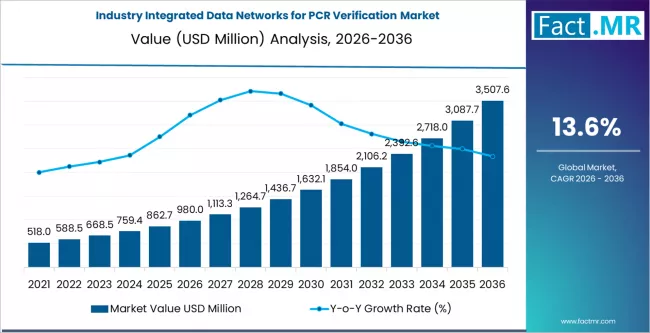
The industry integrated data networks for PCR verification market is expected to reach USD 980 million in 2026, growing to USD 3,507.6 million by 2036, with a CAGR of 13.6%. Commercial realities in this market are shaped by increasing pressure on pricing discipline, as suppliers compete to offer integrated solutions at competitive rates.
Industry Integrated Data Networks For Pcr Verification Market Market Value Analysis | Source: Fact.MR
Summary of Industry-Integrated Data Networks for PCR Verification Market
Market Snapshot
Global industry-integrated data networks for PCR verification market revenue stood atUSD 980 million in 2026and is forecast to reachUSD 3,507.6 million by 2036.
At a13.6% CAGR from 2026 to 2036, this market is set to expand~3.5x in value, addingUSD 2,527.6 million in absolute opportunity.
Growth is driven by increasing demand forsecure, traceable, and compliant PCR verification systemsacross healthcare and diagnostic ecosystems.
These networks are evolving intocritical digital infrastructure, enabling real-time validation, interoperability, and data integrity across distributed testing environments.
Demand and Growth Drivers
Rising need fortamper-proof and interoperable PCR verification systemsis a primary growth driver.
Increasing regulatory focus ondata transparency, traceability, and complianceis accelerating adoption.
Expansion ofdiagnostic testing networks and digital health ecosystemsis supporting market growth.
Growing integration ofcloud-based platforms and secure data exchange frameworksis reinforcing demand.
Advancements inhealth data infrastructure and verification technologiesare improving scalability and efficiency.
Product and Segment View
Cloud-based verification networks hold 61.3% of deployment share in 2026,emergingas the dominant segment due to scalability and accessibility advantages.
Healthcare providers account for 48.7% of end-user share in 2026, positioning them as the leading segment driven by high testing volumes and compliance requirements.
Key solution categories include:
Cloud-based verification networks
On-premiseintegrated systems
Hybrid data exchange platforms
Key functionalities include:
Secure data sharing
Real-time PCR validation
Audit trails and compliance monitoring
Interoperability across systems
Geography and Competitive Outlook
Growth is concentrated acrossNorth America, Europe, and Asia Pacific, supported by digital health adoption and regulatory frameworks.
India (13.8% CAGR), China (13.2%), Brazil (12.5%), United States (9.6%), Germany (8.9%), and United Kingdom (8.5%)are key growth markets.
Market expansion is closely tied todigital health transformation, regulatory compliance mandates, and expansion of diagnostic infrastructure.
Healthcare Providers, Diagnostic Labs, Government Agencies
Segmentation by Functionality
Data Verification, Secure Exchange, Compliance Monitoring, Interoperability
Segmentation by Region
North America, Latin America, Western Europe, Eastern Europe, East Asia, South Asia & Pacific, MEA
Source: Fact.MR analysis. Updated May 6, 2026
Buyer leverage is escalating as larger organizations seek tailored, scalable platforms that provide more robust data verification capabilities at lower costs. This demand for customization can lead to longer sales cycles and price sensitivity. Volume predictability is affected by the varying pace at which industries adopt PCR verification solutions, influenced by regulatory changes and evolving technological standards. As a result, suppliers must navigate uncertain demand fluctuations while managing the costs of innovation and infrastructure. Companies that effectively balance these factors will be better positioned to secure long-term contracts, but will face challenges in achieving stable margins.
Cross-enterprise data networks; Enterprise data exchanges; Industrial data platforms; Trusted industry networks; Others
Data Exchanged
PCR %, mass balance, certificates; Supplier and recycler data; Origin & transaction data; Material provenance data; Others
Technology
Interoperable APIs and digital product passports; ERP-integrated data layers; High-volume data ingestion; Secure data fabrics; Others
Region
North America; Europe; Asia Pacific; Latin America; Middle East & Africa
Source: Fact.MR analysis. Updated May 6, 2026
Segmental Analysis
What Is the Impact of Data Exchanged on the Industry Integrated Data Networks for PCR Verification Market?
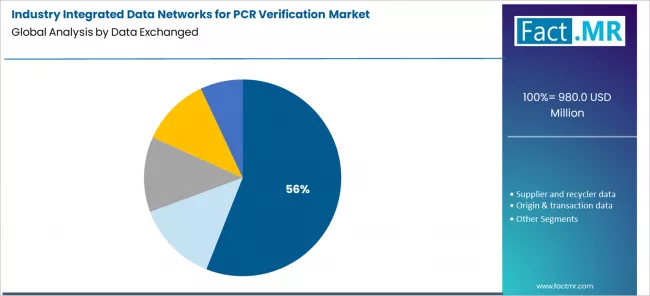
Industry Integrated Data Networks For Pcr Verification Market Analysis By Data Exchanged | Source: Fact.MR
In the industry integrated data networks for PCR verification market, the type of data exchanged plays a crucial role in ensuring transparency and traceability in the recycling process. PCR %, mass balance, and certificates lead the market with a 56% share, as they provide essential information about the recycled content, material flow, and certification of recycled products. This data allows for the verification of sustainability claims and ensures that PCR materials are properly sourced and processed. As demand for verified and sustainable products grows, the exchange of these critical data elements will continue to drive the adoption of integrated data networks for PCR verification.
How Does Network Type Influence the Industry Integrated Data Networks for PCR Verification Market?
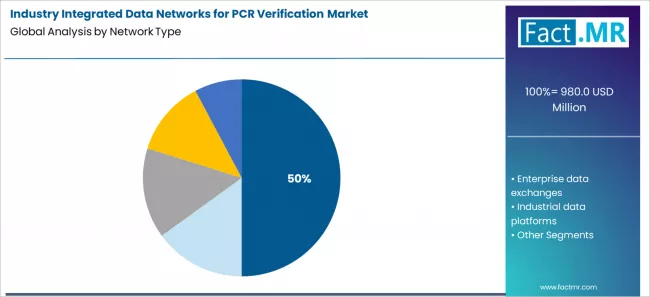
Industry Integrated Data Networks For Pcr Verification Market Analysis By Network Type | Source: Fact.MR
Network type plays a significant role in enabling efficient and secure data exchange across different stakeholders in the supply chain, with cross-enterprise data networks leading the market at a 50% share. These networks allow for seamless communication and data sharing between suppliers, recyclers, manufacturers, and other participants in the value chain. By connecting multiple enterprises, cross-enterprise data networks ensure that the verification process is transparent and that PCR materials are tracked throughout the supply chain. As the demand for more efficient and reliable PCR verification systems increases, cross-enterprise data networks will continue to be essential in enabling a fully integrated and trustworthy recycling ecosystem.
What are the Principal Drivers, Constraints, and Evolving Dynamics of the Industry Integrated Data Networks for PCR Verification Market?
Growth in industry integrated data networks for PCR verification has been shaped by requirements to authenticate post consumer recycled (PCR) material content across supply chains. Manufacturers and brand owners implement networked systems that link production data with material certificates to confirm recycled content claims and support regulatory reporting. Traceability from feedstock sourcing through processing and final product assembly influences specification of data platforms and reporting protocols.
Constraints include the cost of digital infrastructure and the need for consistent data capture across partners with varied technical capabilities. Integration with existing enterprise systems poses challenges where data formats differ. Work to align common data standards and improve interoperability is in progress. Collaboration among technology providers, material suppliers, and end users aims to expand verified material tracking and improve decision quality in PCR verification.
Analysis of the Industry Integrated Data Networks for PCR Verification Market by Key Country
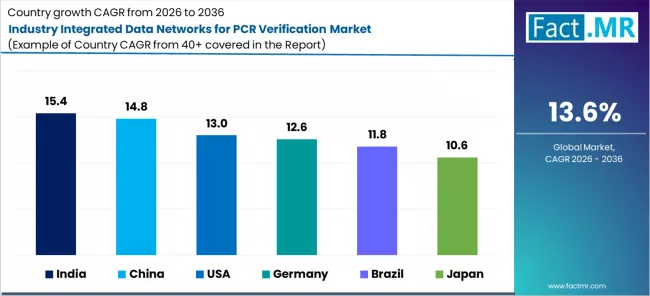
Industry Integrated Data Networks For Pcr Verification Market Cagr Analysis By Country | Source: Fact.MR
Country
CAGR 2026 to 2036
Germany
12.6%
USA
13%
China
14.8%
India
15.4%
Brazil
11.8%
Japan
9.6%
Source: Fact.MR analysis. Updated May 6, 2026
The report covers an in-depth analysis of 40+ countries; top-performing countries are highlighted below.
What is the Growth Outlook for Industry Integrated Data Networks for PCR Verification in Germany?
Germany’s industry integrated data networks for PCR verification market is projected to grow at a CAGR of 12.6% from 2026 to 2036. With increasing emphasis on sustainability and recycling, Germany’s demand for efficient verification systems for PCR materials is on the rise. These systems help industries manage and track recycled content, ensuring compliance with regulatory standards. Germany’s strong recycling infrastructure and commitment to eco-friendly packaging are expected to drive steady growth in the market for integrated data networks in the coming years.
How is the Demand for Industry Integrated Data Networks for PCR Verification Performing in the USA?
Demand for industry integrated data networks for PCR verification in the USA is expected to grow at a CAGR of 13% from 2026 to 2036. The USA’s push for more sustainable waste management practices and greater accountability in the use of PCR materials is fueling the adoption of integrated data networks. These systems provide critical tools for verifying the quality and origin of recycled materials, helping companies meet increasing regulatory demands. As the USA focuses on reducing plastic waste, the demand for these verification systems will rise.
What is the Market Outlook for Industry Integrated Data Networks for PCR Verification in China?
China is projected to experience significant growth in the industry integrated data networks for PCR verification market, with a projected CAGR of 14.8% from 2026 to 2036. China’s expanding recycling industry and government efforts to improve waste management are driving the demand for more efficient verification solutions. These data networks enable better transparency and traceability of PCR materials, aligning with China’s sustainability goals. As the country strengthens its environmental regulations and waste reduction policies, the market for integrated data networks in PCR verification is expected to grow rapidly.
What is the Growth Potential for Industry Integrated Data Networks for PCR Verification in India?
India’s industry integrated data networks for PCR verification market is forecast to grow at a robust CAGR of 15.4% from 2026 to 2036. As India continues to focus on enhancing its recycling systems and waste management infrastructure, the need for effective data networks to verify PCR content is rising. These solutions help ensure that recycled materials meet quality standards and are suitable for reuse in manufacturing. With the government’s increasing support for sustainability and recycling, India’s market for integrated data networks for PCR verification is expected to experience strong growth.
What is the Demand for Industry Integrated Data Networks for PCR Verification in Brazil?
The PCR verification industry in Brazil is set to grow at a CAGR of 11.8% from 2026 to 2036. As Brazil faces challenges in waste management and recycling, the demand for systems that verify PCR content and improve recycling efficiency is on the rise. Integrated data networks play a vital role in ensuring the traceability and authenticity of recycled materials. With the country’s focus on reducing plastic waste and improving recycling processes, Brazil’s market for these systems is poised for steady growth.
What is the Market Expansion Outlook for Industry Integrated Data Networks for PCR Verification in Japan?
Demand for industry integrated data networks for PCR verification in Japan is projected to grow at a CAGR of 9.6% from 2026 to 2036. Japan’s advanced recycling infrastructure and strong commitment to sustainability drive the adoption of integrated data networks for PCR verification. These systems enable better tracking and management of recycled materials, supporting Japan’s efforts to improve recycling rates and reduce plastic waste. Despite a slower growth rate compared to other regions, Japan’s market for these solutions will continue to expand due to its regulatory environment and commitment to environmental sustainability.
How is Competition Structured in the Industry Integrated Data Networks for PCR Verification Market?
Competition in the industry integrated data networks for PCR verification market centers on the ability to provide interoperable, secure, and scalable data exchange that supports verification of post consumer recycled (PCR) content claims across value chains. Catena X and SAP Business Network compete with enterprise grade networks that embed PCR verification into broader supplier collaboration and product lifecycle systems. Their platforms emphasize standardization and broad partner connectivity.
IBM Sterling and NEC focus on robust network security and integration with existing enterprise resource planning systems, enabling traceability of PCR metrics alongside transactional data. AntChain and Huawei Cloud emphasize blockchain and cloud infrastructure that ensure data integrity and high availability for diverse industrial partners. Circularise positions itself with decentralized, material centric traceability solutions that record PCR content through multiple manufacturing stages. Fujitsu integrates PCR verification workflows into its digital services suite, supporting cross system data harmonization. Competitive differentiation arises from ease of integration with legacy systems, real time data access, and support for multistakeholder verification processes. Buyers evaluate providers based on technical interoperability, documented use cases, and the ability to meet evolving sustainability reporting requirements.
Key Players of the Industry Integrated Data Networks for PCR Verification Market
CatenaX
SAP Business Network
AntChain
NEC
Circularise
IBM Sterling
Huawei Cloud
Fujitsu
Bibliographies
AntChain. (2026). AntChain: Blockchain-based solutions for secure and transparent PCR content verification. AntChain.
Catena-X. (2026). Catena-X: Revolutionizing supply chain transparency with industry-integrated data networks. Catena-X.
European Commission, Joint Research Centre. (2024). Verification, traceability, and data integrity requirements for recycled plastic content. JRC Technical Reports.
ISO. (2023). ISO 22095: Chain of custody - General terminology and models. International Organization for Standardization.
World Economic Forum. (2023). Global frameworks for digital traceability and material verification in circular economies. WEF.
Cross-enterprise data networks, Enterprise data exchanges, Industrial data platforms, Trusted industry networks, Others
Data Exchanged
PCR %, mass balance, certificates, Supplier and recycler data, Origin & transaction data, Material provenance data, Others
Technology
Interoperable APIs and digital product passports, ERP-integrated data layers, High-volume data ingestion, Secure data fabrics, Others
Regions Covered
North America, Europe, Asia Pacific, Latin America, Middle East & Africa
Countries Covered
United States, Canada, Mexico, Brazil, Germany, United Kingdom, France, Italy, Spain, China, Japan, South Korea, India, Australia & New Zealand
Key Companies Profiled
Catena-X, SAP Business Network, AntChain, NEC, Circularise, IBM Sterling, Huawei Cloud, Fujitsu
Additional Attributes
Dollar revenue by end-use, network type, data exchanged, and technology; regional demand trends, competitive landscape, technological advancements in industry integrated data networks for PCR verification, and innovations in supply chain compliance and data interoperability
Source: Fact.MR analysis. Updated May 6, 2026
Industry Integrated Data Networks for PCR Verification Market Key Segments
How big is the industry integrated data networks for pcr verification market in 2026?
The global industry integrated data networks for pcr verification market is estimated to be valued at USD 980.0 million in 2026.
What will be the size of industry integrated data networks for pcr verification market in 2036?
The market size for the industry integrated data networks for pcr verification market is projected to reach USD 3,507.6 million by 2036.
How much will be the industry integrated data networks for pcr verification market growth between 2026 and 2036?
The industry integrated data networks for pcr verification market is expected to grow at a 13.6% CAGR between 2026 and 2036.
What are the key product types in the industry integrated data networks for pcr verification market?
The key product types in industry integrated data networks for pcr verification market are multi-industry pcr verification (packaging, electronics, automotive), brand and oem compliance reporting, export-oriented pcr supply chains, precision manufacturing verification, emerging formal pcr ecosystems and regional compliance networks.
Which network type segment to contribute significant share in the industry integrated data networks for pcr verification market in 2026?
In terms of network type, cross-enterprise data networks segment to command 50.0% share in the industry integrated data networks for pcr verification market in 2026.