- Market Value (2025): USD 1.7 Bn
- Estimated Value (2026): USD 1.8 Bn
- Forecast Value (2036): USD 2.4 Bn
- CAGR (2026-2036): 2.9%
What is the Marzipan Market forecast to be worth by 2036?
USD 1.8 billion in 2026 to USD 2.4 billion by 2036 at 2.9% CAGR.
- The marzipan market reached USD 1.7 billion in 2025 as seasonal confectionery and bakery decoration demand remained steady.
- Demand is projected to increase from USD 1.8 billion in 2026 to USD 2.4 billion by 2036.
- The market is forecast to record 2.9% CAGR from 2026 to 2036 as confectioners and online specialty sellers protect almond-based product lines.
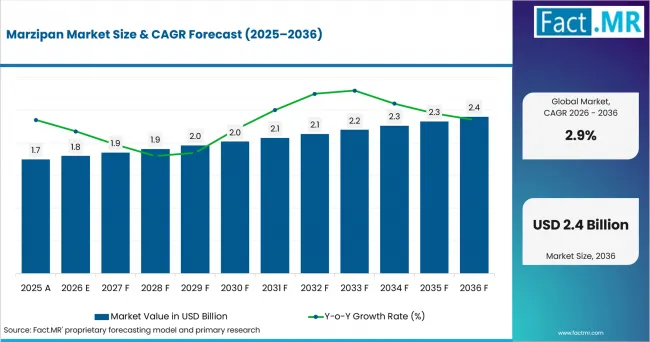
Marzipan Market Value Analysis | Source: Fact.MR
What are the defining numbers behind Marzipan Market growth?
USD 0.6 billion absolute opportunity by 2036, led by Vanilla, Tubes and Online Sales.
- Demand Drivers in the Market
- Retail shoppers need gift-ready sweets that carry a familiar almond taste during Easter, Christmas and local festival seasons.
- Bakeries need pliable paste that covers cakes cleanly and supports decorative shapes without replacing fondant in premium work.
- Online sellers need sturdy packs for niche sweets. The U.S. Census Bureau reported in May 2026 that first-quarter retail e-commerce sales reached USD 326.7 billion.
- Chocolate brands need stable almond fillings because marzipan gives tablets and pralines a clear flavor identity.
- Key Segments Analyzed
- By Flavor: Vanilla is projected to hold 36.80% share in 2026 due to its familiar taste and easy pairing with almond paste.
- By Packaging: Tubes are expected to account for 29.9% share in 2026 because decorators value controlled dispensing.
- By Distribution Channel: Online Sales are anticipated to capture 55.90% share in 2026 owing to gifting orders and specialty imports.
- By Product: Almond-Based Marzipan Products are estimated to represent 68.40% share in 2026 since almond content defines the category for most shoppers.
- Analyst Opinion at Fact.MR
- Shambhu Nath Jha, Principal Analyst at Fact.MR, notes that marzipan demand is shaped by taste trust and seasonal presentation. Suppliers are expected to win repeat orders when paste texture, almond content and allergen documentation remain consistent. Retail-ready packaging and dependable small-batch supply are expected to matter more than broad confectionery range alone.
- Strategic Implications
- Confectionery brands should protect almond taste consistency before extending marzipan into chocolate tablets and filled pralines.
- Retail category teams should separate seasonal gift boxes from everyday bakery-use products to avoid weak shelf planning.
- Ingredient buyers should watch almond availability. USDA NASS forecast California almond production at 3.00 billion meat pounds in July 2025.
- Online sellers should test crush-resistant boxes and tube seals before expanding gift-pack delivery.
France is forecast to record 3.9% CAGR through 2036 supported by premium bakery and confectionery usage. Japan is projected to post 3.9% CAGR as gift culture and online specialty purchases keep almond sweets visible. South Korea is anticipated to advance at 3.5% CAGR owing to mobile commerce and imported confectionery access. The USA is estimated to hold 3.1% CAGR because online gifting and specialty retail support demand. Italy is expected to record 3.1% CAGR due to bakery traditions and decorative cake applications. The UK is forecast to post 2.9% CAGR as inflation-sensitive shoppers remain selective about premium sweets.
How does the Marzipan Market break down by segment?
Vanilla leads Flavor at 36.80%; Online Sales lead Distribution Channel at 55.90%.
Which flavor dominates?
Vanilla is projected to account for 36.8% share in 2026.
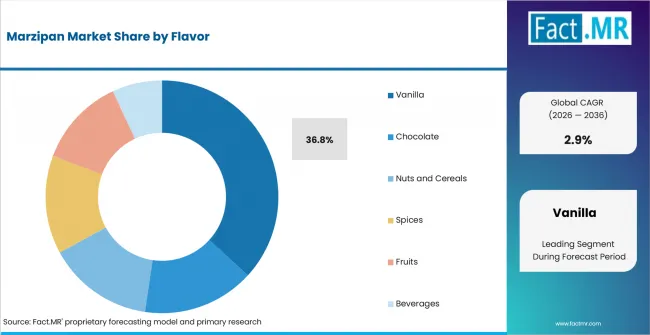
Marzipan Market Analysis By Flavor | Source: Fact.MR
Vanilla holds a visible position because it works with almond paste without overpowering the base taste. Natural vanilla and artificial vanilla support different price points in retail and bakery use. Chocolate flavors remain relevant for tablets and pralines. Nuts, spices, fruits and beverage flavors create seasonal options. The segment stays close to confectionery gifting where shoppers expect familiar flavor and clean product labeling.
What leads the Packaging segment?
Tubes are expected to hold 29.9% share in 2026.
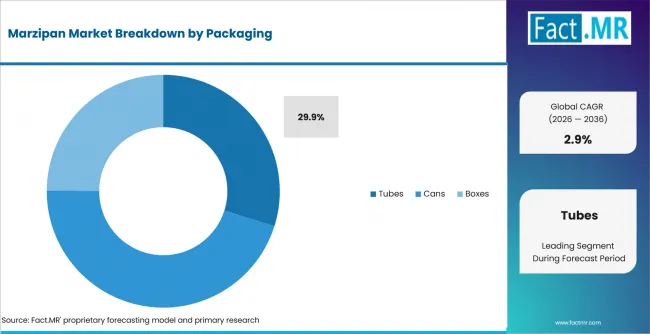
Marzipan Market Analysis By Packaging | Source: Fact.MR
Tubes are valued by decorators and small bakeries because they help apply marzipan in measured amounts. Squeeze tubes fit retail use where shoppers want convenience for home baking. Industrial tubes serve bakery lines that need repeatable handling. Cans and boxes remain relevant for bulk storage and gift packs. Packaging choice is shaped by whether marzipan is used as an ingredient or a finished sweet.
How does Distribution Channel shape demand?
Online Sales are anticipated to lead with 55.9% share in 2026.
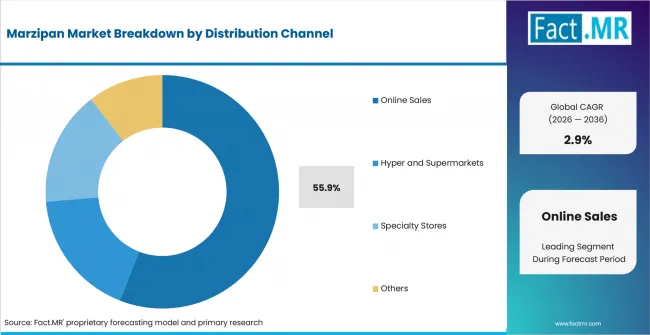
Marzipan Market Analysis By Distribution Channel | Source: Fact.MR
Online Sales lead because marzipan is often bought as a specialty product or gift item that shoppers do not always find locally. E-commerce supports imported brands and holiday assortments. Hypermarkets and supermarkets keep the product visible in seasonal aisles. METI reported in August 2025 that Japan’s BtoC e-commerce market reached JPY 26.1 trillion in 2024, up 5.1% from 2023.
What supports Almond-Based Marzipan Products?
Almond-Based Marzipan Products are estimated to represent 68.40% share in 2026.
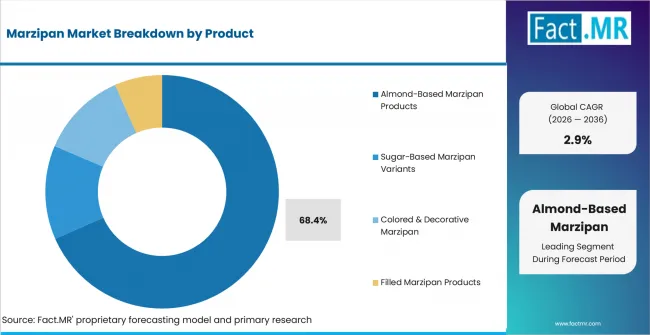
Marzipan Market Analysis By Product | Source: Fact.MR
Almond-based products define the market because consumers associate marzipan with almond paste and molded confectionery. Raw almond paste supports bakery filling and cake-covering uses. Flavored almond marzipan helps brands introduce seasonal variations while retaining the core identity. Barry Callebaut’s American Almond range describes marzipan as a soft paste prepared from blanched almonds and sugar, with 40% select grade almonds in its premium quality format.
What is accelerating Marzipan Market adoption, and what is holding it back?
Seasonal gifting drives adoption; almond and sugar cost pressure restrains expansion.
Drivers Impact Analysis
| Driver | (~) % Impact on CAGR | Geographic Relevance | Impact Timeline |
|---|---|---|---|
| Seasonal gifting and decorated sweets | +0.8% | Europe, USA and Japan | Short term (<= 2 years) |
| Online specialty retail | +0.6% | USA, UK, South Korea and Japan | Short term (<= 2 years) |
| Bakery decoration use | +0.5% | Europe and North America | Medium term (2-4 years) |
| Chocolate-filled marzipan formats | +0.4% | Germany, France, Italy and Japan | Medium term (2-4 years) |
| Premium almond positioning | +0.3% | Specialty confectionery clusters | Long term (>= 4 years) |
Source: Fact.MR analysis. Updated Aug 17, 2026
- Seasonal gifting and decorated sweets: Marzipan fits occasions where shoppers value shape, color and tradition. Retailers are expected to plan tighter holiday assortments when shrink and unsold inventory are controlled.
- Online specialty retail: Web stores help niche brands reach shoppers who search by origin, flavor or gifting format. The channel supports cross-border access when local retail shelves are narrow.
- Bakery decoration use: Marzipan remains useful to professional bakers because it can be rolled, shaped and colored. The format supports premium cakes where almond taste is part of the finish.
- Chocolate-filled marzipan formats: Chocolate makers use marzipan to create a distinct filling without complex inclusions. Tablet and praline formats are projected to remain stable routes for flavored products.
- Premium almond positioning: Almond content gives the category a clear taste marker. Brands are expected to use recipe claims and texture consistency to defend shelf prices.
Opportunity Impact Analysis
| Opportunity | (~) % Impact on CAGR | Geographic Relevance | Impact Timeline |
|---|---|---|---|
| Gift-ready online boxes | +0.4% | USA, UK, Japan and South Korea | Short term (<= 2 years) |
| Bakery ingredient tubes | +0.3% | Europe and North America | Medium term (2-4 years) |
| Vegan and plant-forward variants | +0.2% | Europe and Japan | Medium term (2-4 years) |
| Private-label seasonal lines | +0.1% | Europe and mass retail channels | Long term (>= 4 years) |
Source: Fact.MR analysis. Updated Aug 17, 2026
- Gift-ready online boxes: Brands can use assorted fruits, holiday shapes and chocolate-covered pieces to raise basket size. Success depends on packaging that protects appearance during delivery.
- Bakery ingredient tubes: Tubes give small bakeries and home decorators a simple handling format. Producers are anticipated to use this format for controlled application and lower waste.
- Vegan and plant-forward variants: Almond-based recipes fit plant-forward positioning when dairy is avoided. Clear labeling is expected to decide whether the claim is trusted.
Restraints Impact Analysis
| Restraint | (~) % Impact on CAGR | Geographic Relevance | Impact Timeline |
|---|---|---|---|
| Almond and sugar cost exposure | -0.5% | Global | Short term (<= 2 years) |
| Nut-allergen labeling burden | -0.3% | USA, UK and EU | Short term (<= 2 years) |
| Shelf-life and handling limits | -0.2% | Online and specialty retail | Medium term (2-4 years) |
| Competition from cheaper fondant | -0.1% | Bakery decoration channels | Long term (>= 4 years) |
Source: Fact.MR analysis. Updated Aug 17, 2026
- Almond and sugar cost exposure: Marzipan depends on almond paste and sugar. USDA ERS reported in July 2026 that sugar and sweets prices were 6.9% higher in June 2026 than in June 2025.
- Nut-allergen labeling burden: In the United States, FDA treats almonds as tree nuts within the major-food-allergen category, and major allergens must be declared on labels of covered FDA-regulated packaged foods. Requirements for non-prepacked bakery products vary by jurisdiction and require separate country-specific evidence.
- Shelf-life and handling limits: Finished shapes must retain texture and appearance through storage and delivery. Heat, crushing and drying risk make shipping controls part of product quality.
- Competition from cheaper fondant: Cake decorators can use fondant when almond flavor is not central to the finished item. Marzipan suppliers are expected to defend demand through taste and premium presentation.
Which countries are scaling Marzipan Market fastest?
- The country comparison spans 1.0 percentage point and forms two practical growth bands across the forecast period.
- France and Japan remain 0.4 percentage point above South Korea as premium confectionery and gift-led purchase behavior support the upper band.
- South Korea stays 0.4 percentage point above the USA due to mobile commerce and imported confectionery access.
- The USA and Italy each record 3.1% CAGR as online gifting and bakery traditions support steady category planning.
- The UK closes the displayed range at 2.9% CAGR because shoppers remain selective about premium sweets.
- Comparable CAGRs create different entry conditions due to retail access, allergen controls and local gifting habits. Full report coverage includes North America, Latin America, Europe, East Asia, South Asia and Pacific, Middle East and Africa.
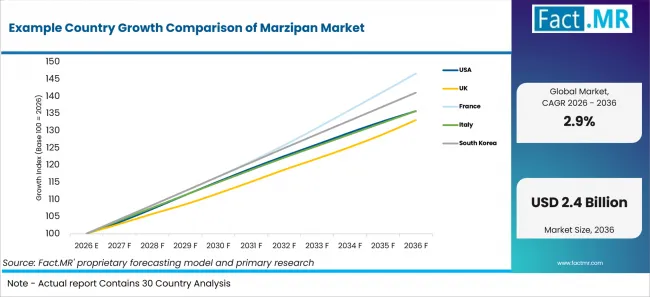
Example Country Growth Comparison Of Marzipan Market | Source: Fact.MR
| Country | CAGR |
|---|---|
| France | 3.9% |
| Japan | 3.9% |
| South Korea | 3.5% |
| USA | 3.1% |
| Italy | 3.1% |
| UK | 2.9% |
Source: Fact.MR analysis. Updated Aug 17, 2026
What supports USA adoption?
3.1% CAGR, supported by online specialty retail and almond-based confectionery use.
FDA released revised food-allergen labeling guidance on January 6, 2025, addressing tree nuts and other major food allergens; U.S. law identifies nine major food allergens. Suppliers are expected to defend demand through almond quality, reliable online packs and clear allergen labeling.
How is the UK developing demand?
2.9% CAGR, supported by seasonal retail and allergen-aware specialty stores.
The UK is forecast to post 2.9% CAGR as marzipan remains tied to cake decoration, imported sweets and holiday retail. ONS reported in July 2026 that food and non-alcoholic beverage prices rose 1.7% in the 12 months to June 2026. Specialty stores are expected to keep marzipan visible where shoppers value tradition and controlled allergen information.
What is driving France’s growth from 2026 to 2036?
3.9% CAGR, backed by food expenditure and premium pastry use.
France is projected to record 3.9% CAGR because almond paste fits premium pastry work and chocolate gifting. INSEE reported provisional 2025 data on May 29, 2026 showing French household expenditure on food and non-alcoholic beverages at EUR 192.8 billion.
How does Italy perform?
3.1% CAGR, led by bakery tradition and decorative confectionery use.
Italy is estimated to record 3.1% CAGR as bakeries use almond paste in decorated cakes and festive sweets. ISTAT reported in February 2026 that retail sales values rose 0.8% over 2025, while volumes fell 0.6%. Marzipan suppliers are expected to focus on formats that protect premium value without widening price resistance.
How is South Korea scaling demand?
3.5% CAGR, driven by mobile commerce and specialty imports.
South Korea is anticipated to advance at 3.5% CAGR from a 2026. The Ministry of Data and Statistics reported in February 2026 that December 2025 online shopping transaction value reached KRW 24.2904 trillion, up 6.2% from December 2024. Imported confectionery sellers are expected to use online assortments to test premium marzipan demand.
What supports Japan’s growth?
3.9% CAGR, backed by gift culture and specialty online channels.
Japan is forecast to post 3.9% CAGR as small decorated sweets fit gift packs and department-store assortments. The Cabinet Office reported in July 2026 that the June 2026 Consumer Confidence Index rose 0.2 points to 33.8. Premium marzipan sellers are expected to benefit when packaging communicates quality in compact gift formats.
Who leads the Marzipan Market?
Key companies include Bergen Marzipan, Alfred Ritter GmbH & Co. KG (Ritter Sport), Valrhona, Barry Callebaut, KESSKO, Viba Sweets.
Competition includes finished confectionery brands and professional ingredient suppliers. Bergen Marzipan sells molded-fruit and chocolate marzipan products, while Alfred Ritter GmbH & Co. KG (Ritter Sport) sells a marzipan chocolate format. Barry Callebaut’s American Almond brand explicitly offers marzipan and almond paste, while Valrhona has verified professional almond-paste products. Viba and Reber sell marzipan products, including chocolate-coated formats.
Which companies are the key providers?
Companies profiled in the report include Bergen Marzipan, Alfred Ritter GmbH & Co. KG (Ritter Sport), Valrhona, Barry Callebaut, Kessko, Viba Sweets.
- Bergen Marzipan
- Alfred Ritter GmbH & Co. KG (Ritter Sport)
- Valrhona
- Barry Callebaut
- KESSKO
- Viba Sweets
Bibliography
- Economic and Social Research Institute, Cabinet Office, Government of Japan. (2026, July 1). Consumer Confidence Survey: June 2026.
- Institut national de la statistique et des études économiques. (2026, May 29). Consommation effective des ménages par fonction [Actual household consumption by function].
- Istat. (2026, February 5). Retail trade – December 2025.
- Ministry of Data and Statistics. (2026, February 2). Online shopping in December 2025 [Press release].
- Ministry of Economy, Trade and Industry. (2025, August 26). Results of FY2024 E-Commerce Market Survey compiled.
- Office for National Statistics. (2026, July 22). Consumer price inflation, UK: June 2026.
- U.S. Census Bureau. (2026, May 18). Quarterly retail e-commerce sales: 1st quarter 2026 [Press release].
- U.S. Food and Drug Administration. (2025, January 6). FDA releases allergen, food safety, and plant-based alternative labeling guidances.
- U.S. Department of Agriculture, Economic Research Service. (2026, July 24). Food Price Outlook: Summary findings.
This Report Addresses
- The report provides strategic intelligence on the Marzipan Market within adjacent confectioneries category and premium sweets buying behavior.
- Segment analysis covers vanilla flavors and tube packaging alongside online sales, with context from chocolate formats that use filled confectionery lines.
- Input-side assessment considers almond paste behavior and related almond powder use in bakery and confectionery applications.
- Country outlook evaluates the USA, UK, France, Italy, South Korea and Japan across retail access, allergen controls and specialty gifting.
- Competitive analysis profiles finished confectionery brands and ingredient suppliers that show direct marzipan relevance.
What does the Marzipan Market cover?
Marzipan products are almond-based confectionery forms sold as paste, molded sweets, decorative pieces, filled products and chocolate combinations. The market covers retail gift packs, bakery-use formats and specialty confectionery sold through physical and online channels. It connects to nearby categories such as almond butter, dry roasted almonds and premium chocolate.
What is included in the scope?
The scope includes vanilla, chocolate, nuts and cereals, spices, fruits and beverage flavors. Tubes, cans and boxes are included where the packaging supports retail sale, bakery handling or gift presentation. Distribution coverage includes online sales, hypermarkets and supermarkets, specialty stores and foodservice distribution. The product view includes almond-based marzipan, sugar-based variants, decorative formats and filled products. Related ingredient references include cocoa inputs and cocoa beans where marzipan is sold with chocolate coatings.
What is excluded from the scope?
The scope excludes fondant, plain almond flour, bakery fillings without marzipan identity and chocolate products where almond paste is not part of the item. It also excludes unrelated nut snacks, general pastry mixes and private-label chocolate revenue unless marzipan use is visible. Adjacent choices such as sugar-free confectionery and industrial chocolate are included only when they directly connect to marzipan products.
How Was the Analysis Built?
The analysis combines desk research, company portfolio review, public statistics and primary interviews. Numeric source, portfolio, country and interview counts are stated only when supported by the project’s internal research log.
- Primary Research: Primary research includes discussions with confectionery producers, ingredient suppliers, retailers, bakery users, distributors and subject-matter experts. These conversations examine product positioning, packaging needs, seasonal order planning, allergen controls and the factors that influence wider market acceptance.
- Desk Research: Desk research covers government statistics, regulatory publications, company product pages, trade data, food-safety guidance, retail indicators and other authoritative sources. Key public evidence sources cited in this summary are documented in the bibliography; the complete research log is maintained separately.
- Market Sizing and Forecasting: Market estimates combine historical performance, demand indicators, segment shares, company participation, country-level growth, adoption patterns, channel activity and barriers to market expansion.
- Data Validation and Update Cycle: Findings are validated by comparing interviews with public data, company activity, retail patterns, regulatory changes and product availability. Regular updates review new launches, seasonal assortments, channel shifts and changes in commercial adoption.
Segmentation
What is the report’s scope and coverage?
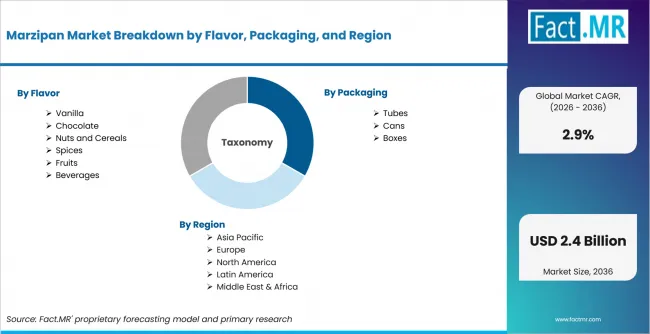
Marzipan Market Breakdown By Flavor, Packaging, And Region | Source: Fact.MR
| Attribute | Details |
|---|---|
| Quantitative Units | USD billion |
| Market Definition | Almond-based confectionery pastes and molded sweets sold for retail gifting, bakery decoration, chocolate fillings and foodservice dessert use |
| Flavor | Vanilla; Chocolate; Nuts and Cereals; Spices; Fruits; Beverages |
| Packaging | Tubes; Cans; Boxes |
| Distribution Channel | Online Sales; Hyper and Supermarkets; Specialty Stores; Others |
| Product | Almond-Based Marzipan Products; Sugar-Based Marzipan Variants; Colored and Decorative Marzipan; Filled Marzipan Products |
| Regions Covered | North America; Latin America; Europe; East Asia; South Asia and Pacific; Middle East and Africa |
| Countries Covered | USA; UK; France; Italy; South Korea; Japan |
| Key Companies Profiled | Bergen Marzipan; Alfred Ritter GmbH & Co. KG (Ritter Sport); Valrhona; Barry Callebaut; KESSKO; Viba Sweets |
| Forecast Period | 2026 to 2036 |
| Approach | Hybrid top-down and bottom-up approach using confectionery retail data; almond supply signals; e-commerce indicators; seasonal gifting cycles; channel participation; product portfolio checks; allergen rules; country adoption patterns and company relevance review |
Source: Fact.MR analysis. Updated Aug 17, 2026
How is the market segmented?
-
By Flavor
- Vanilla
- Natural Vanilla
- Artificial Vanilla
- Chocolate
- Dark Chocolate
- Milk Chocolate
- Nuts and Cereals
- Nut Based Flavors
- Cereal Based Flavors
- Spices
- Warm Spices
- Hot Spices
- Fruits
- Citrus Fruits
- Tropical Fruits
- Beverages
- Coffee Based Flavors
- Tea Based Flavors
- Vanilla
-
By Packaging
- Tubes
- Squeeze Tubes
- Industrial Tubes
- Cans
- Metal Cans
- Aerosol Cans
- Boxes
- Carton Boxes
- Bulk Boxes
- Tubes
-
By Distribution Channel
- Online Sales
- E Commerce Platforms
- Digital Retail
- Hyper and Supermarkets
- Modern Trade Retail
- In Store Retail
- Specialty Stores
- Food Specialty Stores
- Beverage Specialty Stores
- Others
- Convenience Stores
- Foodservice Distribution
- Online Sales
-
By Product
- Almond-Based Marzipan Products
- Raw Almond Marzipan Paste
- Flavored Almond Marzipan
- Sugar-Based Marzipan Variants
- Refined Sugar Marzipan
- Alternative Sweetener Marzipan
- Colored and Decorative Marzipan
- Natural Color Marzipan
- Artificial Color Marzipan
- Filled Marzipan Products
- Nut Filled Marzipan
- Fruit Filled Marzipan
- Almond-Based Marzipan Products
-
By Region
- North America
- Latin America
- Europe
- East Asia
- South Asia and Oceania
- Middle East and Africa
Frequently Asked Questions
How big is the marzipan market in 2026?
What is the CAGR of the marzipan market from 2026 to 2036?
Which flavor leads the marzipan market?
Which packaging type leads the marzipan market?
Who are the leading companies in the marzipan market?
Who worked on this report


Preview the report firsthand - request a free sample
Free SampleGet the brochure for pricing and purchase details
Download PDF