- Base Value(2025): 1.6 Bn
- Forecast Value (2035): 2.1 Bn
- CAGR (2035): 2.7%
Truck Campers Market Outlook (2025 to 2035)
The global truck campers market is projected to increase from USD 1.6 billion in 2025 to USD 2.1 billion by 2035, with a CAGR of 2.7%, driven by increasing consumer interest in self-sufficient, off-grid travel and the rising ownership of pickup trucks. Their use makes them ideal for remote, off-grid travel, offering lightweight, modular comfort with enhanced fuel efficiency and mobility.
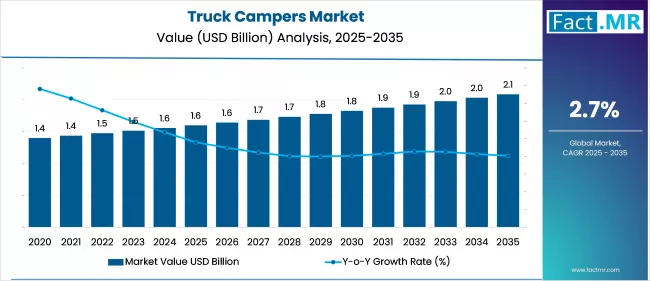
Truck Campers Market | Source: Fact.MR
What are the Drivers of the Truck Campers Market?
The truck camper market is expanding due to rising demand for flexible and independent travel. Consumers want outdoor, off-grid experiences that allow them to explore nature without relying on conventional accommodations. Truck campers provide the mobility and convenience of accessing remote areas while remaining self-contained.
As mid-size and full-size pickup trucks gain popularity worldwide, more people are considering using them for leisure travel. This trend broadens the market for detachable camper units that can be used with these vehicles.
Health and safety concerns following the pandemic have pushed travellers to opt for more private and self-sufficient modes of tourism. Truck campers offer a safe distance, minimal contact, and control over travel routines, making them an appealing option.
Product innovations, including lighter materials, solar panels, and smart storage solutions, have enhanced the functionality and efficiency of truck campers, making them suitable for both short trips and extended travel.
What are the Regional Trends of the Truck Campers Market?
North America has a strong outdoor recreation culture, and activities such as camping and overlanding drive demand for truck campers, which provide mobility and comfort to outdoor enthusiasts. The rise of remote work and nomadic lifestyles is fueling the market, as truck campers offer a flexible living and working environment.
Europe is experiencing steady growth, particularly in Germany, France, and the U.K. While motorhomes reign supreme, compact and environmentally friendly truck campers are gaining popularity among younger travelers. Emission regulations and road size restrictions are increasing demand for lightweight, Euro 6-compliant models that are suitable for both urban and rural travel.
Asia-Pacific exhibits mixed trends. Australia has a mature market, bolstered by vast landscapes and an off-road culture. India and China are emerging markets, with India experiencing a 22% increase in pickup sales between 2021 and 2023, indicating a potential base for camper adoption.
In Latin America and the Middle East & Africa, market presence is limited but growing in tourism-focused regions such as Chile, the UAE, and South Africa.
What are the Challenges and Restraining Factors of the Truck Campers Market?
One major challenge is the high cost of ownership. Customers must purchase both pickup truck and camper unit, which can be prohibitively expensive. Fully equipped truck campers frequently command high prices, especially when paired with four-wheel-drive trucks designed for rugged travel.
In many countries, structural modifications to vehicles must comply with national transportation regulations. In India, for example, changes must be approved under Rule 126 of the Central Motor Vehicle Rules, a process that is time-consuming and inconsistently enforced. Similarly, in European countries, the added weight and size of the camper must comply with strict emissions and road safety regulations.
Many areas lack designated camping areas, waste disposal stations, and legal overnight parking areas. This is especially important for urban users or travellers in developing countries, where RV infrastructure is limited or nonexistent.
Compatibility between camper models and available pickup trucks may also be an issue. Mid-size trucks, popular in some areas, may be unable to support the weight or dimensions of larger campers, thereby limiting consumer choices. Overloading concerns also raise safety and insurance issues.
Country-Wise Outlook
U.K. Truck Campers Market Sees Growth Amid Rising Adventure Travel Trends
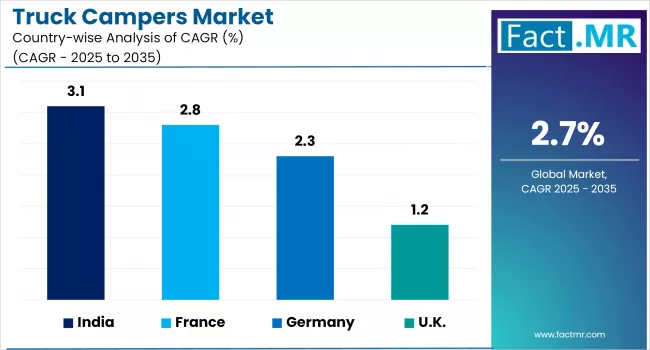
Truck Campers Market Cagr Analysis By Country | Source: Fact.MR
The truck camper market in the U.K. is gradually expanding, driven by a growing interest in compact, adventure-ready travel solutions. Truck campers, which were previously overshadowed by caravans and campervans, are gaining popularity among outdoor enthusiasts and solo travellers who value flexibility and access to rugged terrain. Following the pandemic, more Britons turned to nature-based and socially distant modes of travel, making the trend more visible.
The growing popularity of pickup trucks such as the Ford Ranger, Nissan Navara, and Toyota Hilux, which are used for both commercial and recreational purposes in the U.K., is a major driver. With over 50,000 new pickups registered in the UK alone in 2023, there is a growing demand for compatible truck camper units, particularly lightweight models designed for mid-size trucks.
The U.K.'s Ultra Low Emission Zones (ULEZ), particularly in London and other urban areas, have reduced the appeal of diesel-powered vehicles. As a result, there is a growing demand for truck campers constructed with lightweight materials and aerodynamically optimized designs to increase fuel efficiency. Furthermore, the upcoming 2035 targets for phasing out new petrol and diesel vehicles are growing interest in hybrid-compatible and electrified RV solutions.
Truck campers are ideal for spontaneous travel due to their ease of installation and minimal setup requirements. The compact size also makes it easier to access remote or rural areas, such as the Scottish Highlands or Wales' Brecon Beacons, where traditional RVs may struggle to navigate. Social media and van-life influencers have contributed to increased awareness among younger demographics.
France Sees Growing Demand for Truck Campers Amid Rising Outdoor Recreation Culture
France presents a promising but specialized market for truck campers, owing to the country's strong outdoor recreation culture and growing interest in alternative travel. While caravans and campervans continue to dominate, truck campers are gaining popularity among nature-loving travelers looking for compact, self-sufficient transportation. The growing popularity of solo or couple-based road trips in destinations like Corsica, Provence, and the French Alps is driving market growth.
The rising cost of international travel and accommodations has boosted domestic tourism in France. Over 70% of French residents vacationed in 2023, with a preference for modular camper vehicles. Truck campers offer more freedom and cost-efficiency than campsites in national parks and the countryside.
Several French rental companies now offer truck camper rentals, allowing customers to experience them firsthand before making a purchase decision. This model is especially popular among festival-goers, hikers, and seasonal workers who require temporary but adaptable accommodations during the spring and summer.
The truck camper market in France is still maturing, but it has strong foundations: a thriving tourism industry, environmental consciousness, and shifting consumer preferences. Targeted product design, emissions compliance, and flexible pricing strategies will be critical for brands looking to expand their presence in this high-potential European market.
India Sees Growing Interest in Outdoor and Off-Grid Travel, Boosting Truck Camper Potential
The India's truck camper market is still in its early stages, and rising interest in outdoor and off-grid travel is creating the groundwork for future growth. Traditionally, India has preferred hotels and homestays for domestic tourism, but recent shifts in consumer preferences, particularly among younger, tech-savvy travellers, are generating interest in mobile living. Pickup trucks, such as the Isuzu D-Max V-Cross and Toyota Hilux, are gaining popularity in both urban and adventure markets, making them compatible with camper modules.
Travellers in Ladakh, Spiti Valley, and the Western Ghats seek deeper connections with nature away from crowded tourist routes. Truck campers offer a viable option for exploring these terrains with independence and safety. In 2023, India's domestic tourism is expected to exceed 1.7 billion visits, with nature-based travel accounting for an increasing share, indicating strong potential demand for mobile accommodations.
Vehicle modification laws under the central motor vehicles rules are stringent and frequently inconsistently applied across states. Structural changes require official approval, complicating the legal use of aftermarket or imported truck campers. Furthermore, there is a lack of clarity regarding insurance, registration, and road tax policies for modified camper vehicles, which may deter mainstream adoption.
Category-wise Analysis
Hard Side Truck Campers to Exhibit Leading by Type
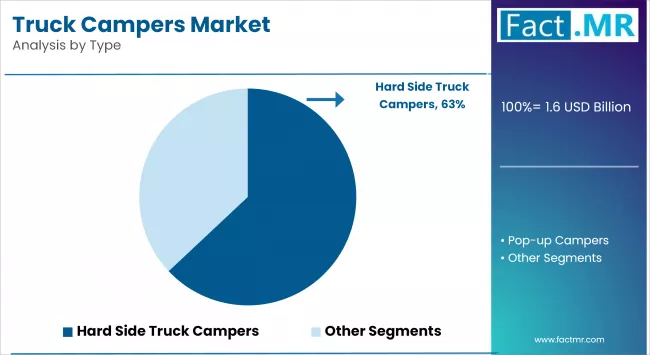
Truck Campers Market Analysis By Type | Source: Fact.MR
Hard side truck campers are a popular category in the truck camper market, distinguished by their solid wall construction and full insulation. These campers offer enhanced protection against extreme weather conditions, making them suitable for year-round use, including winter camping. Their rigid structure allows for additional interior amenities such as full kitchens, bathrooms, and entertainment systems, making them ideal for long-term travel.
Hard side models are typically heavier and require larger trucks for transport, but they provide a more residential-like environment. They are popular among users who value comfort, durability, and off-grid capability during long trips.
Pop-up truck campers, on the other hand, are equipped with a collapsible roof that can be raised when in use and lowered while travelling. This design makes them lighter, more aerodynamic, and more fuel-efficient than hard-sided models. Pop-up campers are easier to store and navigate, especially on rough terrain or narrow trails, making them ideal for off-road and minimalist adventurers.
While they may have fewer amenities and thinner insulation, many models still include essential features such as small kitchens, sleeping quarters, and storage space. They appeal to buyers seeking affordable prices, convenient transportation, and access to remote camping locations.
Standard Truck Campers to Exhibit Leading by Technology
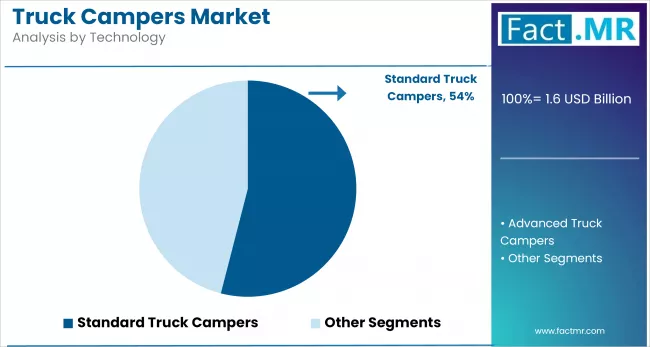
Truck Campers Market Analysis By Technology | Source: Fact.MR
Standard truck campers are the entry-level models in the truck camper market, offering essential features for short to medium-length trips. They typically have a sleeping area, a small kitchenette, and limited storage. These models are popular due to their low cost, simplicity, and ease of use, making them ideal for first-time buyers or casual weekend adventurers.
Standard truck campers are typically lighter in weight, making them suitable for a broader range of pickup trucks. Their simple design allows for low maintenance and quick setup, making them appealing to users who value functionality and low-cost travel.
Advanced truck campers offer luxury, technology, and versatility. These luxury campers have full bathrooms, slide-outs, solar panels, lithium battery systems, and smart controls. Advanced models for long-term travel and off-grid living have four-season insulation, upgraded suspension, and luxury interiors. Experienced travellers seeking greater self-sufficiency, durability, and convenience in remote or long-term use prefer them, even though they cost more and require heavy-duty trucks.
Individuals/Groups to Exhibit Leading by End-Use
Individuals/Groups are the primary users of truck campers, which often include solo travelers, couples, families, and outdoor enthusiasts. Truck campers appeal to these users due to their flexibility, low cost, and ability to access remote or off-grid locations.
Truck campers provide a compact yet functional solution for weekend trips, long road trips, and seasonal travel, making them ideal for individuals and small groups. Their compatibility with personal pickup trucks, ease of setup, and range of options (from basic to fully equipped models) make them a popular choice for those looking for adventure and mobility without the size or cost of traditional RVs.
Camping companies are an emerging market that offers rental or guided adventure services in the form of truck campers. These companies purchase multiple units to cater to travellers who desire a camper experience without committing to ownership. Truck campers are particularly appealing to rental fleets due to their compact footprint, low maintenance requirements, and suitability for national park tours and off-road excursions. Camping companies often select models with durable construction and user-friendly layouts to cater to a diverse range of customers, from first-time campers to seasoned veterans.
Competitive Analysis
The global truck campers market is becoming increasingly competitive, with a mix of established RV manufacturers, specialized adventure-vehicle builders, and emerging modular design firms catering to off-grid travelers, outdoor enthusiasts, and pickup owners. This competitive environment is largely driven by innovation in lightweight materials, modular configurations, enhanced fuel efficiency, and compatibility with a wide range of truck models.
Manufacturers are constantly competing by incorporating lightweight materials, increasing interior space with slide-outs, and providing added comfort features such as solar panels, off-road suspension, and smart control systems. These innovations appeal to tech-savvy and environmentally conscious consumers, particularly in North America and Europe, where outdoor recreation trends are experiencing a surge.
Consumers are more interested in brands that offer modular layouts, multi-season insulation, and options for rugged terrain. The camper's compactness and detachable design for truck use give it a practical advantage, especially for customers who value flexibility. Players who provide customized solutions for both half-ton and heavy-duty pickups attract a larger audience.
The market exhibits regional variations in preferences, leading to increased competition. North America, particularly the U.S. and Canada, leads the way due to its strong camping culture, extensive national parks, and long-distance road travel traditions. Meanwhile, manufacturers are gradually expanding into parts of Europe, Australia, and Japan, where compact vehicles and fuel efficiency are preferred, prompting the development of ultra-light and aerodynamic models.
Dethleffs, Fiat, Adria Mobil, Trillium Trailers, Pinnacle Vehicles, Roadtrek Motorhomes/Erwin Hymer Group, and other major players compete based on quality, innovation, and customer service. Emerging startups and international brands are also entering the market, increasing product diversity and putting pressure on established manufacturers to innovate.
Recent Development
- In January 2025, Roadtrek Motorhomes introduced EcoTrek, a high-capacity lithium-ion power module that combines an alternator, generator, solar, and shore charging. The system allows for up to 90% usable energy and compact storage in its 2025 Play+ and Play+ Slumber models.
- In January 2024, Northstar Campers introduced the Night Hawk, a truck camper with a hard side, no slide, and a wet bath for both long and short beds. This innovative 7'6" wide floor plan includes a 10-cubic-foot 12-volt compressor refrigerator, a 41-gallon fresh tank, plenty of storage, ample countertop space, 350 watts of solar power, and more.
Segmentation
Segmentation of the Truck Campers Market
-
By Type :
- Hard Side Truck Campers
- Adventurer Campers
- Arctic Fox Campers
- Bigfoot Campers
- Capri Campers
- Others
- Pop-up Campers
- Hallmark Campers
- Phoenix Campers
- Others
- Hard Side Truck Campers
-
By Technology :
- Standard Truck Campers
- Advanced Truck Campers
-
By End-Use :
- Individuals/Groups
- Camping Companies
- Others
-
By Region :
- North America
- Latin America
- Western Europe
- Eastern Europe
- East Asia
- South Asia & Pacific
- Middle East & Africa
Frequently Asked Questions
What is the global truck campers market size in 2025?
Who are the major players operating in the truck campers market?
What is the estimated valuation of the truck campers market by 2035?
What value CAGR is the truck campers market exhibit over the last five years?
Who worked on this report


Preview the report firsthand - request a free sample
Free SampleGet the brochure for pricing and purchase details
Download PDF