- Market Value (2025): USD 3.3 Bn
- Estimated Value (2026): USD 3.5 Bn
- Forecast Value (2036): USD 5.7 Bn
- CAGR (2026-2036): 5.0%
What is the Hydro Lubricant Market forecast to be worth by 2036?
USD 5.7 billion by 2036 at a 5.0% CAGR.
- The hydro lubricant market reached USD 3.3 billion in 2025.
- Demand is projected to increase from USD 3.5 billion in 2026 to USD 5.7 billion by 2036.
- The market is forecast to expand at a 5.0% CAGR from 2026 to 2036.
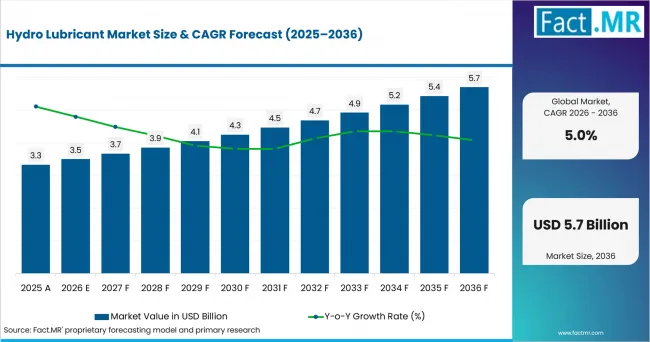
Hydro Lubricant Market Value Analysis | Source: Fact.MR
What are the defining numbers behind Hydro Lubricant Market growth?
An absolute opportunity of USD 2.2 billion is expected between 2026 and 2036.
- Demand Drivers in the Market
- Food and beverage plants need lubricants that can work around frequent cleaning without adding contamination risk. NSF H1 and ISO 21469 provide recognized benchmarks for incidental food contact, while FDA rules define permitted use conditions. This supports specialized hydro formulations within the wider lubricants market.
- Conveyor systems are another important use case. Klüber Lubrication describes hydro-lubrication technology based on a homogeneous water-and-oil solution that can be metered during operation and cleaned more easily. This can make hydro systems more practical than industrial grease where residue is a concern.
- Steel and foundry operations create demand for water-containing hydraulic fluids because fire risk is higher around hot equipment. ISO 4404-1 covers corrosion resistance for fire-resistant fluids, while suppliers such as Condat and GEO Specialty Chemicals offer water-glycol products for these environments. Similar requirements are seen in mining lubricants.
- Wet processing areas also need lubricants that can tolerate repeated washdowns. ExxonMobil positions its NSF H1 Mobil SHC Cibus products for hydraulic and gear applications exposed to moisture, supporting demand in plants where lubrication and cleaning frequently overlap with metalworking fluids.
- Automation raises the cost of conveyor stoppages, so lubrication has to support reliable movement without making cleaning more difficult. As plants add more continuous handling and packaging equipment, demand increases for low-residue fluids that can be metered accurately alongside other maintenance products such as compressor lubricants.
- Key Segments Analyzed
- Food Processing Industries account for 45.6% of Industry in 2026 because bakery, dairy, meat, poultry and beverage plants combine continuous conveyors, frequent washdowns and strict contamination controls that favor precisely metered water-containing lubricants.
- Conveyor Belt Hydro Lubricants account for 87.9% of Application in 2026 because water-containing formulations can be dosed continuously on production and packaging conveyors while supporting cleaning, friction control and lower residue on moving surfaces.
- Analyst Opinion at Fact.MR
- “Hydro lubrication is commercially strongest where conventional lubrication creates a second operational problem, such as residue on a food conveyor, fire risk near hot metal, or difficult cleanup after a leak. Suppliers that can prove friction control, corrosion protection, material compatibility and hygiene performance in the same formulation will have the clearest route to repeat industrial use.”
- Shambhu Nath Jha, Principal Consultant, Fact.MR
- Strategic Implications
- Food-processing suppliers should design products around sanitation routines and conveyor compatibility. Controlled dosing matters more to plant operators than simply positioning water content as a sustainability benefit.
- Fire-resistant fluid suppliers need to validate how formulations interact with pumps and seals. Water-rich HFA and HFC fluids behave differently from conventional hydraulic oils, so compatibility has to be proven before conversion.
- Distributors can make product selection easier by clearly separating food-grade and fire-resistant hydro lubricants from general industrial products. Practical changeover guidance can also reduce the risk of incorrect use.
- Equipment OEM requirements influence formulation choices because conveyors and hydraulic systems place different demands on viscosity and water content. Closer supplier relationships with equipment manufacturers can therefore improve product fit.
How does the Hydro Lubricant Market break down by segment?
The Hydro Lubricant Market is segmented by Industry and Application.
Why do Food Processing Industries lead Industry?
Food Processing Industries account for 45.6% of Industry in 2026.
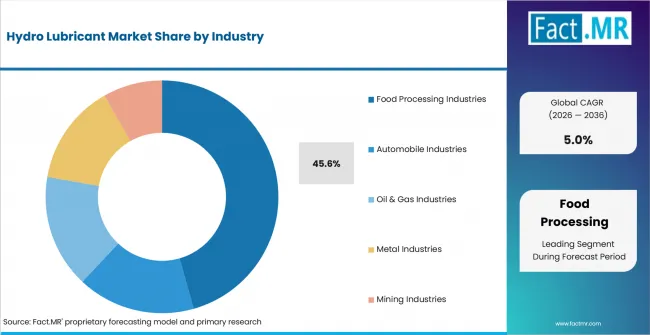
Hydro Lubricant Market Analysis By Industry | Source: Fact.MR
Food plants use lubrication across conveyors and packaging equipment that often operate close to exposed products. This means the lubricant has to control friction while also fitting hygiene and washdown requirements.
NSF H1 lubricants and ISO 21469 certification provide recognized assurance for food-processing use. Water-containing conveyor lubricants add another practical benefit because they can be applied in small quantities and are easier to manage on frequently cleaned production lines.
Demand is reinforced by the number of lubrication points inside a typical plant. Bakery and dairy operations, for example, often use long conveyor systems across processing and packaging, creating recurring lubricant consumption.
Why do Conveyor Belt Hydro Lubricants lead Application?
Conveyor Belt Hydro Lubricants account for 87.9% of Application in 2026.
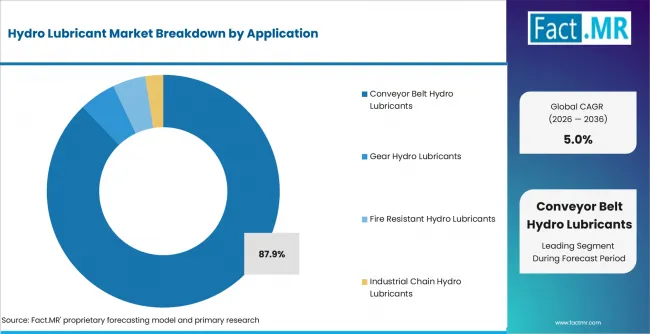
Hydro Lubricant Market Analysis By Application | Source: Fact.MR
Conveyors are a natural fit for hydro lubrication because the fluid can be applied directly where friction needs to be controlled without leaving a heavy oil film. Klüber Lubrication describes its conveyor technology as a homogeneous water-and-oil solution that supports precise metering and easier cleaning.
This is particularly useful on packaging and production lines where excess lubricant can attract dirt or complicate washdown. Cleaner application can therefore improve line operation as well as maintenance.
Other hydro lubricants are used in gears and hydraulic systems, but these applications are more specialized. Conveyor systems contain many repeated lubrication points, which gives this category a much broader consumption base.
What is accelerating Hydro Lubricant Market adoption, and what is holding it back?
Demand is being supported by stricter hygiene requirements in food processing and the wider use of automated conveyor systems. Fire-resistant fluids also create demand in hot industrial environments.
Adoption can be slower where users need to manage corrosion or water concentration carefully. Seal compatibility and equipment requalification can also make conversion from conventional oils more difficult.
Drivers Impact Analysis
| Factor | (~) % Impact on CAGR | Geographic Relevance | Impact Timeline |
|---|---|---|---|
| Food-grade hygiene and incidental-contact requirements | +1.4% | North America, Europe, Brazil, Japan | 2026-2036 |
| Expansion of automated conveyor and packaging lines | +1.1% | Global food and beverage manufacturing | 2026-2034 |
| Fire-risk control in metal, foundry and mining hydraulics | +0.8% | Germany, Brazil, USA, Japan | 2026-2036 |
Source: Fact.MR analysis. Updated Aug 31, 2026
Opportunity Impact Analysis
| Factor | (~) % Impact on CAGR | Geographic Relevance | Impact Timeline |
|---|---|---|---|
| Low-residue conveyor lubrication for wet processing lines | +1.0% | Germany, USA, U.K., Japan | 2027-2036 |
| Water-glycol fire-resistant systems in hot-process equipment | +0.8% | Germany, Brazil, USA | 2026-2035 |
| OEM-approved hydro formulations for gear and chain systems | +0.6% | Europe, North America, East Asia | 2028-2036 |
Source: Fact.MR analysis. Updated Aug 31, 2026
Restraints Impact Analysis
| Factor | (~) % Impact on CAGR | Geographic Relevance | Impact Timeline |
|---|---|---|---|
| Corrosion, seal and materials compatibility requirements | -0.9% | Global industrial users | 2026-2036 |
| Water evaporation and concentration control in aqueous fluids | -0.7% | Hot-process and high-duty applications | 2026-2036 |
| Conversion and validation cost versus established oil systems | -0.6% | Mature industrial markets | 2026-2033 |
Source: Fact.MR analysis. Updated Aug 31, 2026
Which countries are scaling the Hydro Lubricant Market through 2036?
- Germany has demand from both food manufacturing and metal processing. Food plants require clean conveyor lubrication, while foundries and other hot-process industries create a separate use case for fire-resistant water-containing fluids.
- Brazil’s large food-processing sector supports recurring lubricant use across conveyors and packaging lines. Hygiene requirements also increase demand for products that can operate reliably in wet processing environments.
- USA demand is influenced by FDA requirements for incidental food contact. A broad installed base of food and packaging equipment supports continued use of specialized lubricants designed for controlled application around processing lines.
- U.K. demand is supported by a sizeable food-manufacturing sector. Automated production and frequent washdown create recurring need for lubricants that can work in clean processing environments without adding residue.
- Japan is investing in labor-saving automation across food manufacturing. More conveyors and automated handling systems increase the need for precisely applied lubricants that can operate within strict hygiene requirements.
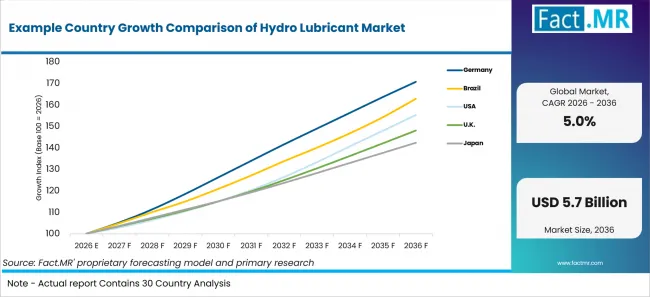
Example Country Growth Comparison Of Hydro Lubricant Market | Source: Fact.MR
Country CAGR (2026-2036)
| Country | CAGR (2026-2036) |
|---|---|
| Germany | 5.5% |
| Brazil | 5.0% |
| USA | 4.5% |
| U.K. | 4.0% |
| Japan | 3.6% |
Source: Fact.MR analysis. Updated Aug 31, 2026
What is driving Germany's growth through 2036?
Germany is projected to expand at a 5.5% CAGR from 2026 to 2036.
Germany has a broad food-processing manufacturing base with thousands of establishments and substantial turnover. German Federal Statistical Office data for 2025 show about 5,484 establishments and nearly 600,000 employees in manufacture of food products, providing a large installed base of conveyors, packaging lines, bearings and drive systems that require routine lubrication.
The same market also benefits from Germany’s metal and machinery sectors, where fire-resistant HFC and HFA fluids can be specified around hot surfaces or underground operations. Buyers therefore evaluate hydro lubricants for both hygiene and safety functions, with corrosion and material compatibility remaining central purchasing criteria.
What is driving Brazil's growth through 2036?
Brazil is projected to expand at a 5.0% CAGR from 2026 to 2036.
IBGE reports that manufacture of food products represented 23.0% of Brazilian industrial net sales revenue in 2024 and employed about 2.1 million people. That scale supports a large population of meat, beverage, bakery and packaged-food lines where conveyor lubrication is a recurring maintenance requirement.
Food-grade assurance is also commercially important. NSF identifies ISO 21469 as a legally required certification for food-grade lubricants in Brazil. This strengthens the value of formulations with controlled composition, hygienic manufacturing and clear incidental-contact positioning when suppliers target processing and packaging plants.
What is driving USA's growth through 2036?
USA is projected to expand at a 4.5% CAGR from 2026 to 2036.
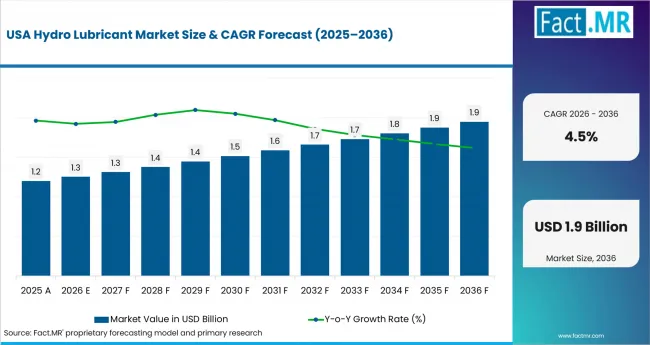
Hydro Lubricant Market Country Value Analysis | Source: Fact.MR
U.S. food-processing lubrication is strongly influenced by the FDA framework for lubricants with incidental food contact under 21 CFR 178.3570. FDA food-contact substance notifications also cover lubricant ingredients used in repeat-use food-processing applications, reinforcing the need for controlled formulation and documented use conditions.
This favors suppliers that can combine H1-compatible chemistry with washdown resistance, corrosion protection and multi-equipment use across conveyors, bearings, gearboxes and hydraulic systems. The commercial advantage is particularly clear in plants seeking to reduce the risk of misapplication between food-grade and general industrial lubricants.
What is driving U.K.'s growth through 2036?
U.K. is projected to expand at a 4.0% CAGR from 2026 to 2036.
The Office for National Statistics reports that manufacture of food represented 22.9% of total U.K. manufacturers’ product sales in 2025. The scale of food manufacturing supports a large population of production conveyors, packaging equipment and washdown-intensive machinery requiring routine lubrication and hygiene controls.
Hydro lubricants can address this installed base where low residue, controlled metering and easier cleaning are valued. Demand is strongest when suppliers can show compatibility with conveyor materials, sanitation chemicals and operating temperatures rather than relying on a general water-based claim.
What is driving Japan's growth through 2036?
Japan is projected to expand at a 3.6% CAGR from 2026 to 2036.
Japan’s Ministry of Agriculture, Forestry and Fisheries is promoting labor-saving investment and productivity improvement in food manufacturing, including automation, robots and advanced production equipment. Its 2024 hygiene guideline for robot introduction was designed to help manufacturers implement advanced equipment while complying with HACCP-based hygiene management.
As more processing steps become automated, the installed base of conveyors, robot axes, bearings, gear drives and material-handling systems rises. This supports demand for clean, precisely metered lubrication systems that can operate around food zones without adding sanitation complexity.
Who Leads the Hydro Lubricant Market?
Key players in the Hydro Lubricant Market include Kluber Lubrication, Exxon Mobil Corporation, Sinopec Corporation, The DOW Chemical Company, GEO Specialty Chemicals, Croda International Plc., Condat Lubricants and Metalworking Lubricants Company.
Competition depends on how well suppliers solve specific operating problems. Conveyor users look for clean application and reliable metering, while hydraulic-system buyers place more emphasis on fire resistance and compatibility with equipment materials.
Klüber competes through hydro-lubrication technology for industrial conveyors using a water-and-oil solution designed for controlled application. ExxonMobil serves food-processing environments with NSF H1 lubricants, while Condat and GEO Specialty Chemicals offer water-glycol HFC fluids for hot-process and mining applications.
This gives the market several distinct competitive positions, depending on whether the buyer is prioritizing hygiene, fire protection or equipment reliability.
Which companies are the key providers?
Key providers include Kluber Lubrication, Exxon Mobil Corporation, Sinopec Corporation, The DOW Chemical Company, GEO Specialty Chemicals, Croda International Plc., Condat Lubricants, and Metalworking Lubricants Company.
- Kluber Lubrication
- Exxon Mobil Corporation
- Sinopec Corporation
- The DOW Chemical Company
- GEO Specialty Chemicals
- Croda International Plc.
- Condat Lubricants
- Metalworking Lubricants Company
Bibliography
- International Organization for Standardization. (2012, confirmed 2023). ISO 4404-1: Petroleum and Related Products - Determination of the Corrosion Resistance of Fire-Resistant Hydraulic Fluids - Part 1: Water-Containing Fluids. ISO.
- NSF. (2026). Food-Grade Lubricants and ISO 21469 Certification. NSF.
- U.S. Food and Drug Administration. (2026). Inventory of Effective Food Contact Substance Notifications: Lubricants with Incidental Food Contact. U.S. Department of Health and Human Services.
- Klüber Lubrication. (2026). Hydro Lubricants: Water-Based Lubricants for Industrial Applications. Klüber Lubrication.
- ExxonMobil. (2026). Mobil SHC Cibus Series Food Machinery Lubricants. Exxon Mobil Corporation.
- Condat. (2026). HFC Hydraulic Fluids. Condat.
- GEO Specialty Chemicals. (2026). GEOlube NF46 2180/2181 Fire Resistant Hydraulic Fluids. GEO Specialty Chemicals.
- German Federal Statistical Office. (2026). Employees and Turnover of Establishments in Manufacturing: Manufacture of Food Products, 2025. Federal Statistical Office.
- Brazilian Institute of Geography and Statistics. (2026). Annual Industrial Survey 2024: Manufacturing Industries Lead Employment. IBGE.
- Office for National Statistics. (2026). U.K. Manufacturers’ Sales by Product: 2025. Government of the United Kingdom.
- Ministry of Agriculture, Forestry and Fisheries, Japan. (2025). Productivity Improvement and Labor-Saving Investment in Food Manufacturing. Government of Japan.
Ministry of Agriculture, Forestry and Fisheries, Japan. (2024). Guidelines for Hygienic Management When Introducing and Operating Robots in Food Manufacturing. Government of Japan
This Report Answers
- How large is the hydro lubricant market in 2026 and what value is projected for 2036?
- How do food-grade hygiene, washdown, automation and fire-risk requirements influence demand?
- Which Industry and Application classifications hold the leading 2026 shares?
- How are Germany, Brazil, USA, U.K. and Japan shaping hydro lubricant demand through 2036?
- Which food-grade, corrosion, fire-resistance, metering and equipment-compatibility capabilities shape competition among suppliers?
What does the Hydro Lubricant Market cover?
The Hydro Lubricant Market covers commercial water-containing and water-enabled industrial lubricant formulations used to control friction, wear, heat, corrosion, cleanliness or fire risk. Revenue is counted across Industry and Application classifications when water is a functional part of the lubricant chemistry or delivery system.
What is included in the scope?
Included Industry demand covers Food Processing Industries, Automobile Industries, Oil & Gas Industries, Metal Industries and Mining Industries. Food processing includes bakery, dairy, meat and poultry, and beverage operations; automotive includes vehicle and component manufacturing, assembly and paint-shop operations; oil and gas includes upstream, midstream, downstream and refinery operations; metal industries include primary production, fabrication, steel and aluminum processing; mining includes surface, underground, mineral-processing and material-handling operations.
Included Application revenue covers Conveyor Belt Hydro Lubricants for bulk handling, packaging, production conveyors and sorting systems; Gear Hydro Lubricants for industrial, worm, helical and planetary gears; Fire Resistant Hydro Lubricants for high-temperature equipment, steel mills, foundries and pressurized hydraulics; and Industrial Chain Hydro Lubricants for drive, conveyor, hoisting and roller chains.
What is excluded from the scope?
Conventional mineral oils, synthetic oils, greases and process fluids are excluded when water is not a functional component of the formulation or application system. Standard food-grade lubricants are excluded if their commercial use does not involve hydro-lubrication or water-containing functionality.
The scope also excludes standalone coolants, cleaning chemicals, corrosion inhibitors sold without a lubrication function, hydraulic hardware, conveyors, chains, gearboxes and other machinery. Revenue from equipment maintenance services and finished food or manufactured products is outside the market.
How Was the Analysis Built?
The analysis draws on more than 100 public and technical sources, over 25 lubricant and downstream-company portfolios and more than 20 industry interviews across at least 20 countries.
- Primary Research: Interviews with lubricant formulators, food-processing maintenance teams, conveyor OEMs, hydraulic-system specialists, metal-processing operators, mining maintenance teams and industrial distributors examine dosing, friction, wear, washdown, corrosion, fire resistance, compatibility, changeover and procurement behavior.
- Desk Research: The review covers food-grade lubricant standards, incidental-contact requirements, fire-resistant hydraulic-fluid classifications, food-manufacturing activity, automation programs, conveyor and packaging equipment, product portfolios and country-level industrial adoption mechanisms.
- Market Sizing and Forecasting: Estimates combine value across Industry and Application classifications with installed equipment, lubrication points, dosing frequency, fluid replacement cycles, water-containing formulation penetration, plant utilization, industrial output and country-level adoption patterns.
- Data Validation and Update Cycle: Findings are cross-checked against institutional publications, technical standards, company product information and industry interviews. Updates account for regulatory changes, certification requirements, plant automation, formulation advances, equipment compatibility and industrial production trends.
Segmentation
What is the report's scope and coverage?
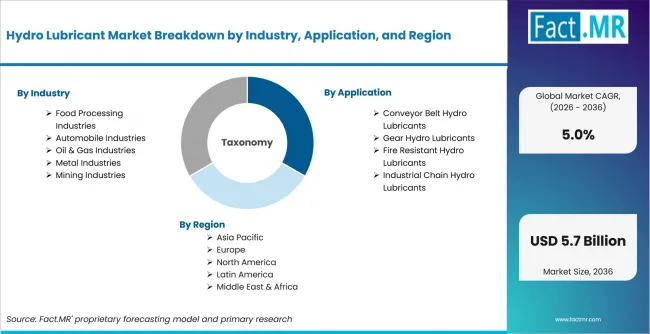
Hydro Lubricant Market Breakdown By Industry, Application, And Region | Source: Fact.MR
| Attribute | Details |
|---|---|
| Base Year | 2025 |
| 2025 Market Value | USD 3.3 billion |
| 2026 Market Value | USD 3.5 billion |
| 2036 Market Value | USD 5.7 billion |
| Forecast CAGR | 5.0% (2026-2036) |
| Absolute Opportunity | USD 2.2 billion (2026-2036) |
| Forecast Period | 2026-2036 |
| Segment Coverage | Industry; Application |
| Country Focus | Germany; Brazil; USA; U.K.; Japan |
Source: Fact.MR analysis. Updated Aug 31, 2026
How is the market segmented?
-
By Industry:
- Food Processing Industries
- Bakery Processing
- Dairy Processing
- Meat and Poultry Processing
- Beverage Processing
- Automobile Industries
- Vehicle Manufacturing
- Automotive Component Manufacturing
- Assembly Operations
- Paint Shop Operations
- Oil & Gas Industries
- Upstream Operations
- Midstream Operations
- Downstream Operations
- Refinery Operations
- Metal Industries
- Primary Metal Production
- Metal Fabrication
- Steel Processing
- Aluminum Processing
- Mining Industries
- Surface Mining
- Underground Mining
- Mineral Processing
- Material Handling Operations
- Food Processing Industries
-
By Application:
- Conveyor Belt Hydro Lubricants
- Bulk Material Handling
- Packaging Lines
- Production Conveyors
- Sorting Systems
- Gear Hydro Lubricants
- Industrial Gearboxes
- Worm Gears
- Helical Gears
- Planetary Gears
- Fire Resistant Hydro Lubricants
- High Temperature Equipment
- Steel Mill Operations
- Foundry Equipment
- Pressurized Hydraulic Systems
- Industrial Chain Hydro Lubricants
- Drive Chains
- Conveyor Chains
- Hoisting Chains
- Roller Chains
- Conveyor Belt Hydro Lubricants
-
By Region:
- North America
- Latin America
- Western Europe
- Eastern Europe
- East Asia
- South Asia and Pacific
- Middle East & Africa
Frequently Asked Questions
What is the Hydro Lubricant Market value in 2026?
At what CAGR is the market projected to grow?
What is the projected market value by 2036?
Which Industry classification leads the market?
Which Application classification leads the market?
What CAGR is projected for Germany?
What CAGR is projected for Brazil?
What is the primary driver in this market?
What is the main restraint?
Who worked on this report


Preview the report firsthand - request a free sample
Free SampleGet the brochure for pricing and purchase details
Download PDF