- Market Value (2025): USD 93.1 Mn
- Estimated Value (2026): USD 100.0 Mn
- Forecast Value (2036): USD 205.0 Mn
- CAGR (2026-2036): 7.4%
What is the Acid Digestion Bombs Market forecast to be worth by 2036?
USD 100.0 million in 2026 to USD 205.0 million by 2036 at 7.4% CAGR.
- The acid digestion bombs market reached USD 93.1 million in 2025 as laboratories continued to require controlled sample preparation under heat and pressure.
- Demand is projected to increase from USD 100.0 million in 2026 to USD 205.0 million by 2036.
- The market is forecast to record 7.4% CAGR from 2026 to 2036 owing to demand for enclosed digestion across environmental, geological, food, pharmaceutical, and materials-testing applications.
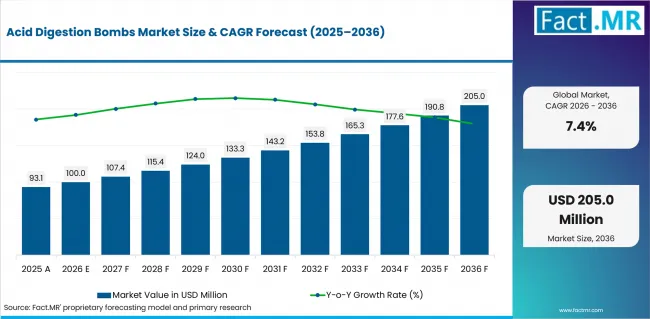
Acid Digestion Bombs Market Value Analysis | Source: Fact.MR
What are the defining numbers behind Acid Digestion Bombs Market growth?
USD 105.0 million absolute opportunity is expected between 2026 and 2036.
- Demand Drivers in the Market
- Laboratories handling mineral, environmental, food, agricultural, metallurgical, pharmaceutical, and materials samples need digestion equipment suited to difficult sample preparation.
- Heating-mode choice affects workflow design because conventional oven heating, microwave heating, and hotplate or block heating place different demands on vessels and operating procedures.
- Vessel selection remains central where users must match PTFE-lined steel, PFA or TFM, microwave digestion, or quartz vessels to the sample and heating conditions.
- Testing laboratories, academic laboratories, mining and metals laboratories, government and regulatory laboratories, and industrial quality-control laboratories create distinct purchasing requirements.
- Key Segments Analyzed
- By Application: Environmental analysis is expected to hold 36.0% share in 2026 because laboratories require enclosed digestion for difficult environmental samples before measurement.
By Heating Mode: Conventional oven heating is projected to account for 40.0% share in 2026 as it supports controlled vessel-based digestion under established laboratory procedures.
By Vessel Type: PTFE-lined steel bombs are anticipated to capture 40.0% share in 2026 due to their combination of a chemically resistant internal surface and a pressure-containing external body.
By End User: Testing laboratories are estimated to represent 26.0% share in 2026 because they handle varied sample-preparation assignments and require repeatable digestion procedures across multiple applications.
- By Application: Environmental analysis is expected to hold 36.0% share in 2026 because laboratories require enclosed digestion for difficult environmental samples before measurement.
- Analyst Opinion at Fact.MR
- Shambhu Nath Jha, Senior Analyst at Fact.MR, states, “Acid digestion bomb selection must align vessel material, heating mode, sample chemistry, and laboratory handling procedures. Purchasing decisions are expected to depend on pressure containment, chemical compatibility, repeatable digestion performance, and safe operation rather than vessel capacity or heating speed alone.”
- Strategic Implications
- Laboratory managers need an agreed digestion protocol covering sample chemistry, vessel compatibility, heating conditions, pressure limits, and cleaning procedures before equipment quotations turn into purchasing decisions. That protocol should reflect the laboratory’s routine workload and difficult sample types.
- Equipment providers need to show how vessel construction, heating mode, and handling requirements support repeatable sample preparation. Clear application guidance becomes important because PTFE-lined steel, PFA or TFM, microwave digestion, and quartz vessels are not interchangeable across all workflows.
- Investors need to separate direct exposure to enclosed acid digestion systems from broader laboratory sample-preparation equipment. Market relevance is strongest where suppliers generate revenue from specialized vessels, compatible heating systems, replacement components, and recurring service support.
The UK is expected to lead the Acid Digestion Bombs Market with a 9.4% CAGR from 2026 to 2036, supported by laboratory demand across environmental, testing and regulated sample-preparation workflows. Australia is projected to record a 9.1% CAGR as mining and geological assay activity sustains digestion requirements. The USA is anticipated to grow at 8.7% through broad adoption across testing and industrial laboratories. Canada is estimated to post an 8.4% CAGR through diversified laboratory demand, while Germany is forecast at 7.3%, supported by established analytical procedures and careful matching of samples, vessels and heating methods.
How does the Acid Digestion Bombs Market break down by segment?
Environmental analysis leads Application with 36.0% share, while conventional oven heating and PTFE-lined steel bombs each lead their respective categories with 40.0% share in 2026.
Why does environmental analysis lead Application?
Environmental analysis is projected to account for 36.0% share in 2026.
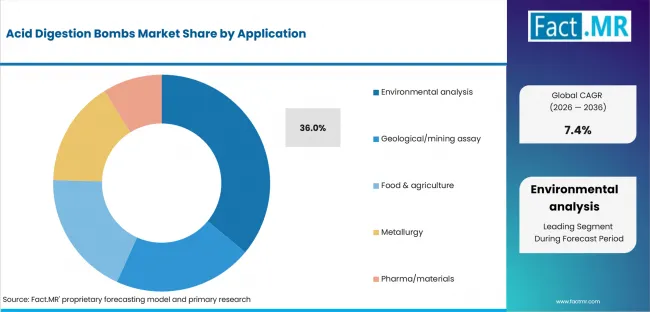
Acid Digestion Bombs Market Analysis By Application | Source: Fact.MR
This work can involve samples that require enclosed digestion before measurement. Acid digestion bombs give laboratories a defined vessel-based route for preparing such material. Geological and mining assay, food and agriculture, metallurgy, and pharmaceutical and materials work remain important alternatives, but each brings a different mix of sample composition and analytical routine. Environmental analysis leads because it represents the largest application share in the assessed market.
Why does conventional oven heating lead Heating Mode?
Conventional oven heating leads with 40.0% share in 2026.
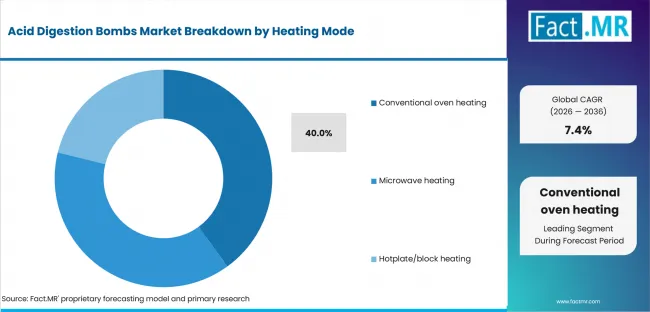
Acid Digestion Bombs Market Analysis By Heating Mode | Source: Fact.MR
The method supports a contained digestion workflow in which vessels are heated under controlled conditions. It competes with microwave heating and hotplate or block heating, both of which can suit different laboratory routines. The choice is not interchangeable: laboratories must consider vessel design, processing time, sample behavior, and operator procedure. Conventional oven heating remains the leading mode in the current segmentation.
Why do PTFE-lined steel bombs lead Vessel Type?
PTFE-lined steel bombs hold 40.0% share in 2026.
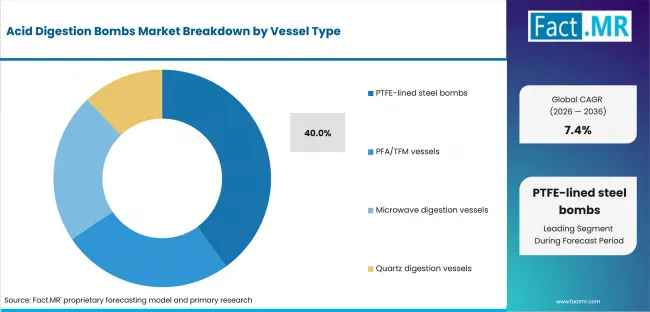
Acid Digestion Bombs Market Analysis By Vessel Type | Source: Fact.MR
Their configuration combines an internal contact surface with an external pressure-containing body. PFA or TFM vessels, microwave digestion vessels, and quartz digestion vessels serve other combinations of sample, heating, and handling needs. Buyers therefore assess the complete vessel system rather than material name alone. PTFE-lined steel bombs lead the category because they hold the largest recorded vessel-type share.
Why do testing laboratories lead End User?
Testing laboratories account for 26.0% share in 2026.
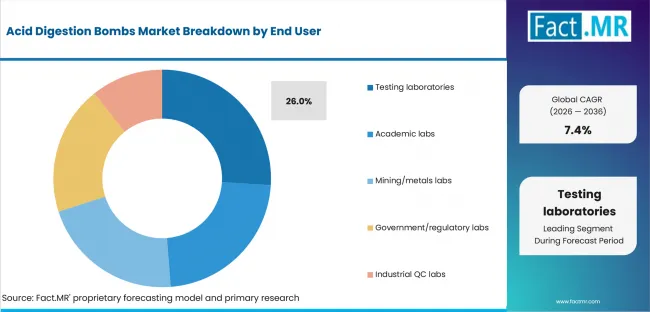
Acid Digestion Bombs Market Analysis By End User | Source: Fact.MR
Testing laboratories encounter varied sample-preparation assignments and must maintain repeatable operating procedures across them. Academic laboratories may place greater weight on research flexibility, while mining and metals laboratories concentrate on mineral and metallurgical matrices. Government and regulatory laboratories and industrial quality-control laboratories also use digestion workflows within their respective mandates. Testing laboratories lead, but the 26.0% share shows that demand remains distributed across several user groups.
What is accelerating Acid Digestion Bombs Market adoption, and what is holding it back?
Demand is expected to be driven by varied sample-preparation requirements and broader use of controlled digestion workflows. Adoption is projected to be restrained by vessel compatibility requirements and disciplined high-pressure handling procedures.
Drivers Impact Analysis
| DRIVER | MARKET RELEVANCE | PRIMARY ADOPTION CONTEXT | RELEVANCE HORIZON |
|---|---|---|---|
| Diverse sample-preparation requirements | High | UK, USA and Germany | Short term (≤ 2 years) |
| Expansion across laboratory settings | High | USA, Canada and UK | Short term (≤ 2 years) |
| Availability of multiple heating workflows | High | Developed laboratory markets | Medium term (2–4 years) |
| Specialized vessel configurations | High | Mining and environmental laboratories | Medium term (2–4 years) |
| Repeatable analytical procedures | High | UK, Germany and USA | Long term (≥ 4 years) |
Source: Fact.MR analysis. Updated Jul 23, 2026
- Diverse sample-preparation requirements: Environmental and geological applications are expected to create recurring demand for enclosed digestion equipment. Food and pharmaceutical testing is anticipated to widen the application base.
- Expansion across laboratory settings: Testing laboratories are projected to support equipment demand through varied sample workloads. Academic and regulatory laboratories are expected to create further purchasing routes.
- Availability of multiple heating workflows: Conventional oven systems are expected to support established digestion procedures. Microwave and block-heating options are anticipated to serve laboratories with different throughput requirements.
- Specialized vessel configurations: PTFE-lined steel vessels are projected to support aggressive digestion conditions. PFA and quartz alternatives are expected to address different sample compatibility requirements.
- Repeatable analytical procedures: Controlled temperature and pressure are expected to improve digestion consistency. Standardized handling procedures are anticipated to support regulated testing and quality-control workflows.
Opportunity Impact Analysis
| OPPORTUNITY | MARKET RELEVANCE | PRIMARY ADOPTION CONTEXT | RELEVANCE HORIZON |
|---|---|---|---|
| Integrated equipment-selection guidance | High | Global laboratory markets | Short term (≤ 2 years) |
| Improved vessel compatibility information | High | UK, USA and Germany | Medium term (2–4 years) |
| Replacement vessel demand | High | Testing and industrial laboratories | Medium term (2–4 years) |
| Service and maintenance programs | High | Developed laboratory clusters | Long term (≥ 4 years) |
Source: Fact.MR analysis. Updated Jul 23, 2026
- Integrated equipment-selection guidance: Suppliers are expected to reduce purchasing uncertainty by linking applications with suitable heating modes. Vessel selection is projected to become clearer through structured evaluation support.
- Improved vessel compatibility information: Detailed chemical compatibility guidance is anticipated to reduce unsuitable equipment choices. Clear pressure and temperature limits are expected to improve operating confidence.
- Replacement vessel demand: Laboratories operating several digestion systems are expected to require replacement liners and seals. Recurring vessel purchases are projected to support aftermarket revenue.
- Service and maintenance programs: Inspection services are anticipated to support safe equipment operation. Operator training and replacement planning are expected to strengthen long-term supplier relationships.
Restraints Impact Analysis
| RESTRAINT | MARKET RELEVANCE | PRIMARY ADOPTION CONTEXT | RELEVANCE HORIZON |
|---|---|---|---|
| Sample and vessel compatibility complexity | High | Global | Short term (≤ 2 years) |
| High-pressure handling requirements | High | Academic and testing laboratories | Short term (≤ 2 years) |
| Cleaning and maintenance requirements | High | Industrial and regulatory laboratories | Medium term (2–4 years) |
| Low equipment utilization | High | Smaller laboratories and research facilities | Medium term (2–4 years) |
Source: Fact.MR analysis. Updated Jul 23, 2026
- Sample and vessel compatibility complexity: A vessel suited to one sample may be unsuitable for another material. This limitation is expected to increase evaluation time and purchasing risk.
- High-pressure handling requirements: Enclosed digestion systems require trained operators and controlled cooling procedures. Safe vessel opening is projected to remain an operational requirement.
- Cleaning and maintenance requirements: Residue removal is expected to affect analytical repeatability. Liner wear and seal condition are anticipated to increase maintenance requirements.
- Low equipment utilization: Smaller laboratories are expected to delay purchases where digestion volumes remain limited. Specialized equipment costs are projected to restrict adoption in low-throughput facilities.
Which countries are scaling Acid Digestion Bombs Market fastest?
The country comparison is defined less by the overall CAGR range and more by the spacing between the markets. The five markets fall within a 2.1 percentage-point range from the UK to Germany. The UK and Australia form a compact upper cluster with only a measured difference between them. The USA and Canada create a closely aligned middle group. A pronounced 1.1 percentage-point gap separates Canada from Germany. This pattern reflects differences in laboratory applications and equipment-selection requirements rather than current market size alone.
- The UK occupies a notable position through demand from environmental testing and regulated laboratory workflows. Equipment approval is expected to depend on vessel compatibility and controlled operating procedures.
- Australia remains close to the UK in CAGR terms but follows a different adoption route. Geological testing and mining assay are expected to support demand for vessels suited to difficult mineral samples.
- The USA is positioned within the middle cluster through its broad laboratory base. Buyers are expected to compare conventional ovens with microwave and block-heating systems before selecting suitable vessel configurations.
- Canada records a moderate separation from the USA despite a comparable development pace. Demand is distributed across testing laboratories and mining facilities as well as government and industrial quality-control settings.
- Germany is positioned outside the main cluster and remains closely aligned with the global market rate. Adoption is expected to depend on careful matching between sample chemistry and vessel construction along with heating procedures.
Comparable CAGRs can produce different market-entry conditions because laboratories serve different sample portfolios. Deployment timing is therefore expected to depend on operator training and equipment utilization as well as compatibility documentation.
The full report provides country-level CAGR analysis across North America, Latin America, Europe, East Asia, South Asia, Oceania and the Middle East and Africa.
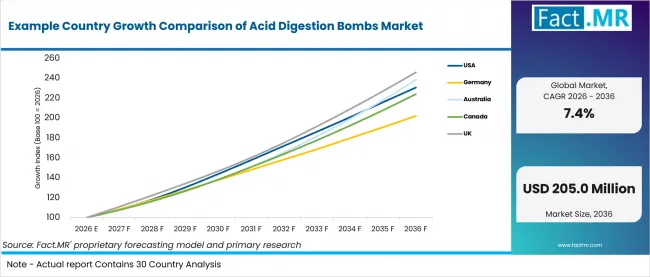
Example Country Growth Comparison Of Acid Digestion Bombs Market | Source: Fact.MR
| COUNTRY | CAGR, 2026 to 2036 |
|---|---|
| UK | 9.4% |
| Australia | 9.1% |
| USA | 8.7% |
| Canada | 8.4% |
| Germany | 7.3% |
Source: Fact.MR analysis. Updated Jul 23, 2026
What is driving the UK’s growth through 2036?
9.4% CAGR from 2026 to 2036. Local environmental testing and regulated laboratory workflows.
The UK’s growth is tied to laboratories that require repeatable digestion procedures for environmental and regulated samples. Buyers are expected to assess vessel compatibility alongside pressure control and cleaning requirements. Demand is therefore likely to favor systems supported by clear operating documentation and reliable replacement components.
How is Australia developing demand?
9.1% CAGR, driven by geological testing and mining-assay requirements.
Australia follows a resource-focused adoption route where mineral samples can require controlled digestion before analytical measurement. Laboratories serving geological and mining applications are expected to prioritize vessels suited to difficult matrices and aggressive conditions. Equipment selection is likely to depend on pressure containment and compatibility with established assay procedures.
What supports USA adoption?
8.7% CAGR, backed by a broad testing and industrial laboratory base.
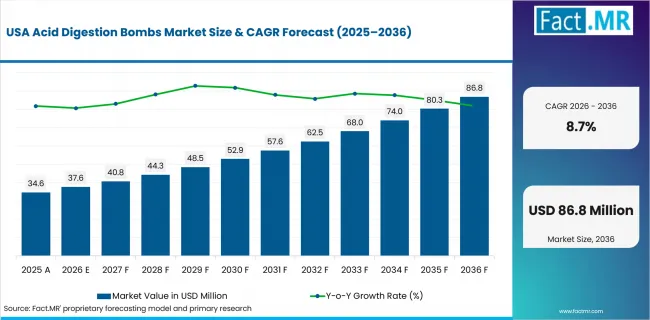
Acid Digestion Bombs Market Country Value Analysis | Source: Fact.MR
The USA’s development reflects varied demand across environmental testing and industrial quality control. Buyers can compare conventional oven systems with microwave and block-heating workflows. This creates a commercial requirement for suppliers to explain how vessel construction and heating mode fit each laboratory’s throughput and sample portfolio.
How is Canada scaling demand?
8.4% CAGR from 2026 to 2036. Local mining laboratories and public testing requirements.
Canada’s market is distributed across testing facilities and mining laboratories as well as government and industrial quality-control settings. This mixed customer base is expected to create demand for flexible vessel portfolios rather than one standard configuration. Supplier support is likely to matter where laboratories operate several digestion methods.
How does Germany perform?
7.3% CAGR, shaped by established analytical procedures and careful system qualification.
Germany’s growth model places greater weight on matching sample chemistry with vessel material and heating conditions. Laboratories are expected to compare chemical resistance and pressure limits before approving equipment. Adoption may therefore progress through disciplined qualification and documented operating procedures rather than rapid capacity expansion.
Who leads the Acid Digestion Bombs Market?
Parr Instrument shows the clearest direct relevance, while Berghof Products and Milestone Srl strengthen the wider field for enclosed digestion vessels and laboratory sample preparation.
Parr Instrument supports controlled digestion through pressure vessels designed for demanding laboratory workflows. Berghof Products contributes high-pressure digestion systems for difficult sample preparation. Milestone Srl supports microwave-based digestion and related laboratory workflows. Anton Paar and CEM Corporation extend the competitive landscape through digestion platforms and analytical preparation equipment.
From 2026 to 2036, competition is expected to depend on vessel compatibility and pressure containment across different sample chemistries. Laboratories are also likely to compare heating-mode flexibility and cleaning requirements along with replacement support. Providers that demonstrate repeatable digestion performance and clear application guidance may gain stronger demand from testing laboratories and mining facilities as well as regulatory and industrial quality-control users.
Which companies are the key providers?
Key companies include Parr Instrument; Berghof Products; Milestone Srl; Anton Paar; CEM Corporation.
- Parr Instrument
- Berghof Products
- Milestone Srl
- Anton Paar
- CEM Corporation
Bibliography
- Australian Bureau of Statistics. (2026, June 2). Mineral and petroleum exploration, Australia, March 2026.
- Environment Agency. (2025, March 12). Abandoned metal mines in England: Baseline length of rivers and estuaries polluted by harmful metals.
- Federal Statistical Office of Germany. (2026, February 6). Production in December 2025: Down 1.9% on the previous month.
- UK Department for Environment, Food & Rural Affairs. (2025, September 30). UK Heavy Metal Monitoring Network: Annual report 2024.
This Report Answers
- The report provides strategic intelligence on the Acid Digestion Bombs Market across Application and Heating Mode choices that shape controlled laboratory sample-preparation workflows.
- Segment analysis covers Environmental analysis and Conventional oven heating as the share leaders within the 2026 market. PTFE-lined steel bombs and Testing laboratories lead the Vessel Type and End User categories.
- Country outlook evaluates the UK and Australia alongside the USA and Canada. Germany completes the growth comparison across the profiled markets.
- Competitive analysis profiles Parr Instrument and Berghof Products alongside Milestone Srl and Anton Paar. CEM Corporation completes the assessed provider set.
- Vessel and workflow assessment covers PTFE-lined steel bombs and PFA or TFM vessels. Microwave digestion vessels and quartz digestion vessels complete the vessel view alongside conventional oven, microwave and block-heating workflows.
What does the Acid Digestion Bombs Market cover?
Enclosed acid digestion vessels are used to prepare difficult laboratory samples under controlled heat and pressure.
The Acid Digestion Bombs Market covers enclosed vessels and related digestion systems used for environmental analysis and geological or mining assay. Coverage extends to food and agricultural testing as well as metallurgy and pharmaceutical or materials analysis. The market includes conventional oven heating and microwave digestion. Hotplate or block-heating workflows are also included where compatible pressure vessels are required. Vessel coverage includes PTFE-lined steel bombs and PFA or TFM vessels. Microwave digestion vessels and quartz digestion vessels complete the assessed product scope.
The market differs from general laboratory sample-preparation equipment because commercial value depends on containing aggressive digestion conditions and maintaining safe operating control. Open beakers and routine low-pressure laboratory containers remain outside the boundary. General analytical instruments are excluded unless they form part of an enclosed acid-digestion workflow. Unrelated heating equipment is excluded when it is not designed to support compatible digestion vessels.
What is included in the scope?
Acid digestion bombs are used across testing laboratories and academic laboratories. Mining and metals laboratories are included alongside government and regulatory laboratories. Industrial quality-control laboratories complete the assessed end-user base.
The scope includes Application and Heating Mode alongside Vessel Type and End User. Coverage spans environmental analysis and geological or mining assay. Food and agriculture as well as metallurgy and pharmaceutical or materials applications are included. Heating modes cover conventional ovens and microwave systems. Hotplate or block heating follows the same process-use rule. Vessel types include PTFE-lined steel and PFA or TFM configurations. Quartz and microwave digestion vessels are also included.
What is excluded from the scope?
General laboratory heating equipment and unrelated analytical systems remain outside the scope of this market.
The scope excludes equipment that does not provide an enclosed digestion route under controlled heat and pressure. Open-vessel acid preparation and routine laboratory glassware are excluded. Standalone analytical instruments are outside the boundary unless directly integrated with the digestion workflow. General ovens and hotplates are excluded when they are not used with compatible digestion vessels. Products serving applications outside the listed analysis and end-user categories are also excluded.
How Was the Analysis Built?
The assessment combines public laboratory-safety, digestion-vessel, materials and company information with country-level demand signals and industry interviews relevant to acid-digestion workflows.
- Primary Research: Primary research includes discussions with manufacturers, service providers, technology developers, distributors, end users, procurement teams, and subject-matter experts. These conversations examine purchasing priorities, product adoption, operational challenges, approval requirements, competitive positioning, and the factors that influence wider market acceptance.
- Desk Research: Desk research covers government statistics, regulatory publications, company filings, trade data, technical studies, industry associations, standards, public policy, and other authoritative sources. Every source used in the analysis is documented in the bibliography.
- Market Sizing and Forecasting: Market estimates combine historical performance, demand indicators, pricing and volume trends, segment shares, company participation, country-level growth, adoption patterns, investment activity, and barriers to market expansion.
- Data Validation and Update Cycle: Findings are validated by comparing primary interviews with public data, company activity, regulatory changes, trade patterns, and industry developments. Regular updates review new product launches, capacity changes, partnerships, approvals, procurement trends, and shifts in commercial adoption.
Segmentation
What is the report's scope and coverage?
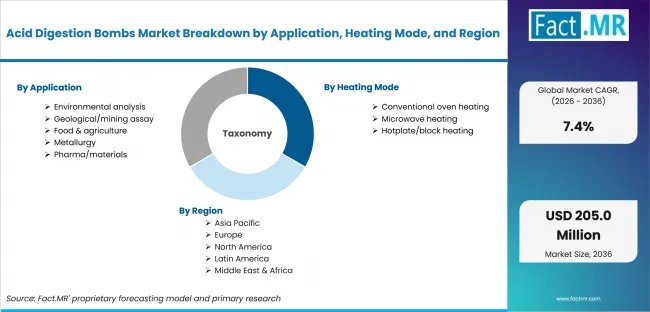
Acid Digestion Bombs Market Breakdown By Application, Heating Mode, And Region | Source: Fact.MR
| Attribute | Details |
|---|---|
| Quantitative Units | USD 100.0 million in 2026 to USD 205.0 million by 2036 at 7.4% CAGR |
| Market Definition | Enclosed acid digestion vessels used for controlled sample preparation under heat and pressure |
| Application | Environmental analysis; Geological/mining assay; Food & agriculture; Metallurgy; Pharma/materials |
| Heating Mode | Conventional oven heating; Microwave heating; Hotplate/block heating |
| Vessel Type | PTFE-lined steel bombs; PFA/TFM vessels; Microwave digestion vessels; Quartz digestion vessels |
| End User | Testing laboratories; Academic labs; Mining/metals labs; Government/regulatory labs; Industrial QC labs |
| Regions Covered | North America; Latin America; Europe; East Asia; South Asia & Oceania; Middle East & Africa |
| Countries Covered | USA; Germany; Australia; Canada; UK |
| Key Companies Profiled | Parr Instrument; Berghof Products; Milestone Srl; Anton Paar; CEM Corporation |
| Forecast Period | 2026 to 2036 |
| Approach | Hybrid top-down and bottom-up market assessment |
Source: Fact.MR analysis. Updated Jul 23, 2026
How is the market segmented?
-
By Application:
- Environmental analysis
- Geological/mining assay
- Food & agriculture
- Metallurgy
- Pharma/materials
-
By Heating Mode:
- Conventional oven heating
- Microwave heating
- Hotplate/block heating
-
By Vessel Type:
- PTFE-lined steel bombs
- PFA/TFM vessels
- Microwave digestion vessels
- Quartz digestion vessels
-
By End User:
- Testing laboratories
- Academic labs
- Mining/metals labs
- Government/regulatory labs
- Industrial QC labs
-
By Region:
- North America
- Europe
- South Asia & Oceania
Frequently Asked Questions
Which application leads the Acid Digestion Bombs Market?
Which heating mode leads the market?
Which vessel type leads the market?
Which end user leads the market?
Which country records the fastest growth?
Which companies are included in the market assessment?
Who worked on this report


Preview the report firsthand - request a free sample
Free SampleGet the brochure for pricing and purchase details
Download PDF