- Market Value (2025): USD 455.8 Mn
- Estimated Value (2026): USD 492.4 Mn
- Forecast Value (2036): USD 1065.0 Mn
- CAGR (2026-2036): 8.0%
What is the Acid Resistant Capsules Market forecast to be worth by 2036?
USD 492.4 million in 2026 to USD 1065.0 million by 2036 at an 8.0% CAGR.
- The acid resistant capsules market stood at USD 455.8 million in 2025, with prescription medicines that need gastric protection accounting for most capsule volume.
- Revenue will expand from USD 492.4 million in 2026 to USD 1065.0 million by 2036 as developers move peptides, enzymes and other fragile actives into oral capsules.
- An 8.0% CAGR reflects a shift away from coating filled capsules after the fact and toward shells that resist acid on their own.
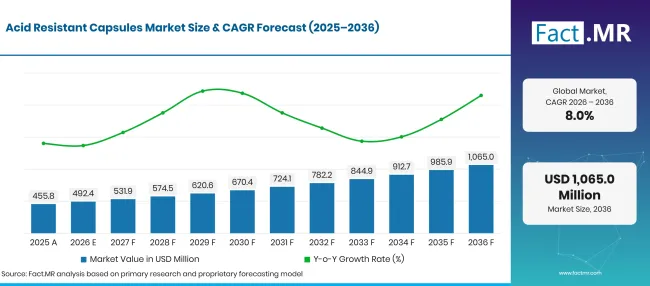
Acid Resistant Capsules Market Forecast Global | Source: Fact.MR
| Year | Basis | Market Value (USD million) |
|---|---|---|
| 2025 | Actual | 455.8 |
| 2026 | Estimate | 492.4 |
| 2036 | Forecast | 1065.0 |
| CAGR 2026 to 2036 | Forecast period | 8.0% |
Source: Fact.MR analysis. Updated Nov 3, 2026
What are the defining numbers behind Acid Resistant Capsules Market growth?
The 2026 to 2036 period adds USD 572.6 million in new value, most of it from enteric shells used in pharmaceutical formulations.
- Demand Drivers in the Market
- Ready-to-fill shells remove a costly process step. Lonza Capsugel states that its Enprotect capsule reaches full compendial acid resistance without a secondary coating or heat treatment, holding for up to 2 hours at pH 1.2 and dissolving above pH 6.0 [1]. Removing the coating stage shortens development and protects heat-sensitive fills.
- The pipeline of new oral actives keeps growing. Evonik reported in October 2025 that more than 700 oral drug development programmes use novel active ingredients, many of them sensitive molecules such as live biotherapeutics, RNA and biologics [2]. These candidates need protection in the stomach before they can reach their absorption site.
- Regulators continue to clear a steady flow of new medicines. EMA recommended 104 human medicines for marketing authorisation in 2025, and 38 of them contained a new active substance [3]. Each new oral product with an acid-labile ingredient opens a potential slot for an enteric capsule format.
- Probiotic and enzyme supplements are adopting the same technology. Brands want live cultures and digestive enzymes to survive gastric transit, so capsule makers now offer delayed-release shells sized for nutraceutical filling lines.
- Key Segments Analyzed
- By Product Type: Enteric Coated Capsules will hold 71.9% of 2026 value, since they meet the pharmacopoeial gastro-resistance test that prescription products must pass.
- By Application: Pharmaceuticals will account for 58.7% of 2026 revenue, given that acid-labile drugs and stomach-irritating actives need a dosage form that opens only in the intestine.
- By Material: Gelatin will capture 64.8% of 2026 sales, reflecting decades of validated supply and its fit with existing high-speed filling equipment.
- By End-User: Pharmaceutical Companies will represent 62.3% of 2026 demand, as drug makers buy shells in volume for both clinical and commercial batches.
- Analyst Opinion at Fact.MR
- Shambhu Nath Jha, Principal Consultant at Fact.MR, states, “The enteric capsule has become an early formulation decision instead of a fix applied after a stability problem appears. Suppliers that can show compendial acid resistance in the shell itself will win programmes, because developers want to skip the coating step and the scale-up risk it brings. Over the next ten years, oral peptides and microbiome products will push demand toward shells with tighter release windows, and documentation quality will separate suppliers as much as price.”
- Strategic Implications
- Capsule manufacturers should publish dissolution data at pH 1.2 and at intestinal pH for every shell grade, since formulators now screen suppliers on test results before they request samples.
- Drug developers should decide between gelatin and HPMC shells at the preformulation stage, matching the shell to fill moisture, nitrite limits and the target release site.
- Contract manufacturers should qualify ready-to-fill enteric shells on their standard filling lines, which lets them offer gastro-resistant products without investing in capsule banding or coating pans.
- Investors should look for suppliers with patented enteric shell chemistry and regulatory files in place, because these assets take years to replicate.
Germany will grow at 10.0%, the top pace of the five, as its export-led drug industry scales new oral formulations for markets outside the EU. Japan follows closely at 9.7%, helped by a domestic manufacturing base where capsules already form a sizeable share of output. Growth of 8.1% in the United Kingdom will come from strong pharmaceutical research and export activity, even though recent output has been uneven. Brazil trails at 6.9%; generic substitution keeps unit prices low, which limits value even as local formulation capacity grows. The United States closes the group at 5.6%, where a large installed base of enteric products means new demand comes mainly from novel drug approvals.
How does the Acid Resistant Capsules Market break down by segment?
Enteric Coated Capsules will lead Product Type at 71.9%; Pharmaceuticals will head Application at 58.7%; Gelatin will top Material at 64.8%; Pharmaceutical Companies will hold End-User at 62.3% in 2026.
Which Product Type leads?
Enteric Coated Capsules take 71.9% of 2026 sales.
| Product Type | Share (2026) |
|---|---|
| Enteric Coated Capsules (Leading segment) | 71.9% |
| Other segments combined | 28.1%* |
| Total | 100.0% |
Source: Fact.MR analysis. Updated Nov 3, 2026
Prescription products that claim gastro-resistance must pass a two-stage dissolution test, first in acid and then in buffer, and enteric coated capsules are built to clear it. The protection can come from a functional coating on the shell or from a shell cast with enteric polymer. Evonik’s EUDRACAP enteric uses an HPMC capsule with a functional coating and runs on automated filling machines without a separate coating step. Producers of powder-filled hard gelatin capsules increasingly add enteric versions to their range. Delayed release capsules form the other main category. They slow disintegration in the stomach but do not always meet the full compendial acid-resistance limits, so they serve supplements and some over-the-counter products. Other formats include capsule-in-capsule designs and colon-targeted shells for site-specific delivery.
What supports Pharmaceuticals within Application?
Pharmaceuticals account for 58.7% of 2026 revenue.
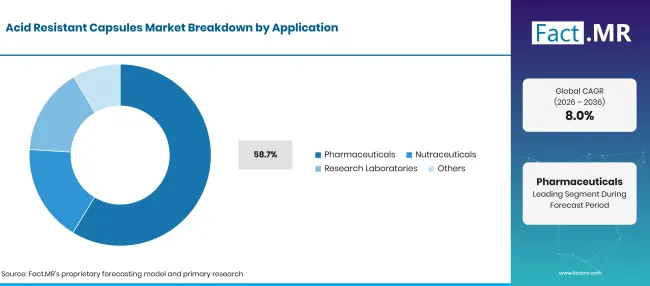
Acid Resistant Capsules Market Breakdown Application | Source: Fact.MR
| Application | Share (2026) |
|---|---|
| Pharmaceuticals (Leading segment) | 58.7% |
| Other segments combined | 41.3%* |
| Total | 100.0% |
Source: Fact.MR analysis. Updated Nov 3, 2026
Many active ingredients break down in gastric acid or irritate the stomach lining, and drug companies need a dosage form that protects both the molecule and the patient. Proton pump inhibitors, pancreatic enzymes and several anti-inflammatory drugs already rely on enteric protection, and peptide candidates add new demand. Prescription capsules also carry the strictest testing burden, which raises value per unit. Nutraceuticals form the next application, led by probiotics and digestive enzymes sold through probiotic supplements channels. Lonza Capsugel reported in May 2026 that its Licaps DUOCAP capsule-in-capsule format delivered up to four times the enzyme activity of standard capsules in the upper small intestine in a laboratory gut model [4]. Research laboratories use small lots of enteric shells for preclinical and early clinical work.
How does Material shape demand?
Gelatin captures 64.8% of 2026 value.
| Material | Share (2026) |
|---|---|
| Gelatin (Leading segment) | 64.8% |
| Other segments combined | 35.2%* |
| Total | 100.0% |
Source: Fact.MR analysis. Updated Nov 3, 2026
Gelatin shells fill quickly on installed machines and carry long regulatory histories, which keeps them the default for many commercial products. Suppliers now add nitrosamine controls to protect that position. In September 2026, Lonza Capsugel launched a nitrite testing service for gelatin capsules with a validated assay that quantifies nitrite down to 100 ppb [5]. Makers of softgel capsules face similar scrutiny of shell excipients. HPMC is the main alternative and the base for most ready-to-fill enteric shells, since it holds less water and suits moisture-sensitive fills. Roquette won a 2025 NIE New Ingredient Award for low-nitrite METHOCEL HPMC, which keeps nitrite at or below 200 ppb in every batch [6]. Sourcing of pharmaceutical gelatin and cellulose polymers will shape shell costs for both routes.
What supports Pharmaceutical Companies within End-User?
Pharmaceutical Companies represent 62.3% of 2026 demand.
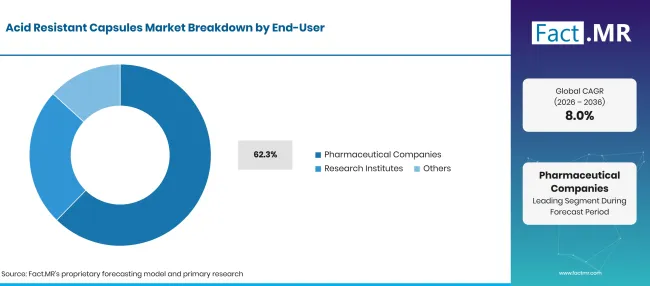
Acid Resistant Capsules Market Breakdown End User | Source: Fact.MR
| End-User | Share (2026) |
|---|---|
| Pharmaceutical Companies (Leading segment) | 62.3% |
| Other segments combined | 37.7%* |
| Total | 100.0% |
Source: Fact.MR analysis. Updated Nov 3, 2026
Drug makers buy enteric shells for clinical supplies and then for commercial launch, and they rarely switch supplier once a product is registered. Their purchase decisions rest on dissolution data, drug master file support and proven runs on pharmaceutical capsule filling machines. Roquette expanded its coating range in February 2025 with Tabshield film coatings for immediate and enteric release, which gives formulators a coating route alongside enteric shells [7]. Research institutes test shells in early formulation work and in academic delivery studies. Other end users include contract developers that run oral solid dosage contract manufacturing for clients without in-house capsule expertise.
What is accelerating Acid Resistant Capsules Market adoption, and what is holding it back?
Adoption grows as developers bring more acid-sensitive molecules to oral form and as ready-to-fill shells remove the coating step. Supplements add volume through probiotics and enzymes. Growth is checked by the cost of functional shells, which run well above standard capsules. Dissolution validation and pharmacopoeial testing also add time before a product reaches the market.
Drivers Impact Analysis
| DRIVER | (~) % IMPACT ON CAGR | GEOGRAPHIC RELEVANCE | IMPACT TIMELINE |
|---|---|---|---|
| Oral pipelines with acid-sensitive small molecules and peptides | +1.3% | Global | Medium term (2-4 years) |
| Ready-to-fill enteric shells that remove post-fill coating | +1.1% | North America, Western Europe | Short term (<=2 years) |
| Probiotic and digestive enzyme supplements needing gastric protection | +0.9% | Global | Short term (<=2 years) |
| New medicine approvals in Europe and the United States | +0.6% | North America, Western Europe | Medium term (2-4 years) |
Source: Fact.MR analysis. Updated Nov 3, 2026
Opportunity Impact Analysis
| OPPORTUNITY | (~) % IMPACT ON CAGR | GEOGRAPHIC RELEVANCE | IMPACT TIMELINE |
|---|---|---|---|
| Shells for oral peptides and live biotherapeutic products | +0.8% | Global | Long term (>=4 years) |
| Colon-targeted and capsule-in-capsule release designs | +0.6% | North America, Western Europe | Medium term (2-4 years) |
| Enteric shell supply to contract manufacturers | +0.5% | South Asia & Pacific, Latin America | Medium term (2-4 years) |
| Low-nitrite gelatin and HPMC grades for nitrosamine control | +0.4% | Global | Short term (<=2 years) |
Source: Fact.MR analysis. Updated Nov 3, 2026
Restraints Impact Analysis
| RESTRAINT | (~) % IMPACT ON CAGR | GEOGRAPHIC RELEVANCE | IMPACT TIMELINE |
|---|---|---|---|
| Higher unit cost of functional shells versus standard capsules | -0.6% | Global | Medium term (2-4 years) |
| Dissolution and stability testing for gastro-resistance claims | -0.5% | Global | Short term (<=2 years) |
| Shell brittleness and fit issues on high-speed filling lines | -0.3% | Global | Medium term (2-4 years) |
| Generic price pressure on mature enteric products | -0.2% | Latin America, North America | Long term (>=4 years) |
Source: Fact.MR analysis. Updated Nov 3, 2026
Which countries are scaling the Acid Resistant Capsules Market through 2036?
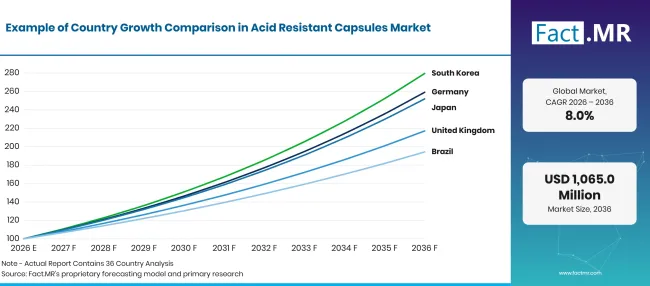
Acid Resistant Capsules Market Growth Index | Source: Fact.MR
| Country | CAGR (2026 to 2036) |
|---|---|
| Germany | 10.0% |
| Japan | 9.7% |
| United Kingdom | 8.1% |
| Brazil | 6.9% |
| United States | 5.6% |
Source: Fact.MR analysis. Updated Nov 3, 2026
What supports Germany’s adoption?
10.0% CAGR, driven by export-scale drug manufacturing and new oral formulations.
Germany is one of Europe’s main sources of finished medicines, and its plants supply oral products far beyond the EU. Eurostat reported in April 2026 that Germany exported EUR 67.9 billion of medicinal and pharmaceutical products to countries outside the EU in 2025, second only to Ireland [8]. That export base gives capsule suppliers large, regulated customers who need validated gastro-resistant shells for products sold into several markets at once.
How is Japan developing demand?
9.7% CAGR, backed by a domestic production base already familiar with capsule dosage forms.
Japanese manufacturers already produce capsule medicines at scale, which shortens the path to enteric formats. MHLW data published in December 2025 show domestic pharmaceutical production of about JPY 10.25 trillion in 2024, up 2.1% from 2023 [9]. Capsules accounted for about JPY 754.5 billion of that output, or 7.4%, even though capsule production fell 4.2% in the year. Switching existing capsule lines to higher-value enteric shells is one way producers can recover that value.
What is supporting the United Kingdom’s adoption?
8.1% CAGR, reflecting deep pharmaceutical research and an export-focused drug industry.
The United Kingdom pairs strong drug research with an export-oriented manufacturing base. The government’s Life Sciences Competitiveness Indicators 2026 show UK pharmaceutical exports of GBP 24.7 billion in 2024, down 4% from 2023 [10]. The same release puts pharmaceutical manufacturing gross value added at GBP 20.4 billion in 2023. Developers in the country use enteric capsules in early trials, where a ready-to-fill shell saves time against coating development.
How is Brazil scaling demand?
6.9% CAGR, as generic substitution widens access while local formulation capacity grows.
Brazil’s market leans heavily on generics, which caps value per capsule. ANVISA noted in May 2026, marking 27 years of the country’s generics law, that generic medicines are priced at least 35% below reference brands [11]. Supplier investment is rising, though. Roquette opened a pharmaceutical innovation centre in Barueri, near São Paulo, in October 2025 to support local formulation work from concept to launch [12].
What supports United States adoption?
5.6% CAGR, given a mature enteric product base and a steady flow of novel drug approvals.
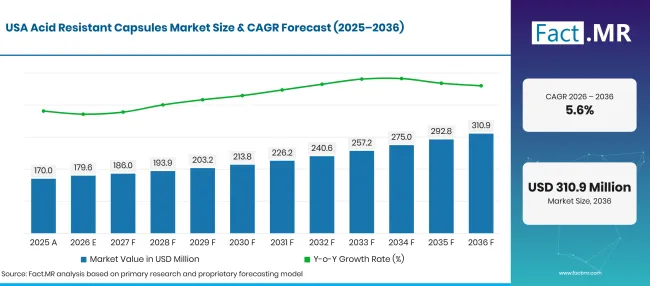
Acid Resistant Capsules Market Forecast Usa | Source: Fact.MR
The United States already has a large catalogue of delayed-release and enteric products, so new demand rests mainly on fresh approvals and reformulations. FDA’s Center for Drug Evaluation and Research approved 46 novel drugs in 2025 [13]. Oral candidates among them, along with peptide programmes moving toward capsules, keep developers testing ready-to-fill enteric shells against conventional coating.
Who leads the Acid Resistant Capsules Market?
Competition splits into three groups. Polymer-led specialists, Lonza Capsugel and Evonik, own the shell chemistry behind ready-to-fill enteric products and compete on compendial performance and regulatory files.
Lonza Capsugel’s Enprotect uses a bilayer HPMC and HPMCAS shell that resists acid without a coating step [1], and the company added a gelatin nitrite testing service in September 2026 [5]. Evonik won a CPHI Pharma Award in October 2025 for EUDRACAP colon, a ready-to-fill capsule that targets the ileo-colonic region [2]. Volume capsule makers form the second group: ACG, Suheung and Roquette sell delayed-release or acid-protection HPMC shells next to broad gelatin ranges, and they compete on price and filling performance. Regional specialists, Lyfe Group and Farmacapsulas, market acid resistant HPMC shells mainly to supplement and generic producers in the Americas. The suppliers that pair proven acid resistance with low-nitrite materials will win most new drug programmes.
Which companies are the key providers?
Key companies include Lonza Capsugel; Evonik; ACG; Suheung; Roquette; Lyfe Group; and Farmacapsulas.
- Lonza Capsugel
- Evonik
- ACG
- Suheung
- Roquette
- Lyfe Group
- Farmacapsulas
Bibliography
- [1] Lonza Capsugel. (2025, July 9). Capsugel® Enprotect® ’FAQ’ Article Series: Different Applications.
- [2] Evonik Industries AG. (2025, October 29). Evonik wins CPHI Pharma Award for EUDRACAP® colon functional capsules.
- [3] European Medicines Agency. (2026, June 11). EMA’s 2025 annual report shows strong approval numbers for human and veterinary medicines.
- [4] Lonza Capsugel. (2026, May 28). Lonza Capsugel’s Licaps® DUOCAP® technology delivers up to four times the enzyme activity of standard capsules in peer-reviewed study.
- [5] Lonza Capsugel. (2026, September 24). Lonza Capsugel Launches Integrated Offering Supporting Drug Product Nitrosamine Risk Management.
- [6] Roquette. (2025, November 5). Roquette Wins NIE Award for Low-Nitrite METHOCEL™ HPMC.
- [7] Roquette. (2025, February 11). Innovative and High-Performance Coatings Platform.
- [8] Eurostat. (2026, April 13). Medicinal & pharma products: €221 billion trade surplus.
- [9] Ministry of Health, Labour and Welfare. (2025, December 24). 薬事工業生産動態統計年報の概要 (令和6年: 2024).
- [10] Office for Life Sciences. (2026, March 19). Life sciences competitiveness indicators 2026: summary.
- [11] Agência Nacional de Vigilância Sanitária. (2026, May 26). 27 anos dos medicamentos genéricos no Brasil.
- [12] Roquette. (2025, October 15). New Pharmaceutical Innovation Center in Brazil.
- [13] U.S. Food and Drug Administration. (2026, July 8). Novel Drug Approvals for 2025.
This Report Answers
- How much value acid resistant capsules will add between 2026 and 2036, and which formulation needs create it.
- Why enteric coated capsules lead over delayed release formats in prescription products.
- Where gelatin keeps its hold and where HPMC shells take new programmes.
- How pharmaceutical companies, research institutes and contract developers buy and qualify shells.
- Which of the five profiled countries will grow quickest and why.
- How shell specialists, volume capsule makers and regional suppliers compete for new drug programmes.
What does the Acid Resistant Capsules Market cover?
This market tracks capsule shells and capsule dosage forms designed to stay closed in the acidic stomach and to open in the small intestine or colon. Protection comes either from an enteric coating applied to the shell or from a shell formed with acid-resistant polymers such as HPMCAS or hypromellose phthalate.
Value is measured at the manufacturer level in USD million, using shell and capsule sales to drug makers, supplement brands and research users. Finished-medicine sales through pharmacies are tracked only to describe the distribution channels that carry these products.
What is included in the scope?
Ready-to-fill enteric and acid-resistant capsule shells in gelatin, HPMC and other polymers.
Capsules made acid resistant by a functional coating, banding or sealing step.
Delayed-release shells sold for probiotics, enzymes and other supplements.
Colon-targeted and capsule-in-capsule designs that protect the fill in the stomach.
What is excluded from the scope?
Standard immediate-release gelatin and HPMC capsules without acid protection.
Enteric-coated tablets, pellets and granules sold outside a capsule.
Softgel products, unless the shell itself is acid resistant.
Capsule filling machines, coating equipment and bulk polymer sales.
How Was the Analysis Built?
The analysis draws on 120+ sources, 35+ company portfolios, 25+ countries, and more than 20 industry interviews.
- Primary Research: Primary research includes discussions with manufacturers, service providers, technology developers, distributors, end users, and subject-matter experts. These conversations examine purchasing priorities, product adoption, operational challenges, approval requirements, competitive positioning, and the factors that influence wider market acceptance.
- Desk Research: Desk research covers government statistics, regulatory publications, company filings, trade data, technical studies, industry associations, standards, public policy, and other authoritative sources. Every source used in the analysis is documented in the bibliography.
- Market Sizing and Forecasting: Market estimates combine historical performance, demand indicators, pricing and volume trends, segment shares, company participation, country-level growth, adoption patterns, investment activity, and barriers to market expansion.
- Data Validation and Update Cycle: Findings are validated by comparing primary interviews with public data, company activity, regulatory changes, trade patterns, and industry developments. Regular updates review new product launches, capacity changes, partnerships, approvals, and shifts in commercial adoption.
Segmentation
What is the report’s scope and coverage?
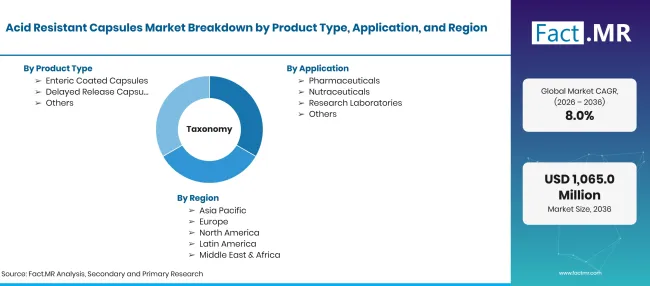
Acid Resistant Capsules Market Taxonomy | Source: Fact.MR
| Attribute | Details |
|---|---|
| Quantitative Units | USD million in 2026 to USD million by 2036 at CAGR |
| Market Definition | Capsule shells and capsule dosage forms that resist gastric acid and release their contents in the intestine, through enteric coatings or functional shell polymers. |
| Product Type | Enteric Coated Capsules; Delayed Release Capsules; Others |
| Application | Pharmaceuticals; Nutraceuticals; Research Laboratories; Others |
| Material | Gelatin; HPMC; Others |
| End-User | Pharmaceutical Companies; Research Institutes; Others |
| Distribution Channel | Hospital Pharmacies; Online Pharmacies; Retail Pharmacies; Others |
| Regions Covered | North America; Latin America; Western Europe; Eastern Europe; East Asia; South Asia & Pacific; Middle East & Africa |
| Countries Covered | Germany; Japan; United Kingdom; Brazil; United States |
| Companies Profiled | Lonza Capsugel; Evonik; ACG; Suheung; Roquette; Lyfe Group; Farmacapsulas |
| Forecast Period | 2026 to 2036 |
| Approach | Shell-level demand modelling built from formulation pipelines, capsule production data and supplier product portfolios. |
Source: Fact.MR analysis. Updated Nov 3, 2026
How is the market segmented?
-
By Product Type
- Enteric Coated Capsules
- Delayed Release Capsules
- Others
-
By Application
- Pharmaceuticals
- Nutraceuticals
- Research Laboratories
- Others
-
By Material
- Gelatin
- HPMC
- Others
-
By End-User
- Pharmaceutical Companies
- Research Institutes
- Others
-
By Distribution Channel
- Hospital Pharmacies
- Online Pharmacies
- Retail Pharmacies
- Others
-
By Region
- North America
- Latin America
- Western Europe
- Eastern Europe
- East Asia
- South Asia & Pacific
- Middle East & Africa
Frequently Asked Questions
How large is the acid resistant capsules market in 2026?
What growth rate will the acid resistant capsules market record?
Which product type leads?
Which application leads?
Which material leads?
Which end-user leads?
Which country will grow quickest?
Who are the main companies?
What holds the market back?
Who worked on this report


Preview the report firsthand - request a free sample
Free SampleGet the brochure for pricing and purchase details
Download PDF