Acid Resistant Pipe Market (2026 - 2036)

Acid Resistant Pipe Market Size and Share Forecast Outlook 2026 to 2036

Core Findings

    Acid Resistant Pipe Market Forecast and Outlook 2026 to 2036

    The global acid resistant pipe market is anticipated to grow from USD 1.9 billion in 2026 to approximately USD 3.0 billion by 2036, reflecting a CAGR of 4.7%.

    Key Takeaways from Acid Resistant Pipe Market

    • Acid Resistant Pipe Market Value 2026: USD 1.9 billion
    • Acid Resistant Pipe Market Forecast Value 2036: USD 3.0 billion
    • Acid Resistant Pipe Market Forecast CAGR: 4.7%
    • Leading Material Segment: FRP or GRP 29%
    • Key Growth Regions: U.S., Japan, South Korea, Europe, China, Brazil
    • Prominent Players: NOV Fiber Glass Systems, Future Pipe Industries, Amiblu (Hobas), Georg Fischer (GF Piping), IPEX, AGRU, Sekisui Chemical, Crane Resistoflex, Saint-Gobain, Lubrizol (Corzan CPVC)
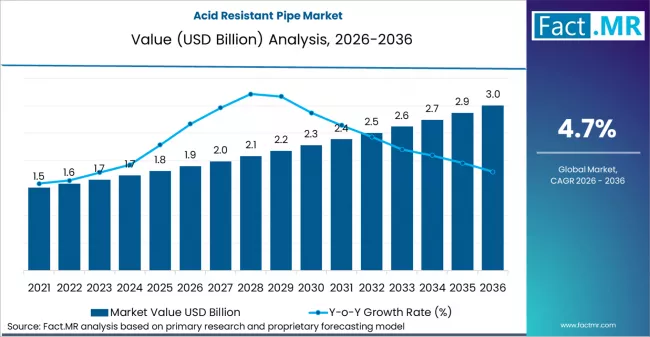
    Acid Resistant Pipe Market Market Value Analysis

    FRP or GRP pipes lead due to their excellent corrosion resistance, lightweight design, and suitability for chemical processing environments. PTFE-lined carbon steel, PVC/CPVC, HDPE, and alloy pipes are applied depending on chemical compatibility, pressure requirements, and operational conditions.

    Chemical processing remains the largest end-use segment, followed by fertilizers, mining and metals, water/wastewater, and pulp and paper industries. Pipes with diameters under 4 inches are common in lab-scale or small-scale operations, while larger diameters cater to industrial pipelines. Installation methods vary from above-ground, buried, plant retrofit, to offshore or marine applications. North America, particularly the U.S., leads demand, with Japan, South Korea, Europe, China, U.K., and Brazil also showing growth. Suppliers focus on material integrity, long-term corrosion resistance, and reliable installation performance to meet stringent industrial standards.

    Acid Resistant Pipe Market

    Metric Value
    Estimated Value in (2026E) USD 1.9 billion
    Forecast Value in (2036F) USD 3.0 billion
    Forecast CAGR (2026 to 2036) 4.7%

    Category

    Category Segments
    Material FRP or GRP; PTFE-Lined Carbon Steel; PVC or CPVC; HDPE; Alloy including Hastelloy or Stainless Steel; Other
    End Use Chemical Processing; Fertilizers; Mining and Metals; Water or Wastewater Treatment; Pulp and Paper; Other
    Diameter Below 4 inches; 4–12 inches; 12–24 inches; Above 24 inches; Other
    Installation Above-Ground Installations; Buried Systems; Plant Retrofit Applications; Offshore or Marine Use; Other
    Region North America; Europe; Asia Pacific; Latin America; Middle East & Africa

    Segmental Analysis

    By Material, Which Segment Holds the Dominant Share in the Acid Resistant Pipe Market?
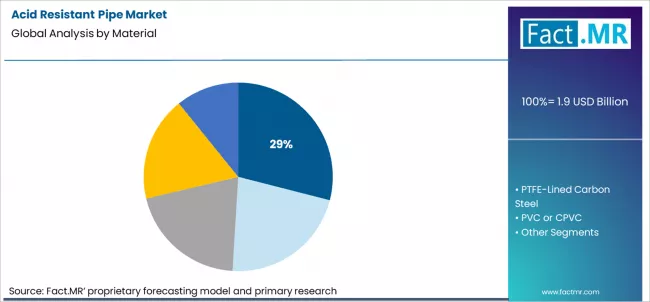
    Acid Resistant Pipe Market Analysis By Material

    In terms of material, FRP and GRP pipes account for a 29.0% share, positioning this category as the leading material segment in the acid resistant pipe market. These materials are widely specified for corrosive fluid handling due to chemical resistance and structural stability under continuous exposure.

    • FRP and GRP pipes are commonly deployed in process environments requiring long service life with reduced maintenance frequency.
    • Material performance under aggressive chemical conditions supports steady adoption across industrial piping systems.

    By End Use, Which Segment Accounts for the Largest Share in the Acid Resistant Pipe Market?
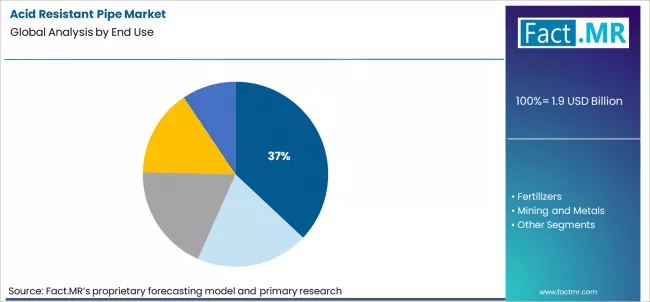
    Acid Resistant Pipe Market Analysis By End Use

    Chemical processing applications hold a 37.0% share, making this the largest end use segment. Acid handling requirements and continuous processing operations drive sustained demand for corrosion resistant piping solutions.

    • Acid resistant pipes support safe transport of reactive fluids across chemical production facilities.
    • Usage concentration reflects strict material performance requirements within chemical processing infrastructure.

    By Diameter, Which Segment Leads Demand in the Acid Resistant Pipe Market?
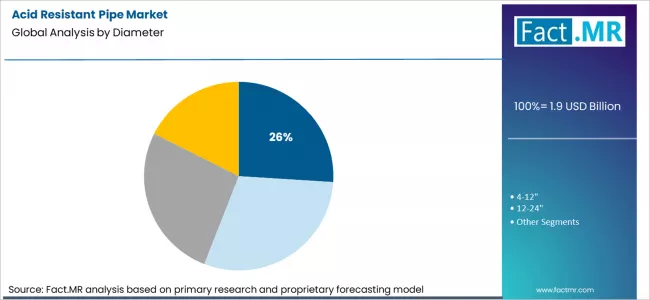
    Acid Resistant Pipe Market Analysis By Diameter

    Pipes with diameters below 4 inches represent a 26.0% share, establishing this range as the most widely used. Smaller diameters are frequently applied in dosing lines, transfer systems, and localized process circuits.

    • Narrow diameter pipes support precise flow control in chemical distribution networks.
    • Demand aligns with modular piping layouts and compact plant configurations.

    By Installation, Which Segment Maintains the Highest Share in the Acid Resistant Pipe Market?
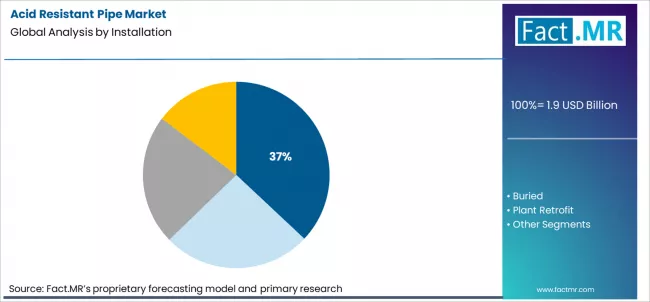
    Acid Resistant Pipe Market Analysis By Installation

    Above ground installations account for a 37.0% share, making this the dominant installation type. Accessibility requirements and inspection ease influence installation preferences in corrosive service environments.

    • Above ground layouts allow regular monitoring and maintenance of acid transport systems.
    • Installation choice reflects operational safety priorities and regulatory compliance needs.

    What are the Drivers, Restraints, and Key Trends of the Acid Resistant Pipe Market?

    • Drivers: Chemical processing plants, fertilizer units, and mining operations depend on acid resistant piping to safely handle corrosive fluids without frequent failures, driving steady demand for pipe systems that protect equipment integrity, worker safety, and long term plant uptime.
    • Restraint: Choosing the right pipe material can be complex, as acid concentration, temperature, pressure, and installation environment vary widely, often requiring careful engineering tradeoffs between performance, cost, and ease of installation.
    • Trend 1: FRP, GRP, and fluoropolymer lined pipes are increasingly selected for aggressive chemical applications as operators look to extend service life while reducing corrosion related maintenance and unplanned shutdowns.
    • Trend 2: Demand is growing for larger diameter and retrofit friendly piping solutions, particularly in aging chemical and wastewater plants where operators seek corrosion resistance upgrades without full system replacement.

    Analysis of the Acid Resistant Pipe Market by Key Country
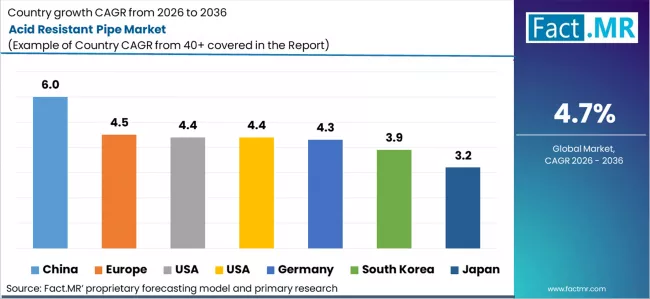
    Acid Resistant Pipe Market Cagr Analysis By Country

    Country CAGR
    China 6.0%
    Brazil 5.6%
    Europe 4.5%
    U.S. 4.4%
    U.K. 4.4%
    Germany 4.3%
    South Korea 3.9%
    Japan 3.2%

    The report covers an in depth analysis of 8 countries; higher growth markets are highlighted below.

    What Is Driving Demand for Acid Resistant Pipes in China?

    China records the highest growth at 6.0%, driven by continued expansion of chemical processing, pulp and paper, and heavy industrial facilities. Acid resistant piping is required to handle aggressive media and high flow rates over extended operating cycles. Alloy based and lined pipe systems are increasingly selected to reduce corrosion related downtime and maintenance exposure.

    • Expansion of chemical and process industries supports strong pipe demand.
    • Corrosion control requirements favor advanced material selection.

    How Is Brazil Emerging as a Growth Market for Acid Resistant Piping?

    Brazil is projected to grow at 5.6%, supported by rising investment in mining, fertilizers, and industrial processing plants. Acid resistant pipes are widely used in slurry handling and chemical transfer lines. Purchasing decisions emphasize mechanical durability and suitability for both buried and above ground installation environments.

    • Mining and fertilizer activity sustains pipe demand.
    • Installation flexibility influences material choice.

    What Is Supporting Market Expansion Across Europe?

    Europe is expected to expand at 4.5%, driven by ongoing plant retrofits and upgrades in chemicals and metals processing facilities. PVC, CPVC, and composite pipe systems are used to replace aging infrastructure. Buyers prioritize compliance, long service life, and compatibility with existing plant layouts.

    • Retrofit activity supports steady replacement demand.
    • Regulatory compliance shapes material adoption.

    What Defines Market Conditions in the U.S.?

    The U.S. market is forecast to grow at 4.4%, shaped by demand from chemical manufacturing and wastewater treatment applications. FRP and lined steel pipes are commonly specified to manage corrosive flows. System upgrades and capacity expansion projects contribute to consistent market activity.

    • Chemical and water treatment demand sustains pipe usage.
    • Upgrade projects support steady replacement cycles.

    How Is the U.K. Positioned in the Acid Resistant Pipe Market?

    The U.K. is projected to grow at 4.4%, supported by investments in specialty chemicals and industrial processing. Acid resistant piping is used where operational safety and corrosion resistance are critical. Buyers favor materials that simplify installation and reduce long term maintenance requirements.

    • Specialty chemical production supports pipe demand.
    • Maintenance reduction drives material selection.

    What Role Does Germany Play in Market Development?

    Germany is expected to grow at 4.3%, reflecting strong demand from advanced manufacturing, water treatment, and chemical processing sectors. HDPE and composite pipes are widely used for both onshore and offshore installations. Demand aligns with structured capital investment planning in industrial infrastructure.

    • Advanced manufacturing sustains consistent pipe demand.
    • Planned infrastructure investment shapes purchasing behavior.

    How Is South Korea Contributing to Market Growth?

    South Korea is forecast to grow at 3.9%, driven by fertilizer production and industrial expansion requiring corrosion resistant fluid handling systems. PTFE lined and composite pipes are selected for their chemical compatibility and operational reliability. Buyers emphasize performance consistency under continuous duty conditions.

    • Fertilizer sector growth supports pipe adoption.
    • Reliability requirements influence material choice.

    What Factors Shape Market Development in Japan?

    Japan is expected to register a CAGR of 3.2%, reflecting mature chemical and industrial facilities with established piping systems. Acid resistant pipes remain in service over long operating cycles. Demand remains stable as system optimization and preventative maintenance reduce frequent replacement needs.

    • Mature industrial base sustains baseline demand.
    • Long service intervals limit rapid market expansion.

    Competitive Landscape of the Acid Resistant Pipe Market
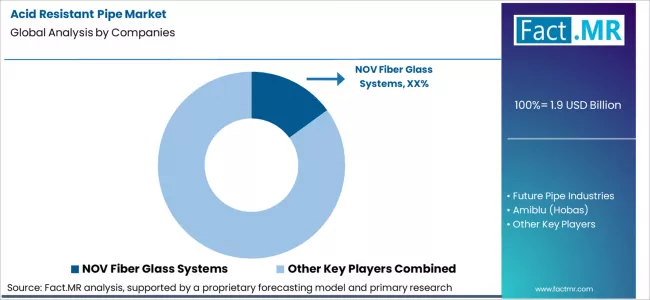
    Acid Resistant Pipe Market Analysis By Company

    The acid resistant pipe market serves industries where aggressive chemicals, corrosive fluids, and harsh operating conditions are part of daily operations. These piping systems are critical in sectors such as chemicals, fertilizers, mining, metals, pulp and paper, and water treatment, where failure can lead to safety risks, downtime, and costly maintenance. Buyers in this market focus on long-term corrosion resistance, mechanical strength, ease of installation, and compatibility with specific acids and process temperatures. Competition is shaped by material performance, lifecycle cost, and the ability to support complex industrial layouts.

    Manufacturers differentiate through a wide range of materials including FRP and GRP, PTFE-lined carbon steel, PVC and CPVC, HDPE, and high-performance alloys such as Hastelloy and stainless steel. FRP and thermoplastic pipes are widely adopted for above-ground and buried installations due to their corrosion resistance and lower maintenance needs, while lined steel and alloy pipes remain essential in high-pressure or high-temperature applications. Suppliers with strong engineering support gain advantage by helping customers select the right pipe system for diameter, installation method, and chemical exposure.

    Market players include NOV Fiber Glass Systems, Future Pipe Industries, Amiblu, Georg Fischer, IPEX, AGRU, Sekisui Chemical, Crane Resistoflex, Saint-Gobain, and Lubrizol, supplying acid-resistant piping solutions across global process industries.

    Key Players in the Acid Resistant Pipe Market

    • NOV Fiber Glass Systems
    • Future Pipe Industries
    • Amiblu
    • Georg Fischer
    • IPEX
    • AGRU
    • Sekisui Chemical
    • Crane Resistoflex
    • Saint-Gobain
    • Lubrizol

    Scope of the Report

    Items Values
    Quantitative Units 2026 USD 1.9 Billion
    Material FRP or GRP, PTFE-lined carbon steel, PVC or CPVC, HDPE, Alloy including Hastelloy or stainless steel
    End Use Chemicals processing, Fertilizers production, Mining and metals operations, Water and wastewater treatment, Pulp and paper manufacturing
    Diameter Below 4 inches, 4 to 12 inches, 12 to 24 inches, Above 24 inches
    Installation Above-ground installation, Buried installation, Plant retrofit projects, Offshore or marine installation
    Regions Covered North America, Europe, Asia Pacific, Latin America, Middle East & Africa
    Countries Covered U.S., Japan, South Korea, Germany, China, U.K., Brazil
    Key Companies Profiled NOV Fiber Glass Systems, Future Pipe Industries, Amiblu, Georg Fischer, IPEX, AGRU, Sekisui Chemical, Crane Resistoflex, Saint-Gobain, Lubrizol
    Additional Attributes Dollar revenue by acid resistant pipe material, end use, diameter range, and installation type; regional demand trends; corrosion and chemical resistance requirements; lifecycle cost advantages over metal piping; retrofit demand in chemical and fertilizer plants; growth in composite and lined pipe adoption for harsh environments

    Acid Resistant Pipe Market Segments

    • Material:

      • FRP or GRP
      • PTFE Lined Carbon Steel
      • PVC or CPVC
      • HDPE
      • Alloy Hastelloy or Stainless Steel
    • End Use:

      • Chemicals
      • Fertilizers
      • Mining and Metals
      • Water or Wastewater
      • Pulp and Paper
    • Diameter:

      • Below 4 inches
      • 4 to 12 inches
      • 12 to 24 inches
      • Above 24 inches
    • Installation:

      • Above Ground
      • Buried
      • Plant Retrofit
      • Offshore or Marine
    • Region:

      • North America
        • U.S.
        • Canada
        • Mexico
      • Europe
        • Germany
        • Italy
        • UK
        • France
        • Spain
        • Netherlands
        • Switzerland
        • Rest of Europe
      • Asia Pacific
        • Japan
        • Australia
        • South Korea
        • China
        • India
        • Rest of Asia Pacific
      • Latin America
        • Brazil
        • Argentina
        • Rest of Latin America
      • Middle East and Africa
        • United Arab Emirates
        • South Africa
        • Rest of Middle East and Africa

    Bibliography

    • United Nations Industrial Development Organization. (2024). Corrosion resistant materials and piping systems in chemical and process industries. Vienna, Austria: UNIDO.
    • Organisation for Economic Co-operation and Development. (2024). Industrial infrastructure, materials durability, and chemical processing trends. Paris, France: OECD.
    • International Trade Centre. (2024). Global trade patterns and demand for industrial pipes, tubes, and fluid handling systems. Geneva, Switzerland: ITC.
    • U.S. Environmental Protection Agency. (2024). Corrosion control, material selection, and safety considerations for chemical handling infrastructure. Washington, DC: U.S. EPA.
    • World Intellectual Property Organization. (2025). Technological developments in composite, lined, and corrosion resistant piping systems. Geneva, Switzerland: WIPO.

    Table of Content

    1. Executive Summary
      • Global Market Outlook
      • Demand to side Trends
      • Supply to side Trends
      • Technology Roadmap Analysis
      • Analysis and Recommendations
    2. Market Overview
      • Market Coverage / Taxonomy
      • Market Definition / Scope / Limitations
    3. Market Background
      • Market Dynamics
        • Drivers
        • Restraints
        • Opportunity
        • Trends
      • Scenario Forecast
        • Demand in Optimistic Scenario
        • Demand in Likely Scenario
        • Demand in Conservative Scenario
      • Opportunity Map Analysis
      • Product Life Cycle Analysis
      • Supply Chain Analysis
      • Investment Feasibility Matrix
      • Value Chain Analysis
      • PESTLE and Porter’s Analysis
      • Regulatory Landscape
      • Regional Parent Market Outlook
      • Production and Consumption Statistics
      • Import and Export Statistics
    4. Global Market Analysis 2021 to 2025 and Forecast, 2026 to 2036
      • Historical Market Size Value (USD Million) Analysis, 2021 to 2025
      • Current and Future Market Size Value (USD Million) Projections, 2026 to 2036
        • Y to o to Y Growth Trend Analysis
        • Absolute $ Opportunity Analysis
    5. Global Market Pricing Analysis 2021 to 2025 and Forecast 2026 to 2036
    6. Global Market Analysis 2021 to 2025 and Forecast 2026 to 2036, By Material
      • Introduction / Key Findings
      • Historical Market Size Value (USD Million) Analysis By Material, 2021 to 2025
      • Current and Future Market Size Value (USD Million) Analysis and Forecast By Material, 2026 to 2036
        • FRP or GRP
        • PTFE-Lined Carbon Steel
        • PVC or CPVC
        • HDPE
        • Alloy (Hastelloy or SS)
      • Y to o to Y Growth Trend Analysis By Material, 2021 to 2025
      • Absolute $ Opportunity Analysis By Material, 2026 to 2036
    7. Global Market Analysis 2021 to 2025 and Forecast 2026 to 2036, By End Use
      • Introduction / Key Findings
      • Historical Market Size Value (USD Million) Analysis By End Use, 2021 to 2025
      • Current and Future Market Size Value (USD Million) Analysis and Forecast By End Use, 2026 to 2036
        • Chemicals
        • Fertilizers
        • Mining and Metals
        • Water or Wastewater
        • Pulp and Paper
      • Y to o to Y Growth Trend Analysis By End Use, 2021 to 2025
      • Absolute $ Opportunity Analysis By End Use, 2026 to 2036
    8. Global Market Analysis 2021 to 2025 and Forecast 2026 to 2036, By Diameter
      • Introduction / Key Findings
      • Historical Market Size Value (USD Million) Analysis By Diameter, 2021 to 2025
      • Current and Future Market Size Value (USD Million) Analysis and Forecast By Diameter, 2026 to 2036
        • <4"
        • 4-12"
        • 12-24"
        • >24"
      • Y to o to Y Growth Trend Analysis By Diameter, 2021 to 2025
      • Absolute $ Opportunity Analysis By Diameter, 2026 to 2036
    9. Global Market Analysis 2021 to 2025 and Forecast 2026 to 2036, By Installation
      • Introduction / Key Findings
      • Historical Market Size Value (USD Million) Analysis By Installation, 2021 to 2025
      • Current and Future Market Size Value (USD Million) Analysis and Forecast By Installation, 2026 to 2036
        • Above-Ground
        • Buried
        • Plant Retrofit
        • Offshore or Marine
      • Y to o to Y Growth Trend Analysis By Installation, 2021 to 2025
      • Absolute $ Opportunity Analysis By Installation, 2026 to 2036
    10. Global Market Analysis 2021 to 2025 and Forecast 2026 to 2036, By Region
      • Introduction
      • Historical Market Size Value (USD Million) Analysis By Region, 2021 to 2025
      • Current Market Size Value (USD Million) Analysis and Forecast By Region, 2026 to 2036
        • North America
        • Latin America
        • Western Europe
        • Eastern Europe
        • East Asia
        • South Asia and Pacific
        • Middle East & Africa
      • Market Attractiveness Analysis By Region
    11. North America Market Analysis 2021 to 2025 and Forecast 2026 to 2036, By Country
      • Historical Market Size Value (USD Million) Trend Analysis By Market Taxonomy, 2021 to 2025
      • Market Size Value (USD Million) Forecast By Market Taxonomy, 2026 to 2036
        • By Country
          • USA
          • Canada
          • Mexico
        • By Material
        • By End Use
        • By Diameter
        • By Installation
      • Market Attractiveness Analysis
        • By Country
        • By Material
        • By End Use
        • By Diameter
        • By Installation
      • Key Takeaways
    12. Latin America Market Analysis 2021 to 2025 and Forecast 2026 to 2036, By Country
      • Historical Market Size Value (USD Million) Trend Analysis By Market Taxonomy, 2021 to 2025
      • Market Size Value (USD Million) Forecast By Market Taxonomy, 2026 to 2036
        • By Country
          • Brazil
          • Chile
          • Rest of Latin America
        • By Material
        • By End Use
        • By Diameter
        • By Installation
      • Market Attractiveness Analysis
        • By Country
        • By Material
        • By End Use
        • By Diameter
        • By Installation
      • Key Takeaways
    13. Western Europe Market Analysis 2021 to 2025 and Forecast 2026 to 2036, By Country
      • Historical Market Size Value (USD Million) Trend Analysis By Market Taxonomy, 2021 to 2025
      • Market Size Value (USD Million) Forecast By Market Taxonomy, 2026 to 2036
        • By Country
          • Germany
          • UK
          • Italy
          • Spain
          • France
          • Nordic
          • BENELUX
          • Rest of Western Europe
        • By Material
        • By End Use
        • By Diameter
        • By Installation
      • Market Attractiveness Analysis
        • By Country
        • By Material
        • By End Use
        • By Diameter
        • By Installation
      • Key Takeaways
    14. Eastern Europe Market Analysis 2021 to 2025 and Forecast 2026 to 2036, By Country
      • Historical Market Size Value (USD Million) Trend Analysis By Market Taxonomy, 2021 to 2025
      • Market Size Value (USD Million) Forecast By Market Taxonomy, 2026 to 2036
        • By Country
          • Russia
          • Poland
          • Hungary
          • Balkan & Baltic
          • Rest of Eastern Europe
        • By Material
        • By End Use
        • By Diameter
        • By Installation
      • Market Attractiveness Analysis
        • By Country
        • By Material
        • By End Use
        • By Diameter
        • By Installation
      • Key Takeaways
    15. East Asia Market Analysis 2021 to 2025 and Forecast 2026 to 2036, By Country
      • Historical Market Size Value (USD Million) Trend Analysis By Market Taxonomy, 2021 to 2025
      • Market Size Value (USD Million) Forecast By Market Taxonomy, 2026 to 2036
        • By Country
          • China
          • Japan
          • South Korea
        • By Material
        • By End Use
        • By Diameter
        • By Installation
      • Market Attractiveness Analysis
        • By Country
        • By Material
        • By End Use
        • By Diameter
        • By Installation
      • Key Takeaways
    16. South Asia and Pacific Market Analysis 2021 to 2025 and Forecast 2026 to 2036, By Country
      • Historical Market Size Value (USD Million) Trend Analysis By Market Taxonomy, 2021 to 2025
      • Market Size Value (USD Million) Forecast By Market Taxonomy, 2026 to 2036
        • By Country
          • India
          • ASEAN
          • Australia & New Zealand
          • Rest of South Asia and Pacific
        • By Material
        • By End Use
        • By Diameter
        • By Installation
      • Market Attractiveness Analysis
        • By Country
        • By Material
        • By End Use
        • By Diameter
        • By Installation
      • Key Takeaways
    17. Middle East & Africa Market Analysis 2021 to 2025 and Forecast 2026 to 2036, By Country
      • Historical Market Size Value (USD Million) Trend Analysis By Market Taxonomy, 2021 to 2025
      • Market Size Value (USD Million) Forecast By Market Taxonomy, 2026 to 2036
        • By Country
          • Kingdom of Saudi Arabia
          • Other GCC Countries
          • Turkiye
          • South Africa
          • Other African Union
          • Rest of Middle East & Africa
        • By Material
        • By End Use
        • By Diameter
        • By Installation
      • Market Attractiveness Analysis
        • By Country
        • By Material
        • By End Use
        • By Diameter
        • By Installation
      • Key Takeaways
    18. Key Countries Market Analysis
      • USA
        • Pricing Analysis
        • Market Share Analysis, 2025
          • By Material
          • By End Use
          • By Diameter
          • By Installation
      • Canada
        • Pricing Analysis
        • Market Share Analysis, 2025
          • By Material
          • By End Use
          • By Diameter
          • By Installation
      • Mexico
        • Pricing Analysis
        • Market Share Analysis, 2025
          • By Material
          • By End Use
          • By Diameter
          • By Installation
      • Brazil
        • Pricing Analysis
        • Market Share Analysis, 2025
          • By Material
          • By End Use
          • By Diameter
          • By Installation
      • Chile
        • Pricing Analysis
        • Market Share Analysis, 2025
          • By Material
          • By End Use
          • By Diameter
          • By Installation
      • Germany
        • Pricing Analysis
        • Market Share Analysis, 2025
          • By Material
          • By End Use
          • By Diameter
          • By Installation
      • UK
        • Pricing Analysis
        • Market Share Analysis, 2025
          • By Material
          • By End Use
          • By Diameter
          • By Installation
      • Italy
        • Pricing Analysis
        • Market Share Analysis, 2025
          • By Material
          • By End Use
          • By Diameter
          • By Installation
      • Spain
        • Pricing Analysis
        • Market Share Analysis, 2025
          • By Material
          • By End Use
          • By Diameter
          • By Installation
      • France
        • Pricing Analysis
        • Market Share Analysis, 2025
          • By Material
          • By End Use
          • By Diameter
          • By Installation
      • India
        • Pricing Analysis
        • Market Share Analysis, 2025
          • By Material
          • By End Use
          • By Diameter
          • By Installation
      • ASEAN
        • Pricing Analysis
        • Market Share Analysis, 2025
          • By Material
          • By End Use
          • By Diameter
          • By Installation
      • Australia & New Zealand
        • Pricing Analysis
        • Market Share Analysis, 2025
          • By Material
          • By End Use
          • By Diameter
          • By Installation
      • China
        • Pricing Analysis
        • Market Share Analysis, 2025
          • By Material
          • By End Use
          • By Diameter
          • By Installation
      • Japan
        • Pricing Analysis
        • Market Share Analysis, 2025
          • By Material
          • By End Use
          • By Diameter
          • By Installation
      • South Korea
        • Pricing Analysis
        • Market Share Analysis, 2025
          • By Material
          • By End Use
          • By Diameter
          • By Installation
      • Russia
        • Pricing Analysis
        • Market Share Analysis, 2025
          • By Material
          • By End Use
          • By Diameter
          • By Installation
      • Poland
        • Pricing Analysis
        • Market Share Analysis, 2025
          • By Material
          • By End Use
          • By Diameter
          • By Installation
      • Hungary
        • Pricing Analysis
        • Market Share Analysis, 2025
          • By Material
          • By End Use
          • By Diameter
          • By Installation
      • Kingdom of Saudi Arabia
        • Pricing Analysis
        • Market Share Analysis, 2025
          • By Material
          • By End Use
          • By Diameter
          • By Installation
      • Turkiye
        • Pricing Analysis
        • Market Share Analysis, 2025
          • By Material
          • By End Use
          • By Diameter
          • By Installation
      • South Africa
        • Pricing Analysis
        • Market Share Analysis, 2025
          • By Material
          • By End Use
          • By Diameter
          • By Installation
    19. Market Structure Analysis
      • Competition Dashboard
      • Competition Benchmarking
      • Market Share Analysis of Top Players
        • By Regional
        • By Material
        • By End Use
        • By Diameter
        • By Installation
    20. Competition Analysis
      • Competition Deep Dive
        • NOV Fiber Glass Systems
          • Overview
          • Product Portfolio
          • Profitability by Market Segments (Product/Age /Sales Channel/Region)
          • Sales Footprint
          • Strategy Overview
            • Marketing Strategy
            • Product Strategy
            • Channel Strategy
        • Future Pipe Industries
        • Amiblu (Hobas)
        • Georg Fischer (GF Piping)
        • IPEX
        • AGRU
        • Sekisui Chemical
        • Crane Resistoflex
        • Saint-Gobain
        • Lubrizol (Corzan CPVC)
    21. Assumptions & Acronyms Used
    22. Research Methodology

    List Of Table

    • Table 1: Global Market Value (USD Million) Forecast by Region, 2021 to 2036
    • Table 2: Global Market Value (USD Million) Forecast by Material, 2021 to 2036
    • Table 3: Global Market Value (USD Million) Forecast by End Use, 2021 to 2036
    • Table 4: Global Market Value (USD Million) Forecast by Diameter, 2021 to 2036
    • Table 5: Global Market Value (USD Million) Forecast by Installation, 2021 to 2036
    • Table 6: North America Market Value (USD Million) Forecast by Country, 2021 to 2036
    • Table 7: North America Market Value (USD Million) Forecast by Material, 2021 to 2036
    • Table 8: North America Market Value (USD Million) Forecast by End Use, 2021 to 2036
    • Table 9: North America Market Value (USD Million) Forecast by Diameter, 2021 to 2036
    • Table 10: North America Market Value (USD Million) Forecast by Installation, 2021 to 2036
    • Table 11: Latin America Market Value (USD Million) Forecast by Country, 2021 to 2036
    • Table 12: Latin America Market Value (USD Million) Forecast by Material, 2021 to 2036
    • Table 13: Latin America Market Value (USD Million) Forecast by End Use, 2021 to 2036
    • Table 14: Latin America Market Value (USD Million) Forecast by Diameter, 2021 to 2036
    • Table 15: Latin America Market Value (USD Million) Forecast by Installation, 2021 to 2036
    • Table 16: Western Europe Market Value (USD Million) Forecast by Country, 2021 to 2036
    • Table 17: Western Europe Market Value (USD Million) Forecast by Material, 2021 to 2036
    • Table 18: Western Europe Market Value (USD Million) Forecast by End Use, 2021 to 2036
    • Table 19: Western Europe Market Value (USD Million) Forecast by Diameter, 2021 to 2036
    • Table 20: Western Europe Market Value (USD Million) Forecast by Installation, 2021 to 2036
    • Table 21: Eastern Europe Market Value (USD Million) Forecast by Country, 2021 to 2036
    • Table 22: Eastern Europe Market Value (USD Million) Forecast by Material, 2021 to 2036
    • Table 23: Eastern Europe Market Value (USD Million) Forecast by End Use, 2021 to 2036
    • Table 24: Eastern Europe Market Value (USD Million) Forecast by Diameter, 2021 to 2036
    • Table 25: Eastern Europe Market Value (USD Million) Forecast by Installation, 2021 to 2036
    • Table 26: East Asia Market Value (USD Million) Forecast by Country, 2021 to 2036
    • Table 27: East Asia Market Value (USD Million) Forecast by Material, 2021 to 2036
    • Table 28: East Asia Market Value (USD Million) Forecast by End Use, 2021 to 2036
    • Table 29: East Asia Market Value (USD Million) Forecast by Diameter, 2021 to 2036
    • Table 30: East Asia Market Value (USD Million) Forecast by Installation, 2021 to 2036
    • Table 31: South Asia and Pacific Market Value (USD Million) Forecast by Country, 2021 to 2036
    • Table 32: South Asia and Pacific Market Value (USD Million) Forecast by Material, 2021 to 2036
    • Table 33: South Asia and Pacific Market Value (USD Million) Forecast by End Use, 2021 to 2036
    • Table 34: South Asia and Pacific Market Value (USD Million) Forecast by Diameter, 2021 to 2036
    • Table 35: South Asia and Pacific Market Value (USD Million) Forecast by Installation, 2021 to 2036
    • Table 36: Middle East & Africa Market Value (USD Million) Forecast by Country, 2021 to 2036
    • Table 37: Middle East & Africa Market Value (USD Million) Forecast by Material, 2021 to 2036
    • Table 38: Middle East & Africa Market Value (USD Million) Forecast by End Use, 2021 to 2036
    • Table 39: Middle East & Africa Market Value (USD Million) Forecast by Diameter, 2021 to 2036
    • Table 40: Middle East & Africa Market Value (USD Million) Forecast by Installation, 2021 to 2036

    List Of Figures

    • Figure 1: Global Market Pricing Analysis
    • Figure 2: Global Market Value (USD Million) Forecast 2021 to 2036
    • Figure 3: Global Market Value Share and BPS Analysis by Material, 2026 and 2036
    • Figure 4: Global Market Y to o to Y Growth Comparison by Material, 2026 to 2036
    • Figure 5: Global Market Attractiveness Analysis by Material
    • Figure 6: Global Market Value Share and BPS Analysis by End Use, 2026 and 2036
    • Figure 7: Global Market Y to o to Y Growth Comparison by End Use, 2026 to 2036
    • Figure 8: Global Market Attractiveness Analysis by End Use
    • Figure 9: Global Market Value Share and BPS Analysis by Diameter, 2026 and 2036
    • Figure 10: Global Market Y to o to Y Growth Comparison by Diameter, 2026 to 2036
    • Figure 11: Global Market Attractiveness Analysis by Diameter
    • Figure 12: Global Market Value Share and BPS Analysis by Installation, 2026 and 2036
    • Figure 13: Global Market Y to o to Y Growth Comparison by Installation, 2026 to 2036
    • Figure 14: Global Market Attractiveness Analysis by Installation
    • Figure 15: Global Market Value (USD Million) Share and BPS Analysis by Region, 2026 and 2036
    • Figure 16: Global Market Y to o to Y Growth Comparison by Region, 2026 to 2036
    • Figure 17: Global Market Attractiveness Analysis by Region
    • Figure 18: North America Market Incremental Dollar Opportunity, 2026 to 2036
    • Figure 19: Latin America Market Incremental Dollar Opportunity, 2026 to 2036
    • Figure 20: Western Europe Market Incremental Dollar Opportunity, 2026 to 2036
    • Figure 21: Eastern Europe Market Incremental Dollar Opportunity, 2026 to 2036
    • Figure 22: East Asia Market Incremental Dollar Opportunity, 2026 to 2036
    • Figure 23: South Asia and Pacific Market Incremental Dollar Opportunity, 2026 to 2036
    • Figure 24: Middle East & Africa Market Incremental Dollar Opportunity, 2026 to 2036
    • Figure 25: North America Market Value Share and BPS Analysis by Country, 2026 and 2036
    • Figure 26: North America Market Value Share and BPS Analysis by Material, 2026 and 2036
    • Figure 27: North America Market Y to o to Y Growth Comparison by Material, 2026 to 2036
    • Figure 28: North America Market Attractiveness Analysis by Material
    • Figure 29: North America Market Value Share and BPS Analysis by End Use, 2026 and 2036
    • Figure 30: North America Market Y to o to Y Growth Comparison by End Use, 2026 to 2036
    • Figure 31: North America Market Attractiveness Analysis by End Use
    • Figure 32: North America Market Value Share and BPS Analysis by Diameter, 2026 and 2036
    • Figure 33: North America Market Y to o to Y Growth Comparison by Diameter, 2026 to 2036
    • Figure 34: North America Market Attractiveness Analysis by Diameter
    • Figure 35: North America Market Value Share and BPS Analysis by Installation, 2026 and 2036
    • Figure 36: North America Market Y to o to Y Growth Comparison by Installation, 2026 to 2036
    • Figure 37: North America Market Attractiveness Analysis by Installation
    • Figure 38: Latin America Market Value Share and BPS Analysis by Country, 2026 and 2036
    • Figure 39: Latin America Market Value Share and BPS Analysis by Material, 2026 and 2036
    • Figure 40: Latin America Market Y to o to Y Growth Comparison by Material, 2026 to 2036
    • Figure 41: Latin America Market Attractiveness Analysis by Material
    • Figure 42: Latin America Market Value Share and BPS Analysis by End Use, 2026 and 2036
    • Figure 43: Latin America Market Y to o to Y Growth Comparison by End Use, 2026 to 2036
    • Figure 44: Latin America Market Attractiveness Analysis by End Use
    • Figure 45: Latin America Market Value Share and BPS Analysis by Diameter, 2026 and 2036
    • Figure 46: Latin America Market Y to o to Y Growth Comparison by Diameter, 2026 to 2036
    • Figure 47: Latin America Market Attractiveness Analysis by Diameter
    • Figure 48: Latin America Market Value Share and BPS Analysis by Installation, 2026 and 2036
    • Figure 49: Latin America Market Y to o to Y Growth Comparison by Installation, 2026 to 2036
    • Figure 50: Latin America Market Attractiveness Analysis by Installation
    • Figure 51: Western Europe Market Value Share and BPS Analysis by Country, 2026 and 2036
    • Figure 52: Western Europe Market Value Share and BPS Analysis by Material, 2026 and 2036
    • Figure 53: Western Europe Market Y to o to Y Growth Comparison by Material, 2026 to 2036
    • Figure 54: Western Europe Market Attractiveness Analysis by Material
    • Figure 55: Western Europe Market Value Share and BPS Analysis by End Use, 2026 and 2036
    • Figure 56: Western Europe Market Y to o to Y Growth Comparison by End Use, 2026 to 2036
    • Figure 57: Western Europe Market Attractiveness Analysis by End Use
    • Figure 58: Western Europe Market Value Share and BPS Analysis by Diameter, 2026 and 2036
    • Figure 59: Western Europe Market Y to o to Y Growth Comparison by Diameter, 2026 to 2036
    • Figure 60: Western Europe Market Attractiveness Analysis by Diameter
    • Figure 61: Western Europe Market Value Share and BPS Analysis by Installation, 2026 and 2036
    • Figure 62: Western Europe Market Y to o to Y Growth Comparison by Installation, 2026 to 2036
    • Figure 63: Western Europe Market Attractiveness Analysis by Installation
    • Figure 64: Eastern Europe Market Value Share and BPS Analysis by Country, 2026 and 2036
    • Figure 65: Eastern Europe Market Value Share and BPS Analysis by Material, 2026 and 2036
    • Figure 66: Eastern Europe Market Y to o to Y Growth Comparison by Material, 2026 to 2036
    • Figure 67: Eastern Europe Market Attractiveness Analysis by Material
    • Figure 68: Eastern Europe Market Value Share and BPS Analysis by End Use, 2026 and 2036
    • Figure 69: Eastern Europe Market Y to o to Y Growth Comparison by End Use, 2026 to 2036
    • Figure 70: Eastern Europe Market Attractiveness Analysis by End Use
    • Figure 71: Eastern Europe Market Value Share and BPS Analysis by Diameter, 2026 and 2036
    • Figure 72: Eastern Europe Market Y to o to Y Growth Comparison by Diameter, 2026 to 2036
    • Figure 73: Eastern Europe Market Attractiveness Analysis by Diameter
    • Figure 74: Eastern Europe Market Value Share and BPS Analysis by Installation, 2026 and 2036
    • Figure 75: Eastern Europe Market Y to o to Y Growth Comparison by Installation, 2026 to 2036
    • Figure 76: Eastern Europe Market Attractiveness Analysis by Installation
    • Figure 77: East Asia Market Value Share and BPS Analysis by Country, 2026 and 2036
    • Figure 78: East Asia Market Value Share and BPS Analysis by Material, 2026 and 2036
    • Figure 79: East Asia Market Y to o to Y Growth Comparison by Material, 2026 to 2036
    • Figure 80: East Asia Market Attractiveness Analysis by Material
    • Figure 81: East Asia Market Value Share and BPS Analysis by End Use, 2026 and 2036
    • Figure 82: East Asia Market Y to o to Y Growth Comparison by End Use, 2026 to 2036
    • Figure 83: East Asia Market Attractiveness Analysis by End Use
    • Figure 84: East Asia Market Value Share and BPS Analysis by Diameter, 2026 and 2036
    • Figure 85: East Asia Market Y to o to Y Growth Comparison by Diameter, 2026 to 2036
    • Figure 86: East Asia Market Attractiveness Analysis by Diameter
    • Figure 87: East Asia Market Value Share and BPS Analysis by Installation, 2026 and 2036
    • Figure 88: East Asia Market Y to o to Y Growth Comparison by Installation, 2026 to 2036
    • Figure 89: East Asia Market Attractiveness Analysis by Installation
    • Figure 90: South Asia and Pacific Market Value Share and BPS Analysis by Country, 2026 and 2036
    • Figure 91: South Asia and Pacific Market Value Share and BPS Analysis by Material, 2026 and 2036
    • Figure 92: South Asia and Pacific Market Y to o to Y Growth Comparison by Material, 2026 to 2036
    • Figure 93: South Asia and Pacific Market Attractiveness Analysis by Material
    • Figure 94: South Asia and Pacific Market Value Share and BPS Analysis by End Use, 2026 and 2036
    • Figure 95: South Asia and Pacific Market Y to o to Y Growth Comparison by End Use, 2026 to 2036
    • Figure 96: South Asia and Pacific Market Attractiveness Analysis by End Use
    • Figure 97: South Asia and Pacific Market Value Share and BPS Analysis by Diameter, 2026 and 2036
    • Figure 98: South Asia and Pacific Market Y to o to Y Growth Comparison by Diameter, 2026 to 2036
    • Figure 99: South Asia and Pacific Market Attractiveness Analysis by Diameter
    • Figure 100: South Asia and Pacific Market Value Share and BPS Analysis by Installation, 2026 and 2036
    • Figure 101: South Asia and Pacific Market Y to o to Y Growth Comparison by Installation, 2026 to 2036
    • Figure 102: South Asia and Pacific Market Attractiveness Analysis by Installation
    • Figure 103: Middle East & Africa Market Value Share and BPS Analysis by Country, 2026 and 2036
    • Figure 104: Middle East & Africa Market Value Share and BPS Analysis by Material, 2026 and 2036
    • Figure 105: Middle East & Africa Market Y to o to Y Growth Comparison by Material, 2026 to 2036
    • Figure 106: Middle East & Africa Market Attractiveness Analysis by Material
    • Figure 107: Middle East & Africa Market Value Share and BPS Analysis by End Use, 2026 and 2036
    • Figure 108: Middle East & Africa Market Y to o to Y Growth Comparison by End Use, 2026 to 2036
    • Figure 109: Middle East & Africa Market Attractiveness Analysis by End Use
    • Figure 110: Middle East & Africa Market Value Share and BPS Analysis by Diameter, 2026 and 2036
    • Figure 111: Middle East & Africa Market Y to o to Y Growth Comparison by Diameter, 2026 to 2036
    • Figure 112: Middle East & Africa Market Attractiveness Analysis by Diameter
    • Figure 113: Middle East & Africa Market Value Share and BPS Analysis by Installation, 2026 and 2036
    • Figure 114: Middle East & Africa Market Y to o to Y Growth Comparison by Installation, 2026 to 2036
    • Figure 115: Middle East & Africa Market Attractiveness Analysis by Installation
    • Figure 116: Global Market - Tier Structure Analysis
    • Figure 117: Global Market - Company Share Analysis

    - FAQs -

    How big is the acid resistant pipe market in 2026?

    The global acid resistant pipe market is estimated to be valued at USD 1.9 billion in 2026.

    What will be the size of acid resistant pipe market in 2036?

    The market size for the acid resistant pipe market is projected to reach USD 3.0 billion by 2036.

    How much will be the acid resistant pipe market growth between 2026 and 2036?

    The acid resistant pipe market is expected to grow at a 4.7% CAGR between 2026 and 2036.

    What are the key product types in the acid resistant pipe market?

    The key product types in acid resistant pipe market are frp or grp, ptfe-lined carbon steel, pvc or cpvc, hdpe and alloy (hastelloy or ss).

    Which end use segment to contribute significant share in the acid resistant pipe market in 2026?

    In terms of end use, chemicals segment to command 37.0% share in the acid resistant pipe market in 2026.

    Acid Resistant Pipe Market