- Base Value(2025): 924.5 Mn
- Estimated Value(2026): 980 Mn
- Forecast Value (2036): 1755 Mn
- CAGR (2026 - 2036): 6%
Acoustic Doors Market Forecast 2026 to 2036
In 2025, the acoustic doors market was valued at USD 924.5 million. Based on Fact MR's analysis, demand for acoustic doors is estimated to grow to USD 980 million in 2026 and USD 1,755 million by 2036. FMR projects a CAGR of 6% during the forecast period.
The absolute dollar growth from 2026 to 2036 is USD 775 million. This growth is driven by increasing demand for noise-reduction solutions across both residential and commercial sectors, spurred by expanding urbanization and construction activities globally. However, the market faces challenges such as high material costs and regulatory constraints in certain regions.
India leads with a CAGR of 7.8%, driven by rapid urbanization and construction growth. Vietnam follows with a 7.2% CAGR, fueled by expanding infrastructure and growing demand for noise control in residential and commercial buildings. Indonesia, with a 6.9% CAGR, also benefits from growing urban development and infrastructure projects. Saudi Arabia and the UAE show CAGRs of 6.4% and 6.1%, respectively, due to their rising construction activities and noise management needs. Mexico grows at 5.6%, driven by increasing infrastructure development and noise regulation enforcement. The USA and Germany experience slower growth at 3.5% and 3.0%, respectively, due to more mature markets and established noise control regulations.
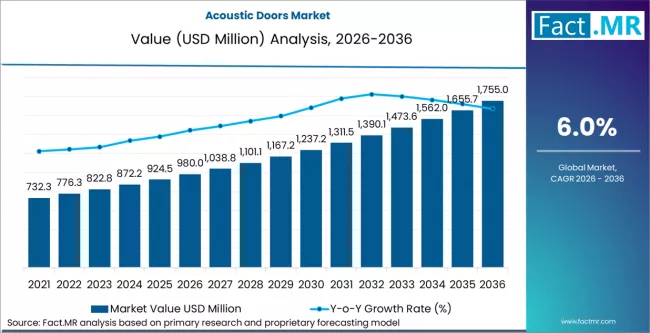
Acoustic Doors Market Market Value Analysis | Source: Fact.MR
Acoustic Doors Market Definition
The acoustic doors market involves the production and sale of door systems designed to reduce sound transmission between spaces. These doors use dense cores, seals, seals, and specialized materials to absorb, block, or damp sound. Their primary function is to improve acoustic comfort in environments where noise control is critical. Key end uses include commercial buildings, studios, healthcare facilities, hospitality spaces, and residential buildings where noise isolation and privacy are required.
Market Inclusions
This report covers global and regional market sizes for acoustic doors with a defined forecast period. It includes segment breakdowns by product type (solid core, honeycomb core, acoustic glass doors), application (commercial, residential, industrial), and end user. Pricing trends, material cost analysis, and trade flow data are also included to reflect industry dynamics.
Market Exclusions
The scope excludes standard interior or exterior doors not engineered for noise reduction. It omits unrelated building components like windows, drywall, and general partitions. Specialty acoustic panels or full wall acoustic systems are not covered, focusing exclusively on door solutions designed for sound control.
Research Methodology
- Primary Research: Interviews were conducted with architects, acoustic consultants, facility managers, and door manufacturers.
- Desk Research: Data was collected from industry reports, construction statistics, and building standards publications.
- Market‑Sizing and Forecasting: A hybrid model was used, combining top‑down construction market estimates with bottom‑up product shipment data.
Data Validation and Update Cycle
Findings were reviewed by experts and aligned with recent sales and construction activity, with periodic updates.
Acoustic Doors Market Summary
Market Definition
The acoustic doors market focuses on specialized doors designed to reduce sound transmission, enhancing acoustic comfort and privacy in spaces where noise control is essential. These doors use materials such as dense cores, seals, and advanced soundproofing technologies to absorb or block sound, ensuring optimal noise insulation in residential, commercial, and industrial environments.
Demand Drivers
- Increasing Urbanization: With the rise in urban construction, noise reduction has become a critical aspect of residential and commercial buildings.
- Regulatory Compliance: Growing noise control regulations and building codes requiring effective soundproofing solutions.
- Focus on Privacy and Comfort: Increasing consumer demand for privacy and noise-free environments in offices, homes, hospitals, and other public spaces.
Key Segments
- By Door Type: Single-leaf acoustic doors dominate, accounting for 51% of the market share by 2026. These are cost-effective and efficient solutions, especially for smaller spaces.
- By Application: Commercial buildings are projected to hold 49% of the market share by 2026 due to the growing need for noise control in offices and meeting rooms.
- By Performance Rating: Doors with STC ratings above 50 are expected to gain traction due to rising demand for superior noise isolation.
Regional Outlook
- India: Expected to grow at a 7.8% CAGR, driven by rapid urbanization and infrastructure development.
- China: Leading the market with a 9.6% CAGR, fueled by increasing demand for construction and noise control.
- USA: Growth at a 3.5% CAGR due to established regulations and the demand for noise-reducing solutions in mature markets.
Analyst Opinion
The market for acoustic doors is on a strong growth trajectory, driven by regulatory requirements and a shift toward noise-free living and working environments. The demand is particularly strong in urban areas, where construction and noise concerns are prevalent.
Strategic Insights
- Performance Standards: As regulations push for stricter noise control, higher-performance acoustic doors with elevated STC ratings are gaining share.
- Regional Dynamics: North America and Europe lead the adoption of high-performance doors, while in Asia Pacific, demand remains strong for cost-effective solutions amidst rapid urban development.
Methodology
The analysis combines primary research from interviews with industry experts, including architects and consultants, with secondary research on market trends, construction activities, and regulatory frameworks.
Segmental Analysis
Acoustic Doors Market Analysis by Door Type
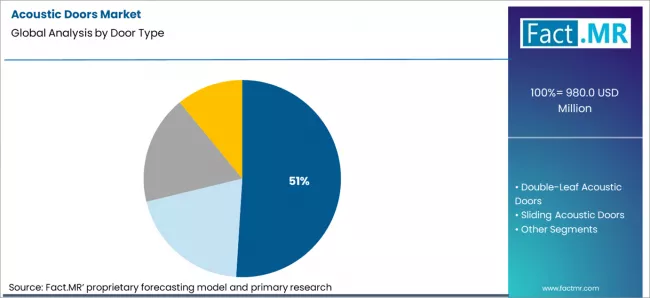
Acoustic Doors Market Analysis By Door Type | Source: Fact.MR
- Market Overview: Single-leaf acoustic doors are expected to capture 51% of the market share by 2026. These doors are typically used in spaces where sound insulation is a priority, offering a cost-effective and efficient solution for noise reduction in commercial, residential, and industrial settings. The single-leaf design is preferred for smaller openings or areas where space is limited, providing excellent acoustic performance without the need for the more complex configurations of double-leaf or sliding doors.
- Demand Drivers:
- Space Efficiency: Single-leaf doors are ideal for installations in areas with limited space, making them the preferred choice for many commercial buildings, offices, and residential settings. The simplicity of the single-leaf design contributes to ease of installation and operation.
- Cost-Effectiveness: Single-leaf acoustic doors typically come at a lower price point than double-leaf or sliding acoustic doors, making them more affordable for large-scale projects where sound control is necessary without additional complexity.
- Growing Demand for Noise Control in Urban Environments: As urban environments become more densely populated, the demand for effective soundproofing solutions, including single-leaf acoustic doors, increases to minimize noise pollution and enhance comfort.
Acoustic Doors Market Analysis by Application
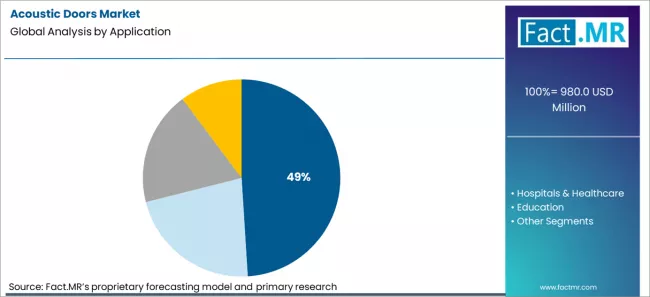
Acoustic Doors Market Analysis By Application | Source: Fact.MR
- Market Overview: Commercial buildings are projected to account for 49% of the market share by 2026. Acoustic doors are increasingly being used in commercial spaces, including offices, meeting rooms, and conference halls, to reduce noise disturbances and provide a more conducive working environment. Their use is expanding as businesses prioritize noise control in open-plan offices and high-traffic areas.
- Demand Drivers:
- Noise Control in Commercial Environments: Commercial buildings, particularly those in urban areas, require effective sound insulation to create quiet, productive workspaces. Acoustic doors are essential in meeting these requirements, which drives demand in office buildings, hotels, and conference centers.
- Focus on Employee Well-being and Productivity: The growing recognition of the link between workplace noise levels and employee productivity is boosting the demand for acoustic doors in commercial buildings. These doors help create environments that foster concentration, meetings, and collaborative spaces without distractions.
- Regulatory Compliance and Acoustic Standards: As regulations around noise control become stricter in certain commercial sectors, businesses are turning to acoustic doors to comply with local noise reduction standards and ensure comfort for employees and visitors.
Acoustic Doors Market Drivers, Restraints, and Opportunities
FMR analysts observe that the acoustic doors market is a mature yet evolving segment within building construction and specialist facilities, shaped by long‑standing needs to control noise in commercial, institutional, and residential projects. Historically, standard doors offered minimal sound isolation; growing emphasis on occupant comfort, productivity, and regulatory sound criteria drove demand for designated acoustic solutions. The 2026 valuation reflects this structural stability, with baseline demand tied to global construction activity, retrofit projects, and performance standards that define minimum sound transmission class (STC) requirements in many markets.
While demand for basic architectural doors remains large, higher‑performance acoustic door systems with elevated STC ratings and engineered seals are gaining share. These premium products command higher per‑unit pricing, contributing to net value growth even as overall unit volumes align with construction cycles. The market exists at its current size because acoustic performance is increasingly specified early in design, and regulatory frameworks enforce measurable sound control metrics.
- Performance Specification Trend: As occupants and designers prioritize indoor acoustics, demand grows for doors with higher STC ratings that reduce noise transfer in offices, hospitals, schools, and multi‑family buildings.
- Regulatory Sound Standards: Building codes and standards such as ISO 717/1 and local fire and acoustic code requirements push adoption of certified acoustic door assemblies that meet specific isolation criteria, raising average selling prices.
- Regional Construction Dynamics: In North America and Europe where stringent building codes and quality expectations prevail, uptake of high‑performance acoustic doors outpaces markets where basic cost‑led construction remains predominant.
Regional Analysis
The market analysis covers key global regions, including South Asia and Pacific, Middle East & Africa, North America, Latin America, Western Europe, and Eastern Europe. It is segmented geographically, with specific market dynamics for each region. The full report provides a detailed market attractiveness analysis.
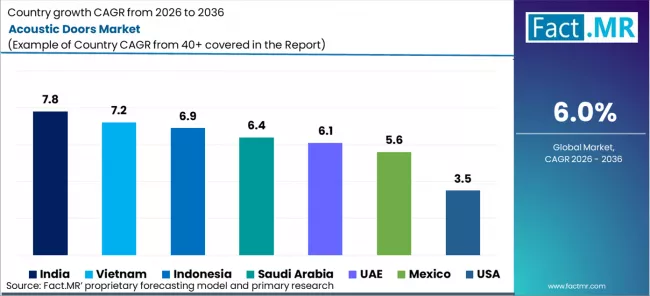
Acoustic Doors Market Cagr Analysis By Country | Source: Fact.MR
| Country | CAGR (%) |
|---|---|
| India | 7.8% |
| Vietnam | 7.2% |
| Indonesia | 6.9% |
| Saudi Arabia | 6.4% |
| UAE | 6.1% |
| Mexico | 5.6% |
| USA | 3.5% |
| Germany | 3.0% |
Source: Fact.MR analysis. Updated Feb 17, 2026
Source: Fact MR (FMR) analysis, based on proprietary forecasting model and primary research.
South Asia and Pacific:
South Asia and Pacific is a "key emerging market" for acoustic doors, with increasing demand from construction, residential, and commercial sectors in countries like India, Vietnam, and Indonesia.
- India: Demand for acoustic doors in India is projected to rise at 7.8% CAGR through 2036. The growing construction and real estate sectors, along with a rising demand for soundproof solutions in urban areas, drive significant market expansion.
- Vietnam: Demand for acoustic doors in Vietnam is projected to rise at 7.2% CAGR through 2036. Urbanization and infrastructure development, along with increased awareness of acoustic solutions, continue to contribute to market growth.
- Indonesia: Demand for acoustic doors in Indonesia is projected to rise at 6.9% CAGR through 2036. The country's growing construction industry and focus on noise reduction in residential and commercial buildings support steady growth.
Middle East & Africa:
The Middle East and Africa are "key hubs for construction and architectural innovation," where the demand for acoustic doors is driven by increased building construction and a growing focus on noise control.
- Saudi Arabia: Demand for acoustic doors in Saudi Arabia is projected to rise at 6.4% CAGR through 2036. The ongoing urbanization and infrastructural development in the country, along with a strong focus on improving building acoustics, contribute to market growth.
- UAE: Demand for acoustic doors in the UAE is projected to rise at 6.1% CAGR through 2036. The UAE's booming construction market and emphasis on high-quality residential and commercial buildings drive demand for acoustic doors.
North America:
North America remains a "leader in noise control solutions," with the USA contributing to steady growth in the acoustic doors market due to a high level of construction and renovation activity.
- USA: Demand for acoustic doors in the U.S. is projected to rise at 3.5% CAGR through 2036. The market is supported by the growing commercial building sector and the adoption of noise reduction technologies in construction projects.
Latin America:
In Latin America, especially in Mexico, the market for acoustic doors is expanding due to growth in the construction industry and increasing awareness of noise control solutions.
- Mexico: Demand for acoustic doors in Mexico is projected to rise at 5.6% CAGR through 2036. The country’s expanding construction sector and rising demand for soundproof solutions in both residential and commercial buildings drive the market forward.
Western Europe:
Europe remains a "mature market" for acoustic doors, with established demand for noise reduction technologies in the region’s construction industry.
- Germany: Demand for acoustic doors in Germany is projected to rise at 3.0% CAGR through 2036. Germany's strong construction and renovation markets, along with a high level of regulatory compliance for noise reduction, support steady demand for acoustic doors.
Fact MR's analysis of the Acoustic Doors Market in South Asia and Pacific, Middle East & Africa, North America, Latin America, and Western Europe consists of country-wise assessments that include India, Vietnam, Indonesia, Saudi Arabia, UAE, Mexico, the United States, and Germany. Readers can find detailed trends, regulatory updates, and company-specific investments shaping the market’s growth in these countries.
How Are Key Players Competing in the Acoustic Doors Market?
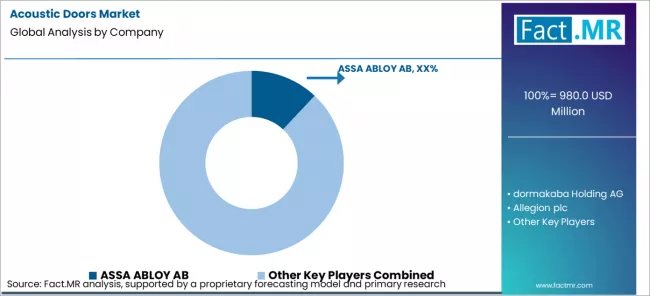
Acoustic Doors Market Analysis By Company | Source: Fact.MR
The acoustic doors market is being shaped by industry leaders such as ASSA ABLOY AB, dormakaba Holding AG, and Allegion plc, who focus on providing high-performance doors for noise control in commercial, residential, and industrial applications. Hörmann KG Verkaufsgesellschaft and JELD-WEN Holding, Inc. emphasize the development of custom acoustic solutions to meet specific building regulations and client needs. Masonite International Corporation and Schüco International KG offer innovative designs with enhanced soundproofing capabilities, while Howden Joinery Group Plc targets residential and commercial sectors with cost-effective, efficient noise-reducing solutions. These players are differentiating by offering robust product features, customization, and compliance with modern construction standards.
Recent Industry Developments
- Product launch - ECLISSE “Syntésis Line Acoustic” sliding door (Published Jul 10, 2024): ECLISSE introduced the Syntésis Line Acoustic invisible sliding door designed to reduce inter-room noise (reported soundproofing performance options cited in the product coverage).
- Patent - Double-door panel sealing structure for acoustic test chambers (Published Nov 25, 2025): This utility model discloses a multi-element sealing architecture (including a third sealing element between door leaves) to improve airtightness and reduce sound leakage in double-door acoustic test box applications.
- Acquisition - Owens Corning completes acquisition of Masonite (Completed May 15, 2024): Owens Corning completed its acquisition of Masonite, a global door and door-systems provider, strengthening scale and distribution across the door market (including specialty performance door categories).
Key Players of the Acoustic Doors Market
- ASSA ABLOY AB
- dormakaba Holding AG
- Allegion plc
- Hörmann KG Verkaufsgesellschaft
- JELD-WEN Holding, Inc.
- Masonite International Corporation
- Schüco International KG
- Howden Joinery Group Plc
Report Scope
| Metric | Value |
|---|---|
| Quantitative Units | USD 980 million (2026) to USD 1,755 million (2036), at a CAGR of 6.0% |
| Market Definition | The Acoustic Doors Market includes doors designed to reduce sound transmission, providing noise control for commercial, residential, and industrial applications. |
| By Door Type | Single-Leaf Acoustic Doors, Double-Leaf Acoustic Doors, Sliding Acoustic Doors, Other |
| By Application | Commercial Buildings, Hospitals & Healthcare, Education, Residential |
| By Performance Rating | STC 30-40, STC 40-50, Above STC 50, Other |
| By Sales Channel | Specialist Contractors, Direct Manufacturer Sales, Building Distributors, Other |
| Regions Covered | North America, Latin America, Europe, East Asia, South Asia, Oceania, Middle East and Africa |
| Countries Covered | United States, Canada, Mexico, Brazil, Argentina, Germany, France, United Kingdom, Italy, Spain, China, India, Japan, South Korea, Indonesia, Australia, and 40+ countries |
| Key Companies Profiled | ASSA ABLOY AB, dormakaba Holding AG, Allegion plc, Hörmann KG Verkaufsgesellschaft, JELD-WEN Holding, Inc., Masonite International Corporation, Schüco International KG, Howden Joinery Group Plc |
| Forecast Period | 2026 to 2036 |
| Approach | Hybrid top-down and bottom-up market modeling validated through primary interviews with manufacturers and supported by trade data benchmarking and market research. |
Source: Fact.MR analysis. Updated Feb 17, 2026
Bibliographies
- Product Launch - ECLISSE “Syntésis Line Acoustic” Sliding Door: ECLISSE. (2024, July 10). ECLISSE introduces Syntésis Line Acoustic sliding door. Batinfo. [1]
- Patent - Double-Door Panel Sealing Structure for Acoustic Test Chambers: U.S. Patent No. CN223594043U. (2025, November 25). Double-door panel sealing structure for acoustic test chambers. Google Patents. [2]
- Acquisition - Owens Corning Completes Acquisition of Masonite: Owens Corning. (2024, May 15). Owens Corning completes acquisition of Masonite. Owens Corning Investor Relations. [3]
Segmentation
Acoustic Doors Market Key Segments
-
By Door Type :
- Single-Leaf Acoustic Doors
- Double-Leaf Acoustic Doors
- Sliding Acoustic Doors
- Other
-
By Application :
- Commercial Buildings
- Hospitals & Healthcare
- Education
- Residential
-
By Performance Rating :
- STC 30-40
- STC 40-50
- Above STC 50
- Other
-
By Sales Channel :
- Specialist Contractors
- Direct Manufacturer Sales
- Building Distributors
- Other
-
Region :
- North America
- USA
- Canada
- Mexico
- Europe
- Germany
- UK
- France
- Italy
- Spain
- Nordic Countries
- BENELUX
- Rest of Europe
- Asia Pacific
- China
- Japan
- South Korea
- India
- Australia
- Rest of Asia Pacific
- Latin America
- Brazil
- Argentina
- Rest of Latin America
- Middle East and Africa
- Kingdom of Saudi Arabia
- United Arab Emirates
- South Africa
- Rest of Middle East and Africa
- Other Regions
- Oceania
- Central Asia
- Other Markets
- North America
Frequently Asked Questions
How large is the demand for Acoustic Doors in the global market in 2026?
What will be the market size of Acoustic Doors in the global market by 2036?
What is the expected demand growth for Acoustic Doors in the global market between 2026 and 2036?
Which door type is expected to dominate the market?
Which region is expected to show the highest growth rate for Acoustic Doors?
How significant is the growth outlook for Vietnam in this market?
What is the growth outlook for the United States in this report?
What is the growth forecast for Saudi Arabia in the Acoustic Doors market?
Which European market is highlighted in this analysis?
Which company is identified as a leading player in the Acoustic Doors market?
What are Acoustic Doors used for?
What does the Acoustic Doors market include in this report?
How is the market forecast developed in this report?
What is meant by the Acoustic Doors market in this report?
Who worked on this report


Preview the report firsthand - request a free sample
Free SampleGet the brochure for pricing and purchase details
Download PDF