- Market Value (2025): USD 932.5 Mn
- Estimated Value (2026): USD 975.9 Mn
- Forecast Value (2036): USD 1537.4 Mn
- CAGR (2026-2036): 4.7%
Dry Grinding Ball Mill Market Forecast and Outlook 2026 to 2036
According to the Fact.MR analysis, the dry grinding ball mills market crossed the valuation of USD 932.5 million in 2025 and the is projected to grow from USD 975.9 million in 2026 to USD 1537.4 million by 2036. Demand for dry grinding ball mills is likely to grow at a CAGR of 4.7% over the forecast period.
Demand for dry grinding ball mills is rising as cement, mineral and battery-material producers need fine powders without water. Suppliers of dry grinding ball mills are improving liners, separators and drive efficiency to cut energy per tonne. For example, the US Geological Survey estimated world cement production at about 4 billion tonnes in 2024, much of it ground in ball and vertical mills. Similar output is projected to drive sales of dry grinding ball mills through 2036.
Key Takeaways from the Dry Grinding Ball Mill Market
- Dry Grinding Ball Mill Market Value (2025): 932.5 million
- Dry Grinding Ball Mill Market Value (2026): USD 975.9 million
- Dry Grinding Ball Mill Market Forecast Value (2036): USD 1537.4 million
- Dry Grinding Ball Mill Market Forecast CAGR (2026-2036): 4.7%
- Leading Product Type: Horizontal Tumbling Mills (38.6%)
- Key Market Participants: Metso Corporation, FLSmidth & Co. A/S, Thyssenkrupp AG, Outotec Oyj, KHD Humboldt Wedag International AG, Gebr. Pfeiffer SE
- Key Growth Regions: Japan, United States, Germany, United Kingdom, Brazil
Sales of dry grinding ball mills are benefiting from supplier consolidation as mining and cement customers increasingly prefer equipment providers offering integrated comminution systems, engineering support and lifecycle services. The Government of India reported that iron ore production reached a record 313 million tonnes and limestone production reached 484 million tonnes in FY 2025–26, while the value of major mineral production increased by 26.8%. In July 2026, estimated MCDR mineral production was valued at ₹15,961 crore, compared with ₹11,266 crore in July 2025, an increase of approximately 41.7%. These trends support investment in grinding capacity and integrated equipment packages. Suppliers with broader portfolios and established service networks are therefore better positioned to secure large project contracts and aftermarket revenue.
Dry Grinding Ball Mill Market
| Metric | Value |
|---|---|
| Estimated Value in (2026) | USD 975.9 million |
| Forecast Value in (2036) | USD 1,537.4 million |
| Forecast CAGR (2026 to 2036) | 4.7% |
Source: Fact.MR analysis. Updated Nov 18, 2026
Source: Fact.MR analysis.
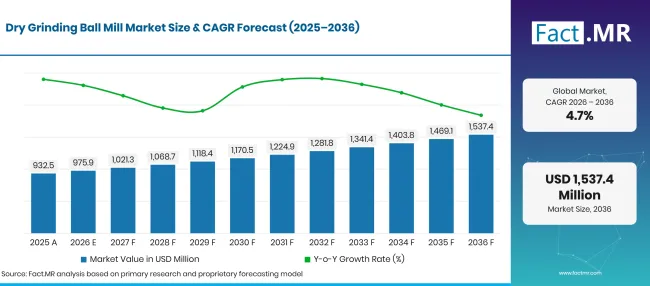
Dry Grinding Ball Mill Market Forecast Global | Source: Fact.MR
Category
| Category | Segments |
|---|---|
| Product Type | Horizontal Tumbling Mills, Planetary Ball Mills, Vibratory Ball Mills, Others |
| Application | Mining, Cement, Chemical, Pharmaceuticals, Others |
| Capacity | Large, Small, Medium, Others |
| End-User | Industrial, Commercial, Others |
| Region | Japan; United States; Germany; United Kingdom; Brazil |
Source: Fact.MR analysis. Updated Nov 18, 2026
Source: Fact.MR analysis.
Segmental Analysis
Why do horizontal tumbling mills lead product demand in the Dry Grinding Ball Mill Market?
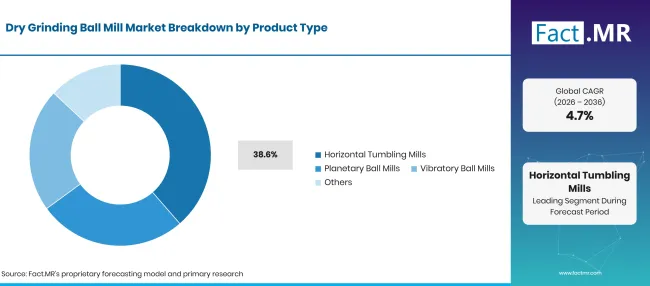
Dry Grinding Ball Mill Market Breakdown Product Type | Source: Fact.MR
Demand for horizontal tumbling mills is supported by increasing mineral extraction, ore beneficiation and cement production activities, where large-scale grinding capacity is essential for continuous industrial operations. These mills are widely used in mineral processing and cement grinding because they can handle high material volumes and sustained operating cycles. Supporting this demand, the Ministry of Mines, Government of India, reported that iron ore production reached 115.87 million tonnes during April–July 2026, compared with 92.48 million tonnes in the corresponding period of 2025–26, representing an increase of approximately 25.3%. Limestone production also increased to 173.14 million tonnes from 157.81 million tonnes during the same comparison period. Rising mineral production increases the need for ore grinding and material processing capacity. Additionally, cement manufacturers require efficient grinding systems to support large-scale production. These requirements are encouraging equipment suppliers to improve mill liners, diaphragms and grinding efficiency. Consequently, horizontal tumbling mills account for 38.6% of dry grinding ball mill revenue in 2026, about USD 375 million, and are expected to retain their leading position through 2036.
What makes mining the leading application in the Dry Grinding Ball Mill Market?
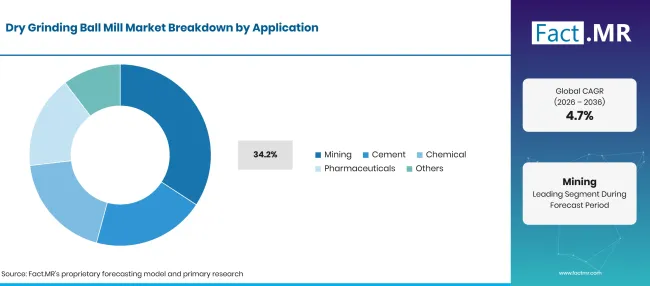
Dry Grinding Ball Mill Market Breakdown Application | Source: Fact.MR
Mining segment to lead with 34.2% of dry grinding ball mill application revenue in 2026, about USD 335 million, as ore and industrial minerals require size reduction before separation. Dry grinding suits water-scarce sites and minerals sensitive to moisture. For example, Vale reported iron ore production of about 328 million tonnes in 2024. Similar mining activity is projected to keep mining the leading application.
Why do large-capacity mills lead the Dry Grinding Ball Mill Market?
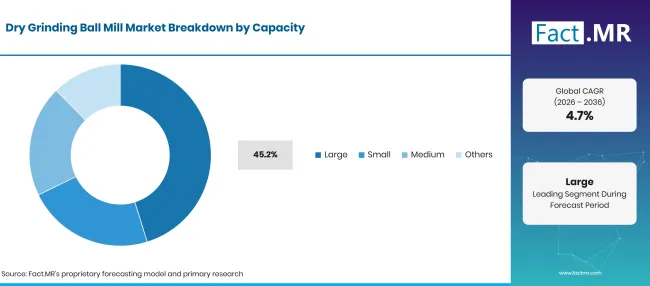
Dry Grinding Ball Mill Market Breakdown Capacity | Source: Fact.MR
Sales of large-capacity dry grinding ball mills are supported by capacity expansion investments across cement manufacturing and mineral processing industries. Large cement plants and mine concentrators require high-throughput grinding systems to process greater material volumes and improve operational efficiency. Supporting this demand, the Ministry of Statistics and Programme Implementation (MoSPI) reported that India's cement production reached 46.493 million tonnes in January 2026, increasing 10.47% year-on-year from 42.088 million tonnes in January 2025. Furthermore, cumulative cement production during April 2025–January 2026 increased 8.81% to 397.796 million tonnes. The expansion of cement production capacity is also encouraging manufacturers to invest in larger grinding installations, high-capacity drives and upgraded mill configurations. On the supply side, dry grinding ball mill manufacturers are offering larger-diameter mills, improved gear systems and high-efficiency grinding technologies to serve industrial customers. The higher purchase value of these installations further supports revenue contribution from large-capacity equipment. Consequently, large-capacity mills hold 45.2% of market revenue in 2026, about USD 440 million, and are expected to maintain their leading position.
What accounts for industrial users dominance in the Dry Grinding Ball Mill Market?
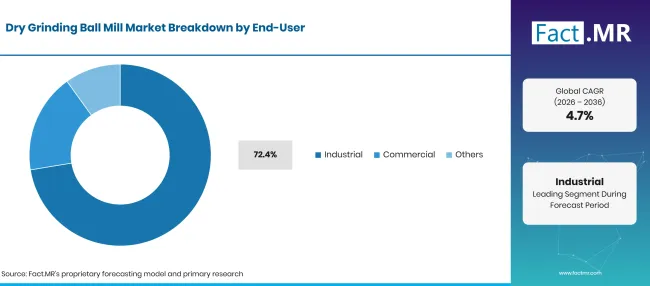
Dry Grinding Ball Mill Market Breakdown End User | Source: Fact.MR
Industrial users segment to represent 72.4% of dry grinding ball mill revenue in 2026, about USD 705 million, as cement, mining, chemical and ceramics plants run continuous grinding. Commercial users such as toll processors and laboratories buy smaller units. Suppliers of dry grinding ball mills are bundling mills with classifiers and service contracts. Similar continuous operation is projected to keep industrial users in the lead.
Dry Grinding Ball Mill Market-Drivers, Restraints & Trends
Drivers:
Demand for dry grinding ball mills is rising as battery cathode, anode and specialty mineral producers need fine, dry powders. For example, Japan's METI battery strategy targets 150 GWh of domestic battery manufacturing capacity by 2030. Suppliers of dry grinding ball mills are offering contamination-free linings for battery materials. Similar material demand is projected to drive sales of dry grinding ball mills through the forecast period.
Restraints:
Demand for dry grinding ball mills is limited by high energy use and competition from vertical roller mills. Many new cement lines choose vertical mills for lower power per tonne. Similar efficiency comparisons are projected to slow sales of dry grinding ball mills in cement raw grinding. Suppliers of dry grinding ball mills must offer high-efficiency separators and drives.
Opportunity:
Energy-Efficient Grinding Circuits Demand for lower-energy grinding is rising as cement and mining companies set decarbonization targets. Suppliers of dry grinding ball mills are combining ball mills with roller presses and high-efficiency classifiers. Similar energy targets are projected to shape sales of dry grinding ball mills.
Trend:
Fine Grinding for Battery Materials Demand for fine, contamination-free powders is rising in cathode and graphite processing. Suppliers such as NETZSCH and Eirich are offering ceramic-lined mills for battery materials. Similar material requirements are projected to drive sales of dry grinding ball mills in battery supply chains.
Dry Grinding Ball Mill Market by Analysis by Key Country
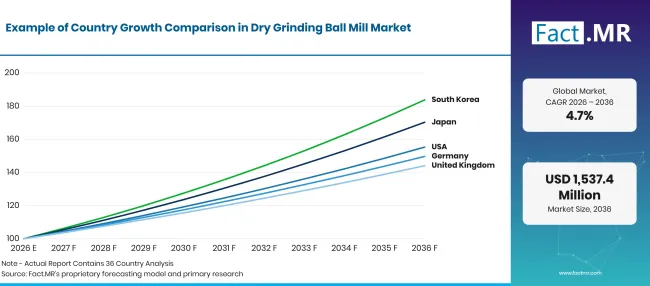
Dry Grinding Ball Mill Market Growth Index | Source: Fact.MR
| Country | CAGR (2026-2036) |
|---|---|
| Japan | 5.5% |
| United States | 4.5% |
| Germany | 4.1% |
| United Kingdom | 3.7% |
| Brazil | 3.4% |
Source: Fact.MR analysis. Updated Nov 18, 2026
Source: Fact.MR analysis.
Why is Japan the fastest-growing market for dry grinding ball mills?
Demand for dry grinding ball mills in Japan is projected to record a 5.5% CAGR, the fastest among the five key countries, as battery-material and fine-ceramic producers expand.
METI's target of 150 GWh domestic battery capacity by 2030 supports powder processing investment. Suppliers of dry grinding ball mills are serving Japanese makers with high-purity linings. Similar industrial policy is projected to drive sales in Japan. Japan’s Ministry of Economy, Trade and Industry (METI), in its revised Battery and Power Industry Strategy published on June 2, 2026, set a target to establish domestic battery manufacturing capacity of 150 GWh per year between 2030 and the mid-2030s. It also aims to triple Japanese companies’ global battery-related sales between 2025 and 2035 and commercialize all-solid-state batteries around 2030. These targets provide direct policy support for investment in battery materials and associated powder-processing equipment.
How is critical mineral policy supporting dry grinding ball mill sales in the United States?
Sales of dry grinding ball mills in the United States are estimated to grow at a 4.5% CAGR as federal funding supports critical-mineral processing and battery-material projects.
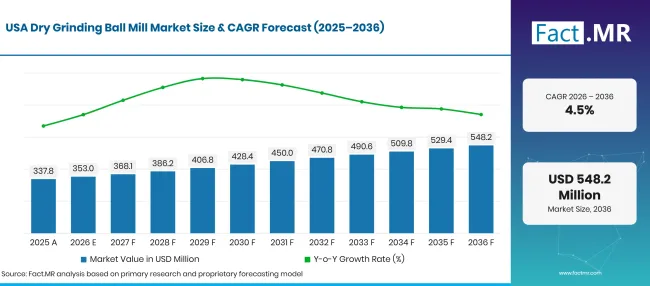
Dry Grinding Ball Mill Market Forecast Usa | Source: Fact.MR
In March 2026, the U.S. Department of Energy announced up to USD 500 million to expand domestic critical-mineral processing, battery manufacturing, and recycling capacity. The Department subsequently selected four mining-technology projects for USD 73 million in September 2026. These initiatives are expected to encourage investment in mineral processing facilities, creating opportunities for grinding-equipment suppliers and their local service networks.
What is shaping dry grinding ball mill demand in Germany?
Demand for dry grinding ball mills in Germany is projected to represent 4.1% CAGR as cement and chemical producers modernize grinding to meet EU emissions targets.
German suppliers such as Gebr. Pfeiffer, Loesche, NETZSCH and Eirich also export mills worldwide. Suppliers of dry grinding ball mills are upgrading separators and drives. Similar modernization is projected to drive sales in Germany. Germany’s Federal Ministry of Finance reported in September 2026 that the Climate and Transformation Fund was being bolstered by €100 billion from the Special Fund for Infrastructure and Climate Neutrality. The fund supports industrial transformation and climate action. Separately, Germany’s Federal Ministry for Economic Affairs reported that the first funding competition under the Federal Fund for Industry and Climate Action would provide approximately €476 million for selected projects, with a second funding call launched in January 2026.
What is shaping dry grinding ball mill demand in the United Kingdom?
Demand for dry grinding ball mills in the United Kingdom is projected to grow at a 3.7% CAGR as ceramics, chemicals, cement, and minerals producers invest in equipment modernization.
In May 2026, the UK Government announced a £120 million funding package for the ceramics sector to support energy efficiency and decarbonization, alongside £350 million for the chemicals industry to strengthen critical supply chains. These measures are expected to support selective investment in efficient grinding systems and equipment retrofits, contributing to steady replacement demand.
Why is dry grinding ball mill growth slower in Brazil?
Demand for dry grinding ball mills in Brazil is estimated to record a 3.4% CAGR, the slowest among the five key countries, as large iron ore operations rely mainly on wet grinding.
Cement producers add capacity gradually with construction cycles. Manufacturers of dry grinding ball mills are targeting industrial mineral and cement upgrades. Similar conditions are projected to keep growth slower in Brazil. Brazil’s Ministry of Mines and Energy published a 2026 mineral-project overview identifying USD 42.47 billion in total mineral-sector project investment and approximately 48,200 associated jobs. Iron ore projects account for USD 19.2 billion of the investment pipeline and are associated with a listed production capacity of 375.2 million tonnes per year. This indicates substantial mining-sector activity, although it does not establish how much investment will go toward dry grinding equipment.
Competitive Landscape for Dry Grinding Ball Mill Market
Competition in the dry grinding ball mill market is divided between large mining and cement equipment groups and specialist grinding firms. Metso, FLSmidth and KHD Humboldt Wedag compete on full comminution lines and service, while Gebr. Pfeiffer, Christian Pfeiffer, Loesche, Eirich and NETZSCH compete on grinding technology. Buyers select suppliers on energy per tonne, fineness control, wear life and service coverage.
From 2024 onward, competition shifted toward consolidation and energy efficiency. FLSmidth's purchase of thyssenkrupp Mining Technologies and Metso's integration of Outotec reshaped the supplier base. Suppliers with efficient circuits and battery-material expertise are best placed to grow.
Recent Developments
- In October 2026, FLS secured a DKK 175 million order for a Chilean copper mine expansion, including a 19.6 MW gearless ball mill, HPGR equipment, mill liners and installation services. Delivery and commissioning are scheduled for 2027.
- In November 2026, Metso partnered with Loesche to introduce vertical roller mill dry-grinding technology for mineral processing in February. In November, it secured an approximately EUR 9 million order to supply the technology for a Nevada gold mine.
- In September 2026, NETZSCH expanded its PAMIR dry agitator bead mill portfolio with Ceramic/PU designs for the PAMIR 40 and 1500. The configuration reduces iron contamination and wear when processing sensitive minerals, fillers and white products.
Key Players in Dry Grinding Ball Mill Market
Key companies operating in the market include Metso Corporation, FLS, thyssenkrupp Polysius, KHD Humboldt Wedag International AG, Christian Pfeiffer Maschinenfabrik GmbH, Eirich Group, and NETZSCH Group.
- Metso Corporation
- FLS
- thyssenkrupp Polysius
- KHD Humboldt Wedag International AG
- Christian Pfeiffer Maschinenfabrik GmbH
- Eirich Group
- NETZSCH Group
Bibliography
- Department for Business and Trade. (2026, May 21). Government steps in to back long-term resilience of UK’s chemicals and ceramics industries. GOV.UK.
- Federal Ministry for Economic Affairs and Energy. (2026). Annual economic report 2026: Investments and reforms for growth and resilience. Government of Germany.
- Federal Ministry of Finance. (2026, September 4). Climate and transformation fund. Government of Germany.
- FLSmidth & Co. A/S. (2026, October 9). FLS wins DKK 175 million order to supply its market-leading grinding technologies for a copper expansion project in Chile.
- Metso Corporation. (2026, February 25). Setting the benchmark in sustainable comminution: Metso and Loesche introduce transformative dry grinding technology.
- Metso Corporation. (2026, November 9). Metso to deliver Metso Loesche VRM dry grinding technology for First Majestic’s Jerritt Canyon Gold Mine restart project.
- Ministry of Economy, Trade and Industry. (2026, June 2). “Battery industry strategy” revised as the “Battery and power industry strategy.” Government of Japan.
- Ministry of Mines and Energy. (2026). Projetos minerais: Panorama Brasil [Mineral projects: Brazil overview]. Government of Brazil.
- Ministry of Mines, Government of India. (2026). Monthly summary on minerals and non-ferrous metals: July 2026.
- Ministry of Statistics and Programme Implementation. (2026). Review report: January 2026. Government of India.
- Ministry of Mines, Government of India. (2026). Monthly summary on minerals and non-ferrous metals: July 2026.
- NETZSCH Grinding & Dispersing. (2026, September 10). NETZSCH expands PAMIR portfolio with new Ceramic/PU design for sensitive dry grinding applications.
- Press Information Bureau. (2026). Mineral production and critical mineral development in India. Government of India.
- U.S. Department of Energy. (2026, March 13). Energy Department announces $500 million to strengthen domestic critical materials processing and manufacturing.
- U.S. Department of Energy. (2026, September 9). DOE’s Office of Critical Minerals and Energy Innovation announces $73 million to advance domestic mining technology.
- U.S. Geological Survey. (2025). Mineral commodity summaries 2025: Cement.
- Vale S.A. (2025). Production and sales report 4Q24.
Segmentation
Scope of Report
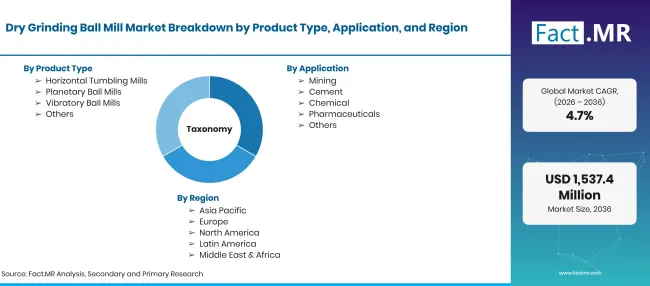
Dry Grinding Ball Mill Market Taxonomy | Source: Fact.MR
| Items | Values |
|---|---|
| Quantitative Units (2026) | USD 975.9 Million |
| Product Type | Horizontal Tumbling Mills, Planetary Ball Mills, Vibratory Ball Mills, Others |
| Application | Mining, Cement, Chemical, Pharmaceuticals, Others |
| Capacity | Large, Small, Medium, Others |
| End-User | Industrial, Commercial, Others |
| Regions Covered | North America, Latin America, Europe, East Asia, South Asia and Pacific, Middle East & Africa |
| Countries Covered | United States, Germany, Japan, United Kingdom, Brazil, and other countries |
| Key Companies Profiled | Metso Corporation; FLS; thyssenkrupp Polysius; KHD Humboldt Wedag International AG; Christian Pfeiffer Maschinenfabrik GmbH; Eirich Group and NETZSCH Group |
| Additional Attributes | Dollar revenue in the Dry Grinding Ball Mill Market is segmented by product type (horizontal tumbling mills, planetary ball mills, vibratory ball mills); application (mining, cement, chemical, pharmaceuticals); capacity (large, small, medium); end-user (industrial, commercial) and region. |
Source: Fact.MR analysis. Updated Nov 18, 2026
Dry Grinding Ball Mill Market by Segments
-
Product Type
- Horizontal Tumbling Mills
- Planetary Ball Mills
- Vibratory Ball Mills
- Others
-
Application
- Mining
- Cement
- Chemical
- Pharmaceuticals
- Others
-
Capacity
- Large
- Small
- Medium
- Others
-
End-User
- Industrial
- Commercial
- Others
-
Region:
- North America
- United States
- Canada
- Mexico
- Europe
- Germany
- United Kingdom
- France
- Italy
- Spain
- Rest of Europe
- Asia Pacific
- China
- India
- Japan
- South Korea
- Australia
- Rest of Asia Pacific
- Latin America
- Brazil
- Mexico
- Argentina
- Rest of Latin America
- Middle East & Africa
- GCC Countries
- South Africa
- Rest of Middle East & Africa
Frequently Asked Questions
How big is the global Dry Grinding Ball Mill Market in 2026?
What will be the size of the Dry Grinding Ball Mill Market by 2036?
How fast will the Dry Grinding Ball Mill Market grow during the forecast period?
Which product type segment holds the largest share of the Dry Grinding Ball Mill Market?
Who worked on this report
Who worked on this report


Preview the report firsthand - request a free sample
Free SampleGet the brochure for pricing and purchase details
Download PDF