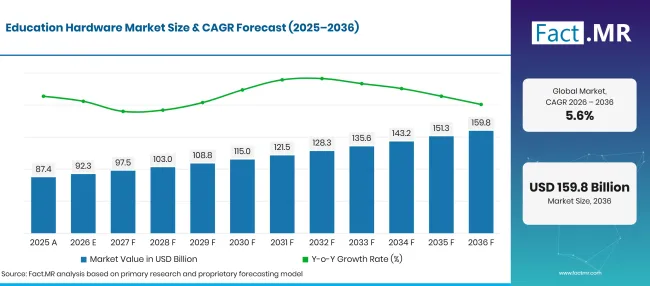
- Market Value (2025): USD 87.4 Bn
- Estimated Value (2026): USD 92.3 Bn
- Forecast Value (2036): USD 159.8 Bn
- CAGR (2026-2036): 5.6%
Education Hardware Market Forecast and Outlook 2026 to 2036
The global education hardware market reached USD 87.4 billion in 2025, with its valuation rising to USD 92.3 billion in 2026. Revenue is forecast to reach USD 159.8 billion by 2036, registering a CAGR of 5.6% over the forecast period.
School administrators are increasingly planning purchases from single-device orders toward managed fleets that remain useful throughout a teaching cycle. PCs carry a large share of spending because students need individual access for assignments and assessments. Interactive displays serve a different purpose by supporting shared lessons. The resulting opportunity depends on reliable replacement budgets, repair support and dependable access to classrooms, not just the first installation.
Market Summary for the Education Hardware Market
- Education Hardware Market Value (2025): USD 87.4 billion
- Education Hardware Market Value (2026): USD 92.3 billion
- Education Hardware Market Forecast Value (2036): USD 159.8 billion
- Education Hardware Market Forecast CAGR (2026-2036): 5.6%
- Leading Application: K-12 Education (61.4%)
- Companies Profiled: Dell Inc., HP Development Company L.P., Microsoft, Apple, SMART Technologies, Promethean, Samsung, BenQ, Lenovo, AVer Information
- Country Outlooks: Japan, Brazil, USA, Germany and UK
The buying criteria differ between student computers and shared teaching displays. A student laptop must survive daily transport and frequent logins. A shared display needs reliable touch response and clear visibility across a room. In June 2025, SMART Technologies introduced the SMART Board Mini as a teaching and collaboration device for lecture spaces. Its launch illustrates how vendors are positioning classroom equipment around how teachers work, although purchases remain subject to school budgets and local specifications.
Education Hardware Market
| Metric | Value |
|---|---|
| Estimated Value in (2026) | USD 92.3 billion |
| Forecast Value in (2036) | USD 159.8 billion |
| Forecast CAGR (2026 to 2036) | 5.6% |
Source: Fact.MR analysis. Updated Nov 18, 2026
Education Hardware Market Forecast Global | Source: Fact.MR
Category
| Category | Segments |
|---|---|
| Type | PCs, Interactive Displays, Classroom Wearables |
| Application | K-12 Education, Higher Education |
| Region | North America, Latin America, Europe, Asia Pacific, Middle East & Africa |
Source: Fact.MR analysis. Updated Nov 18, 2026
Segmental Analysis
Why do PCs account for a major share of education hardware spending?
Education Hardware Market Breakdown Type | Source: Fact.MR
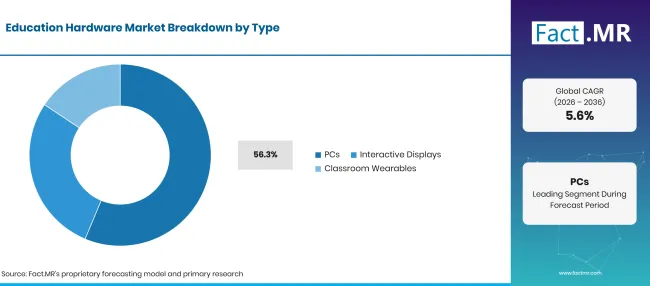
PCs are projected to account for 56.3% of education hardware revenue in 2026. Schools use laptops and desktops for independent classwork and scheduled assessments, while education departments must manage repairs across large device fleets. In the UK Department for Education technology survey published in November 2025, 93% of teachers who evaluated laptops considered them at least partly fit for purpose. Equipment suitability affects how schools judge the timing of replacements. Device makers are likely to compete on service coverage, durability and fleet management alongside the initial purchase price.
How does K-12 education shape hardware purchasing?
Education Hardware Market Breakdown Application | Source: Fact.MR
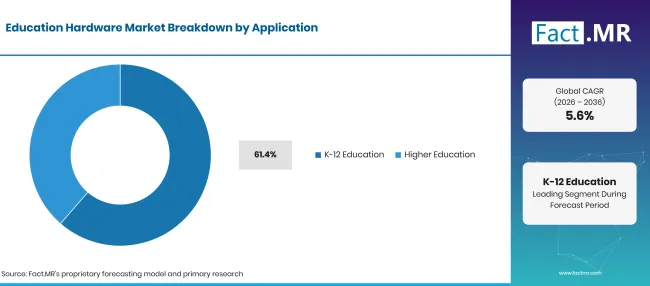
K-12 schools are projected to generate 61.4% of education hardware demand in 2026. Public school networks commonly buy equipment across several buildings, so standard device specifications simplify technical support and replacement schedules. Germany’s Federal Statistical Office reported in November 2026 that 8,998,200 pupils attended general education schools during the 2025/26 year. Such institutional scale makes scheduled purchasing more relevant than isolated orders. Schools also need equipment that works for pupils with different ages and learning needs.
Education Hardware Market-Drivers, Restraints & Trends
Drivers
Institutional replacement cycles create repeat demand after the first wave of classroom computer purchases. Teaching departments must keep devices reliable during examinations and ordinary lessons. Japan’s Ministry of Education outlined a planned five-year replacement process under its GIGA School program in its 2026 budget material.
Restraints
Connectivity gaps can leave computing devices underused where reliable school networking is missing. Brazil’s 2025 School Census reported broadband internet at 76.8% of municipal primary schools. Hardware purchasing must be coordinated with infrastructure improvement. Schools purchasing computers before network readiness may face delays in classroom deployment or additional installation costs.
Trend
The market also includes collaborative teaching equipment that connects directly to teacher computers. SMART Technologies introduced its SMART Board Mini in June 2025 for lecture and meeting settings. It is an example of how interactive display suppliers serve shared teaching spaces while PC brands address individual student work. The two buying cases have different installation and support needs.
Education Hardware Market by Analysis by Country
Education Hardware Market Growth Index | Source: Fact.MR
| Country | CAGR (2026-2036) |
|---|---|
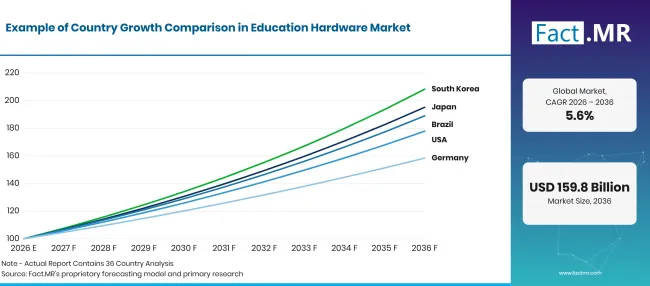
| Japan | 6.9% |
| Brazil | 6.6% |
| USA | 5.9% |
| Germany | 4.7% |
| UK | 4.0% |
Source: Fact.MR analysis. Updated Nov 18, 2026
How is scheduled device replacement affecting education hardware in Japan?
Japan's scheduled renewal of school computers gives local education boards a clear reason to plan their next equipment orders.
In April 2026, the Ministry of Education outlined JPY 67.6 billion for public-school device renewal in its budget material. The programme keeps attention on replacement timing and reliable after-sales service. In April 2025, the ministry reported participation by 28,149 schools in the national academic achievement survey. Computers used for assessments need reliable charging and dependable operation across teaching hours. Japan’s education hardware revenue is projected to increase at a 6.9% CAGR between 2026 and 2036. Local authorities are expected to examine repair arrangements before selecting a common computer specification. Universities offer an additional route to sales through computer laboratory renewals and updates to shared teaching spaces. The Ministry of Education reported 8,528,213 pupils in public elementary and junior high schools in December 2025.
Why is school connectivity changing the hardware outlook in Brazil?
Brazil's school connectivity improvements are creating more practical conditions for everyday classroom computing. In February 2026, the National Institute for Educational Studies and Research (Inep) reported that 94.5% of basic-education schools had internet access in 2025.
A connected classroom can make better use of student PCs and shared teaching displays. The 2025 School Census showed that 72.7% of state-run primary schools had portable computers for students. Such installed equipment creates continuing demand for repair services and device renewal. Education hardware sales in Brazil are forecast to grow at a 6.6% CAGR through 2036. Municipal education offices are likely to assess purchases against their own classroom needs and available technical support. The same Inep census found student laptops in 40.4% of municipal primary schools.
How do school district budgets shape education hardware demand in the USA?
The scale of the USA public education system supports regular investment in school computers and shared classroom equipment. In April 2026, the National Education Association estimated US public school enrollment at 48,370,054 for the 2025/26 academic year. District technology teams need devices that can remain useful across an entire school day.
Reliable charging and repairs influence how schools compare equipment offers. The association also estimated 16,026 public school districts in 2025/26. Different district buying schedules create room for suppliers with flexible distribution and service networks. Education hardware sales in the USA are projected to rise at a 5.9% CAGR from 2026 to 2036. Federal connectivity support helps schools operate digital systems, while individual districts continue to decide when computers and displays should be replaced.
What supports school technology purchasing in Germany?
Germany's large school system creates an established base for student computers and shared teaching equipment. Destatis reported in March 2026 that about 11.5 million pupils attended general, vocational and health-related schools during 2025/26.
School administrators need reliable devices across classrooms while regional authorities plan upgrades at different times. In September 2026, the federal government described DigitalPakt 2.0 as a EUR 5 billion initiative for digital education. Funding arrangements are anticipated to influence the timing of future equipment investment. Germany’s demand for education hardware is expected to advance at a 4.7% CAGR through 2036. PCs and interactive displays serve different teaching tasks, so equipment plans are likely to reflect room needs and technical support. Destatis reported in November 2026 that 811,200 children started school in 2025/26.
Why does the UK emphasize the value of existing education hardware?
Education hardware spending in the UK is shaped by the useful life of computers already installed in schools. In November 2025, the Department for Education reported that 93% of surveyed primary teachers with access to laptops regarded them as at least partly fit for purpose. School managers assess whether repairs or new devices are the better choice for each classroom.
The department recorded 24,499 schools in England in January 2026. These institutions have different technology budgets and replacement timetables. Education hardware sales in the UK are anticipated to expand at a 4.0% CAGR through 2036. A 2025 Department for Education survey also found that 79% of secondary schools had a technology infrastructure refresh plan.
Competitive Landscape for Education Hardware Market
Competition spans student computing devices and shared classroom systems. Dell, HP, Lenovo and Apple offer computer devices used by education institutions, while Microsoft supplies education-focused computing platforms and devices. Hardware purchasing teams compare administration tools, warranty coverage and software compatibility when selecting PC fleets. A wide product catalog matters less when a supplier cannot deliver consistent service across a school network.
SMART Technologies, Promethean and BenQ focus on interactive instruction and classroom displays. Samsung serves education customers with screens and computing equipment, while AVer Information offers classroom visual communication equipment. These suppliers face different installation requirements from student laptop vendors. Education hardware purchasing is likely to favor companies that match the teaching activity to the equipment and provide clear local support terms.
Fact.MR analysis examines competition across computing vendors and classroom equipment specialists. Institutional purchases are shaped by tenders, device availability and service contracts. Vendors that make hardware easier to maintain may preserve relationships with schools over several replacement cycles. Universities also evaluate compatibility with their own teaching systems, which can produce different vendor selections from nearby K-12 districts.
Recent Developments
- In June 2025, SMART Technologies introduced the SMART Board Mini interactive podium at InfoComm 2025.
- In December 2025, Germany’s federal government announced an agreement with the states on DigitalPakt 2.0.
Key Players in Education Hardware Market
Key companies profiled include Dell Inc.; HP Development Company L.P.; Microsoft; Apple; SMART Technologies; Promethean; Samsung; BenQ; Lenovo; and AVer Information.
- Dell Inc.
- HP Development Company L.P.
- Microsoft
- Apple
- SMART Technologies
- Promethean
- Samsung
- BenQ
- Lenovo
- AVer Information
Bibliography
- Department for Education. (2025, November 27). Technology in schools survey report: 2024 to 2025. GOV.UK
- Department for Education. (2026, June 4). Schools, pupils and their characteristics: Academic year 2025/26. Explore Education Statistics
- Department for Education. (2026, August 20). Written answer to HL2124: Educational technology expenditure in schools. UK Parliament
- Federal Statistical Office (Destatis). (2026, March 11). 0.7% more pupils in the 2025/26 school year. Destatis
- Brasil atingiu maior percentual de estudantes em tempo integral. Serviços e Informações do Brasil
- Instituto Nacional de Estudos e Pesquisas Educacionais Anísio Teixeira. (2026, February). Censo Escolar da Educação Básica 2025: Notas estatísticas. Inep Download
- Ministry of Education, Culture, Sports, Science and Technology. (2025, April). Participation of education boards and schools in the 2025 National Assessment of Academic Ability.
- Ministry of Education, Culture, Sports, Science and Technology. (2025, December). Trends in the number of public elementary and junior high schools and pupils.
- Ministry of Education, Culture, Sports, Science and Technology. (2026, April). FY2026 budget highlights: GIGA School device renewal.
Official MEXT PDF - Ministry of Education, Culture, Sports, Science and Technology. (2025, July). Trial of computer-based school assessments: Results.
Official MEXT PDF - National Education Association. (2026, April 10). Rankings and estimates 2026. National Education Association
- SMART Technologies. (2025, June 5). New SMART displays offer compact power and TAA compliance at InfoComm 2025. smarttech.com
Segmentation
Scope of Report
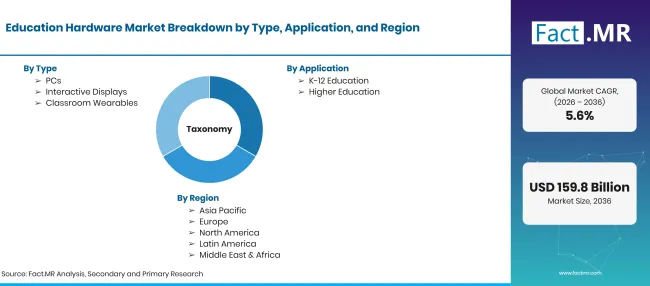
Education Hardware Market Taxonomy | Source: Fact.MR
| Items | Values |
|---|---|
| Quantitative Units (2026) | USD 92.3 Billion |
| Type | PCs, Interactive Displays, Classroom Wearables |
| Application | K-12 Education, Higher Education |
| Regions Covered | North America, Latin America, Europe, Asia Pacific, Middle East & Africa |
| Countries Covered | USA, Germany, Japan, UK, Brazil, and other countries |
| Key Companies Profiled | Dell, HP, Microsoft, Apple, SMART Technologies, Promethean, Samsung, BenQ, Lenovo, AVer Information |
| Additional Attributes | Revenue segmentation by equipment type, educational application and geography. Institutional purchasing and replacement patterns are considered. |
Source: Fact.MR analysis. Updated Nov 18, 2026
Education Hardware Market by Segments
-
Type
- PCs
- Interactive Displays
- Classroom Wearables
-
Application
- K-12 Education
- Higher Education
-
Region
- North America
- Latin America
- Europe
- Asia Pacific
- Middle East & Africa
Frequently Asked Questions
How big is the global Education Hardware Market in 2026?
What is its forecast value in 2036?
How quickly is education hardware revenue projected to grow?
Which equipment type has the highest market share?
Which application accounts for the largest share?
Which country has the highest projected CAGR among those profiled?
What limits school computer purchases?
Who worked on this report


Preview the report firsthand - request a free sample
Free SampleGet the brochure for pricing and purchase details
Download PDF