- Market Value (2025): USD 176.6 Mn
- Estimated Value (2026): USD 184.5 Mn
- Forecast Value (2036): USD 286.6 Mn
- CAGR (2026-2036): 4.5%
Foaming Net Market Forecast and Outlook 2026 to 2036
The foaming net market was valued at USD 176.6 million in 2025. Revenue is estimated at USD 184.5 million in 2026 and is forecast to reach USD 286.6 million by 2036, with a 4.5% CAGR.
Protective foam net sleeves are used when fruit packers need a light cushion around selected produce during handling and transport. Expanded polyethylene is widely used for flexible protective nets, while nylon is a separate material option in the segmentation. Sales may reflect the cost of fruit damage and the time spent applying individual sleeves.
Key Takeaways from the Foaming Net Market
- Foaming Net Market Value (2025): USD 176.6 million
- Foaming Net Market Value (2026): USD 184.5 million
- Foaming Net Market Forecast Value (2036): USD 286.6 million
- Foaming Net Market Forecast CAGR (2026–2036): 4.5%
- Leading Material Type: Polyethylene (54.2%)
- Key Market Participants:
- Countries with growth forecasts: UK, Germany, USA, Japan and Brazil
For a produce packer, the main commercial question is whether a foam sleeve saves enough damaged fruit to justify its price and fitting time. Supply reliability is expected to influence repeat sales when harvest volumes change quickly. Converters that keep a dependable range of net sizes are better able to serve both local growers and export packhouses.
Foaming Net Market
| Metric | Value |
|---|---|
| Estimated Value in (2026) | USD 184.5 million |
| Forecast Value in (2036) | USD 286.6 million |
| Forecast CAGR (2026 to 2036) | 4.5% |
Source: Fact.MR analysis. Updated Nov 18, 2026
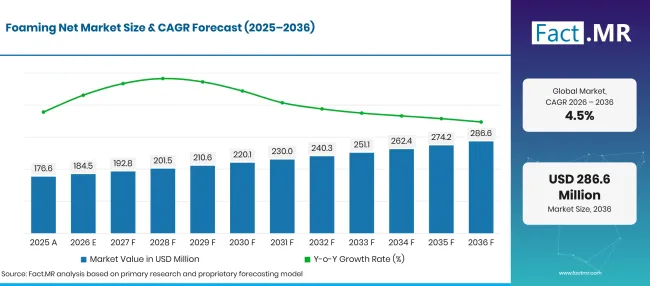
Foaming Net Market Forecast Global | Source: Fact.MR
Category
| Category | Segments |
|---|---|
| Material Type | Polyethylene, Nylon, Others |
| Application | Fruits and Vegetables, Personal Care Products, Others |
| Distribution Channel | Supermarkets/Hypermarkets, Online Retail, Specialty Stores, Others |
| End-User | Household, Commercial |
| Region | North America, Latin America, Europe, Asia Pacific, Middle East & Africa |
Source: Fact.MR analysis. Updated Nov 18, 2026
Segmental Analysis
Why is polyethylene widely selected for protective net sleeves?
Foaming Net Market Breakdown Material Type 1 | Source: Fact.MR
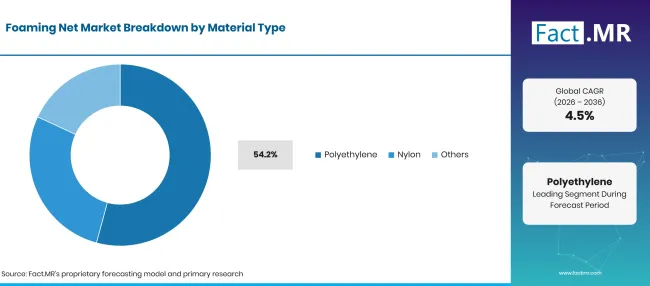
Polyethylene is forecast to account for 54.2% of foaming net revenue in 2026. Expanded polyethylene can be formed into a light net that cushions the surface of selected fruit while letting packers fit it around different shapes. This material may remain the common choice where retailers want a consistent presentation. Nylon netting represents an alternative for applications with different strength requirements. Other materials serve smaller or more specialized requirements. Foam converters may compete on sleeve fit and reliable supply instead of material claims alone.
Where do produce packers find value in foam sleeves?
Foaming Net Market Breakdown Application | Source: Fact.MR
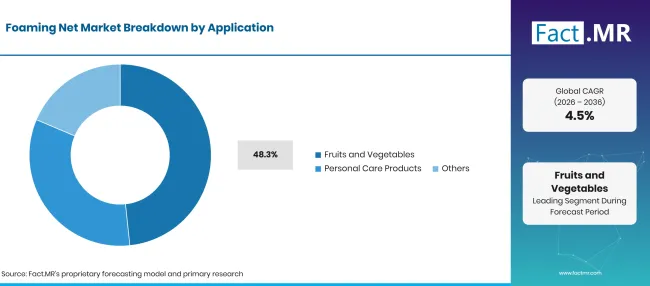
Fruits and vegetables are forecast to represent 48.3% of foaming net revenue in 2026. Produce packhouses select individual sleeves mainly for fruit that can show marks during handling. The value of the packed item influences whether the added protection is commercially sensible. Export-grade fruit may remain a natural application for fitted foam netting. Personal care packaging presents a different use case where the net may cushion a fragile container. Other applications include small items requiring a flexible protective surface. Sales depend on practical packing needs across these separate channels. The produce application also involves different routes to sale. Exporters can place nets around selected fruit before cartons leave the farm, while local packers may apply sleeves closer to final distribution.
Why do supermarkets and hypermarkets hold a notable channel position?
Foaming Net Market Breakdown Distribution Channel | Source: Fact.MR
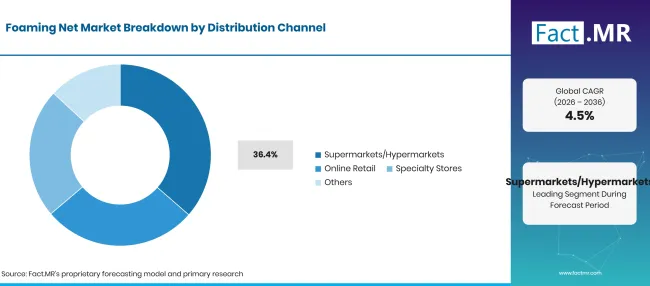
Supermarkets and hypermarkets are forecast to account for 36.4% of distribution-channel revenue in 2026. Many consumer-facing fruit packs pass through large retail networks where appearance and handling damage affect selling quality. Retailers influence packaging specifications even when a produce supplier purchases the net before shipment. Online retail could create additional opportunities for suitable individually packed goods. Specialty shops remain relevant where smaller quantities of premium fruit receive extra protection. Other channels cover direct distributor sales and local packaging outlets. Selection depends on handling needs and order size. Sales channels have different handling patterns that influence packaging choice.
What explains household demand in the end-user classification?
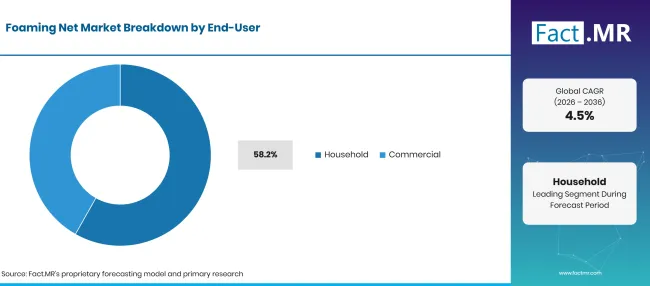
Foaming Net Market Breakdown End User | Source: Fact.MR
Household use is forecast to account for 58.2% of the end-user classification in 2026. This category reflects the consumer-facing destination of protected goods, although growers and commercial packers often purchase the sleeves themselves. Demand connected to household goods may remain closely linked to produce presentation in retail stores. Commercial end users include packing operations and businesses protecting fragile items during transport. Their purchasing decisions depend on repeat order volumes and the cost of fitting each net. Clear separation between the purchaser and the final end user keeps the segment analysis consistent. The end-user division also requires care when interpreting commercial purchases.
Foaming Net Market-Drivers, Restraints & Trends
Drivers:
Packhouses and packaging converters purchase foam net sleeves when they need a protective layer that fits around individual fruit. In January 2026, Brazil’s National Supply Company reported that national fruit exports reached 1.31 million tonnes in 2025. The trade flow illustrates the scale of produce that travels through export packing operations. Foam net manufacturers may serve the share of these shipments where surface protection improves the chances of a sale.
Restraints:
Packaging costs include the sleeve itself and the labour needed to place it around produce. HM Revenue & Customs confirmed that the UK Plastic Packaging Tax rate increased to GBP 228.82 per tonne from April 1, 2026. The tax applies to qualifying plastic packaging components containing less than 30% recycled plastic. Suppliers serving affected packaging categories may pay closer attention to material use and the commercial value of extra cushioning.
Trend:
Retailers and fresh-produce packers are reviewing how much plastic they use per packed item. In October 2026, Eurostat reported that the EU generated 35.9 kilograms of plastic packaging waste per resident during 2024.
Foaming Net Market by Analysis by Key Country
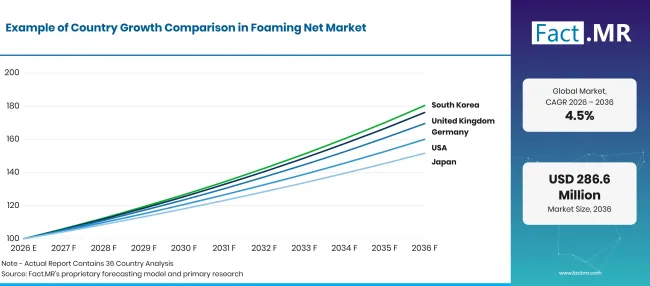
Foaming Net Market Growth Index | Source: Fact.MR
| Country | CAGR (2026–2036) |
|---|---|
| United Kingdom | 5.8% |
| Germany | 5.4% |
| United States | 4.8% |
| Japan | 4.3% |
| Brazil | 3.4% |
Source: Fact.MR analysis. Updated Nov 18, 2026
What is shaping foaming net sales in United Kingdom?
Across the UK, fruit importers and produce retailers may select foam net sleeves for consignments where surface marks can reduce saleable value.
The country also has a sizeable domestic vegetable handling network. In June 2026, the Department for Environment, Food & Rural Affairs reported that fresh fruit supply reached 4.1 million tonnes in 2025. That supply includes imported fruit which passes through distribution centres before reaching shops. Foaming net sales in the UK are forecast to increase at a 5.8% CAGR through 2036. Retail packers may focus on sleeve sizes that fit selected fruit without slowing routine packing.
What is shaping foaming net sales in Germany?
Germany’s vegetable packing and distribution operations create opportunities for carefully selected foam net applications.
In February 2026, the Federal Statistical Office reported that German farms harvested 4.5 million tonnes of vegetables during 2025. Larger harvest flows bring more sorting and movement between farms and wholesalers, although many vegetables are sold without individual sleeves. Foaming net revenue in Germany is forecast to rise at a 5.4% CAGR by 2036. Packhouses may weigh sleeve dimensions against the different grades and sizes they handle each week.
What is shaping foaming net sales in United States?
US fruit and vegetable distributors manage long domestic routes alongside produce imported from neighbouring countries.
In 2026, the U.S. Department of Agriculture Foreign Agricultural Service reported that American fruit and vegetable exports were worth USD 12.92 billion in 2025. Those trade flows illustrate the scale of packed produce moving through commercial channels, although foam sleeves are used only for suitable items. US foaming net demand is estimated to grow at a 4.8% CAGR from 2026 to 2036. Distributors may favour cushioning methods that protect selected fruit during repeated handling and fit standard packing processes.
What is shaping foaming net sales in Japan?
Japanese fruit suppliers place considerable attention on appearance in selected retail and gift channels.
Foam net sleeves are useful where buyers want protection around individual pieces of produce during packing and delivery. In May 2026, the Ministry of Agriculture, Forestry and Fisheries reported that shipments from the 2025 mandarin harvest reached 598,900 tonnes. Japanese foaming net market at a 4.3% CAGR from 2026 to 2036. Packaging converters may compete on net fit and ease of use for different fruit sizes.
What is shaping foaming net sales in Brazil?
Brazilian growers and fruit exporters require packaging that suits long shipping journeys and varying product grades.
In 2026, the Ministry of Development, Industry, Trade and Services reported that exports of fresh or dried non-oilseed fruits and nuts totalled 1.23 million tonnes in 2025. Export activity creates a market for protective handling materials, especially when the appearance of selected fruit affects customer acceptance. Brazil’s foaming net market is forecast to grow at a 3.4% CAGR from 2026 to 2036. Export packers may choose sleeve formats according to the fruit type and the length of the delivery route.
Competitive Landscape for Foaming Net Market
Foaming net supply includes specialist protective-net producers alongside businesses that convert polyethylene foam for packing. The Supreme Industries markets PROTECnet as a tubular polyethylene foam sleeve for protecting fruit and fragile items. Its official product description confirms an established example of the format covered by this report. Customer selection is anticipated to depend on sleeve dimensions and dependable delivery. Export packhouses also evaluate whether a producer can supply enough identical nets during a short harvest period. That purchasing pattern gives specialist net producers a distinct role within protective packaging. Businesses that offer wider foam products compete in related applications without necessarily selling the same tubular sleeve.
Sealed Air and Pregis operate across protective packaging, including cushioning systems used for shipments. Their broader activity illustrates the packaging choices facing customers who compare foam net sleeves with other protective formats. Direct foam-net suppliers may compete most closely through cutting quality and access to established produce-packaging customers. A distributor working with several fruit sizes may prefer a dependable set of sleeve dimensions. Reliable stock is especially useful when export shipping schedules change quickly. The wider protective-packaging sector offers different solutions for the same customer problem, which is preventing damage during transport. Foam sleeves are compact and individually fitted, while paper cushioning and larger foam components are designed for other shipment shapes.
Recent Developments
- In October 2026, Sealed Air expanded its closed-cell polyethylene foam manufacturing capacity at its Madera, California, facility. The expansion strengthens regional supply of Ethafoam and Stratocell protective packaging products for industrial, automotive, electronics and medical applications.
- In January 2026, Pregis introduced EasyPack Strata, a high-speed on-demand paper packaging system. The system produces structured paper pads for void filling and cushioning, supporting flexible packaging requirements in high-volume fulfillment operations.
Key Players in Foaming Net Market
Key companies profiled include The Supreme Industries Limited (PROTECnet); Kamaksha Thermocol; Adhiraj Agro Industries; and Goldcoin Foam Pvt. Ltd.
- The Supreme Industries Limited (PROTECnet)
- Kamaksha Thermocol
- Adhiraj Agro Industries
- Goldcoin Foam Pvt. Ltd.
Bibliography
- Companhia Nacional de Abastecimento. (2026, January). Boletim Hortigranjeiro (Vol. 12, No. 1). Conab.
- Department for Environment, Food & Rural Affairs. (2026, June 25). Horticulture statistics 2025. GOV.UK.
- Eurostat. (2026, October 22). Plastic packaging waste in the EU: 35.9 kg per person.
- Federal Statistical Office of Germany. (2026, February 26). Gemüseernte erreicht 2025 neuen Höchststand. Destatis.
- HM Revenue & Customs. (2026, August 27). Plastic Packaging Tax (PPT) statistics background and references. GOV.UK.
- Ministry of Agriculture, Forestry and Fisheries. (2026, May 26). 2025 mandarin cultivation area, bearing area, harvest, and shipment volume [Crop statistics survey].
- Pregis. (2026, January 27). Pregis launches EasyPack Strata, a high-speed on-demand paper system designed for versatile protection in fulfillment operations.
- Sealed Air. (2026, October 15). Sealed Air expands specialty foam manufacturing capacity.
- U.S. Department of Agriculture, Foreign Agricultural Service. (2026). Fruits and vegetables: U.S. fruits and vegetables exports in 2025.
Segmentation
Scope of Report
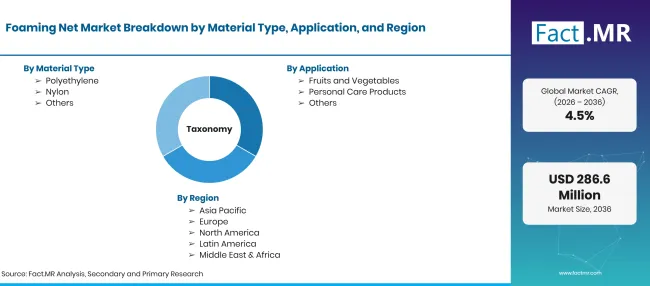
Foaming Net Market Taxonomy | Source: Fact.MR
| Items | Values |
|---|---|
| Quantitative Units (2026) | USD 184.5 Million |
| Material Type | Polyethylene, Nylon, Others |
| Application | Fruits and Vegetables, Personal Care Products, Others |
| Distribution Channel | Supermarkets/Hypermarkets, Online Retail, Specialty Stores, Others |
| End-User | Household, Commercial |
| Regions Covered | North America, Latin America, Europe, Asia Pacific, Middle East & Africa |
| Countries Covered | United Kingdom, Germany, United States, Japan, Brazil, and other countries |
| Companies Profiled | The Supreme Industries Limited, Kamaksha Thermocol, Adhiraj Agro Industries, Goldcoin Foam Pvt. Ltd. |
| Additional Attributes | Protective net sleeves used around selected produce and fragile goods, by material, application, distribution channel and end-user. |
Source: Fact.MR analysis. Updated Nov 18, 2026
Foaming Net Market by Segments
-
Material Type
- Polyethylene
- Nylon
- Others
-
Application
- Fruits and Vegetables
- Personal Care Products
- Others
-
Distribution Channel
- Supermarkets/Hypermarkets
- Online Retail
- Specialty Stores.
- Others.
-
End-User
- Household
- Commercial
-
Region:
- North America
- United States
- Canada
- Mexico
- Europe
- Germany
- United Kingdom
- France
- Italy
- Spain
- Rest of Europe
- Asia Pacific
- China
- India
- Japan
- South Korea
- Australia
- Rest of Asia Pacific
- Latin America
- Brazil
- Mexico
- Argentina
- Rest of Latin America
- Middle East & Africa
- GCC Countries
- South Africa
- Rest of Middle East & Africa
- North America
Frequently Asked Questions
How big is the global Foaming Net Market in 2026?
What is the forecast value of the Foaming Net Market by 2036?
What CAGR is projected for the Foaming Net Market?
Which material type has the main share?
Which application accounts for the main share?
Which distribution channel holds the main share?
Which end-user category holds the main share?
Who worked on this report


Preview the report firsthand - request a free sample
Free SampleGet the brochure for pricing and purchase details
Download PDF