- Market Value (2025): USD 102.8 Bn
- Estimated Value (2026): USD 109.9 Bn
- Forecast Value (2036): USD 214.2 Bn
- CAGR (2026-2036): 6.9%
Life Sciences and Laboratory Equipment Market Forecast and Outlook 2026 to 2036
As per the Fact.MR analysis, the life sciences and laboratory equipment market crossed a valuation of USD 102.8 billion in 2025 and is projected to grow from USD 109.9 billion in 2026 to USD 214.2 billion by 2036. Demand for life sciences and laboratory equipment is likely to grow at a CAGR of 6.9% over the forecast period.
Demand for life sciences and laboratory equipment is rising as drug makers build new research and manufacturing capacity and as diagnostics move toward molecular and mass spectrometry methods. Suppliers of laboratory equipment are combining instruments, consumables and software to secure recurring revenue. For example, in February 2025, Eli Lilly announced plans for four new US manufacturing sites with about USD 27 billion of investment, each requiring analytical and quality-control laboratories. Similar capacity programs are projected to drive sales of life sciences and laboratory equipment through 2036.
Key Takeaways from the Life Sciences and Laboratory Equipment Market
- Life Sciences and Laboratory Equipment Market Value (2025): USD 102.8 billion
- Life Sciences and Laboratory Equipment Market Value (2026): USD 109.9 billion
- Life Sciences and Laboratory Equipment Market Forecast Value (2036): USD 214.2 billion
- Life Sciences and Laboratory Equipment Market Forecast CAGR (2026-2036): 6.9%
- Leading Product Type: Analytical Equipment (38.5%)
- Key Market Participants: Danaher Corporation, Thermo Fisher Scientific Inc., Agilent Technologies Inc., PerkinElmer Inc., Waters Corporation, Bruker Corporation
- Key Growth Regions: Germany, Brazil, United States, United Kingdom, Japan
In July 2025, Waters Corporation agreed to combine with BD's Biosciences and Diagnostic Solutions business, creating a larger group across chromatography, mass spectrometry, flow cytometry and diagnostics. Demand for life sciences and laboratory equipment is growing as customers favor suppliers with broad workflows and service networks. Suppliers of laboratory equipment are using acquisitions to widen portfolios. Similar consolidation is projected to shape sales of life sciences and laboratory equipment worldwide.
Life Sciences and Laboratory Equipment Market
| Metric | Value |
|---|---|
| Estimated Value in (2026) | USD 109.9 billion |
| Forecast Value in (2036) | USD 214.2 billion |
| Forecast CAGR (2026 to 2036) | 6.9% |
Source: Fact.MR analysis. Updated Nov 18, 2026
Source: Fact.MR analysis.
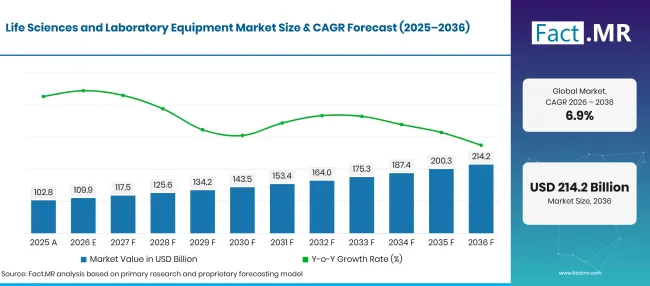
Life Sciences And Laboratory Equipment Market Forecast Global | Source: Fact.MR
Category
| Category | Segments |
|---|---|
| Product Type | Analytical Equipment, General Laboratory Equipment, Specialty Equipment, Others |
| Application | Research and Development, Clinical Diagnostics, Quality Control, Others |
| End-User | Pharmaceutical and Biotechnology Companies, Academic and Research Institutes, Hospitals and Diagnostic Laboratories, Others |
| Region | Germany; Brazil; United States; United Kingdom; Japan |
Source: Fact.MR analysis. Updated Nov 18, 2026
Segmental Analysis
How does demand for analytical equipment and supplier innovation shape product growth in the Life Sciences and Laboratory Equipment Market?
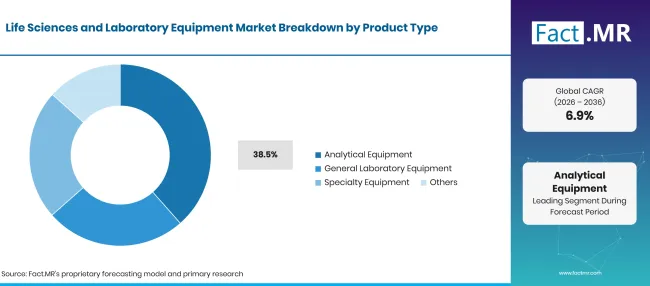
Life Sciences And Laboratory Equipment Market Breakdown Product Type | Source: Fact.MR
Demand for analytical equipment is increasing as pharmaceutical and biotechnology companies expand drug discovery, formulation development, quality control and clinical testing activities. Chromatography, mass spectrometry and spectroscopy systems are essential for identifying compounds, characterizing biologics and verifying drug purity and stability. Supporting this demand, the U.S. FDA reported 172 new drug and biologics license applications (138 NDAs and 34 BLAs) filed during FY 2026, reflecting continued activity across pharmaceutical and biologics development. This expanding development pipeline increases the need for advanced analytical testing and laboratory instrumentation. Analytical instruments also carry high purchase costs and require regular calibration, maintenance and software support, creating recurring supplier revenue. On the supply side, manufacturers are integrating automation, advanced data management and high-throughput capabilities into analytical platforms to meet increasingly complex testing requirements. Continued pharmaceutical pipeline activity and regulatory emphasis on product quality are expected to sustain analytical equipment's leading position, representing 38.5% of market revenue USD 42.3 billion in 2026, through 2036.
Why does research and development lead application demand in the Life Sciences and Laboratory Equipment Market?
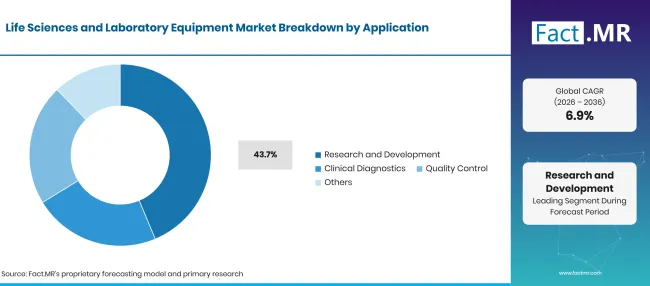
Life Sciences And Laboratory Equipment Market Breakdown Application | Source: Fact.MR
Research and development accounts for 43.7% of application revenue in 2026, about USD 48.0 billion, as biologics, cell and gene therapies and new modalities require characterization at every stage. Pharmaceutical companies have maintained substantial discovery budgets despite fluctuations in academic funding, and laboratory equipment suppliers are adapting their systems specifically for biologics analysis. This momentum is reinforced by federal research funding trends: Congress set the National Institutes of Health’s FY2026 discretionary budget at $48.7 billion, a modest increase over FY2025 after rejecting a proposed 40% cut, with roughly 82% of that funding flowing to external grants, contracts, and awards. Similarly, the National Science Foundation secured $8.75 billion for FY2026 including $7.2 billion for its core research and related activities account supporting nearly 10,000 new research awards and over 250,000 scientists, technicians, and students. With comparable pipeline activity projected across the sector, R&D is expected to remain the leading application going forward.
How are pharmaceutical manufacturing investments and laboratory procurement shaping end-user demand in the Life Sciences and Laboratory Equipment Market?
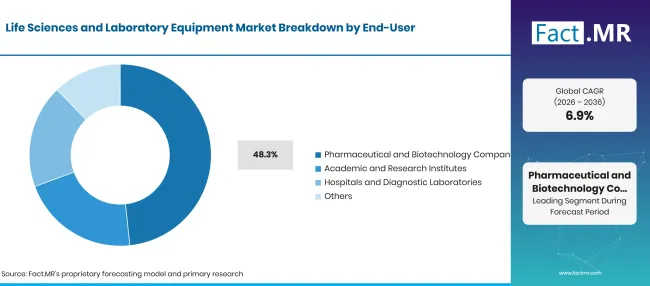
Life Sciences And Laboratory Equipment Market Breakdown End User | Source: Fact.MR
Sales demand from pharmaceutical and biotechnology companies is supported by expanding drug production, regulatory approvals and investments in research and manufacturing infrastructure. These companies account for 48.3% of end-user revenue in 2026, about USD 53.1 billion, reflecting their extensive procurement of analytical instruments, laboratory testing systems and quality-control equipment. Government data provides evidence of this activity. According to NITI Aayog's PLI performance indicators through March 2026, participating pharmaceutical companies recorded production and sales of INR 97,962 crore during FY 2025–26, while cumulative production and sales reached INR 3,64,588 crore. Additionally, the U.S. FDA recorded 172 new drug and biologics license applications filed and 132 approvals during FY 2026, indicating continued commercial development activity across pharmaceutical and biotechnology companies. Rising pharmaceutical sales and product development activity are encouraging companies to expand laboratory capacity, upgrade analytical instruments and procure automated testing systems. Equipment suppliers are responding through broader product portfolios, integrated software platforms and long-term service agreements with large drug manufacturers. Continued growth in pharmaceutical production and biotechnology development is expected to sustain pharmaceutical and biotechnology companies as the leading end-user segment through 2036.
Life Sciences and Laboratory Equipment Market-Drivers, Restraints & Trends
Drivers:
Demand for life sciences and laboratory equipment is rising as pharmaceutical companies expand manufacturing in the United States and Europe. For example, in March 2025, Johnson & Johnson announced more than USD 55 billion of US investment over four years, including new manufacturing sites. Suppliers of laboratory equipment are equipping new quality-control labs. Similar investment is projected to drive sales of life sciences and laboratory equipment through the forecast period.
Restraints: Demand for life sciences and laboratory equipment is exposed to research funding uncertainty. For example, in February 2025, the NIH announced a 15% cap on indirect costs for grants, a policy later challenged in court, unsettling US academic purchasing. Similar funding pressure is projected to slow sales of laboratory equipment to universities. Suppliers of laboratory equipment must lean on pharma, diagnostics and applied markets.
Opportunity:
Laboratory Automation and Data Integration Demand for automated sample handling and connected instruments is rising as laboratories face staff shortages. Suppliers of laboratory equipment are offering robotic workcells and cloud data platforms. Similar efficiency needs are projected to drive sales of laboratory equipment.
Trend:
Proteomics and Multi-Omics Tools Demand for protein analysis tools is rising alongside genomics. In July 2024, Thermo Fisher completed its acquisition of Olink, adding affinity-based proteomics. Similar portfolio moves are projected to drive sales of life sciences and laboratory equipment in research.
Life Sciences and Laboratory Equipment Market by Analysis by Key Country
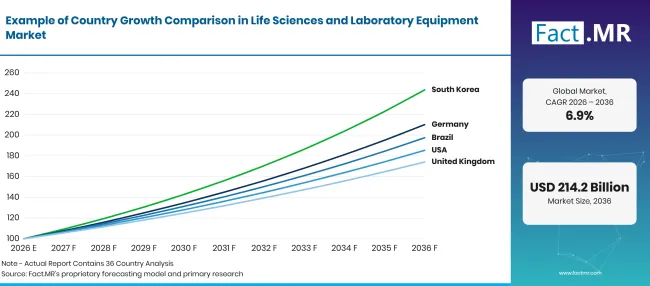
Life Sciences And Laboratory Equipment Market Growth Index | Source: Fact.MR
| Country | CAGR (2026-2036) |
|---|---|
| Germany | 7.7% |
| Brazil | 7.0% |
| United States | 6.4% |
| United Kingdom | 5.7% |
| Japan | 5.0% |
Source: Fact.MR analysis. Updated Nov 18, 2026
Source: Fact.MR analysis.
What is driving laboratory equipment demand in Germany?
Demand for life sciences and laboratory equipment in Germany is estimated to hold at a 7.7% CAGR, the fastest among the five key countries, as drug makers expand production.
For example, Eli Lilly is building a manufacturing site in Alzey with about EUR 2.3 billion of investment. Companies focused on manufacturing laboratory equipment such as Eppendorf, Merck KGaA and Bruker serve German customers locally. Similar investment is projected to drive sales in Germany.
What is shaping laboratory equipment demand in Brazil?
Sales of life sciences and laboratory equipment in Brazil are projected to grow at a 7.0% CAGR as public institutes such as Fiocruz and Butantan expand vaccine and biologics production.
Private diagnostic chains also add molecular testing. Suppliers of laboratory equipment are serving Brazil through distributors. Similar health investment is projected to drive sales in Brazil.
How is reshoring supporting laboratory equipment sales in the United States?
Sales of life sciences and laboratory equipment in the United States are projected to record a 6.4% CAGR as pharmaceutical reshoring offsets pressure on academic funding.
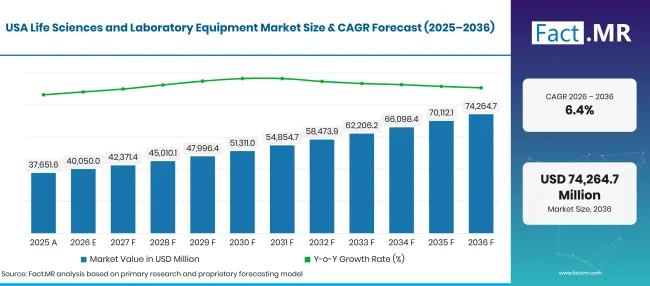
Life Sciences And Laboratory Equipment Market Forecast Usa | Source: Fact.MR
New US plants announced by Lilly and J&J in 2025 need quality-control labs. Manufacturers of laboratory equipment, led by Thermo Fisher, Danaher and Agilent, serve these projects. Similar investment is projected to drive sales in the United States.
What is shaping laboratory equipment demand in the United Kingdom?
Demand for life sciences and laboratory equipment in the United Kingdom is projected to represent a 5.7% CAGR as the government's Life Sciences Sector Plan of July 2025 supports research and manufacturing.
University and biobank research create steady demand. Suppliers of laboratory equipment are serving UK research clusters. Similar policy support is projected to drive sales in the United Kingdom.
Why is laboratory equipment growth slower in Japan?
Demand for life sciences and laboratory equipment in Japan is projected to register a 5.0% CAGR, the slowest among the five key countries, as research budgets grow slowly.
Domestic makers such as Shimadzu hold strong positions. Companies Manufacturing laboratory equipment are targeting biologics and regenerative medicine labs. Similar budget conditions are projected to keep growth slower in Japan.
Competitive Landscape for Life Sciences and Laboratory Equipment Market
Competition in the life sciences and laboratory equipment market is divided between broad workflow suppliers and instrument specialists. Thermo Fisher, Danaher, Agilent and Merck KGaA compete on breadth across instruments, consumables and services, while Waters, Bruker, Shimadzu, Bio-Rad and Eppendorf compete on specialized technologies. Buyers select suppliers on performance, compliance software, service and total cost.
From 2024 onward, competition shifted toward consolidation and multi-omics. Thermo Fisher bought Olink, and Waters agreed to combine with BD's biosciences and diagnostics business. Suppliers with integrated workflows and recurring consumables are best placed to grow.
Recent Developments
- In February 2026, Waters Corporation completed its combination with BD's Biosciences & Diagnostic Solutions business, valued at USD 18.8 billion, expanding its capabilities across chromatography, mass spectrometry, flow cytometry, and clinical diagnostics.
- In July 2024, Thermo Fisher Scientific completed its acquisition of Olink Holding AB for approximately USD 3.1 billion. Olink's next-generation proteomics technologies strengthen Thermo Fisher's capabilities in protein research, mass spectrometry and life sciences research applications.
- In February 2025, Thermo Fisher Scientific announced a definitive agreement to acquire Solventum's Purification & Filtration business for approximately USD 4.1 billion. The business generated approximately USD 1 billion in revenue in 2024 and provides purification and filtration technologies used in biologics production and bioprocessing. Thermo Fisher completed the acquisition on September 2, 2025.
Key Players in Life Sciences and Laboratory Equipment Market
Key companies operating in the market include Danaher Corporation, Thermo Fisher Scientific Inc., Agilent Technologies Inc., PerkinElmer Inc., Waters Corporation, Bruker Corporation, Bio-Rad Laboratories Inc., Merck KGaA, Shimadzu Corporation, and Eppendorf AG.
- Danaher Corporation
- Thermo Fisher Scientific Inc.
- Agilent Technologies Inc.
- PerkinElmer Inc.
- Waters Corporation
- Bruker Corporation
- Bio-Rad Laboratories Inc.
- Merck KGaA
- Shimadzu Corporation
- Eppendorf AG
Bibliography
- Department for Science, Innovation and Technology. (2025). Life sciences sector plan. UK Government.
- Eli Lilly and Company. (2025, February 26). Lilly plans to more than double U.S. manufacturing investment since 2020 exceeding $50 billion.
- Johnson & Johnson. (2025, March 21). Johnson & Johnson increases U.S. investment to more than $55 billion over the next four years.
- National Institutes of Health. (2025, February 7). Supplemental guidance to the 2024 NIH Grants Policy Statement: Indirect cost rates (NOT-OD-25-068).
- NITI Aayog. (2026). Production Linked Incentive (PLI) scheme: Sector-wise performance indicators till March 2026. Government of India.
- Thermo Fisher Scientific. (2024). Thermo Fisher Scientific completes acquisition of Olink, announces commencement of subsequent offering period.
- U.S. Food and Drug Administration. (2026). FY 2026 Q4 real-time report: Prescription drugs.
- Waters Corporation. (2025). Waters and BD to combine biosciences and diagnostics business.
- Waters Corporation. (2026). Waters completes combination with BD's Biosciences & Diagnostic Solutions businesses
Segmentation
Scope of Report
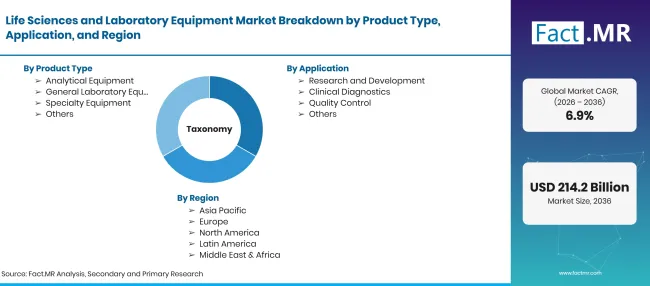
Life Sciences And Laboratory Equipment Market Taxonomy | Source: Fact.MR
| Items | Values |
|---|---|
| Quantitative Units (2026) | USD 109.9 Billion |
| Product Type | Analytical Equipment, General Laboratory Equipment, Specialty Equipment, Others |
| Application | Research and Development, Clinical Diagnostics, Quality Control, Others |
| End-User | Pharmaceutical and Biotechnology Companies, Academic and Research Institutes, Hospitals and Diagnostic Laboratories, Others |
| Regions Covered | North America, Latin America, Europe, East Asia, South Asia and Pacific, Middle East & Africa |
| Countries Covered | United States, Germany, Japan, United Kingdom, Brazil, and other countries |
| Key Companies Profiled | Danaher Corporation, Thermo Fisher Scientific Inc., Agilent Technologies Inc., PerkinElmer Inc., Waters Corporation, Bruker Corporation, Bio-Rad Laboratories Inc., Merck KGaA, Shimadzu Corporation, Eppendorf AG |
| Additional Attributes | Dollar revenue in the Life Sciences and Laboratory Equipment Market is segmented by product type (analytical equipment, general laboratory equipment, specialty equipment); application (research and development, clinical diagnostics, quality control); end-user (pharmaceutical and biotechnology companies, academic and research institutes, hospitals and diagnostic laboratories) and region. |
Source: Fact.MR analysis. Updated Nov 18, 2026
Life Sciences and Laboratory Equipment Market by Segments
-
Product Type
- Analytical Equipment
- General Laboratory Equipment
- Specialty Equipment
- Others
-
Application
- Research and Development
- Clinical Diagnostics
- Quality Control
- Others
-
End-User
- Pharmaceutical and Biotechnology Companies
- Academic and Research Institutes
- Hospitals and Diagnostic Laboratories
- Others
-
Region:
- North America
- United States
- Canada
- Mexico
- Europe
- Germany
- United Kingdom
- France
- Italy
- Spain
- Rest of Europe
- Asia Pacific
- China
- India
- Japan
- South Korea
- Australia
- Rest of Asia Pacific
- Latin America
- Brazil
- Mexico
- Argentina
- Rest of Latin America
- Middle East & Africa
- GCC Countries
- South Africa
- Rest of Middle East & Africa
- North America
Frequently Asked Questions
How big is the global Life Sciences and Laboratory Equipment Market in 2026?
What will be the size of the Life Sciences and Laboratory Equipment Market by 2036?
How fast will the Life Sciences and Laboratory Equipment Market grow during the forecast period?
Which product type segment holds the largest share of the Life Sciences and Laboratory Equipment Market?
Who worked on this report


Preview the report firsthand - request a free sample
Free SampleGet the brochure for pricing and purchase details
Download PDF