Acute Coronary Syndrome Therapeutics Market Size, Share, Growth and Forecast (2026 - 2036)
The Acute Coronary Syndrome Therapeutics Market is segmented by Drug Class (Antiplatelet Agents, Anticoagulants, Thrombolytics, Beta Blockers, Lipid-Lowering Therapies), by Disease Type (ST-Elevation Myocardial Infarction, Non-ST-Elevation Myocardial Infarction, Unstable Angina, Recurrent ACS, High-Risk NSTE-ACS), by Route of Administration, by End User, and by Sales Channel, and Region. Forecast for 2026 to 2036.
Fact.MR states that acute coronary syndrome therapeutics demand is shifting toward fast clot control and long-term event prevention. Hospitals need antiplatelet and anticoagulant access during emergency care.
Acute Coronary Syndrome Therapeutics Market Size, Market Forecast and Outlook by Fact.MR
- The acute coronary syndrome therapeutics market was valued at USD 12.6 billion in 2025. Demand is expected to increase from USD 13.3 billion in 2026 to USD 24.9 billion by 2036.
- The market is forecast to record 6.5% CAGR during 2026 to 2036 as emergency cardiac pathways use antiplatelet therapy and stabilization drugs to reduce recurrent ischemic events.
- Acute coronary syndrome therapeutics demand is becoming more guideline-led. The 2025 ACC/AHA/ACEP/NAEMSP/SCAI guideline covers management of patients with unstable angina, NSTEMI, and STEMI. [1]
- The guideline supports protocol-based drug use across emergency departments and inpatient cardiology units.
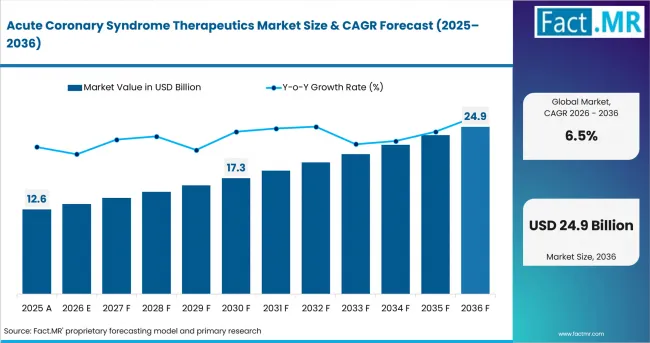
Summary of Acute Coronary Syndrome Therapeutics Market
- Demand Drivers in the Market
- Emergency Treatment: Hospitals need antiplatelets and anticoagulants for rapid ACS stabilization.
- PCI Support: Cardiac centers use drug therapy before and after coronary intervention.
- Secondary Prevention: Long-term therapy reduces recurrent ischemic events after discharge.
- Key Segments Analyzed
- By Drug Class: Antiplatelet agents are expected to hold 42.0% share in 2026 because most ACS pathways require platelet inhibition.
- By Disease Type: NSTEMI is anticipated to account for 44.0% share in 2026 as high-sensitivity diagnosis identifies more non-ST-elevation cases.
- By Route of Administration: Oral therapy is projected to hold 61.0% share in 2026 since post-discharge prevention relies on daily treatment.
- By End User: Hospitals lead as emergency departments and inpatient cardiology units start ACS therapy. The segment is anticipated to capture 56.0% share in 2026.
- By Sales Channel: Hospital pharmacies are expected to hold 43.0% share in 2026 because acute drugs are started during emergency and inpatient care.
- By Geography: India is projected to record 8.2% CAGR from 2026 to 2036 as cardiac emergency access and private hospital capacity expand.
- Analyst Opinion at Fact.MR
- Shambhu Nath Jha, Principal Consultant at Fact.MR, states, “Acute coronary syndrome therapeutics are becoming more risk based and protocol driven. Hospitals use drug therapy to stabilize patients early and reduce repeat cardiac events.”
- Strategic Implications
- Protocol Alignment: Hospitals should align antiplatelet and anticoagulant use with updated ACS guidance.
- Bleeding Review: Clinicians need therapy choices that balance ischemic protection with patient bleeding risk.
- Discharge Continuity: Providers should improve adherence support for post-ACS oral therapy.
| Metric | Value |
|---|---|
| Industry Size 2026 | USD 13.3 billion |
| Industry Value 2036 | USD 24.9 billion |
| CAGR 2026 to 2036 | 6.5% |
The market is moving from one-time acute treatment toward full treatment continuity. Antiplatelet therapy stays important during hospitalization and after discharge. Anticoagulants support acute clot management during invasive and non-invasive care. Lipid-lowering drugs support stabilization after ACS diagnosis.
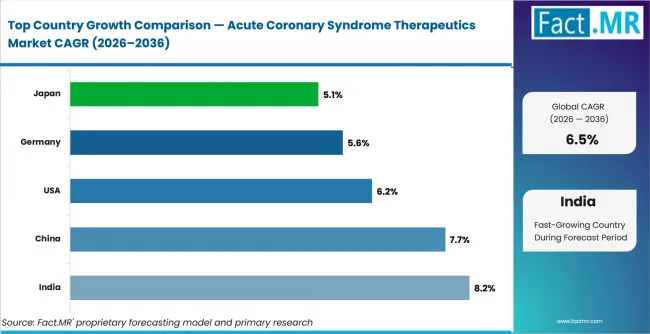
India is projected to record 8.2% CAGR by 2036 as cardiac emergency access and private hospital capacity expand. China is likely to post 7.7% CAGR from 2026 to 2036 as hospital-based cardiology care and diagnostics improve. The United States is expected to register 6.2% CAGR from 2026 to 2036 as ACS protocols and secondary prevention sustain demand. Germany is forecast to advance at 5.6% CAGR by 2036 because mature cardiac care systems support protocol-led therapy use. Japan is set to record 5.1% CAGR through 2036 as aging demographics and hospital-based cardiology care sustain treatment demand.
Segmental Analysis
Acute Coronary Syndrome Therapeutics Market Analysis by Drug Class

Antiplatelet agents are expected to hold 42.0% share in 2026 because most ACS pathways need platelet inhibition. The 2025 Australian ACS guideline states that landmark trials of P2Y12 inhibitors in ACS patients undergoing PCI established 9-12 months of dual antiplatelet therapy as the standard duration [2]. Aspirin and P2Y12 inhibitors are important across ACS treatment and post-discharge prevention. Anticoagulants help control clots during hospitalization and invasive care. Thrombolytics stay important when timely PCI access is limited. Beta blockers help selected patients reduce cardiac workload after stabilization. Lipid-lowering therapies support plaque stabilization and recurrent event reduction.
- Platelet Control: Antiplatelet agents reduce thrombotic risk during acute care and after hospital discharge.
- Injectable Support: Anticoagulants help hospitals manage clot risk during inpatient and PCI-linked treatment.
- Stabilization Need: Lipid-lowering therapies support longer-term risk control after ACS diagnosis.
Acute Coronary Syndrome Therapeutics Market Analysis by Disease Type

NSTEMI leads because high-sensitivity diagnosis finds more non-ST-elevation cases. Emergency clinicians use biomarkers and ECG review before treatment decisions. The segment is likely to account for 44.0% share in 2026 as hospitals detect more myocardial injury without ST elevation. STEMI needs urgent care because reperfusion and drug timing are critical. Unstable angina demand continues but is smaller due to biomarker-based classification. Recurrent ACS needs therapy reassessment. High-risk NSTE-ACS requires intensive antithrombotic management.
- NSTEMI Therapy: Non-ST-elevation cases need careful antithrombotic use and early risk-based treatment decisions.
- STEMI Treatment: STEMI pathways require immediate drug support around reperfusion and cath lab care.
- Recurrent Events: Repeat ACS cases need stronger adherence review and therapy optimization after discharge.
Acute Coronary Syndrome Therapeutics Market Analysis by Route of Administration
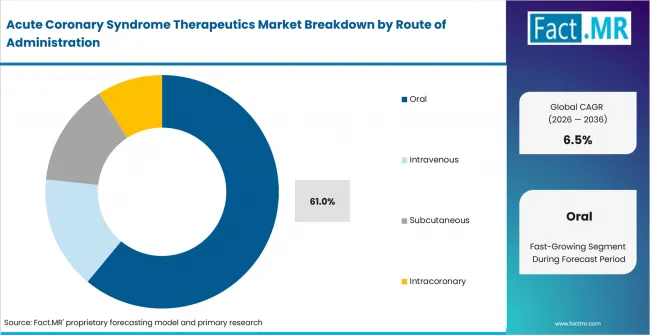
Oral therapy is projected to hold 61.0% share in 2026 because post-discharge prevention relies on daily treatment. The 2025 ACC/AHA/ACEP/NAEMSP/SCAI ACS guideline states that dual antiplatelet therapy with aspirin and an oral P2Y12 inhibitor is indicated for at least 12 months in ACS patients who are not at high bleeding risk [3]. Oral antiplatelets and lipid-lowering drugs support therapy continuity after discharge. Intravenous drugs are important during emergency and cath lab care. Subcutaneous anticoagulants support selected hospitalized patients. Intracoronary drug use is limited to specialized interventional care.
- Oral Continuity: Oral drugs support longer treatment courses after patients leave acute care settings.
- IV Urgency: Intravenous therapy helps clinicians manage unstable patients during emergency and cath lab treatment.
- Subcutaneous Use: Injectable anticoagulants support selected inpatient pathways before discharge or invasive review.
Acute Coronary Syndrome Therapeutics Market Analysis by End User
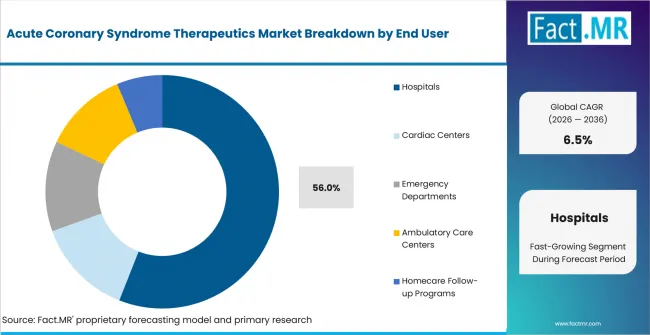
Hospitals lead as emergency departments and inpatient cardiology units start ACS therapy. ACS patients usually enter treatment through emergency evaluation and rapid medication initiation. The segment is anticipated to capture 56.0% share in 2026 because hospitals manage acute stabilization and inpatient monitoring. Cardiac centers handle complex cases and PCI-linked medication protocols. Emergency departments initiate early antiplatelet and anticoagulant use. Ambulatory care centers support follow-up therapy.
- Hospital Start: Acute facilities begin antiplatelet and anticoagulant treatment during emergency cardiac evaluation.
- Cardiac Centers: Specialist centers manage therapy around PCI and higher-risk ACS presentations.
- Follow-up Care: Ambulatory programs help patients continue secondary prevention after hospital discharge.
Acute Coronary Syndrome Therapeutics Market Analysis by Sales Channel
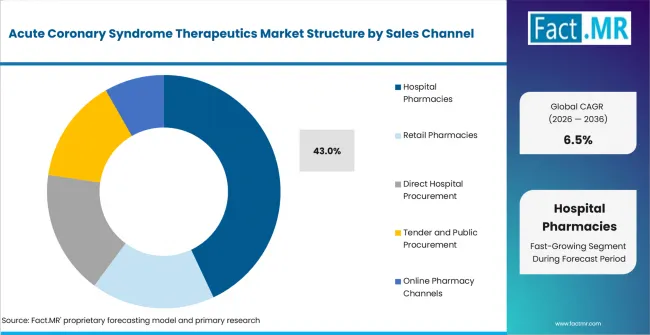
Hospital pharmacies are expected to hold 43.0% share in 2026 because acute drugs are started during emergency and inpatient care. Hospital pharmacy units manage antiplatelets and stabilization drugs. Retail pharmacies help patients continue oral therapy after discharge. Direct hospital procurement serves inpatient injectable drugs and formulary purchases. Tender and public procurement channels support government hospitals. Online pharmacy channels serve selected refill demand in regulated markets.
- Hospital Access: Inpatient pharmacies secure acute drug supply for emergency and cath lab workflows.
- Retail Continuity: Retail pharmacies support repeat oral therapy after ACS patients leave hospital care.
- Public Tenders: Tender channels influence access in government hospitals and national cardiac programs.
Acute Coronary Syndrome Therapeutics Market Drivers, Restraints, and Opportunities

Cardiovascular disease burden and guideline-led treatment are the main drivers for ACS therapeutics demand. CDC reported that cardiovascular disease caused 919,032 deaths in the United States in 2023. [4] The high burden keeps emergency cardiac therapy and secondary prevention central to healthcare spending.
Bleeding risk and therapy cost can slow adoption. Strong antithrombotic therapy can raise bleeding concerns in older patients and high-risk groups. Branded drugs face formulary pressure when generics become available. PCI-linked therapy needs hospital infrastructure and specialist access. Rural areas may still face delays in diagnosis and treatment initiation.
Opportunities in the Acute Coronary Syndrome Therapeutics Market
- Generic Expansion: Generic antiplatelets can widen access in cost-sensitive hospital systems, helping pharmacy committees manage discharge therapy budgets across ACS care programs.
- Adherence Support: Drug makers can support digital refill and follow-up programs after discharge, helping patients stay on antiplatelet therapy under clinical supervision.
- Risk-Based Therapy: Hospitals can tailor antithrombotic use through bleeding and ischemic risk assessment, improving therapy choice for patients with complex ACS profiles.
Regional Analysis
Based on regional analysis, the acute coronary syndrome therapeutics market is segmented into North America, Latin America, Western Europe, Eastern Europe, East Asia, South Asia and Pacific, and Middle East and Africa.
.webp)
| Country | CAGR (2026 to 2036) |
|---|---|
| India | 8.2% |
| China | 7.7% |
| United States | 6.2% |
| Germany | 5.6% |
| Japan | 5.1% |
South Asia and East Asia Acute Coronary Syndrome Therapeutics Market Analysis
South Asia and East Asia demand comes from cardiac emergency expansion and wider hospital treatment access. India leads the regional outlook due to rising private hospital capacity and improving emergency care access. China has wider tertiary hospital infrastructure and stronger inpatient cardiology capacity.
- India: India is projected to record 8.2% CAGR by 2036 as cardiac emergency access and private hospital capacity expand. Urban hospitals are improving ACS drug protocols and cath lab-linked care. Smaller cities still face ambulance delays and limited specialist access. The diabetes and hypertension burden supports sustained therapy demand. Public hospitals remain price-sensitive for branded drugs.
- China: China has large hospital networks and expanding cardiology capacity. Tertiary centers use antiplatelets and stabilization drugs across ACS pathways. China is likely to post 7.7% CAGR from 2026 to 2036 as hospital-based cardiology care and diagnostics improve. Domestic drug suppliers can serve cost-sensitive hospitals. Premium brands may keep access in advanced cardiac centers. Hospital purchasing rules and guideline adoption will affect supplier position.
North America Acute Coronary Syndrome Therapeutics Market Analysis
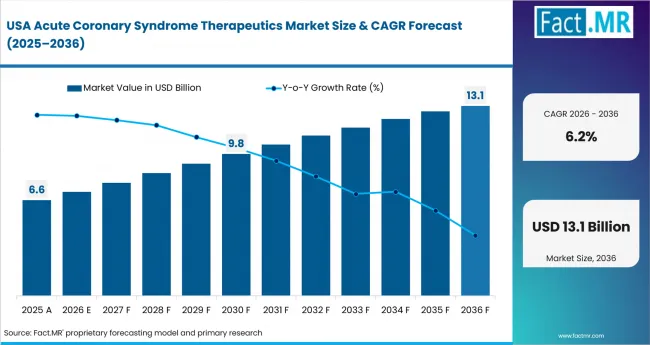
North America demand is led by the United States because emergency cardiac pathways and inpatient pharmacy systems are well established. Hospitals use antiplatelet and anticoagulant protocols during emergency care. Retail pharmacies support long-term oral therapy after discharge.
- United States: The United States is expected to register 6.2% CAGR over the forecast period as ACS protocols and secondary prevention support demand. Emergency departments start antithrombotic therapy after ECG and biomarker review. Hospital pharmacies manage acute drug availability for cath lab and inpatient care. Branded antiplatelet use faces generic and formulary pressure. Updated ACC/AHA guidance will shape therapy duration and bleeding-risk decisions.
Western Europe Acute Coronary Syndrome Therapeutics Market Analysis

Western Europe demand comes from established cardiac care systems and guideline-based therapy. Germany leads the regional view because hospitals have broad PCI access and strong inpatient cardiology pathways. Treatment demand is steady due to replacement use and secondary prevention needs.
- Germany: Germany is forecast to advance at 5.6% CAGR from 2026 to 2036 because mature cardiac care systems support protocol-led therapy use. Hospitals use antiplatelets and statins across ACS pathways. Cardiac centers focus on higher-risk patients and post-event prevention.
East Asia Mature Market View

Japan has an aging population and established hospital-based cardiology care. ACS therapy demand is steady because older patients need careful drug selection and follow-up. Hospitals have strong diagnostic access and interventional cardiology capacity.
- Japan: Japan is set to record 5.1% CAGR through 2036 as aging demographics and hospital-based cardiology care sustain treatment demand. Emergency hospitals use antiplatelets and anticoagulants in protocol-led ACS care. Older patients raise bleeding risk and influence therapy selection. PCI access is established across major centers. Demand rises more slowly than in India and China because infrastructure is already developed.
Competitive Aligners for Market Suppliers
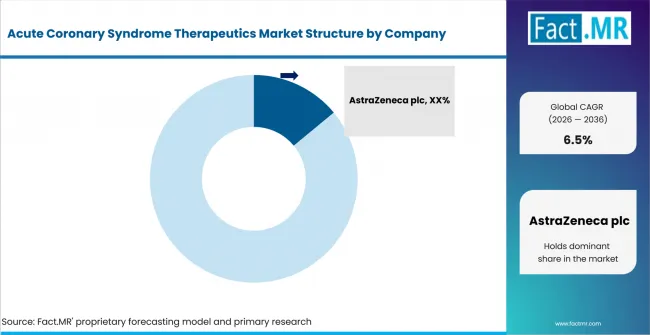
Acute coronary syndrome therapeutics cover emergency treatment and longer-term prevention after a cardiac event. AstraZeneca plc participates through Brilinta and Brilique in antiplatelet therapy. Bayer AG supports cardiovascular treatment through its pharmaceutical portfolio. Bayer reported EUR 45.6 billion in 2025 Group sales and continued activity in cardiovascular and specialty medicines. [5]
Sanofi S.A. serves hospital anticoagulant use through enoxaparin-linked products. Daiichi Sankyo Company, Limited competes across cardiovascular therapy areas with anticoagulant experience. Viatris Inc. supports access through established and generic cardiovascular medicines used in routine post-event care.
By 2036, competition will depend on clinical evidence and treatment continuity. ACS therapy starts in emergency care and continues after discharge. Hospitals will favor suppliers that support protocol-based treatment and bleeding-risk management. Companies that help improve adherence after discharge will gain stronger access across hospital and retail pharmacy channels.
Key Companies in Acute Coronary Syndrome Therapeutics Market
- AstraZeneca plc
- Bayer AG
- Sanofi S.A.
- Daiichi Sankyo Company, Limited
- Viatris Inc.
Bibliography
- [1] American Heart Association. (2025, February 27). 2025 guideline for the management of patients with acute coronary syndromes. American Heart Association.
- [2] National Heart Foundation of Australia & Cardiac Society of Australia and New Zealand. (2025). Australian clinical guideline for diagnosing and managing acute coronary syndromes 2025. National Heart Foundation of Australia.
- [3] Rao, S. V., O’Donoghue, M. L., Ruel, M., Rab, T., Tamis-Holland, J. E., Alexander, J. H., Morrow, D. A., Baber, U., Mukherjee, D., Baker, H., Platz, E., Cohen, M. G., Promes, S. B., Cruz-Ruiz, M., Sandner, S., Davis, L. L., Sandoval, Y., de Lemos, J. A., Schunder, R., et al. (2025, February 27). 2025 ACC/AHA/ACEP/NAEMSP/SCAI guideline for the management of patients with acute coronary syndromes. Circulation.
- [4] Centers for Disease Control and Prevention. (2024, October 24). Heart disease facts. Centers for Disease Control and Prevention.
- [5] Bayer AG. (2026, March 4). Annual Report 2025. Bayer AG.
This Report Addresses
- Strategic intelligence on acute coronary syndrome therapeutics demand across drug class, disease type, route, end user, and sales channel.
- Forecast mapping from USD 13.3 billion in 2026 to USD 24.9 billion by 2036.
- Segment analysis covering antiplatelet agents, NSTEMI, oral therapy, hospitals, and hospital pharmacies.
- Regional outlook covering India, China, the United States, Germany, and Japan.
- Competitive analysis of AstraZeneca plc, Bayer AG, Sanofi S.A., Daiichi Sankyo Company, Limited, Viatris Inc.
- Therapy assessment covering antiplatelet agents, anticoagulants, thrombolytics, beta blockers, and lipid-lowering therapies.
- Channel assessment covering hospital pharmacies, retail pharmacies, direct hospital procurement, public tenders, and online pharmacy channels.
- Primary interviews, supplier checks, official source review, and acute cardiac therapy workflow validation support the forecast.
Acute Coronary Syndrome Therapeutics Market Definition
The acute coronary syndrome therapeutics market covers drugs used to treat unstable angina, NSTEMI, and STEMI. It includes antiplatelet agents and lipid-lowering therapies used during acute care and secondary prevention. The market differs from broad cardiovascular drugs because it focuses on drug therapy linked to acute coronary events.
Acute Coronary Syndrome Therapeutics Market Inclusions
The scope includes branded and generic drugs used in ACS treatment pathways. It includes oral antiplatelets and lipid-lowering treatments used after ACS. Hospital pharmacy and retail pharmacy sales are included when the product is used for acute or post-ACS therapy.
Acute Coronary Syndrome Therapeutics Market Exclusions
The scope excludes diagnostics and cath lab consumables. It excludes chronic stable angina therapy without an acute coronary event. General hypertension drugs are excluded unless used in ACS stabilization. Lifestyle programs and cardiac rehabilitation services are outside scope.
Acute Coronary Syndrome Therapeutics Market Research Methodology
- Primary Research
- Primary research includes interviews with cardiologists and emergency medicine physicians. It includes input from hospital pharmacists and cath lab care teams.
- Desk Research
- Desk research reviews cardiology guidelines and official company reports. It covers antiplatelet therapy and secondary prevention drugs.
- Market-Sizing and Forecasting
- Forecasting uses drug class demand and disease type mix. Route of administration and channel structure support the market assessment.
- Data Validation and Update Cycle
- Forecasts are validated through hospital feedback and supplier checks. ACS admission patterns and formulary movement help confirm market direction.
Scope of the Report

| Attribute | Details |
|---|---|
| Quantitative Units | USD 13.3 billion in 2026 to USD 24.9 billion by 2036 at 6.5% CAGR |
| Market Definition | Drugs used to treat unstable angina, NSTEMI, and STEMI |
| Drug Class | Antiplatelet Agents, Anticoagulants, Thrombolytics, Beta Blockers, Lipid-Lowering Therapies |
| Disease Type | ST-Elevation Myocardial Infarction, Non-ST-Elevation Myocardial Infarction, Unstable Angina, Recurrent ACS, High-Risk NSTE-ACS |
| Route of Administration | Oral, Intravenous, Subcutaneous, Intracoronary |
| End User | Hospitals, Cardiac Centers, Emergency Departments, Ambulatory Care Centers, Homecare Follow-up Programs |
| Sales Channel | Hospital Pharmacies, Retail Pharmacies, Direct Hospital Procurement, Tender and Public Procurement, Online Pharmacy Channels |
| Regions Covered | North America, Latin America, Western Europe, Eastern Europe, East Asia, South Asia and Pacific, Middle East and Africa |
| Countries Covered | India, China, United States, Germany, Japan |
| Key Companies Profiled | AstraZeneca plc, Bayer AG, Sanofi S.A., Daiichi Sankyo Company, Limited, Viatris Inc. |
| Forecast Period | 2026 to 2036 |
| Approach | Hybrid top-down and bottom-up approach using drug class demand, disease type mix, route of administration, end-user demand, sales channel structure, and regional validation |
Acute Coronary Syndrome Therapeutics Market Analysis by Segments
-
By Drug Class:
- Antiplatelet Agents
- Anticoagulants
- Thrombolytics
- Beta Blockers
- Lipid-Lowering Therapies
-
By Disease Type:
- ST-Elevation Myocardial Infarction
- Non-ST-Elevation Myocardial Infarction
- Unstable Angina
- Recurrent ACS
- High-Risk NSTE-ACS
-
By Route of Administration:
- Oral
- Intravenous
- Subcutaneous
- Intracoronary
-
By End User:
- Hospitals
- Cardiac Centers
- Emergency Departments
- Ambulatory Care Centers
- Homecare Follow-up Programs
-
By Sales Channel:
- Hospital Pharmacies
- Retail Pharmacies
- Direct Hospital Procurement
- Tender and Public Procurement
- Online Pharmacy Channels
-
Region:
- North America
- United States
- Canada
- Europe
- Germany
- United Kingdom
- France
- Italy
- Spain
- Asia Pacific
- China
- Japan
- South Korea
- Taiwan
- Singapore
- Latin America
- Brazil
- Mexico
- Argentina
- Middle East & Africa
- GCC Countries
- South Africa
- Israel
- North America

- Frequently Asked Questions -
What is the Acute Coronary Syndrome Therapeutics Market size in 2026?
The acute coronary syndrome therapeutics market is estimated to reach USD 13.3 billion in 2026 as emergency cardiac treatment expands.
What will the Acute Coronary Syndrome Therapeutics Market be worth by 2036?
The acute coronary syndrome therapeutics market is projected to reach USD 24.9 billion by 2036.
What CAGR is projected for the Acute Coronary Syndrome Therapeutics Market?
The acute coronary syndrome therapeutics market is forecast to record 6.5% CAGR during 2026 to 2036.
Which drug class leads the Acute Coronary Syndrome Therapeutics Market?
Antiplatelet agents lead with 42.0% share in 2026 because most ACS pathways require platelet inhibition.
Which country expands faster in the Acute Coronary Syndrome Therapeutics Market?
India is projected to record 8.2% CAGR from 2026 to 2036 as cardiac emergency access and private hospital capacity expand.
How does China perform in the Acute Coronary Syndrome Therapeutics Market?
China is likely to post 7.7% CAGR from 2026 to 2036 as hospital-based cardiology care and diagnostics improve.
How does the United States perform in the Acute Coronary Syndrome Therapeutics Market?
The United States is forecast to register 6.2% CAGR from 2026 to 2036 as ACS protocols and secondary prevention sustain demand.
What is the primary driver in the Acute Coronary Syndrome Therapeutics Market?
The primary driver is emergency cardiac treatment. Hospitals need antiplatelets and anticoagulants for rapid ACS stabilization.
What is the main restraint in the Acute Coronary Syndrome Therapeutics Market?
The main restraint is bleeding risk. Strong antithrombotic therapy can raise safety concerns in older or high-risk patients.
Why are antiplatelet agents important in this market?
Antiplatelet agents are important because platelet inhibition supports acute treatment and prevention after hospital discharge.
Table of Content
- Executive Summary
- Global Market Outlook
- Demand to side Trends
- Supply to side Trends
- Technology Roadmap Analysis
- Analysis and Recommendations
- Market Overview
- Market Coverage / Taxonomy
- Market Definition / Scope / Limitations
- Research Methodology
- Chapter Orientation
- Analytical Lens and Working Hypotheses
- Market Structure, Signals, and Trend Drivers
- Benchmarking and Cross-market Comparability
- Market Sizing, Forecasting, and Opportunity Mapping
- Research Design and Evidence Framework
- Desk Research Programme (Secondary Evidence)
- Company Annual and Sustainability Reports
- Peer-reviewed Journals and Academic Literature
- Corporate Websites, Product Literature, and Technical Notes
- Earnings Decks and Investor Briefings
- Statutory Filings and Regulatory Disclosures
- Technical White Papers and Standards Notes
- Fact.MR Internal Proprietary Databases and Historical Market Datasets
- Subscription Datasets and Paid Sources
- Social Channels, Communities, and Digital Listening Inputs
- Additional Desk Sources
- Expert Input and Fieldwork (Primary Evidence)
- Primary Modes
- Qualitative Interviews and Expert Elicitation
- Quantitative Surveys and Structured Data Capture
- Blended Approach
- Why Primary Evidence is Used
- Field Techniques
- Interviews
- Surveys
- Focus Groups
- Observational and In-context Research
- Social and Community Interactions
- Stakeholder Universe Engaged
- C-suite Leaders
- Board Members
- Presidents and Vice Presidents
- R&D and Innovation Heads
- Technical Specialists
- Domain Subject-matter Experts
- Scientists
- Physicians and Other Healthcare Professionals
- Governance, Ethics, and Data Stewardship
- Research Ethics
- Data Integrity and Handling
- Primary Modes
- Tooling, Models, and Reference Databases
- Desk Research Programme (Secondary Evidence)
- Data Engineering and Model Build
- Opportunity
- Trends
- Scenario Forecast
- Demand in Optimistic Scenario
- Demand in Likely Scenario
- Demand in Conservative Scenario
- Opportunity Map Analysis
- Product Life Cycle Analysis
- Supply Chain Analysis
- Investment Feasibility Matrix
- Value Chain Analysis
- PESTLE and Porter’s Analysis
- Regulatory Landscape
- Regional Parent Market Outlook
- Production and Consumption Statistics
- Import and Export Statistics
- Global Market Analysis 2021 to 2025 and Forecast, 2026 to 2036
- Historical Market Size Value (USD Million) Analysis, 2021 to 2025
- Current and Future Market Size Value (USD Million) Projections, 2026 to 2036
- Y to o to Y Growth Trend Analysis
- Absolute $ Opportunity Analysis
- Global Market Pricing Analysis 2021 to 2025 and Forecast 2026 to 2036
- Global Market Analysis 2021 to 2025 and Forecast 2026 to 2036, By Product Type
- Introduction / Key Findings
- Historical Market Size Value (USD Million) Analysis By Product Type , 2021 to 2025
- Current and Future Market Size Value (USD Million) Analysis and Forecast By Product Type , 2026 to 2036
- Neutral Displacement Connectors
- Positive Displacement Connectors
- Negative Displacement Connectors
- Split Septum Connectors
- Antimicrobial Needleless Connectors
- Neutral Displacement Connectors
- Y to o to Y Growth Trend Analysis By Product Type , 2021 to 2025
- Absolute $ Opportunity Analysis By Product Type , 2026 to 2036
- Global Market Analysis 2021 to 2025 and Forecast 2026 to 2036, By Design Type
- Introduction / Key Findings
- Historical Market Size Value (USD Million) Analysis By Design Type, 2021 to 2025
- Current and Future Market Size Value (USD Million) Analysis and Forecast By Design Type, 2026 to 2036
- Straight Fluid Path
- Mechanical Valve
- Swabbable Valve
- Closed System Connector
- Extension Set-Integrated Connector
- Straight Fluid Path
- Y to o to Y Growth Trend Analysis By Design Type, 2021 to 2025
- Absolute $ Opportunity Analysis By Design Type, 2026 to 2036
- Global Market Analysis 2021 to 2025 and Forecast 2026 to 2036, By Application
- Introduction / Key Findings
- Historical Market Size Value (USD Million) Analysis By Application, 2021 to 2025
- Current and Future Market Size Value (USD Million) Analysis and Forecast By Application, 2026 to 2036
- Central Venous Catheters
- Peripheral IV Catheters
- Arterial Lines
- Oncology Infusion
- Emergency and Critical Care Infusion
- Central Venous Catheters
- Y to o to Y Growth Trend Analysis By Application, 2021 to 2025
- Absolute $ Opportunity Analysis By Application, 2026 to 2036
- Global Market Analysis 2021 to 2025 and Forecast 2026 to 2036, By End User
- Introduction / Key Findings
- Historical Market Size Value (USD Million) Analysis By End User, 2021 to 2025
- Current and Future Market Size Value (USD Million) Analysis and Forecast By End User, 2026 to 2036
- Hospitals
- Ambulatory Surgical Centers
- Emergency Departments
- Intensive Care Value (USD Million)s
- Oncology Centers
- Hospitals
- Y to o to Y Growth Trend Analysis By End User, 2021 to 2025
- Absolute $ Opportunity Analysis By End User, 2026 to 2036
- Global Market Analysis 2021 to 2025 and Forecast 2026 to 2036, By Sales Channel
- Introduction / Key Findings
- Historical Market Size Value (USD Million) Analysis By Sales Channel, 2021 to 2025
- Current and Future Market Size Value (USD Million) Analysis and Forecast By Sales Channel, 2026 to 2036
- Direct Hospital Contracts
- Medical Device Distributors
- Group Purchasing Organizations
- Online Medical Supply Channels
- OEM Infusion Set Supply
- Direct Hospital Contracts
- Y to o to Y Growth Trend Analysis By Sales Channel, 2021 to 2025
- Absolute $ Opportunity Analysis By Sales Channel, 2026 to 2036
- Global Market Analysis 2021 to 2025 and Forecast 2026 to 2036, By Region
- Introduction
- Historical Market Size Value (USD Million) Analysis By Region, 2021 to 2025
- Current Market Size Value (USD Million) Analysis and Forecast By Region, 2026 to 2036
- North America
- Latin America
- Western Europe
- Eastern Europe
- East Asia
- South Asia and Pacific
- Middle East & Africa
- Market Attractiveness Analysis By Region
- North America Market Analysis 2021 to 2025 and Forecast 2026 to 2036, By Country
- Historical Market Size Value (USD Million) Trend Analysis By Market Taxonomy, 2021 to 2025
- Market Size Value (USD Million) Forecast By Market Taxonomy, 2026 to 2036
- By Country
- USA
- Canada
- Mexico
- By Product Type
- By Design Type
- By Application
- By End User
- By Sales Channel
- By Country
- Market Attractiveness Analysis
- By Country
- By Product Type
- By Design Type
- By Application
- By End User
- By Sales Channel
- Key Takeaways
- Latin America Market Analysis 2021 to 2025 and Forecast 2026 to 2036, By Country
- Historical Market Size Value (USD Million) Trend Analysis By Market Taxonomy, 2021 to 2025
- Market Size Value (USD Million) Forecast By Market Taxonomy, 2026 to 2036
- By Country
- Brazil
- Chile
- Rest of Latin America
- By Product Type
- By Design Type
- By Application
- By End User
- By Sales Channel
- By Country
- Market Attractiveness Analysis
- By Country
- By Product Type
- By Design Type
- By Application
- By End User
- By Sales Channel
- Key Takeaways
- Western Europe Market Analysis 2021 to 2025 and Forecast 2026 to 2036, By Country
- Historical Market Size Value (USD Million) Trend Analysis By Market Taxonomy, 2021 to 2025
- Market Size Value (USD Million) Forecast By Market Taxonomy, 2026 to 2036
- By Country
- Germany
- UK
- Italy
- Spain
- France
- Nordic
- BENELUX
- Rest of Western Europe
- By Product Type
- By Design Type
- By Application
- By End User
- By Sales Channel
- By Country
- Market Attractiveness Analysis
- By Country
- By Product Type
- By Design Type
- By Application
- By End User
- By Sales Channel
- Key Takeaways
- Eastern Europe Market Analysis 2021 to 2025 and Forecast 2026 to 2036, By Country
- Historical Market Size Value (USD Million) Trend Analysis By Market Taxonomy, 2021 to 2025
- Market Size Value (USD Million) Forecast By Market Taxonomy, 2026 to 2036
- By Country
- Russia
- Poland
- Hungary
- Balkan & Baltic
- Rest of Eastern Europe
- By Product Type
- By Design Type
- By Application
- By End User
- By Sales Channel
- By Country
- Market Attractiveness Analysis
- By Country
- By Product Type
- By Design Type
- By Application
- By End User
- By Sales Channel
- Key Takeaways
- East Asia Market Analysis 2021 to 2025 and Forecast 2026 to 2036, By Country
- Historical Market Size Value (USD Million) Trend Analysis By Market Taxonomy, 2021 to 2025
- Market Size Value (USD Million) Forecast By Market Taxonomy, 2026 to 2036
- By Country
- China
- Japan
- South Korea
- By Product Type
- By Design Type
- By Application
- By End User
- By Sales Channel
- By Country
- Market Attractiveness Analysis
- By Country
- By Product Type
- By Design Type
- By Application
- By End User
- By Sales Channel
- Key Takeaways
- South Asia and Pacific Market Analysis 2021 to 2025 and Forecast 2026 to 2036, By Country
- Historical Market Size Value (USD Million) Trend Analysis By Market Taxonomy, 2021 to 2025
- Market Size Value (USD Million) Forecast By Market Taxonomy, 2026 to 2036
- By Country
- India
- ASEAN
- Australia & New Zealand
- Rest of South Asia and Pacific
- By Product Type
- By Design Type
- By Application
- By End User
- By Sales Channel
- By Country
- Market Attractiveness Analysis
- By Country
- By Product Type
- By Design Type
- By Application
- By End User
- By Sales Channel
- Key Takeaways
- Middle East & Africa Market Analysis 2021 to 2025 and Forecast 2026 to 2036, By Country
- Historical Market Size Value (USD Million) Trend Analysis By Market Taxonomy, 2021 to 2025
- Market Size Value (USD Million) Forecast By Market Taxonomy, 2026 to 2036
- By Country
- Kingdom of Saudi Arabia
- Other GCC Countries
- Turkiye
- South Africa
- Other African Union
- Rest of Middle East & Africa
- By Product Type
- By Design Type
- By Application
- By End User
- By Sales Channel
- By Country
- Market Attractiveness Analysis
- By Country
- By Product Type
- By Design Type
- By Application
- By End User
- By Sales Channel
- Key Takeaways
- Key Countries Market Analysis
- USA
- Pricing Analysis
- Market Share Analysis, 2025
- By Product Type
- By Design Type
- By Application
- By End User
- By Sales Channel
- Canada
- Pricing Analysis
- Market Share Analysis, 2025
- By Product Type
- By Design Type
- By Application
- By End User
- By Sales Channel
- Mexico
- Pricing Analysis
- Market Share Analysis, 2025
- By Product Type
- By Design Type
- By Application
- By End User
- By Sales Channel
- Brazil
- Pricing Analysis
- Market Share Analysis, 2025
- By Product Type
- By Design Type
- By Application
- By End User
- By Sales Channel
- Chile
- Pricing Analysis
- Market Share Analysis, 2025
- By Product Type
- By Design Type
- By Application
- By End User
- By Sales Channel
- Germany
- Pricing Analysis
- Market Share Analysis, 2025
- By Product Type
- By Design Type
- By Application
- By End User
- By Sales Channel
- UK
- Pricing Analysis
- Market Share Analysis, 2025
- By Product Type
- By Design Type
- By Application
- By End User
- By Sales Channel
- Italy
- Pricing Analysis
- Market Share Analysis, 2025
- By Product Type
- By Design Type
- By Application
- By End User
- By Sales Channel
- Spain
- Pricing Analysis
- Market Share Analysis, 2025
- By Product Type
- By Design Type
- By Application
- By End User
- By Sales Channel
- France
- Pricing Analysis
- Market Share Analysis, 2025
- By Product Type
- By Design Type
- By Application
- By End User
- By Sales Channel
- India
- Pricing Analysis
- Market Share Analysis, 2025
- By Product Type
- By Design Type
- By Application
- By End User
- By Sales Channel
- ASEAN
- Pricing Analysis
- Market Share Analysis, 2025
- By Product Type
- By Design Type
- By Application
- By End User
- By Sales Channel
- Australia & New Zealand
- Pricing Analysis
- Market Share Analysis, 2025
- By Product Type
- By Design Type
- By Application
- By End User
- By Sales Channel
- China
- Pricing Analysis
- Market Share Analysis, 2025
- By Product Type
- By Design Type
- By Application
- By End User
- By Sales Channel
- Japan
- Pricing Analysis
- Market Share Analysis, 2025
- By Product Type
- By Design Type
- By Application
- By End User
- By Sales Channel
- South Korea
- Pricing Analysis
- Market Share Analysis, 2025
- By Product Type
- By Design Type
- By Application
- By End User
- By Sales Channel
- Russia
- Pricing Analysis
- Market Share Analysis, 2025
- By Product Type
- By Design Type
- By Application
- By End User
- By Sales Channel
- Poland
- Pricing Analysis
- Market Share Analysis, 2025
- By Product Type
- By Design Type
- By Application
- By End User
- By Sales Channel
- Hungary
- Pricing Analysis
- Market Share Analysis, 2025
- By Product Type
- By Design Type
- By Application
- By End User
- By Sales Channel
- Kingdom of Saudi Arabia
- Pricing Analysis
- Market Share Analysis, 2025
- By Product Type
- By Design Type
- By Application
- By End User
- By Sales Channel
- Turkiye
- Pricing Analysis
- Market Share Analysis, 2025
- By Product Type
- By Design Type
- By Application
- By End User
- By Sales Channel
- South Africa
- Pricing Analysis
- Market Share Analysis, 2025
- By Product Type
- By Design Type
- By Application
- By End User
- By Sales Channel
- USA
- Market Structure Analysis
- Competition Dashboard
- Competition Benchmarking
- Market Share Analysis of Top Players
- By Regional
- By Product Type
- By Design Type
- By Application
- By End User
- By Sales Channel
- Competition Analysis
- Competition Deep Dive
- ICU Medical, Inc.
- Overview
- Product Portfolio
- Profitability by Market Segments (Product/Age /Sales Channel/Region)
- Sales Footprint
- Strategy Overview
- Marketing Strategy
- Product Strategy
- Channel Strategy
- Becton, Dickinson and Company
- B. Braun SE
- Baxter International Inc.
- Vygon S.A.
- ICU Medical, Inc.
- Competition Deep Dive
- Assumptions & Acronyms Used
List Of Table
- Table 1: Global Market Value (USD Million) Forecast by Region, 2021 to 2036
- Table 2: Global Market Value (USD Million) Forecast by Product Type , 2021 to 2036
- Table 3: Global Market Value (USD Million) Forecast by Design Type, 2021 to 2036
- Table 4: Global Market Value (USD Million) Forecast by Application, 2021 to 2036
- Table 5: Global Market Value (USD Million) Forecast by End User, 2021 to 2036
- Table 6: Global Market Value (USD Million) Forecast by Sales Channel, 2021 to 2036
- Table 7: North America Market Value (USD Million) Forecast by Country, 2021 to 2036
- Table 8: North America Market Value (USD Million) Forecast by Product Type , 2021 to 2036
- Table 9: North America Market Value (USD Million) Forecast by Design Type, 2021 to 2036
- Table 10: North America Market Value (USD Million) Forecast by Application, 2021 to 2036
- Table 11: North America Market Value (USD Million) Forecast by End User, 2021 to 2036
- Table 12: North America Market Value (USD Million) Forecast by Sales Channel, 2021 to 2036
- Table 13: Latin America Market Value (USD Million) Forecast by Country, 2021 to 2036
- Table 14: Latin America Market Value (USD Million) Forecast by Product Type , 2021 to 2036
- Table 15: Latin America Market Value (USD Million) Forecast by Design Type, 2021 to 2036
- Table 16: Latin America Market Value (USD Million) Forecast by Application, 2021 to 2036
- Table 17: Latin America Market Value (USD Million) Forecast by End User, 2021 to 2036
- Table 18: Latin America Market Value (USD Million) Forecast by Sales Channel, 2021 to 2036
- Table 19: Western Europe Market Value (USD Million) Forecast by Country, 2021 to 2036
- Table 20: Western Europe Market Value (USD Million) Forecast by Product Type , 2021 to 2036
- Table 21: Western Europe Market Value (USD Million) Forecast by Design Type, 2021 to 2036
- Table 22: Western Europe Market Value (USD Million) Forecast by Application, 2021 to 2036
- Table 23: Western Europe Market Value (USD Million) Forecast by End User, 2021 to 2036
- Table 24: Western Europe Market Value (USD Million) Forecast by Sales Channel, 2021 to 2036
- Table 25: Eastern Europe Market Value (USD Million) Forecast by Country, 2021 to 2036
- Table 26: Eastern Europe Market Value (USD Million) Forecast by Product Type , 2021 to 2036
- Table 27: Eastern Europe Market Value (USD Million) Forecast by Design Type, 2021 to 2036
- Table 28: Eastern Europe Market Value (USD Million) Forecast by Application, 2021 to 2036
- Table 29: Eastern Europe Market Value (USD Million) Forecast by End User, 2021 to 2036
- Table 30: Eastern Europe Market Value (USD Million) Forecast by Sales Channel, 2021 to 2036
- Table 31: East Asia Market Value (USD Million) Forecast by Country, 2021 to 2036
- Table 32: East Asia Market Value (USD Million) Forecast by Product Type , 2021 to 2036
- Table 33: East Asia Market Value (USD Million) Forecast by Design Type, 2021 to 2036
- Table 34: East Asia Market Value (USD Million) Forecast by Application, 2021 to 2036
- Table 35: East Asia Market Value (USD Million) Forecast by End User, 2021 to 2036
- Table 36: East Asia Market Value (USD Million) Forecast by Sales Channel, 2021 to 2036
- Table 37: South Asia and Pacific Market Value (USD Million) Forecast by Country, 2021 to 2036
- Table 38: South Asia and Pacific Market Value (USD Million) Forecast by Product Type , 2021 to 2036
- Table 39: South Asia and Pacific Market Value (USD Million) Forecast by Design Type, 2021 to 2036
- Table 40: South Asia and Pacific Market Value (USD Million) Forecast by Application, 2021 to 2036
- Table 41: South Asia and Pacific Market Value (USD Million) Forecast by End User, 2021 to 2036
- Table 42: South Asia and Pacific Market Value (USD Million) Forecast by Sales Channel, 2021 to 2036
- Table 43: Middle East & Africa Market Value (USD Million) Forecast by Country, 2021 to 2036
- Table 44: Middle East & Africa Market Value (USD Million) Forecast by Product Type , 2021 to 2036
- Table 45: Middle East & Africa Market Value (USD Million) Forecast by Design Type, 2021 to 2036
- Table 46: Middle East & Africa Market Value (USD Million) Forecast by Application, 2021 to 2036
- Table 47: Middle East & Africa Market Value (USD Million) Forecast by End User, 2021 to 2036
- Table 48: Middle East & Africa Market Value (USD Million) Forecast by Sales Channel, 2021 to 2036
List Of Figures
- Figure 1: Global Market Pricing Analysis
- Figure 2: Global Market Value (USD Million) Forecast 2021-2036
- Figure 3: Global Market Value Share and BPS Analysis by Product Type, 2026 and 2036
- Figure 4: Global Market Y-o-Y Growth Comparison by Product Type,2026 to 2036
- Figure 5: Global Market Attractiveness Analysis by Product Type
- Figure 6: Global Market Value Share and BPS Analysis by Design Type, 2026 and 2036
- Figure 7: Global Market Y-o-Y Growth Comparison by Design Type,2026 to 2036
- Figure 8: Global Market Attractiveness Analysis by Design Type
- Figure 9: Global Market Value Share and BPS Analysis by Application, 2026 and 2036
- Figure 10: Global Market Y-o-Y Growth Comparison by Application,2026 to 2036
- Figure 11: Global Market Attractiveness Analysis by Application
- Figure 12: Global Market Value Share and BPS Analysis by End User, 2026 and 2036
- Figure 13: Global Market Y-o-Y Growth Comparison by End User,2026 to 2036
- Figure 14: Global Market Attractiveness Analysis by End User
- Figure 15: Global Market Value Share and BPS Analysis by Sales Channel, 2026 and 2036
- Figure 16: Global Market Y-o-Y Growth Comparison by Sales Channel,2026 to 2036
- Figure 17: Global Market Attractiveness Analysis by Sales Channel
- Figure 18: Global Market Value (USD Million) Share and BPS Analysis by Region, 2026 and 2036
- Figure 19: Global Market Y-o-Y Growth Comparison by Region,2026 to 2036
- Figure 20: Global Market Attractiveness Analysis by Region
- Figure 21: North America Market Incremental Dollar Opportunity,2026 to 2036
- Figure 22: Latin America Market Incremental Dollar Opportunity,2026 to 2036
- Figure 23: Western Europe Market Incremental Dollar Opportunity,2026 to 2036
- Figure 24: Eastern Europe Market Incremental Dollar Opportunity,2026 to 2036
- Figure 25: East Asia Market Incremental Dollar Opportunity,2026 to 2036
- Figure 26: South Asia and Pacific Market Incremental Dollar Opportunity,2026 to 2036
- Figure 27: Middle East & Africa Market Incremental Dollar Opportunity,2026 to 2036
- Figure 28: North America Market Value Share and BPS Analysis by Country, 2026 and 2036
- Figure 29: North America Market Value Share and BPS Analysis by Product Type, 2026 and 2036
- Figure 30: North America Market Y-o-Y Growth Comparison by Product Type,2026 to 2036
- Figure 31: North America Market Attractiveness Analysis by Product Type
- Figure 32: North America Market Value Share and BPS Analysis by Design Type, 2026 and 2036
- Figure 33: North America Market Y-o-Y Growth Comparison by Design Type,2026 to 2036
- Figure 34: North America Market Attractiveness Analysis by Design Type
- Figure 35: North America Market Value Share and BPS Analysis by Application, 2026 and 2036
- Figure 36: North America Market Y-o-Y Growth Comparison by Application,2026 to 2036
- Figure 37: North America Market Attractiveness Analysis by Application
- Figure 38: North America Market Value Share and BPS Analysis by End User, 2026 and 2036
- Figure 39: North America Market Y-o-Y Growth Comparison by End User,2026 to 2036
- Figure 40: North America Market Attractiveness Analysis by End User
- Figure 41: North America Market Value Share and BPS Analysis by Sales Channel, 2026 and 2036
- Figure 42: North America Market Y-o-Y Growth Comparison by Sales Channel,2026 to 2036
- Figure 43: North America Market Attractiveness Analysis by Sales Channel
- Figure 44: Latin America Market Value Share and BPS Analysis by Country, 2026 and 2036
- Figure 45: Latin America Market Value Share and BPS Analysis by Product Type, 2026 and 2036
- Figure 46: Latin America Market Y-o-Y Growth Comparison by Product Type,2026 to 2036
- Figure 47: Latin America Market Attractiveness Analysis by Product Type
- Figure 48: Latin America Market Value Share and BPS Analysis by Design Type, 2026 and 2036
- Figure 49: Latin America Market Y-o-Y Growth Comparison by Design Type,2026 to 2036
- Figure 50: Latin America Market Attractiveness Analysis by Design Type
- Figure 51: Latin America Market Value Share and BPS Analysis by Application, 2026 and 2036
- Figure 52: Latin America Market Y-o-Y Growth Comparison by Application,2026 to 2036
- Figure 53: Latin America Market Attractiveness Analysis by Application
- Figure 54: Latin America Market Value Share and BPS Analysis by End User, 2026 and 2036
- Figure 55: Latin America Market Y-o-Y Growth Comparison by End User,2026 to 2036
- Figure 56: Latin America Market Attractiveness Analysis by End User
- Figure 57: Latin America Market Value Share and BPS Analysis by Sales Channel, 2026 and 2036
- Figure 58: Latin America Market Y-o-Y Growth Comparison by Sales Channel,2026 to 2036
- Figure 59: Latin America Market Attractiveness Analysis by Sales Channel
- Figure 60: Western Europe Market Value Share and BPS Analysis by Country, 2026 and 2036
- Figure 61: Western Europe Market Value Share and BPS Analysis by Product Type, 2026 and 2036
- Figure 62: Western Europe Market Y-o-Y Growth Comparison by Product Type,2026 to 2036
- Figure 63: Western Europe Market Attractiveness Analysis by Product Type
- Figure 64: Western Europe Market Value Share and BPS Analysis by Design Type, 2026 and 2036
- Figure 65: Western Europe Market Y-o-Y Growth Comparison by Design Type,2026 to 2036
- Figure 66: Western Europe Market Attractiveness Analysis by Design Type
- Figure 67: Western Europe Market Value Share and BPS Analysis by Application, 2026 and 2036
- Figure 68: Western Europe Market Y-o-Y Growth Comparison by Application,2026 to 2036
- Figure 69: Western Europe Market Attractiveness Analysis by Application
- Figure 70: Western Europe Market Value Share and BPS Analysis by End User, 2026 and 2036
- Figure 71: Western Europe Market Y-o-Y Growth Comparison by End User,2026 to 2036
- Figure 72: Western Europe Market Attractiveness Analysis by End User
- Figure 73: Western Europe Market Value Share and BPS Analysis by Sales Channel, 2026 and 2036
- Figure 74: Western Europe Market Y-o-Y Growth Comparison by Sales Channel,2026 to 2036
- Figure 75: Western Europe Market Attractiveness Analysis by Sales Channel
- Figure 76: Eastern Europe Market Value Share and BPS Analysis by Country, 2026 and 2036
- Figure 77: Eastern Europe Market Value Share and BPS Analysis by Product Type, 2026 and 2036
- Figure 78: Eastern Europe Market Y-o-Y Growth Comparison by Product Type,2026 to 2036
- Figure 79: Eastern Europe Market Attractiveness Analysis by Product Type
- Figure 80: Eastern Europe Market Value Share and BPS Analysis by Design Type, 2026 and 2036
- Figure 81: Eastern Europe Market Y-o-Y Growth Comparison by Design Type,2026 to 2036
- Figure 82: Eastern Europe Market Attractiveness Analysis by Design Type
- Figure 83: Eastern Europe Market Value Share and BPS Analysis by Application, 2026 and 2036
- Figure 84: Eastern Europe Market Y-o-Y Growth Comparison by Application,2026 to 2036
- Figure 85: Eastern Europe Market Attractiveness Analysis by Application
- Figure 86: Eastern Europe Market Value Share and BPS Analysis by End User, 2026 and 2036
- Figure 87: Eastern Europe Market Y-o-Y Growth Comparison by End User,2026 to 2036
- Figure 88: Eastern Europe Market Attractiveness Analysis by End User
- Figure 89: Eastern Europe Market Value Share and BPS Analysis by Sales Channel, 2026 and 2036
- Figure 90: Eastern Europe Market Y-o-Y Growth Comparison by Sales Channel,2026 to 2036
- Figure 91: Eastern Europe Market Attractiveness Analysis by Sales Channel
- Figure 92: East Asia Market Value Share and BPS Analysis by Country, 2026 and 2036
- Figure 93: East Asia Market Value Share and BPS Analysis by Product Type, 2026 and 2036
- Figure 94: East Asia Market Y-o-Y Growth Comparison by Product Type,2026 to 2036
- Figure 95: East Asia Market Attractiveness Analysis by Product Type
- Figure 96: East Asia Market Value Share and BPS Analysis by Design Type, 2026 and 2036
- Figure 97: East Asia Market Y-o-Y Growth Comparison by Design Type,2026 to 2036
- Figure 98: East Asia Market Attractiveness Analysis by Design Type
- Figure 99: East Asia Market Value Share and BPS Analysis by Application, 2026 and 2036
- Figure 100: East Asia Market Y-o-Y Growth Comparison by Application,2026 to 2036
- Figure 101: East Asia Market Attractiveness Analysis by Application
- Figure 102: East Asia Market Value Share and BPS Analysis by End User, 2026 and 2036
- Figure 103: East Asia Market Y-o-Y Growth Comparison by End User,2026 to 2036
- Figure 104: East Asia Market Attractiveness Analysis by End User
- Figure 105: East Asia Market Value Share and BPS Analysis by Sales Channel, 2026 and 2036
- Figure 106: East Asia Market Y-o-Y Growth Comparison by Sales Channel,2026 to 2036
- Figure 107: East Asia Market Attractiveness Analysis by Sales Channel
- Figure 108: South Asia and Pacific Market Value Share and BPS Analysis by Country, 2026 and 2036
- Figure 109: South Asia and Pacific Market Value Share and BPS Analysis by Product Type, 2026 and 2036
- Figure 110: South Asia and Pacific Market Y-o-Y Growth Comparison by Product Type,2026 to 2036
- Figure 111: South Asia and Pacific Market Attractiveness Analysis by Product Type
- Figure 112: South Asia and Pacific Market Value Share and BPS Analysis by Design Type, 2026 and 2036
- Figure 113: South Asia and Pacific Market Y-o-Y Growth Comparison by Design Type,2026 to 2036
- Figure 114: South Asia and Pacific Market Attractiveness Analysis by Design Type
- Figure 115: South Asia and Pacific Market Value Share and BPS Analysis by Application, 2026 and 2036
- Figure 116: South Asia and Pacific Market Y-o-Y Growth Comparison by Application,2026 to 2036
- Figure 117: South Asia and Pacific Market Attractiveness Analysis by Application
- Figure 118: South Asia and Pacific Market Value Share and BPS Analysis by End User, 2026 and 2036
- Figure 119: South Asia and Pacific Market Y-o-Y Growth Comparison by End User,2026 to 2036
- Figure 120: South Asia and Pacific Market Attractiveness Analysis by End User
- Figure 121: South Asia and Pacific Market Value Share and BPS Analysis by Sales Channel, 2026 and 2036
- Figure 122: South Asia and Pacific Market Y-o-Y Growth Comparison by Sales Channel,2026 to 2036
- Figure 123: South Asia and Pacific Market Attractiveness Analysis by Sales Channel
- Figure 124: Middle East & Africa Market Value Share and BPS Analysis by Country, 2026 and 2036
- Figure 125: Middle East & Africa Market Value Share and BPS Analysis by Product Type, 2026 and 2036
- Figure 126: Middle East & Africa Market Y-o-Y Growth Comparison by Product Type,2026 to 2036
- Figure 127: Middle East & Africa Market Attractiveness Analysis by Product Type
- Figure 128: Middle East & Africa Market Value Share and BPS Analysis by Design Type, 2026 and 2036
- Figure 129: Middle East & Africa Market Y-o-Y Growth Comparison by Design Type,2026 to 2036
- Figure 130: Middle East & Africa Market Attractiveness Analysis by Design Type
- Figure 131: Middle East & Africa Market Value Share and BPS Analysis by Application, 2026 and 2036
- Figure 132: Middle East & Africa Market Y-o-Y Growth Comparison by Application,2026 to 2036
- Figure 133: Middle East & Africa Market Attractiveness Analysis by Application
- Figure 134: Middle East & Africa Market Value Share and BPS Analysis by End User, 2026 and 2036
- Figure 135: Middle East & Africa Market Y-o-Y Growth Comparison by End User,2026 to 2036
- Figure 136: Middle East & Africa Market Attractiveness Analysis by End User
- Figure 137: Middle East & Africa Market Value Share and BPS Analysis by Sales Channel, 2026 and 2036
- Figure 138: Middle East & Africa Market Y-o-Y Growth Comparison by Sales Channel,2026 to 2036
- Figure 139: Middle East & Africa Market Attractiveness Analysis by Sales Channel
- Figure 140: Global Market - Tier Structure Analysis
- Figure 141: Global Market - Company Share Analysis