Acute Care Needleless Connectors Market Size, Share, Growth and Forecast (2026 - 2036)
The Acute Care Needleless Connectors Market is segmented by Product Type (Neutral Displacement Connectors, Positive Displacement Connectors, Negative Displacement Connectors, Split Septum Connectors, Antimicrobial Needleless Connectors), by Design Type (Straight Fluid Path, Mechanical Valve, Swabbable Valve, Closed System Connector, Extension Set-Integrated Connector), by Application, by End User, and by Sales Channel, and Region. Forecast for 2026 to 2036.
Fact.MR notes that acute care needleless connector demand is moving toward safer IV access and better infection-control. Hospitals need connectors that reduce needle exposure and support closed IV access.
Acute Care Needleless Connectors Market Size, Market Forecast and Outlook by Fact.MR
- The acute care needleless connectors market was valued at USD 1.1 billion in 2025.
- Demand is expected to increase from USD 1.2 billion in 2026 to USD 2.3 billion by 2036.
- The market is forecast to record 6.7% CAGR during 2026 to 2036 as hospitals standardize safer IV access devices and strengthen catheter-related bloodstream infection prevention practices.
- Acute care needleless connector demand is becoming more protocol-led.
- Hospitals need connectors that support compatible closed IV systems and reduce handling risk.
- CDC recommends changing needleless connectors no more frequently than every 72 hours or according to manufacturer recommendations for infection reduction.
- This keeps hospital focus on connector change policy and access-port cleaning.
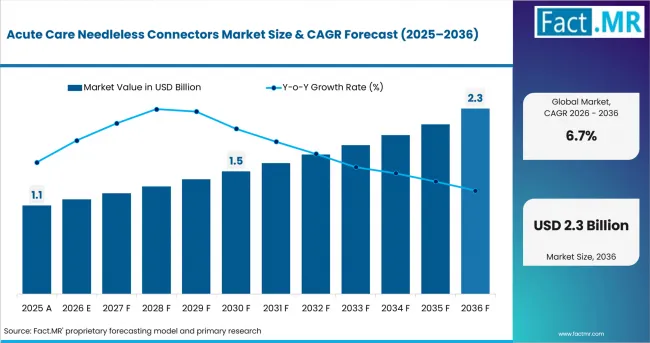
Summary of acute care needleless connectors market
- Demand Drivers in the Market
- Infection Control: Hospitals use needleless connectors to support safer access and catheter-related infection prevention practices.
- Staff Safety: Needle-free access reduces needlestick exposure during medication administration and line access.
- Standardized IV Care: Acute care facilities use connector standardization to simplify training and reduce practice variation.
- Key Segments Analyzed
- By Product Type: Neutral displacement connectors are expected to hold 38.0% share in 2026 because hospitals prefer lower reflux and simpler flushing behavior.
- By Design Type: Straight fluid path connectors are likely to account for 36.0% share in 2026 as clinicians need clear flushing and lower internal residual volume.
- By Application: Central venous catheters are projected to hold 42.0% share in 2026 because bloodstream infection risk keeps connector performance important.
- By End User: Hospitals lead as inpatient units perform frequent IV access and connector changes. The segment is anticipated to capture 58.0% share in 2026.
- By Sales Channel: Direct hospital contracts are expected to hold 44.0% share in 2026 since health systems standardize connector brands through supply agreements.
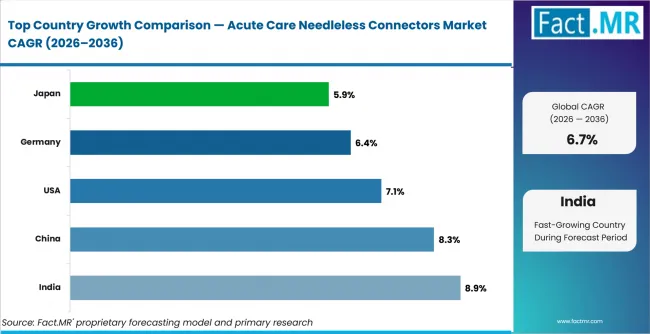
- By Geography: India is projected to record 8.9% CAGR from 2026 to 2036 as hospital infusion therapy and infection-control spending expand.
- Analyst Opinion at Fact.MR
- Shambhu Nath Jha, Principal Consultant at Fact.MR, states, “Acute care needleless connectors are moving beyond routine IV access. Hospitals are focusing on cleanable designs and staff training. Suppliers that help standardize safe use will gain better access to acute care settings.”
- Strategic Implications
- Connector Standardization: Hospitals should reduce unnecessary connector variation across wards and infusion protocols.
- Staff Training: Nurses need clear disinfection and connector change practices.
- Evidence Support: Suppliers should provide clinical evidence and compatibility guidance for acute care buyers.
| Metric | Value |
|---|---|
| Industry Size 2026 | USD 1.2 billion |
| Industry Value 2036 | USD 2.3 billion |
| CAGR 2026 to 2036 | 6.7% |
The market is shifting from basic needle-free access toward connectors with better flush performance and lower contamination risk. ICU Medical announced in 2025 that FDA cleared new labeling claims for its Clave portfolio of needlefree connectors. [2] Acute care providers are paying closer attention to clinical evidence and staff training.
India is projected to record 8.9% CAGR by 2036 as hospital infusion therapy and infection-control spending expand. China is likely to post 8.3% CAGR through 2036 as tertiary hospital networks and critical care capacity develop. The United States is expected to register 7.1% CAGR from 2026 to 2036 as replacement demand and CLABSI reduction programs sustain use. Germany is forecast to advance at 6.4% CAGR by 2036 because regulated hospital purchasing supports safer IV access devices. Japan is set to record 5.9% CAGR from 2026 to 2036 as mature acute care settings continue device replacement.
Segmental Analysis
Acute Care Needleless Connectors Market Analysis by Product Type

Neutral displacement connectors are expected to hold 38.0% share in 2026 because hospitals prefer lower reflux and simpler flushing. A 2025 systematic review in the Journal of Infusion Nursing reported evidence linking needleless connector fluid displacement, blood reflux, and catheter occlusion outcomes [3]. These connectors help limit fluid movement during connection and disconnection. Positive displacement connectors still matter because they can help reduce catheter occlusion when used correctly. Negative displacement connectors serve price-sensitive facilities but need careful clamping. Split septum connectors support simpler access. Antimicrobial connectors are gaining attention in high-risk units.
- Neutral Flow: Neutral displacement designs help reduce reflux concerns during routine connection and disconnection steps.
- Occlusion Control: Positive displacement connectors support catheter patency when staff follow the correct clamping sequence.
- High-Risk Use: Antimicrobial connectors can support intensive care and oncology units with infection-prevention needs.
Acute Care Needleless Connectors Market Analysis by Design Type
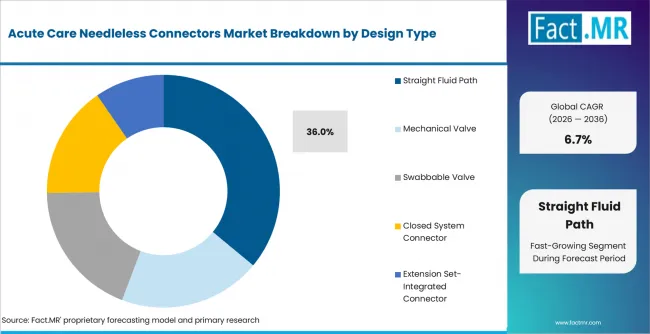
Straight fluid path connectors lead because clinicians need clear flushing and lower internal residual volume. Acute care nurses often prefer smooth connector surfaces that are easier to disinfect. The segment is likely to account for 36.0% share in 2026 as hospitals seek designs that support consistent cleaning and flushing. Mechanical valve connectors serve broad infusion workflows. Swabbable valves support cleaning before access. Closed system connectors reduce open handling. Extension set-integrated connectors make line setup easier in high-use areas.
- Fluid Clarity: Straight flow designs can support easier flushing and visual confirmation during line access.
- Swab Access: Smooth external surfaces help clinicians clean connector hubs before each IV access step.
- Set Integration: Extension-set connectors reduce assembly steps during emergency and inpatient infusion setup.
Acute Care Needleless Connectors Market Analysis by Application
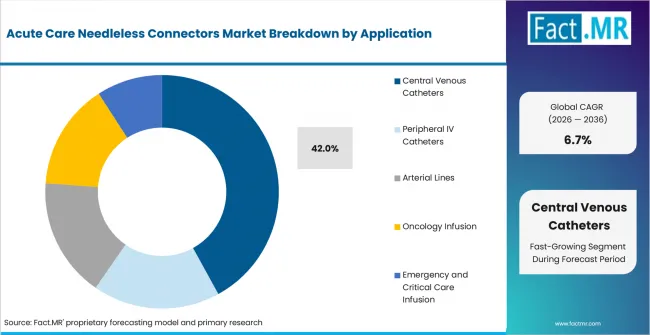
Central venous catheters are projected to hold 42.0% share in 2026 because bloodstream infection risk keeps connector performance important. WHO stated in 2026 that bloodstream infections and other infections linked to central venous catheters contribute to patient morbidity, mortality, longer hospital stays, and higher health care costs [4]. Central line access is frequent in intensive care and complex inpatient treatment. Peripheral IV catheters create high unit volume because they are widely used across acute care. Arterial lines need reliable access and pressure monitoring compatibility. Oncology infusion uses connectors for repeated drug administration. Emergency and critical care infusion depends on fast line access.
- Central Line Use: Central venous catheters need reliable connector performance during frequent medication and flush events.
- Peripheral Volume: Peripheral IV access creates high connector use across general inpatient and emergency departments.
- Oncology Access: Oncology infusion requires dependable closed access during repeated medication delivery and line maintenance.
Acute Care Needleless Connectors Market Analysis by End User
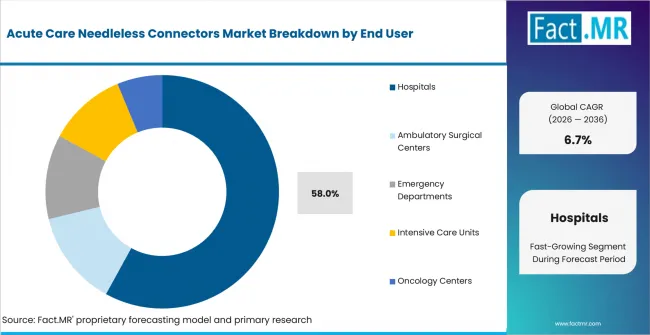
Hospitals lead as inpatient units handle frequent IV access and connector changes. Hospital use is high across intensive care and surgical wards. The segment is anticipated to capture 58.0% share in 2026 because acute care facilities manage the highest volume of IV access events. Ambulatory surgical centers use connectors for perioperative medication and fluids. Emergency departments need quick and safe IV access. Intensive care units require strict catheter maintenance.
- Hospital Base: Large inpatient facilities drive connector demand through continuous IV therapy and line maintenance.
- ICU Need: Intensive care units require connectors that support frequent access under infection-control protocols.
- Surgical Flow: Ambulatory centers need easy line access for perioperative medication and fluid administration.
Acute Care Needleless Connectors Market Analysis by Sales Channel
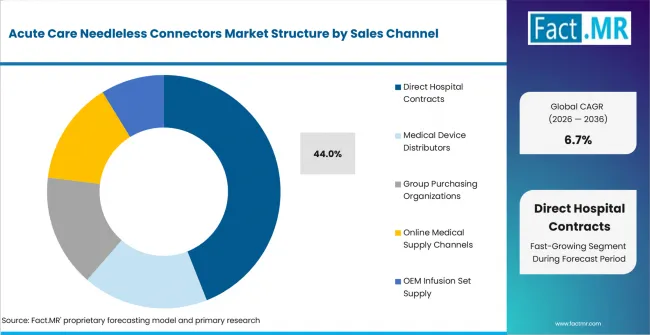
Direct hospital contracts are expected to hold 44.0% share in 2026 because health systems standardize connector brands through supply agreements. Large hospitals often select connectors through value analysis committees and infection-prevention review. Medical device distributors serve smaller hospitals and clinics. Group purchasing organizations help negotiate pricing and product availability. Online medical supply channels support urgent and small-order needs. OEM infusion set supply builds connectors into ready-to-use sets. Sales channel strength depends on clinical evidence and reliable supply.
- Contract Standardization: Direct contracts help health systems align connector choice across departments and care protocols.
- Distributor Reach: Distributors support smaller acute care providers that need regular replenishment and product guidance.
- OEM Integration: Infusion set suppliers simplify ordering by building connectors into complete administration sets.
Acute Care Needleless Connectors Market Drivers, Restraints, and Opportunities

Infection prevention and needlestick injury reduction are the main drivers for acute care needleless connector demand. CDC recommends scrubbing the access port with an appropriate antiseptic and accessing the port only with sterile devices. Hospitals rely on connector protocols because catheter hubs can become contamination points during repeated access.
Cost pressure can slow adoption. Hospitals often view connectors as routine consumables, which can push selection toward lower-cost products. Connector performance also depends on correct use and flushing. Poor staff training can reduce the benefit of premium designs. Compatibility with IV sets and catheter systems must also be checked to reduce leaks and breaks.
Opportunities in the Acute Care Needleless Connectors Market
- Standardization Programs: Suppliers can support hospitals that want one connector technology across inpatient units.
- ICU Bundles: Connector makers can target critical care bundles with training and disinfection support.
- Integrated Sets: OEM suppliers can add connectors into preassembled IV and extension sets.
Regional Analysis
Based on regional analysis, the acute care needleless connectors market is segmented into North America, Latin America, Western Europe, Eastern Europe, East Asia, South Asia and Pacific, and Middle East and Africa.
.webp)
| Country | CAGR (2026 to 2036) |
|---|---|
| India | 8.9% |
| China | 8.3% |
| United States | 7.1% |
| Germany | 6.4% |
| Japan | 5.9% |
Source: Fact MR analysis, based on proprietary forecasting model and primary research.
South Asia and East Asia Acute Care Needleless Connectors Market Analysis

South Asia and East Asia demand comes from hospital expansion and higher infusion therapy use. India leads the regional outlook as private hospitals and critical care beds increase. China has deep hospital networks and domestic medical device supply. Japan has established use and steady replacement demand.
- India: India is projected to record 8.9% CAGR over the study period as hospital infusion therapy and infection-control spending increase. Private hospitals and tertiary care centers are adopting standardized IV access products. Intensive care and oncology units need reliable connectors. Price pressure still affects public-sector purchasing. Distributor support will remain important outside large cities.
- China: China is likely to post 8.3% CAGR through 2036 as tertiary hospital networks and critical care capacity improve. Large hospitals need connectors for central lines and infusion sets. Domestic manufacturers can serve value-focused demand. Premium brands may gain share in intensive care and oncology departments. Hospital standardization will depend on clinical evidence and rules.
- Japan: Japan is set to record 5.9% CAGR from 2026 to 2036 as established acute care facilities continue device replacement. Hospitals already use needleless access systems across inpatient and outpatient care. Replacement demand comes from connector upgrades and infection-control protocol updates. Clinical staff value cleanable designs and predictable flushing. Adoption is already high, so revenue gains will be slower than India and China.
North America Acute Care Needleless Connectors Market Analysis
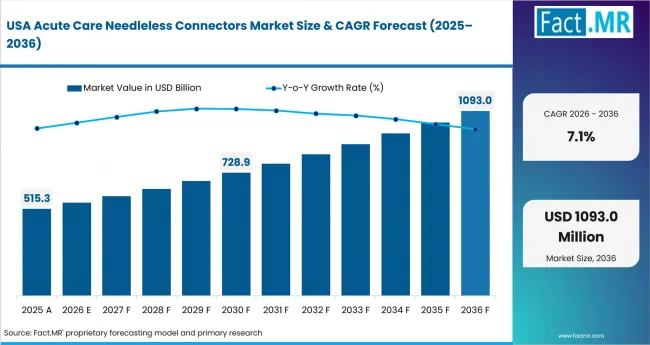
North America demand is led by the United States because hospitals have established CLABSI prevention programs and standardized IV supply contracts. Acute care facilities review connector choice through infection-prevention committees and value analysis. Replacement demand stays steady because connectors are routine consumables used across central and peripheral lines.
- United States: The United States is expected to register 7.1% CAGR through 2036 as replacement demand and CLABSI reduction programs support use. Hospitals use needleless connectors across ICU and emergency care. Product selection often depends on clinical evidence and staff preference.
Western Europe Acute Care Needleless Connectors Market Analysis

Western Europe demand comes from regulated hospital purchasing and replacement of older IV access products. Germany leads the regional view because acute care hospitals use standardized medical device contracts and clinical documentation.
- Germany: Germany is forecast to advance at 6.4% CAGR over the forecast period because regulated hospital purchasing supports safer IV access devices. Germany ONKO-KISS surveillance protocol states that vascular catheter-associated infection rate is an important quality-management measure and is calculated per 1,000 vascular catheter days [5]. Hospitals use needleless connectors across surgical wards and intensive care.
Competitive Aligners for Market Suppliers
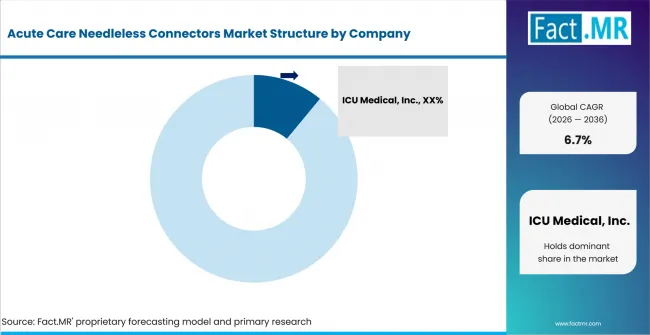
The acute care needleless connectors market is led by infusion therapy and vascular access suppliers. ICU Medical, Inc. competes through Clave and related needlefree connector platforms. Becton, Dickinson and Company serves acute care IV access through MaxPlus and MaxZero connector technologies. B. Braun SE competes through CARESITE and CARESITE Micro connector lines.
Baxter International Inc. and Vygon S.A. support hospital IV access needs through broader infusion and vascular access portfolios. BD states that its MaxPlus and MaxZero needle-free connector technology is designed to help reduce infection and occlusion risk. Hospitals compare connectors on usability and contamination control because daily IV access depends on consistent handling.
By 2036, competition will depend on clinical evidence and reliable supply. Hospitals need connectors that can be standardized across departments and supported with clear protocols. Suppliers with dependable distribution and practical training support can gain better positions in acute care settings.
Key Companies in Acute Care Needleless Connectors Market
- ICU Medical, Inc.
- Becton, Dickinson and Company
- B. Braun SE
- Baxter International Inc.
- Vygon S.A.
Bibliography
- [1] Centers for Disease Control and Prevention. (2024, February 28). Strategies for prevention of catheter-related infections in adult and pediatric patients. CDC.
- [2] ICU Medical, Inc. (2025, September 18). ICU Medical announces new FDA 510(k) cleared labeling claims for Clave portfolio of needlefree IV connectors. ICU Medical.
- [3] Moureau, N., Gorski, L. A., Flynn, J., & Johnson, K. (2025, March). A systematic review of needleless connector function and occlusion outcomes: Evidence leading the way. Journal of Infusion Nursing, 48(2), 84–105.
- [4] World Health Organization. (2026, May 28). Guidelines for the prevention of bloodstream infections and other infections associated with the use of intravascular catheters: Part 2: Central venous catheters. World Health Organization.
- [5] Nationales Referenzzentrum für Surveillance von nosokomialen Infektionen. (2025, December). Protocol: Surveillance of nosocomial infections in patients with allogeneic and autologous stem cell transplantation. Charité – Universitätsmedizin Berlin.
This Report Addresses
- Strategic intelligence on acute care needleless connector demand across product type, design type, application, end user, and sales channel.
- Forecast mapping from USD 1.2 billion in 2026 to USD 2.3 billion by 2036.
- Segment analysis covering neutral displacement connectors, straight fluid path designs, central venous catheters, hospitals, and direct contracts.
- Regional outlook covering India, China, the United States, Germany, and Japan.
- Competitive analysis of ICU Medical, Inc., Becton, Dickinson and Company, B. Braun SE, Baxter International Inc., Vygon S.A.
- Product assessment covering neutral, positive, negative, split septum, and antimicrobial needleless connectors.
- Application assessment covering central lines, peripheral IV lines, arterial lines, oncology infusion, and emergency care infusion.
- Primary interviews, supplier checks, official source review, and acute care IV workflow validation support the forecast.
Acute Care Needleless Connectors Market Definition
The acute care needleless connectors market covers IV access connectors used to connect syringes and vascular access devices without needles. These devices support medication delivery and infusion therapy in hospitals and acute care settings. The market differs from general IV accessories because connector design affects access safety and catheter performance.
Acute Care Needleless Connectors Market Inclusions
The scope includes neutral and antimicrobial needleless connectors used in acute care. It includes standalone connectors and connectors integrated into extension sets or IV administration sets. Products used with central lines and critical care infusion are included.
Acute Care Needleless Connectors Market Exclusions
The scope excludes conventional needle-based IV access devices and hypodermic needles. It excludes IV catheters sold without needleless connector content. General caps and extension tubing are excluded unless sold as part of a connector system. Home infusion-only products are excluded unless used in acute care pathways.
Acute Care Needleless Connectors Market Research Methodology
- Primary Research
- Primary research includes interviews with vascular access nurses and hospital infection-prevention managers. It includes input from acute care supply managers and infusion therapy distributors.
- Desk Research
- Desk research reviews infection-control recommendations and official product materials. It covers FDA clearance updates and hospital purchasing signals.
- Market-Sizing and Forecasting
- Forecasting uses product type demand and application movement. End-user demand and sales channel structure support the market assessment.
- Data Validation and Update Cycle
- Forecasts are validated through supplier checks and hospital feedback. CLABSI prevention programs and acute care IV therapy volume help confirms market direction.
Scope of the Report

| Attribute | Details |
|---|---|
| Quantitative Units | USD 1.2 billion in 2026 to USD 2.3 billion by 2036 at 6.7% CAGR |
| Market Definition | IV access connectors used to connect syringes, administration sets, and vascular access devices without needles |
| Product Type | Neutral Displacement Connectors, Positive Displacement Connectors, Negative Displacement Connectors, Split Septum Connectors, Antimicrobial Needleless Connectors |
| Design Type | Straight Fluid Path, Mechanical Valve, Swabbable Valve, Closed System Connector, Extension Set-Integrated Connector |
| Application | Central Venous Catheters, Peripheral IV Catheters, Arterial Lines, Oncology Infusion, Emergency and Critical Care Infusion |
| End User | Hospitals, Ambulatory Surgical Centers, Emergency Departments, Intensive Care Units, Oncology Centers |
| Sales Channel | Direct Hospital Contracts, Medical Device Distributors, Group Purchasing Organizations, Online Medical Supply Channels, OEM Infusion Set Supply |
| Regions Covered | North America, Latin America, Western Europe, Eastern Europe, East Asia, South Asia and Pacific, Middle East and Africa |
| Countries Covered | India, China, United States, Germany, Japan |
| Key Companies Profiled | ICU Medical, Inc., Becton, Dickinson and Company, B. Braun SE, Baxter International Inc., Vygon S.A. |
| Forecast Period | 2026 to 2036 |
| Approach | Hybrid top-down and bottom-up approach using product type demand, design type use, application movement, end-user demand, sales channel structure, and regional validation |
Acute Care Needleless Connectors Market Analysis by Segments
-
By Product Type:
- Neutral Displacement Connectors
- Positive Displacement Connectors
- Negative Displacement Connectors
- Split Septum Connectors
- Antimicrobial Needleless Connectors
-
By Design Type:
- Straight Fluid Path
- Mechanical Valve
- Swabbable Valve
- Closed System Connector
- Extension Set-Integrated Connector
-
By Application:
- Central Venous Catheters
- Peripheral IV Catheters
- Arterial Lines
- Oncology Infusion
- Emergency and Critical Care Infusion
-
By End User:
- Hospitals
- Ambulatory Surgical Centers
- Emergency Departments
- Intensive Care Units
- Oncology Centers
-
By Sales Channel:
- Direct Hospital Contracts
- Medical Device Distributors
- Group Purchasing Organizations
- Online Medical Supply Channels
- OEM Infusion Set Supply
-
Region:
- North America
- United States
- Canada
- Europe
- Germany
- United Kingdom
- France
- Italy
- Spain
- Asia Pacific
- China
- Japan
- South Korea
- Taiwan
- Singapore
- Latin America
- Brazil
- Mexico
- Argentina
- Middle East & Africa
- GCC Countries
- South Africa
- Israel
- North America

- Frequently Asked Questions -
What is the Acute Care Needleless Connectors Market size in 2026?
The acute care needleless connectors market is estimated to reach USD 1.2 billion in 2026.
What will the Acute Care Needleless Connectors Market be worth by 2036?
The acute care needleless connectors market is projected to reach USD 2.3 billion by 2036 as hospitals standardize closed IV access.
What CAGR is projected for the Acute Care Needleless Connectors Market?
The acute care needleless connectors market is forecast to record 6.7% CAGR during 2026 to 2036.
Which end user leads the Acute Care Needleless Connectors Market?
Hospitals hold 58.0% share in 2026 because inpatient units perform frequent IV access and connector changes.
Which country expands fastest in the Acute Care Needleless Connectors Market?
India is projected to record 8.9% CAGR from 2026 to 2036 as hospital infusion therapy and infection-control spending expand.
How does China perform in the Acute Care Needleless Connectors Market?
China is likely to post 8.3% CAGR from 2026 to 2036 as tertiary hospital networks and critical care capacity develop.
What is the primary driver in the Acute Care Needleless Connectors Market?
The primary driver is infection-control practice. Hospitals need safer IV access devices that support catheter maintenance protocols.
What is the main restraint in the Acute Care Needleless Connectors Market?
The main restraint is price pressure. Hospitals often compare connectors as routine consumables during purchasing decisions.
Why are neutral displacement connectors important in this market?
Neutral displacement connectors are important because they help reduce reflux concerns during routine line access and disconnection.
Table of Content
- Executive Summary
- Global Market Outlook
- Demand to side Trends
- Supply to side Trends
- Technology Roadmap Analysis
- Analysis and Recommendations
- Market Overview
- Market Coverage / Taxonomy
- Market Definition / Scope / Limitations
- Research Methodology
- Chapter Orientation
- Analytical Lens and Working Hypotheses
- Market Structure, Signals, and Trend Drivers
- Benchmarking and Cross-market Comparability
- Market Sizing, Forecasting, and Opportunity Mapping
- Research Design and Evidence Framework
- Desk Research Programme (Secondary Evidence)
- Company Annual and Sustainability Reports
- Peer-reviewed Journals and Academic Literature
- Corporate Websites, Product Literature, and Technical Notes
- Earnings Decks and Investor Briefings
- Statutory Filings and Regulatory Disclosures
- Technical White Papers and Standards Notes
- Trade Journals, Industry Magazines, and Analyst Briefs
- Conference Proceedings, Webinars, and Seminar Materials
- Government Statistics Portals and Public Data Releases
- Press Releases and Reputable Media Coverage
- Specialist Newsletters and Curated Briefings
- Sector Databases and Reference Repositories
- Fact.MR Internal Proprietary Databases and Historical Market Datasets
- Subscription Datasets and Paid Sources
- Social Channels, Communities, and Digital Listening Inputs
- Additional Desk Sources
- Expert Input and Fieldwork (Primary Evidence)
- Primary Modes
- Qualitative Interviews and Expert Elicitation
- Quantitative Surveys and Structured Data Capture
- Blended Approach
- Why Primary Evidence is Used
- Field Techniques
- Interviews
- Surveys
- Focus Groups
- Observational and In-context Research
- Social and Community Interactions
- Stakeholder Universe Engaged
- C-suite Leaders
- Board Members
- Presidents and Vice Presidents
- R&D and Innovation Heads
- Technical Specialists
- Domain Subject-matter Experts
- Scientists
- Physicians and Other Healthcare Professionals
- Governance, Ethics, and Data Stewardship
- Research Ethics
- Data Integrity and Handling
- Primary Modes
- Tooling, Models, and Reference Databases
- Desk Research Programme (Secondary Evidence)
- Data Engineering and Model Build
- Data Acquisition and Ingestion
- Cleaning, Normalisation, and Verification
- Synthesis, Triangulation, and Analysis
- Quality Assurance and Audit Trail
- Market Background
- Market Dynamics
- Drivers
- Restraints
- Opportunity
- Trends
- Scenario Forecast
- Demand in Optimistic Scenario
- Demand in Likely Scenario
- Demand in Conservative Scenario
- Opportunity Map Analysis
- Product Life Cycle Analysis
- Supply Chain Analysis
- Investment Feasibility Matrix
- Value Chain Analysis
- PESTLE and Porter’s Analysis
- Regulatory Landscape
- Regional Parent Market Outlook
- Production and Consumption Statistics
- Import and Export Statistics
- Market Dynamics
- Global Market Analysis 2021 to 2025 and Forecast, 2026 to 2036
- Historical Market Size Value (USD Million) Analysis, 2021 to 2025
- Current and Future Market Size Value (USD Million) Projections, 2026 to 2036
- Y to o to Y Growth Trend Analysis
- Absolute $ Opportunity Analysis
- Global Market Pricing Analysis 2021 to 2025 and Forecast 2026 to 2036
- Global Market Analysis 2021 to 2025 and Forecast 2026 to 2036, By Drug Class
- Introduction / Key Findings
- Historical Market Size Value (USD Million) Analysis By Drug Class , 2021 to 2025
- Current and Future Market Size Value (USD Million) Analysis and Forecast By Drug Class , 2026 to 2036
- Benzodiazepines
- Hydantoins
- Barbiturates
- Other Anticonvulsants
- Benzodiazepines
- Y to o to Y Growth Trend Analysis By Drug Class , 2021 to 2025
- Absolute $ Opportunity Analysis By Drug Class , 2026 to 2036
- Global Market Analysis 2021 to 2025 and Forecast 2026 to 2036, By Route of Administration
- Introduction / Key Findings
- Historical Market Size Value (USD Million) Analysis By Route of Administration, 2021 to 2025
- Current and Future Market Size Value (USD Million) Analysis and Forecast By Route of Administration, 2026 to 2036
- Intranasal
- Oral
- Intramuscular
- Buccal
- Rectal
- Intravenous
- Intranasal
- Y to o to Y Growth Trend Analysis By Route of Administration, 2021 to 2025
- Absolute $ Opportunity Analysis By Route of Administration, 2026 to 2036
- Global Market Analysis 2021 to 2025 and Forecast 2026 to 2036, By Distribution Channel
- Introduction / Key Findings
- Historical Market Size Value (USD Million) Analysis By Distribution Channel, 2021 to 2025
- Current and Future Market Size Value (USD Million) Analysis and Forecast By Distribution Channel, 2026 to 2036
- Hospital Pharmacies
- Specialty Clinic Pharmacies
- Online Stores
- Retail Pharmacies
- Drug Store Chains
- Hospital Pharmacies
- Y to o to Y Growth Trend Analysis By Distribution Channel, 2021 to 2025
- Absolute $ Opportunity Analysis By Distribution Channel, 2026 to 2036
- Global Market Analysis 2021 to 2025 and Forecast 2026 to 2036, By End User
- Introduction / Key Findings
- Historical Market Size Value (USD Million) Analysis By End User, 2021 to 2025
- Current and Future Market Size Value (USD Million) Analysis and Forecast By End User, 2026 to 2036
- Hospitals
- Specialty Neurology Clinics
- Ambulatory Surgical Centers
- Home Care Settings
- Emergency Care Centers
- Hospitals
- Y to o to Y Growth Trend Analysis By End User, 2021 to 2025
- Absolute $ Opportunity Analysis By End User, 2026 to 2036
- Global Market Analysis 2021 to 2025 and Forecast 2026 to 2036, By Age Group
- Introduction / Key Findings
- Historical Market Size Value (USD Million) Analysis By Age Group, 2021 to 2025
- Current and Future Market Size Value (USD Million) Analysis and Forecast By Age Group, 2026 to 2036
- Adults
- Pediatric
- Geriatric
- Adults
- Y to o to Y Growth Trend Analysis By Age Group, 2021 to 2025
- Absolute $ Opportunity Analysis By Age Group, 2026 to 2036
- Global Market Analysis 2021 to 2025 and Forecast 2026 to 2036, By Region
- Introduction
- Historical Market Size Value (USD Million) Analysis By Region, 2021 to 2025
- Current Market Size Value (USD Million) Analysis and Forecast By Region, 2026 to 2036
- North America
- Latin America
- Western Europe
- Eastern Europe
- East Asia
- South Asia and Pacific
- Middle East & Africa
- Market Attractiveness Analysis By Region
- North America Market Analysis 2021 to 2025 and Forecast 2026 to 2036, By Country
- Historical Market Size Value (USD Million) Trend Analysis By Market Taxonomy, 2021 to 2025
- Market Size Value (USD Million) Forecast By Market Taxonomy, 2026 to 2036
- By Country
- USA
- Canada
- Mexico
- By Drug Class
- By Route of Administration
- By Distribution Channel
- By End User
- By Age Group
- By Country
- Market Attractiveness Analysis
- By Country
- By Drug Class
- By Route of Administration
- By Distribution Channel
- By End User
- By Age Group
- Key Takeaways
- Latin America Market Analysis 2021 to 2025 and Forecast 2026 to 2036, By Country
- Historical Market Size Value (USD Million) Trend Analysis By Market Taxonomy, 2021 to 2025
- Market Size Value (USD Million) Forecast By Market Taxonomy, 2026 to 2036
- By Country
- Brazil
- Chile
- Rest of Latin America
- By Drug Class
- By Route of Administration
- By Distribution Channel
- By End User
- By Age Group
- By Country
- Market Attractiveness Analysis
- By Country
- By Drug Class
- By Route of Administration
- By Distribution Channel
- By End User
- By Age Group
- Key Takeaways
- Western Europe Market Analysis 2021 to 2025 and Forecast 2026 to 2036, By Country
- Historical Market Size Value (USD Million) Trend Analysis By Market Taxonomy, 2021 to 2025
- Market Size Value (USD Million) Forecast By Market Taxonomy, 2026 to 2036
- By Country
- Germany
- UK
- Italy
- Spain
- France
- Nordic
- BENELUX
- Rest of Western Europe
- By Drug Class
- By Route of Administration
- By Distribution Channel
- By End User
- By Age Group
- By Country
- Market Attractiveness Analysis
- By Country
- By Drug Class
- By Route of Administration
- By Distribution Channel
- By End User
- By Age Group
- Key Takeaways
- Eastern Europe Market Analysis 2021 to 2025 and Forecast 2026 to 2036, By Country
- Historical Market Size Value (USD Million) Trend Analysis By Market Taxonomy, 2021 to 2025
- Market Size Value (USD Million) Forecast By Market Taxonomy, 2026 to 2036
- By Country
- Russia
- Poland
- Hungary
- Balkan & Baltic
- Rest of Eastern Europe
- By Drug Class
- By Route of Administration
- By Distribution Channel
- By End User
- By Age Group
- By Country
- Market Attractiveness Analysis
- By Country
- By Drug Class
- By Route of Administration
- By Distribution Channel
- By End User
- By Age Group
- Key Takeaways
- East Asia Market Analysis 2021 to 2025 and Forecast 2026 to 2036, By Country
- Historical Market Size Value (USD Million) Trend Analysis By Market Taxonomy, 2021 to 2025
- Market Size Value (USD Million) Forecast By Market Taxonomy, 2026 to 2036
- By Country
- China
- Japan
- South Korea
- By Drug Class
- By Route of Administration
- By Distribution Channel
- By End User
- By Age Group
- By Country
- Market Attractiveness Analysis
- By Country
- By Drug Class
- By Route of Administration
- By Distribution Channel
- By End User
- By Age Group
- Key Takeaways
- South Asia and Pacific Market Analysis 2021 to 2025 and Forecast 2026 to 2036, By Country
- Historical Market Size Value (USD Million) Trend Analysis By Market Taxonomy, 2021 to 2025
- Market Size Value (USD Million) Forecast By Market Taxonomy, 2026 to 2036
- By Country
- India
- ASEAN
- Australia & New Zealand
- Rest of South Asia and Pacific
- By Drug Class
- By Route of Administration
- By Distribution Channel
- By End User
- By Age Group
- By Country
- Market Attractiveness Analysis
- By Country
- By Drug Class
- By Route of Administration
- By Distribution Channel
- By End User
- By Age Group
- Key Takeaways
- Middle East & Africa Market Analysis 2021 to 2025 and Forecast 2026 to 2036, By Country
- Historical Market Size Value (USD Million) Trend Analysis By Market Taxonomy, 2021 to 2025
- Market Size Value (USD Million) Forecast By Market Taxonomy, 2026 to 2036
- By Country
- Kingdom of Saudi Arabia
- Other GCC Countries
- Turkiye
- South Africa
- Other African Union
- Rest of Middle East & Africa
- By Drug Class
- By Route of Administration
- By Distribution Channel
- By End User
- By Age Group
- By Country
- Market Attractiveness Analysis
- By Country
- By Drug Class
- By Route of Administration
- By Distribution Channel
- By End User
- By Age Group
- Key Takeaways
- Key Countries Market Analysis
- USA
- Pricing Analysis
- Market Share Analysis, 2025
- By Drug Class
- By Route of Administration
- By Distribution Channel
- By End User
- By Age Group
- Canada
- Pricing Analysis
- Market Share Analysis, 2025
- By Drug Class
- By Route of Administration
- By Distribution Channel
- By End User
- By Age Group
- Mexico
- Pricing Analysis
- Market Share Analysis, 2025
- By Drug Class
- By Route of Administration
- By Distribution Channel
- By End User
- By Age Group
- Brazil
- Pricing Analysis
- Market Share Analysis, 2025
- By Drug Class
- By Route of Administration
- By Distribution Channel
- By End User
- By Age Group
- Chile
- Pricing Analysis
- Market Share Analysis, 2025
- By Drug Class
- By Route of Administration
- By Distribution Channel
- By End User
- By Age Group
- Germany
- Pricing Analysis
- Market Share Analysis, 2025
- By Drug Class
- By Route of Administration
- By Distribution Channel
- By End User
- By Age Group
- UK
- Pricing Analysis
- Market Share Analysis, 2025
- By Drug Class
- By Route of Administration
- By Distribution Channel
- By End User
- By Age Group
- Italy
- Pricing Analysis
- Market Share Analysis, 2025
- By Drug Class
- By Route of Administration
- By Distribution Channel
- By End User
- By Age Group
- Spain
- Pricing Analysis
- Market Share Analysis, 2025
- By Drug Class
- By Route of Administration
- By Distribution Channel
- By End User
- By Age Group
- France
- Pricing Analysis
- Market Share Analysis, 2025
- By Drug Class
- By Route of Administration
- By Distribution Channel
- By End User
- By Age Group
- India
- Pricing Analysis
- Market Share Analysis, 2025
- By Drug Class
- By Route of Administration
- By Distribution Channel
- By End User
- By Age Group
- ASEAN
- Pricing Analysis
- Market Share Analysis, 2025
- By Drug Class
- By Route of Administration
- By Distribution Channel
- By End User
- By Age Group
- Australia & New Zealand
- Pricing Analysis
- Market Share Analysis, 2025
- By Drug Class
- By Route of Administration
- By Distribution Channel
- By End User
- By Age Group
- China
- Pricing Analysis
- Market Share Analysis, 2025
- By Drug Class
- By Route of Administration
- By Distribution Channel
- By End User
- By Age Group
- Japan
- Pricing Analysis
- Market Share Analysis, 2025
- By Drug Class
- By Route of Administration
- By Distribution Channel
- By End User
- By Age Group
- South Korea
- Pricing Analysis
- Market Share Analysis, 2025
- By Drug Class
- By Route of Administration
- By Distribution Channel
- By End User
- By Age Group
- Russia
- Pricing Analysis
- Market Share Analysis, 2025
- By Drug Class
- By Route of Administration
- By Distribution Channel
- By End User
- By Age Group
- Poland
- Pricing Analysis
- Market Share Analysis, 2025
- By Drug Class
- By Route of Administration
- By Distribution Channel
- By End User
- By Age Group
- Hungary
- Pricing Analysis
- Market Share Analysis, 2025
- By Drug Class
- By Route of Administration
- By Distribution Channel
- By End User
- By Age Group
- Kingdom of Saudi Arabia
- Pricing Analysis
- Market Share Analysis, 2025
- By Drug Class
- By Route of Administration
- By Distribution Channel
- By End User
- By Age Group
- Turkiye
- Pricing Analysis
- Market Share Analysis, 2025
- By Drug Class
- By Route of Administration
- By Distribution Channel
- By End User
- By Age Group
- South Africa
- Pricing Analysis
- Market Share Analysis, 2025
- By Drug Class
- By Route of Administration
- By Distribution Channel
- By End User
- By Age Group
- USA
- Market Structure Analysis
- Competition Dashboard
- Competition Benchmarking
- Market Share Analysis of Top Players
- By Regional
- By Drug Class
- By Route of Administration
- By Distribution Channel
- By End User
- By Age Group
- Competition Analysis
- Competition Deep Dive
- Neurelis, Inc.
- Overview
- Product Portfolio
- Profitability by Market Segments (Product/Age /Sales Channel/Region)
- Sales Footprint
- Strategy Overview
- Marketing Strategy
- Product Strategy
- Channel Strategy
- Aquestive Therapeutics, Inc.
- UCB S.A.
- Aculys Pharma, Inc.
- Bausch Health Companies Inc.
- Neurelis, Inc.
- Competition Deep Dive
- Assumptions & Acronyms Used
List Of Table
- Table 1: Global Market Value (USD Million) Forecast by Region, 2021 to 2036
- Table 2: Global Market Value (USD Million) Forecast by Drug Class , 2021 to 2036
- Table 3: Global Market Value (USD Million) Forecast by Route of Administration, 2021 to 2036
- Table 4: Global Market Value (USD Million) Forecast by Distribution Channel, 2021 to 2036
- Table 5: Global Market Value (USD Million) Forecast by End User, 2021 to 2036
- Table 6: Global Market Value (USD Million) Forecast by Age Group, 2021 to 2036
- Table 7: North America Market Value (USD Million) Forecast by Country, 2021 to 2036
- Table 8: North America Market Value (USD Million) Forecast by Drug Class , 2021 to 2036
- Table 9: North America Market Value (USD Million) Forecast by Route of Administration, 2021 to 2036
- Table 10: North America Market Value (USD Million) Forecast by Distribution Channel, 2021 to 2036
- Table 11: North America Market Value (USD Million) Forecast by End User, 2021 to 2036
- Table 12: North America Market Value (USD Million) Forecast by Age Group, 2021 to 2036
- Table 13: Latin America Market Value (USD Million) Forecast by Country, 2021 to 2036
- Table 14: Latin America Market Value (USD Million) Forecast by Drug Class , 2021 to 2036
- Table 15: Latin America Market Value (USD Million) Forecast by Route of Administration, 2021 to 2036
- Table 16: Latin America Market Value (USD Million) Forecast by Distribution Channel, 2021 to 2036
- Table 17: Latin America Market Value (USD Million) Forecast by End User, 2021 to 2036
- Table 18: Latin America Market Value (USD Million) Forecast by Age Group, 2021 to 2036
- Table 19: Western Europe Market Value (USD Million) Forecast by Country, 2021 to 2036
- Table 20: Western Europe Market Value (USD Million) Forecast by Drug Class , 2021 to 2036
- Table 21: Western Europe Market Value (USD Million) Forecast by Route of Administration, 2021 to 2036
- Table 22: Western Europe Market Value (USD Million) Forecast by Distribution Channel, 2021 to 2036
- Table 23: Western Europe Market Value (USD Million) Forecast by End User, 2021 to 2036
- Table 24: Western Europe Market Value (USD Million) Forecast by Age Group, 2021 to 2036
- Table 25: Eastern Europe Market Value (USD Million) Forecast by Country, 2021 to 2036
- Table 26: Eastern Europe Market Value (USD Million) Forecast by Drug Class , 2021 to 2036
- Table 27: Eastern Europe Market Value (USD Million) Forecast by Route of Administration, 2021 to 2036
- Table 28: Eastern Europe Market Value (USD Million) Forecast by Distribution Channel, 2021 to 2036
- Table 29: Eastern Europe Market Value (USD Million) Forecast by End User, 2021 to 2036
- Table 30: Eastern Europe Market Value (USD Million) Forecast by Age Group, 2021 to 2036
- Table 31: East Asia Market Value (USD Million) Forecast by Country, 2021 to 2036
- Table 32: East Asia Market Value (USD Million) Forecast by Drug Class , 2021 to 2036
- Table 33: East Asia Market Value (USD Million) Forecast by Route of Administration, 2021 to 2036
- Table 34: East Asia Market Value (USD Million) Forecast by Distribution Channel, 2021 to 2036
- Table 35: East Asia Market Value (USD Million) Forecast by End User, 2021 to 2036
- Table 36: East Asia Market Value (USD Million) Forecast by Age Group, 2021 to 2036
- Table 37: South Asia and Pacific Market Value (USD Million) Forecast by Country, 2021 to 2036
- Table 38: South Asia and Pacific Market Value (USD Million) Forecast by Drug Class , 2021 to 2036
- Table 39: South Asia and Pacific Market Value (USD Million) Forecast by Route of Administration, 2021 to 2036
- Table 40: South Asia and Pacific Market Value (USD Million) Forecast by Distribution Channel, 2021 to 2036
- Table 41: South Asia and Pacific Market Value (USD Million) Forecast by End User, 2021 to 2036
- Table 42: South Asia and Pacific Market Value (USD Million) Forecast by Age Group, 2021 to 2036
- Table 43: Middle East & Africa Market Value (USD Million) Forecast by Country, 2021 to 2036
- Table 44: Middle East & Africa Market Value (USD Million) Forecast by Drug Class , 2021 to 2036
- Table 45: Middle East & Africa Market Value (USD Million) Forecast by Route of Administration, 2021 to 2036
- Table 46: Middle East & Africa Market Value (USD Million) Forecast by Distribution Channel, 2021 to 2036
- Table 47: Middle East & Africa Market Value (USD Million) Forecast by End User, 2021 to 2036
- Table 48: Middle East & Africa Market Value (USD Million) Forecast by Age Group, 2021 to 2036
List Of Figures
- Figure 1: Global Market Pricing Analysis
- Figure 2: Global Market Value (USD Million) Forecast 2021-2036
- Figure 3: Global Market Value Share and BPS Analysis by Drug Class , 2026 and 2036
- Figure 4: Global Market Y-o-Y Growth Comparison by Drug Class , 2026-2036
- Figure 5: Global Market Attractiveness Analysis by Drug Class
- Figure 6: Global Market Value Share and BPS Analysis by Route of Administration, 2026 and 2036
- Figure 7: Global Market Y-o-Y Growth Comparison by Route of Administration, 2026-2036
- Figure 8: Global Market Attractiveness Analysis by Route of Administration
- Figure 9: Global Market Value Share and BPS Analysis by Distribution Channel, 2026 and 2036
- Figure 10: Global Market Y-o-Y Growth Comparison by Distribution Channel, 2026-2036
- Figure 11: Global Market Attractiveness Analysis by Distribution Channel
- Figure 12: Global Market Value Share and BPS Analysis by End User, 2026 and 2036
- Figure 13: Global Market Y-o-Y Growth Comparison by End User, 2026-2036
- Figure 14: Global Market Attractiveness Analysis by End User
- Figure 15: Global Market Value Share and BPS Analysis by Age Group, 2026 and 2036
- Figure 16: Global Market Y-o-Y Growth Comparison by Age Group, 2026-2036
- Figure 17: Global Market Attractiveness Analysis by Age Group
- Figure 18: Global Market Value (USD Million) Share and BPS Analysis by Region, 2026 and 2036
- Figure 19: Global Market Y-o-Y Growth Comparison by Region, 2026-2036
- Figure 20: Global Market Attractiveness Analysis by Region
- Figure 21: North America Market Incremental Dollar Opportunity, 2026-2036
- Figure 22: Latin America Market Incremental Dollar Opportunity, 2026-2036
- Figure 23: Western Europe Market Incremental Dollar Opportunity, 2026-2036
- Figure 24: Eastern Europe Market Incremental Dollar Opportunity, 2026-2036
- Figure 25: East Asia Market Incremental Dollar Opportunity, 2026-2036
- Figure 26: South Asia and Pacific Market Incremental Dollar Opportunity, 2026-2036
- Figure 27: Middle East & Africa Market Incremental Dollar Opportunity, 2026-2036
- Figure 28: North America Market Value Share and BPS Analysis by Country, 2026 and 2036
- Figure 29: North America Market Value Share and BPS Analysis by Drug Class , 2026 and 2036
- Figure 30: North America Market Y-o-Y Growth Comparison by Drug Class , 2026-2036
- Figure 31: North America Market Attractiveness Analysis by Drug Class
- Figure 32: North America Market Value Share and BPS Analysis by Route of Administration, 2026 and 2036
- Figure 33: North America Market Y-o-Y Growth Comparison by Route of Administration, 2026-2036
- Figure 34: North America Market Attractiveness Analysis by Route of Administration
- Figure 35: North America Market Value Share and BPS Analysis by Distribution Channel, 2026 and 2036
- Figure 36: North America Market Y-o-Y Growth Comparison by Distribution Channel, 2026-2036
- Figure 37: North America Market Attractiveness Analysis by Distribution Channel
- Figure 38: North America Market Value Share and BPS Analysis by End User, 2026 and 2036
- Figure 39: North America Market Y-o-Y Growth Comparison by End User, 2026-2036
- Figure 40: North America Market Attractiveness Analysis by End User
- Figure 41: North America Market Value Share and BPS Analysis by Age Group, 2026 and 2036
- Figure 42: North America Market Y-o-Y Growth Comparison by Age Group, 2026-2036
- Figure 43: North America Market Attractiveness Analysis by Age Group
- Figure 44: Latin America Market Value Share and BPS Analysis by Country, 2026 and 2036
- Figure 45: Latin America Market Value Share and BPS Analysis by Drug Class , 2026 and 2036
- Figure 46: Latin America Market Y-o-Y Growth Comparison by Drug Class , 2026-2036
- Figure 47: Latin America Market Attractiveness Analysis by Drug Class
- Figure 48: Latin America Market Value Share and BPS Analysis by Route of Administration, 2026 and 2036
- Figure 49: Latin America Market Y-o-Y Growth Comparison by Route of Administration, 2026-2036
- Figure 50: Latin America Market Attractiveness Analysis by Route of Administration
- Figure 51: Latin America Market Value Share and BPS Analysis by Distribution Channel, 2026 and 2036
- Figure 52: Latin America Market Y-o-Y Growth Comparison by Distribution Channel, 2026-2036
- Figure 53: Latin America Market Attractiveness Analysis by Distribution Channel
- Figure 54: Latin America Market Value Share and BPS Analysis by End User, 2026 and 2036
- Figure 55: Latin America Market Y-o-Y Growth Comparison by End User, 2026-2036
- Figure 56: Latin America Market Attractiveness Analysis by End User
- Figure 57: Latin America Market Value Share and BPS Analysis by Age Group, 2026 and 2036
- Figure 58: Latin America Market Y-o-Y Growth Comparison by Age Group, 2026-2036
- Figure 59: Latin America Market Attractiveness Analysis by Age Group
- Figure 60: Western Europe Market Value Share and BPS Analysis by Country, 2026 and 2036
- Figure 61: Western Europe Market Value Share and BPS Analysis by Drug Class , 2026 and 2036
- Figure 62: Western Europe Market Y-o-Y Growth Comparison by Drug Class , 2026-2036
- Figure 63: Western Europe Market Attractiveness Analysis by Drug Class
- Figure 64: Western Europe Market Value Share and BPS Analysis by Route of Administration, 2026 and 2036
- Figure 65: Western Europe Market Y-o-Y Growth Comparison by Route of Administration, 2026-2036
- Figure 66: Western Europe Market Attractiveness Analysis by Route of Administration
- Figure 67: Western Europe Market Value Share and BPS Analysis by Distribution Channel, 2026 and 2036
- Figure 68: Western Europe Market Y-o-Y Growth Comparison by Distribution Channel, 2026-2036
- Figure 69: Western Europe Market Attractiveness Analysis by Distribution Channel
- Figure 70: Western Europe Market Value Share and BPS Analysis by End User, 2026 and 2036
- Figure 71: Western Europe Market Y-o-Y Growth Comparison by End User, 2026-2036
- Figure 72: Western Europe Market Attractiveness Analysis by End User
- Figure 73: Western Europe Market Value Share and BPS Analysis by Age Group, 2026 and 2036
- Figure 74: Western Europe Market Y-o-Y Growth Comparison by Age Group, 2026-2036
- Figure 75: Western Europe Market Attractiveness Analysis by Age Group
- Figure 76: Eastern Europe Market Value Share and BPS Analysis by Country, 2026 and 2036
- Figure 77: Eastern Europe Market Value Share and BPS Analysis by Drug Class , 2026 and 2036
- Figure 78: Eastern Europe Market Y-o-Y Growth Comparison by Drug Class , 2026-2036
- Figure 79: Eastern Europe Market Attractiveness Analysis by Drug Class
- Figure 80: Eastern Europe Market Value Share and BPS Analysis by Route of Administration, 2026 and 2036
- Figure 81: Eastern Europe Market Y-o-Y Growth Comparison by Route of Administration, 2026-2036
- Figure 82: Eastern Europe Market Attractiveness Analysis by Route of Administration
- Figure 83: Eastern Europe Market Value Share and BPS Analysis by Distribution Channel, 2026 and 2036
- Figure 84: Eastern Europe Market Y-o-Y Growth Comparison by Distribution Channel, 2026-2036
- Figure 85: Eastern Europe Market Attractiveness Analysis by Distribution Channel
- Figure 86: Eastern Europe Market Value Share and BPS Analysis by End User, 2026 and 2036
- Figure 87: Eastern Europe Market Y-o-Y Growth Comparison by End User, 2026-2036
- Figure 88: Eastern Europe Market Attractiveness Analysis by End User
- Figure 89: Eastern Europe Market Value Share and BPS Analysis by Age Group, 2026 and 2036
- Figure 90: Eastern Europe Market Y-o-Y Growth Comparison by Age Group, 2026-2036
- Figure 91: Eastern Europe Market Attractiveness Analysis by Age Group
- Figure 92: East Asia Market Value Share and BPS Analysis by Country, 2026 and 2036
- Figure 93: East Asia Market Value Share and BPS Analysis by Drug Class , 2026 and 2036
- Figure 94: East Asia Market Y-o-Y Growth Comparison by Drug Class , 2026-2036
- Figure 95: East Asia Market Attractiveness Analysis by Drug Class
- Figure 96: East Asia Market Value Share and BPS Analysis by Route of Administration, 2026 and 2036
- Figure 97: East Asia Market Y-o-Y Growth Comparison by Route of Administration, 2026-2036
- Figure 98: East Asia Market Attractiveness Analysis by Route of Administration
- Figure 99: East Asia Market Value Share and BPS Analysis by Distribution Channel, 2026 and 2036
- Figure 100: East Asia Market Y-o-Y Growth Comparison by Distribution Channel, 2026-2036
- Figure 101: East Asia Market Attractiveness Analysis by Distribution Channel
- Figure 102: East Asia Market Value Share and BPS Analysis by End User, 2026 and 2036
- Figure 103: East Asia Market Y-o-Y Growth Comparison by End User, 2026-2036
- Figure 104: East Asia Market Attractiveness Analysis by End User
- Figure 105: East Asia Market Value Share and BPS Analysis by Age Group, 2026 and 2036
- Figure 106: East Asia Market Y-o-Y Growth Comparison by Age Group, 2026-2036
- Figure 107: East Asia Market Attractiveness Analysis by Age Group
- Figure 108: South Asia and Pacific Market Value Share and BPS Analysis by Country, 2026 and 2036
- Figure 109: South Asia and Pacific Market Value Share and BPS Analysis by Drug Class , 2026 and 2036
- Figure 110: South Asia and Pacific Market Y-o-Y Growth Comparison by Drug Class , 2026-2036
- Figure 111: South Asia and Pacific Market Attractiveness Analysis by Drug Class
- Figure 112: South Asia and Pacific Market Value Share and BPS Analysis by Route of Administration, 2026 and 2036
- Figure 113: South Asia and Pacific Market Y-o-Y Growth Comparison by Route of Administration, 2026-2036
- Figure 114: South Asia and Pacific Market Attractiveness Analysis by Route of Administration
- Figure 115: South Asia and Pacific Market Value Share and BPS Analysis by Distribution Channel, 2026 and 2036
- Figure 116: South Asia and Pacific Market Y-o-Y Growth Comparison by Distribution Channel, 2026-2036
- Figure 117: South Asia and Pacific Market Attractiveness Analysis by Distribution Channel
- Figure 118: South Asia and Pacific Market Value Share and BPS Analysis by End User, 2026 and 2036
- Figure 119: South Asia and Pacific Market Y-o-Y Growth Comparison by End User, 2026-2036
- Figure 120: South Asia and Pacific Market Attractiveness Analysis by End User
- Figure 121: South Asia and Pacific Market Value Share and BPS Analysis by Age Group, 2026 and 2036
- Figure 122: South Asia and Pacific Market Y-o-Y Growth Comparison by Age Group, 2026-2036
- Figure 123: South Asia and Pacific Market Attractiveness Analysis by Age Group
- Figure 124: Middle East & Africa Market Value Share and BPS Analysis by Country, 2026 and 2036
- Figure 125: Middle East & Africa Market Value Share and BPS Analysis by Drug Class , 2026 and 2036
- Figure 126: Middle East & Africa Market Y-o-Y Growth Comparison by Drug Class , 2026-2036
- Figure 127: Middle East & Africa Market Attractiveness Analysis by Drug Class
- Figure 128: Middle East & Africa Market Value Share and BPS Analysis by Route of Administration, 2026 and 2036
- Figure 129: Middle East & Africa Market Y-o-Y Growth Comparison by Route of Administration, 2026-2036
- Figure 130: Middle East & Africa Market Attractiveness Analysis by Route of Administration
- Figure 131: Middle East & Africa Market Value Share and BPS Analysis by Distribution Channel, 2026 and 2036
- Figure 132: Middle East & Africa Market Y-o-Y Growth Comparison by Distribution Channel, 2026-2036
- Figure 133: Middle East & Africa Market Attractiveness Analysis by Distribution Channel
- Figure 134: Middle East & Africa Market Value Share and BPS Analysis by End User, 2026 and 2036
- Figure 135: Middle East & Africa Market Y-o-Y Growth Comparison by End User, 2026-2036
- Figure 136: Middle East & Africa Market Attractiveness Analysis by End User
- Figure 137: Middle East & Africa Market Value Share and BPS Analysis by Age Group, 2026 and 2036
- Figure 138: Middle East & Africa Market Y-o-Y Growth Comparison by Age Group, 2026-2036
- Figure 139: Middle East & Africa Market Attractiveness Analysis by Age Group
- Figure 140: Global Market - Tier Structure Analysis
- Figure 141: Global Market - Company Share Analysis