Acute Respiratory Disease Diagnostics Market Size, Share, Growth and Forecast (2026 - 2036)

The Acute Respiratory Disease Diagnostics Market is segmented by Test, by Pathogen, by End User, by Sample Type, by Mode of Testing, and by Region. Forecast for 2026 to 2036.

Acute Respiratory Disease Diagnostics Market Forecast and Outlook by Fact.MR

  • The acute respiratory disease diagnostics market was valued at USD 5.8 billion in 2025.
  • Based on Fact.MR analysis, the market is estimated to grow to USD 6.3 billion in 2026 and USD 12.8 billion by 2036.
  • Fact.MR projects a CAGR of 7.4% during the forecast period.
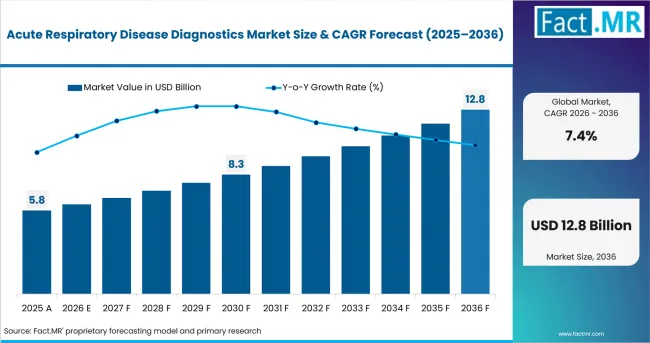
Acute Respiratory Disease Diagnostics Market Value Analysis

Metric Value
Estimated Value in 2026 USD 6.3 Billion
Forecast Value in 2036 USD 12.8 Billion
Forecast CAGR (2026 to 2036) 7.4%

Summary of the Acute Respiratory Disease Diagnostics Market

  • Demand Drivers
    • Respiratory disease surveillance programs are increasing demand for rapid and accurate diagnostic testing. Public health agencies are strengthening infectious disease monitoring capabilities.
    • Molecular testing technologies are improving diagnostic precision across healthcare settings. Faster pathogen identification supports clinical decision making.
    • Hospitals are expanding use of multiplex respiratory panels to improve diagnostic efficiency. Broader pathogen detection supports treatment selection.
  • Key Segments Analyzed
    • By Test: Molecular Diagnostics hold 40% share in 2026 due to high diagnostic sensitivity and clinical acceptance.
    • By Pathogen: Viral Infections account for 55% share in 2026 supported by seasonal respiratory disease testing volumes.
    • By End User: Hospitals & Clinics contribute 45% share in 2026 due to strong patient testing activity.
    • By Sample Type: Nasopharyngeal Swabs register 50% share in 2026 due to compatibility with major diagnostic platforms.
    • By Mode of Testing: Laboratory-based Testing capture 65% share in 2026 supported by advanced testing infrastructure.
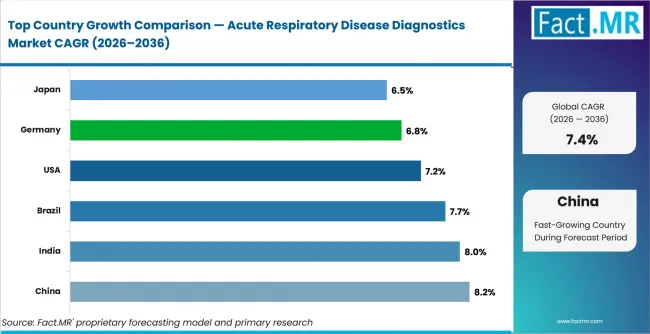
    • By Geography: China is projected to record 8.2% CAGR through 2036 supported by respiratory surveillance expansion.
  • Analyst Opinion at Fact.MR
    • Shambhu Nath Jha, Principal Consultant at Fact.MR, opines, “Diagnostic value is shifting toward rapid multi-pathogen detection and integrated surveillance capabilities. Organizations that strengthen molecular testing capacity and laboratory connectivity are positioned to benefit from long-term testing demand.”
  • Strategic Implications
    • Diagnostic manufacturers should expand multiplex testing capabilities across respiratory disease panels. Broader pathogen coverage improves clinical utility.
    • Healthcare providers should strengthen laboratory infrastructure for molecular diagnostics. Faster testing turnaround improves patient management.
    • Public health organizations should improve surveillance network integration across healthcare systems. Earlier outbreak detection supports disease control measures.

Revenue generation is forecast to increase by approximately USD 6.5 billion between 2026 and 2036. Growth reflects rising respiratory infection surveillance and wider use of molecular testing technologies. Demand is supported by healthcare preparedness programs and diagnostic accuracy requirements. Adoption is constrained by testing cost pressures and reimbursement limitations in several healthcare systems.

China is projected to expand at 8.2% CAGR through 2036 supported by respiratory surveillance investment. India is expected to advance at 8.0% CAGR from 2026 to 2036 due to diagnostic infrastructure expansion. Brazil is forecast to grow at 7.7% CAGR by 2036 driven by public healthcare testing initiatives. The United States is estimated to witness 7.2% CAGR through 2036 supported by molecular diagnostics adoption. Germany is likely to register 6.8% CAGR by 2036 due to established laboratory networks. Japan is anticipated to record 6.5% CAGR from 2026 to 2036 supported by infectious disease monitoring programs.

Segmental Analysis

Acute Respiratory Disease Diagnostics Market Analysis by Test
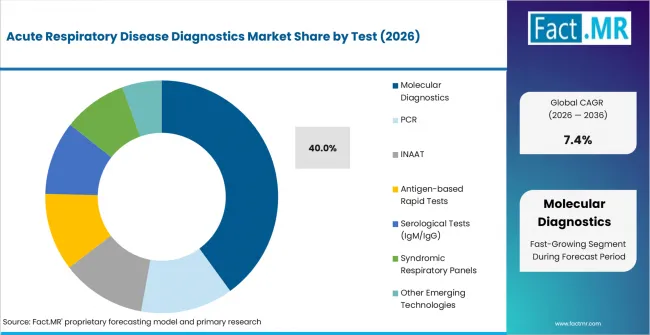
Acute Respiratory Disease Diagnostics Market Analysis By Test

Molecular Diagnostics is estimated to hold 40% share in 2026. High analytical accuracy and strong clinical confidence support segment leadership. Molecular platforms improve pathogen identification across hospital and laboratory environments. Roche received U.S. FDA Emergency Use Authorization (EUA) for its cobas® liat SARS-CoV-2, Influenza A/B & RSV nucleic acid test, which detects four major respiratory viruses from a single nasal swab sample. The multiplex PCR test delivers results in about 20 minutes, supporting rapid diagnosis and treatment decisions for respiratory infections. [1]

  • Diagnostic Accuracy: Molecular tests provide precise pathogen detection. Healthcare providers rely on these systems for clinical decision support.
  • Laboratory Preference: Diagnostic laboratories prioritize molecular platforms for respiratory disease testing. Testing volumes support sustained utilization.
  • Technology Advancement: Manufacturers are improving testing speed and automation capabilities. Product innovation strengthens market adoption.

Acute Respiratory Disease Diagnostics Market Analysis by Pathogen
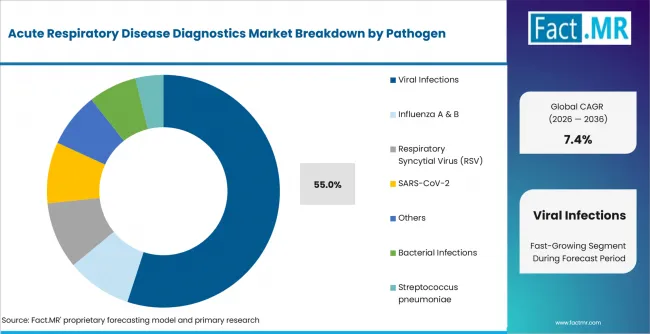
Acute Respiratory Disease Diagnostics Market Analysis By Pathogen

Viral Infections are estimated to account for 55% share in 2026. Seasonal respiratory outbreaks generate substantial testing demand. Public health surveillance programs support segment growth.

  • Surveillance Activity: Viral infection monitoring remains a major healthcare priority. Testing demand reflects disease tracking requirements.
  • Seasonal Testing: Influenza and respiratory virus outbreaks increase diagnostic utilization. Healthcare facilities expand testing during peak infection periods.
  • Public Health Focus: Government agencies invest in viral disease detection programs. Monitoring activities support diagnostic demand.

Acute Respiratory Disease Diagnostics Market Analysis by End User
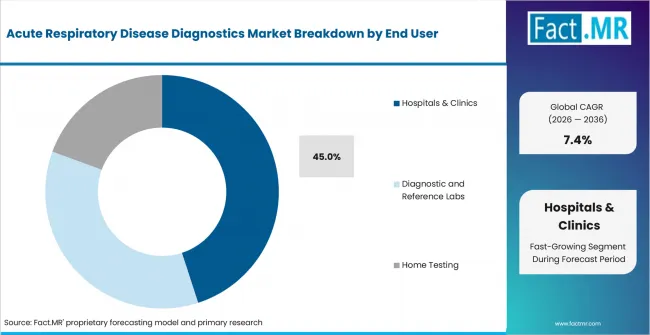
Acute Respiratory Disease Diagnostics Market Analysis By End User

Hospitals & Clinics are estimated to contribute 45% share in 2026. Patient testing activity remains concentrated in clinical care settings. Diagnostic utilization reflects routine and emergency healthcare requirements. The U.S. FDA authorized marketing of the Healgen Rapid Check COVID-19/Flu A&B Antigen Test, the first at-home combination test for COVID-19 and influenza cleared through the traditional regulatory pathway. The test enables consumers to detect multiple acute respiratory infections from a single nasal swab sample. [2]

  • Patient Volumes: Hospitals process substantial respiratory testing volumes. Clinical demand supports segment leadership.
  • Treatment Decisions: Diagnostic results influence therapy selection and patient management. Testing remains integrated into care pathways.
  • Infrastructure Availability: Healthcare facilities maintain established testing capabilities. Laboratory access supports utilization.

Acute Respiratory Disease Diagnostics Market Analysis by Sample Type
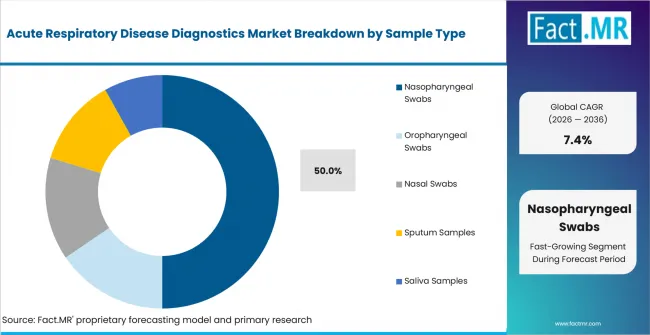
Acute Respiratory Disease Diagnostics Market Analysis By Sample Type

Nasopharyngeal Swabs are estimated to register 50% share in 2026. Sample collection practices support broad compatibility with respiratory testing platforms. Clinical familiarity strengthens utilization.

  • Testing Compatibility: Nasopharyngeal samples support molecular and antigen testing methods. Diagnostic reliability supports adoption.
  • Clinical Acceptance: Healthcare professionals routinely utilize this collection method. Established procedures support testing consistency.
  • Collection Efficiency: Sample acquisition remains practical across healthcare settings. Broad applicability strengthens demand.

Acute Respiratory Disease Diagnostics Market Analysis by Mode of Testing
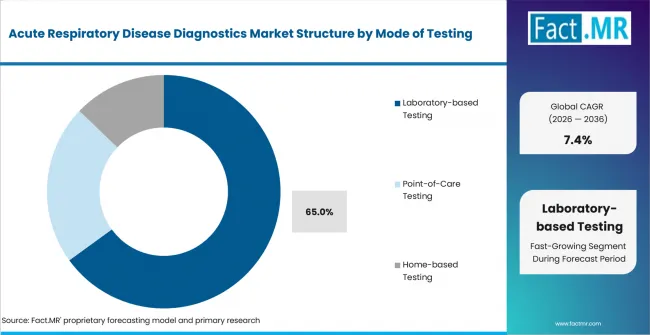
Acute Respiratory Disease Diagnostics Market Analysis By Mode Of Testing

Laboratory-based Testing is estimated to hold 65% share in 2026. Advanced testing capabilities and higher throughput support segment leadership. Healthcare systems rely on centralized laboratory infrastructure for respiratory diagnostics. Roche received U.S. FDA 510(k) clearance for its cobas® Respiratory 4-flex assay, the first respiratory test powered by TAGS technology to simultaneously detect SARS-CoV-2, Influenza A, Influenza B, and RSV. The test expands Roche's molecular diagnostics portfolio and supports rapid, high-throughput respiratory disease testing in clinical laboratories. [3]

  • Testing Capacity: Laboratories process large testing volumes efficiently. Centralized operations support demand concentration.
  • Advanced Platforms: Molecular diagnostic systems are primarily installed within laboratory environments. Infrastructure investment supports utilization.
  • Quality Standards: Laboratory testing supports diagnostic accuracy and regulatory compliance. Healthcare providers prioritize validated results.

Drivers, Restraints, and Opportunities
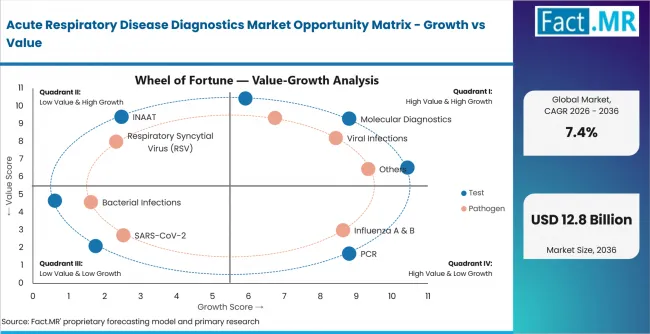
Acute Respiratory Disease Diagnostics Market Opportunity Matrix Growth Vs Value

Fact.MR analysts observe that respiratory disease diagnostics has evolved from outbreak-focused testing toward routine surveillance and early disease identification. Healthcare systems are increasing investment in laboratory preparedness and diagnostic capacity. Market value reflects sustained testing demand across hospitals and public health agencies. Respiratory infection monitoring remains a priority across developed and emerging healthcare markets. LEX Diagnostics received U.S. FDA 510(k) clearance and CLIA Waiver for its LEX VELO System, a rapid PCR platform that delivers respiratory test results directly from a patient swab in less than 10 minutes. The system supports near-patient diagnosis of acute respiratory infections and expands access to molecular respiratory testing. [4]

Diagnostic workflows are shifting toward multiplex and molecular testing platforms that identify multiple pathogens from a single sample. Laboratories are prioritizing testing efficiency and faster result delivery.

  • Surveillance Expansion: Public health agencies are strengthening respiratory disease monitoring programs. Broader testing coverage supports demand for advanced diagnostic platforms and laboratory services.
  • Multiplex Testing Shift: Healthcare providers are increasing use of respiratory panels that detect multiple pathogens simultaneously. Diagnostic efficiency improves through faster identification of infection sources.
  • Cost Constraints: Adoption is constrained by high molecular testing costs and reimbursement limitations. Smaller healthcare facilities often face budget restrictions during technology upgrades.

Regional Analysis

The acute respiratory disease diagnostics market is assessed across North America, Europe, Asia Pacific, Latin America, and the Middle East & Africa. The study evaluates respiratory testing demand, laboratory infrastructure, infectious disease surveillance programs, healthcare spending, and diagnostic technology adoption across major economies.

Top Country Growth Comparison Acute Respiratory Disease Diagnostics Market Cagr (2026 2036)

Country CAGR (2026 to 2036)
China 8.2%
India 8.0%
Brazil 7.7%
United States 7.2%
Germany 6.8%
Japan 6.5%

Acute Respiratory Disease Diagnostics Market Cagr Analysis By Country

Asia Pacific Acute Respiratory Disease Diagnostics Market Analysis
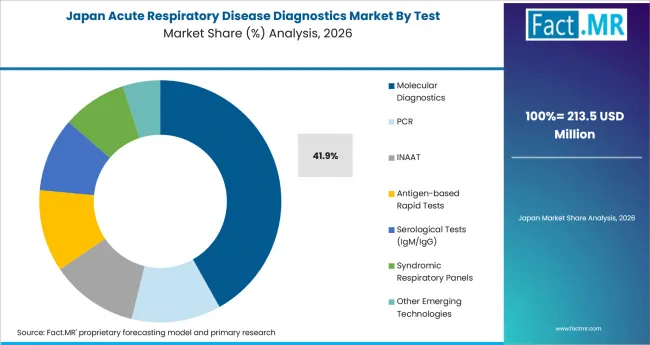
Acute Respiratory Disease Diagnostics Market Japan Market Share Analysis By Test

Asia Pacific represents a major growth center for respiratory disease diagnostics. Governments are expanding infectious disease surveillance programs. Laboratory modernization initiatives support diagnostic technology adoption across healthcare systems.

  • China: Demand for acute respiratory disease diagnostics in China is projected to rise at 8.2% CAGR through 2036. Public health authorities are strengthening respiratory surveillance networks across major provinces. Diagnostic laboratories are increasing investment in molecular testing platforms. Growth is attributable to disease monitoring programs and expanding laboratory capacity.
  • India: India is expected to witness 8.0% CAGR by 2036 driven by expansion of diagnostic infrastructure and wider access to molecular testing services. Public healthcare facilities are improving respiratory disease detection capabilities. Testing demand reflects increasing focus on infectious disease preparedness. Growth is led by laboratory network expansion and healthcare digitization.
  • Japan: Japan is anticipated to expand at 6.5% CAGR from 2026 to 2036 due to strong infectious disease monitoring frameworks and established healthcare infrastructure. Healthcare providers prioritize early respiratory pathogen detection. Laboratory utilization remains supported by seasonal disease surveillance. Growth reflects sustained investment in diagnostic preparedness.

North America Acute Respiratory Disease Diagnostics Market Analysis
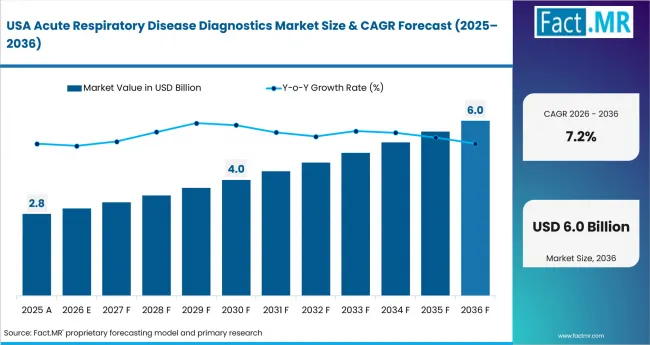
Acute Respiratory Disease Diagnostics Market Country Value Analysis

North America remains a substantial market for respiratory diagnostic technologies. Advanced laboratory infrastructure supports testing demand. Molecular diagnostics adoption continues shaping market development.

  • United States: The United States is projected to expand at 7.2% CAGR by 2036 as healthcare providers increase utilization of multiplex respiratory testing platforms. Clinical laboratories are investing in workflow automation and rapid diagnostics. Respiratory surveillance programs support testing activity. Growth is driven by technological innovation and strong healthcare expenditure.

Europe Acute Respiratory Disease Diagnostics Market Analysis
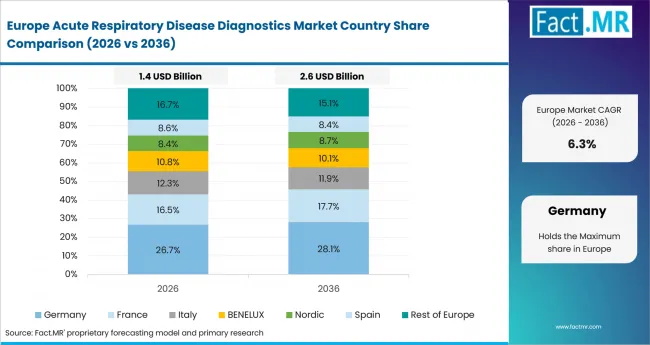
Acute Respiratory Disease Diagnostics Market Europe Country Market Share Analysis, 2026 & 2036

Europe benefits from established laboratory networks and structured disease surveillance systems. Diagnostic testing remains integrated into public healthcare frameworks. Healthcare modernization supports adoption of advanced testing technologies. bioMérieux received IVDR CE marking for two BIOFIRE® SPOTFIRE® panels, including its Respiratory Panel, enabling near-patient detection of multiple respiratory pathogens across Europe. The approval strengthens access to rapid molecular diagnostics for acute respiratory infections in decentralized healthcare settings. [5]

  • Germany: Germany is projected to register 6.8% CAGR from 2026 to 2036 supported by advanced laboratory infrastructure and strong infectious disease monitoring programs. Healthcare institutions are increasing use of molecular diagnostic platforms for respiratory pathogens. Testing demand benefits from established reimbursement pathways. Growth is attributable to diagnostic standardization and healthcare system efficiency.

Latin America Acute Respiratory Disease Diagnostics Market Analysis

Latin America is gaining importance in respiratory disease surveillance and diagnostic testing. Public healthcare investment supports laboratory expansion. Disease monitoring initiatives contribute to market growth.

  • Brazil: Brazil is forecast to grow at 7.7% CAGR through 2036 as public health authorities strengthen respiratory disease surveillance and laboratory testing capacity. Healthcare institutions are improving access to molecular diagnostics across urban centers. Demand is supported by infectious disease monitoring requirements. Growth reflects expanding diagnostic infrastructure and broader healthcare coverage.


Competitive Aligners for Market Players
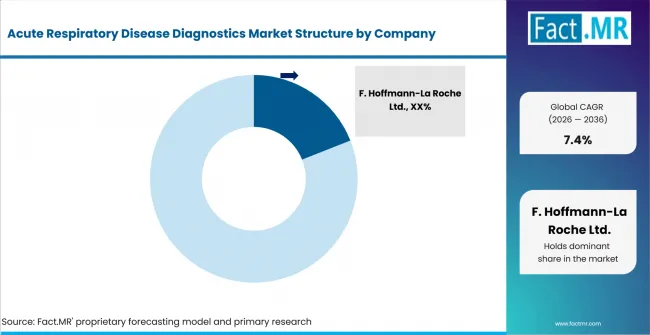
Acute Respiratory Disease Diagnostics Market Analysis By Company

The competitive structure reflects a concentration of global diagnostics manufacturers with strong laboratory testing portfolios. Product accuracy and testing speed influence purchasing decisions across healthcare systems. Companies with established laboratory relationships maintain stronger commercial positioning.

Diagnostic manufacturers with extensive molecular testing portfolios benefit from broad product reach and regulatory experience. Established distribution networks improve access to hospitals and reference laboratories. Product innovation remains a major source of competitive differentiation. Hospitals and diagnostic laboratories evaluate suppliers based on testing performance and workflow efficiency. Long validation cycles create barriers for new technologies. Reimbursement frameworks influence purchasing decisions across several healthcare markets.

Commercial success is increasingly linked to multiplex testing capability and laboratory integration. Organizations that strengthen automation and connectivity features improve their position within diagnostic workflows. Continued investment in respiratory surveillance supports long-term demand for advanced diagnostic solutions.

Key Players

  • F. Hoffmann-La Roche Ltd.
  • Abbott Laboratories
  • QuidelOrtho Corporation
  • Becton, Dickinson and Company
  • Thermo Fisher Scientific Inc.
  • bioMérieux SA

Bibliography

  • [1] Roche. (2024). Roche launches new molecular diagnostic solutions to strengthen respiratory disease testing and laboratory efficiency.
  • [2] U.S. Food and Drug Administration (FDA). (2024). FDA authorizes marketing of first home flu and COVID-19 combination test outside emergency use.
  • [3] Roche Diagnostics. (2025). Roche’s first respiratory test powered by TAGS technology receives FDA clearance for SARS-CoV-2, Influenza A, Influenza B, and RSV.
  • [4] Lex Diagnostics. (2026) Lex Diagnostics receives FDA 510(k) clearance and CLIA waiver for Lex Velo® System.
  • [5] bioMérieux. (2026). bioMérieux receives IVDR CE marking for two BIOFIRE® SPOTFIRE® panels to strengthen near-patient respiratory and sore throat diagnostics across Europe.

This Report Addresses

  • Analysis of respiratory diagnostic testing demand across hospitals, laboratories, and public health institutions.
  • Market forecast from USD 6.3 billion in 2026 to USD 12.8 billion by 2036 at 7.4% CAGR.
  • Opportunity assessment across molecular diagnostics, respiratory panels, and point-of-care testing.
  • Segment forecasts covering test type, pathogen, end user, sample type, and testing mode.
  • Competitive assessment of respiratory diagnostics manufacturers and laboratory solution providers.
  • Evaluation of molecular testing trends and infectious disease surveillance programs.
  • Country-level analysis across China, India, Brazil, the United States, Germany, and Japan.
  • Report delivery through PDF and Excel formats supported by primary interviews and industry analysis.

Acute Respiratory Disease Diagnostics Market Definition

The acute respiratory disease diagnostics market covers diagnostic tests used to detect respiratory infections caused by viral and bacterial pathogens. These tests assist healthcare professionals in identifying disease causes and selecting appropriate treatment pathways. Diagnostic methods include molecular testing, viral antigen testing, serology testing, and multiplex respiratory panels. Demand is concentrated across hospitals, diagnostic laboratories, and public health institutions.

Acute Respiratory Disease Diagnostics Market Inclusions

The study covers global and regional forecasts from 2026 to 2036 by test type, pathogen, end user, sample type, and mode of testing. It includes molecular diagnostics, antigen testing, respiratory panel testing, laboratory testing platforms, and point-of-care diagnostic solutions used for acute respiratory disease detection.

Acute Respiratory Disease Diagnostics Market Exclusions

The study excludes chronic respiratory disease monitoring tools and pulmonary function testing systems. It omits respiratory treatment products and therapeutic devices. Imaging technologies and non-diagnostic respiratory monitoring equipment are excluded unless directly associated with respiratory disease diagnosis.

Acute Respiratory Disease Diagnostics Market Research Methodology

  • Primary Research
    • Interviews were conducted with laboratory directors, infectious disease specialists, hospital administrators, diagnostic manufacturers, and public health professionals across major markets.
  • Desk Research
    • Analysis included company disclosures, regulatory publications, public health reports, diagnostic industry updates, and infectious disease surveillance data released during 2024 and 2025.
  • Market-Sizing and Forecasting
    • A hybrid model combines top-down healthcare expenditure analysis with bottom-up estimates derived from testing volumes, laboratory activity, and diagnostic platform deployment.
  • Data Validation and Update Cycle
    • Forecast outputs were validated through company disclosures, laboratory utilization data, public health statistics, and expert interviews.

Scope of the Report

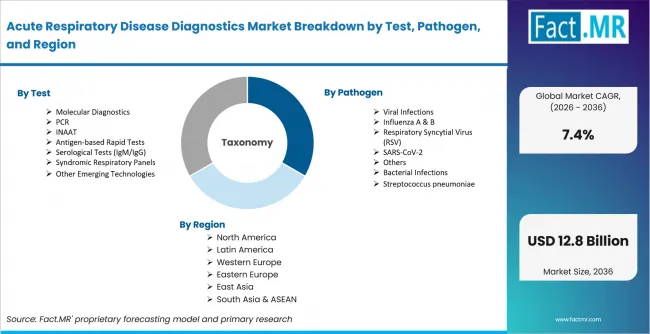
Acute Respiratory Disease Diagnostics Market Breakdown By Test, Pathogen, And Region

Attribute Details
Quantitative Units USD 6.3 Billion (2026) to USD 12.8 Billion (2036) at a CAGR of 7.4%
Market Definition Covers diagnostic tests used to detect acute respiratory infections caused by viral and bacterial pathogens
Test Segmentation Molecular Diagnostics, Antigen-based Rapid Tests, Serological Tests (IgM/IgG), Syndromic Respiratory Panels, Other Emerging Technologies
Pathogen Segmentation Viral Infections, Bacterial Infections
End User Segmentation Hospitals & Clinics, Diagnostic and Reference Labs, Home Testing, Others
Sample Type Segmentation Nasopharyngeal Swabs, Oropharyngeal Swabs, Nasal Swabs, Sputum Samples, Saliva Samples
Mode of Testing Segmentation Laboratory-based Testing, Point-of-Care Testing, Home-based Testing
Regions Covered North America, Europe, Asia Pacific, Latin America, Middle East & Africa
Countries Covered China, India, Japan, United States, Germany, Brazil
Key Companies Profiled Roche, Abbott, QuidelOrtho, BD, Thermo Fisher Scientific, bioMérieux
Forecast Period 2026 to 2036
Approach Hybrid top-down and bottom-up model using testing volumes and healthcare utilization analysis.

Acute Respiratory Disease Diagnostics Market by Segment

  • By Test

    • Molecular Diagnostics
    • PCR
    • INAAT
    • Antigen-based Rapid Tests
    • Serological Tests (IgM/IgG)
    • Syndromic Respiratory Panels
    • Other Emerging Technologies (CRISPR-based, Nanopore Sequencing, AI-driven Imaging)
  • By Pathogen

    • Viral Infections
    • Influenza A & B
    • Respiratory Syncytial Virus (RSV)
    • SARS-CoV-2
    • Others
    • Bacterial Infections
    • Streptococcus pneumoniae
    • Haemophilus influenzae
    • Mycoplasma pneumoniae
    • Bordetella pertussis
    • Others
  • By End User

    • Hospitals & Clinics
    • Diagnostic and Reference Labs
    • Home Testing
  • By Sample Type

    • Nasopharyngeal Swabs
    • Oropharyngeal Swabs
    • Nasal Swabs
    • Sputum Samples
    • Saliva Samples
  • By Mode of Testing

    • Laboratory-based Testing
    • Point-of-Care Testing
    • Home-based Testing
  • By Region

    • North America
      • United States
      • Canada
      • Mexico
    • Latin America
      • Brazil
      • Argentina
      • Rest of Latin America
    • Europe
      • Germany
      • United Kingdom
      • France
      • Italy
      • Spain
      • Rest of Europe
    • Asia Pacific
      • China
      • India
      • Japan
      • South Korea
      • ASEAN
      • Australia and New Zealand
    • Middle East & Africa
      • Saudi Arabia
      • UAE
      • South Africa
      • Rest of Middle East & Africa

- Frequently Asked Questions -

How large is the global acute respiratory disease diagnostics market in 2025?

The global acute respiratory disease diagnostics market is estimated at USD 5.8 billion in 2025 based on Fact.MR analysis.

What will the acute respiratory disease diagnostics market size be in 2026?

Demand for acute respiratory disease diagnostics is estimated to reach USD 6.3 billion in 2026 supported by testing expansion.

What is the projected acute respiratory disease diagnostics market size by 2036?

The market is projected to reach USD 12.8 billion by 2036 reflecting sustained investment in respiratory disease detection.

What is the expected CAGR for the acute respiratory disease diagnostics market from 2026 to 2036?

Fact.MR projects the global acute respiratory disease diagnostics market to expand at a CAGR of 7.4% during the forecast period.

Which test segment is poised to lead market demand?

Molecular Diagnostics lead with 40% share in 2026 due to high accuracy and strong clinical adoption.

Which country records the strongest growth in the market?

China records 8.2% CAGR through 2036 supported by respiratory surveillance investment and laboratory infrastructure expansion.

Table of Content

  1. Executive Summary
    • Global Market Outlook
    • Demand to side Trends
    • Supply to side Trends
    • Technology Roadmap Analysis
    • Analysis and Recommendations
  2. Market Overview
    • Market Coverage / Taxonomy
    • Market Definition / Scope / Limitations
  3. Research Methodology
    • Chapter Orientation
    • Analytical Lens and Working Hypotheses
      • Market Structure, Signals, and Trend Drivers
      • Benchmarking and Cross-market Comparability
      • Market Sizing, Forecasting, and Opportunity Mapping
    • Research Design and Evidence Framework
      • Desk Research Programme (Secondary Evidence)
        • Company Annual and Sustainability Reports
        • Peer-reviewed Journals and Academic Literature
        • Corporate Websites, Product Literature, and Technical Notes
        • Earnings Decks and Investor Briefings
        • Statutory Filings and Regulatory Disclosures
        • Technical White Papers and Standards Notes
        • Trade Journals, Industry Magazines, and Analyst Briefs
        • Conference Proceedings, Webinars, and Seminar Materials
        • Government Statistics Portals and Public Data Releases
        • Press Releases and Reputable Media Coverage
        • Specialist Newsletters and Curated Briefings
        • Sector Databases and Reference Repositories
        • Fact.MR Internal Proprietary Databases and Historical Market Datasets
        • Subscription Datasets and Paid Sources
        • Social Channels, Communities, and Digital Listening Inputs
        • Additional Desk Sources
      • Expert Input and Fieldwork (Primary Evidence)
        • Primary Modes
          • Qualitative Interviews and Expert Elicitation
          • Quantitative Surveys and Structured Data Capture
          • Blended Approach
        • Why Primary Evidence is Used
        • Field Techniques
          • Interviews
          • Surveys
          • Focus Groups
          • Observational and In-context Research
          • Social and Community Interactions
        • Stakeholder Universe Engaged
          • C-suite Leaders
          • Board Members
          • Presidents and Vice Presidents
          • R&D and Innovation Heads
          • Technical Specialists
          • Domain Subject-matter Experts
          • Scientists
          • Physicians and Other Healthcare Professionals
        • Governance, Ethics, and Data Stewardship
          • Research Ethics
          • Data Integrity and Handling
      • Tooling, Models, and Reference Databases
    • Data Engineering and Model Build
      • Data Acquisition and Ingestion
      • Cleaning, Normalisation, and Verification
      • Synthesis, Triangulation, and Analysis
    • Quality Assurance and Audit Trail
  4. Market Background
    • Market Dynamics
      • Drivers
      • Restraints
      • Opportunity
      • Trends
    • Scenario Forecast
      • Demand in Optimistic Scenario
      • Demand in Likely Scenario
      • Demand in Conservative Scenario
    • Opportunity Map Analysis
    • Product Life Cycle Analysis
    • Supply Chain Analysis
    • Investment Feasibility Matrix
    • Value Chain Analysis
    • PESTLE and Porter’s Analysis
    • Regulatory Landscape
    • Regional Parent Market Outlook
    • Production and Consumption Statistics
    • Import and Export Statistics
  5. Global Market Analysis 2021 to 2025 and Forecast, 2026 to 2036
    • Historical Market Size Value (USD Million) Analysis, 2021 to 2025
    • Current and Future Market Size Value (USD Million) Projections, 2026 to 2036
      • Y to o to Y Growth Trend Analysis
      • Absolute $ Opportunity Analysis
  6. Global Market Pricing Analysis 2021 to 2025 and Forecast 2026 to 2036
  7. Global Market Analysis 2021 to 2025 and Forecast 2026 to 2036, By Drug Class
    • Introduction / Key Findings
    • Historical Market Size Value (USD Million) Analysis By Drug Class , 2021 to 2025
    • Current and Future Market Size Value (USD Million) Analysis and Forecast By Drug Class , 2026 to 2036
      • Targeted Therapies
      • Hypomethylating Agents
      • BCL-2 Inhibitors
      • Supportive Care Drugs
      • Chemotherapy Agents
    • Y to o to Y Growth Trend Analysis By Drug Class , 2021 to 2025
    • Absolute $ Opportunity Analysis By Drug Class , 2026 to 2036
  8. Global Market Analysis 2021 to 2025 and Forecast 2026 to 2036, By Disease Type
    • Introduction / Key Findings
    • Historical Market Size Value (USD Million) Analysis By Disease Type, 2021 to 2025
    • Current and Future Market Size Value (USD Million) Analysis and Forecast By Disease Type, 2026 to 2036
      • Newly Diagnosed AML
      • Relapsed AML
      • Refractory AML
      • Secondary AML
      • Mutation-Defined AML
    • Y to o to Y Growth Trend Analysis By Disease Type, 2021 to 2025
    • Absolute $ Opportunity Analysis By Disease Type, 2026 to 2036
  9. Global Market Analysis 2021 to 2025 and Forecast 2026 to 2036, By Route of Administration
    • Introduction / Key Findings
    • Historical Market Size Value (USD Million) Analysis By Route of Administration, 2021 to 2025
    • Current and Future Market Size Value (USD Million) Analysis and Forecast By Route of Administration, 2026 to 2036
      • Intravenous
      • Subcutaneous
      • Combination Regimens
      • Oral
    • Y to o to Y Growth Trend Analysis By Route of Administration, 2021 to 2025
    • Absolute $ Opportunity Analysis By Route of Administration, 2026 to 2036
  10. Global Market Analysis 2021 to 2025 and Forecast 2026 to 2036, By End User
    • Introduction / Key Findings
    • Historical Market Size Value (USD Million) Analysis By End User, 2021 to 2025
    • Current and Future Market Size Value (USD Million) Analysis and Forecast By End User, 2026 to 2036
      • Hospitals
      • Cancer Centers
      • Hematology Clinics
      • Academic Medical Centers
      • Specialty Oncology Centers
    • Y to o to Y Growth Trend Analysis By End User, 2021 to 2025
    • Absolute $ Opportunity Analysis By End User, 2026 to 2036
  11. Global Market Analysis 2021 to 2025 and Forecast 2026 to 2036, By Sales Channel
    • Introduction / Key Findings
    • Historical Market Size Value (USD Million) Analysis By Sales Channel, 2021 to 2025
    • Current and Future Market Size Value (USD Million) Analysis and Forecast By Sales Channel, 2026 to 2036
      • Hospital Pharmacies
      • Specialty Pharmacies
      • Direct Hospital Supply
      • Retail Pharmacies
      • Tender and Public Supply
    • Y to o to Y Growth Trend Analysis By Sales Channel, 2021 to 2025
    • Absolute $ Opportunity Analysis By Sales Channel, 2026 to 2036
  12. Global Market Analysis 2021 to 2025 and Forecast 2026 to 2036, By Region
    • Introduction
    • Historical Market Size Value (USD Million) Analysis By Region, 2021 to 2025
    • Current Market Size Value (USD Million) Analysis and Forecast By Region, 2026 to 2036
      • North America
      • Latin America
      • Western Europe
      • Eastern Europe
      • East Asia
      • South Asia and Pacific
      • Middle East & Africa
    • Market Attractiveness Analysis By Region
  13. North America Market Analysis 2021 to 2025 and Forecast 2026 to 2036, By Country
    • Historical Market Size Value (USD Million) Trend Analysis By Market Taxonomy, 2021 to 2025
    • Market Size Value (USD Million) Forecast By Market Taxonomy, 2026 to 2036
      • By Country
        • USA
        • Canada
        • Mexico
      • By Drug Class
      • By Disease Type
      • By Route of Administration
      • By End User
      • By Sales Channel
    • Market Attractiveness Analysis
      • By Country
      • By Drug Class
      • By Disease Type
      • By Route of Administration
      • By End User
      • By Sales Channel
    • Key Takeaways
  14. Latin America Market Analysis 2021 to 2025 and Forecast 2026 to 2036, By Country
    • Historical Market Size Value (USD Million) Trend Analysis By Market Taxonomy, 2021 to 2025
    • Market Size Value (USD Million) Forecast By Market Taxonomy, 2026 to 2036
      • By Country
        • Brazil
        • Chile
        • Rest of Latin America
      • By Drug Class
      • By Disease Type
      • By Route of Administration
      • By End User
      • By Sales Channel
    • Market Attractiveness Analysis
      • By Country
      • By Drug Class
      • By Disease Type
      • By Route of Administration
      • By End User
      • By Sales Channel
    • Key Takeaways
  15. Western Europe Market Analysis 2021 to 2025 and Forecast 2026 to 2036, By Country
    • Historical Market Size Value (USD Million) Trend Analysis By Market Taxonomy, 2021 to 2025
    • Market Size Value (USD Million) Forecast By Market Taxonomy, 2026 to 2036
      • By Country
        • Germany
        • UK
        • Italy
        • Spain
        • France
        • Nordic
        • BENELUX
        • Rest of Western Europe
      • By Drug Class
      • By Disease Type
      • By Route of Administration
      • By End User
      • By Sales Channel
    • Market Attractiveness Analysis
      • By Country
      • By Drug Class
      • By Disease Type
      • By Route of Administration
      • By End User
      • By Sales Channel
    • Key Takeaways
  16. Eastern Europe Market Analysis 2021 to 2025 and Forecast 2026 to 2036, By Country
    • Historical Market Size Value (USD Million) Trend Analysis By Market Taxonomy, 2021 to 2025
    • Market Size Value (USD Million) Forecast By Market Taxonomy, 2026 to 2036
      • By Country
        • Russia
        • Poland
        • Hungary
        • Balkan & Baltic
        • Rest of Eastern Europe
      • By Drug Class
      • By Disease Type
      • By Route of Administration
      • By End User
      • By Sales Channel
    • Market Attractiveness Analysis
      • By Country
      • By Drug Class
      • By Disease Type
      • By Route of Administration
      • By End User
      • By Sales Channel
    • Key Takeaways
  17. East Asia Market Analysis 2021 to 2025 and Forecast 2026 to 2036, By Country
    • Historical Market Size Value (USD Million) Trend Analysis By Market Taxonomy, 2021 to 2025
    • Market Size Value (USD Million) Forecast By Market Taxonomy, 2026 to 2036
      • By Country
        • China
        • Japan
        • South Korea
      • By Drug Class
      • By Disease Type
      • By Route of Administration
      • By End User
      • By Sales Channel
    • Market Attractiveness Analysis
      • By Country
      • By Drug Class
      • By Disease Type
      • By Route of Administration
      • By End User
      • By Sales Channel
    • Key Takeaways
  18. South Asia and Pacific Market Analysis 2021 to 2025 and Forecast 2026 to 2036, By Country
    • Historical Market Size Value (USD Million) Trend Analysis By Market Taxonomy, 2021 to 2025
    • Market Size Value (USD Million) Forecast By Market Taxonomy, 2026 to 2036
      • By Country
        • India
        • ASEAN
        • Australia & New Zealand
        • Rest of South Asia and Pacific
      • By Drug Class
      • By Disease Type
      • By Route of Administration
      • By End User
      • By Sales Channel
    • Market Attractiveness Analysis
      • By Country
      • By Drug Class
      • By Disease Type
      • By Route of Administration
      • By End User
      • By Sales Channel
    • Key Takeaways
  19. Middle East & Africa Market Analysis 2021 to 2025 and Forecast 2026 to 2036, By Country
    • Historical Market Size Value (USD Million) Trend Analysis By Market Taxonomy, 2021 to 2025
    • Market Size Value (USD Million) Forecast By Market Taxonomy, 2026 to 2036
      • By Country
        • Kingdom of Saudi Arabia
        • Other GCC Countries
        • Turkiye
        • South Africa
        • Other African Union
        • Rest of Middle East & Africa
      • By Drug Class
      • By Disease Type
      • By Route of Administration
      • By End User
      • By Sales Channel
    • Market Attractiveness Analysis
      • By Country
      • By Drug Class
      • By Disease Type
      • By Route of Administration
      • By End User
      • By Sales Channel
    • Key Takeaways
  20. Key Countries Market Analysis
    • USA
      • Pricing Analysis
      • Market Share Analysis, 2025
        • By Drug Class
        • By Disease Type
        • By Route of Administration
        • By End User
        • By Sales Channel
    • Canada
      • Pricing Analysis
      • Market Share Analysis, 2025
        • By Drug Class
        • By Disease Type
        • By Route of Administration
        • By End User
        • By Sales Channel
    • Mexico
      • Pricing Analysis
      • Market Share Analysis, 2025
        • By Drug Class
        • By Disease Type
        • By Route of Administration
        • By End User
        • By Sales Channel
    • Brazil
      • Pricing Analysis
      • Market Share Analysis, 2025
        • By Drug Class
        • By Disease Type
        • By Route of Administration
        • By End User
        • By Sales Channel
    • Chile
      • Pricing Analysis
      • Market Share Analysis, 2025
        • By Drug Class
        • By Disease Type
        • By Route of Administration
        • By End User
        • By Sales Channel
    • Germany
      • Pricing Analysis
      • Market Share Analysis, 2025
        • By Drug Class
        • By Disease Type
        • By Route of Administration
        • By End User
        • By Sales Channel
    • UK
      • Pricing Analysis
      • Market Share Analysis, 2025
        • By Drug Class
        • By Disease Type
        • By Route of Administration
        • By End User
        • By Sales Channel
    • Italy
      • Pricing Analysis
      • Market Share Analysis, 2025
        • By Drug Class
        • By Disease Type
        • By Route of Administration
        • By End User
        • By Sales Channel
    • Spain
      • Pricing Analysis
      • Market Share Analysis, 2025
        • By Drug Class
        • By Disease Type
        • By Route of Administration
        • By End User
        • By Sales Channel
    • France
      • Pricing Analysis
      • Market Share Analysis, 2025
        • By Drug Class
        • By Disease Type
        • By Route of Administration
        • By End User
        • By Sales Channel
    • India
      • Pricing Analysis
      • Market Share Analysis, 2025
        • By Drug Class
        • By Disease Type
        • By Route of Administration
        • By End User
        • By Sales Channel
    • ASEAN
      • Pricing Analysis
      • Market Share Analysis, 2025
        • By Drug Class
        • By Disease Type
        • By Route of Administration
        • By End User
        • By Sales Channel
    • Australia & New Zealand
      • Pricing Analysis
      • Market Share Analysis, 2025
        • By Drug Class
        • By Disease Type
        • By Route of Administration
        • By End User
        • By Sales Channel
    • China
      • Pricing Analysis
      • Market Share Analysis, 2025
        • By Drug Class
        • By Disease Type
        • By Route of Administration
        • By End User
        • By Sales Channel
    • Japan
      • Pricing Analysis
      • Market Share Analysis, 2025
        • By Drug Class
        • By Disease Type
        • By Route of Administration
        • By End User
        • By Sales Channel
    • South Korea
      • Pricing Analysis
      • Market Share Analysis, 2025
        • By Drug Class
        • By Disease Type
        • By Route of Administration
        • By End User
        • By Sales Channel
    • Russia
      • Pricing Analysis
      • Market Share Analysis, 2025
        • By Drug Class
        • By Disease Type
        • By Route of Administration
        • By End User
        • By Sales Channel
    • Poland
      • Pricing Analysis
      • Market Share Analysis, 2025
        • By Drug Class
        • By Disease Type
        • By Route of Administration
        • By End User
        • By Sales Channel
    • Hungary
      • Pricing Analysis
      • Market Share Analysis, 2025
        • By Drug Class
        • By Disease Type
        • By Route of Administration
        • By End User
        • By Sales Channel
    • Kingdom of Saudi Arabia
      • Pricing Analysis
      • Market Share Analysis, 2025
        • By Drug Class
        • By Disease Type
        • By Route of Administration
        • By End User
        • By Sales Channel
    • Turkiye
      • Pricing Analysis
      • Market Share Analysis, 2025
        • By Drug Class
        • By Disease Type
        • By Route of Administration
        • By End User
        • By Sales Channel
    • South Africa
      • Pricing Analysis
      • Market Share Analysis, 2025
        • By Drug Class
        • By Disease Type
        • By Route of Administration
        • By End User
        • By Sales Channel
  21. Market Structure Analysis
    • Competition Dashboard
    • Competition Benchmarking
    • Market Share Analysis of Top Players
      • By Regional
      • By Drug Class
      • By Disease Type
      • By Route of Administration
      • By End User
      • By Sales Channel
  22. Competition Analysis
    • Competition Deep Dive
      • AbbVie Inc.
        • Overview
        • Product Portfolio
        • Profitability by Market Segments (Product/Age /Sales Channel/Region)
        • Sales Footprint
        • Strategy Overview
          • Marketing Strategy
          • Product Strategy
          • Channel Strategy
      • Genentech, Roche
      • Astellas Pharma Inc.
      • Syndax Pharmaceuticals, Inc.
      • Kura Oncology, Inc.
  23. Assumptions & Acronyms Used

List Of Table

  • Table 1: Global Market Value (USD Million) Forecast by Region, 2021 to 2036
  • Table 2: Global Market Value (USD Million) Forecast by Drug Class, 2021 to 2036
  • Table 3: Global Market Value (USD Million) Forecast by Disease Type, 2021 to 2036
  • Table 4: Global Market Value (USD Million) Forecast by Route of Administration, 2021 to 2036
  • Table 5: Global Market Value (USD Million) Forecast by End User, 2021 to 2036
  • Table 6: Global Market Value (USD Million) Forecast by Sales Channel, 2021 to 2036
  • Table 7: North America Market Value (USD Million) Forecast by Country, 2021 to 2036
  • Table 8: North America Market Value (USD Million) Forecast by Drug Class, 2021 to 2036
  • Table 9: North America Market Value (USD Million) Forecast by Disease Type, 2021 to 2036
  • Table 10: North America Market Value (USD Million) Forecast by Route of Administration, 2021 to 2036
  • Table 11: North America Market Value (USD Million) Forecast by End User, 2021 to 2036
  • Table 12: North America Market Value (USD Million) Forecast by Sales Channel, 2021 to 2036
  • Table 13: Latin America Market Value (USD Million) Forecast by Country, 2021 to 2036
  • Table 14: Latin America Market Value (USD Million) Forecast by Drug Class, 2021 to 2036
  • Table 15: Latin America Market Value (USD Million) Forecast by Disease Type, 2021 to 2036
  • Table 16: Latin America Market Value (USD Million) Forecast by Route of Administration, 2021 to 2036
  • Table 17: Latin America Market Value (USD Million) Forecast by End User, 2021 to 2036
  • Table 18: Latin America Market Value (USD Million) Forecast by Sales Channel, 2021 to 2036
  • Table 19: Western Europe Market Value (USD Million) Forecast by Country, 2021 to 2036
  • Table 20: Western Europe Market Value (USD Million) Forecast by Drug Class, 2021 to 2036
  • Table 21: Western Europe Market Value (USD Million) Forecast by Disease Type, 2021 to 2036
  • Table 22: Western Europe Market Value (USD Million) Forecast by Route of Administration, 2021 to 2036
  • Table 23: Western Europe Market Value (USD Million) Forecast by End User, 2021 to 2036
  • Table 24: Western Europe Market Value (USD Million) Forecast by Sales Channel, 2021 to 2036
  • Table 25: Eastern Europe Market Value (USD Million) Forecast by Country, 2021 to 2036
  • Table 26: Eastern Europe Market Value (USD Million) Forecast by Drug Class, 2021 to 2036
  • Table 27: Eastern Europe Market Value (USD Million) Forecast by Disease Type, 2021 to 2036
  • Table 28: Eastern Europe Market Value (USD Million) Forecast by Route of Administration, 2021 to 2036
  • Table 29: Eastern Europe Market Value (USD Million) Forecast by End User, 2021 to 2036
  • Table 30: Eastern Europe Market Value (USD Million) Forecast by Sales Channel, 2021 to 2036
  • Table 31: East Asia Market Value (USD Million) Forecast by Country, 2021 to 2036
  • Table 32: East Asia Market Value (USD Million) Forecast by Drug Class, 2021 to 2036
  • Table 33: East Asia Market Value (USD Million) Forecast by Disease Type, 2021 to 2036
  • Table 34: East Asia Market Value (USD Million) Forecast by Route of Administration, 2021 to 2036
  • Table 35: East Asia Market Value (USD Million) Forecast by End User, 2021 to 2036
  • Table 36: East Asia Market Value (USD Million) Forecast by Sales Channel, 2021 to 2036
  • Table 37: South Asia and Pacific Market Value (USD Million) Forecast by Country, 2021 to 2036
  • Table 38: South Asia and Pacific Market Value (USD Million) Forecast by Drug Class, 2021 to 2036
  • Table 39: South Asia and Pacific Market Value (USD Million) Forecast by Disease Type, 2021 to 2036
  • Table 40: South Asia and Pacific Market Value (USD Million) Forecast by Route of Administration, 2021 to 2036
  • Table 41: South Asia and Pacific Market Value (USD Million) Forecast by End User, 2021 to 2036
  • Table 42: South Asia and Pacific Market Value (USD Million) Forecast by Sales Channel, 2021 to 2036
  • Table 43: Middle East & Africa Market Value (USD Million) Forecast by Country, 2021 to 2036
  • Table 44: Middle East & Africa Market Value (USD Million) Forecast by Drug Class, 2021 to 2036
  • Table 45: Middle East & Africa Market Value (USD Million) Forecast by Disease Type, 2021 to 2036
  • Table 46: Middle East & Africa Market Value (USD Million) Forecast by Route of Administration, 2021 to 2036
  • Table 47: Middle East & Africa Market Value (USD Million) Forecast by End User, 2021 to 2036
  • Table 48: Middle East & Africa Market Value (USD Million) Forecast by Sales Channel, 2021 to 2036

List Of Figures

  • Figure 1: Global Market Pricing Analysis
  • Figure 2: Global Market Value (USD Million) Forecast 2021-2036
  • Figure 3: Global Market Value Share and BPS Analysis by Drug Class, 2026 and 2036
  • Figure 4: Global Market Y-o-Y Growth Comparison by Drug Class, 2026 to 2036
  • Figure 5: Global Market Attractiveness Analysis by Drug Class
  • Figure 6: Global Market Value Share and BPS Analysis by Disease Type, 2026 and 2036
  • Figure 7: Global Market Y-o-Y Growth Comparison by Disease Type, 2026 to 2036
  • Figure 8: Global Market Attractiveness Analysis by Disease Type
  • Figure 9: Global Market Value Share and BPS Analysis by Route of Administration, 2026 and 2036
  • Figure 10: Global Market Y-o-Y Growth Comparison by Route of Administration, 2026 to 2036
  • Figure 11: Global Market Attractiveness Analysis by Route of Administration
  • Figure 12: Global Market Value Share and BPS Analysis by End User, 2026 and 2036
  • Figure 13: Global Market Y-o-Y Growth Comparison by End User, 2026 to 2036
  • Figure 14: Global Market Attractiveness Analysis by End User
  • Figure 15: Global Market Value Share and BPS Analysis by Sales Channel, 2026 and 2036
  • Figure 16: Global Market Y-o-Y Growth Comparison by Sales Channel, 2026 to 2036
  • Figure 17: Global Market Attractiveness Analysis by Sales Channel
  • Figure 18: Global Market Value (USD Million) Share and BPS Analysis by Region, 2026 and 2036
  • Figure 19: Global Market Y-o-Y Growth Comparison by Region, 2026 to 2036
  • Figure 20: Global Market Attractiveness Analysis by Region
  • Figure 21: North America Market Incremental Dollar Opportunity, 2026 to 2036
  • Figure 22: Latin America Market Incremental Dollar Opportunity, 2026 to 2036
  • Figure 23: Western Europe Market Incremental Dollar Opportunity, 2026 to 2036
  • Figure 24: Eastern Europe Market Incremental Dollar Opportunity, 2026 to 2036
  • Figure 25: East Asia Market Incremental Dollar Opportunity, 2026 to 2036
  • Figure 26: South Asia and Pacific Market Incremental Dollar Opportunity, 2026 to 2036
  • Figure 27: Middle East & Africa Market Incremental Dollar Opportunity, 2026 to 2036
  • Figure 28: North America Market Value Share and BPS Analysis by Country, 2026 and 2036
  • Figure 29: North America Market Value Share and BPS Analysis by Drug Class, 2026 and 2036
  • Figure 30: North America Market Y-o-Y Growth Comparison by Drug Class, 2026 to 2036
  • Figure 31: North America Market Attractiveness Analysis by Drug Class
  • Figure 32: North America Market Value Share and BPS Analysis by Disease Type, 2026 and 2036
  • Figure 33: North America Market Y-o-Y Growth Comparison by Disease Type, 2026 to 2036
  • Figure 34: North America Market Attractiveness Analysis by Disease Type
  • Figure 35: North America Market Value Share and BPS Analysis by Route of Administration, 2026 and 2036
  • Figure 36: North America Market Y-o-Y Growth Comparison by Route of Administration, 2026 to 2036
  • Figure 37: North America Market Attractiveness Analysis by Route of Administration
  • Figure 38: North America Market Value Share and BPS Analysis by End User, 2026 and 2036
  • Figure 39: North America Market Y-o-Y Growth Comparison by End User, 2026 to 2036
  • Figure 40: North America Market Attractiveness Analysis by End User
  • Figure 41: North America Market Value Share and BPS Analysis by Sales Channel, 2026 and 2036
  • Figure 42: North America Market Y-o-Y Growth Comparison by Sales Channel, 2026 to 2036
  • Figure 43: North America Market Attractiveness Analysis by Sales Channel
  • Figure 44: Latin America Market Value Share and BPS Analysis by Country, 2026 and 2036
  • Figure 45: Latin America Market Value Share and BPS Analysis by Drug Class, 2026 and 2036
  • Figure 46: Latin America Market Y-o-Y Growth Comparison by Drug Class, 2026 to 2036
  • Figure 47: Latin America Market Attractiveness Analysis by Drug Class
  • Figure 48: Latin America Market Value Share and BPS Analysis by Disease Type, 2026 and 2036
  • Figure 49: Latin America Market Y-o-Y Growth Comparison by Disease Type, 2026 to 2036
  • Figure 50: Latin America Market Attractiveness Analysis by Disease Type
  • Figure 51: Latin America Market Value Share and BPS Analysis by Route of Administration, 2026 and 2036
  • Figure 52: Latin America Market Y-o-Y Growth Comparison by Route of Administration, 2026 to 2036
  • Figure 53: Latin America Market Attractiveness Analysis by Route of Administration
  • Figure 54: Latin America Market Value Share and BPS Analysis by End User, 2026 and 2036
  • Figure 55: Latin America Market Y-o-Y Growth Comparison by End User, 2026 to 2036
  • Figure 56: Latin America Market Attractiveness Analysis by End User
  • Figure 57: Latin America Market Value Share and BPS Analysis by Sales Channel, 2026 and 2036
  • Figure 58: Latin America Market Y-o-Y Growth Comparison by Sales Channel, 2026 to 2036
  • Figure 59: Latin America Market Attractiveness Analysis by Sales Channel
  • Figure 60: Western Europe Market Value Share and BPS Analysis by Country, 2026 and 2036
  • Figure 61: Western Europe Market Value Share and BPS Analysis by Drug Class, 2026 and 2036
  • Figure 62: Western Europe Market Y-o-Y Growth Comparison by Drug Class, 2026 to 2036
  • Figure 63: Western Europe Market Attractiveness Analysis by Drug Class
  • Figure 64: Western Europe Market Value Share and BPS Analysis by Disease Type, 2026 and 2036
  • Figure 65: Western Europe Market Y-o-Y Growth Comparison by Disease Type, 2026 to 2036
  • Figure 66: Western Europe Market Attractiveness Analysis by Disease Type
  • Figure 67: Western Europe Market Value Share and BPS Analysis by Route of Administration, 2026 and 2036
  • Figure 68: Western Europe Market Y-o-Y Growth Comparison by Route of Administration, 2026 to 2036
  • Figure 69: Western Europe Market Attractiveness Analysis by Route of Administration
  • Figure 70: Western Europe Market Value Share and BPS Analysis by End User, 2026 and 2036
  • Figure 71: Western Europe Market Y-o-Y Growth Comparison by End User, 2026 to 2036
  • Figure 72: Western Europe Market Attractiveness Analysis by End User
  • Figure 73: Western Europe Market Value Share and BPS Analysis by Sales Channel, 2026 and 2036
  • Figure 74: Western Europe Market Y-o-Y Growth Comparison by Sales Channel, 2026 to 2036
  • Figure 75: Western Europe Market Attractiveness Analysis by Sales Channel
  • Figure 76: Eastern Europe Market Value Share and BPS Analysis by Country, 2026 and 2036
  • Figure 77: Eastern Europe Market Value Share and BPS Analysis by Drug Class, 2026 and 2036
  • Figure 78: Eastern Europe Market Y-o-Y Growth Comparison by Drug Class, 2026 to 2036
  • Figure 79: Eastern Europe Market Attractiveness Analysis by Drug Class
  • Figure 80: Eastern Europe Market Value Share and BPS Analysis by Disease Type, 2026 and 2036
  • Figure 81: Eastern Europe Market Y-o-Y Growth Comparison by Disease Type, 2026 to 2036
  • Figure 82: Eastern Europe Market Attractiveness Analysis by Disease Type
  • Figure 83: Eastern Europe Market Value Share and BPS Analysis by Route of Administration, 2026 and 2036
  • Figure 84: Eastern Europe Market Y-o-Y Growth Comparison by Route of Administration, 2026 to 2036
  • Figure 85: Eastern Europe Market Attractiveness Analysis by Route of Administration
  • Figure 86: Eastern Europe Market Value Share and BPS Analysis by End User, 2026 and 2036
  • Figure 87: Eastern Europe Market Y-o-Y Growth Comparison by End User, 2026 to 2036
  • Figure 88: Eastern Europe Market Attractiveness Analysis by End User
  • Figure 89: Eastern Europe Market Value Share and BPS Analysis by Sales Channel, 2026 and 2036
  • Figure 90: Eastern Europe Market Y-o-Y Growth Comparison by Sales Channel, 2026 to 2036
  • Figure 91: Eastern Europe Market Attractiveness Analysis by Sales Channel
  • Figure 92: East Asia Market Value Share and BPS Analysis by Country, 2026 and 2036
  • Figure 93: East Asia Market Value Share and BPS Analysis by Drug Class, 2026 and 2036
  • Figure 94: East Asia Market Y-o-Y Growth Comparison by Drug Class, 2026 to 2036
  • Figure 95: East Asia Market Attractiveness Analysis by Drug Class
  • Figure 96: East Asia Market Value Share and BPS Analysis by Disease Type, 2026 and 2036
  • Figure 97: East Asia Market Y-o-Y Growth Comparison by Disease Type, 2026 to 2036
  • Figure 98: East Asia Market Attractiveness Analysis by Disease Type
  • Figure 99: East Asia Market Value Share and BPS Analysis by Route of Administration, 2026 and 2036
  • Figure 100: East Asia Market Y-o-Y Growth Comparison by Route of Administration, 2026 to 2036
  • Figure 101: East Asia Market Attractiveness Analysis by Route of Administration
  • Figure 102: East Asia Market Value Share and BPS Analysis by End User, 2026 and 2036
  • Figure 103: East Asia Market Y-o-Y Growth Comparison by End User, 2026 to 2036
  • Figure 104: East Asia Market Attractiveness Analysis by End User
  • Figure 105: East Asia Market Value Share and BPS Analysis by Sales Channel, 2026 and 2036
  • Figure 106: East Asia Market Y-o-Y Growth Comparison by Sales Channel, 2026 to 2036
  • Figure 107: East Asia Market Attractiveness Analysis by Sales Channel
  • Figure 108: South Asia and Pacific Market Value Share and BPS Analysis by Country, 2026 and 2036
  • Figure 109: South Asia and Pacific Market Value Share and BPS Analysis by Drug Class, 2026 and 2036
  • Figure 110: South Asia and Pacific Market Y-o-Y Growth Comparison by Drug Class, 2026 to 2036
  • Figure 111: South Asia and Pacific Market Attractiveness Analysis by Drug Class
  • Figure 112: South Asia and Pacific Market Value Share and BPS Analysis by Disease Type, 2026 and 2036
  • Figure 113: South Asia and Pacific Market Y-o-Y Growth Comparison by Disease Type, 2026 to 2036
  • Figure 114: South Asia and Pacific Market Attractiveness Analysis by Disease Type
  • Figure 115: South Asia and Pacific Market Value Share and BPS Analysis by Route of Administration, 2026 and 2036
  • Figure 116: South Asia and Pacific Market Y-o-Y Growth Comparison by Route of Administration, 2026 to 2036
  • Figure 117: South Asia and Pacific Market Attractiveness Analysis by Route of Administration
  • Figure 118: South Asia and Pacific Market Value Share and BPS Analysis by End User, 2026 and 2036
  • Figure 119: South Asia and Pacific Market Y-o-Y Growth Comparison by End User, 2026 to 2036
  • Figure 120: South Asia and Pacific Market Attractiveness Analysis by End User
  • Figure 121: South Asia and Pacific Market Value Share and BPS Analysis by Sales Channel, 2026 and 2036
  • Figure 122: South Asia and Pacific Market Y-o-Y Growth Comparison by Sales Channel, 2026 to 2036
  • Figure 123: South Asia and Pacific Market Attractiveness Analysis by Sales Channel
  • Figure 124: Middle East & Africa Market Value Share and BPS Analysis by Country, 2026 and 2036
  • Figure 125: Middle East & Africa Market Value Share and BPS Analysis by Drug Class, 2026 and 2036
  • Figure 126: Middle East & Africa Market Y-o-Y Growth Comparison by Drug Class, 2026 to 2036
  • Figure 127: Middle East & Africa Market Attractiveness Analysis by Drug Class
  • Figure 128: Middle East & Africa Market Value Share and BPS Analysis by Disease Type, 2026 and 2036
  • Figure 129: Middle East & Africa Market Y-o-Y Growth Comparison by Disease Type, 2026 to 2036
  • Figure 130: Middle East & Africa Market Attractiveness Analysis by Disease Type
  • Figure 131: Middle East & Africa Market Value Share and BPS Analysis by Route of Administration, 2026 and 2036
  • Figure 132: Middle East & Africa Market Y-o-Y Growth Comparison by Route of Administration, 2026 to 2036
  • Figure 133: Middle East & Africa Market Attractiveness Analysis by Route of Administration
  • Figure 134: Middle East & Africa Market Value Share and BPS Analysis by End User, 2026 and 2036
  • Figure 135: Middle East & Africa Market Y-o-Y Growth Comparison by End User, 2026 to 2036
  • Figure 136: Middle East & Africa Market Attractiveness Analysis by End User
  • Figure 137: Middle East & Africa Market Value Share and BPS Analysis by Sales Channel, 2026 and 2036
  • Figure 138: Middle East & Africa Market Y-o-Y Growth Comparison by Sales Channel, 2026 to 2036
  • Figure 139: Middle East & Africa Market Attractiveness Analysis by Sales Channel
  • Figure 140: Global Market - Tier Structure Analysis
  • Figure 141: Global Market - Company Share Analysis

Acute Respiratory Disease Diagnostics Market