- Market Value (2025): USD 1.4 Bn
- Estimated Value (2026): USD 1.5 Bn
- Forecast Value (2036): USD 4.7 Bn
- CAGR (2026-2036): 11.7%
What is the Aero-Conformal Antenna Arrays Market forecast to be worth by 2036?
USD 1.5 Billion in 2026 to USD 4.7 Billion by 2036 at an 11.7% CAGR.
- The aero-conformal antenna arrays market reached USD 1.4 Billion in 2025.
- Demand is forecast to increase from USD 1.5 Billion in 2026 to USD 4.7 Billion by 2036.
- The market is forecast to record 11.7% CAGR from 2026 to 2036 as aircraft programs place more sensing and link functions into low-profile arrays.
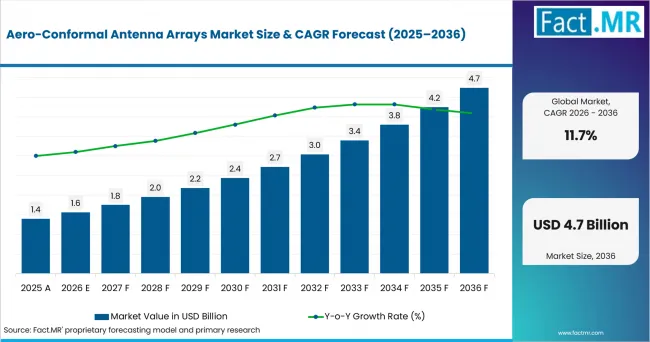
Aero Conformal Antenna Arrays Market Value Analysis | Source: Fact.MR
What are the defining numbers behind Aero-Conformal Antenna Arrays Market growth?
An absolute opportunity of USD 3.2 Billion between 2026 and 2036.
- Demand Drivers in the Market
- Radar teams need beam steering for search and tracking across tight aircraft surfaces. AESA designs are forecast to remain central because electronic steering moves the beam without a rotating array.
- Embedded arrays are forecast to give designers more sites for warning and sensing while keeping the outer aircraft shape clean. They can also support jamming functions in areas where free surface space is tight.
- SATCOM and data-link teams need reliable links from shallow fit spaces. Flush arrays are forecast to support these links where large external hardware would add drag or conflict with mission gear.
- Special-mission aircraft and uncrewed aircraft are forecast to favor smaller sensors that reduce weight and leave more room for other mission equipment. Lower mass can ease the task of fitting more sensors on a small airframe. It can also leave more room for power units and other mission gear.
- Key Segments Analyzed
- By Conformal Geometry: Fuselage conformal is forecast to hold 39.0% share in 2026 because the fuselage offers broad surface area and several possible array sites.
- By Array Technology: AESA is forecast to account for 33.0% share in 2026 owing to electronic beam steering and its fit with multifunction radar and EW architectures.
- By RF Band: X band is forecast to represent 29.0% share in 2026 due to its established use in airborne radar where compact array dimensions and target resolution are valuable.
- By Aircraft Function: Radar is forecast to capture 36.0% share in 2026 as surveillance and fire-control missions continue to require AESA arrays with precise beam control.
- Analyst Opinion at Fact.MR
- Fact.MR Principal Consultant Shambhu Nath Jha states, “Commercial results depend on how well an array works after it is fitted to the airframe surface. The market is forecast to reward firms that prove RF results together with cooling and aircraft fit. Firms that link array design with flight clearance and mission electronics are forecast to have a clearer route to aircraft programs.”
- Strategic Implications
- Array firms should design around the host airframe from the start. Curved surfaces and fit depth affect how an array can be fitted and tested. Radome materials and cooling routes need early planning so the design can move from lab tests to an approved aircraft fit.
- AESA developers should document beam results across each installed shape so aircraft teams can compare flush layouts with nose or podded arrays under the same mission needs.
- RF subsystem firms should plan radar and EW coexistence early because both functions can share limited aircraft space and spectrum.
- Airframe integrators should reserve array sites early in platform design because array placement affects several aircraft systems. Structural loads and RF coverage need to be reviewed together. Cooling routes and wiring access also need to be fixed before the flight clearance process begins.
Japan is forecast to post 12.5% CAGR through 2036 as fighter upgrade expands airborne RF needs. The USA is projected to record 12.2% as a large combat-aircraft fleet sustains radar and mission work. Germany is forecast to reach 11.9% through Eurofighter renewal. France is forecast at 11.6% as Rafale and airborne sensing programs advance. The UK is forecast at 11.3% as Typhoon radar upgrades support continued fit work.
How does the Aero-Conformal Antenna Arrays Market break down by segment?
Fuselage conformal is forecast to lead Conformal Geometry at 39.0% share in 2026; Radar is forecast to lead Aircraft Function at 36.0% share.
Which Conformal Geometry dominates?
Fuselage conformal is forecast to hold 39.0% share in 2026.
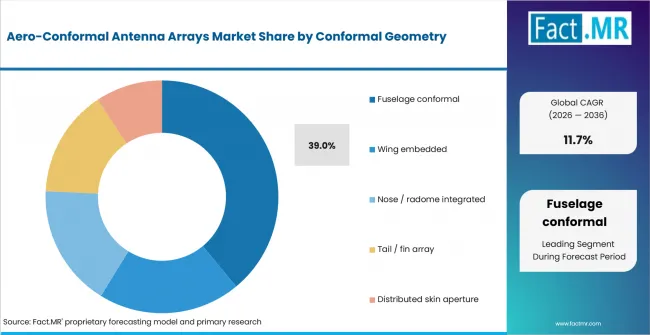
Aero Conformal Antenna Arrays Market Analysis By Conformal Geometry | Source: Fact.MR
Nose and radome-fitted arrays remain useful for forward radar tasks where a clear field of view supports detection and tracking. Wing or tail placements can handle other RF functions, helping preserve nose space for the primary radar role.
What leads the Array Technology segment?
AESA is forecast to account for 33.0% share in 2026.
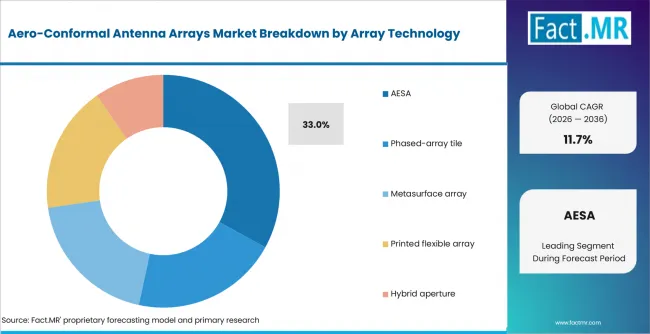
Aero Conformal Antenna Arrays Market Analysis By Array Technology | Source: Fact.MR
Electronic beam steering supports curved aircraft surfaces without mechanical movement. Phased-array tiles provide modular coverage, while printed flexible arrays fit thin structures. This flexibility allows RF functions to be distributed across several airframe locations instead of one nose-mounted unit.
How does RF Band shape demand?
X band is forecast to represent 29.0% share in 2026.
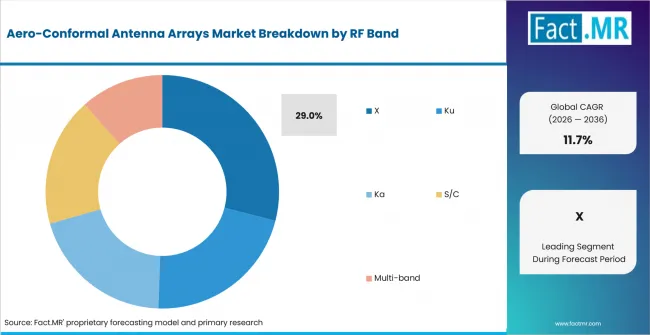
Aero Conformal Antenna Arrays Market Analysis By Rf Band | Source: Fact.MR
Band selection depends on mission role, available aircraft surface area, and power limits. These factors shape which array design can support each frequency range while maintaining the required balance between coverage, integration, and overall RF performance.
What supports Radar within Aircraft Function?
Radar is forecast to capture 36.0% share in 2026.
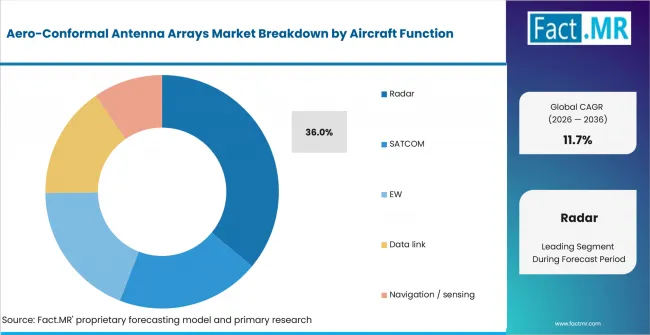
Aero Conformal Antenna Arrays Market Analysis By Aircraft Function | Source: Fact.MR
Radar arrays remain central to detection and tracking, while data-link arrays support communication between aircraft and ground stations with limited exposed hardware. Navigation and sensing functions can use smaller arrays placed across multiple airframe locations to support broader mission needs.
What is accelerating Aero-Conformal Antenna Arrays Market adoption, and what is holding it back?
Airframe fit and multifunction RF demand support adoption; flight-clearance work and thermal limits shape deployment timing.
Drivers Impact Analysis
| DRIVER | (~) % IMPACT ON CAGR | GEOGRAPHIC RELEVANCE | IMPACT TIMELINE |
|---|---|---|---|
| Low-profile aircraft fit | +1.3% | Global | Short term (<= 2 years) |
| AESA radar upgrades | +1.0% | North America, Europe, East Asia | Medium term (2-4 years) |
| Airborne EW growth | +0.8% | North America, Europe | Medium term (2-4 years) |
| SATCOM and data-link fit | +0.6% | Global | Long term (>= 4 years) |
Opportunity Impact Analysis
| OPPORTUNITY | (~) % IMPACT ON CAGR | GEOGRAPHIC RELEVANCE | IMPACT TIMELINE |
|---|---|---|---|
| Distributed skin arrays | +0.8% | Global | Long term (>= 4 years) |
| Multi-band flush arrays | +0.6% | North America, Europe, East Asia | Medium term (2-4 years) |
| Special-mission aircraft retrofits | +0.5% | Europe, North America | Medium term (2-4 years) |
| Flexible and printed arrays | +0.4% | Global | Long term (>= 4 years) |
Restraints Impact Analysis
| RESTRAINT | (~) % IMPACT ON CAGR | GEOGRAPHIC RELEVANCE | IMPACT TIMELINE |
|---|---|---|---|
| Flight and mission clearance | -0.6% | Global | Short term (<= 2 years) |
| Heat and power limits | -0.5% | Global | Medium term (2-4 years) |
| Curved-array calibration | -0.4% | Global | Medium term (2-4 years) |
| Long aircraft program cycles | -0.3% | North America, Europe, East Asia | Long term (>= 4 years) |
Which countries are scaling the Aero-Conformal Antenna Arrays Market through 2036?
- The displayed country range spans 1.2 percentage points from Japan at 12.5% CAGR to the UK at 11.3%.
- Japan remains 0.3 percentage point above the USA as fighter upgrade broadens airborne RF fit work.
- The USA remains 0.3 percentage point above Germany as fleet scale supports radar and mission upgrades.
- Germany remains 0.3 percentage point above France through Eurofighter renewal and EW fit.
- France remains 0.3 percentage point above the UK as Rafale and airborne sensing programs sustain aircraft RF work.
- The UK closes the displayed range as Typhoon radar upgrades maintain demand for airborne array fit.
Comparable CAGRs can create different entry conditions because aircraft fleets and upgrade schedules differ by country. Flight-clearance rules and mission priorities further shape when arrays enter each program. Full report coverage includes North America; Latin America; Western Europe; Eastern Europe; East Asia; South Asia & Pacific; and Middle East & Africa.
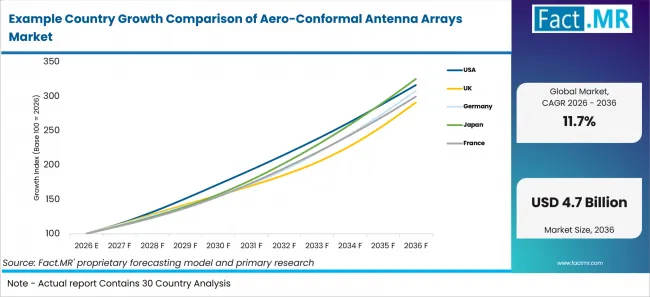
Example Country Growth Comparison Of Aero Conformal Antenna Arrays Market | Source: Fact.MR
| Country | CAGR (2026-2036) |
|---|---|
| Japan | 12.5% |
| United States | 12.2% |
| Germany | 11.9% |
| France | 11.6% |
| United Kingdom | 11.3% |
What supports USA adoption?
12.2% CAGR, supported by fighter-fleet scale and airborne radar upgrade.
The U.S. market is forecast to benefit from a large fighter fleet that receives radar and EW upgrades over long service lives. In June 2026, the U.S. Government Accountability Office reported that the Department of Defense operated and sustained more than 800 U.S. F-35 aircraft. That fleet creates repeated aircraft-fit work across new builds and sustainment programs. Array firms are forecast to focus on RF results and thermal control while matching each platform’s structural and low-observable surface needs.
How is the United Kingdom developing demand?
11.3% CAGR, backed by Typhoon radar upgrades and combat-aircraft renewal.
The UK outlook is tied to combat-aircraft upgrades and a broad military aviation base. The Ministry of Defence reported 507 fixed-wing platforms at April 1, 2026, with Typhoon the most common type at 124 aircraft. These fleet numbers support continued aircraft-fit work for radar, electronic warfare, and other mission systems.
What is supporting Germany’s adoption?
11.9% CAGR, led by Eurofighter renewal and EW fit.
Germany is forecast to gain from new Eurofighter production and more capable airborne EW. The Bundeswehr said Germany will receive 20 Eurofighter Tranche 5 aircraft. It also said the German aircraft are planned to receive the Arexis self-protection system with future AI capabilities.
How does Japan perform?
12.5% CAGR, shaped by fighter upgrade and dense mission-system fit.
Japan is forecast to post 12.5% CAGR as fighter programs increase the need for compact radar and EW fit. Japan’s Ministry of Defense budgeted for eight F-35A aircraft in FY2025 and said the aircraft have advanced electronic-warfare capabilities. The same budget says domestic companies will continue final assembly and checkout for F-35As acquired from FY2023 through FY2027.
What supports France adoption?
11.6% CAGR, driven by Rafale work and airborne sensing programs.
France is forecast to sustain demand through Rafale upgrades and wider airborne sensing work. In June 2025, France’s Ministry of the Armed Forces reported that the Rafale F5 would feature a new radar, enhanced connectivity, and greater emphasis on electronic warfare. These upgrades keep radar and EW integration active in French combat-aircraft plans.
Who leads the Aero-Conformal Antenna Arrays Market?
RTX and Northrop Grumman are active in airborne radar and electronic-warfare systems for fighter aircraft. L3Harris supplies the Viper Shield electronic-warfare suite, which is designed to interoperate with the APG-83 AESA radar on the F-16. Competitive differentiation is expected to depend on RF performance, aircraft integration, size and weight, power and cooling requirements, and the depth of ground and flight qualification.
In February 2025, L3Harris reported that Viper Shield completed its first flight on a single-seat Block 70 F-16. The flight included tests of compatibility with the mission computer and other avionics subsystems, together with interoperability testing involving the APG-83 AESA fire-control radar. Northrop Grumman also provides the APG-83 SABR AESA radar and IVEWS electronic-warfare suite for the F-16, with the two systems designed for digital interoperability.
Which companies are the key providers?
Companies profiled include RTX; Northrop Grumman; L3Harris; BAE Systems; ThinKom Solutions.
- RTX
- Northrop Grumman
- L3Harris
- BAE Systems
- ThinKom Solutions
Bibliography
- European Space Agency. (2025, August 12). CREAM: Avoiding collisions in space through automation.
- Moog Inc. (2025, May 28). Air Force Research Laboratory awards Moog contract to develop new multimode propulsion system to enhance dynamic space operations.
- L3Harris Technologies. (2025, April 8). Mission flexibility enabled with new L3Harris family of in-space engines.
- Georgi, P., & Surfield, C. (2025, March 31). New and revised statistics for the U.S. space economy, 2012–2023. U.S. Bureau of Economic Analysis.
- Ministry of Defence. (2026, August 20). UK armed forces equipment and formations 2026.
- Bundeswehr. (2025, October 15). Eurofighter Tranche 5 geht in Produktion: Deutschland erhält 20 Stück.
- Ministry of Defense, Japan. (2025, April 11). Progress and budget in fundamental reinforcement of defense capabilities: Overview of FY2025 budget.
- Ministère des Armées. (2025, June 17). Rafale standard F5 : à la pointe de la technologie.
- L3Harris Technologies. (2025, February 4). US Air Force completes first flight of L3Harris Viper Shield electronic warfare system.
This Report Answers
- The report explains where flush arrays fit across aircraft surfaces and identifies the shape that leads the 2026 segment mix.
- The segment review compares AESA with other array designs and RF bands. It also covers aircraft uses while keeping each category within the defined airborne array boundary.
- The country review connects the listed CAGRs with current fighter fleets and official program work that can shape the timing of airborne array fit.
- The firm review covers active providers in airborne radar and EW using current first-party evidence.
- The scope review keeps the market boundary focused on arrays sold for aircraft-fit roles while ground and naval systems remain separate categories
What does the Aero-Conformal Antenna Arrays Market cover?
The market covers airborne antenna arrays that are shaped to the aircraft or embedded within its external geometry. It includes radar and EW arrays plus SATCOM and data-link arrays. Related coverage includes aero-conformal ESA antennas, airborne radar systems, and military antenna systems.
The assessment also considers nearby mission functions covered in electronic warfare systems, aircraft sensor platforms, and satellite communication equipment. These links provide adjacent design context while the sizing in this report remains limited to aero-conformal antenna arrays.
What is included in the scope?
The scope includes fuselage and wing fits as well as nose or radome arrays. Tail and skin locations are covered when the antenna forms part of the aircraft. Adjacent context includes invisible aero-conformal arrays and combat aircraft swarm radars.
What is excluded from the scope?
The scope excludes ground radar arrays and shipboard antennas. Stand-alone satellite terminals and telecom base-station arrays also fall outside the defined boundary. Broader aircraft context is covered by surveillance drone systems and aviation digital components.
How Was the Analysis Built?
The analysis draws on 120+ sources, 35+ company portfolios, 25+ countries, and more than 20 industry interviews.
- Primary Research: Primary research includes discussions with manufacturers, service providers, technology developers, distributors, end users, and subject-matter experts. These conversations examine purchasing priorities, product adoption, operational challenges, approval requirements, competitive positioning, and the factors that influence wider market acceptance.
- Desk Research: Desk research covers government statistics, regulatory publications, company filings, trade data, technical studies, industry associations, standards, public policy, and other authoritative sources. Every source used in the analysis is documented in the bibliography.
- Market Sizing and Forecasting: Market estimates combine historical performance, demand indicators, pricing and volume trends, segment shares, company participation, country-level growth, adoption patterns, investment activity, and barriers to market expansion.
- Data Validation and Update Cycle: Findings are validated by comparing primary interviews with public data, company activity, regulatory changes, trade patterns, and industry developments. Regular updates review new product launches, capacity changes, partnerships, approvals, and shifts in commercial adoption.
What is the report’s scope and coverage?
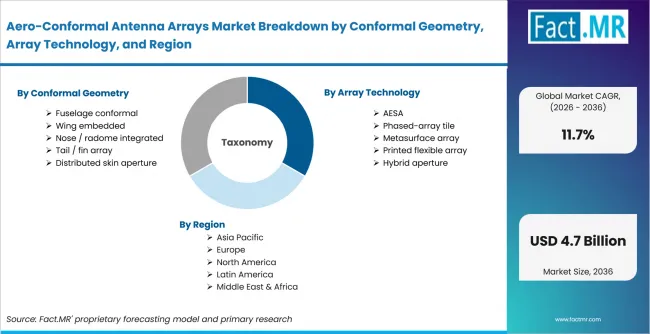
Aero Conformal Antenna Arrays Market Breakdown By Conformal Geometry, Array Technology, And Region | Source: Fact.MR
| Attribute | Details |
|---|---|
| Quantitative Units | USD Billion |
| Market Definition | Airborne arrays shaped to aircraft surfaces or built into them for radar, EW, satellite links, data links, navigation, and sensing. The design limits exposed hardware that can add drag. |
| Conformal Geometry | Fuselage conformal; Wing embedded; Nose / radome integrated; Tail / fin array; Distributed skin aperture |
| Array Technology | AESA; Phased-array tile; Metasurface array; Printed flexible array; Hybrid aperture |
| RF Band | X; Ku; Ka; S/C; Multi-band |
| Aircraft Function | Radar; SATCOM; EW; Data link; Navigation / sensing |
| Regions Covered | North America; Latin America; Western Europe; Eastern Europe; East Asia; South Asia & Pacific; Middle East & Africa |
| Countries Covered | United States; United Kingdom; Germany; Japan; France |
| Key Companies Profiled | RTX; Northrop Grumman; L3Harris; BAE Systems; ThinKom Solutions |
| Forecast Period | 2026 to 2036 |
| Approach | Hybrid top-down and bottom-up review using aircraft programs, airborne RF fit, segment mix, country programs, official evidence, and company portfolios. |
How is the market segmented?
-
By Conformal Geometry:
- Fuselage conformal
- Wing embedded
- Nose / radome integrated
- Tail / fin array
- Distributed skin aperture
-
By Array Technology:
- AESA
- Phased-array tile
- Metasurface array
- Printed flexible array
- Hybrid aperture
-
By RF Band:
- X
- Ku
- Ka
- S/C
- Multi-band
-
By Aircraft Function:
- Radar
- SATCOM
- EW
- Data link
- Navigation / sensing
-
By Region:
- North America
- Latin America
- Western Europe
- Eastern Europe
- East Asia
- South Asia & Pacific
- Middle East & Africa