- Base Value(2026): 2.2 Bn
- Estimated Value(2026): 2.2 Bn
- Forecast Value (2036): 4.6 Bn
- CAGR (2026 - 2036): 7.6%
Combat Aircraft Swarm Radars Market Forecast and Outlook 2026 to 2036
The global market for combat aircraft radars designed to counter drone swarms is evolving rapidly, projected to grow from USD 2.21 billion in 2026 to USD 4.60 billion by 2036, at a 7.6% CAGR.
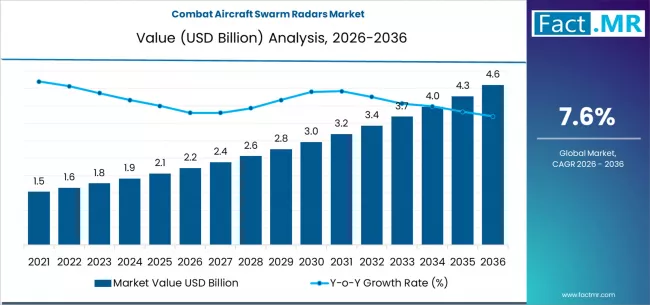
Combat Aircraft Swarm Radars Market Market Value Analysis | Source: Fact.MR
Summary of Combat Aircraft Swarm Radars Market
- Market Snapshot
- Global combat aircraft swarm radars market revenue stood at USD 2.21 billion in 2026 and is forecast to reach USD 4.60 billion by 2036.
- At a 7.6% CAGR from 2026 to 2036, this market is set to expand ~2.1x in value, adding USD 2.39 billion in absolute opportunity.
- Growth is being driven by the increasing threat of drone swarms and the shift toward counter-UAS capabilities in modern air combat.
- Swarm radar systems are emerging as critical technologies, enabling simultaneous detection, classification, and tracking of multiple low-altitude aerial threats.
- Demand and Growth Drivers
- Rising proliferation of drone swarm warfare is accelerating demand for advanced radar systems.
- Increasing integration of AI and machine learning into radar systems is enhancing real-time threat detection and prioritization.
- Defense modernization programs across major economies are driving adoption of next-generation radar technologies.
- Need for systems that provide:
- Multi-target tracking capability
- Real-time threat classification
- High-resolution detection of small UAVs
- Low probability of intercept and enhanced stealth compatibility
- Transition toward software-defined and multi-function RF systems is improving adaptability against evolving swarm tactics.
- Product and Segment View
- Active Electronically Scanned Array (AESA) holds 44% of radar type share in 2026, emerging as the leading segment due to superior multi-target tracking and resistance to jamming.
- Swarm Detection & Counter-UAS accounts for 52% of application share in 2026, positioning it as the dominant segment.
- Key product categories include:
- Active Electronically Scanned Array (AESA)
- Passive Electronically Scanned Array (PESA)
- Hybrid AESA-PESA
- AI-assisted phased array systems
- Others
- Geography and Competitive Outlook
- Growth is supported across North America, Europe, and Asia Pacific, driven by defense modernization and increasing drone threat scenarios.
- Key growth markets and CAGR: India (8.90%), China (8.20%), United States (6.90%), UK (7.00%), Germany (6.60%).
- Market expansion is closely tied to:
- Increasing drone swarm threats
- AI-driven radar advancements
- Upgrades to existing fighter aircraft platforms
- Key companies active in this market include: Lockheed Martin Corporation, Northrop Grumman, Raytheon Technologies (RTX), BAE Systems, Thales Group.
Combat Aircraft Swarm Radars Market - At a Glance
| Attribute | Details |
|---|---|
| Market Value 2026 | USD 2.21 billion |
| Market Value 2036 | USD 4.60 billion |
| Absolute Dollar Opportunity 2026–2036 | USD 2.39 billion |
| Total Growth 2026–2036 | 108.1% |
| CAGR 2026–2036 | 7.6% |
| Growth Multiple | ~2.1x |
| Key Demand Theme | Increasing need for advanced radar systems to detect and counter drone swarms |
| Leading Segment by Radar Type (2026) | AESA |
| Segment Share (2026) | 44% |
| Leading Segment by Application (2026) | Swarm Detection & Counter-UAS |
| Segment Share (2026) | 52% |
| Key Growth Regions | North America, Europe, Asia Pacific |
| Country CAGRs | India 8.90%, China 8.20%, USA 6.90%, UK 7.00%, Germany 6.60% |
| Top Companies | Lockheed Martin, Northrop Grumman, Raytheon Technologies (RTX), BAE Systems, Thales Group |
| Segmentation by Radar Type | AESA, PESA, Hybrid AESA-PESA, AI-Assisted Phased Array, Others |
| Segmentation by Application | Swarm Detection & Counter-UAS, Air-to-Air Tracking, Terrain Following, Electronic Warfare |
| Segmentation by Region | North America, Latin America, Europe, Asia Pacific, MEA |
Source: Fact.MR analysis. Updated Apr 6, 2026
Growth is driven by the urgent tactical shift from traditional air dominance to defending against asymmetric, low-cost swarm threats. Modern radars are no longer just for tracking individual high-value targets; they must detect, classify, and prioritize dozens of small, low-flying drones simultaneously.
The core trend is the integration of artificial intelligence and machine learning directly into the radar's processing chain. AI enables real-time discrimination of swarm members from clutter, predicts swarm behavior, and assigns threat levels to guide kinetic or electronic countermeasures. This capability is becoming a critical differentiator for next-generation fighter aircraft and upgrade programs.
Development is focused on achieving greater power efficiency, wider scan volumes, and lower probability of intercept to maintain aircraft stealth while managing the swarm threat. The transition is from hardware-defined systems to software-defined, updateable sensors where new threat libraries and AI models can be deployed to counter evolving swarm tactics.
India leads growth with an 8.90% CAGR, driven by its active border security challenges and ambitious indigenous fighter program. China follows at 8.20%, focusing on integrating advanced swarm detection into its expanding fleet of stealth aircraft. Markets in the US and Europe are characterized by upgrades to existing platforms like the F-35, Eurofighter, and Rafale to maintain technological overmatch.
Category
| Category | Segments |
|---|---|
| Radar Type | Active Electronically Scanned Array (AESA), Passive Electronically Scanned Array (PESA), Hybrid AESA-PESA, Phased Array with AI-Assisted Swarm Detection, Others |
| Application | Swarm Detection & Counter-UAS, Air-to-Air Target Tracking, Terrain Following & Obstacle Avoidance, Electronic Warfare Support |
| Region | North America, Latin America, Western Europe, Eastern Europe, East Asia, South Asia & Pacific, MEA |
Source: Fact.MR analysis. Updated Apr 6, 2026
Segmental Analysis
By Radar Type, Which Technology is Foundational?
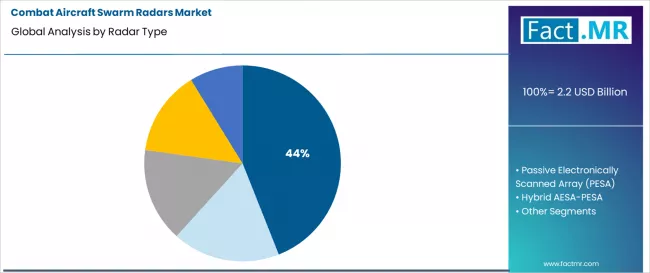
Combat Aircraft Swarm Radars Market Analysis By Radar Type | Source: Fact.MR
Active electronically scanned array (AESA) radar holds a dominant 44% share. Its solid-state, software-defined architecture is ideally suited for swarm warfare. AESA provides the agile, multi-mode beam steering needed to simultaneously track a high volume of targets while performing other functions like communications or electronic attack. Its reliability and resistance to jamming make it the indispensable core technology upon which advanced AI-driven swarm detection algorithms are built.
By Application, Which Mission is Defining Demand?

Combat Aircraft Swarm Radars Market Analysis By Application | Source: Fact.MR
Swarm detection & counter-UAS is the defining application, commanding a 52% share. This reflects the paradigm shift in air combat priorities. The technical challenge of distinguishing a small drone from a bird or ground clutter, and then tracking hundreds of such objects in a coordinated swarm, is the primary driver for radar software and processing upgrades across both new and legacy combat aircraft platforms.
What are the Drivers, Restraints, and Key Trends of the Combat Aircraft Swarm Radars Market?
The proliferation of commercially available drone technology and the demonstrated tactical threat of drone swarms in recent conflicts. This has created an immediate and unambiguous requirement for air platforms to defend themselves and high-value assets from saturation attacks.
The extreme technical difficulty and associated cost of developing and integrating AI/ML processors that can operate in the size, weight, and power-constrained environment of a fighter jet’s radar, while meeting the rigorous safety and certification standards of military aviation.
The move towards multi-function RF systems where the AESA radar acts as a central hub not only for sensing but also for electronic warfare (jamming, deception) and secure datalink communications, creating a unified "sense-and-effector" against swarms.
Analysis of the Market by Key Countries
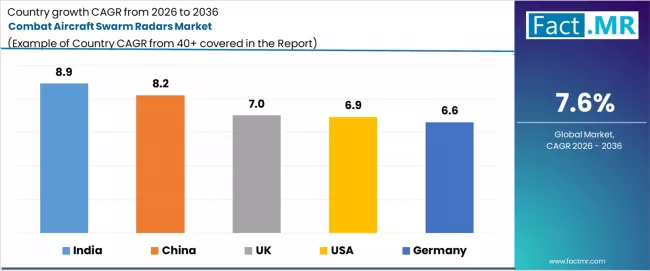
Combat Aircraft Swarm Radars Market Cagr Analysis By Country | Source: Fact.MR
| Country | CAGR (2026-2036) |
|---|---|
| India | 8.90% |
| China | 8.20% |
| UK | 7.00% |
| USA | 6.90% |
| Germany | 6.60% |
Source: Fact.MR analysis. Updated Apr 6, 2026
What is Driving India's Investment in Indigenous Swarm Defense Capabilities?
India's leading 8.90% CAGR is fueled by a direct response to regional security dynamics and a strategic push for self-reliance. The imperative to protect airspace from potential saturation attacks drives significant investment.
This focus is channeled into two primary streams: outfitting the indigenous TEJAS MK-1A and upcoming MK-2 fighters with advanced, domestically developed AESA radars featuring AI-driven swarm processing, and pursuing comprehensive radar upgrade programs for its sizable fleet of Sukhoi and Mirage aircraft, often through technology-sharing partnerships with global OEMs.
How is China Integrating Swarm Detection Across Its Modernizing Fighter Fleet?
China's 8.20% growth stems from a systematic, network-centric approach to air defense. The development and integration of advanced AESA radars are synchronized across platforms like the J-20 stealth fighter, J-10C, and J-16 to create a unified sensor grid.
Domestic R&D prioritizes AI-enabled sensor fusion and data-linking, aiming to seamlessly integrate the radar picture from a single aircraft into a broader battle management system. This allows for collaborative engagement, where one platform detects a swarm and cues weapons from another, creating a resilient kill web.
Why is USA’s Market Focused on Upgrading Both Legacy and 5th-Generation Platforms?
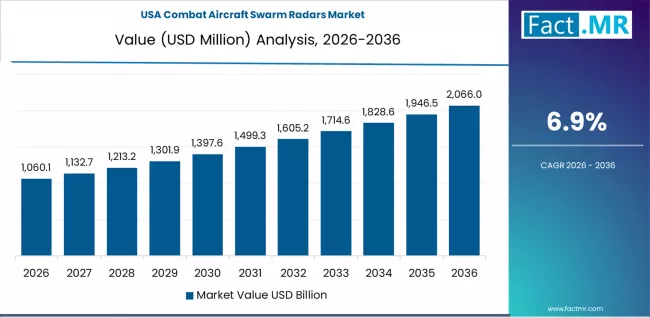
Combat Aircraft Swarm Radars Market Country Value Analysis | Source: Fact.MR
The USA's 6.90% CAGR reflects a two-pronged strategy to maintain overwhelming technological advantage. For 5th-generation assets like the F-35, growth is driven by continuous capability updates via software, enhancing the existing APG-81 radar's swarm discrimination algorithms.
Concurrently, significant investment flows into upgrading 4th-generation platforms like the F-15EX and F-16 with new-generation AESA radars (e.g., APG-82, APG-83). These upgrades are designed with open-system architectures, allowing for future AI processor inserts to counter evolving swarm tactics without a full hardware replacement.
What Role does the UK Play in Consortium-Based Radar Modernization?
The UK's 7.00% growth is deeply tied to its leadership in multinational European defense programs. The core of its market activity involves the ongoing Captor-E AESA radar integration onto the Eurofighter Typhoon, which includes specific software development for swarm detection.
The UK is a pivotal partner in the Future Combat Air System (FCAS/GCAP) program, where it collaborates with Italy and Japan to define and develop the next-generation radar system, with multifunction swarm defense as a foundational operational requirement from the outset.
How is Germany's Expertise Shaping Next-Generation European Swarm Defense Radars?
Germany's 6.60% CAGR is anchored in its engineering leadership within Europe's defense industrial base. As a core member of the Eurofighter consortium, German industry is crucial for the development and integration of advanced radar modes for the Captor-E system.
Germany's market influence is concentrated on the FCAS program, where its expertise in sensor technology, electronic warfare, and systems integration is directed toward creating a revolutionary System of Systems approach. The focus is on developing a radar that functions not merely as a sensor, but as the central node for electromagnetic spectrum dominance against swarm threats.
Competitive Landscape of the Combat Aircraft Swarm Radars Market
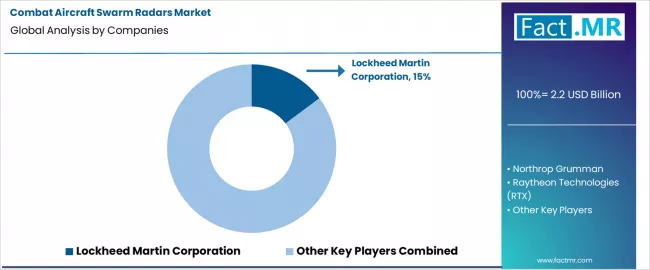
Combat Aircraft Swarm Radars Market Analysis By Company | Source: Fact.MR
Established defense prime contractors who serve as system integrators for major fighter programs dominate the landscape. Success depends on mastery of AESA technology, AI/ML algorithm development, and the ability to miniaturize high-performance computing for airborne environments.
| Strategic Recommendation | Rationale |
|---|---|
| Invest in Open, Modular Radar Architectures | Develop systems that allow for drop-in replacement of processor and AI modules to extend platform life and simplify upgrades, appealing to cost-conscious militaries. |
| Forge Alliances with AI Software Specialists | Partner with agile tech firms specializing in machine learning and cognitive EW to accelerate algorithm development and stay ahead of evolving swarm tactics. |
| Develop and Market Retrofit Solutions | Create scalable AESA back-ends and processor upgrades for legacy fighter fleets, offering a cost-effective path to enhanced swarm defense for operators not buying new jets. |
| Demonstrate Integration with Broader Kill Webs | Prove how the radar's tracking data seamlessly integrates with ground-based C2, missile systems, and directed energy weapons to enable multi-domain swarm defeat. |
Source: Fact.MR analysis. Updated Apr 6, 2026
Key Players in the Combat Aircraft Swarm Radars Market
- Lockheed Martin Corporation
- Northrop Grumman
- Raytheon Technologies (RTX)
- BAE Systems
- Thales Group
References
- Defence Advanced Research Projects Agency (DARPA). (2024). Algorithms for Counter-Swarm Systems (ACS). Program Information.
- Kendall, F. (2023). Department of the Air Force Posture Statement. U.S. Department of the Air Force.
- Moscow Institute of Physics and Technology. (2023). Signal Processing for Dense Target Environments in AESA Radars. Journal of Communications Technology and Electronics, 68(4).
- North Atlantic Treaty Organization (NATO). (2024). STO Lecture Series on Counter-Unmanned Aircraft Systems (C-UAS). NATO Science & Technology Organization.
- Wang, H., & Liu, Z. (2023). Cognitive Radar and Machine Learning for Autonomous Target Recognition. Artech House.
Segmentation
Scope of Report
| Items | Values |
|---|---|
| Quantitative Units | USD Billion |
| Radar Type | AESA, PESA, Hybrid AESA-PESA, Phased Array with AI-Assisted Swarm Detection, Others |
| Application | Swarm Detection & Counter-UAS, Air-to-Air Target Tracking, Terrain Following, EW Support |
| Key Countries | India, China, USA, UK, Germany |
| Key Companies | Lockheed Martin, Northrop Grumman, Raytheon Technologies, BAE Systems, Thales Group |
| Additional Analysis | Technical analysis of AI/ML processing requirements for real-time swarm discrimination in radar returns; comparative assessment of sensor fusion techniques (radar, EO/IR, ESM) for swarm identification; cost-benefit analysis of new-build vs. retrofit radar solutions for legacy fighter fleets; examination of cybersecurity vulnerabilities in networked, software-defined radar systems; impact of electronic warfare and low-probability-of-intercept (LPI) requirements on radar design for swarm engagement. |
Source: Fact.MR analysis. Updated Apr 6, 2026
Market by Segments
-
Radar Type :
- Active Electronically Scanned Array (AESA)
- Passive Electronically Scanned Array (PESA)
- Hybrid AESA-PESA
- Phased Array with AI-Assisted Swarm Detection
- Others
-
Application :
- Swarm Detection & Counter-UAS
- Air-to-Air Target Tracking
- Terrain Following & Obstacle Avoidance
- Electronic Warfare Support
-
Region :
- North America
- USA
- Canada
- Latin America
- Brazil
- Mexico
- Argentina
- Rest of Latin America
- Western Europe
- Germany
- UK
- France
- Spain
- Italy
- BENELUX
- Rest of Western Europe
- Eastern Europe
- Russia
- Poland
- Czech Republic
- Rest of Eastern Europe
- East Asia
- China
- Japan
- South Korea
- Rest of East Asia
- South Asia & Pacific
- India
- ASEAN
- Australia
- Rest of South Asia & Pacific
- MEA
- Saudi Arabia
- UAE
- Turkiye
- Rest of MEA
- North America
Frequently Asked Questions
How big is the combat aircraft swarm radars market in 2026?
What will be the size of combat aircraft swarm radars market in 2036?
How much will be the combat aircraft swarm radars market growth between 2026 and 2036?
What are the key product types in the combat aircraft swarm radars market?
Which application segment to contribute significant share in the combat aircraft swarm radars market in 2026?
Who worked on this report


Preview the report firsthand - request a free sample
Free SampleGet the brochure for pricing and purchase details
Download PDF