- Base Value(2025): 21.0 Bn
- Estimated Value(2026): 22.1 Bn
- Forecast Value (2036): 37.7 Bn
- CAGR (2026 - 2036): 5.5%
Electronic Warfare Market Forecast and Outlook By Fact.MR
In 2025, the electronic warfare market was valued at USD 21.0 billion. Based on Fact.MR analysis, demand for electronic warfare systems is estimated to grow to USD 22.1 billion in 2026 and USD 37.7 billion by 2036. FACT.MR projects a CAGR of 5.5% during the forecast period.
The market is expected to generate an absolute dollar opportunity of USD 15.6 billion between 2026 and 2036. This represents a transformational expansion reflecting accelerating defence budget allocations to EW across NATO members, Indo-Pacific partners, and emerging military modernisation programmes. Growth is moderated by lengthy procurement cycles, export control restrictions on advanced EW technologies under ITAR and EAR regulations, and integration complexity of next-generation multi-domain systems into legacy platforms.
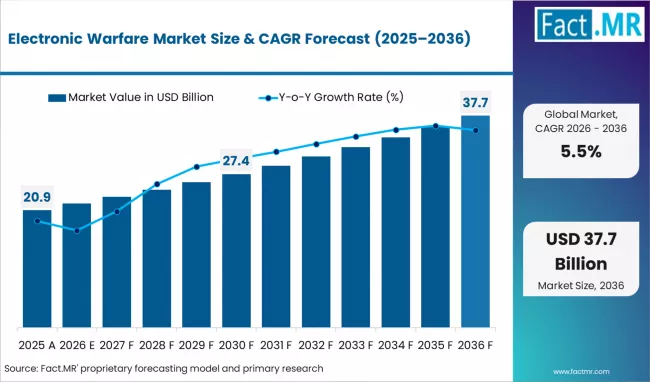
Electronic Warfare Market Market Value Analysis | Source: Fact.MR
| Metric | Value |
|---|---|
| Estimated Value in 2026 | USD 22.1 billion |
| Forecast Value in 2036 | USD 37.7 billion |
| Forecast CAGR (2026 to 2036) | 5.5% |
Source: Fact.MR analysis. Updated Mar 24, 2026
Geopolitical tensions and lessons from active conflict theatres are reshaping defence procurement priorities toward spectrum denial, electronic protection, and signals intelligence. The Russia-Ukraine conflict demonstrated the operational impact of EW on modern battlefield outcomes, accelerating EW budget line-item growth across European NATO members and Indo-Pacific nations. Unmanned platform EW integration and directed energy weapon development are defining the next investment cycle.
Country growth reflects defence modernisation pace, threat environment intensity, and indigenous EW capability investment. India leads at 10.9% CAGR driven by the Ministry of Defence's Make in India defence manufacturing push and active border threat requirements. China follows at 10.6% through the People's Liberation Army's multi-domain warfare doctrine investment. Japan records 9.5% through rising defence budgets under the 2022 National Security Strategy revision targeting EW capability gaps. Australia posts 9.1% through AUKUS technology sharing and Defence Strategic Review EW investment mandates. Germany grows at 9.0% as NATO commitments drive Bundeswehr spectrum modernisation. The United States maintains 9.9% driven by continuous DoD EW Roadmap programme funding and next-generation airborne EW platform upgrades.
Summary of Electronic Warfare Market
- Market Definition
- Electronic warfare encompasses electromagnetic spectrum exploitation, denial, and protection systems including jammers, radar warning receivers, and directed energy weapons deployed across airborne, naval, ground, and unmanned military platforms globally.
- Demand Drivers
- Rising defence budgets among NATO members and Indo-Pacific allies are increasing EW system procurement as electromagnetic spectrum dominance becomes a central military capability requirement.
- The PLA's multi-domain warfare doctrine investment is accelerating EW modernisation spending in China, compelling regional adversary nations to increase counter-EW capability acquisition.
- The U.S. DoD EW Roadmap and Next-Generation Jammer programme funding sustain continuous investment in advanced airborne and naval EW systems across the forecast period.
- Key Segments Analyzed
- By Category Type: Electronic protection leads with approximately 43% share in 2026 due to platform self-protection requirements across all military domains and growing investment in integrated defensive EW suites.
- By Product: Jammer systems dominate with approximately 37% share in 2026 as airborne and naval platforms prioritise active spectrum denial capability against evolving radar and missile guidance threats.
- By Platform: Airborne EW leads platform segmentation driven by high unit-value EW suite integration across fighter aircraft, transport, and UAV platforms and the criticality of air superiority in modern doctrine.
- Analyst Opinion at FACT.MR
- Shambhu Nath Jha, Principal Consultant at Fact.MR, opines, 'CXOs will find this report essential for understanding how software-defined EW architectures and directed energy investment are reshaping competitive positioning across the global defence electronics sector through 2036.'
- Strategic Implications
- Defence contractors should accelerate software-defined EW platform development to reduce programme refresh timelines and qualify for continuous capability upgrade contracts under open architecture procurement frameworks.
- Companies should pursue strategic partnerships with Indo-Pacific defence ministries, particularly India and Australia, where local content requirements and technology transfer policies create long-term programme incumbency opportunities.
- Manufacturers should invest in unmanned platform EW integration capabilities as UAV and UCAV EW mission payloads represent the fastest-growing addressable segment through 2036.
- Methodology
- Market sizing based on defence budget EW line-item allocations and programme acquisition values validated with official contract award notices.
- DoD budget documents, NATO programme data, SIPRI arms transfer records, and national defence white papers supported demand analysis.
- Forecasts incorporated platform procurement volumes, EW system unit price trends, defence budget trajectories, and expert interviews with programme managers.
Segmental Analysis
Electronic Warfare Market Analysis by Category Type
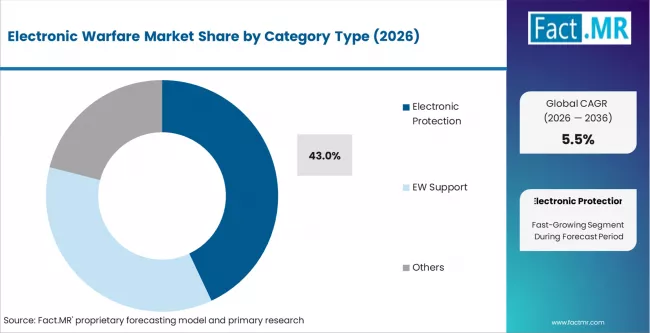
Electronic Warfare Market Analysis By Category Type | Source: Fact.MR
Based on FACT.MR's electronic warfare market report, electronic protection is estimated to hold approximately 43% share in 2026 due to universal platform self-protection requirements across naval, airborne, ground, and unmanned systems and mandatory integration of defensive EW suites on frontline military assets.
- BAE Systems Investment: In January 2025, BAE Systems was awarded a U.S. Navy contract for Next Generation Electronic Warfare suite development for surface combatants, reinforcing its position in integrated electronic protection and EW support systems. [5]
- Raytheon Technology Development: In 2024, Raytheon Technologies completed initial operational testing of its Next-Generation Jammer Mid-Band system for the U.S. Navy EA-18G Growler aircraft, advancing the programme toward full-rate production. [6]
- EW Support Adoption Trend: Defence procurement across European NATO members in 2024 prioritised EW support and signals intelligence systems following operational analysis from the Russia-Ukraine conflict highlighting the value of real-time spectrum awareness in contested environments. [7]
Electronic Warfare Market Analysis by Product
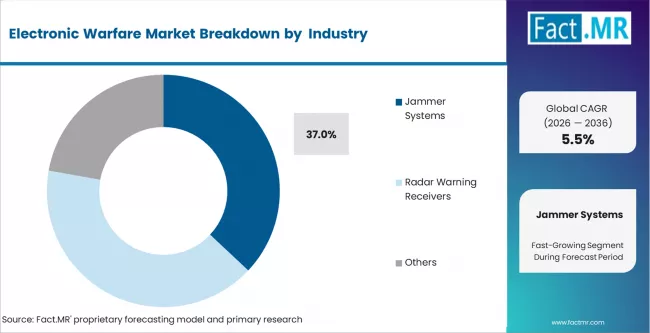
Electronic Warfare Market Analysis By Product | Source: Fact.MR
FACT.MR estimates jammer systems will account for approximately 37% share in 2026 due to high-priority spectrum denial requirements across airborne strike and naval surface platforms and sustained U.S., European, and Indo-Pacific procurement of active jamming capabilities.
- Northrop Grumman Jammer Investment: In 2024, Northrop Grumman announced expansion of its airborne electronic attack system production line in Rolling Meadows, Illinois, supporting increased jammer delivery volumes for U.S. and allied air force procurement programmes. [8]
- Directed Energy Weapons Development: In January 2025, Lockheed Martin demonstrated its HELIOS directed energy weapon system integrated with U.S. Navy destroyer platforms, advancing the operational readiness of high-power laser EW systems. [9]
- Radar Warning Receiver Programme Trend: India's Defence Research and Development Organisation issued procurement notices in 2024 for indigenised radar warning receiver integration on Tejas Mk1A fighters, reflecting the growing national EW programme investment driving India's 10.9% CAGR. [10]
Drivers, Restraints, and Opportunities
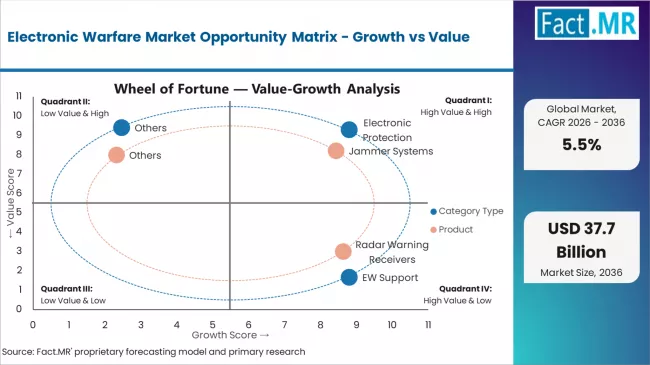
Electronic Warfare Market Opportunity Matrix Growth Vs Value | Source: Fact.MR
FACT.MR analysts observe that the electronic warfare market is structurally linked to geopolitical tension cycles and defence budget expansion phases.Traditional hardware-refresh procurement is giving way to software-defined open architecture programmes that allow faster capability upgrades at lower cost per sortie. Legacy fixed-function EW systems are being phased out as multi-domain integration requirements demand cognitive EW platforms capable of real-time spectrum adaptation. Higher per-unit system values for software-defined platforms partially offset volume constraints from longer procurement cycles.
- U.S. DoD EW Roadmap Investment: The U.S. Department of Defense published its updated Electronic Warfare Strategy in 2024, directing service branches to accelerate Next-Generation Jammer and airborne EW suite modernisation programmes. Raytheon and Northrop Grumman received major EW system development contract awards in fiscal year 2024 under these priorities. [2]
- India Make in India EW Defence Push: India's Ministry of Defence approved the indigenisation of electronic warfare systems under the Defence Acquisition Procedure 2020, with Tata Power SED and Bharat Electronics Limited receiving EW system supply contracts in 2024. This policy directly drives India's leading CAGR position through domestic production mandates. [3]
- NATO Spectrum Modernisation Mandate: NATO's Electronic Warfare Policy updated in 2024 directed member states to achieve interoperable EW capabilities by 2030, compelling Germany, France, and the United Kingdom to increase EW programme budgets. Germany's Bundeswehr issued EW system tender notices in late 2024 to fill identified spectrum capability gaps. [4]
Regional Analysis
The electronic warfare market is analysed across North America, Asia Pacific, Europe, Latin America, and Middle East and Africa, covering 40+ countries with distinct demand profiles shaped by defence budget size, threat environment intensity, indigenous EW capability levels, and alliance-driven technology access frameworks. The full report offers market attractiveness analysis based on defence modernisation timelines, programme pipeline data, and procurement cycle forecasts.
.webp "Top Country Growth Comparison Electronic Warfare Market Cagr (2026 2036)")
Top Country Growth Comparison Electronic Warfare Market Cagr (2026 2036) | Source: Fact.MR
| Country | CAGR (2026-2036) |
|---|---|
| India | 10.9% |
| China | 10.6% |
| USA | 9.9% |
| Japan | 9.5% |
| Australia | 9.1% |
| Germany | 9.0% |
Source: Fact.MR analysis. Updated Mar 24, 2026
Source: Fact.MR (FACT.MR) analysis, based on proprietary forecasting model and primary research
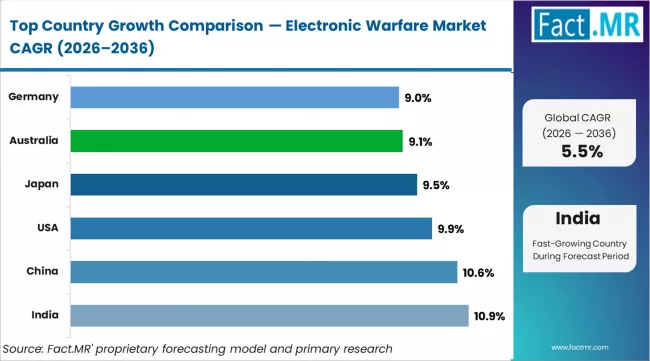
Electronic Warfare Market Cagr Analysis By Country | Source: Fact.MR
Asia Pacific Electronic Warfare Market Analysis
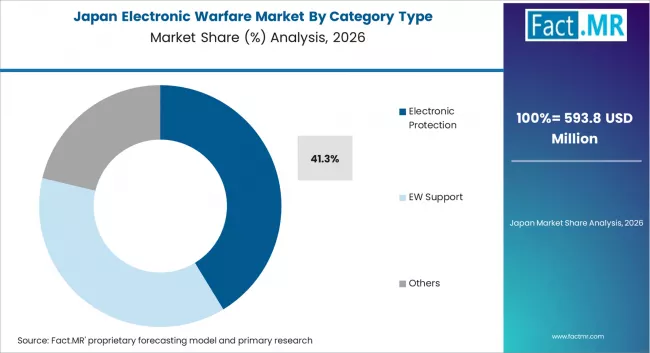
Electronic Warfare Market Japan Market Share Analysis By Category Type | Source: Fact.MR
Asia Pacific is the fastest-growing electronic warfare region, driven by rising defence budgets, geopolitical tensions, and rapid military modernisation across key economies. Major players include Tata Power SED, Bharat Electronics Limited, BAE Systems Australia, and Elbit Systems.
- India: Accelerated defence procurement and indigenous capability development are driving India’s electronic warfare demand, projected to grow at a CAGR of 10.9% through 2036. In 2024, the Ministry of Defence approved 14 EW-related programmes under DAP 2020, including a self-protection jammer contract awarded to Tata Power SED. The Indian Army also initiated procurement of vehicle-mounted EW systems to strengthen border surveillance and response capabilities.
- China: Large-scale military modernisation and domestic production expansion continue to shape China’s EW market, expected to grow at a CAGR of 10.6% through 2036. Under the 14th Five-Year Plan, the PLA is enhancing multi-domain EW capabilities. Companies such as AVIC and CETC expanded production to support advanced fighter and naval platform integration, alongside upgrades in AESA radar systems with embedded EW functions.
- Japan: Strategic defence investments and spectrum warfare prioritisation are supporting steady growth in Japan’s EW market, forecast at a CAGR of 9.5% through 2036. The 2025 defence budget allocated JPY 280 billion for EW development. Mitsubishi Electric secured contracts for airborne EW systems, while Toshiba is supplying electronic intelligence systems for ground forces.
FACT.MR's Asia Pacific coverage includes India, China, Japan, South Korea, Australia & New Zealand, ASEAN, and Rest of South Asia & Pacific.
North America Electronic Warfare Market Analysis
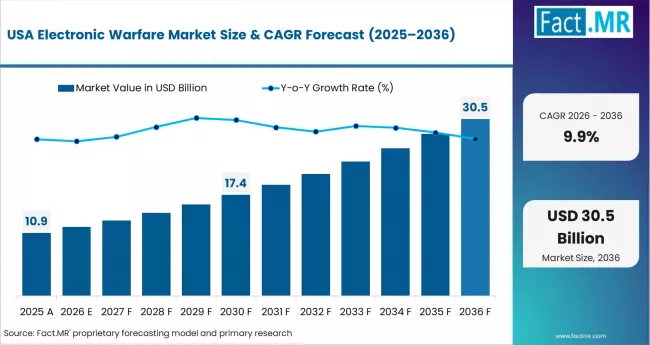
Electronic Warfare Market Country Value Analysis | Source: Fact.MR
North America remains the largest and most technologically advanced EW market, led by strong U.S. defence investments and continuous system upgrades. Key companies include Raytheon Technologies, Northrop Grumman, and BAE Systems.
- USA: Sustained programme funding and next-generation system development are propelling EW demand in the United States, expected to grow at a CAGR of 9.9% through 2036. The Navy’s Next-Generation Jammer programme progressed to production in 2024, while the Air Force initiated new EW upgrade tenders. DARPA also expanded cognitive EW research to enhance spectrum dominance capabilities.
FACT.MR's North America coverage includes the United States, Canada, and Mexico.
Europe Electronic Warfare Market Analysis
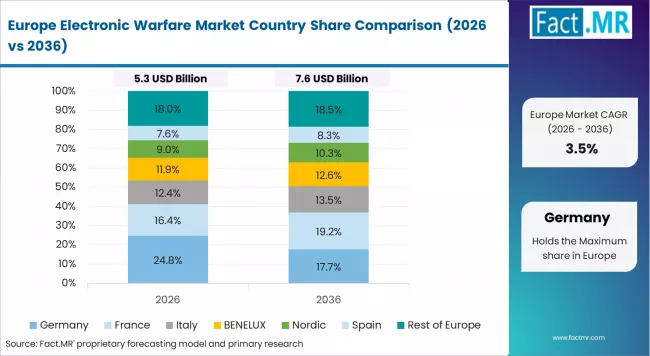
Electronic Warfare Market Europe Country Market Share Analysis, 2026 & 2036 | Source: Fact.MR
Europe is witnessing strong growth in EW systems driven by NATO commitments and increased defence spending across member states. Leading suppliers include BAE Systems, Thales, and Rheinmetall.
- Germany: Increased defence funding and NATO alignment are accelerating EW system adoption in Germany, projected to grow at a CAGR of 9.0% through 2036. The government approved EUR 2.3 billion in EW-related spending under the Special Defence Fund in 2024. Rheinmetall secured contracts for ground-based EW systems, supporting the Bundeswehr’s spectrum dominance initiatives.
- Australia: Government-led capability building and alliance-driven technology collaboration are boosting Australia’s EW demand, projected to grow at a CAGR of 9.1% through 2036. The 2024 Defence Industry Development Strategy identified EW as a sovereign priority, with AUD 500 million allocated. BAE Systems Australia is upgrading EW systems on RAAF aircraft, supported by AUKUS Pillar II collaboration.
FACT.MR's Europe coverage includes Germany, France, the UK, Italy, Spain, Nordic countries, BENELUX, and Rest of Western Europe.
Competitive Aligners for Market Players
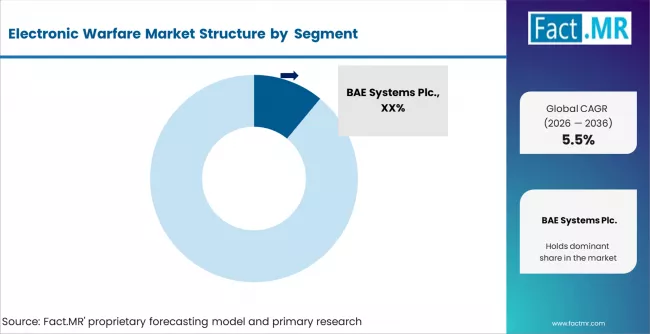
Electronic Warfare Market Analysis By Company | Source: Fact.MR
The electronic warfare market is highly concentrated, with a handful of major defence contractors dominating global revenues. Companies such as Raytheon Technologies, Northrop Grumman, BAE Systems, Lockheed Martin, and L3Harris Technologies together account for over half of the market. Unlike typical commercial industries, competition here is not primarily based on price. Instead, success depends on long-term programme involvement, access to classified technologies, and deep relationships with defence agencies.
Firms that operate across multiple platforms airborne, naval, and ground tend to enjoy more stable revenues. For example, involvement in major programmes like next-generation jamming systems or advanced airborne electronic suites provides years of predictable income through both initial contracts and ongoing upgrades. In fact, software updates, maintenance, and lifecycle support are becoming just as important as hardware sales, especially as systems shift toward open architecture designs.
At the same time, governments actively manage supplier dependence. Defence ministries often structure contracts so that large prime contractors work alongside domestic subcontractors, ensuring local industry participation while maintaining accountability. Additionally, many countries now require technology transfer and local production as part of procurement deals. This favors established global players who already have international partnerships, making it harder for smaller companies to compete at scale.
Key Players of Electronic Warfare Market
- BAE Systems Plc.
- Harris Corporation
- General Dynamics
- Elbit Systems
- Lockheed Martin
- Raytheon
- Northrop Grumman
- Boeing
- Tata Power SED
- Cobham Plc.
Bibliography
- [1] U.S. Department of Defense. (2024). Electronic Warfare Strategy and DoD EW Roadmap Update: Service Branch Guidance for Next-Generation Jammer and Airborne EW Suite Modernisation Programme Acceleration. August 2024.
- [2] Ministry of Defence, Government of India. (2024). Defence Acquisition Procedure 2020 Programme Update: Capital Acquisition Approvals for Indigenous Electronic Warfare Systems Including Jammer and EW Support Platform Contracts. December 2024.
- [3] North Atlantic Treaty Organization. (2024). NATO Electronic Warfare Policy Update: Member State Interoperable EW Capability Requirement Mandate and 2030 Implementation Timeline for Alliance Spectrum Modernisation. October 2024.
- [4] BAE Systems Plc. (2025). Contract Award Announcement: U.S. Navy Next Generation Electronic Warfare Suite Development Contract for Surface Combatant Platforms. January 2025.
- [5] Raytheon Technologies. (2024). Programme Milestone Announcement: Next-Generation Jammer Mid-Band Initial Operational Test and Evaluation Completion for U.S. Navy EA-18G Growler Aircraft. September 2024.
- [6] Center for Naval Analyses. (2024). Electromagnetic Spectrum Operations Lessons Identified from the Russia-Ukraine Conflict: EW System Performance Assessment and Allied Procurement Priority Implications. November 2024.
- [7] Northrop Grumman Corporation. (2024). Facility Investment Announcement: Airborne Electronic Attack System Production Line Expansion at Rolling Meadows Illinois Facility for U.S. and Allied Air Force Programmes. October 2024.
- [8] Lockheed Martin Corporation. (2025). Technology Demonstration: HELIOS High Energy Laser Integrated Optical-dazzler with Surveillance Directed Energy Weapon Operational Integration on U.S. Navy Destroyer Platform. January 2025.
- [9] Defence Research and Development Organisation, Government of India. (2024). Procurement Notice: Radar Warning Receiver Indigenisation Programme for Tejas Mk1A Light Combat Aircraft Integration. July 2024.
This Report Addresses
- Strategic intelligence on U.S. DoD EW Roadmap programme investment, NATO spectrum modernisation mandates, India Make in India EW defence push, China PLA multi-domain warfare doctrine, and AUKUS Pillar II EW technology sharing shaping global electronic warfare demand.
- Market forecast from USD 22.1 billion in 2026 to USD 37.7 billion by 2036 at 5.5% CAGR, segmented by category type, product, platform, and region.
- Growth opportunity mapping across India's indigenisation programme, China's PLA EW modernisation, U.S. Next-Generation Jammer production, Germany's Bundeswehr EW fund spending, Japan's National Security Strategy EW investment, and Australia's AUKUS-aligned capability development.
- Country CAGR outlook for India 10.9%, China 10.6%, USA 9.9%, Japan 9.5%, Australia 9.1%, and Germany 9.0%, with defence budget, threat environment, and programme pipeline drivers per country.
- Competitive analysis of Raytheon, Northrop Grumman, BAE Systems, Lockheed Martin, Harris Corporation, General Dynamics, and Elbit Systems covering programme backlog, technology differentiation, open architecture compliance, and international partnership strategies.
- Technology tracking covering software-defined EW platform development, cognitive electronic warfare systems, directed energy weapon operational integration, unmanned platform EW payload miniaturisation, and open architecture mission system standards.
- Regulatory analysis covering U.S. ITAR and EAR export control constraints on EW technology transfers, NATO capability interoperability requirements, India DPP 2020 indigenisation mandates, Australian sovereign capability policy, and Japan Self-Defense Force procurement rules.
- Report delivered in PDF, Excel datasets, PowerPoint summary, and dashboard formats supported by DoD contract award data, defence budget documents, SIPRI arms transfer records, and primary research interviews with EW programme managers.
Electronic Warfare Market Definition
The electronic warfare market encompasses systems and technologies designed to exploit, deny, disrupt, or protect use of the electromagnetic spectrum in military operations. This includes jamming systems, radar warning receivers, directed energy weapons, and signals intelligence platforms deployed across airborne, naval, ground, and unmanned platforms by defence forces worldwide.
Electronic Warfare Market Inclusions
Global and regional revenue forecasts from 2026 to 2036 by category type, product, and platform. Covers electronic protection, EW support, and electronic attack systems across naval, airborne, ground, and unmanned platforms in North America, Europe, Asia Pacific, Latin America, and Middle East and Africa.
Electronic Warfare Market Exclusions
Excludes civilian spectrum management equipment, commercial radar systems not designed for EW applications, and cybersecurity tools unless integrated into multi-domain EW platforms. Omits intelligence community signals collection classified programmes and purely kinetic weapon systems without EW components.
Electronic Warfare Market Research Methodology
-
Primary Research: Interviews with defence procurement officials, EW programme managers, systems integrators, platform OEM representatives, and defence electronics engineers across North America, Europe, and Asia Pacific.
-
Desk Research: Sources include U.S. DoD budget justification documents, NATO EW programmes, SIPRI arms transfer databases, national defence white papers, and official contract award notices from 2024-2025.
-
Market Sizing and Forecasting: Hybrid model using defence budget allocations, programme acquisition values, platform procurement volumes, and average EW system unit prices by category and platform type.
-
Data Validation and Update Cycle: Forecasts validated using official contract award data, defence budget appropriations, company revenue disclosures, and programme milestone announcements.
Segmentation
Scope of Report
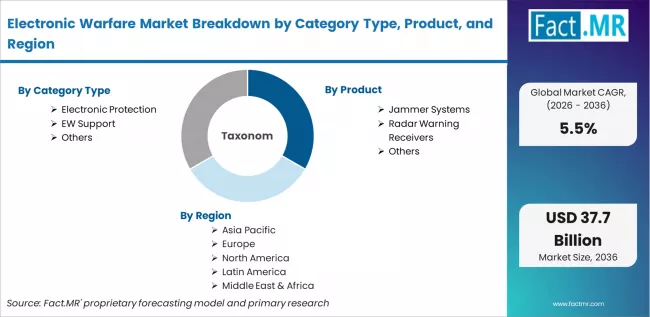
Electronic Warfare Market Breakdown By Category Type, Product, And Region | Source: Fact.MR
| Quantitative Units | USD 22.1 billion (2026) to USD 37.7 billion (2036), at a CAGR of 5.5% |
|---|---|
| Market Definition | Systems for electromagnetic spectrum exploitation, denial, disruption, and protection deployed by military forces across airborne, naval, ground, and unmanned platforms globally. |
| Category Type Segmentation | Electronic Protection,Support, Electronic Attack Systems |
| Product Segmentation | Jammer Systems, Radar Warning Receivers, Directed Energy Weapons, Others in Electronic Warfare |
| Platform Segmentation | Airborne, Naval, Ground, Unmanned Electronic Warfare |
| Application Coverage | Air superiority EW, naval surface and submarine EW, ground force spectrum management, unmanned platform electronic attack, and signals intelligence across allied and national defence programmes. |
| Regions Covered | Asia Pacific, Europe, North America, Latin America, Middle East and Africa |
| Countries Covered | China, Japan, South Korea, India, Australia and New Zealand, ASEAN, Rest of South Asia and Pacific, Germany, UK, France, Italy, Spain, Nordic, BENELUX, Rest of Western Europe, Russia, Poland, Hungary, Balkan and Baltic, USA, Canada, Mexico, Brazil, Chile, Ecuador, Rest of Latin America, Saudi Arabia, GCC, Turkey, South Africa, Rest of MEA |
| Key Companies Profiled | BAE Systems, Harris Corporation, General Dynamics, Elbit Systems, Lockheed Martin, Raytheon, Northrop Grumman, Boeing, Tata Power SED, Cobham Plc. |
| Forecast Period | 2026 to 2036 |
| Approach | Hybrid top-down and bottom-up model using defence budget EW allocations, programme acquisition values, platform procurement volumes, and primary interviews with defence procurement officials and programme managers. |
Source: Fact.MR analysis. Updated Mar 24, 2026
Electronic Warfare Market by Segments
-
By Category Type :
- Electronic Protection
- EW Support
- Electronic Attack Systems
-
By Product :
- Jammer Systems
- Radar Warning Receivers
- Directed Energy Weapons
- Others in Electronic Warfare
-
By Platform :
- Naval Electronic Warfare
- Airborne Electronic Warfare
- Ground Electronic Warfare
- Unmanned Electronic Warfare
-
By Region :
- North America
- United States
- Canada
- Mexico
- Latin America
- Brazil
- Chile
- Ecuador
- Rest of Latin America
- Western Europe
- Germany
- United Kingdom
- France
- Italy
- Spain
- Nordic
- BENELUX
- Rest of Western Europe
- Eastern Europe
- Russia
- Poland
- Hungary
- Balkan and Baltic
- Rest of Eastern Europe
- East Asia
- China
- Japan
- South Korea
- South Asia and Pacific
- India
- ASEAN
- Australia and New Zealand
- Rest of South Asia and Pacific
- Middle East and Africa
- Kingdom of Saudi Arabia
- Other GCC Countries
- Turkey
- South Africa
- Other African Union
- Rest of Middle East and Africa
- North America
Frequently Asked Questions
How large is the electronic warfare market in 2025?
What will the market size be in 2026?
What is the projected market size by 2036?
What is the expected CAGR?
Which category type segment leads the market?
Which product segment dominates?
Which country shows the fastest growth?
What is the primary restraint?
Who worked on this report


Preview the report firsthand - request a free sample
Free SampleGet the brochure for pricing and purchase details
Download PDF