- Market Value (2025): USD 7.9 Bn
- Estimated Value (2026): USD 8.7 Bn
- Forecast Value (2036): USD 22.9 Bn
- CAGR (2026-2036): 10.1%
What is the Aviation Digital Components Market forecast to be worth by 2036?
USD 8.7 billion in 2026 to USD 22.9 billion by 2036 at a 10.1% CAGR.
- 2025 market value: USD 7.9 billion.
- 2026 to 2036 value progression: USD 8.7 billion to USD 22.9 billion.
- 2026 to 2036 CAGR: 10.1%.
What are the defining numbers behind Aviation Digital Components Market growth?
The market is expected to create an absolute opportunity of USD 14.1 billion between 2026 and 2036.
- Demand Drivers in the Market
- Aircraft production and fleet replacement create a direct line-fit demand base for digital electronics. Boeing's 2026 Commercial Market Outlook projects nearly 44,000 new commercial airplane deliveries through 2045. Each new platform requires qualified computing, sensing, power-control and data-interface hardware, while replacement aircraft generally use more integrated digital architectures than the aircraft they retire.
- Air-ground digital communication is also increasing the number of onboard systems that must exchange structured data with flight crews and ground infrastructure. The Federal Aviation Administration reported in 2026 that Data Communications services were operating across all 20 U.S. Air Route Traffic Control Centers and supporting more than 8,000 equipped aircraft. This extends demand for compatible flight-management interfaces, data concentrators, secure communication modules and aircraft sensors that feed digital flight functions.
- Integrated modular avionics changes the economics of airborne computing by allowing several aircraft functions to share qualified computing resources while maintaining separation between applications. EASA AMC 20-170 provides an accepted means for demonstrating the safety of integrated modular avionics. This supports demand for processors, network switches, I/O modules and platform hardware that can carry reusable certification evidence across several aircraft functions.
- Advanced air mobility adds a new set of digitally intensive aircraft programs. The FAA completed a powered-lift operating framework in 2024, removing one operational uncertainty for aircraft that depend heavily on digital flight control, electrical power management and distributed sensing. As these platforms move from prototypes into certification programs, component suppliers gain opportunities before production reaches conventional commercial-aircraft volumes.
- Connectivity also raises the assurance burden around onboard networks. EASA Part-IS requirements now apply across a broad set of aviation organisations, while FAA guidance addresses network security for connected aircraft. Equipment makers therefore need secure interfaces, controlled update paths and traceable hardware configurations alongside conventional reliability and environmental qualification.
- Key Segments Analyzed
- Digital Component: Integrated modular avionics modules account for 26.0% in 2026 because shared computing platforms reduce separate-box count while supporting several certified aircraft functions.
- Aircraft Domain: Flight controls represent 24.0% in 2026 because fly-by-wire architectures require continuous sensing, computing and command electronics with redundancy and high assurance.
- Platform: Commercial aircraft account for 45.0% in 2026 because line-fit production and long-lived retrofit programs create recurring demand across a large installed fleet.
- Certification Criticality: DAL A and B account for 34.0% in 2026 because components used in safety-critical functions carry extensive verification, configuration control and certification evidence.
- Analyst Opinion at Fact.MR
- "In aviation electronics, component value is shaped as much by qualification history as by silicon content. Airframers and system integrators prefer building blocks that fit an approved architecture, carry reusable assurance evidence and remain supportable for the life of the aircraft program. Suppliers that manage hardware obsolescence without reopening avoidable certification work can protect both delivery schedules and lifecycle economics.", says Shambhu Nath Jha, Principal Consultant, Fact.MR.
- Strategic Implications
- Airframers should treat digital component selection as an architecture decision rather than a late-stage purchasing choice. Processor family, network interface and power architecture can influence software partitioning, thermal design and certification evidence across several systems. Early component baselining reduces the risk that a late substitution forces new verification work.
- Suppliers need lifecycle plans that cover component end-of-life, alternate sources and configuration traceability. The same discipline applies across aerospace parts, but it is more restrictive for programmable hardware because a silicon or firmware change can alter certification evidence even when the physical form factor remains unchanged.
- More-electric and powered-lift programs create opportunities for closer coordination between digital power electronics, flight-control compute and aircraft motors. Suppliers that validate these interfaces at system level can reduce integration work for aircraft developers.
- Cockpit modernization also favors common computing and data architectures that can support flight management, alerting and crew interfaces without multiplying separate hardware. Related demand around cockpit alerts shows why processing and display functions increasingly need coordinated certification and human-factors validation.
How does the Aviation Digital Components Market break down by segment?
The market is segmented by Digital Component, Aircraft Domain, Platform and Certification Criticality.
Why do Integrated modular avionics modules lead Digital Component?
Integrated modular avionics modules account for 26.0% of Digital Component in 2026.
Their value comes from concentrating several software applications on shared, qualified computing resources instead of assigning a dedicated computer to each aircraft function.
EASA AMC 20-170 sets out an accepted compliance path for integrated modular avionics, including the safety considerations that arise when applications share platform resources. That framework makes processor performance, partitioning, deterministic networking and configuration control central purchasing criteria.
Safran Electronics & Defense provides a current example through its UCAP multifunction avionics platform, which combines a multi-core processor, a multi-application and multi-DAL operating environment, onboard sensor interfaces and Ethernet/A664 switching. Buyers can use this type of modular hardware to add functions while preserving a controlled platform baseline.
Why do Flight controls lead Aircraft Domain?
Flight controls account for 24.0% of Aircraft Domain in 2026.
Fly-by-wire systems continuously convert pilot or autopilot commands into electronic control signals, compare sensor inputs and command actuators, so computing and I/O hardware remain active throughout the flight.
The safety consequence of an erroneous flight-control command drives redundancy and assurance requirements. Safran describes primary flight-control systems as safety-critical and supplies fly-by-wire and electro-hydraulic actuation across commercial and military aircraft. Digital engine control units add another high-assurance processing load within the propulsion domain.
Flight-control hardware therefore carries a higher integration burden than many cabin or convenience electronics. Buyers evaluate deterministic response, fault containment and certification evidence alongside weight and power. The same aircraft-level integration logic extends to cabin sensors when environmental data must feed central avionics or maintenance systems.
Why do Commercial aircraft lead Platform?
Commercial aircraft account for 45.0% of Platform in 2026.
The segment combines line-fit demand from new production with a large in-service fleet that requires avionics updates, replacement LRUs and connectivity upgrades over long operating lives.
Boeing's 2026 outlook projects the global commercial fleet to exceed 50,000 airplanes by 2045, with nearly 44,000 new deliveries over the period. That production base supports recurring demand for digital flight controls, navigation hardware, data concentrators, power electronics and health-monitoring modules.
Program standardization also matters. Once a component family is qualified on an aircraft platform, airframers and airlines have strong incentives to preserve configuration commonality across production blocks and fleets. This makes program wins durable, but it also raises the cost of entering an established architecture.
Why do DAL A and B lead Certification Criticality?
DAL A and B account for 34.0% of Certification Criticality in 2026.
These assurance levels apply to functions where failure can have severe safety consequences, so electronic hardware and software require deeper verification, traceability and configuration control.
FAA AC 20-152A recognizes DO-254 for airborne electronic hardware, while AC 20-115D recognizes DO-178C for airborne software. The rigor increases with safety consequence, which raises engineering content around programmable devices, circuit-board assemblies and the software that runs on or interfaces with them.
For buyers, the practical value is reduced certification risk. A module with established design-assurance evidence, controlled manufacturing changes and long-term support can lower the effort needed to qualify it on another program or derivative aircraft. That makes certification pedigree a commercial differentiator rather than a documentation exercise.
What is accelerating Aviation Digital Components Market adoption, and what is holding it back?
Adoption is being accelerated by aircraft replacement, digital air-ground communications and the shift toward shared computing architectures. The main constraint is qualification time. A change in processor, programmable logic or board design can require new verification because the evidence is tied to a controlled hardware baseline.
Drivers Impact Analysis
| Factor | (~) % Impact on CAGR | Geographic Relevance | Impact Timeline |
|---|---|---|---|
| Aircraft production and fleet replacement | +2.6% | Global; strongest in major commercial-aircraft supply chains | 2026-2036 |
| Digital air-ground communication and connected avionics | +2.1% | USA and Europe, with broader international equipage | 2026-2032 |
| More-electric and digitally controlled aircraft architectures | +1.8% | USA, Europe and advanced air mobility programs | 2027-2036 |
Source: Fact.MR analysis. Updated Sep 7, 2026
Opportunity Impact Analysis
| Factor | (~) % Impact on CAGR | Geographic Relevance | Impact Timeline |
|---|---|---|---|
| Reusable integrated modular avionics platforms | +1.5% | USA, France, Germany and UK aerospace programs | 2026-2036 |
| Advanced air mobility certification programs | +1.3% | USA, UK, Italy and wider Europe | 2027-2036 |
| Aircraft health-monitoring and data capture modules | +1.0% | Global commercial and defense fleets | 2026-2034 |
Source: Fact.MR analysis. Updated Sep 7, 2026
Restraints Impact Analysis
| Factor | (~) % Impact on CAGR | Geographic Relevance | Impact Timeline |
|---|---|---|---|
| Certification and recertification workload | -1.4% | Global, especially DAL A and B applications | 2026-2036 |
| Semiconductor lifecycle and qualified-substitution risk | -0.9% | Global aerospace electronics supply chains | 2026-2036 |
| Cybersecurity and network-integration burden | -0.7% | USA and Europe, expanding to other markets | 2026-2033 |
Source: Fact.MR analysis. Updated Sep 7, 2026
Which countries are scaling the Aviation Digital Components Market through 2036?
- USA: FAA NextGen equipage and the powered-lift framework are expanding demand for data-linked avionics, digital flight controls and high-assurance onboard computing across conventional and emerging aircraft.
- France: France 2030 support for domestic electronics industrialization and DSNA modernization strengthen the local ecosystem around low-power electronics, secure connectivity and digitally integrated aviation systems.
- Germany: DLR aviation research emphasizes digital development, certification and higher automation, creating test and qualification demand for onboard computing, sensor interfaces and human-machine systems.
- UK: The Future Flight Challenge and continuing civil-aerospace R&D programs support electric aircraft, advanced air mobility and digital flight-system development, giving component suppliers entry points before series production.
- Italy: ENAC is updating its national advanced air mobility plan for 2026-2030, aligning regulators, territories and industry around a clearer path from demonstration to operation for digitally intensive aircraft platforms.
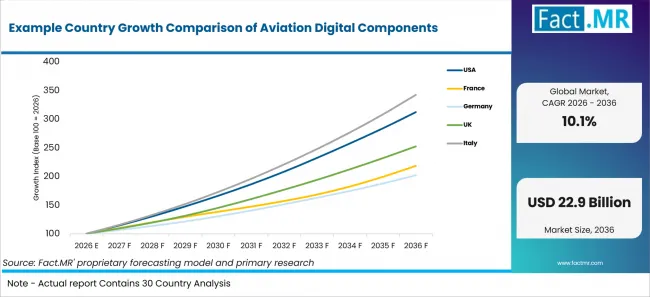
Example Country Growth Comparison Of Aviation Digital Components | Source: Fact.MR
Country CAGR (2026-2036)
| Country | CAGR (2026-2036) |
|---|---|
| USA | 12.1% |
| France | 8.1% |
| Germany | 7.3% |
| UK | 9.7% |
| Italy | 13.1% |
Source: Fact.MR analysis. Updated Sep 7, 2026
What is driving the USA's growth through 2036?
The USA is projected to expand at a 12.1% CAGR through 2036.
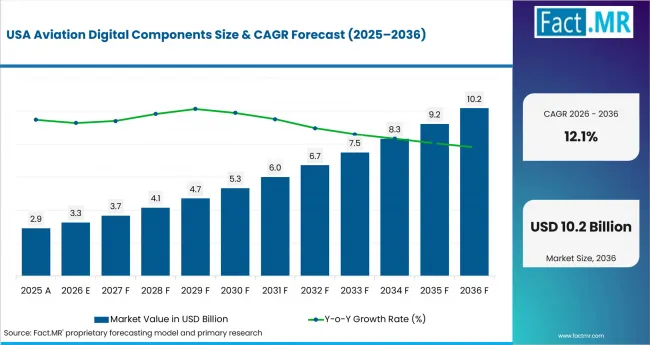
Aviation Digital Components Country Value Analysis | Source: Fact.MR
FAA NextGen accomplishments reported in 2026 show Data Communications operating continuously across all 20 Air Route Traffic Control Centers, with more than 8,000 equipped aircraft. That installed base creates continuing demand for flight-management interfaces, communications hardware and data concentrators that can support digital clearances and evolving airspace functions.
The FAA has also completed the operating framework needed to integrate powered-lift aircraft into the National Airspace System. These programs rely heavily on digital flight controls, high-rate sensing and electrical power-management electronics. For U.S. suppliers, the commercial opportunity therefore spans upgrades to existing fleets and qualification work on new aircraft architectures.
What is driving France's growth through 2036?
France is projected to expand at an 8.1% CAGR through 2036.
The France 2030 electronics strategy supports domestic production and industrialization of low-power semiconductor technologies, sensors and power components. For aviation suppliers, this strengthens the local component base used in onboard compute, power conversion and connected systems.
The aviation infrastructure side is becoming more digital at the same time. DSNA 2030 includes deployment and standardization of systems such as 4-FLIGHT and newer tower technologies. As air-ground operations become more data-driven, aircraft equipment must maintain compatible communication, navigation and information interfaces, sustaining demand for qualified onboard digital hardware.
What is driving Germany's growth through 2036?
Germany is projected to expand at a 7.3% CAGR through 2036.
DLR's aviation research strategy places digitalization across aircraft development and certification, with the aim of reducing development cost and bringing new technologies to market sooner. That approach increases the value of modular digital components that can be simulated, tested and traced through a digital engineering workflow.
DLR and project partners also completed manned flight trials of an AI-based digital co-pilot in 2025. The tests illustrate the hardware demand behind more automated cockpits: additional compute, sensor fusion and reliable crew interfaces must work together under certification constraints. Research activity of this type creates a bridge from laboratory electronics to qualified airborne systems.
What is driving the UK's growth through 2036?
The UK is projected to expand at a 9.7% CAGR through 2036.
UKRI's final evaluation of the Future Flight Challenge describes an ecosystem built around electric sub-regional aircraft, advanced air mobility vehicles and drones. These aircraft types require compact computing, digitally controlled power electronics and networked sensing before they reach commercial service.
The Aerospace Technology Institute program continues to fund civil-aerospace industrial research through 2029-2030. For component suppliers, that creates opportunities to enter demonstrator and qualification programs early, when architecture choices are still open and the evidence needed for later certification is being built.
What is driving Italy's growth through 2036?
Italy is projected to expand at a 13.1% CAGR through 2036.
ENAC published a draft update of the national Advanced Air Mobility Strategic Plan for 2026-2030 in May 2026. The update focuses on a more practical roadmap, stronger governance and alignment with European action plans.
A clearer regulatory and operating path helps aircraft developers move from demonstration toward certification and service planning. That progression increases demand for flight-control computers, connectivity modules, power electronics and health-monitoring hardware that can satisfy both aircraft-level safety requirements and European information-security obligations.
Who Leads the Aviation Digital Components Market?
Key players in the Aviation Digital Components Market include Honeywell Aerospace, Collins Aerospace, Thales, Safran, Curtiss-Wright and L3Harris. Competition is shaped by certification history, architecture integration, lifecycle support, size-weight-power performance and the ability to maintain controlled hardware configurations across long aircraft programs.
Honeywell Aerospace became an independent public company in June 2026 and retains a broad avionics portfolio spanning integrated flight decks, flight management, navigation and sensors, flight controls, satellite communications and flight-data systems. Collins Aerospace, an RTX business, supplies avionics systems, computing and networks, integrated cockpit solutions and related support across civil and defense platforms.
Thales combines flight avionics, connected aircraft systems and flight-management technology. Safran Electronics & Defense supplies multifunction avionics computers, FADEC units and flight-control electronics. Curtiss-Wright competes through rugged modular computing and open-architecture COTS platforms, while L3Harris supplies flight-data recorders, surveillance avionics, displays and aircraft-data services.
Which companies are the key providers?
Key providers include Honeywell Aerospace, Collins Aerospace, Thales, Safran, Curtiss-Wright and L3Harris.
- Honeywell Aerospace
- Collins Aerospace
- Thales
- Safran
- Curtiss-Wright
- L3Harris
Bibliography
- The Boeing Company. (2026). Commercial Market Outlook 2026-2045. Boeing.
- Federal Aviation Administration. (2026). NextGen Accomplishments. U.S. Department of Transportation.
- Federal Aviation Administration. (2025). Data Communication Program. U.S. Department of Transportation.
- Federal Aviation Administration. (2022). AC 20-152A: Development Assurance for Airborne Electronic Hardware. U.S. Department of Transportation.
- Federal Aviation Administration. (2017). AC 20-115D: Airborne Software Development Assurance Using EUROCAE ED-12 and RTCA DO-178. U.S. Department of Transportation.
- Federal Aviation Administration. (2024). Integration of Powered-Lift: Pilot Certification and Operations; Miscellaneous Amendments Related to Rotorcraft and Airplanes. U.S. Department of Transportation.
- Federal Aviation Administration. (2023). TSO Cybersecurity - Aircraft Systems Information Security Protection. U.S. Department of Transportation.
- European Union Aviation Safety Agency. (2018). AMC 20-170: Integrated Modular Avionics. EASA.
- European Union Aviation Safety Agency. (2025). Easy Access Rules for Information Security. EASA.
- Direction générale des Entreprises. (2024). France 2030: stratégie électronique. Government of France.
- Direction des Services de la Navigation Aérienne. (2025). Stratégie DSNA 2030. Government of France.
- German Aerospace Center. (2025). Aviation Research Strategy and Programme: Digitalisation. DLR.
- German Aerospace Center. (2025, July 25). Flight Trials with AI-Based Digital Co-Pilot Successfully Conducted. DLR.
- UK Research and Innovation. (2025). Final Evaluation of the Future Flight Challenge. UKRI.
- Innovate UK. (2025). ATI Programme Strategic Batch: Expression of Interest. UK Government.
- Ente Nazionale per l'Aviazione Civile. (2026, May 21). Draft Update 2026-2030 of the National Advanced Air Mobility Strategic Plan. ENAC.
- Honeywell Aerospace. (2026, June 29). Honeywell Aerospace Completes Spin-Off and Begins Trading on Nasdaq. Honeywell Aerospace Inc.
- Honeywell Aerospace. (2026). Investor Day Presentation. Honeywell Aerospace Inc.
- RTX. (2026). Collins Aerospace Avionics. RTX Corporation.
- Thales. (2025). Universal Registration Document 2024: Aerospace and Avionics. Thales Group.
- Safran Electronics & Defense. (2026). UCAP Ultra-Compact Multifunction Avionics Platform. Safran.
- Safran Electronics & Defense. (2026). Primary Flight Control System. Safran.
- Curtiss-Wright Defense Solutions. (2026). Open Architectures for Avionics Systems. Curtiss-Wright Corporation.
- L3Harris Technologies. (2026). Avionics, Flight Data and Recorder Solutions. L3Harris Technologies.
This Report Answers
- How do aircraft production and fleet replacement affect demand for qualified digital components?
- Why do integrated modular avionics modules account for 26.0% of Digital Component in 2026?
- Why do flight controls represent 24.0% of Aircraft Domain?
- How do DAL A and B requirements change component qualification and lifecycle support?
- Where do advanced air mobility programs create new component opportunities?
- Which supplier capabilities reduce integration and recertification risk for airframers?
What does the Aviation Digital Components Market cover?
The market covers commercially sold digital electronic hardware installed on aircraft to compute, control, communicate, distribute electrical power or monitor system condition. Revenue includes integrated avionics modules, smart sensors and LRUs, digital power electronics, data concentrators and health-monitoring modules sold for new aircraft and qualified retrofit programs.
The commercial boundary is the certified or certifiable onboard hardware package. Associated embedded software is included where it is part of the sold component or module, but standalone software subscriptions and ground infrastructure are outside the hardware revenue base.
What is included in the scope?
Included products follow the Digital Component categories across the stated Aircraft Domain, Platform and Certification Criticality groups. The scope includes hardware used in flight controls, electrical power, cabin and connectivity, propulsion, landing and environmental systems, plus digital modules for commercial aircraft, business aviation, defense aircraft, rotorcraft and advanced air mobility platforms.
What is excluded from the scope?
The scope excludes ground-based air traffic management hardware, airport digital infrastructure, consumer electronics carried onboard by passengers, standalone cloud software, mechanical actuators without embedded digital electronics, and semiconductor devices sold as generic components before aviation qualification or integration into an airborne module.
How Was the Analysis Built?
- Primary Research:
- Primary research focuses on airframers, avionics and flight-control suppliers, aerospace electronics manufacturers, certification engineers, aircraft-system integrators, MRO engineering teams and procurement managers responsible for qualified electronic hardware.
- Desk Research:
- Desk research uses aircraft delivery outlooks, FAA and EASA certification guidance, advanced air mobility regulation, national aerospace programs, electronics industrial policy, technical product documentation and corporate filings relevant to current supplier status and capabilities.
- Market Sizing and Forecasting:
- Market sizing evaluates aircraft production, digital component content per platform, domain-level electronics intensity, retrofit and replacement cycles, certification criticality, component pricing, advanced air mobility program maturity and the installed base of connected avionics.
- Data Validation and Update Cycle:
- Forecasts are reviewed against aircraft delivery plans, regulatory changes, avionics equipage programs, new platform certifications, electronics supply conditions and supplier portfolio changes. Company status is rechecked where acquisitions, separations or brand changes could affect the provider list.
Segmentation
What is the report's scope and coverage?
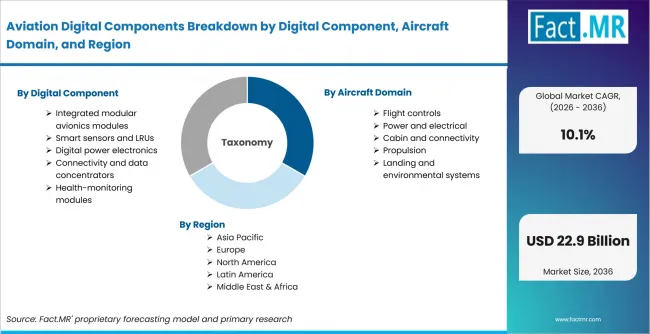
Aviation Digital Components Breakdown By Digital Component, Aircraft Domain, And Region | Source: Fact.MR
| Parameter | Details |
|---|---|
| Quantitative Units | USD billion |
| Market Definition | Qualified digital electronic modules and LRUs installed on aircraft for computing, control, sensing, connectivity, power electronics and health monitoring. |
| Segments Covered | Digital Component; Aircraft Domain; Platform; Certification Criticality |
| Countries Covered | USA; France; Germany; UK; Italy |
| Key Companies Profiled | Honeywell Aerospace; Collins Aerospace; Thales; Safran; Curtiss-Wright; L3Harris |
| Forecast Period | 2026 to 2036 |
| Base Year | 2026 |
| Market Value, 2026 | USD 8.7 billion |
| Market Value, 2036 | USD 22.9 billion |
| CAGR, 2026-2036 | 10.1% |
| Absolute Opportunity | USD 14.1 billion |
| Approach | Hybrid demand-side and platform-based analysis using aircraft production, component content, retrofit cycles, certification criticality and supplier validation. |
Source: Fact.MR analysis. Updated Sep 7, 2026
How is the market segmented?
-
By Digital Component
- Integrated modular avionics modules
- Smart sensors and LRUs
- Digital power electronics
- Connectivity and data concentrators
- Health-monitoring modules
-
By Aircraft Domain
- Flight controls
- Power and electrical
- Cabin and connectivity
- Propulsion
- Landing and environmental systems
-
By Platform
- Commercial aircraft
- Business aviation
- Defense aircraft
- Rotorcraft
- eVTOL and advanced air mobility
-
By Certification Criticality
- DAL A and B
- DAL C
- DAL D and E
- Non-flight-critical connected
- Experimental and emerging
Frequently Asked Questions
What is the Aviation Digital Components Market value in 2026?
At what CAGR is the market projected to grow?
What is the projected market value by 2036?
Which Digital Component accounts for 26.0% share in 2026?
Which Aircraft Domain accounts for 24.0% share in 2026?
Which Platform accounts for 45.0% share in 2026?
Which Certification Criticality category accounts for 34.0% share in 2026?
Which countries are included in the country growth analysis?
What is a main demand driver for aviation digital components?
What is a main restraint on adoption?
Which companies are included among key providers?
Who worked on this report


Preview the report firsthand - request a free sample
Free SampleGet the brochure for pricing and purchase details
Download PDF