- Base Value(2025): 644.6 Mn
- Estimated Value(2026): 683.3 Mn
- Forecast Value (2036): 1223.6 Mn
- CAGR (2026 - 2036): 6.0%
Aftermarket Automotive Parts Market Size, Market Forecast and Outlook by Fact.MR
- The aftermarket automotive parts market was valued at USD 644.6 million in 2025.
- Demand is expected to increase from USD 683.3 million in 2026 to USD 1,223.6 million by 2036.
- The market is forecast to record 6.0% CAGR during 2026 to 2036 as aging vehicles and higher repair intensity support replacement demand.
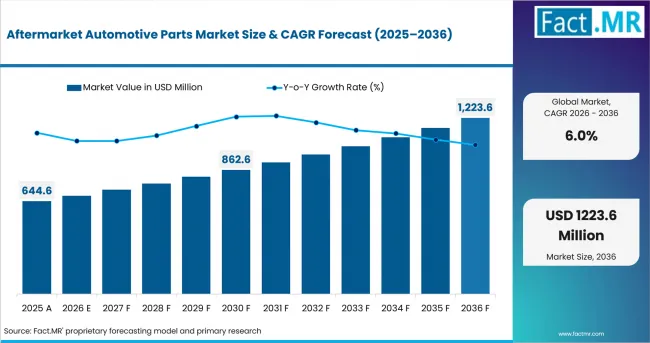
Aftermarket Automotive Parts Market Value Analysis | Source: Fact.MR
| Metric | Details |
|---|---|
| Industry Size 2026 | USD 683.3 million |
| Industry Value 2036 | USD 1,223.6 million |
| CAGR 2026 to 2036 | 6.0% |
Source: Fact.MR analysis. Updated Jun 17, 2026
Summary of Aftermarket Automotive Parts Market
- Demand Drivers in the Market
- Vehicle Aging: Older vehicles create demand for brakes and suspension components.
- Mileage Use: Road travel supports recurring replacement needs because tires and brake parts wear with use.
- Repair Network Expansion: Independent garages need reliable parts supply as repair demand moves beyond dealership service.
- Key Segments Analyzed
- By Vehicle Type: Passenger cars are expected to hold 57.0% share in 2026 because private vehicle use creates frequent maintenance needs.
- By Product Type: Tires are likely to account for 15.8% share in 2026 as replacement frequency stays higher than complex components.
- By Replacement Type: Wear & tear parts are projected to capture 63.0% share in 2026 since routine maintenance drives repeat demand.
- By Sales Channel: Independent retailers are anticipated to hold 46.0% share in 2026 as workshops need faster local part availability.
- By Service Provider: Independent garages are expected to represent 38.0% share in 2026 because cost-sensitive repairs often move outside dealer networks.
- By Geography: Japan is projected to grow at 7.8% CAGR through 2036 as older vehicles support stable replacement demand.
- Analyst Opinion at Fact.MR
- Shambhu Nath Jha, Principal Consultant at Fact.MR, states, “Aftermarket automotive parts demand extends beyond vehicle age. I see the stronger opportunity in service access and fitment accuracy. Distributors that reduce wrong-part returns can protect workshop loyalty.”
- Strategic Implications
- Fitment Accuracy: Parts distributors need better catalog data because wrong part supply delays workshop repair cycles.
- Local Stocking: Retailers should align inventory with vehicle age and common repair patterns in each city.
- EV Readiness: Garages need new parts knowledge as electric vehicles reduce some mechanical demand but raise tire and electronics needs.
Aftermarket automotive parts demand is becoming more service-led. Vehicle owners no longer replace parts only after breakdowns. Workshops are using routine inspections to pull demand for tires and suspension parts. The shift favors distributors that can deliver correct parts quickly. Digital fitment tools are becoming important because wrong part selection creates returns and service delays.
Japan is projected to record 7.8% CAGR through 2036 as older vehicle use supports premium replacement demand. China is likely to post 6.9% CAGR as vehicle ownership and repair networks expand. India is set to advance at 6.7% CAGR because a growing vehicle parc increases demand for routine parts. The United States is forecast at 5.0% CAGR as high road mileage supports recurring replacement. Germany is expected to register 4.8% CAGR by 2036 because mature repair channels support steady parts replacement.
Segmental Analysis
Aftermarket Automotive Parts Market Analysis by Vehicle Type
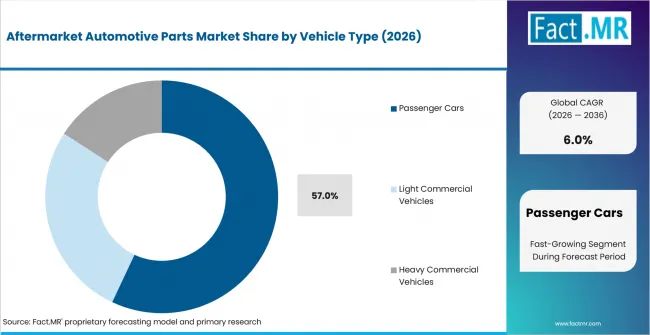
Aftermarket Automotive Parts Market Analysis By Vehicle Type | Source: Fact.MR
Passenger cars are expected to hold 57.0% share in 2026 because private vehicle use creates frequent maintenance and replacement needs. The segment benefits from a large installed base and wide workshop coverage. Light commercial vehicles support steady part replacement because delivery fleets need uptime. Heavy commercial vehicles use higher-value parts but replacement cycles are tied to fleet service schedules.
- Passenger Cars: Passenger cars lead because vehicle owners replace tires and batteries through routine service.
- Light Commercial Vehicles: Delivery fleets create steady demand because downtime affects daily route planning.
- Heavy Commercial Vehicles: Heavy vehicles need durable parts and planned service because repairs are more expensive.
Aftermarket Automotive Parts Market Analysis by Product Type
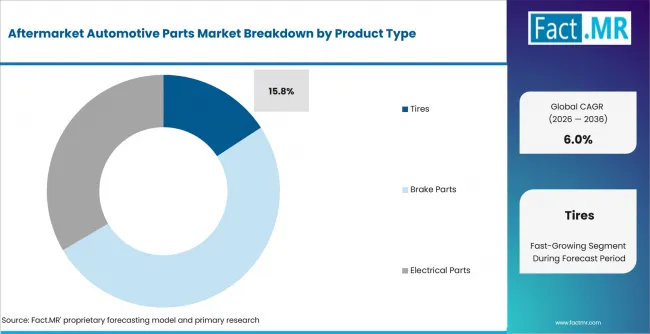
Aftermarket Automotive Parts Market Analysis By Product Type | Source: Fact.MR
Tires lead the product type mix because they have shorter replacement cycles than many mechanical components. Replacement happens due to wear and seasonal needs. Tires are likely to account for 15.8% share in 2026. Brake parts and electrical parts support recurring workshop revenue. Engine and transmission parts carry higher ticket value but lower replacement frequency.
- Tires: Tires lead because wear and road damage create regular replacement demand.
- Brake Parts: Brake pads and related parts support recurring garage visits due to safety checks.
- Electrical Parts: Electrical parts gain importance as vehicles add more sensors and control units.
Aftermarket Automotive Parts Market Analysis by Replacement Type
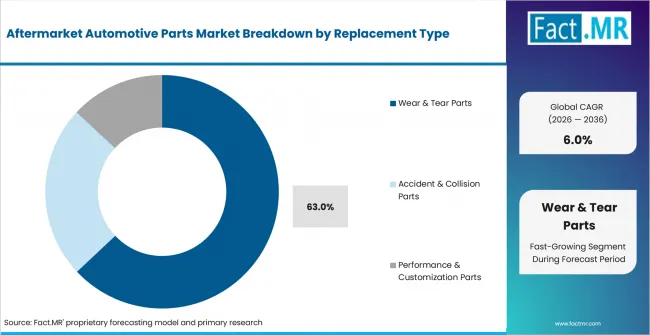
Aftermarket Automotive Parts Market Analysis By Replacement Type | Source: Fact.MR
Wear & tear parts are projected to capture 63.0% share in 2026 because routine maintenance drives repeat demand. These parts include tires and suspension components. Accident and collision parts are more event-led. Performance parts serve customization demand. Maintenance consumables support smaller but frequent purchases.
- Wear Parts: Wear & tear parts lead because every vehicle creates predictable replacement needs over time.
- Collision Parts: Accident replacement parts depend on insurance approval and body shop capacity.
- Upgrade Parts: Performance and customization parts serve vehicle owners who want appearance or driving changes.
Aftermarket Automotive Parts Market Analysis by Sales Channel
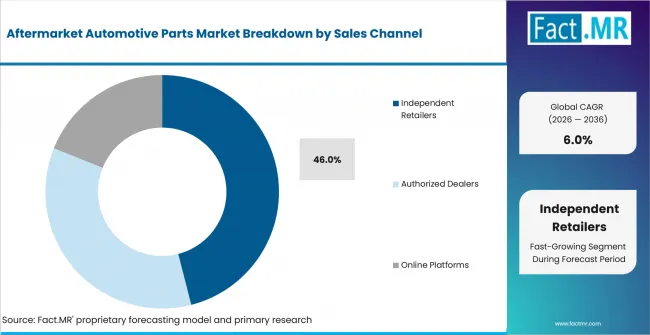
Aftermarket Automotive Parts Market Analysis By Sales Channel | Source: Fact.MR
Independent retailers lead because repair shops need immediate access to common parts. Local distributors support fast delivery and flexible ordering. Authorized dealers serve brand-specific parts and warranty-sensitive repairs. Independent retailers are anticipated to hold 46.0% share in 2026 as workshops depend on nearby inventory. Online platforms are growing through price comparison and fitment tools.
- Independent Retailers: Independent retailers lead because local availability helps workshops finish repairs faster.
- Authorized Dealers: Authorized dealers support brand-specific components and warranty-linked repair demand.
- Online Platforms: Online platforms support price comparison and part discovery for DIY users.
Aftermarket Automotive Parts Market Analysis by Service Provider
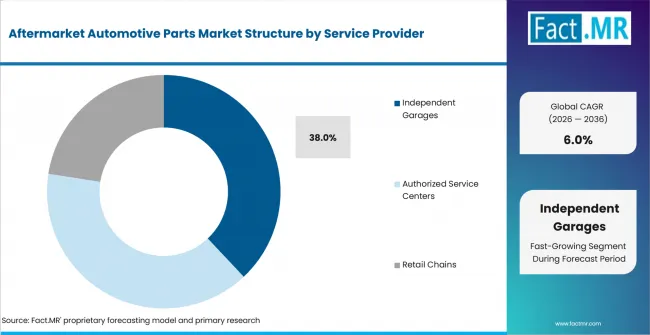
Aftermarket Automotive Parts Market Analysis By Service Provider | Source: Fact.MR
Independent garages are expected to represent 38.0% share in 2026 because cost-sensitive repairs often move outside dealer networks. These garages support older vehicles after warranty periods end. Authorized service centers retain complex repairs and brand-backed parts. Retail chains serve standardized maintenance. DIY users are stronger in markets with mature online fitment tools.
- Independent Garages: Independent garages lead because older vehicles often move away from dealer service after warranty expiry.
- Authorized Centers: Authorized service centers support complex diagnostics and brand-specific components.
- Retail Chains: Retail chains serve standard replacement jobs through predictable pricing and quick service.
Aftermarket Automotive Parts Market Drivers, Restraints, and Opportunities
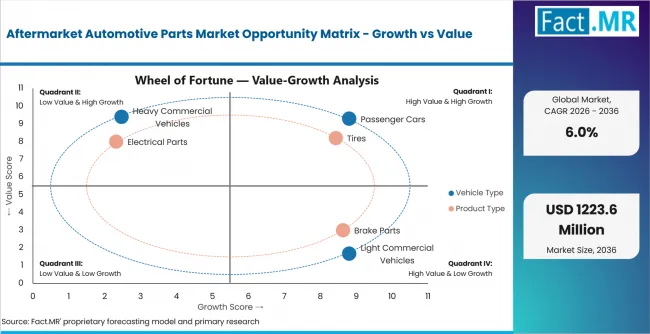
Aftermarket Automotive Parts Market Opportunity Matrix Growth Vs Value | Source: Fact.MR
Mileage accumulation and vehicle aging are the main drivers for aftermarket automotive parts demand. S&P Global Mobility stated on May 21, 2025 that the average age of light vehicles in the United States reached 12.8 years in 2025, creating opportunities for aftermarket and service providers [1]. Older vehicle fleets add another demand layer because suspension and electrical parts face more service needs after years of use. Repair shops benefit as maintenance and replacement needs become more predictable.
Electric vehicles can restrain some traditional mechanical parts demand. The U.S. Department of Energy notes that EVs have fewer moving parts and lower routine maintenance needs for battery and related electronics. This reduces demand for engine oil and some drivetrain components. The shift changes aftermarket demand. It changes the mix toward tires and high-voltage service parts.
Opportunities in the Aftermarket Automotive Parts Market
- Digital Catalogs: Distributors can reduce returns by improving vehicle-fitment data for workshops and online platforms.
- Fleet Repair: Light commercial fleets need fast-moving parts to reduce downtime and protect route schedules.
- EV Parts: Garages can expand into EV tires and electronic components.
Regional Analysis
Based on regional analysis, the aftermarket automotive parts market is segmented into North America, Western Europe, East Asia, South Asia and Pacific, and other regions.
.webp "Top Country Growth Comparison Aftermarket Automotive Parts Market Cagr (2026 2036)")
Top Country Growth Comparison Aftermarket Automotive Parts Market Cagr (2026 2036) | Source: Fact.MR
| Country | CAGR 2026 to 2036 |
|---|---|
| Japan | 7.8% |
| China | 6.9% |
| India | 6.7% |
| United States | 5.0% |
| Germany | 4.8% |
Source: Fact.MR analysis. Updated Jun 17, 2026
Source: Fact.MR analysis and primary research
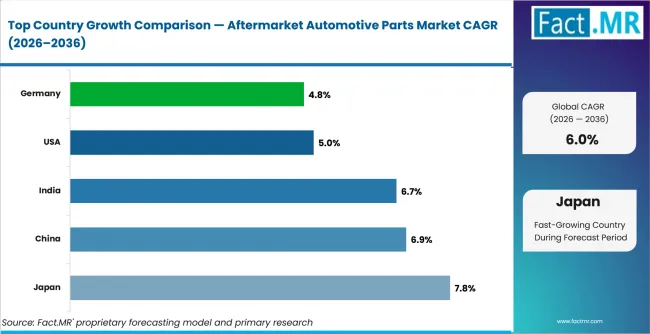
Aftermarket Automotive Parts Market Cagr Analysis By Country | Source: Fact.MR
East Asia Aftermarket Automotive Parts Market Analysis
East Asia demand is supported by large vehicle fleets and strong parts manufacturing. Japan grows faster because older vehicles need dependable replacement parts. China supports scale because repair networks and parts distribution are expanding. EV growth will change the product mix but will not remove replacement demand.
- Japan: Japan is projected to grow at 7.8% CAGR through 2036 as vehicle life and quality expectations support premium replacement demand. Older vehicles need tires and electrical replacement. Workshops value fitment accuracy because Japanese vehicle platforms are highly specific. Demand will favor reliable brands and parts that reduce repeat repair visits.
- China: China is likely to post 6.9% CAGR through 2036 as its large vehicle parc supports wider parts distribution. Repair chains and online parts platforms are improving access for vehicle owners outside major cities. EV growth changes demand away from some engine parts but supports tires and thermal management parts. Local suppliers can move faster on price and availability. Independent garages will need stronger diagnostic capability as connected and electrified vehicles enter the used vehicle base.
East Asia will reward suppliers with part accuracy and fast delivery. Repair networks will prefer distributors that combine local stock with digital fitment support.
South Asia and Pacific Aftermarket Automotive Parts Market Analysis
South Asia and Pacific demand is led by India. Passenger vehicle growth and two-wheeler ownership widen the repair base. Independent garages hold an important role because many vehicle owners seek affordable parts after warranty expiry. SIAM’s 2024-2025 annual report noted record passenger vehicle sales of 4.3 million units in FY 2024-25 [2].
- India: Urban vehicle parc growth and highway use support India’s aftermarket automotive parts demand. The country is set to advance at 6.7% CAGR through 2036 as passenger vehicle and commercial vehicle fleets expand. Price sensitivity keeps independent retailers important because workshops need affordable parts with acceptable quality. Local suppliers can gain demand in filters and suspension components. Online platforms will help compare prices but garage-led fitment will stay important for most replacement work.
North America Aftermarket Automotive Parts Market Analysis
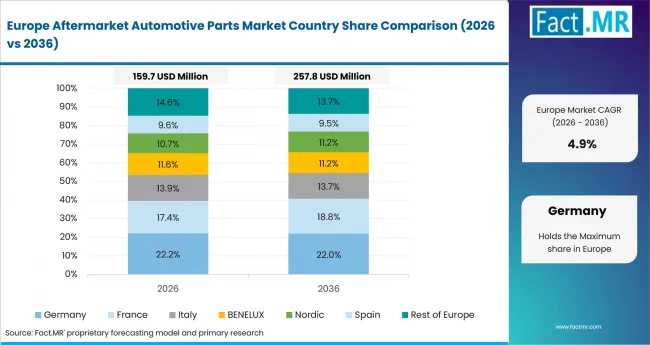
Aftermarket Automotive Parts Market Europe Country Market Share Analysis, 2026 & 2036 | Source: Fact.MR
North America demand is led by the United States. High vehicle use supports tires and filters. Repair shops need fast parts access because delayed repairs affect daily mobility and fleet operations.
- United States: The United States is forecast at 5.0% CAGR through 2036 as road use and vehicle retention support recurring part replacement. FHWA’s 2024 highway statistics show that vehicle miles traveled is a core indicator for wear-related demand [3]. Independent garages serve older vehicles after warranty expiry. Retail chains gain from standard maintenance jobs such as batteries and tires. EV adoption will reduce some engine-related demand but support tires and electronics service.
Western Europe Aftermarket Automotive Parts Market Analysis
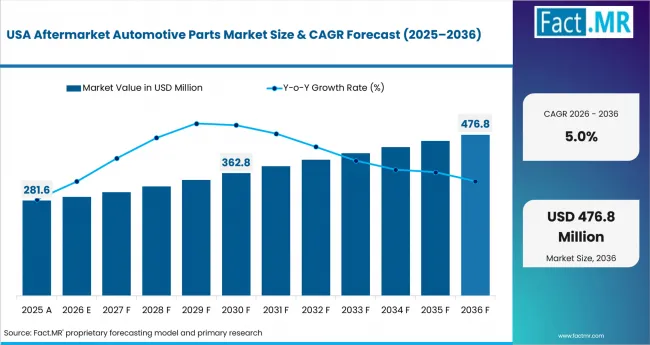
Aftermarket Automotive Parts Market Country Value Analysis | Source: Fact.MR
Western Europe demand comes from aging fleets and regulated service expectations. Germany leads the region because it has a large vehicle base and high repair quality requirements. ACEA reported that there were 256 million cars on EU roads in 2024 and electrically chargeable cars increased to 3.7% of the fleet [4].
- Germany: Germany is expected to register 4.8% CAGR through 2036 because mature repair channels support steady parts replacement. The country has a strong vehicle service culture and a dense workshop base. Demand will come from tires and electronics. EV adoption will change the parts mix over time. Repair shops will need more diagnostic support and safe handling of high-voltage systems. Premium parts suppliers can retain demand through quality proof and service training.
Competitive Aligners for Market Suppliers
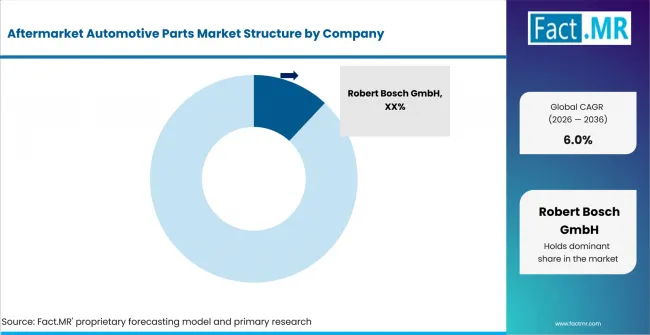
Aftermarket Automotive Parts Market Analysis By Company | Source: Fact.MR
The aftermarket automotive parts market is led by global component suppliers and tire manufacturers that support vehicle repair across garages and retail channels. Robert Bosch GmbH has a strong aftermarket position through diesel systems and workshop solutions. Bosch Limited reported 8.8% growth in its Mobility Aftermarket business in Q3 FY 2024 -25, supported by demand for diesel systems and lubricants. [5] Denso Corporation adds strength through electrical parts and thermal systems. Michelin and Continental AG support replacement demand through tires and mobility solutions.
Competition is driven by fitment accuracy and workshop trust. Garages need parts that arrive on time and match the vehicle without rework. Tire suppliers benefit from regular replacement cycles. Component suppliers compete through braking parts and diagnostic support. Price discipline is important because independent workshops compare margins closely before selecting suppliers.
Through 2036, supplier strength will come from service support and digital catalog quality. Independent garages need fast part identification and dependable stock availability. Authorized service centers need brand-backed components with clear documentation. Suppliers that support workshop training for EV-era repairs can protect future demand as vehicle technology changes.
Key Companies in Aftermarket Automotive Parts Market
- Robert Bosch GmbH
- Denso Corporation
- Michelin
- Continental AG
Aftermarket Automotive Parts Market Analysis by Segments
-
By Vehicle Type:
- Passenger Cars
- Light Commercial Vehicles
- Heavy Commercial Vehicles
-
By Product Type:
- Tires
- Brake Parts
- Electrical Parts
- Engine & Transmission Parts
- Suspension Parts
- Exhaust Parts
- A/C Parts
- Others
-
By Replacement Type:
- Wear & Tear Parts
- Accident & Collision Parts
- Performance & Customization Parts
- Maintenance Consumables
-
By Sales Channel:
- Independent Retailers
- Authorized Dealers
- Online Platforms
- Workshops & Garages
-
By Service Provider:
- Independent Garages
- Authorized Service Centers
- Retail Chains
- DIY Users
-
By Region:
- North America
- United States
- Canada
- Western Europe
- Germany
- United Kingdom
- France
- Italy
- Spain
- East Asia
- Japan
- China
- South Korea
- South Asia and Pacific
- India
- ASEAN
- Australia and New Zealand
- Other Regions
- Latin America
- Middle East and Africa
- North America
Bibliography
- [1] S&P Global Mobility. (2025, May 21). Average age of vehicles in the US rises to 12.8 years in 2025. S&P Global.
- [2] Society of Indian Automobile Manufacturers. (2025, September 11). SIAM Annual Report, 2024-2025.
- [3] Federal Highway Administration. (2026, February). Highway statistics 2024: Table VM-1: Annual vehicle distance traveled in miles and related data. U.S. Department of Transportation.
- [4] European Automobile Manufacturers’ Association. (2026, January 15). Report: Vehicles on European roads 2026.
- [5] Bosch Limited. (2025, January 28). Quarter 03 FY 2024–25 financial results. Bosch Media Service India.
This Report Addresses
- Strategic intelligence on aftermarket automotive parts across vehicle type, product type, replacement type, sales channel, and service provider.
- Forecast mapping from USD 683.3 million in 2026 to USD 1,223.6 million by 2036.
- Segment analysis covering passenger cars, tires, wear & tear parts, independent retailers, and independent garages.
- Regional outlook covering Japan, China, India, the United States, and Germany.
- Competitive analysis of Robert Bosch GmbH, Denso Corporation, Michelin, Continental AG.
- Product assessment covering tires, brakes, electrical parts, suspension parts, exhaust parts, and A/C parts.
- Channel assessment covering independent retailers, authorized dealers, online platforms, and workshops.
- Primary interviews, vehicle parc checks, workshop feedback, and official source validation support the forecast.
Aftermarket Automotive Parts Market Definition
The aftermarket automotive parts market covers replacement parts and components sold after a vehicle has entered use. It includes parts used for repair and performance upgrades. The market differs from OEM production parts because demand comes from vehicles already in operation.
Aftermarket Automotive Parts Market Inclusions
The scope includes tires and maintenance consumables. Sales through independent retailers and repair networks are included. Parts for passenger cars and commercial vehicles are covered.
Aftermarket Automotive Parts Market Exclusions
The scope excludes parts supplied directly for new vehicle assembly. It excludes used vehicles and vehicle servicing labor unless parts are sold with the repair. It excludes fuel and general vehicle accessories that do not replace or support a functional vehicle component.
Aftermarket Automotive Parts Market Research Methodology
- Primary Research: Primary research includes interviews with parts distributors and workshop owners. Garage chains and fleet maintenance heads were reviewed separately.
- Desk Research: Desk research reviews vehicle parc data and road-use indicators. Company disclosures and automotive association reports support regional validation.
- Market-Sizing and Forecasting: Forecasting uses vehicle type demand and product replacement frequency. Sales channel movement and service provider mix support the 2026 to 2036 view.
- Data Validation and Update Cycle: Forecasts are validated through distributor checks and garage feedback. Regional assumptions are reviewed with vehicle age and repair network maturity.
Segmentation
Scope of the Report
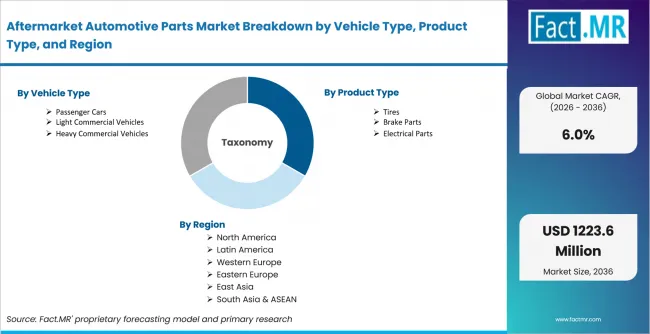
Aftermarket Automotive Parts Market Breakdown By Vehicle Type, Product Type, And Region | Source: Fact.MR
| Attribute | Details |
|---|---|
| Quantitative Units | USD 683.3 million in 2026 to USD 1,223.6 million by 2036 at 6.0% CAGR |
| Market Definition | Replacement automotive parts sold after a vehicle enters use |
| Vehicle Type | Passenger Cars, Light Commercial Vehicles, Heavy Commercial Vehicles |
| Product Type | Tires, Brake Parts, Electrical Parts, Engine & Transmission Parts, Suspension Parts, Exhaust Parts, A/C Parts, Others |
| Replacement Type | Wear & Tear Parts, Accident & Collision Parts, Performance & Customization Parts, Maintenance Consumables |
| Sales Channel | Independent Retailers, Authorized Dealers, Online Platforms, Workshops & Garages |
| Service Provider | Independent Garages, Authorized Service Centers, Retail Chains, DIY Users |
| Regions Covered | North America, Western Europe, East Asia, South Asia and Pacific, Other Regions |
| Countries Covered | Japan, China, India, United States, Germany |
| Key Companies Profiled | Robert Bosch GmbH, Denso Corporation, Michelin, Continental AG |
| Forecast Period | 2026 to 2036 |
| Approach | Hybrid top-down and bottom-up approach using vehicle parc, replacement frequency, product type mix, channel movement, and workshop validation |
Source: Fact.MR analysis. Updated Jun 17, 2026
Frequently Asked Questions
What is the Aftermarket Automotive Parts Market size in 2026?
What will the Aftermarket Automotive Parts Market be worth by 2036?
What CAGR is projected for the Aftermarket Automotive Parts Market?
Which vehicle type leads the Aftermarket Automotive Parts Market?
Which country grows fastest in the Aftermarket Automotive Parts Market?
How does China perform in the Aftermarket Automotive Parts Market?
How does India perform in the Aftermarket Automotive Parts Market?
How does the United States perform in the Aftermarket Automotive Parts Market?
Why are tires important in the Aftermarket Automotive Parts Market?
Why do independent garages lead service demand?
What restrains the Aftermarket Automotive Parts Market?
What is the main opportunity in the Aftermarket Automotive Parts Market?
How do online platforms affect the Aftermarket Automotive Parts Market?
Who worked on this report


Preview the report firsthand - request a free sample
Free SampleGet the brochure for pricing and purchase details
Download PDF