- Market Value (2025): USD 16.8 Bn
- Estimated Value (2026): USD 17.9 Bn
- Forecast Value (2036): USD 33.8 Bn
- CAGR (2026-2036): 6.6%
What is the Automotive Keyless Entry Access Systems Market forecast to be worth by 2036?
USD 17.9 billion in 2026 to USD 33.8 billion by 2036 at 6.6% CAGR.
- The automotive keyless entry access systems market was valued at USD 16.8 billion in 2025.
- Demand is projected to increase from USD 17.9 billion in 2026 to USD 33.8 billion by 2036.
- The market is forecast to record 6.6% CAGR from 2026 to 2036 owing to smart access fitment and phone-based credential use.
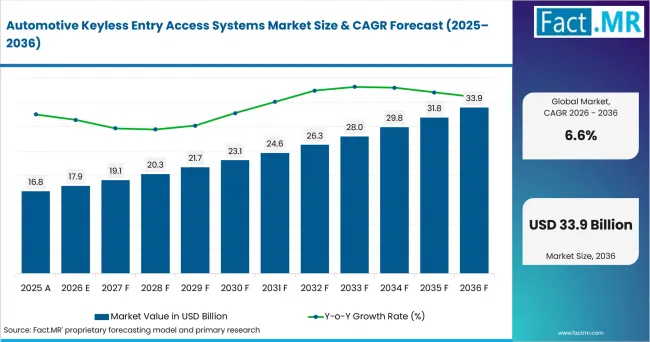
Automotive Keyless Entry Access Systems Market Value Analysis | Source: Fact.MR
What are the defining numbers behind Automotive Keyless Entry Access Systems Market growth?
USD 15.9 billion absolute opportunity by 2036, led by passive keyless entry systems and vehicle access control.
- Demand Drivers in the Market
- Passenger-vehicle manufacturers need passive lock and start functions that work across high-volume platforms without asking drivers to handle a conventional fob.
- Premium and shared-mobility operators require secure credential sharing with revocation and time-limited access for assigned users.
- Vehicle security teams place weight on proximity measurement and encrypted credentials since relay attacks can weaken convenience-led access designs.
- Key Segments Analyzed
- By Access System: Passive Keyless Entry Systems are expected to hold 46% share in 2026 supported by smart access fitment and hands-free entry across passenger and utility vehicles.
- By Vehicle Function: Vehicle Access Control is projected to account for 43% share in 2026 since door lock and remote access remain the most frequent keyless functions.
- By Vehicle Category: Passenger Cars are anticipated to capture 67% share in 2026 owing to production scale and wider transfer of premium access features into hatchbacks and sedans.
- By End User: Automotive Original Equipment Manufacturers are estimated to represent 73% share in 2026 as vehicle makers control body electronics and warranty approval.
- By Authentication Technology: Radio Frequency Identification is forecast to account for 42% share in 2026 due to its installed base in smart keys and engine authorization.
- Analyst Opinion at Fact.MR
- Shambhu Nath Jha, Principal Consultant at Fact.MR, states, “Keyless access is becoming a vehicle identity and security decision. Buyers must define how the vehicle detects an approaching user and verifies the credential before start approval.”
- Strategic Implications
- Vehicle manufacturers should freeze credential ownership and fallback access before finalizing body-control architecture.
- Access-system suppliers can strengthen approval by testing antennas, secure elements and diagnostics as one qualified system.
- Smartphone and semiconductor partners should test across operating systems and device generations before presenting automotive semiconductors as production-ready access components.
The USA follows at 7.1% through theft prevention and premium platform adoption. Germany reaches 6.8% through access-system engineering. Japan records 6.4% through quality-led integration. South Korea posts 6.1% through connected-vehicle programs. India reaches 5.8% through passenger-vehicle growth. Mexico records 5.4% through export assembly and supplier localization.
How does the Automotive Keyless Entry Access Systems Market break down by segment?
Passive Keyless Entry Systems are expected to lead Access System at 46% share in 2026. Vehicle Access Control is projected to lead Vehicle Function at 43% share in 2026.
Which Access System dominates?
Passive Keyless Entry Systems are projected to hold 46% share in 2026.
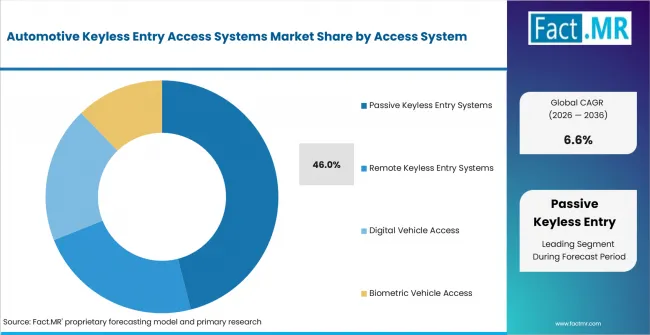
Automotive Keyless Entry Access Systems Market Analysis By Access System | Source: Fact.MR
Their lead reflects demand for touch-free vehicle access without removing the familiar key-fob service model. Smart key systems and hands-free entry systems simplify daily use. Remote keyless entry remains relevant for command-based locking. Digital and biometric access are gaining attention, although adoption depends on secure recovery and authentication procedures.
What leads the Vehicle Function segment?
Vehicle Access Control is expected to account for 43% share in 2026.
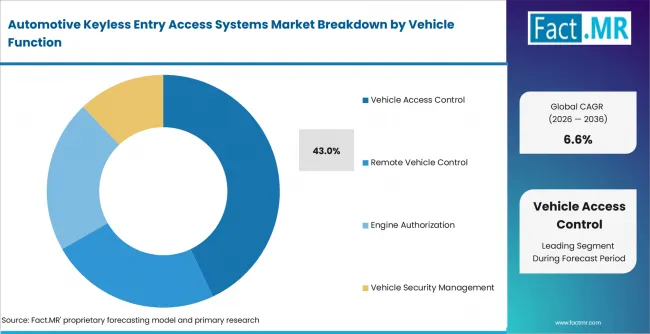
Automotive Keyless Entry Access Systems Market Analysis By Vehicle Function | Source: Fact.MR
Door locking, unlocking and remote entry form the first performance test for any keyless system. Engine Authorization builds on the same credential check before vehicle start. Vehicle Security Management adds theft protection and user-profile control, creating a broader role for access systems beyond basic entry.
Why do Passenger Cars lead Vehicle Category demand?
Passenger Cars are anticipated to capture 67% share in 2026.
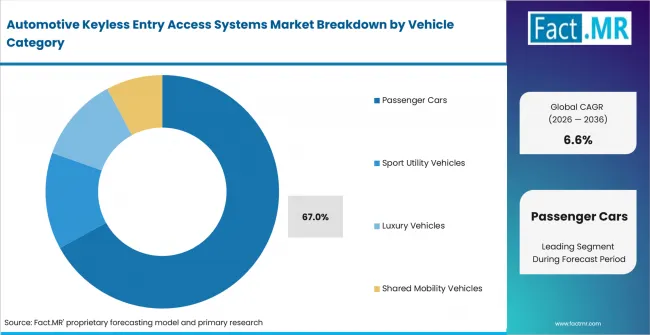
Automotive Keyless Entry Access Systems Market Analysis By Vehicle Category | Source: Fact.MR
High production volumes across hatchbacks and sedans allow manufacturers to spread electronic hardware, software and service costs across larger fleets. Sport Utility Vehicles and Battery Electric Vehicles add further demand through powered access, personalized settings and smartphone-based ownership features that fit newer electric vehicle platforms.
Which End User accounts for the largest share?
Automotive Original Equipment Manufacturers are estimated to represent 73% share in 2026.
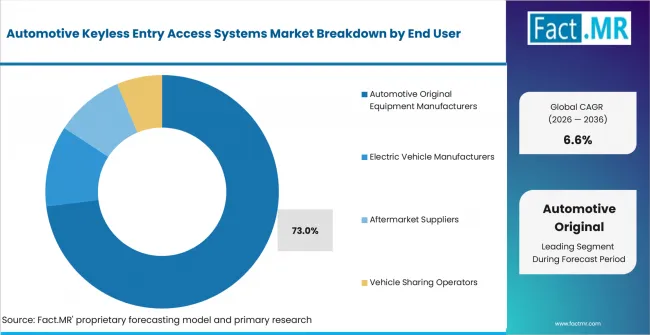
Automotive Keyless Entry Access Systems Market Analysis By End User | Source: Fact.MR
These companies control vehicle architecture, warranty policy and system approval before launch. Tier 1 Automotive Suppliers support hardware and software integration. Fleet and mobility operators create additional demand where access credentials must follow driver assignments, booking changes and vehicle-recovery procedures.
What supports Radio Frequency Identification within Authentication Technology?
Radio Frequency Identification is forecast to hold 42% share in 2026.
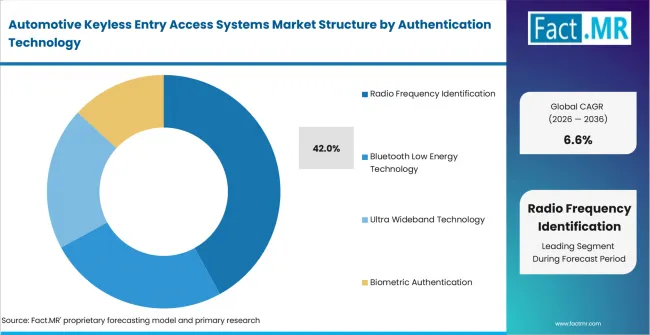
Automotive Keyless Entry Access Systems Market Analysis By Authentication Technology | Source: Fact.MR
Its established role in smart keys and immobilizer systems gives it the widest installed base. Low Frequency and High Frequency Communication support dependable credential exchange. Bluetooth Low Energy and Near Field Communication enable phone-based entry, while Ultra Wideband adds more accurate device positioning for secure ranging.
What is accelerating Automotive Keyless Entry Access Systems Market adoption, and what is holding it back?
Passive-entry scale and digital credential testing are supporting adoption. Security validation and fallback design are expected to slow faster platform changes.
Drivers Impact Analysis
| DRIVER | (~) % IMPACT ON CAGR | GEOGRAPHIC RELEVANCE | IMPACT TIMELINE |
|---|---|---|---|
| Passive keyless fitment | +1.8% | China; USA; Germany; Japan | Short term (<= 2 years) |
| Smartphone digital keys | +1.4% | China; USA; Europe; South Korea | Medium term (2-4 years) |
| Theft-resistant architecture | +1.1% | North America; Europe; premium programs | Short term (<= 2 years) |
| Fleet credential management | +0.8% | USA; China; India; urban mobility markets | Long term (>= 4 years) |
| Localized integration support | +0.5% | India; Mexico; China | Medium term (2-4 years) |
Source: Fact.MR analysis. Updated Aug 6, 2026
- Passive keyless fitment: Smart keys fit existing ownership and dealership routines. This supports volume use without forcing a full move to phone-only access.
- Smartphone digital keys: Phone credentials are expected to add user profiles and shareable access where device testing is reliable.
- Theft-resistant architecture: Precise positioning and encrypted credentials are expected to lift demand for vehicle cybersecurity controls inside access programs.
Opportunity Impact Analysis
| OPPORTUNITY | (~) % IMPACT ON CAGR | GEOGRAPHIC RELEVANCE | IMPACT TIMELINE |
|---|---|---|---|
| Multi-radio BLE and UWB access stacks | +1.2% | China; USA; Germany; Japan | Medium term (2-4 years) |
| Cloud-managed fleet credentials | +1.0% | USA; Europe; China; India | Medium term (2-4 years) |
| Delegated ownership access | +0.7% | Rental; delivery; shared mobility markets | Long term (>= 4 years) |
| Aftermarket enrollment support | +0.5% | North America; Europe; India | Long term (>= 4 years) |
Source: Fact.MR analysis. Updated Aug 6, 2026
- Multi-radio access stacks: Production digital keys can combine discovery, precise ranging and tap-based fallback. Suppliers gain value when these pieces are qualified together.
- Cloud-managed fleet credentials: Fleet operators need vehicle access systems that assign drivers without manual key cabinets or repeated handovers.
- Delegated ownership access: Temporary credentials are expected to help rental and corporate users control access after booking or role changes.
Restraints Impact Analysis
| RESTRAINT | (~) % IMPACT ON CAGR | GEOGRAPHIC RELEVANCE | IMPACT TIMELINE |
|---|---|---|---|
| Relay and credential theft risk | -1.0% | All connected vehicle markets | Short term (<= 2 years) |
| Phone and operating-system variation | -0.8% | Global digital credential programs | Short term (<= 2 years) |
| Fallback and service complexity | -0.6% | OEM and aftermarket channels | Medium term (2-4 years) |
| Localization and radio-rule differences | -0.4% | Cross-border vehicle platforms | Long term (>= 4 years) |
Source: Fact.MR analysis. Updated Aug 6, 2026
- Relay and credential theft risk: Access systems must avoid unauthorized entry while preserving convenience. This raises validation time before platform release.
- Phone and operating-system variation: Digital keys must behave consistently across devices and software versions. Support costs rise when users face inconsistent entry behavior.
- Fallback and service complexity: A driver still needs recovery when a fob battery fails or a phone is unavailable. Dealers must verify ownership before replacement access is enabled.
Which countries are scaling Automotive Keyless Entry Access Systems Market fastest?
- The country comparison spans 2.1 percentage points and forms three practical growth bands through 2036.
- China remains 0.4 percentage point above the USA through new-energy vehicle scale and phone-centered access services.
- The USA remains 0.3 percentage point above Germany through theft prevention and premium platform adoption.
- Germany remains 0.4 percentage point above Japan through access-system engineering and export vehicle programs.
- Japan remains 0.3 percentage point above South Korea through disciplined quality controls and supplier capability.
- South Korea remains 0.3 percentage point above India through connected-vehicle programs and electronics depth.
- Mexico closes the displayed range through export assembly and supplier localization near vehicle plants.
Comparable CAGRs can create different entry conditions due to platform timing and local validation depth. Full report coverage spans North America and Latin America. It also spans Europe and East Asia. South Asia and Pacific and Middle East and Africa complete the regional view.
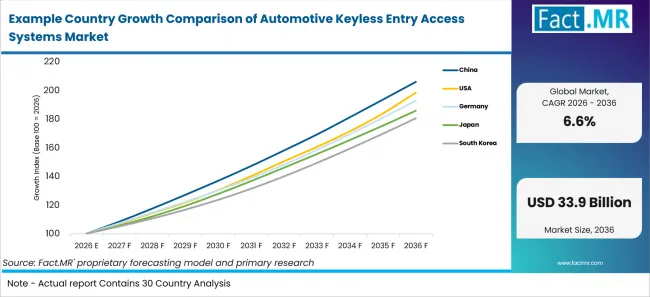
Example Country Growth Comparison Of Automotive Keyless Entry Access Systems Market | Source: Fact.MR
| Country | CAGR (2026-2036) |
|---|---|
| USA | 7.1% |
| Germany | 6.8% |
| Japan | 6.4% |
| South Korea | 6.1% |
| India | 5.8% |
| Mexico | 5.4% |
Source: Fact.MR analysis. Updated Aug 6, 2026
How is the USA scaling demand?
7.1% CAGR, driven by theft prevention and premium vehicle adoption.
USA buyers evaluate access systems through security and service recovery before wider platform use. Premium vehicles and fleets are expected to create demand for clear authorization and remote credential control.
What supports Germany’s outlook?
6.8% CAGR, shaped by premium vehicle engineering and domestic access-system expertise.
Germany’s export-oriented vehicle programs place high weight on consistent behavior across destination markets. Suppliers are expected to gain preference when access hardware and software pass platform-level validation.
What underpins Japan’s growth?
6.4% CAGR, attributable to quality-focused body electronics and disciplined digital-access integration.
Japan’s vehicle industry places emphasis on low standby power and predictable recovery steps. This makes reliability evidence central before digital credentials move into wider vehicle lines.
How is South Korea developing the market?
6.1% CAGR, supported by connected-vehicle platforms and smartphone-led customer experience.
South Korea’s electronics base supports closer coordination between phones and vehicle software. Automakers are expected to expand digital keys when multi-device testing proves stable in daily use.
How is India building keyless access demand?
5.8% CAGR, driven by passenger-vehicle production and wider smartphone use.
India’s market combines cost-sensitive vehicles with rising demand for connected features. Localized fobs and antenna modules are expected to help smart access move into larger vehicle families.
How is Mexico expanding demand?
5.4% CAGR, supported by export assembly and supplier localization near vehicle plants.
Mexico’s role as an export hub for utility vehicles and crossovers supports common access-system content. Suppliers near assembly plants can respond faster to platform changes and service requirements.
Who leads the Automotive Keyless Entry Access Systems Market?
Continental and DENSO hold strong positions through integrated smart-key, body-electronics and authentication systems. Valeo and Hyundai Mobis add hands-free access and connected-vehicle capability.
Aptiv and Bosch strengthen secure vehicle architecture and control integration. NXP Semiconductors supports digital credentials through automotive chips, while Huf, Mitsubishi Electric and Tokai Rika expand the supplier base across keyless entry, immobilizer and access-control hardware.
Which companies are the key providers?
Key companies include Continental AG, DENSO Corporation, Valeo SE, Hyundai Mobis Co., Ltd., Aptiv PLC, Robert Bosch GmbH, NXP Semiconductors N.V., Huf Hülsbeck & Fürst GmbH & Co. KG, Mitsubishi Electric Corporation, and Tokai Rika Co., Ltd.
- Continental AG
- DENSO Corporation
- Valeo SE
- Hyundai Mobis Co., Ltd.
- Aptiv PLC
- Robert Bosch GmbH
- NXP Semiconductors N.V.
- Huf Hülsbeck & Fürst GmbH & Co. KG
- Mitsubishi Electric Corporation
- Tokai Rika Co., Ltd.
Bibliography
- Car Connectivity Consortium. (2025, March 25). The Car Connectivity Consortium updates CCC Digital Key certification program with additional coverage for Bluetooth Low Energy and ultra-wideband technologies.
- National Institute of Standards and Technology. (2025). NIST SP 800-63A-4: Digital identity guidelines—Identity proofing and enrollment. U.S. Department of Commerce.
- United Nations Economic Commission for Europe. (2025). GRVA workshop on the implementation of UN Regulations Nos. 155 and 156 on cybersecurity and software updates.
This Report Answers
- The report provides strategic intelligence on the Automotive Keyless Entry Access Systems Market across access system and authentication technology choices.
- Segment analysis covers Passive Keyless Entry Systems and Vehicle Access Control as stated share leaders within the 2026 market.
- Country outlook evaluates China and the USA alongside Germany and Japan. South Korea, India and Mexico complete the growth comparison.
- Competitive analysis profiles Continental AG and DENSO Corporation alongside Valeo SE and Hyundai Mobis Co., Ltd.
- Technology assessment covers Radio Frequency Identification and Bluetooth Low Energy Technology. Near Field Communication and Ultra Wideband Technology complete the access view.
What does the Automotive Keyless Entry Access Systems Market cover?
Automotive keyless entry access systems are used to authenticate users and control vehicle entry without a traditional mechanical key action.
The market covers passive and remote access systems used in passenger cars and utility vehicles. Digital and biometric access systems are included when they support qualifying commercial vehicles or shared fleets. It includes vehicle-side modules and credential-side systems when they are part of a qualifying automotive access program.
What is included in the scope?
The scope includes Access System and Vehicle Function alongside Vehicle Category and End User.
Authentication Technology is included as the fifth core view. It covers passive access and remote commands. Phone credentials and cloud credentials are included with biometric identity layers. It covers RFID and Bluetooth Low Energy. Near Field Communication and Ultra Wideband are included where these technologies control entry or start authorization.
What is excluded from the scope?
Mechanical keys and standalone lock hardware remain outside the scope of this market.
The scope excludes finished vehicles and unrelated connectivity systems. Standalone smartphones and wearables are excluded when they are not sold as part of an automotive access program. Generic body-control modules and cloud subscriptions are excluded under the same rule. Company revenue without a clear connection to vehicle entry or credential control is excluded.
How Was the Analysis Built?
The analysis draws on 120+ sources, 35+ company portfolios, 25+ countries, and more than 20 industry interviews.
- Primary Research: Primary research includes discussions with manufacturers and service providers. It also includes technology developers, distributors and end users. Procurement teams and subject-matter experts help test purchasing priorities and approval requirements.
- Desk Research: Desk research covers government statistics and regulatory publications. It also reviews company filings, trade data and technical studies. Industry associations and standards provide additional support. Every source used in the analysis is documented in the bibliography.
- Market Sizing and Forecasting: Market estimates combine historical performance and demand indicators. Pricing and volume trends are compared with segment shares. Company participation and country-level growth help test barriers to market expansion.
- Data Validation and Update Cycle: Findings are validated by comparing primary interviews with public data and company activity. Regulatory changes and trade patterns help test industry developments. Regular updates review product launches and partnerships. Approvals and commercial adoption shifts are checked during each update cycle.
Segmentation
What is the report’s scope and coverage?
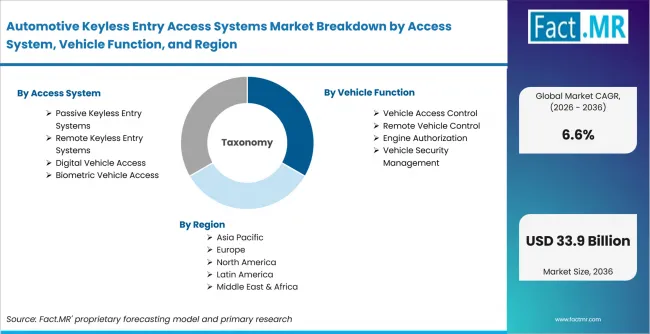
Automotive Keyless Entry Access Systems Market Breakdown By Access System, Vehicle Function, And Region | Source: Fact.MR
| Attribute | Details |
|---|---|
| Quantitative Units | USD Billion |
| Market Definition | Electronic and digital systems used to authenticate approved users and control vehicle entry across passenger, utility, commercial, luxury and shared vehicles |
| Access System | Passive Keyless Entry Systems; Remote Keyless Entry Systems; Digital Vehicle Access; Biometric Vehicle Access |
| Vehicle Function | Vehicle Access Control; Remote Vehicle Control; Engine Authorization; Vehicle Security Management |
| Vehicle Category | Passenger Cars; Sport Utility Vehicles; Battery Electric Vehicles; Light Commercial Vehicles; Luxury Vehicles; Shared Mobility Vehicles |
| End User | Automotive Original Equipment Manufacturers; Electric Vehicle Manufacturers; Commercial Vehicle Manufacturers; Fleet Operators; Aftermarket Suppliers; Mobility Service Providers |
| Authentication Technology | Radio Frequency Identification; Bluetooth Low Energy Technology; Near Field Communication; Ultra Wideband Technology; Encrypted Digital Credentials; Biometric Authentication |
| Regions Covered | North America; Latin America; Europe; East Asia; South Asia and Pacific; Middle East and Africa |
| Countries Covered | China; USA; Germany; Japan; South Korea; India; Mexico |
| Key Companies Profiled | Continental AG; DENSO Corporation; Valeo SE; Hyundai Mobis Co., Ltd.; Aptiv PLC; Robert Bosch GmbH; NXP Semiconductors N.V.; Huf Hülsbeck & Fürst GmbH & Co. KG; Mitsubishi Electric Corporation; Tokai Rika Co., Ltd. |
| Forecast Period | 2026 to 2036 |
| Approach | Hybrid top-down and bottom-up approach using vehicle production; keyless-entry fitment; digital credential adoption; access-system architecture; radio content; country growth patterns and company portfolio review |
Source: Fact.MR analysis. Updated Aug 6, 2026
How is the market segmented?
-
By Access System:
- Passive Keyless Entry Systems
- Smart Key Systems
- Hands-free Entry Systems
- Remote Keyless Entry Systems
- Key Fob Entry
- Smartphone-based Entry
- Digital Vehicle Access
- Digital Key
- Cloud-based Vehicle Key
- Biometric Vehicle Access
- Fingerprint Authentication
- Passive Keyless Entry Systems
-
By Vehicle Function:
- Vehicle Access Control
- Door Lock and Unlock
- Remote Door Access
- Remote Vehicle Control
- Remote Locking
- Remote Unlocking
- Engine Authorization
- Push Button Start
- Immobilizer Control
- Vehicle Security Management
- Anti-theft Protection
- User Profile Management
- Vehicle Access Control
-
By Vehicle Category:
- Passenger Cars
- Hatchbacks
- Sedans
- Sport Utility Vehicles
- Battery Electric Vehicles
- Light Commercial Vehicles
- Luxury Vehicles
- Premium Sedans
- Premium Sport Utility Vehicles
- Shared Mobility Vehicles
- Car Sharing Fleets
- Rental Vehicles
- Passenger Cars
-
By End User:
- Automotive Original Equipment Manufacturers
- Global Vehicle Manufacturers
- Tier 1 Automotive Suppliers
- Electric Vehicle Manufacturers
- Commercial Vehicle Manufacturers
- Fleet Operators
- Aftermarket Suppliers
- Replacement Parts Distributors
- Mobility Service Providers
- Vehicle Sharing Operators
- Fleet Management Companies
- Automotive Technology Providers
- Automotive Original Equipment Manufacturers
-
By Authentication Technology:
- Radio Frequency Identification
- Low Frequency Communication
- High Frequency Communication
- Bluetooth Low Energy Technology
- Secure Bluetooth Authentication
- Near Field Communication
- Ultra Wideband Technology
- Precise Device Positioning
- Encrypted Digital Credentials
- Biometric Authentication
- Fingerprint Recognition
- Facial Recognition Algorithms
- Radio Frequency Identification
-
By Region:
- North America
- Latin America
- Europe
- East Asia
- South Asia and Oceania
- Middle East and Africax
Frequently Asked Questions
How big is the automotive keyless entry access systems market in 2026?
What is the CAGR of the automotive keyless entry access systems market from 2026 to 2036?
Which access system leads the automotive keyless entry access systems market?
Which end-user segment leads the automotive keyless entry access systems market?
Who are the leading companies in the automotive keyless entry access systems market?
Who worked on this report


Preview the report firsthand - request a free sample
Free SampleGet the brochure for pricing and purchase details
Download PDF