- Market Value (2025): USD 527.6 Mn
- Estimated Value (2026): USD 859.0 Mn
- Forecast Value (2036): USD 551.5 Mn
- CAGR (2026-2036): 4.5%
What is the Aggregate Spreader Market forecast to be worth by 2036?
USD 551.5 million in 2026 to USD 859.0 million by 2036 at a 4.5% CAGR.
- Demand for aggregate spreaders was worth USD 527.6 million in 2025, with replacement of aging chip spreaders at county and municipal road departments accounting for much of the spend.
- By 2036 the market will reach USD 859.0 million, up from USD 551.5 million in 2026, as public road owners shift more of their budgets toward surface treatments that extend pavement life.
- A 4.5% CAGR reflects a replacement-led equipment base in which sealing programs, not new road mileage, decide the timing of most purchases.
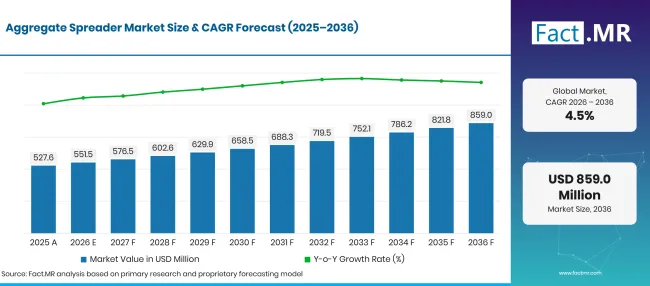
Aggregate Spreader Market Forecast Global | Source: Fact.MR
| Year | Basis | Market Value (USD million) |
|---|---|---|
| 2025 | Actual | 527.6 |
| 2026 | Estimate | 551.5 |
| 2036 | Forecast | 859.0 |
| CAGR 2026 to 2036 | Forecast period | 4.5% |
Source: Fact.MR analysis. Updated Nov 3, 2026
What are the defining numbers behind Aggregate Spreader Market growth?
The 2026 to 2036 period adds USD 307.5 million in new value, with truck-mounted units for road maintenance crews taking the bulk of it.
- Demand Drivers in the Market
- Preservation budgets keep spreaders working. US highway agencies spent $78 billion on maintenance in 2024, about 24% of total highway spending [1]. Chip seals are one of the lowest-cost treatments in that budget, and each sealing crew needs a self-propelled or truck-mounted spreader behind its binder distributor.
- Low-volume road networks create the steadiest demand. Of the 247,200 miles of road in Great Britain in April 2025, minor roads accounted for 215,200 miles, or about 87.0% [2]. Councils treat much of this mileage with surface dressing, which places a single layer of chips over sprayed binder.
- Aging structures and pavements are pulling maintenance forward in Japan. MLIT counts about 240,000 road bridges aged 50 years or more at the end of fiscal 2025, up from about 130,000 [3]. Deck approaches and connecting roads need resurfacing as these structures are repaired, which supports spreading work on municipal routes.
- Contractors want tighter control of chip rates on narrow urban streets. LeeBoy describes its Rosco CSV chip spreader as having a variable-width spread hopper and a compact footprint for tight areas such as urban routes [4]. Rate and width control reduce wasted stone and loose chips after sealing.
- Key Segments Analyzed
- By Product Type: Truck-Mounted Spreaders will hold 42.3% share in 2026 because a single chassis can haul stone and spread it without a second towing unit.
- By Application: Construction will account for 38.2% of 2026 value, given that new roads and widening schemes need graded aggregate placed across base and shoulder layers.
- By Distribution Channel: Distributors will capture 39.4% of 2026 revenue, as dealers handle demonstrations, financing and seasonal parts supply for contractors.
- By End-User: Construction Companies will command 45.3% of 2026 sales, since paving and sealing contractors run most spreading jobs under public contracts.
- Analyst Opinion at Fact.MR
- Shambhu Nath Jha, Principal Consultant at Fact.MR, states, “Aggregate spreaders are bought on the strength of the sealing season. A machine that misses two weeks of it costs a contractor more than its price difference. Through 2036, road owners will put more money into chip seals and surface dressing because these treatments stretch limited maintenance budgets. Suppliers that pair accurate gate and width control with fast dealer service will take most of the replacement orders from counties, councils and contract sealing crews.”
- Strategic Implications
- Manufacturers should offer gate controls that link chip rate to travel speed, as road owners now check rates and loose-chip complaints more closely.
- Distributors should stock gates, belts and conveyor parts before the sealing season opens, because most spreaders work only a few months each year.
- Construction companies and municipalities should compare tailgate units, towed spreaders and self-propelled machines by annual sealed lane miles, not by purchase price alone.
- Investors should favor suppliers with dealer coverage in rural road regions, where most chip seal and surface dressing work takes place.
The five countries split into two groups once their maintenance funding is set side by side. The United Kingdom leads at 5.7%, with new local road funding tied to council performance on potholes and surface dressing. Germany follows at 4.3%, a full 1.4 points lower, since its federal money flows mainly into bridges and motorways that use asphalt overlays. Japan reaches 4.0% as aging bridge approaches and municipal roads draw repair crews. US growth comes in at 3.6%, reflecting a large but mature chip seal fleet that is replaced on long cycles. Brazil trails at 3.2%, given that federal maintenance contracts favor patching and overlays over chip sealing for now.
How does the Aggregate Spreader Market break down by segment?
Truck-Mounted Spreaders will lead Product Type at 42.3%; Construction will head Application at 38.2%; Distributors will lead Distribution Channel at 39.4%; Construction Companies will hold End-User at 45.3% in 2026.
Which Product Type leads?
Truck-Mounted Spreaders take 42.3% of 2026 sales.
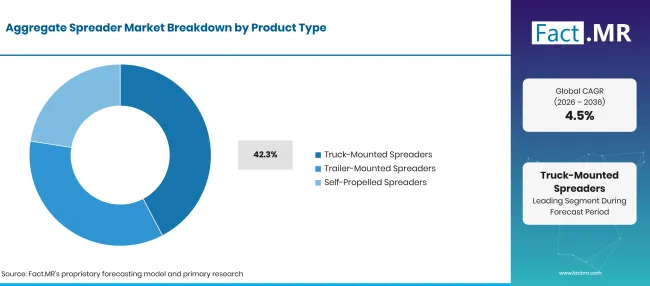
Aggregate Spreader Market Breakdown Product Type | Source: Fact.MR
| Product Type | Share (2026) |
|---|---|
| Truck-Mounted Spreaders (Leading segment) | 42.3% |
| Other segments combined | 57.7%* |
| Total | 100.0% |
Source: Fact.MR analysis. Updated Nov 3, 2026
Road crews value equipment that moves straight from the quarry stockpile to the job. A dump body fitted with a spreader tailgate carries its own load and lays chips across a full lane in one pass. In the United States alone, there are 4.2 million miles of public roads, much of it rural mileage served by county crews [5]. That scale suits trucks that can cover long distances between short work zones. Self-propelled spreaders form the second group and are built for high-output sealing behind a binder distributor. They carry hoppers up to 24 feet wide and are fed by a line of tipper trucks. Trailer-mounted units serve smaller contractors and farm users who already own a suitable towing vehicle. These machines often work alongside an asphalt paver on mixed resurfacing jobs.
What leads the Application segment?
Construction represents 38.2% of 2026 revenue.
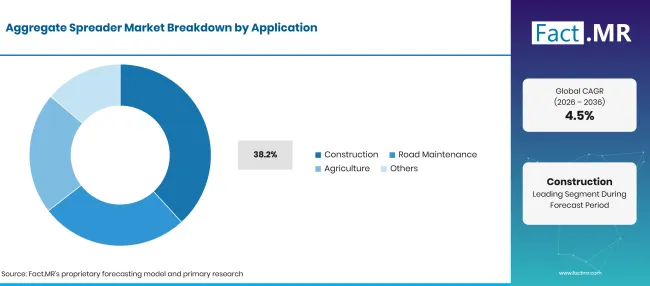
Aggregate Spreader Market Breakdown Application | Source: Fact.MR
| Application | Share (2026) |
|---|---|
| Construction (Leading segment) | 38.2% |
| Other segments combined | 61.8%* |
| Total | 100.0% |
Source: Fact.MR analysis. Updated Nov 3, 2026
New roads, widening schemes and site access routes all need aggregate placed in controlled layers. Spreaders lay base stone, shoulder material and chip courses where a paver would be slow or uneconomic. Projects that use hot mix from an asphalt mixing plant still need chips spread on top of any sealed surface or shoulder. Road maintenance is the next application and covers chip seals, surface dressing and gravel road upkeep. It relies on sprayed bitumen binder that must be covered with chips within minutes. Agriculture uses smaller spreaders for farm tracks and yard surfaces. Other uses include airfield shoulders and industrial sites.
How does Distribution Channel shape demand?
Distributors account for 39.4% of 2026 value.
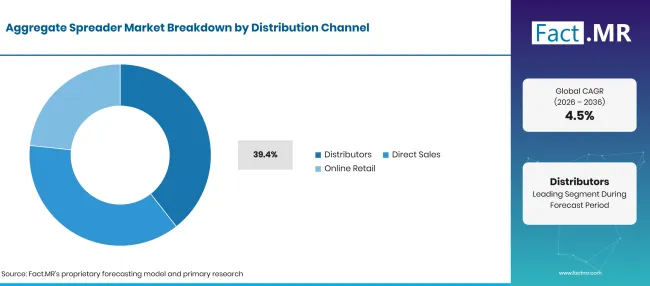
Aggregate Spreader Market Breakdown Distribution Channel | Source: Fact.MR
| Distribution Channel | Share (2026) |
|---|---|
| Distributors (Leading segment) | 39.4% |
| Other segments combined | 60.6%* |
| Total | 100.0% |
Source: Fact.MR analysis. Updated Nov 3, 2026
Dealers decide many purchases in this market. A county buyer wants to see a spreader calibrated on site, arrange financing and know that conveyor chains and gates are in local stock. Equipment dealers also handle trade-ins of older units, which keeps replacement demand flowing through the same channel. Direct sales suit state road agencies and large contractors that tender fleets of identical machines. Online retail covers spare parts and small tailgate spreaders bought by farms and small municipalities. Complex self-propelled machines still need a dealer visit before purchase, so web sales stay a small share of unit volume.
Which End-User segment holds the lead?
Construction Companies hold 45.3% of 2026 sales.
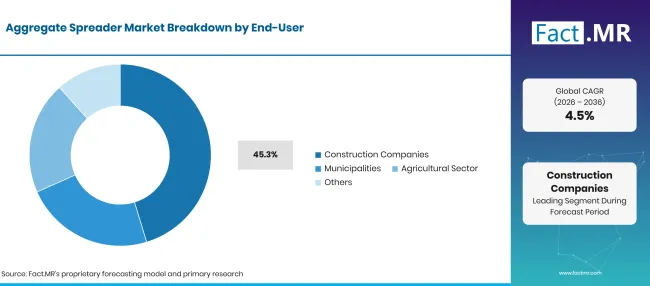
Aggregate Spreader Market Breakdown End User | Source: Fact.MR
| End-User | Share (2026) |
|---|---|
| Construction Companies (Leading segment) | 45.3% |
| Other segments combined | 54.7%* |
| Total | 100.0% |
Source: Fact.MR analysis. Updated Nov 3, 2026
Contract sealing crews run many spreader fleets because public road owners outsource much of their surface treatment work. These firms sell sealing by the square yard, so spreader uptime and rate accuracy feed straight into their margins. Many also offer line work and buy from the same dealers that sell road marking machines. Municipalities form the second user group and often run their own crews on minor roads. Minor roads in Great Britain carried 119.0 billion vehicle miles in 2025, 1.5% more than in 2024 [6]. Agricultural users buy smaller spreaders that can be pulled by farm tractors for tracks and yards. Others include quarries and private estates.
What is accelerating Aggregate Spreader Market adoption, and what is holding it back?
Public owners are spending more on preserving the roads they already have, and chip seals remain one of the cheapest ways to do it. Faster rate control and wider hoppers also help crews seal more lane miles in a short season. On the other side, spreaders stand idle for much of the year, which lengthens payback. Purchases also slow whenever local road budgets are cut.
Drivers Impact Analysis
| DRIVER | (~) % IMPACT ON CAGR | GEOGRAPHIC RELEVANCE | IMPACT TIMELINE |
|---|---|---|---|
| Growth in pavement preservation and chip seal budgets | +1.1% | Global | Medium term (2-4 years) |
| Surface dressing on low-volume local road networks | +0.8% | Western Europe, North America | Short term (<=2 years) |
| Repair of aging bridges and connecting roads | +0.6% | East Asia, Western Europe | Long term (>=4 years) |
| Replacement of older contractor and county fleets | +0.5% | North America | Medium term (2-4 years) |
Source: Fact.MR analysis. Updated Nov 3, 2026
Opportunity Impact Analysis
| OPPORTUNITY | (~) % IMPACT ON CAGR | GEOGRAPHIC RELEVANCE | IMPACT TIMELINE |
|---|---|---|---|
| Variable-width hoppers for narrow urban routes | +0.7% | North America, Western Europe | Medium term (2-4 years) |
| Tailgate spreaders for municipal dump truck fleets | +0.5% | Global | Short term (<=2 years) |
| Speed-linked gate controls and rate logging | +0.4% | Global | Long term (>=4 years) |
| Chip seal programs on rural networks in emerging economies | +0.3% | Latin America, South Asia & Pacific | Long term (>=4 years) |
Source: Fact.MR analysis. Updated Nov 3, 2026
Restraints Impact Analysis
| RESTRAINT | (~) % IMPACT ON CAGR | GEOGRAPHIC RELEVANCE | IMPACT TIMELINE |
|---|---|---|---|
| High purchase price of self-propelled spreaders | -0.7% | Global | Short term (<=2 years) |
| Dependence on public road maintenance budgets | -0.6% | Global | Medium term (2-4 years) |
| Short, weather-dependent sealing season | -0.4% | Western Europe, North America, East Asia | Medium term (2-4 years) |
| Preference for asphalt overlays in some markets | -0.3% | Latin America, Western Europe | Long term (>=4 years) |
Source: Fact.MR analysis. Updated Nov 3, 2026
Which countries are scaling the Aggregate Spreader Market through 2036?
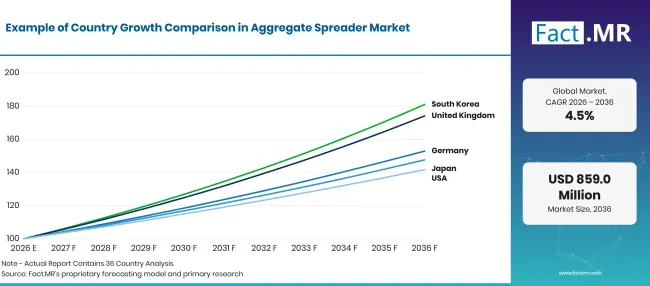
Aggregate Spreader Market Growth Index | Source: Fact.MR
| Country | CAGR (2026 to 2036) |
|---|---|
| United Kingdom | 5.7% |
| Germany | 4.3% |
| Japan | 4.0% |
| United States | 3.6% |
| Brazil | 3.2% |
Source: Fact.MR analysis. Updated Nov 3, 2026
What supports aggregate spreader adoption in the United Kingdom?
5.7% CAGR, driven by local road funding tied to council performance on repairs.
The UK government set out £1.6 billion of highway maintenance funding for councils in England in March 2025, including a £500 million uplift [7]. It also confirmed £4.8 billion for motorways and major A roads in 2025 to 2026. Councils must publish progress reports to keep part of the uplift, which pushes them toward planned treatments such as surface dressing. Local authority crews and their contractors are the main spreader buyers.
How is Germany developing demand?
4.3% CAGR, backed by a large federal road budget weighted toward motorways and bridges.
Germany’s transport ministry has budgeted €11.054 billion for federal trunk roads in 2026 [8]. The Bundestag was told in October 2025 that a further €3 billion from the infrastructure fund will go to maintaining federal roads between 2026 and 2029 [9]. Most of this money funds bridges and asphalt overlays. Spreaders sell mainly to contractors working on state, district and farm roads, where surface treatments are more common.
What is supporting Japan’s adoption?
4.0% CAGR, helped by repair work on aging bridges and a dense municipal road network.
Japan’s roads total about 1,230,300 km, and municipal roads account for 84.1% of that length [10]. MLIT surveyed 2,788 km of road for hidden cavities under the pavement in fiscal 2025 and found 194 sites with a high collapse risk, all now under repair [3]. Such programs create small, scattered resurfacing jobs. Buyers favor compact spreaders that work in narrow streets.
How does the United States perform?
3.6% CAGR, reflecting a mature chip seal fleet that is replaced on long cycles.
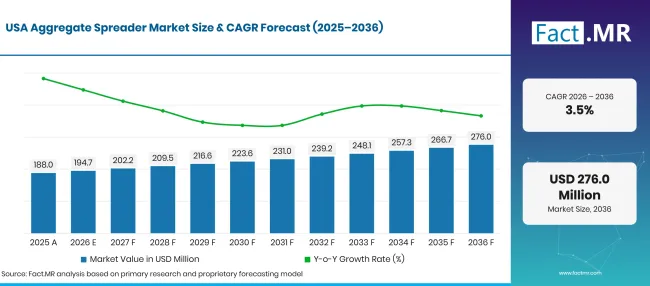
Aggregate Spreader Market Forecast Usa | Source: Fact.MR
Capital outlay reached $159 billion in 2024, or 49% of US highway spending [1]. County road departments and contract sealers run a large installed base of self-propelled chip spreaders. Replacement, not fleet expansion, drives most orders. State preservation programs keep demand steady, and dealers in the Midwest and South handle much of the volume.
How is Brazil developing demand?
3.2% CAGR, as federal maintenance spending improves road condition but favors patching and overlays.
The national transport infrastructure department (DNIT) invested about R$ 8 billion in corrective and routine maintenance in 2025 across 57,000 km of federal highways [11]. Its November survey rated 69% of that network in good condition. Chip seals appear mainly on state and municipal roads with lower traffic. Spreader demand comes from regional contractors who need local parts support.
Who leads the Aggregate Spreader Market?
Supply falls into three groups that compete on different terms. North American chip seal specialists form the first group: Etnyre, LeeBoy with its Rosco line, and BearCat Manufacturing. These firms build self-propelled spreaders for high-output sealing and win on spread accuracy, operator comfort and dealer service in county markets.
Etnyre presents its chip spreaders as built for chip sealing, with a page updated in September 2026 [12]. LeeBoy’s Rosco CSV adds a variable-width hopper for urban routes [4]. The second group sells simpler equipment to truck owners. Buyers Products offers a bed-mounted chip spreader that replaces a dump truck tailgate, a lower-cost route for townships and road departments. The third group covers regional and broad-line makers. Phoenix Engineering supplies chipping spreaders for UK surface dressing, while XCMG lists a chips spreader and a synchronous chip sealing vehicle in its road machinery range. Through 2036, rate control and parts support during the sealing season will separate the suppliers that keep county and contractor accounts.
Which companies are the key providers?
Key companies in the Aggregate Spreader Market include Etnyre, LeeBoy, BearCat Manufacturing, Buyers Products, Phoenix Engineering and XCMG.
- Etnyre
- LeeBoy
- BearCat Manufacturing
- Buyers Products
- Phoenix Engineering
- XCMG
Bibliography
- [1] Federal Highway Administration. (2026, August 5). Funding and Spending: Our Nation’s Highways 2026.
- [2] Department for Transport. (2026, February 12). Road lengths in Great Britain: 2025.
- [3] Ministry of Land, Infrastructure, Transport and Tourism. (2026, August 26). Inspection results for bridges and other structures in fiscal 2025: Road Maintenance Annual Report.
- [4] LeeBoy. (2026, April 21). CSV.
- [5] Federal Highway Administration. (2026, August 5). Roads: Our Nation’s Highways 2026.
- [6] Department for Transport. (2026, May 20). Road traffic estimates in Great Britain, 2025: Traffic in Great Britain by road type.
- [7] Department for Transport. (2025, March 23). PM tells councils to prove action on pothole plague to unlock extra cash and reveals £4.8 billion for major roads.
- [8] Bundesministerium für Verkehr. (2026, July 6). Schnieder: Rund 33,7 Milliarden Euro investieren wir in unsere Infrastruktur.
- [9] Deutscher Bundestag. (2025, October 30). Mittel aus dem Sondervermögen für Autobahnprojekte.
- [10] Ministry of Land, Infrastructure, Transport and Tourism. (2025, March). Road policy development: preventive maintenance of roads.
- [11] Agência Gov. (2026, January 2). Investimento de R$ 8 bilhões promove melhoria na condição das rodovias pelo país.
- [12] Etnyre. (2026, September 24). Chip Spreaders.
This Report Answers
- How is aggregate spreader revenue split by product type, application, distribution channel and end-user?
- Why do truck-mounted units hold the lead over self-propelled and towed spreaders?
- Which road maintenance budgets in the United Kingdom, Germany, Japan, the United States and Brazil shape purchases?
- How much of the spending comes from chip sealing compared with new construction?
- What role do dealers play in calibration, financing and seasonal parts supply?
- Which suppliers compete in self-propelled, tailgate and regional spreader lines?
What does the Aggregate Spreader Market cover?
This study tracks revenue from machines that place aggregate at a controlled rate over road, shoulder and site surfaces. It counts self-propelled chip spreaders and truck-mounted tailgate or box spreaders. Trailer-mounted units sold to contractors, municipalities and farms are also covered.
Values are stated in USD million at manufacturer selling price for 2026 to 2036. Control systems, hoppers and conveyors count when they are sold with the spreader, as most buyers order them as one package.
What is included in the scope?
Self-propelled chip spreaders used behind binder distributors for chip seal and surface dressing work.
Truck-mounted tailgate and box spreaders that place gravel or chips from a dump body.
Trailer-mounted spreaders towed by trucks or tractors for road, farm and site use.
Factory-fitted rate controls, width extensions and conveyors sold with new spreaders.
What is excluded from the scope?
Salt, grit and de-icing spreaders used only for winter road treatment.
Fertilizer, seed and lime spreaders, along with binder spreaders that place cement or lime powder.
Bitumen distributors, asphalt pavers and binder products such as asphalt additives sold to the same crews.
Dump trucks without a spreading attachment, aggregate materials and contract sealing services.
How Was the Analysis Built?
The analysis draws on 120+ sources, 35+ company portfolios, 25+ countries, and more than 20 industry interviews.
- Primary Research: Primary research includes discussions with manufacturers, service providers, technology developers, distributors, end users, and subject-matter experts. These conversations examine purchasing priorities, product adoption, operational challenges, approval requirements, competitive positioning, and the factors that influence wider market acceptance.
- Desk Research: Desk research covers government statistics, regulatory publications, company filings, trade data, technical studies, industry associations, standards, public policy, and other authoritative sources. Every source used in the analysis is documented in the bibliography.
- Market Sizing and Forecasting: Market estimates combine historical performance, demand indicators, pricing and volume trends, segment shares, company participation, country-level growth, adoption patterns, investment activity, and barriers to market expansion.
- Data Validation and Update Cycle: Findings are validated by comparing primary interviews with public data, company activity, regulatory changes, trade patterns, and industry developments. Regular updates review new product launches, capacity changes, partnerships, approvals, and shifts in commercial adoption
Segmentation
What is the report’s scope and coverage?
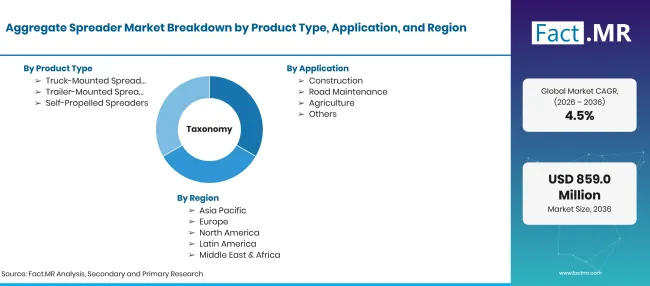
Aggregate Spreader Market Taxonomy | Source: Fact.MR
| Attribute | Details |
|---|---|
| Quantitative Units | USD million in 2026 to USD million by 2036 at CAGR |
| Market Definition | Equipment that meters and spreads gravel, crushed stone and cover chips across prepared or sprayed road and site surfaces, in truck-mounted, trailer-mounted and self-propelled forms. |
| Product Type | Truck-Mounted Spreaders; Trailer-Mounted Spreaders; Self-Propelled Spreaders |
| Application | Construction; Road Maintenance; Agriculture; Others |
| Distribution Channel | Distributors; Direct Sales; Online Retail |
| End-User | Construction Companies; Municipalities; Agricultural Sector; Others |
| Regions Covered | North America; Latin America; Western Europe; Eastern Europe; East Asia; South Asia & Pacific; Middle East & Africa |
| Countries Covered | United Kingdom; Germany; Japan; United States; Brazil |
| Companies Profiled | Etnyre; LeeBoy; BearCat Manufacturing; Buyers Products; Phoenix Engineering; XCMG |
| Forecast Period | 2026 to 2036 |
| Approach | Installed spreader fleets and replacement cycles linked to public road maintenance and sealing budgets, checked against supplier product ranges and dealer coverage. |
Source: Fact.MR analysis. Updated Nov 3, 2026
How is the market segmented?
-
By Product Type
- Truck-Mounted Spreaders
- Trailer-Mounted Spreaders
- Self-Propelled Spreaders
-
By Application
- Construction
- Road Maintenance
- Agriculture
- Others
-
By Distribution Channel
- Distributors
- Direct Sales
- Online Retail
-
By End-User
- Construction Companies
- Municipalities
- Agricultural Sector
- Others
-
By Region
- North America
- Latin America
- Western Europe
- Eastern Europe
- East Asia
- South Asia & Pacific
- Middle East & Africa
Frequently Asked Questions
How large is the aggregate spreader market in 2026?
What growth rate will the aggregate spreader market record?
Which product type leads?
Which application leads?
Which distribution channel leads?
Which end-user leads?
Which country will grow quickest?
Who are the main companies?
What holds the market back?
Who worked on this report


Preview the report firsthand - request a free sample
Free SampleGet the brochure for pricing and purchase details
Download PDF