- Base Value(2025): 8.8 Bn
- Estimated Value(2026): 9.6 Bn
- Forecast Value (2036): 24.12 Bn
- CAGR (2026 - 2036): 9.6%
Road Marking Machine Market Analysis and Forecast by Fact.MR
- The global road marking machine market is estimated at USD 9.64 billion in 2026 and is forecast to expand at a CAGR of 9.6% to reach USD 24.12 billion by 2036.
- Road marking machines encompass fully automatic, semi-automatic, and manual systems that apply thermoplastic, paint-based, and cold plastic markings to roads, highways, parking lots, airports, and industrial facilities.
- The market is driven by large-scale highway and urban road construction programs, increasing emphasis on road safety standards, growing adoption of smart traffic management systems, airport expansion projects, and rising demand for durable, reflective road markings that support both human drivers and autonomous vehicle navigation.
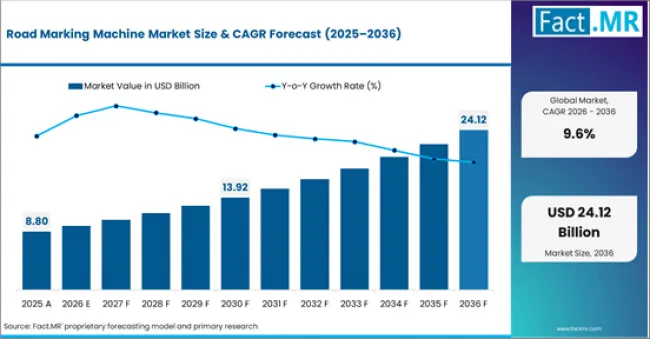
Road Marking Machine Market Value Analysis | Source: Fact.MR
Summary of Road Marking Machine Market
- Market Snapshot
- In 2025, the global Road Marking Machine Market was valued at approximately USD 8.80 billion.
- The market is estimated to reach USD 9.64 billion in 2026 and is projected to attain USD 24.12 billion by 2036.
- The road marking machine market is likely to expand at a CAGR of 9.6% during the forecast period.
- The market is anticipated to create an absolute dollar opportunity of USD 14.48 billion between 2026 and 2036.
- Thermoplastic marking machines account for 50% of technology type share in 2026.
- India (10.7%) and UAE (10.6%) are the key growth markets during the forecast period.
- Demand and Growth Drivers
- Large-scale national highway construction and urban road expansion programs across India, China, Brazil, the Middle East, and Southeast Asia are driving sustained procurement of road marking equipment.
- Growing emphasis on road safety standards and traffic management is increasing marking requirements across both new and existing road networks globally.
- Airport expansion and modernization programs are creating demand for specialized runway, taxiway, and terminal area marking equipment with precision application capabilities.
- Rising adoption of autonomous vehicle navigation systems is increasing demand for high-quality, machine-readable road markings with enhanced reflectivity and geometric precision.
- Replacement demand for aging road marking infrastructure, combined with increasing specification of durable thermoplastic and cold plastic materials, is driving machine upgrade cycles.
- Product and Segment View
- Fully automatic road marking machines account for 45% of the product type segment in 2026, driven by highway-scale projects requiring high-speed, consistent line application over long distances.
- Thermoplastic marking machines hold 50% of the technology type segment in 2026, reflecting the dominance of thermoplastic materials for durable highway markings that resist wear, weathering, and traffic abrasion.
- Roads and highways account for 60% of the application segment, driven by government infrastructure spending on highway construction and road safety programs.
- Key segmentation includes:
- Product Type: Fully automatic, Semi-automatic, Manual road marking machines
- Technology Type: Thermoplastic, Paint-based, Cold plastic, Other technologies
- Application: Roads and highways, Parking lots, Airports, Industrial and commercial facilities
- End Use Industry: Government and municipal, Construction companies, Airport authorities, Industrial sector
- Power Source: Diesel-powered, Petrol-powered, Electric-powered machines
- Line Type: Straight line, Symbol and pattern, Reflective marking machines
- These systems enable:
- High-speed, consistent line application across highway-scale projects with thermoplastic and cold plastic materials
- Precision marking for airports and industrial zones requiring geometric accuracy and reflective performance
- Automated skip-line, pattern, and symbol application that reduces labor requirements and improves consistency
- Geography and Competitive Outlook
- Asia Pacific leads growth through India and China, driven by massive highway construction programs, urban road expansion, and increasing road safety enforcement.
- The Middle East sustains strong demand through the UAE and Saudi Arabia, supported by highway network expansion and airport modernization programs.
- North America and Europe maintain steady demand through the USA and Germany, supported by road maintenance programs and autonomous vehicle readiness standards.
- India (10.7%), UAE (10.6%), and China (10.4%) lead growth, while Brazil (10.1%), the USA (9.8%), Japan (9.5%), and Germany (9.3%) sustain demand.
- Some of the major players in this market include Graco Inc., Hofmann Borum A/S, RME Road Marking Equipment, STiM Group, and Automark Industries.
- Analyst Opinion
- Shambhu Nath Jha, Principal Consultant at Fact.MR, says 'The road marking machine market is entering an acceleration phase driven by the convergence of infrastructure investment cycles across India, China, the Middle East, and Brazil. The shift from paint-based to thermoplastic and cold plastic marking systems is creating equipment upgrade demand, while the growing requirement for machine-readable markings that support autonomous vehicle navigation adds a new specification layer. Manufacturers delivering integrated systems combining marking application, GPS-guided line control, and reflective material dispensing are capturing project specifications, while those offering only basic paint stripers face displacement in high-value government contracts.'
Key Growth Drivers, Constraints, and Opportunities
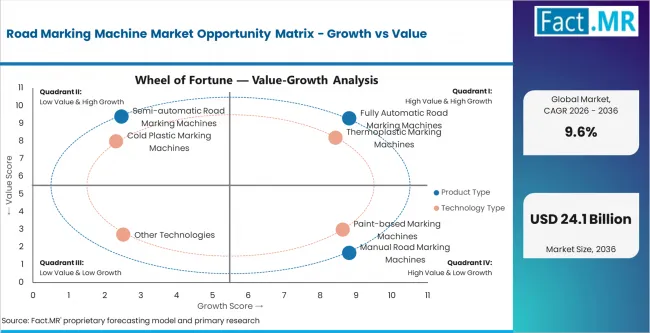
Road Marking Machine Market Opportunity Matrix Growth Vs Value | Source: Fact.MR
Key Factors Driving Growth
- Multi-billion-dollar national highway construction programs in India, China, and the Middle East are creating sustained multi-year demand for high-output road marking machines.
- Increasing enforcement of road safety standards is raising the quality bar for marking equipment procurement across government and municipal agencies.
- Airport expansion and runway modernization programs are creating specialized demand for precision marking equipment meeting aviation-grade standards.
Key Market Constraints
- Government procurement cycles and budget allocation delays create uneven demand patterns that challenge production planning.
- High capital costs for fully automatic truck-mounted systems create procurement barriers for smaller contractors and municipal agencies.
- Seasonal weather constraints in northern climates limit marking application windows, creating concentrated demand peaks.
Key Opportunity Areas
- Autonomous vehicle readiness requirements are creating new specification standards for machine-readable road markings with enhanced reflectivity and precision.
- Electric-powered marking machines are emerging in urban environments where emissions and noise restrictions limit diesel equipment.
- GPS-guided line control and digital quality monitoring create premium equipment segments with higher margins.
Segment-wise Analysis of the Road Marking Machine Market
- Fully automatic road marking machines hold 45% of the product type segment in 2026, driven by demand for high-speed, consistent line application across highway-scale projects.
- Government and municipal accounts for 60% of the end use industry segment, reflecting the dominance of public sector spending as the primary driver of procurement.
- Vehicle-mounted machines account for 65% of the mobility type segment, driven by highway projects where truck-mounted configurations deliver highest productivity.
The road marking machine market is segmented by product type, technology type, application, end use industry, power source, line type, mobility type, and region. Fully automatic machines lead by product type. Thermoplastic machines dominate by technology. Roads and highways lead by application, and government entities are the primary end users.
Which Product Type Segment Dominates the Road Marking Machine Market?
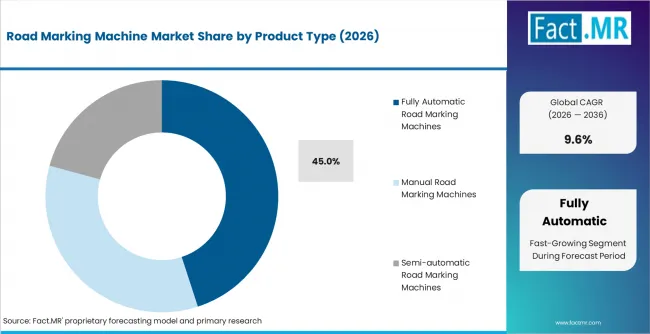
Road Marking Machine Market Analysis By Product Type | Source: Fact.MR
Fully automatic road marking machines account for 45% of the product type segment in 2026. Their leadership reflects the growing scale of highway construction programs where truck-mounted automatic systems deliver the speed, consistency, and precision required for multi-lane marking over long distances. Robotic marking machines are gaining specification interest for smart road systems where GPS-guided precision supports autonomous vehicle navigation.
Semi-automatic machines serve medium-scale urban road projects where self-propelled configurations balance productivity with maneuverability. Manual machines serve small road projects, parking lot layouts, and line touch-up applications where compact size and low cost are the primary procurement criteria.
Which Technology Type Segment Dominates the Road Marking Machine Market?
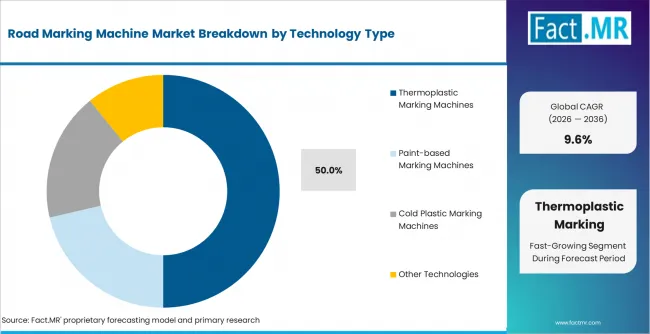
Road Marking Machine Market Analysis By Technology Type | Source: Fact.MR
Thermoplastic marking machines account for 50% of the technology type segment in 2026. The dominance of thermoplastic technology reflects the material's superior durability, wear resistance, and retroreflective performance compared to paint-based alternatives. Extrusion and screed-type thermoplastic systems produce thick markings that resist traffic abrasion and weather erosion over multi-year lifespans.
Cold plastic marking machines are the fastest-growing technology segment, driven by demand for high-durability structured markings in urban environments. Paint-based machines continue to serve high-volume, lower-specification applications where rapid application speed and lower material cost take precedence over marking longevity.
Which Application Segment Dominates the Road Marking Machine Market?

Road Marking Machine Market Analysis By Application | Source: Fact.MR
Roads and highways account for 60% of the application segment in 2026. Highway lane marking, edge lines, and intersection markings represent the largest and most equipment-intensive applications. Government highway programs across India, China, the USA, and the Middle East drive the majority of equipment procurement.
Parking lots represent the second-largest application. Airport marking is a specialized high-value segment where precision requirements create demand for purpose-built equipment. Industrial facility marking serves warehouse safety lines, factory zoning, and hazard marking applications.
Which Product Trend is Shaping the Next Phase of Growth in the Road Marking Machine Market?
GPS-guided, autonomous road marking systems with integrated quality monitoring are emerging as the defining product trend. Modern fully automatic marking machines now incorporate satellite-guided line control, laser alignment, and real-time material application monitoring that deliver geometric precision supporting autonomous vehicle navigation. These systems reduce reliance on operator skill, improve marking consistency, and generate digital quality records satisfying stringent government inspection standards.
The shift toward autonomous vehicle-ready road infrastructure is raising the performance threshold for markings across developed markets. Markings must maintain consistent contrast ratios, retroreflective performance, and geometric accuracy that machine vision systems can reliably detect. Equipment manufacturers integrating precise glass bead dispensing, uniform material application, and GPS-verified line placement are capturing premium project specifications in highway and urban programs.
Regional Outlook Across Key Markets
.webp "Top Country Growth Comparison Road Marking Machine Market Cagr (2026 2036)")
Top Country Growth Comparison Road Marking Machine Market Cagr (2026 2036) | Source: Fact.MR
| Country | CAGR (%) |
|---|---|
| India | 10.7% |
| UAE | 10.6% |
| China | 10.4% |
| Brazil | 10.1% |
| USA | 9.8% |
| Japan | 9.5% |
| Germany | 9.3% |
Source: Fact.MR analysis. Updated May 25, 2026
- India leads growth at 10.7%, driven by the Bharatmala Pariyojana highway program, urban road expansion, and increasing road safety enforcement.
- The UAE follows at 10.6%, supported by highway development, airport expansion, and smart city infrastructure programs.
- China grows at 10.4%, driven by continued highway network expansion and growing adoption of thermoplastic marking technologies.
- The USA (9.8%), Japan (9.5%), and Germany (9.3%) sustain demand through road maintenance, autonomous vehicle readiness, and airport modernization.
Source: Fact MR (FMR) analysis, based on proprietary forecasting model and primary research.
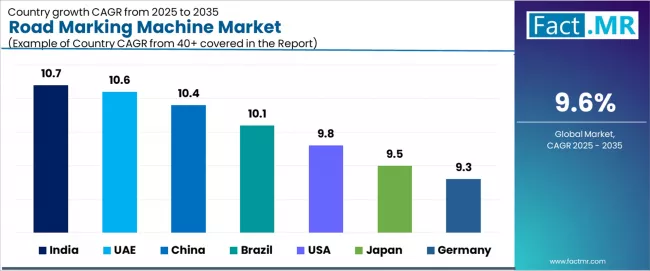
Road Marking Machine Market Cagr Analysis By Country | Source: Fact.MR
Market Outlook for Road Marking Machines in India
The India road marking machine market is projected to grow at a CAGR of 10.7% through 2036. Demand is driven by the Bharatmala Pariyojana highway program, smart city road development, and increasing road safety enforcement standards.
- Bharatmala Pariyojana drives multi-year highway marking equipment procurement.
- Smart city programs expand urban marking equipment demand.
- Road safety enforcement raises marking specification and durability standards.
Road Marking Machine Demand Trends in the UAE
The UAE road marking machine market is projected to grow at a CAGR of 10.6% through 2036. Growth is supported by highway expansion, airport modernization, smart city development, and demand for heat-resistant marking systems.
- Highway expansion creates sustained demand for thermoplastic marking equipment.
- Airport modernization drives specialized runway marking equipment procurement.
- Heat-resistant marking requirements shape technology specification.
China Road Marking Machine Market Growth Assessment
The China road marking machine market is projected to grow at a CAGR of 10.4% through 2036. Demand is driven by highway expansion, urban road modernization, and growing adoption of automated GPS-guided marking systems.
- Highway network expansion sustains demand for fully automatic marking machines.
- Urban modernization drives adoption of cold plastic and thermoplastic technologies.
- Domestic manufacturing supports cost-competitive supply.
United States Road Marking Machine Market Demand Analysis

Road Marking Machine Market Country Value Analysis | Source: Fact.MR
The U.S. road marking machine market is projected to grow at a CAGR of 9.8% through 2036. Demand is shaped by federal highway maintenance, state road budgets, airport marking requirements, and autonomous vehicle-ready marking standards.
- Federal highway programs sustain multi-year equipment procurement.
- Autonomous vehicle readiness raises retroreflective marking standards.
- Airport runway modernization creates specialized demand.
Germany Road Marking Machine Market Opportunity Outlook
The Germany road marking machine market is projected to grow at a CAGR of 9.3% through 2036. Demand is supported by Autobahn maintenance, urban road safety, airport infrastructure, and cold plastic marking adoption.
- Autobahn maintenance drives consistent equipment procurement.
- Cold plastic adoption expands in urban applications.
- Road safety standards support high-reflectivity equipment specification.
Competitive Benchmarking and Company Positioning
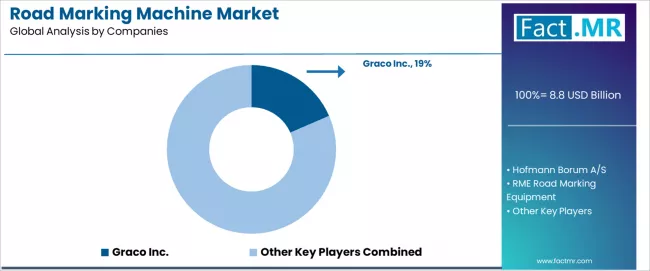
Road Marking Machine Market Analysis By Company | Source: Fact.MR
Road Marking Machine Market Analysis By Company
- Graco Inc. dominates the market with approximately 19% share through its LineLazer and ThermoLazer product families and extensive global distribution.
- Hofmann Borum A/S, RME Road Marking Equipment, and STiM Group compete through European technology leadership and specialized thermoplastic equipment.
- Product breadth, technology coverage, contractor relationships, and after-sales service are the primary competitive differentiators.
The competitive landscape features Graco Inc. as the clear market leader with approximately 19% share through its LineLazer airless striping platform, ThermoLazer thermoplastic systems, and SmartControl digital tracking. Graco's position is built on technology leadership in airless spray and hydraulic pump systems, the industry's broadest distribution network, and deep contractor brand loyalty.
Hofmann Borum A/S and STiM Group maintain strong positions in European and emerging markets through specialized thermoplastic and cold plastic equipment, while RME Road Marking Equipment serves value segments. Chinese manufacturers including Zhengzhou Dayu Machinery and Jiangsu Winfar are expanding globally through price-competitive fully automatic systems.
Automark Industries serves the rapidly growing Indian domestic market with automated thermoplastic systems supporting the Bharatmala highway program. Titan Tool and TATU Group compete in specific regional and application segments.
Strategic priorities include integrating GPS-guided line control, developing electric-powered urban systems, expanding thermoplastic technology capabilities, and building service infrastructure in high-growth markets.
Key Companies in the Road Marking Machine Market
- Graco Inc. is the dominant player, supported by LineLazer and ThermoLazer platforms, SmartControl digital systems, and the broadest distribution network.
- Hofmann Borum A/S, RME Road Marking Equipment, and STiM Group hold established positions through European technology leadership.
- Zhengzhou Dayu Machinery, Automark Industries, Titan Tool Inc., TATU Group, and Jiangsu Winfar compete through regional strength and competitive pricing.
Recent Industry Developments
- Graco Inc. - Product Platform / SmartControl Digital Tracking Integration (2025)
- Graco continued expanding its SmartControl digital tracking system across LineLazer and ThermoLazer platforms, enabling real-time job performance data including spray pressure, material consumption, and line quality metrics.
- STiM Group - Market Expansion / Middle East and South Asia Distribution (2025)
- STiM Group expanded road marking equipment distribution into the Middle East and South Asia, addressing growing demand for thermoplastic and cold plastic systems driven by highway construction programs.
- Automark Industries - Product Development / Automated Thermoplastic Systems for India (2025)
- Automark Industries expanded its automated thermoplastic road marking machine portfolio for the Indian market, supporting growing demand from the Bharatmala Pariyojana highway program.
Leading Companies Shaping the Road Marking Machine Market
- Graco Inc.
- Hofmann Borum A/S
- RME Road Marking Equipment
- STiM Group
- Zhengzhou Dayu Machinery Co., Ltd
- Automark Industries (India) Pvt Ltd.
- Titan Tool Inc.
- TATU Group
- Jiangsu Winfar Transport Facilities Co., Ltd
Sources and Research References
- Graco Inc. SmartControl digital tracking system and LineLazer platform documentation.
- National highway construction programs including Bharatmala Pariyojana project data.
- Airport expansion project databases and capital expenditure records.
- Road safety regulation databases and government procurement records.
- Primary interviews with equipment manufacturers, road contractors, and government agencies.
This bibliography is provided for reader reference and is not exhaustive. The full report contains the complete reference list and detailed citations.
Key Questions This Report Addresses
- What is the current and future size of the Road Marking Machine market?
- How fast is the road marking machine market expected to grow between 2026 and 2036?
- Which product type is likely to lead the market by 2026?
- Which technology type holds the highest share by 2026?
- What factors are driving demand globally?
- How is autonomous vehicle readiness influencing the market?
- Why is India the fastest-growing market?
- How are thermoplastic technologies shaping demand?
- Which countries show the fastest growth through 2036?
- Who are the key companies?
- How does Fact.MR validate the forecast?
Road Marking Machine Market Definition
The road marking machine market covers fully automatic, semi-automatic, and manual equipment that applies thermoplastic, paint-based, cold plastic, preformed tape, and reflective markings to roads, highways, parking lots, airports, and industrial facilities.
Road Marking Machine Market Inclusions
- The scope covers global and regional market size and forecasts for 2026 to 2036 across product type, technology type, application, end use industry, power source, line type, and region.
- It includes analysis of highway construction programs, road maintenance budgets, airport expansion projects, and road safety regulation timelines.
- The report covers pricing and cost analysis across manual, semi-automatic, and fully automatic equipment categories.
- It covers technology trends, market drivers and constraints, and the competitive landscape of leading manufacturers.
Road Marking Machine Market Exclusions
- The scope excludes road marking materials sold separately from marking equipment.
- It excludes road construction equipment not specifically designed for marking application.
- The report excludes traffic sign installation equipment and signal systems not classified as road marking machines.
- It also excludes hand-held spray paint equipment used for small-scale touch-up work without line-striping capability.
Road Marking Machine Market Research Methodology
- The methodology combines secondary research, primary interviews, and forecast modelling.
- It draws on 60+ secondary sources and benchmarks 25+ manufacturer product portfolios.
- Market sizing covers 25+ countries through a demand-side model, supported by top-down validation.
- Key inputs include highway construction budgets, road network expansion plans, airport capital expenditure, and equipment replacement cycle analysis.
- The model cross-checks demand with equipment production capacity, material pricing, and project completion data.
- Primary validation includes 20+ interviews across equipment manufacturers, road contractors, and government procurement agencies.
- Final estimates go through project-pipeline checks, procurement-volume review, and sensitivity testing.
Segmentation
Scope of Analysis
| Parameter | Details |
|---|---|
| Quantitative Units | USD 9.64 billion to USD 24.12 billion, at a CAGR of 9.6% |
| Market Definition | The road marking machine market covers fully automatic, semi-automatic, and manual equipment for thermoplastic, paint, cold plastic, and reflective marking application on roads, highways, parking lots, airports, and industrial facilities. |
| Regions Covered | North America, Latin America, Europe, East Asia, South Asia and Pacific, Middle East and Africa |
| Countries Covered | India, UAE, China, Brazil, USA, Japan, Germany, 25 plus countries |
| Key Companies | Graco Inc., Hofmann Borum A/S, RME Road Marking Equipment, STiM Group, Zhengzhou Dayu Machinery, Automark Industries, Titan Tool, TATU Group, Jiangsu Winfar |
| Forecast Period | 2026 to 2036 |
| Approach | Hybrid demand-side and top-down methodology built on highway construction budgets, road maintenance spending, airport capital expenditure, and primary interviews across manufacturers, contractors, and government agencies |
Source: Fact.MR analysis. Updated May 25, 2026
Road Marking Machine Market Segmentation
-
Road Marking Machine Market Segmented by Product Type:
- Fully Automatic Road Marking Machines
- Truck-mounted Automatic
- Highway Marking
- Long Continuous Lines
- Robotic Marking Machines
- Precision Marking
- Smart Road Systems
- Truck-mounted Automatic
- Manual Road Marking Machines
- Hand-push Machines
- Small Road Projects
- Parking Lots
- Hand-held Machines
- Line Touch-ups
- Short Distance Marking
- Hand-push Machines
- Semi-automatic Road Marking Machines
- Self-propelled Machines
- Medium Scale Projects
- Urban Roads
- Truck-mounted Semi-automatic
- High Efficiency
- Long Distance Marking
- Self-propelled Machines
- Fully Automatic Road Marking Machines
-
Road Marking Machine Market Segmented by Technology Type:
- Thermoplastic Marking Machines
- Extrusion Type
- Thick Layer Marking
- Durable Lines
- Screed Type
- Smooth Finish
- High Adhesion
- Extrusion Type
- Paint-based Marking Machines
- Airless Spray Machines
- Fast Application
- Uniform Coating
- Conventional Spray Machines
- Low Cost
- General Purpose
- Airless Spray Machines
- Cold Plastic Marking Machines
- Spray Cold Plastic
- High Durability
- Urban Roads
- Extruded Cold Plastic
- Structured Markings
- Long Lifespan
- Spray Cold Plastic
- Other Technologies
- Preformed Tape Applicators
- Quick Installation
- Temporary Markings
- Laser Marking Systems
- High Precision
- Advanced Applications
- Preformed Tape Applicators
- Thermoplastic Marking Machines
-
Road Marking Machine Market Segmented by Application:
- Roads and Highways
- Highway Marking
- Lane Lines
- Edge Lines
- Urban Roads
- City Streets
- Traffic Management
- Highway Marking
- Parking Lots
- Commercial Parking
- Shopping Malls
- Office Complexes
- Residential Parking
- Apartments
- Gated Communities
- Commercial Parking
- Airports
- Runway Marking
- Landing Strips
- Taxiways
- Terminal Areas
- Parking Bays
- Service Lanes
- Runway Marking
- Industrial and Commercial Facilities
- Warehouses
- Safety Lines
- Navigation Markings
- Factories
- Zoning
- Hazard Markings
- Warehouses
- Roads and Highways
-
Road Marking Machine Market Segmented by End Use Industry:
- Government and Municipal
- Public Works Departments
- Road Construction
- Maintenance Projects
- Urban Authorities
- City Infrastructure
- Traffic Control
- Public Works Departments
- Construction Companies
- Road Contractors
- Highway Projects
- Urban Development
- Infrastructure Developers
- Smart City Projects
- Large-scale Construction
- Road Contractors
- Airport Authorities
- Airport Operators
- Runway Maintenance
- Expansion Projects
- Aviation Contractors
- Specialized Marking
- Safety Compliance
- Airport Operators
- Industrial Sector
- Logistics Companies
- Warehouse Marking
- Distribution Centers
- Manufacturing Units
- Factory Safety
- Operational Efficiency
- Logistics Companies
- Government and Municipal
-
Road Marking Machine Market Segmented by Power Source:
- Diesel-powered Machines
- Heavy-duty Engines
- Highway Projects
- Long Duration Use
- Truck-mounted Engines
- Large-scale Operations
- Continuous Marking
- Heavy-duty Engines
- Petrol-powered Machines
- Small Engines
- Portable Machines
- Short Duration Use
- Medium Engines
- Urban Projects
- General Purpose
- Small Engines
- Electric-powered Machines
- Battery-powered
- Low Emissions
- Indoor Use
- Hybrid Systems
- Fuel + Electric
- Energy Efficient
- Battery-powered
- Diesel-powered Machines
-
Road Marking Machine Market Segmented by Line Type:
- Straight Line Machines
- Single Line Marking
- Lane Lines
- Parking Lines
- Double Line Marking
- Center Lines
- Divider Lines
- Single Line Marking
- Symbol and Pattern Machines
- Stencils
- Arrows
- Letters
- Custom Marking Systems
- Logos
- Special Symbols
- Stencils
- Reflective Marking Machines
- Glass Bead Applicators
- Night Visibility
- Safety Markings
- Thermoplastic Reflective
- High Reflectivity
- Durable Lines
- Glass Bead Applicators
- Straight Line Machines
-
Road Marking Machine Market Segmented by Mobility Type:
- Vehicle-mounted Machines
- Truck-mounted
- Highway Projects
- Long Distance
- Trailer-mounted
- Flexible Deployment
- Medium Scale Projects
- Truck-mounted
- Portable Machines
- Handheld Units
- Small Jobs
- Repair Work
- Wheeled Portable Units
- Easy Transport
- Short Distance Work
- Handheld Units
- Vehicle-mounted Machines
-
Road Marking Machine Market by Region:
- North America
- USA
- Canada
- Mexico
- Latin America
- Brazil
- Chile
- Rest of Latin America
- Western Europe
- Germany
- UK
- Italy
- Spain
- France
- Nordic
- BENELUX
- Rest of Western Europe
- Eastern Europe
- Russia
- Poland
- Hungary
- Balkan & Baltic
- Rest of Eastern Europe
- East Asia
- China
- Japan
- South Korea
- South Asia and Pacific
- India
- ASEAN
- Australia & New Zealand
- Rest of South Asia and Pacific
- Middle East & Africa
- Kingdom of Saudi Arabia
- Other GCC Countries
- Turkiye
- South Africa
- Other African Union
- Rest of Middle East & Africa
- North America
Frequently Asked Questions
How big is the Road Marking Machine Market in 2025?
What will be the size of the Road Marking Machine Market by 2036?
How much will the Road Marking Machine Market grow between 2026 and 2036?
What are the key product types in the Road Marking Machine Market?
Which product type holds the highest share in the Road Marking Machine Market in 2026?
Which technology type holds the highest share in the Road Marking Machine Market in 2026?
Which application holds the highest share in the Road Marking Machine Market in 2026?
Who worked on this report


Preview the report firsthand - request a free sample
Free SampleGet the brochure for pricing and purchase details
Download PDF