- Market Value (2025): USD 1.28 Bn
- Estimated Value (2026): USD 1.35 Bn
- Forecast Value (2036): USD 2.32 Bn
- CAGR (2026-2036): 5.6%
What is the Agricultural Pneumatic Integrated Equipment Market forecast to be worth by 2036?
USD 1.4 billion in 2026 to USD 2.3 billion by 2036 at a 5.6% CAGR.
- Agricultural pneumatic integrated equipment revenue stood at USD 1.28 billion in 2025, with sprayers and pneumatic seeders accounting for most dealer orders.
- Revenue will expand from USD 1.35 billion in 2026 to USD 2.32 billion by 2036, as row-crop and cereal growers replace mechanical metering with air-based distribution.
- A 5.6% CAGR reflects steady fleet replacement in Europe and the Americas, paired with labor pressure that pushes farms toward wider, multi-function machines.
| Year | Basis | Market Value (USD billion) |
|---|---|---|
| 2025 | Actual | 1.28 |
| 2026 | Estimate | 1.35 |
| 2036 | Forecast | 2.32 |
| CAGR 2026 to 2036 | Forecast period | 5.6% |
Source: Fact.MR analysis. Updated Nov 11, 2026
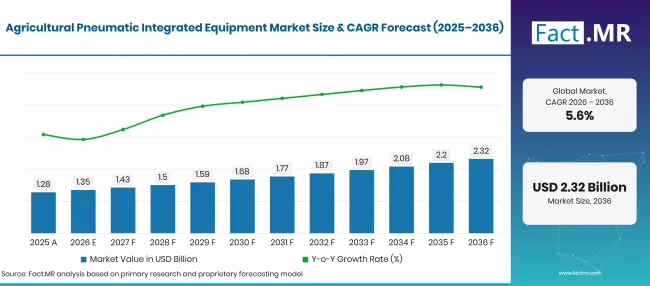
Agricultural Pneumatic Integrated Equipment Market Forecast Global | Source: Fact.MR
What are the defining numbers behind Agricultural Pneumatic Integrated Equipment Market growth?
The 2026 to 2036 period adds USD 1.0 billion in new value, concentrated in sprayers, pneumatic seeders and semi-automatic control systems.
- Demand Drivers in the Market
- Input costs push farms toward accurate placement. Eurostat reported that EU prices for fertilisers and soil improvers rose 8.0% in the fourth quarter of 2025 compared with a year earlier, with increases in 24 of the 27 member states. Pneumatic distributors with section control cut overlap, so every tonne of granular product covers more ground.
- Farm labor is thinning in most producing regions. FAO data show that agriculture, forestry and fishing employed 916 million people in 2023, equal to 26.1% of global employment, while Europe’s share was only 5%. Where workers are scarce, one operator running a combined seeding and fertilizing pass replaces two separate trips.
- Narrow sowing and spraying windows reward capacity. Air carts and wide pneumatic drills fill quickly and cover large blocks in a day, which helps growers finish planting before soil moisture drops or weather turns.
- Semi-automatic control is now standard on new machines. ISOBUS terminals, rate control and section switching let farmers adjust output from the cab, and these features give dealers a clear upgrade story at trade-in time.
- Key Segments Analyzed
- By Product Type: Sprayers will hold 40.8% share in 2026, since crop-protection passes recur several times each season and air-assisted booms improve canopy coverage.
- By Application: Crop Farming will account for 58.2% of 2026 value, given that seeding, fertilizing and spraying of arable crops use pneumatic distribution at every stage.
- By Technology: Semi-Automatic will capture 41.2% in 2026, as farmers want automated rate and section control while keeping the operator in charge of field decisions.
- By Distribution Channel: Offline will command 78.4% of 2026 sales, because high-value machines need demonstration, financing, setup and seasonal servicing through local dealers.
- Analyst Opinion at Fact.MR
- Shambhu Nath Jha, Principal Consultant at Fact.MR, states, “Air-based metering has moved from a premium option to the expected design on new drills and planters, and buyers now compare machines on calibration accuracy and uptime during the sowing window. Manufacturers that pair pneumatic hardware with simple rate control and fast dealer support will win replacement orders from mid-sized farms. Price sensitivity will stay high in Brazil and the United Kingdom, so financing terms and resale values will shape purchase timing as much as product features.”
- Strategic Implications
- Manufacturers should publish clear data on air pressure, metering range, working width and tractor hydraulic needs, so farmers can match a machine to their soil and crop before a demonstration.
- Dealers should run in-field calibration days ahead of each sowing season, since poorly set fans and metering rollers are the main cause of uneven seed spacing and wasted fertilizer.
- Component suppliers should design fans, hoses and distributor heads for quick replacement, as a single blocked line during planting can cost a grower several working days.
- Investors should track farm credit conditions and machinery financing programs, because replacement cycles in this equipment follow farm income more closely than crop prices alone.
Germany leads the country set at 6.7%, helped by deep digital farming use and a strong local implement industry. Brazil follows at 6.1%, where record grain harvests support planter demand even as machinery sales weaken. The United States reaches 5.5% through large-acreage corn and soybean planting that favors wide air carts. Labor shortages and cereal production keep the United Kingdom at 4.9%, while Japan closes the range at 4.4% because its smaller plots slow the shift to large pneumatic machines.
How does the Agricultural Pneumatic Integrated Equipment Market break down by segment?
Sprayers will lead Product Type at 40.8%; Crop Farming will head Application at 58.2%; Semi-Automatic will hold Technology at 41.2%; Offline will lead Distribution Channel at 78.4% in 2026.
Which Product Type leads?
Sprayers take 32.4% of 2026 sales.
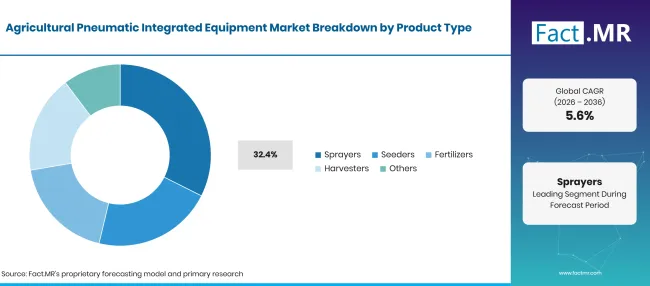
Agricultural Pneumatic Integrated Equipment Market Breakdown Product Type | Source: Fact.MR
| Product Type | Share (2026) |
|---|---|
| Sprayers (Leading segment) | 32.4% |
| Other segments combined | 67.6%* |
| Total | 100.0% |
Source: Fact.MR analysis. Updated Nov 11, 2026
Crop-protection work is repeated across the season, from pre-emergence herbicide to late fungicide passes, so sprayers log more field hours than any other pneumatic implement. Air-assisted booms and pneumatic nozzle control push droplets into dense canopies and reduce drift on windy days. Eurostat early estimates show EU plant protection product prices fell 1% in 2025 while fertiliser prices rose 5%, which keeps chemical budgets stable and spraying frequency steady. Buyers comparing agricultural sprayer options now weigh boom stability and section count alongside tank size. Seeders form the second core group, using fans to carry seed from a central hopper to each coulter. Growers reviewing seed drill machines increasingly ask for a split hopper that places fertilizer with the seed. Fertilizer distributors, harvesters with pneumatic grain handling and other units complete the product range.
What supports Crop Farming within Application?
Crop Farming represents 58.2% of 2026 revenue.
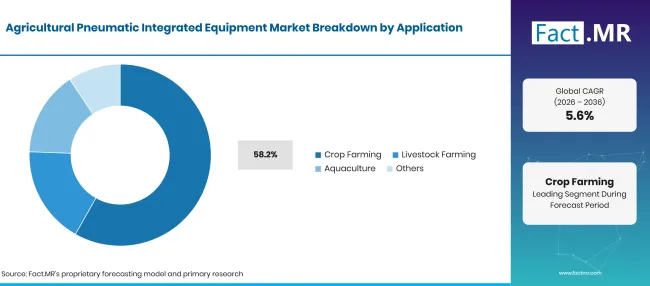
Agricultural Pneumatic Integrated Equipment Market Breakdown Application 1 | Source: Fact.MR
| Application | Share (2026) |
|---|---|
| Crop Farming (Leading segment) | 58.2% |
| Other segments combined | 41.8%* |
| Total | 100.0% |
Source: Fact.MR analysis. Updated Nov 11, 2026
Arable farms use pneumatic distribution in seeding, starter fertilizer placement and spraying, so one crop cycle can involve three or four air-based machines. Brazil shows the scale involved: the national grain harvest reached a record 346.1 million tonnes in 2025, up 18.2% on 2024, across about 81.6 million harvested hectares. Harvests of this size need high-capacity precision planters and sprayers that cover wide fields quickly. Livestock farming uses pneumatic equipment mainly for forage seeding, pasture renovation and feed handling. Aquaculture applies air systems to feed distribution in ponds and tanks, while other uses include horticulture and seed production plots with specialized needs.
How does Technology shape demand?
Semi-Automatic accounts for 41.2% of 2026 value.
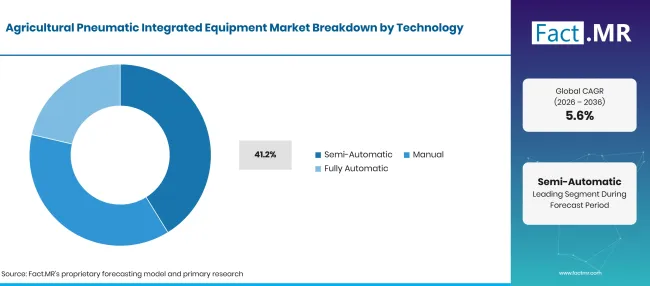
Agricultural Pneumatic Integrated Equipment Market Breakdown Technology | Source: Fact.MR
| Technology | Share (2026) |
|---|---|
| Semi-Automatic (Leading segment) | 41.2% |
| Other segments combined | 58.8%* |
| Total | 100.0% |
Source: Fact.MR analysis. Updated Nov 11, 2026
Most farmers want the machine to handle rate changes and section switching while they stay in control of speed, depth and route. Semi-automatic systems deliver this balance through an ISOBUS terminal and a prescription map, without the cost and connectivity needs of full autonomy. This configuration also suits the many mixed fleets where tractors and implements come from different brands. Manual systems remain common on small farms and in regions where budgets are tight and service access is limited. Fully automatic units, often bundled with smart agriculture solutions, appeal to large operations that already run guidance, telemetry and variable-rate files across the whole season.
Why do farmers still buy through Offline channels?
Offline holds 78.4% of 2026 sales.
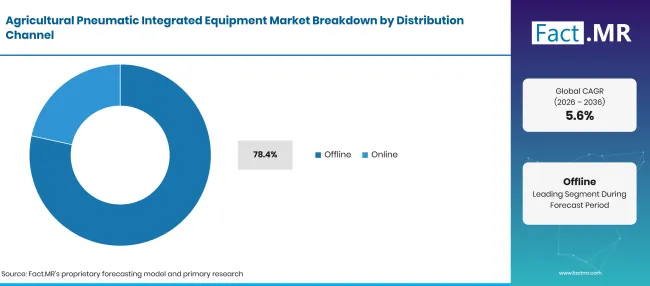
Agricultural Pneumatic Integrated Equipment Market Breakdown Distribution Channel | Source: Fact.MR
| Distribution Channel | Share (2026) |
|---|---|
| Offline (Leading segment) | 78.4% |
| Other segments combined | 21.6%* |
| Total | 100.0% |
Source: Fact.MR analysis. Updated Nov 11, 2026
A pneumatic drill or trailed sprayer is a large purchase that farmers want to see working in their own soil before signing. Dealers provide that demonstration, arrange trade-ins and finance, set up the machine and return before each season to check fans and hoses. Local presence also shortens downtime when a part fails mid-planting. Online channels support spec comparisons, used machine listings and spare parts orders. Some smaller farms access equipment through farm equipment rental services booked online, though the final handover still happens through a yard or depot.
What is accelerating Agricultural Pneumatic Integrated Equipment Market adoption, and what is holding it back?
Rising fertilizer prices, fewer farm workers and narrow field windows push growers toward air-based machines that place inputs accurately in one pass. Demand is limited by high purchase prices, weak machinery sales in some countries and the need for skilled calibration.
Drivers Impact Analysis
| DRIVER | (~) % IMPACT ON CAGR | GEOGRAPHIC RELEVANCE | IMPACT TIMELINE |
|---|---|---|---|
| Need for accurate seed and fertilizer placement as input prices rise | +1.2% | Global | Medium term (2-4 years) |
| Farm labor shortages favoring combined single-pass operations | +1.0% | Western Europe, Japan, North America | Short term (<=2 years) |
| Replacement of mechanical metering with air distribution | +0.8% | North America, Western Europe | Medium term (2-4 years) |
| Wider use of semi-automatic rate and section control | +0.6% | Global | Medium term (2-4 years) |
Source: Fact.MR analysis. Updated Nov 11, 2026
Opportunity Impact Analysis
| OPPORTUNITY | (~) % IMPACT ON CAGR | GEOGRAPHIC RELEVANCE | IMPACT TIMELINE |
|---|---|---|---|
| Split-hopper drills placing seed and fertilizer together | +0.7% | Western Europe, North America | Medium term (2-4 years) |
| High-capacity air carts for large grain farms | +0.6% | Latin America, North America | Long term (>=4 years) |
| Compact pneumatic units sized for small and mid-sized farms | +0.4% | East Asia, South Asia & Pacific | Long term (>=4 years) |
| Retrofit control kits for existing pneumatic fleets | +0.3% | Global | Medium term (2-4 years) |
Source: Fact.MR analysis. Updated Nov 11, 2026
Restraints Impact Analysis
| RESTRAINT | (~) % IMPACT ON CAGR | GEOGRAPHIC RELEVANCE | IMPACT TIMELINE |
|---|---|---|---|
| High purchase price and tight farm credit | -0.7% | Global | Short term (<=2 years) |
| Weak machinery sales cycles in key markets | -0.5% | Latin America, Western Europe | Short term (<=2 years) |
| Limited dealer and calibration support in rural areas | -0.4% | Emerging markets | Medium term (2-4 years) |
| Compatibility gaps between tractors and implements | -0.2% | Global | Long term (>=4 years) |
Source: Fact.MR analysis. Updated Nov 11, 2026
Which countries are scaling the Agricultural Pneumatic Integrated Equipment Market through 2036?
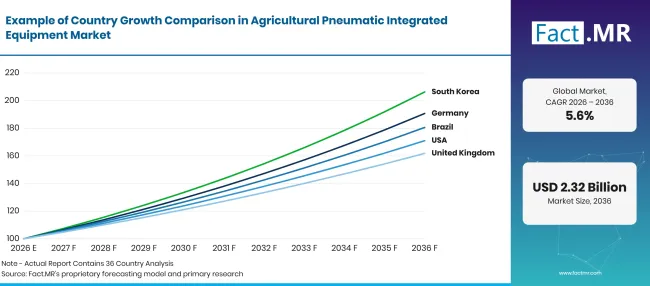
Agricultural Pneumatic Integrated Equipment Market Growth Index | Source: Fact.MR
| Country | CAGR (2026 to 2036) |
|---|---|
| Germany | 6.7% |
| Brazil | 6.1% |
| United States | 5.5% |
| United Kingdom | 4.9% |
| Japan | 4.4% |
Source: Fact.MR analysis. Updated Nov 11, 2026
What supports pneumatic equipment adoption in Germany?
6.7% CAGR, supported by wide digital farming use and a strong implement manufacturing base.
German farms are early users of connected machinery. Germany Trade & Invest reports that 85.5% of German farmers used digital technologies on their farms in 2025, based on a federal agriculture ministry study. This base makes it easier to sell pneumatic drills and sprayers with ISOBUS control and section switching.
How is Brazil developing demand?
6.1% CAGR, as record grain output keeps planter and sprayer fleets under heavy use.
Brazil’s farm machinery market is in a soft phase. ANFAVEA reported that agricultural machinery retail sales fell 3.6% in 2025 to 49.8 thousand units, and the association forecasts a further 6.2% drop in 2026. The long-run picture is stronger, as soybean and corn double-cropping requires fast planting after each harvest. Suppliers that offer financing and high-capacity pneumatic planters will be ready when credit conditions ease.
What is supporting United States adoption?
5.5% CAGR, given the scale of corn and soybean planting on large row-crop farms.
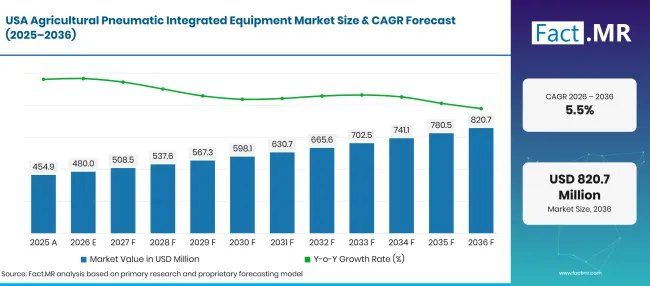
Agricultural Pneumatic Integrated Equipment Market Forecast Usa | Source: Fact.MR
American growers plant very large areas within a few weeks each spring. USDA’s National Agricultural Statistics Service estimated 2025 corn plantings at 95.2 million acres, up 5% from 2024, with soybeans at 83.4 million acres. Wide air carts, vacuum planters and self-propelled sprayers suit this acreage, and the U.S. dealer network supports precision upgrades at trade-in.
How is the United Kingdom developing demand?
4.9% CAGR, reflecting labor pressure and steady cereal production.
Fewer hands are available for fieldwork in England. Defra counted 279 thousand people in the English agricultural workforce on 1 June 2025, down 1.9% from a year earlier. At UK level, Defra put the cereal area at 3.0 million hectares in 2025, up 1.6% on 2024, across 212 thousand holdings. These figures favor combination drills and trailed sprayers that let one operator cover more cereal land.
What supports Japan’s adoption?
4.4% CAGR, owing to a shrinking farm workforce and gradual farm consolidation.
Japan’s farm labor base is contracting fast. The 2025 Census of Agriculture and Forestry counted 1,021,000 core farm workers in individual farm entities, down 25.1% from five years earlier. As remaining farms take over more land, demand will grow for compact pneumatic seeders and sprayers that one person can run. Small paddy plots and hilly terrain still limit the use of wide machines.
Who leads the Agricultural Pneumatic Integrated Equipment Market?
Full-line groups and implement specialists compete on different grounds. Full-line groups such as John Deere, CNH, AGCO and Kubota sell tractors, air carts, planters and sprayers through large dealer networks, so they win buyers who want one brand and one service contract.
AGCO showed this breadth at Commodity Classic in February 2025, where its Fendt Rogator applicator was presented as switching between liquid and dry application in under two hours. Specialist implement makers such as Kverneland Group and HORSCH focus on drills, planters and sprayers and compete on agronomic detail. Kverneland marked 40 years of precision drill production at Soest in September 2025, with its Optima pneumatic precision drill as the flagship. Full-line groups are also widening their seeding ranges through partners: CNH and Bourgault announced a strategic alliance in August 2026 under which CNH dealers will sell Bourgault-built air carts and air drills. Calibration accuracy, uptime in the sowing window and dealer response time will separate winners from the rest through 2036.
Which companies are the key providers?
Key companies in the Agricultural Pneumatic Integrated Equipment Market include John Deere, CNH, AGCO Corporation, Kubota Corporation, Kverneland Group and HORSCH.
- John Deere
- CNH
- AGCO Corporation
- Kubota Corporation
- Kverneland Group
- HORSCH
What is the report’s scope and coverage?
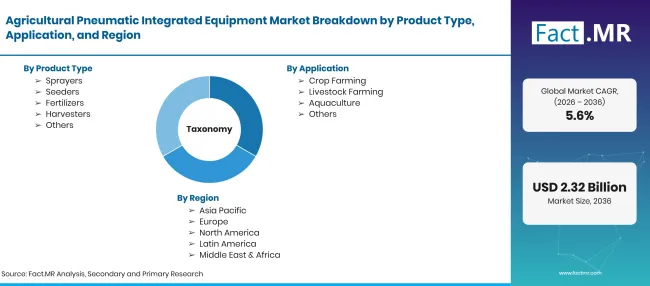
Agricultural Pneumatic Integrated Equipment Market Taxonomy | Source: Fact.MR
| Attribute | Details |
|---|---|
| Quantitative Units | USD billion |
| Market Definition | Farm machinery that uses fans, compressed air or vacuum to meter, convey or apply seed, fertilizer and crop-protection inputs, sold as complete integrated units. |
| Product Type | Sprayers; Seeders; Fertilizers; Harvesters; Others |
| Application | Crop Farming; Livestock Farming; Aquaculture; Others |
| Technology | Semi-Automatic; Manual; Fully Automatic |
| Distribution Channel | Offline; Online |
| Regions Covered | North America; Latin America; Western Europe; Eastern Europe; East Asia; South Asia & Pacific; Middle East & Africa |
| Countries Covered | Germany; Brazil; United States; United Kingdom; Japan |
| Companies Profiled | John Deere; CNH; AGCO Corporation; Kubota Corporation; Kverneland Group; HORSCH |
| Forecast Period | 2026 to 2036 |
| Approach | Unit shipments by machine type and country, multiplied by average selling prices and checked against machinery sales statistics and dealer interviews. |
Source: Fact.MR analysis. Updated Nov 11, 2026
How is the market segmented?
-
By Product Type
- Sprayers
- Seeders
- Fertilizers
- Harvesters
- Others
-
By Application
- Crop Farming
- Livestock Farming
- Aquaculture
- Others
-
By Technology
- Semi-Automatic
- Manual
- Fully Automatic
-
By Distribution Channel
- Offline
- Online
-
By Region
- North America
- Latin America
- Western Europe
- Eastern Europe
- East Asia
- South Asia & Pacific
- Middle East & Africa
Bibliography
- AGCO Corporation. (2025, February 26). AGCO’s Brands to Exhibit Farmer-Focused Products, Technologies and Services at Commodity Classic 2025
- Associação Nacional dos Fabricantes de Veículos Automotores. (2026, April 15). Setor de máquinas agrícolas e rodoviárias tem ingresso recorde de importados em 2025 e projeção de recuo em 2026
- CNH. (2026, August 31). CNH and Bourgault announce strategic alliance to expand global seeding portfolio
- Department for Environment, Food & Rural Affairs. (2025, September 25). Agricultural workforce in England at 1 June 2025
- Department for Environment, Food & Rural Affairs. (2026, July 9). Agriculture in the United Kingdom 2025: Chapter 2: Structure of industry
- Eurostat. (2025, December 18). 3% increase in agricultural prices in 2025
- Eurostat. (2026, May 19). Fertilisers price went up 8.0% in Q4 2025
- Food and Agriculture Organization of the United Nations. (2025, July 24). Employment indicators 2000-2023 (July 2025 update)
- Germany Trade & Invest. (2025, October 8). Smart Farming in Germany
- Kverneland Group. (2025, September 22). Kverneland Group Soest Marks 40 Years of Excellence in Precision Drill Technology
- Ministry of Agriculture, Forestry and Fisheries of Japan. (2025, November 28).
- Secretaria de Comunicação Social, Government of Brazil. (2026, January 15). Brasil atinge novo recorde na safra de grãos, com 346,1 milhões de toneladas em 2025
- U.S. Department of Agriculture, National Agricultural Statistics Service. (2025, June 30). Corn planted acreage up 5% from 2024, soybean acreage down 4% from last year
This Report Answers
- How much is agricultural pneumatic integrated equipment worth in 2025 and 2026, and what value will it reach by 2036?
- Why do sprayers keep the lead in product type while seeders gain from split-hopper designs?
- Which share of revenue comes from crop farming, and how do livestock and aquaculture buyers differ?
- What draws farmers to semi-automatic control over manual or fully automatic machines?
- How do growth rates compare across Germany, Brazil, the United States, the United Kingdom and Japan?
- Which manufacturers compete in pneumatic seeding and spraying, and what separates full-line groups from specialists?
What does the Agricultural Pneumatic Integrated Equipment Market cover?
This market counts complete farm machines in which air flow does the core work of metering, carrying or applying an input. Examples include air-assisted sprayers, pneumatic seed drills and precision planters, air carts and pneumatic fertilizer distributors.
Values are measured at manufacturer selling price in USD billion for new units sold in each year. Revenue is assigned to the country where the machine is first delivered to a farm or contractor.
What is included in the scope?
Pneumatic seed drills and air drill systems with central hoppers and distributor heads are counted.
Air-assisted field sprayers, trailed or self-propelled, are counted when air flow supports droplet delivery or boom control.
Vacuum and pneumatic precision planters, including split-hopper units that place fertilizer with the seed, are part of the scope.
Factory-fitted control systems for rate, section and fan speed are counted as part of the machine value.
What is excluded from the scope?
Tractors and combines without an integrated pneumatic input function are left out.
Standalone compressors, general pneumatic components and industrial blowers sold outside farm machinery are not counted.
Spare parts, wear items and aftermarket service revenue are outside the valuation.
Rental income and used machine resales are excluded, since the market counts new unit sales only.
How Was the Analysis Built?
The analysis draws on 120+ sources, 35+ company portfolios, 25+ countries, and more than 20 industry interviews.
- Primary Research: Primary research includes discussions with manufacturers, service providers, technology developers, distributors, end users, and subject-matter experts. These conversations examine purchasing priorities, product adoption, operational challenges, approval requirements, competitive positioning, and the factors that influence wider market acceptance.
- Desk Research: Desk research covers government statistics, regulatory publications, company filings, trade data, technical studies, industry associations, standards, public policy, and other authoritative sources. Every source used in the analysis is documented in the bibliography.
- Market Sizing and Forecasting: Market estimates combine historical performance, demand indicators, pricing and volume trends, segment shares, company participation, country-level growth, adoption patterns, investment activity, and barriers to market expansion.
- Data Validation and Update Cycle: Findings are validated by comparing primary interviews with public data, company activity, regulatory changes, trade patterns, and industry developments. Regular updates review new product launches, capacity changes, partnerships, approvals, and shifts in commercial adoption.
Frequently Asked Questions
How large is the agricultural pneumatic integrated equipment market in 2026?
What growth rate will the agricultural pneumatic integrated equipment market record?
Which product type leads?
Which application leads?
Which technology leads?
Which distribution channel leads?
Which country will grow quickest?
Who are the main companies?
What holds the market back?
Who worked on this report


Preview the report firsthand - request a free sample
Free SampleGet the brochure for pricing and purchase details
Download PDF