- Base Value(2025): 16.6 Bn
- Estimated Value(2026): 17.7 Bn
- Forecast Value (2036): 34.6 Bn
- CAGR (2026 - 2036): 6.9%
Smart Agriculture Solution Market Forecast and Outlook By Fact.MR
In 2025, the smart agriculture solution market was valued at USD 16.6 billion. Based on Fact MR analysis, demand for smart agriculture solutions is estimated to grow to USD 17.7 billion in 2026 and USD 34.6 billion by 2036. FMR projects a CAGR of 6.9% during the forecast period.
The absolute dollar growth from 2026 to 2036 is USD 16.9 billion. This expansion reflects steady modernization of agricultural operations rather than a rapid structural transformation of the farming sector. Smart agriculture technologies such as precision irrigation systems, remote sensing tools, connected farm equipment, and data driven crop monitoring platforms are gradually integrated into commercial farming operations. Adoption continues as farmers seek to improve crop productivity, manage input costs, and monitor field conditions through digital tools. Growth pace remains moderated by high initial investment costs, fragmented farm structures in many regions, and uneven digital infrastructure across rural agricultural areas.
South Korea leads with a projected CAGR of 11.7%, supported by strong government programs promoting digital agriculture and automated farming systems. The United States follows with a CAGR of 11.5%, driven by large scale commercial farms adopting precision agriculture platforms and connected farm machinery. The European Union records a CAGR of 11.4%, reflecting policy support for digital farm management tools and improved agricultural data systems. The United Kingdom shows a CAGR of 11.2% as agricultural producers expand the use of sensor based crop monitoring and automated irrigation technologies. Japan records the slowest growth at 11.1%, reflecting a mature agricultural technology market where adoption is increasingly linked to equipment replacement cycles. High equipment costs and limited digital connectivity in rural farming areas act as structural constraints in these established markets.
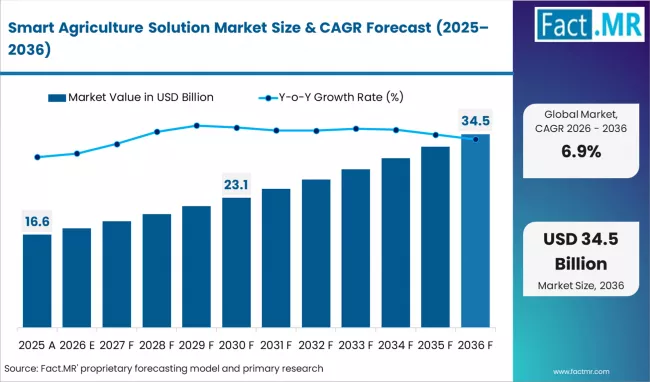
Smart Agriculture Solution Market Market Value Analysis | Source: Fact.MR
Smart Agriculture Solution Market
| Metric | Details |
|---|---|
| Industry Size (2026E) | USD 17.7 billion |
| Industry Value (2036F) | USD 34.6 billion |
| CAGR (2026 to 2036) | 6.9% |
Source: Fact.MR analysis. Updated Mar 18, 2026
Smart Agriculture Solution Market Definition
The Smart Agriculture Solution Market includes digital systems and technologies used to monitor, manage, and optimize agricultural operations. These solutions combine sensors, connected devices, data analytics platforms, and automated equipment to track crop conditions, soil moisture, weather patterns, and farm productivity. Smart agriculture tools help farmers collect and analyze data to support decisions related to irrigation, fertilization, and crop protection. They are used across crop farming, greenhouse production, and livestock management. The primary function of these solutions is to improve farm efficiency, resource use, and agricultural output through data driven farm management systems.
Market Inclusions
This report covers global and regional market sizes for smart agriculture solutions with forecast analysis for the study period. The market is segmented by solution type including precision farming systems, farm management software, sensor networks, and automated monitoring platforms. Application segments include crop monitoring, irrigation management, livestock tracking, and greenhouse control systems. End users include commercial farms, agricultural cooperatives, and agribusiness enterprises. The report also evaluates pricing models, technology deployment patterns, and selected trade flow analysis across major agricultural regions.
Market Exclusions
The report excludes conventional agricultural machinery such as tractors, harvesters, and irrigation equipment that operate without digital monitoring systems. Agricultural inputs such as seeds, fertilizers, and pesticides are also outside the defined scope. The study does not include general farm management consulting services or traditional agricultural advisory programs. Consumer gardening tools and small scale home farming equipment are not covered, as the analysis focuses on digital technology solutions designed for commercial agricultural operations.
Research Methodology
- Primary Research: Interviews were conducted with agricultural technology providers, farm operators, agronomists, and agricultural equipment distributors.
- Desk Research: Public information was gathered from agricultural statistics databases, industry publications, company reports, and government agriculture departments.
- Market-Sizing and Forecasting: A hybrid model combining bottom up technology revenue analysis with top down demand assessment across agricultural production sectors was applied.
- Data Validation and Update Cycle: Findings were cross verified using multiple agricultural data sources and expert inputs, with periodic updates conducted as new market information becomes available.
Summary of the Smart Agriculture Solution Market
- Market Definition
- The market comprises digital technologies and connected systems used to monitor, manage, and optimize agricultural operations. These solutions integrate sensors, data analytics platforms, automated equipment, and connected devices that collect and analyze farm data related to soil conditions, crop growth, weather patterns, and equipment performance to support data driven farm management.
- Demand Drivers
- Increasing adoption of precision farming technologies that improve crop monitoring and resource management.
- Rising deployment of GPS enabled farm machinery and automated guidance systems in large scale farming operations.
- Expansion of digital farm management platforms that analyze field data to support irrigation, fertilization, and crop protection decisions.
- Growing need to improve agricultural productivity and reduce input costs through data driven monitoring systems.
- Key Segments Analyzed
- Component Type: Hardware represents about 45% share supported by widespread deployment of sensors, drones, and GPS enabled monitoring devices.
- Application: Automated machinery guidance control accounts for roughly 30% share due to adoption of GPS based systems guiding tractors and agricultural machinery.
- Technology Use: Smart agriculture solutions are widely used for crop monitoring, irrigation management, and automated farm equipment control.
- Geography: South Korea records the fastest expansion supported by government initiatives promoting digital agriculture technologies.
- Analyst Opinion at Fact MR
- Shambhu Nath Jha, Principal Consultant, Fact MR, opines, "In this updated edition of the Smart Agriculture Solution Market report, industry participants will observe that digital technologies are gradually integrated into farming operations to support precision agriculture practices. Sensor networks, automated machinery systems, and farm management software allow producers to monitor field conditions and optimize resource usage. Companies that combine agricultural equipment with integrated digital platforms will maintain stronger positions within the evolving agricultural technology ecosystem."
- Strategic Implications or Executive Takeaways
- Invest in integrated smart farming systems combining sensors, GPS enabled machinery, and farm management software platforms.
- Expand development of automated machinery guidance technologies that improve operational efficiency during field operations.
- Strengthen partnerships with agricultural equipment manufacturers and agribusiness enterprises deploying digital farming tools.
- Develop scalable solutions that support adoption among both large commercial farms and mid sized agricultural producers.
- Methodology
- Primary interviews conducted with agricultural technology providers, farm operators, agronomists, and agricultural equipment distributors.
- Desk research based on agricultural statistics databases, industry publications, company reports, and government agriculture agency data.
- Market sizing developed through a hybrid approach combining bottom up technology revenue analysis and top down demand assessment across agricultural production sectors.
- Findings validated through multiple agricultural data sources and expert consultations following Fact MR internal modeling standards.
Segmental Analysis
Smart Agriculture Solution Market Analysis by Component Type
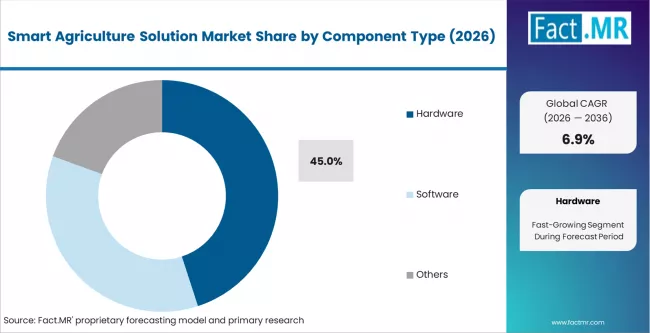
Smart Agriculture Solution Market Analysis By Component Type | Source: Fact.MR
- Market Overview: Hardware components are projected to account for around 45% share of the smart agriculture solution market by 2026. Hardware systems form the operational backbone of smart farming environments and include sensors, drones, GPS systems, automated irrigation controllers, and field monitoring equipment. These devices collect real time agricultural data related to soil conditions, crop growth, weather patterns, and machinery performance. Farmers and agricultural enterprises rely on hardware infrastructure to enable precision farming practices and improve operational monitoring across large cultivation areas. The continued adoption of connected agricultural equipment supports strong demand for hardware based smart farming solutions.
- Demand Drivers:
- Precision Farming Equipment: Sensors, drones, and GPS enabled devices are widely deployed to monitor crop health, soil moisture levels, and field conditions.
- Farm Automation Systems: Agricultural machinery integrated with hardware control systems supports automated planting, irrigation, and harvesting operations.
- Field Data Collection: Hardware based monitoring devices gather real time environmental and crop data that supports farm management decisions.
Smart Agriculture Solution Market Analysis by Application
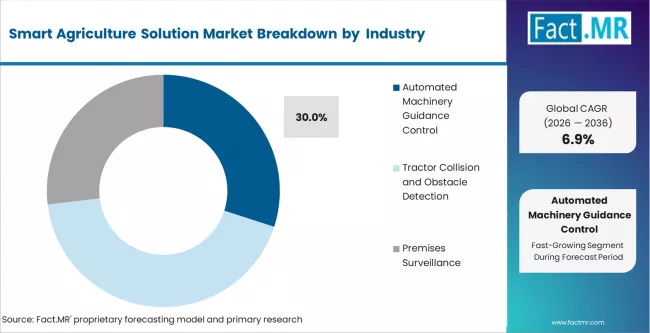
Smart Agriculture Solution Market Analysis By Application | Source: Fact.MR
- Market Overview: Automated machinery guidance control is expected to represent approximately 30% share of the smart agriculture solution market in 2026. This application involves the use of GPS and sensor based systems that guide tractors, harvesters, and other agricultural machinery during field operations. Automated guidance systems help maintain accurate planting rows, optimize field coverage, and reduce overlaps during fertilizer application and crop spraying. Agricultural producers utilize these systems to improve operational efficiency and reduce resource usage across large scale farming operations.
- Demand Drivers:
- Precision Field Operations: Automated guidance systems allow farm machinery to operate with high positional accuracy during planting, spraying, and harvesting.
- Operational Efficiency Improvements: Farmers use machinery guidance control systems to reduce overlaps and minimize resource waste during agricultural activities.
- Adoption of GPS Based Farming: Integration of satellite positioning technologies supports accurate navigation of farm equipment across large agricultural fields.
Key Dynamics
Smart Agriculture Solution Market Drivers, Restraints, and Opportunities
Fact MR analysis indicates that the smart agriculture solution market developed as farming operations integrated digital monitoring technologies to manage crop production and resource usage. Early precision agriculture systems relied on satellite positioning tools and basic sensor networks that helped farmers measure soil conditions and field variability. The current market valuation reflects the expansion of digital farm management platforms that combine sensors, drones, weather data systems, and automated irrigation controls. Demand persists because agricultural producers seek to improve yield stability and operational efficiency across large cultivation areas where manual monitoring remains limited.
A structural shift is occurring as conventional farm management practices gradually transition toward connected agricultural systems capable of collecting real-time environmental data. Traditional farming methods remain widespread in small-scale agricultural operations where technology adoption remains constrained by equipment costs and infrastructure availability. Advanced smart agriculture platforms integrate satellite imagery analysis, automated machinery control systems, and predictive crop management software that require higher capital investment and technical expertise. Even with gradual adoption rates among smaller farms, higher pricing associated with integrated digital agriculture platforms supports steady market value expansion.
- Precision Farming Systems: Agricultural producers deploy sensor networks, GPS-guided machinery, and drone monitoring tools to optimize irrigation, fertilizer application, and crop monitoring activities.
- Agricultural Data Regulation: Government programs and agricultural data governance initiatives in several countries regulate the use and sharing of farm-generated digital data within smart agriculture platforms.
- North America Farm Technology: The United States and Canada maintain large commercial farming operations that adopt precision agriculture technologies to manage extensive crop production areas.
Regional Analysis
The market analysis covers key global regions, including North America, Western Europe, and East Asia. It is segmented geographically, with specific market dynamics for each region. The full report provides a detailed market attractiveness analysis.
.webp "Top Country Growth Comparison Smart Agriculture Solution Market Cagr (2026 2036)")
Top Country Growth Comparison Smart Agriculture Solution Market Cagr (2026 2036) | Source: Fact.MR
| Country / Region | CAGR (2026-2036) |
|---|---|
| USA | 11.5% |
| United Kingdom | 11.2% |
| European Union | 11.4% |
| Japan | 11.1% |
| South Korea | 11.7% |
Source: Fact.MR analysis. Updated Mar 18, 2026
Source: Fact MR (FMR) analysis, based on proprietary forecasting model and primary research
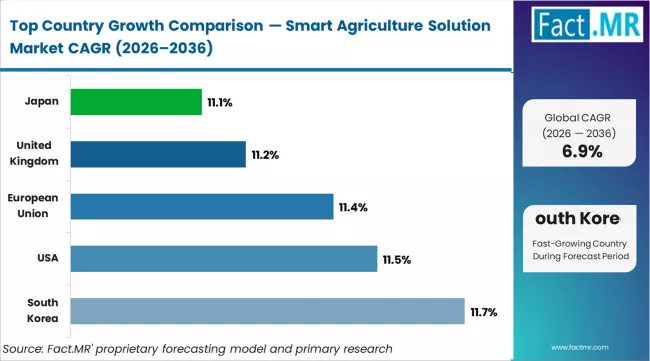
Smart Agriculture Solution Market Cagr Analysis By Country | Source: Fact.MR
North America
The USA represents a major market supported by precision farming technologies, agricultural automation, and digital farm management platforms. Key companies include John Deere, Trimble Inc., and AGCO Corporation.
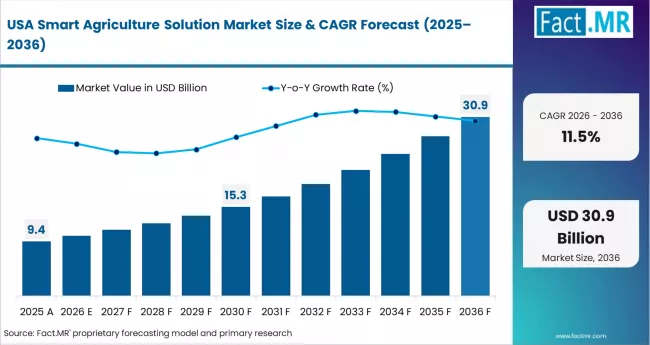
Smart Agriculture Solution Market Country Value Analysis | Source: Fact.MR
- USA: Demand for smart agriculture solutions in the U.S. is projected to rise at 11.5% CAGR through 2036. Growth is supported by precision agriculture initiatives promoted by the United States Department of Agriculture (04-2025) and expansion of digital farming platforms by John Deere (08-2025).
Western Europe
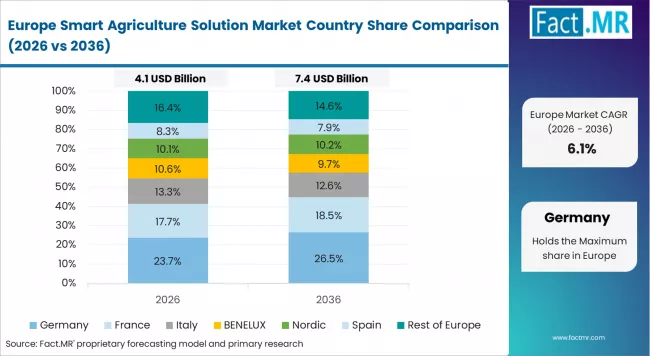
Smart Agriculture Solution Market Europe Country Market Share Analysis, 2026 & 2036 | Source: Fact.MR
The United Kingdom and the European Union represent important markets supported by digital farming programs, agricultural technology adoption, and farm productivity initiatives.
- United Kingdom: Demand for smart agriculture solutions in the UK is projected to rise at 11.2% CAGR through 2036. Growth is supported by agricultural innovation programs promoted by the Department for Environment, Food and Rural Affairs (03-2025) and deployment of farm management software by Trimble Inc. (07-2025).
- European Union: Demand for smart agriculture solutions in the European Union is projected to rise at 11.4% CAGR through 2036. Growth is supported by digital agriculture programs under the European Commission’s Common Agricultural Policy (04-2025) and expansion of agricultural technology platforms by AGCO Corporation (08-2025).
East Asia
Japan and South Korea represent major markets supported by agricultural automation technologies, robotics deployment, and smart farming systems.
- Japan: Demand for smart agriculture solutions in Japan is projected to rise at 11.1% CAGR through 2036. Growth is supported by smart farming initiatives promoted by the Ministry of Agriculture, Forestry and Fisheries (03-2025) and development of agricultural automation systems by Kubota Corporation (07-2025).
- South Korea: Demand for smart agriculture solutions in South Korea is projected to rise at 11.7% CAGR through 2036. Growth is supported by smart farm expansion programs promoted by the Ministry of Agriculture, Food and Rural Affairs (02-2025) and deployment of agricultural IoT platforms by LG CNS (06-2025).
Fact MR's analysis of the smart agriculture solution market in North America, Western Europe, and East Asia consists of country-wise assessments that include the USA, the United Kingdom, the European Union, Japan, and South Korea. Readers can find detailed trends, regulatory updates, and company-specific investments shaping market growth in these countries.
Competitive Landscape
Competitive Structure and Buyer Dynamics in the Smart Agriculture Solution Market
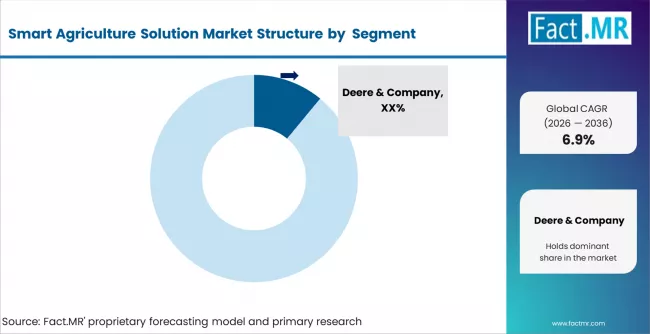
Smart Agriculture Solution Market Analysis By Company | Source: Fact.MR
The competitive structure of the Smart Agriculture Solution Market is moderately fragmented, with agricultural machinery manufacturers, precision technology providers, and agronomic data platforms participating across the value chain. Companies such as Deere & Company, AGCO Corporation, CNH Industrial N.V., and Trimble Inc. hold strong positions through integrated precision farming systems that combine equipment, sensors, and digital farm management platforms. Technology focused firms including Raven Industries, Inc., Topcon Positioning Systems, Inc., and Sentera, Inc. contribute through satellite guidance systems, field monitoring tools, and aerial imaging technologies. Agricultural input providers such as BASF SE, The Climate Corporation, and Yara International ASA support the market through agronomic data platforms and crop management analytics. Competition in the market is primarily influenced by data accuracy, system integration with agricultural machinery, and the ability to improve farm productivity through digital decision support tools.
Several companies maintain structural advantages through integration with agricultural equipment manufacturing and established relationships with farming operations. Firms such as Deere & Company, AGCO Corporation, and CNH Industrial N.V. benefit from combining precision agriculture software with existing farm machinery platforms. This integration supports seamless deployment of automated planting, fertilization, and crop monitoring systems. Companies including Trimble Inc. and Topcon Positioning Systems, Inc. possess expertise in satellite positioning technologies that enable high precision field navigation. Agricultural producers commonly adopt multi vendor technology solutions to reduce reliance on a single platform provider. Procurement decisions often consider system compatibility, long term technical support, and the ability to integrate with existing farm equipment. This purchasing approach moderates supplier pricing leverage, though companies offering integrated machinery and digital agriculture platforms maintain stronger negotiating influence.
Key Players of the Smart Agriculture Solution Market
- Deere & Company
- Trimble Inc.
- AGCO Corporation
- Raven Industries, Inc.
- Topcon Positioning Systems, Inc.
- CNH Industrial N.V.
- BASF SE
- The Climate Corporation
- Yara International ASA
- Sentera, Inc.
Report Scope
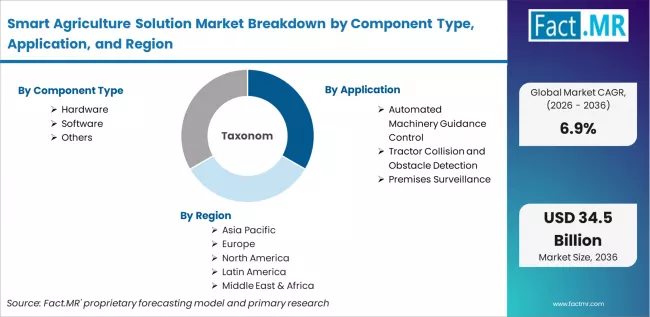
Smart Agriculture Solution Market Breakdown By Component Type, Application, And Region | Source: Fact.MR
| Metric | Value |
|---|---|
| Quantitative Units | USD 17.7 billion (2026) to USD 34.6 billion (2036), at a CAGR of 6.9% |
| Market Definition | The smart agriculture solution market includes deployment of digital technologies, sensors, automated machinery systems, and data-driven platforms that support precision farming, crop monitoring, and agricultural operations management. |
| Component Type | Hardware (Sensor Monitoring Systems, Smart Detection Systems, GPS-enabled Ranging Systems, Drones), Software, Services (Climate Information Service, Supply Chain Management Service, Others including System Integration, Maintenance, and Consulting Services) |
| Application Coverage | Automated Machinery Guidance Control, Tractor Collision and Obstacle Detection, Machinery Safety and Parameter Monitoring, Variable Rate Technology and Building, Premises Surveillance |
| Key Companies Profiled | Deere & Company, Trimble Inc., AGCO Corporation, Raven Industries, Inc., Topcon Positioning Systems, Inc., CNH Industrial N.V., BASF SE, The Climate Corporation, Yara International ASA, Sentera, Inc. |
| Forecast Period | 2026 to 2036 |
| Approach | Hybrid top-down and bottom-up market modeling validated through interviews with agricultural technology providers and farm equipment manufacturers, supported by precision farming adoption analysis, equipment shipment benchmarking, and agricultural digital platform revenue assessment. |
Source: Fact.MR analysis. Updated Mar 18, 2026
Bibliographies
- [1] United States Department of Agriculture. (2025). Precision agriculture initiatives.
- [2] Department for Environment, Food and Rural Affairs, UK. (2025). Agricultural innovation programs.
- [3] European Commission. (2025). Common Agricultural Policy digital programs.
- [4] Ministry of Agriculture, Forestry and Fisheries, Japan. (2025). Smart farming initiatives.
- [5] Ministry of Agriculture, Food and Rural Affairs, South Korea. (2025). Smart farm expansion programs.
- [6] John Deere. (2025). Digital farming platforms expansion.
- [7] Trimble Inc. (2025). Farm management software deployment.
- [8] AGCO Corporation. (2025). Agricultural technology platforms expansion.
- [9] Kubota Corporation. (2025). Agricultural automation systems development.
This Report Addresses
- Market size estimation and revenue forecasts for the Smart Agriculture Solution Market from 2026 to 2036, supported by precision farming technology adoption benchmarks and agricultural equipment digitization indicators.
- Growth opportunity mapping across hardware systems such as sensors, drones, GPS ranging devices, and smart detection equipment, along with farm management software and agricultural technology services.
- Segment and regional revenue forecasts covering automated machinery guidance control, tractor collision and obstacle detection, machinery safety monitoring, variable rate technology, and farm premises surveillance applications across commercial agricultural operations.
- Competition strategy assessment including precision agriculture platform integration, satellite positioning capability, and connected farm equipment benchmarking among agricultural technology and machinery providers.
- Regulatory and agricultural technology policy analysis covering digital agriculture initiatives and farm data governance frameworks implemented by government agriculture departments across major farming regions.
- Market report delivery in PDF, Excel, PPT, and interactive dashboard formats designed for agricultural technology investment planning, farm management system procurement evaluation, and agribusiness strategy development.
- Supply chain vulnerability assessments identifying sensor manufacturing concentration, satellite positioning technology dependencies, and regional agricultural digital infrastructure gaps affecting smart agriculture technology deployment.
Segmentation
Smart Agriculture Solution Market Key Segments
-
Component Type :
- Hardware
- Sensor Monitoring Systems
- Smart Detection Systems
- GPS Enabled Ranging Systems
- Drones
- Software
- Services
- Climate Information Service
- Supply Chain Management Service
- Others
- System Integration
- Maintenance
- Consulting Services
- Hardware
-
Application :
- Automated Machinery Guidance Control
- Tractor Collision and Obstacle Detection
- Machinery Safety and Parameter Monitoring
- Variable Rate Technology and Building
- Premises Surveillance
-
Region :
- North America
- USA
- Canada
- Mexico
- Europe
- Germany
- UK
- France
- Italy
- Spain
- Nordic Countries
- BENELUX
- Rest of Europe
- Asia Pacific
- China
- Japan
- South Korea
- India
- Australia
- Rest of Asia Pacific
- Latin America
- Brazil
- Argentina
- Rest of Latin America
- Middle East and Africa
- Kingdom of Saudi Arabia
- United Arab Emirates
- South Africa
- Rest of Middle East and Africa
- Other Regions
- Oceania
- Central Asia
- Other Markets
- North America
Frequently Asked Questions
How large is the demand for Smart Agriculture Solutions in the global market in 2026?
What will be the market size of Smart Agriculture Solutions in the global market by 2036?
What is the expected demand growth for Smart Agriculture Solutions in the global market between 2026 and 2036?
Which Component Type Segment is poised to lead global demand by 2026?
Which Company is Identified as a Leading Participant in the Smart Agriculture Solution Market?
What is Driving Smart Agriculture Solution Demand in the United States?
What is the United States Growth Outlook in this Report?
What Factors Support Smart Agriculture Solution Adoption in the United Kingdom?
What is the United Kingdom Growth Outlook in this Report?
Why is the European Union Considered an Important Market for Smart Agriculture Solutions?
What is the European Union Growth Outlook in this Report?
Why is Japan an Important Market for Smart Agriculture Solutions?
What is the Japan Growth Outlook in this Report?
Why is South Korea Considered a Key Market for Smart Agriculture Solutions?
What is the South Korea Growth Outlook in this Report?
What are Smart Agriculture Solutions and What are They Mainly Used For?
What does Smart Agriculture Solution Market Mean in this Report?
What is Included in the Scope of this Smart Agriculture Solution Market Report?
What is Excluded from the Scope of this Report?
What does Market Forecast Mean on this Page?
How is the Smart Agriculture Solution Market Forecast Developed in this Report?
Who worked on this report


Preview the report firsthand - request a free sample
Free SampleGet the brochure for pricing and purchase details
Download PDF