
- Market Value (2025): USD 2.15 Bn
- Estimated Value (2026): USD 2.41 Bn
- Forecast Value (2036): USD 7.15 Bn
- CAGR (2026-2036): 11.5%
Agriculture Sensors Market Forecast and Outlook 2026 to 2036
The global agriculture sensor market was USD 2.15 billion in 2025 and reached USD 2.41 billion in 2026. The market is anticipated to reach USD 7.15 billion by 2036, expanding at a CAGR of 11.5% during the 2026 to 2036 assessment period.
Farmers are increasingly using field-level measurements to make irrigation, fertilization and crop-health decisions. In February 2026, the USDA's National Institute of Food and Agriculture (NIFA) highlighted research involving miniature sensors that measure plant temperature, nitrate levels and soil moisture. Each device costs only a few dollars to manufacture and transmits readings through low-power wireless communication. The research combines sensor measurements with machine learning and digital field models to guide more precise water and fertilizer application.
Key Takeaways from the Agriculture Sensors Market
- Sales of agriculture sensors stood at USD 2.15 billion in 2025.
- Agriculture Sensors Market Value (2026): USD 2.41 billion.
- Agriculture Sensors Market Forecast Value (2036): USD 7.15 billion.
- Agriculture Sensors Market Forecast CAGR (2026-2036): 11.5%.
- Leading Sensor Type: Soil moisture and nutrient (28.9%).
- Leading Farm Type: Arable and row crops (42.0%).
- Leading Connectivity: Low-power wide-area networks (34.0%).
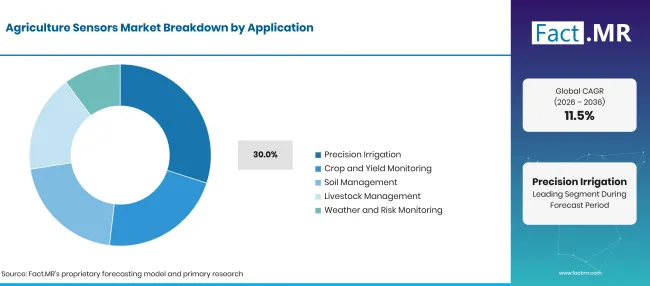
- Leading Application: Precision irrigation (30.0%).
- Key Market Participants: Deere & Company, Trimble, AGCO, Campbell Scientific and Davis Instruments.
- Key Growth Countries: India, China, Brazil, South Korea and the United States.
Lower-cost sensing components and improved digital services are making precision farming more accessible. The USDA NIFA highlighted in February 2026 how miniature agricultural sensors use inexpensive materials, solar charging and wireless communication to transmit field measurements every few minutes. The research also combines readings with drone imagery and satellite information. Such developments are creating opportunities for wider sensor adoption across commercial farms and smaller agricultural operations.
Agriculture Sensors Market
| Metric | Value |
|---|---|
| Market Value (2025) | USD 2.16 billion |
| Market Value (2026) | USD 2.41 billion |
| Forecast Value (2036) | USD 7.15 billion |
| CAGR (2026 to 2036) | 11.5% |
Source: Fact.MR analysis. Updated Nov 27, 2026
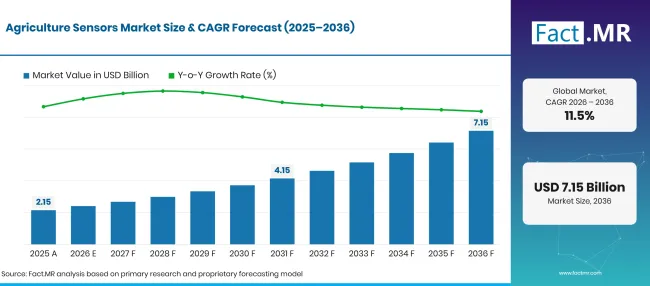
Agriculture Sensors Market Forecast Global | Source: Fact.MR
Agriculture Sensors Market Segmentation
| Category | Segments |
|---|---|
| Sensor Type | Soil moisture and nutrient, Climate and weather, Positioning and location, Crop and plant health, Water and irrigation |
| Farm Type | Arable and row crops, Greenhouse and vertical farming, Livestock farms, Orchards and vineyards, Aquaculture and other |
| Connectivity | Low-power wide-area networks, Cellular, Bluetooth and Wi-Fi, Wired and fieldbus, Satellite |
| Application | Precision irrigation, Crop and yield monitoring, Soil management, Livestock management, Weather and risk monitoring |
| Region | India, China, Brazil, South Korea, United States |
Source: Fact.MR analysis. Updated Nov 27, 2026
Segmental Analysis
What makes soil moisture and nutrient the leading sensor type segment in the Agriculture Sensors Market?
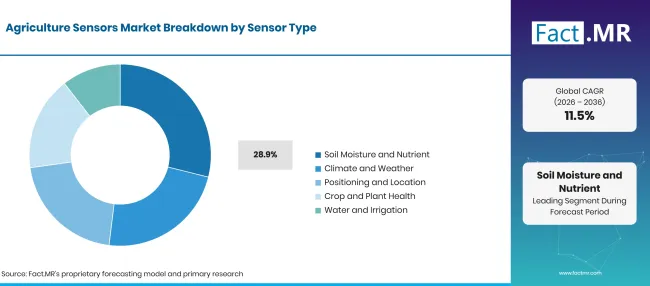
Agriculture Sensors Market Breakdown Sensor Type | Source: Fact.MR
Soil moisture and nutrient sensors capture 28.9% of the market in 2026, equivalent to USD 696.5 million. Their popularity comes from the practical value of knowing when fields require water or additional nutrients rather than relying on fixed application schedules. Climate and weather sensors are also gaining traction as growers seek better information about changing field conditions. In October 2026, the University of Florida's IFAS Extension published a citrus field study showing how soil moisture and electrical conductivity readings track nutrient movement after irrigation and rainfall.
Which factors support arable and row crops as the largest farm type segment in the Agriculture Sensors Market?
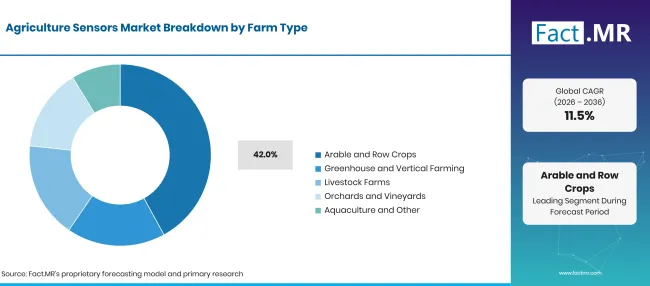
Agriculture Sensors Market Breakdown Farm Type | Source: Fact.MR
Large field sizes and repeated farming operations make arable and row-crop cultivation a natural setting for sensor deployment. This segment captures 42.0% of the 2026 market, equivalent to USD 1.01 billion. Sensors help monitor soil variation and crop conditions across extensive acreage. Greenhouses and orchards are also adopting specialised monitoring systems for controlled growing conditions and crop-specific management. ICAR's Network Program on Precision Agriculture involves 16 research institutes working on sensor-based soil and crop monitoring, alongside other digital farming technologies.
What makes low-power wide-area networks the leading connectivity segment in the Agriculture Sensors Market?
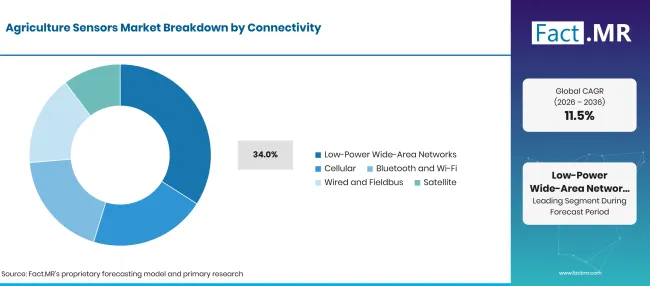
Agriculture Sensors Market Breakdown Connectivity | Source: Fact.MR
Low-power wide-area networks (LPWAN) capture 34.0% of the market in 2026, translating to USD 819.4 million. Their long communication range and limited energy consumption suit sensor installations spread across remote fields. Cellular and Wi-Fi connections are also gaining ground where network coverage and faster data transfer are available. In February 2026, the LoRa Alliance reported that LoRaWAN had reached 125 million deployed devices globally, demonstrating the expanding ecosystem for low-power connected equipment. These deployments span agriculture and several other industries.
Which factors support precision irrigation as the largest application segment in the Agriculture Sensors Market?
Agriculture Sensors Market Breakdown Application | Source: Fact.MR
Precision irrigation captures 30.0% of the 2026 market, equivalent to USD 723.0 million. Soil moisture measurements help farmers decide when to irrigate and how much water different field zones require. Crop and yield monitoring is also gaining attention as growers seek earlier indications of plant stress and changing field performance. In July 2026, the USDA Natural Resources Conservation Service updated its Irrigation Water Management standard, identifying soil moisture monitoring, real-time climate information and computerized irrigation scheduling as tools for planning water applications.
Agriculture Sensors Market - Drivers, Restraints & Trends
Driver: Growing Focus on Precision-Based Farm Management:
Rising expenditure on irrigation, fertilizers and crop protection is encouraging farmers to make decisions using actual soil and crop conditions. Sensors identify moisture shortages, nutrient deficiencies and early signs of plant stress, allowing growers to apply inputs more selectively. In February 2026, USDA NIFA highlighted miniature sensors costing only a few dollars to manufacture. These devices combine wireless readings with digital analysis to guide irrigation and fertilizer application, making precision farming more accessible.
Restraint: Installation Expenses and Technical Limitations:
High initial investment remains a concern for smaller farms, particularly when installations involve gateways, software subscriptions and connectivity charges. Calibration, battery replacement and exposure to harsh field conditions add maintenance expenses. Research highlighted by USDA NIFA in February 2026 also identified durability concerns in experimental sensor designs. Around one-quarter of the soil sensors in its field trials experienced overheating, illustrating the technical improvements required before wider commercial deployment.
Trend: Integration of Wireless Sensing with Digital Farm Platforms:
Agriculture sensors are increasingly connected with farm-management software, remote monitoring systems and automated irrigation controls. Wireless networks allow readings from different field locations to reach a central platform, where growers can assess moisture, weather and crop conditions. In February 2026, the LoRa Alliance reported 125 million LoRaWAN devices deployed worldwide. This expanding connectivity ecosystem is creating favourable conditions for connected agricultural monitoring.
Future Opportunity: Affordable Monitoring Across Diverse Farm Sizes:
Lower-cost probes, solar-powered communication units and subscription-based advisory services could extend sensor adoption beyond large commercial farms. USDA NIFA's February 2026 research highlighted miniature sensors built using inexpensive components and low-power wireless communication. Further improvements in durability, calibration and integration with existing farm equipment could open opportunities across irrigated agriculture, specialty crops and smaller farming operations.
Agriculture Sensors Market Analysis by Key Country
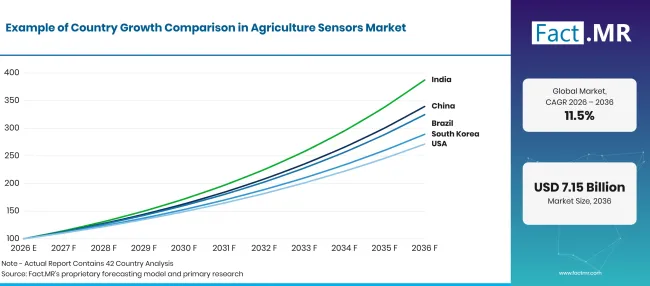
Agriculture Sensors Market Growth Index | Source: Fact.MR
| Country | CAGR (2026-2036) |
|---|---|
| India | 14.5% |
| China | 13.0% |
| Brazil | 12.5% |
| South Korea | 11.2% |
| United States | 10.5% |
Source: Fact.MR analysis. Updated Nov 27, 2026
Why is India recording the highest growth rate in the Agriculture Sensors Market?
India's emphasis on soil testing and efficient water use is creating favourable conditions for agricultural sensor adoption.
On May 9, 2026, the Press Information Bureau reported that 92.87 lakh soil samples had been tested during FY 2025-26 under the Soil Health Management programme. This focus on soil assessment creates opportunities for nutrient probes, moisture sensors and connected irrigation equipment. Sales are also gaining momentum through digital agriculture initiatives and precision farming investments.
How is demand for agriculture sensors developing in China?
Large grain-producing regions are increasingly incorporating digital monitoring into irrigation and field management.
On July 29, 2025, China's Ministry of Agriculture and Rural Affairs reported a digital farmland improvement project in Xiaogang Village, Anhui. The 4,300-mu project included 20 soil-moisture instruments, 197 smart gates and 3.6 kilometres of irrigation channels. This practical deployment highlights the value of sensor-based water management. Wider smart-farm development and investment in agricultural infrastructure are creating further opportunities for field-monitoring technologies.
What is driving agriculture sensor adoption in Brazil?
Brazil's extensive soybean, corn and other commercial crop operations create a strong case for continuous soil monitoring.
In 2025, Embrapa Mandioca e Fruticultura published research validating a low-cost electronic soil-moisture sensor for irrigation management on farms and in greenhouses. The study highlighted the usefulness of real-time readings through computers and mobile devices compared with slower laboratory-based measurements. Growing interest in irrigation efficiency and site-specific crop management is encouraging investment in agricultural sensing equipment.
What is shaping agriculture sensor adoption in South Korea?
South Korea's efforts to modernise farming and address labour shortages are encouraging the use of connected agricultural technologies.
On February 26, 2025, the Ministry of Agriculture, Food and Rural Affairs announced its first five-year smart-farming plan for 2025-2029. The programme targets smart-farm conversion across 35% of the country's 55,000 hectares of greenhouses and the adoption of at least one smart-farming technology across 20% of major field-crop production areas. These targets create opportunities for climate, soil and crop-monitoring equipment.
What is supporting agriculture sensor market growth in the United States?
Investment in water conservation and nutrient management is creating fresh opportunities for agricultural monitoring systems.
In October 2026, the USDA Natural Resources Conservation Service announced a USD 4,479,552 grant for a Wisconsin and Minnesota project focused on precision irrigation and nitrate-loss reduction. The initiative involves 30 growers and evaluates affordable sensors measuring crop water use, soil moisture and nitrogen levels. Such programmes are encouraging practical adoption of field-monitoring technologies across irrigated farming operations.
Competitive Landscape for Agriculture Sensors Market
Competition in the agriculture sensors market centres on measurement accuracy, equipment compatibility, wireless connectivity and the ability to convert field readings into useful farming decisions. Deere integrates precision guidance, machine connectivity and field-data management through its Operations Center ecosystem. Trimble focuses on positioning accuracy and precision agriculture technologies, including its IonoGuard solution.
AGCO expanded its digital portfolio in 2025 with FarmENGAGE, a mixed-fleet platform connecting machine data, agronomic insights and task management. Campbell Scientific specialises in research-grade weather stations, soil-moisture probes and environmental monitoring systems. Davis Instruments offers EnviroMonitor, which combines weather stations and field sensors with wireless nodes, gateways and remote monitoring software.
Recent Developments
- On November 19, 2026, John Deere acquired Orchard Robotics, which operates as Orchard AI, adding plant-level crop intelligence and AI-powered monitoring capabilities for specialty crop growers.
- On March 20, 2025, Trimble and PTx Trimble introduced IonoGuard, a positioning technology designed to improve RTK GNSS signal reliability during solar disturbances.
- On January 21, 2026, AGCO's Precision Planting brand introduced ArrowTube, a seed delivery system designed to improve corn seed orientation, spacing and emergence. The company also introduced the SymphonyVision Duo retrofit spraying system.
- On November 13, 2025, Campbell Scientific data loggers became part of an integrated remote weather-monitoring solution through a partnership between Western Weather Group and MetOcean Telematics.
- On March 23, 2026, Davis Instruments highlighted its EnviroMonitor system, which connects weather stations and field sensors through wireless nodes and gateways for remote monitoring of agricultural conditions.
Key Players in Agriculture Sensors Market
Key companies operating in the market include Deere & Company, Trimble, AGCO, Campbell Scientific, and Davis Instruments.
- Deere & Company
- Trimble
- AGCO
- Campbell Scientific
- Davis Instruments
Bibliography
- AGCO Corporation. (2026). Precision agriculture.
- Campbell Scientific. (n.d.). Agriculture and soils research instrumentation.
- Davis Instruments. (n.d.). EnviroMonitor.
- Embrapa Mandioca e Fruticultura. (2025). Validação de sensor de umidade do solo: Alternativa para o manejo de irrigação em propriedades agrícolas e casa de vegetação.
- Indian Council of Agricultural Research. (n.d.). Significant achievements during 2014-23.
- LoRa Alliance. (2026, February 17). LoRaWAN enters its next growth phase as massive IoT scales globally.
- Ministry of Agriculture and Rural Affairs, China. (2025, July 29). Gangdi bian liangtian, zhong chu gaoyuan liang [From sloping land to high-yield farmland].
- Ministry of Agriculture, Food and Rural Affairs, Republic of Korea. (2025, February 26). S. Korea's first master plan for promotion of the growth of the smart-farming industry for the years 2025-2029.
- Press Information Bureau, Government of India. (2026, May 9). National Mission for Sustainable Agriculture: Building climate-resilient farming in India.
- Trimble Inc. (2025, March 20). Trimble and PTx Trimble expand innovative technology to maintain precision and continuous operations in the agriculture industry.
- U.S. Department of Agriculture, National Institute of Food and Agriculture. (2026, February 9). New technology lets plants tell farmers when they are thirsty.
- U.S. Department of Agriculture, Natural Resources Conservation Service. (2026). FY 2026 Conservation Innovation Grants awards.
- U.S. Department of Agriculture, Natural Resources Conservation Service. (2026, July). Conservation practice standard: Irrigation water management (Code 449).
- University of Florida, Institute of Food and Agricultural Sciences Extension. (2026, October 15). Tracking nutrient movement with soil moisture sensor EC data.
- John Deere. (n.d.). Precision ag technology
Segmentation
Agriculture Sensors Market by Segments
-
Sensor Type
- Soil moisture and nutrient
- Climate and weather
- Positioning and location
- Crop and plant health
- Water and irrigation
-
Farm Type
- Arable and row crops
- Greenhouse and vertical farming
- Livestock farms
- Orchards and vineyards
- Aquaculture and other
-
Connectivity
- Low-power wide-area networks
- Cellular
- Bluetooth and Wi-Fi
- Wired and fieldbus
- Satellite
-
Application
- Precision irrigation
- Crop and yield monitoring
- Soil management
- Livestock management
- Weather and risk monitoring
-
Region
- North America
- United States
- Canada
- Mexico
- Europe
- Germany
- United Kingdom
- France
- Italy
- Spain
- Rest of Europe
- Asia Pacific
- China
- India
- Japan
- South Korea
- Australia and New Zealand
- Rest of Asia Pacific
- Latin America
- Brazil
- Argentina
- Rest of Latin America
- Middle East & Africa
- GCC Countries
- South Africa
- Rest of Middle East & Africa
- North America
Scope of Report
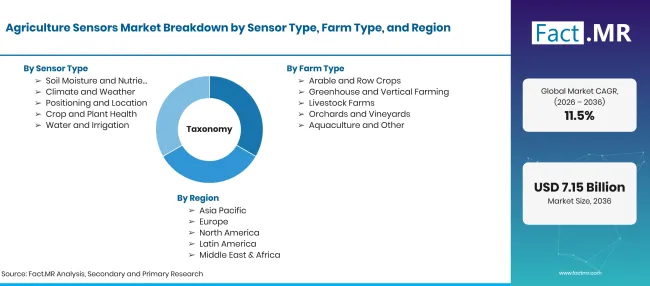
Agriculture Sensors Market Taxonomy | Source: Fact.MR
| Items | Values |
|---|---|
| Quantitative Units (2026) | USD 2.41 billion |
| Sensor Type | Soil moisture and nutrient, Climate and weather, Positioning and location, Crop and plant health, Water and irrigation |
| Farm Type | Arable and row crops, Greenhouse and vertical farming, Livestock farms, Orchards and vineyards, Aquaculture and other |
| Connectivity | Low-power wide-area networks, Cellular, Bluetooth and Wi-Fi, Wired and fieldbus, Satellite |
| Application | Precision irrigation, Crop and yield monitoring, Soil management, Livestock management, Weather and risk monitoring |
| Regions Covered | North America, Latin America, Europe, Asia Pacific, Middle East & Africa |
| Countries Covered | India, China, Brazil, South Korea, United States and other countries |
| Key Companies Profiled | Deere & Company, Trimble, AGCO, Campbell Scientific, Davis Instruments |
| Additional Attributes | Dollar revenue in the Agriculture Sensors Market is segmented by sensor type, farm type, connectivity, application and region. |
Source: Fact.MR analysis. Updated Nov 27, 2026
Table of Contents
Key Takeaways
- Market Size and CAGR
- Top Growth Driver
- Fastest Growing Segment
- Leading Region
- Key Companies
- Emerging Opportunities

