
- Market Value (2025): USD 920.0 Mn
- Estimated Value (2026): USD 984.4 Mn
- Forecast Value (2036): USD 2125.2 Mn
- CAGR (2026-2036): 8.0%
Stable Isotope Labeled Compounds Market Forecast and Outlook 2026 to 2036
The global stable isotope labeled compounds market was USD 920.0 million in 2025 and reached USD 984.4 million in 2026. The market is expected to reach USD 2,125.2 million by 2036, expanding at a CAGR of 8.0% during the 2026 to 2036 assessment period.
Stable isotope labeled compounds are becoming increasingly important in pharmaceutical analysis and metabolic research, where they help researchers trace biochemical changes and improve mass spectrometry measurements. A May 2025 study in Nature Communications used uniformly carbon-13-labeled glucose and glutamine to identify hundreds of labeled metabolites and map previously unknown cellular reactions. Such work is expanding interest in labeled amino acids, metabolic tracers and analytical standards for more precise laboratory investigations.
Key Takeaways from the Stable Isotope Labeled Compounds Market
- Sales of stable isotope labeled compounds stood at USD 920.0 million in 2025
- Stable Isotope Labeled Compounds Market Value (2026): USD 984.4 million
- Stable Isotope Labeled Compounds Market Forecast Value (2036): USD 2125.2 million
- Stable Isotope Labeled Compounds Market Forecast CAGR (2026-2036): 8.0%
- Leading Isotope: Deuterium (2H) (41.7%)
- Key Market Participants: Merck KGaA, Cambridge Isotope Laboratories, Thermo Fisher Scientific, LGC, Cayman Chemical
- Key Growth Countries: China, South Korea, United States, United Kingdom, Germany
Drug research and clinical testing are creating a wider role for stable isotope labeled compounds, particularly in accurate drug-level measurements and protein quantification. A December 2025 study in Nature Communications introduced the Charité Open Peptide Standard, comprising 211 isotope-labeled peptides for consistent plasma and serum proteomics across analytical platforms. This development highlights growing interest in application-specific standards with reliable labeling and high analytical precision.
Stable Isotope Labeled Compounds Market
| Metric | Value |
|---|---|
| Market Value (2025) | USD 911.5 million (Derived estimate) |
| Market Value (2026) | USD 984.4 million |
| Forecast Value (2036) | USD 2,125.2 million |
| CAGR (2026 to 2036) | 8.0% |
Source: Fact.MR analysis. Updated Nov 26, 2026
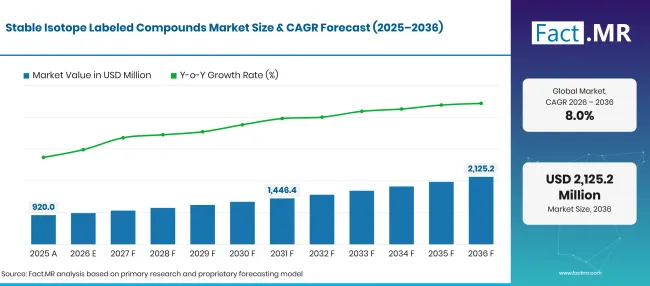
Stable Isotope Labeled Compounds Market Forecast Global | Source: Fact.MR
Category
| Category | Segments |
|---|---|
| Isotope | Deuterium (2H), Carbon-13, Nitrogen-15, Multiply labelled (13C, 15N, 2H), Oxygen-18 |
| Product | Labelled internal standards, Deuterated solvents and reagents, Labelled amino acids and nucleotides, Labelled metabolites, lipids and sugars, Labelled drug substances and metabolites |
| Application | Mass spectrometry bioanalysis, NMR spectroscopy, Drug metabolism and pharmaceutical research, Proteomics and metabolomics, Clinical diagnostics |
| End User | Pharmaceutical and biotechnology, Academic and research institutes, Contract research organisations, Clinical laboratories, Environmental and food laboratories |
| Region | China; South Korea; United States; United Kingdom; Germany |
Source: Fact.MR analysis. Updated Nov 26, 2026
Segmental Analysis
What makes deuterium (²H) the leading isotope segment in the Stable Isotope Labeled Compounds Market?
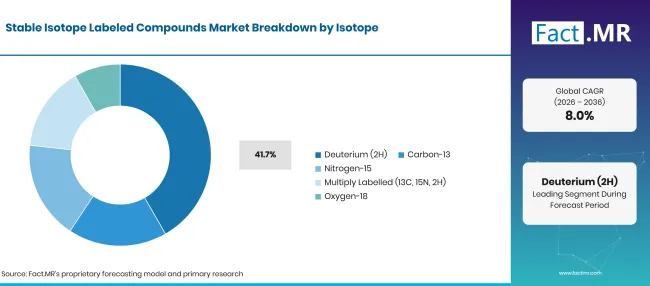
Stable Isotope Labeled Compounds Market Breakdown Isotope | Source: Fact.MR
Deuterium contributes 41.7% of market revenue in 2026, equivalent to USD 410.5 million. Its versatility in pharmaceutical analysis makes it widely used for internal standards, metabolic tracing and drug-development studies. A 2025 review in the European Journal of Medicinal Chemistry highlighted deuterium's role in improving the pharmacokinetic properties of therapeutic molecules and supporting ADME investigations. Carbon-13 and nitrogen-15 are also gaining traction as researchers expand metabolic pathway analysis and protein-labeling applications.
Which factors support labelled internal standards as the largest product segment in the Stable Isotope Labeled Compounds Market?
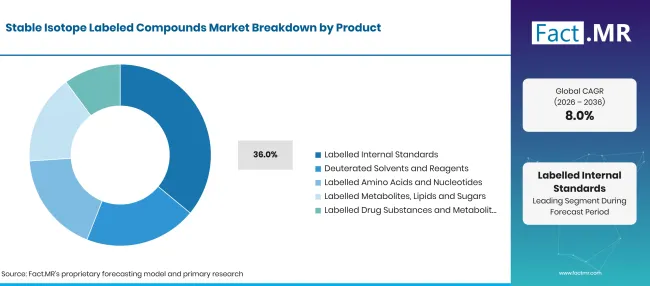
Stable Isotope Labeled Compounds Market Breakdown Product | Source: Fact.MR
Labelled internal standards generate 36.0% of market revenue in 2026, reaching USD 354.4 million. Their importance comes from the need to correct variations during sample extraction and instrumental analysis. The WHO's bioanalytical guidance recommends stable isotope-labelled analytes as internal standards wherever feasible for mass spectrometry methods, while emphasizing isotope purity and stability. Labelled reference materials and analytical reagents are also finding wider use as laboratories expand quantitative testing and metabolomics workflows.
What makes mass spectrometry bioanalysis the leading application segment in the Stable Isotope Labeled Compounds Market?
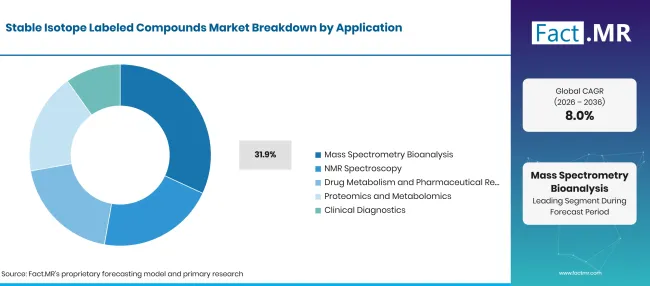
Stable Isotope Labeled Compounds Market Breakdown Application | Source: Fact.MR
Mass spectrometry bioanalysis captures 31.9% of market revenue in 2026, amounting to USD 314.0 million. Pharmaceutical laboratories rely on isotope-labelled compounds to quantify drug concentrations and identify metabolites in biological samples. In 2025, researchers affiliated with the U.S. National Institutes of Health published targeted metabolomic methods using uniformly labelled carbon-13 glucose and glutamine with LC-MS/MS. NMR spectroscopy and metabolic tracing are also gaining ground as researchers investigate molecular structures and follow biochemical pathways.
Which factors support pharmaceutical and biotechnology as the largest end-user segment in the Stable Isotope Labeled Compounds Market?
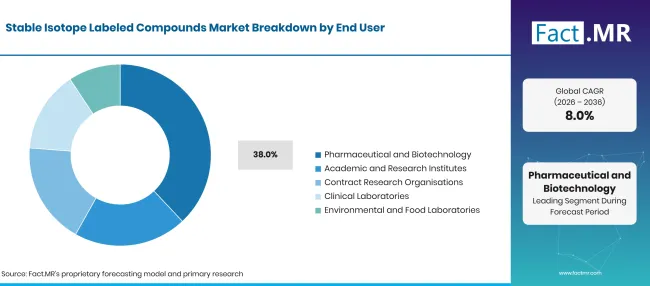
Stable Isotope Labeled Compounds Market Breakdown End User | Source: Fact.MR
Pharmaceutical and biotechnology companies generate 38.0% of market revenue in 2026, equivalent to USD 374.1 million. Drug developers use labelled compounds throughout pharmacokinetic assessments, metabolite identification and clinical bioanalysis. A 2025 research publication on TAK-981 described an LC-MS/MS method using a carbon-13 and nitrogen-15 labelled internal standard to quantify the drug in human plasma. The method also supported multiple clinical trials. Contract research organizations and academic laboratories are expanding their use of isotope-labelled materials for specialized analytical and metabolic investigations.
Stable Isotope Labeled Compounds Market-Drivers, Restraints & Trends
Drivers
Growing reliance on isotope-based analytical testing: Pharmaceutical researchers increasingly depend on isotope-labelled compounds to distinguish drug-related changes from natural variations in biological samples. Their role in accurate LC-MS/MS measurements is making these materials essential across drug development and clinical research. A December 2025 study in the Journal of Proteome Research demonstrated carbon-13 tracing across four major metabolic pathways using labelled glucose and glutamine
Restraints
High synthesis costs and limited availability: Producing highly enriched compounds with precise isotope placement remains expensive and technically demanding. Custom synthesis also extends delivery schedules, while limited availability of certain labelled analytes makes smaller academic laboratories cautious about purchasing them. A 2026 study in the Journal of Chromatography A specifically identified synthesis complexity, high costs and gaps in commercial standard availability as barriers to wider use.
Trend
Increasing preference for custom isotope synthesis: Standard catalogues rarely cover every analyte required in specialized research. Laboratories are therefore seeking tailor-made compounds with specific labelling positions, enrichment levels and molecular structures. This creates an opportunity for manufacturers to expand custom synthesis, improve production flexibility and serve niche analytical requirements. The 2026 plasma LC-MS/MS study demonstrated a new approach using deuterated isotopologue mixtures across eight bioactive compounds.
Trend
Wider adoption in proteomics and metabolomics: Researchers are moving beyond routine metabolite measurement towards tracking entire biochemical pathways. This shift is opening opportunities for labelled peptides, amino acids, glucose and lipid substrates. In February 2026, France's CEA reported a carbon-13 labelling study that identified 238 metabolites in mouse urine through high-resolution mass spectrometry. Such advances create scope for broader isotope portfolios and integrated multi-omics research.
Stable Isotope Labeled Compounds Market Analysis by Key Country
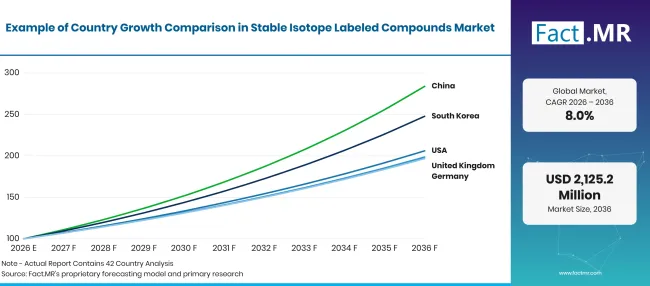
Stable Isotope Labeled Compounds Market Growth Index | Source: Fact.MR
| Country | CAGR (2026-2036) |
|---|---|
| China | 11.0% |
| South Korea | 9.5% |
| United States | 7.5% |
| United Kingdom | 7.1% |
| Germany | 7.0% |
Source: Fact.MR analysis. Updated Nov 26, 2026
Why is China the fastest-growing market for stable isotope labeled compounds?
China's expanding pharmaceutical research base and investment in analytical chemistry are creating a strong market for isotope-labelled materials.
In March 2025, researchers funded by China's National Natural Science Foundation published a method for checking isotopic purity in deuterium-, carbon-13- and nitrogen-15-labelled organic compounds using high-resolution mass spectrometry. This work highlights the country's growing focus on compound quality and analytical accuracy. Pharmaceutical testing, metabolomics laboratories and domestic research institutions are creating additional sales opportunities.
How is demand for stable isotope labeled compounds developing in South Korea?
South Korea's strength in pharmaceutical research and advanced analytical testing is opening fresh applications for stable isotope compounds.
A 2025 study involving Seoul National University researchers used carbon-13-labelled palmitate to investigate lipid biosynthesis through mass spectrometry. Separately, the Korea Research Institute of Standards and Science developed an isotope-dilution LC-MS/MS procedure for measuring 14 amino acids. These research activities are encouraging purchases of labelled substrates and reference standards across pharmaceutical laboratories and biomedical research centres.
What is driving stable isotope labeled compounds demand in United States?
The United States benefits from an extensive network of pharmaceutical developers, clinical research centres and specialized mass spectrometry facilities.
In December 2025, researchers affiliated with the National Institute of Diabetes and Digestive and Kidney Diseases published an LC-MS/MS method using uniformly carbon-13-labelled glucose and glutamine to trace four metabolic pathways. Such investigations are creating opportunities for labelled substrates, analytical standards and custom-synthesized compounds. Pharmaceutical bioanalysis and clinical metabolomics remain important sales channels.
What is shaping stable isotope labeled compounds demand in United Kingdom?
Britain's expanding metabolomics research ecosystem is creating a broader user base for stable isotope-labelled compounds.
On 20 November 2025, UK Biobank released its final metabolomics dataset covering nearly 250 blood metabolites from half a million volunteers. This large research resource is widening opportunities for laboratories studying metabolic biomarkers and disease pathways. Sales growth is likely to benefit from academic research, pharmaceutical biomarker discovery and the increasing use of isotope-based analytical methods.
Why is growth slower for stable isotope labeled compounds in Germany?
Germany's advanced analytical chemistry infrastructure is creating opportunities for high-purity isotope-labelled reference materials.
In February 2026, researchers at the Technical University of Munich published work on intramolecularly labelled sulfamethoxazole reference standards using carbon-13 and nitrogen-15 for fragment-specific isotope analysis. The research demonstrates growing interest in precisely positioned isotope labels for complex analytical applications. Pharmaceutical quality testing, university laboratories and specialized mass spectrometry facilities are likely to sustain purchases across the country.
Competitive Landscape for Stable Isotope Labeled Compounds Market
Competition in the stable isotope labeled compounds market spans specialist isotope producers and diversified life-science suppliers. Merck KGaA offers its ISOTEC® portfolio, covering labelled amino acids, metabolites, fatty acids and pharmaceutical intermediates, alongside custom synthesis and cGMP manufacturing. Cambridge Isotope Laboratories has an extensive catalogue of more than 11,000 products, with custom formulations, analytical testing and clinical-grade production.
Thermo Fisher Scientific serves targeted proteomics through its HeavyPeptide AQUA range, while LGC supplies isotope-labelled reference standards through its TRC portfolio. Cayman Chemical adds analytical reference materials and specialized biochemical compounds. Competition increasingly hinges on isotope enrichment, compound availability, synthesis flexibility and batch-level quality documentation.
Recent Developments
- On April 1, 2026, a European isotope supplier announced a direct supply arrangement for environmental standards across Europe, expanding access to analytical reference materials.
- On August 25, 2026, a new range of Orbitrap Isora and Orbitrap Isora Pro mass spectrometers was launched with dedicated isotope-ratio analysis capabilities.
- On February 26, 2026, a reference standards business was acquired to expand the buyer's analytical reference-material portfolio and strengthen its North American presence.
- On September 3, 2025, a partnership was announced to expand access to PEG-free shielding lipids for lipid nanoparticle research and drug-delivery development.
Key Players in Stable Isotope Labeled Compounds Market
Key companies operating in the market include Merck KGaA, Cambridge Isotope Laboratories, Thermo Fisher Scientific, LGC, and Cayman Chemical.
- Merck KGaA
- Cambridge Isotope Laboratories
- Thermo Fisher Scientific
- LGC
- Cayman Chemical
Bibliography
- Chen, J., Zhu, Y.-Y., Huang, L., Zhang, S.-S., & Gu, S.-X. (2025). Application of deuterium in research and development of drugs. European Journal of Medicinal Chemistry, 287, 117371.
- Damont, A., Legrand, A., Rousseau, K., Bellanger, L., Boiry, S., Gibiat, F., Leguay, J.-J., Junot, C., Fenaille, F., & Ezan, É. (2025). Urinary metabolome dynamics in ¹³C-labeled mice. Metabolomics, 22(1), Article 15.
- Guo, P., Liu, Y., Liu, G., Ma, M., & Chen, B. (2026). An isotopologue-mixture-based internal standard strategy for LC-MS/MS quantification in plasma. Journal of Chromatography A, 1781, Article 467069.
- Jennings, E. Q., Rathmell, W. K., & Rathmell, J. C. (2025). Targeted metabolomic methods for ¹³C stable isotope labeling with uniformly labeled glucose and glutamine using liquid chromatography-tandem mass spectrometry (LC-MS/MS). Journal of Proteome Research, 24(12), 6328–6337.
- Kim, K.-S., Ko, Y. G., Yang, W. S., Kim, H. Y., & Cho, J.-Y. (2025). A parallel reaction monitoring-mass spectrometric method for studying lipid biosynthesis in vitro using ¹³C₁₆-palmitate as an isotope tracer. Analytica Chimica Acta, 1354, Article 344003.
- Liang, C., Ling, L., & Wang, H.-Y. (2025). Rapid determination of isotopic purity of stable isotope (D, ¹⁵N, or ¹³C)-labeled organic compounds by electrospray ionization-high-resolution mass spectrometry. Rapid Communications in Mass Spectrometry, 39(12), Article e10031.
- Tsikas, D. (2025). Quantitative GC-NICI-MS and GC-NICI-MS/MS analysis by using isotopologs as internal standards: A tutorial review. Journal of Chromatography B, 1262, Article 124648.
- Wang, Z., Farztdinov, V., Sinn, L. R., Tober-Lau, P., Ludwig, D., Freiwald, A., Amari, F., Textoris-Taube, K., Niewienda, A., Welter, A. S., Wei, A. A. J., Luckau, L., Kurth, F., Selbach, M., Hartl, J., Mülleder, M., & Ralser, M. (2025). Cross-platform clinical proteomics using the Charité open standard for plasma proteomics (OSPP). Nature Communications, 16, Article 11377.
- World Health Organization. (2025, April 15). TRS 1060: Annex 6: Guideline on bioanalytical method validation and study sample analysis.
- Yin, F., Ye, R., Pierce, A., Gibbs, J., & Baratta, M. (2025). Quantitation of TAK-981 in human plasma via LC-MS/MS and its application in clinical trials. Bioanalysis, 17(12), 795–805.
- UK Biobank. (2025, November 20). World's largest metabolomic study completed, paving way for predictive medicine.
Segmentation
Scope of Report
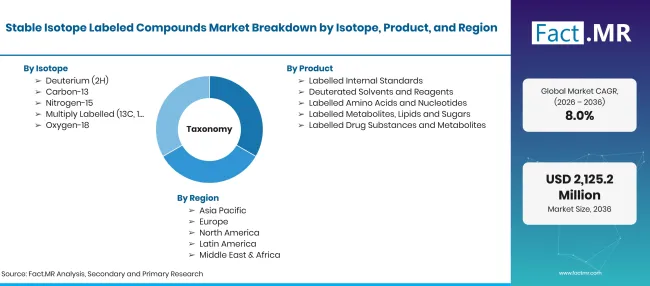
Stable Isotope Labeled Compounds Market Taxonomy | Source: Fact.MR
| Items | Values |
|---|---|
| Quantitative Units (2026) | USD 984.4 Million |
| Isotope | Deuterium (2H), Carbon-13, Nitrogen-15, Multiply labelled (13C, 15N, 2H), Oxygen-18 |
| Product | Labelled internal standards, Deuterated solvents and reagents, Labelled amino acids and nucleotides, Labelled metabolites, lipids and sugars, Labelled drug substances and metabolites |
| Application | Mass spectrometry bioanalysis, NMR spectroscopy, Drug metabolism and pharmaceutical research, Proteomics and metabolomics, Clinical diagnostics |
| End User | Pharmaceutical and biotechnology, Academic and research institutes, Contract research organisations, Clinical laboratories, Environmental and food laboratories |
| Regions Covered | North America, Latin America, Europe, Asia Pacific, Middle East & Africa |
| Countries Covered | China, South Korea, United States, United Kingdom, Germany, and other countries |
| Key Companies Profiled | Merck KGaA, Cambridge Isotope Laboratories, Thermo Fisher Scientific, LGC, Cayman Chemical |
| Additional Attributes | Dollar revenue in the Stable Isotope Labeled Compounds Market is segmented by isotope, product, application and end user and region. |
Source: Fact.MR analysis. Updated Nov 26, 2026
Stable Isotope Labeled Compounds Market by Segments
-
Isotope
- Deuterium (2H)
- Carbon-13
- Nitrogen-15
- Multiply labelled (13C, 15N, 2H)
- Oxygen-18
-
Product
- Labelled internal standards
- Deuterated solvents and reagents
- Labelled amino acids and nucleotides
- Labelled metabolites, lipids and sugars
- Labelled drug substances and metabolites
-
Application
- Mass spectrometry bioanalysis
- NMR spectroscopy
- Drug metabolism and pharmaceutical research
- Proteomics and metabolomics
- Clinical diagnostics
-
End User
- Pharmaceutical and biotechnology
- Academic and research institutes
- Contract research organisations
- Clinical laboratories
- Environmental and food laboratories
-
Region:
- North America
- United States
- Canada
- Mexico
- Europe
- Germany
- United Kingdom
- France
- Italy
- Spain
- Rest of Europe
- Asia Pacific
- China
- India
- Japan
- South Korea
- Australia and New Zealand
- Rest of Asia Pacific
- Latin America
- Brazil
- Argentina
- Rest of Latin America
- Middle East & Africa
- GCC Countries
- South Africa
- Rest of Middle East & Africa
- North America
Table of Contents
Key Takeaways
- Market Size and CAGR
- Top Growth Driver
- Fastest Growing Segment
- Leading Region
- Key Companies
- Emerging Opportunities

