
- Market Value (2025): USD 3.4 Bn
- Estimated Value (2026): USD 3.67 Bn
- Forecast Value (2036): USD 8.3 Bn
- CAGR (2026-2036): 8.5%
Hollow Fiber Filter Market Forecast and Outlook 2026 to 2036
The hollow fiber filter market is projected to grow from USD 3.67 billion in 2026 to USD 8.3 billion by 2036. The ten-year forecast implies a CAGR of 8.5%.
Interest in hollow fiber filters is increasing as water utilities, biopharmaceutical plants, food producers and hospitals use membrane modules to remove particles, bacteria and proteins with compact, scalable equipment. Suppliers are offering PVDF, polyethersulfone, polypropylene and other membranes for ultrafiltration, microfiltration and membrane bioreactors.
Key Takeaways from Hollow Fiber Filter Market
- Sales of hollow fiber filters stood at USD 3.4 billion in 2025
- Hollow Fiber Filter Market Value (2026): USD 3.67 billion
- Hollow Fiber Filter Market Forecast Value (2036): USD 8.3 billion
- Hollow Fiber Filter Market Forecast CAGR (2026-2036): 8.5%
- Leading Application: Water and wastewater treatment (41.3%)
- Companies covered: Toray Industries, DuPont, Veolia, Asahi Kasei, Kovalus Separation Solutions
- Countries covered: India, China, Saudi Arabia, South Korea, United States
In October 2025, DuPont announced the global availability of its IntegraTec XTP 100 IG ultrafiltration modules, incorporating PVDF hollow-fiber membrane technology for industrial process water and wastewater treatment. Demand for hollow fiber filters is increasing as water utilities and industrial facilities invest in membrane systems that remove suspended particles and microorganisms while supporting water reuse. Suppliers such as Toray Industries, DuPont and Veolia are serving these requirements through membrane filtration products and water-treatment solutions.
Hollow Fiber Filter Market
| Metric | Value |
|---|---|
| Estimated Value in (2026) | USD 3.67 billion |
| Forecast Value in (2036) | USD 8.30 billion |
| Forecast CAGR (2026 to 2036) | 8.5% |
Source: Fact.MR analysis.
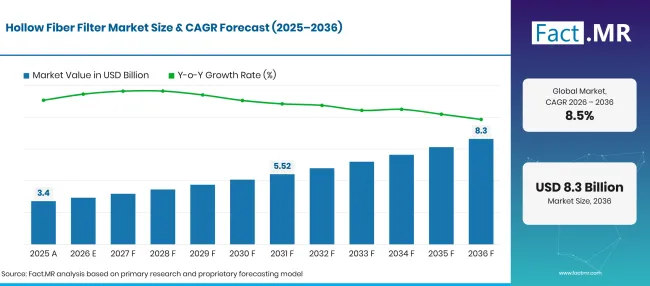
Hollow Fiber Filter Market Forecast Global | Source: Fact.MR
Category
| Category | Segments |
|---|---|
| Application | Water and wastewater treatment, Biopharmaceutical processing, Food and beverage, Industrial process water, Medical plasma and hemofiltration |
| Membrane Material | PVDF, Polyethersulfone and polysulfone, Polypropylene, Polyacrylonitrile, PTFE |
| Filtration Process | Ultrafiltration, Microfiltration, Membrane bioreactor, Membrane contactors, Nanofiltration |
| Configuration | Pressurised inside-out, Pressurised outside-in, Submerged, Single-use modules |
| Country | India; China; Saudi Arabia; South Korea; United States |
Source: Fact.MR analysis.
Segmental Analysis
Why does water and wastewater treatment hold the leading application share in the Hollow Fiber Filter Market?
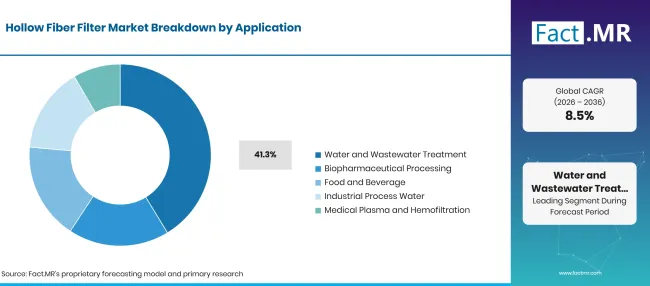
Hollow Fiber Filter Market Breakdown Application | Source: Fact.MR
Water and wastewater treatment accounts for 41.3% of revenue in 2026, approximately USD 1.52 billion, reflecting widespread membrane use in municipal and industrial water treatment facilities. Hollow fiber filters remove suspended solids and support water reuse applications. DuPont's MemCor systems demonstrate their suitability for filtration. Utilities prioritize membrane reliability, treatment capacity and efficient use of installation space.
Why does PVDF hold the leading membrane-material share in the Hollow Fiber Filter Market?
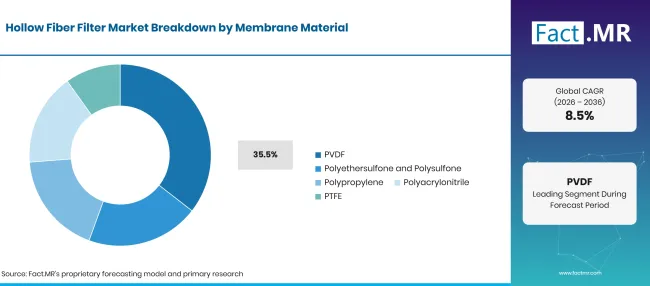
Hollow Fiber Filter Market Breakdown Membrane Material | Source: Fact.MR
PVDF membranes represent 35.5% of revenue in 2026, valued at approximately USD 1.30 billion, owing to their chemical resistance and mechanical durability. These characteristics support repeated cleaning in demanding water treatment environments. DuPont's IntegraTec PVDF modules demonstrate commercial use of the material.
Why does ultrafiltration hold the leading process share in the Hollow Fiber Filter Market?
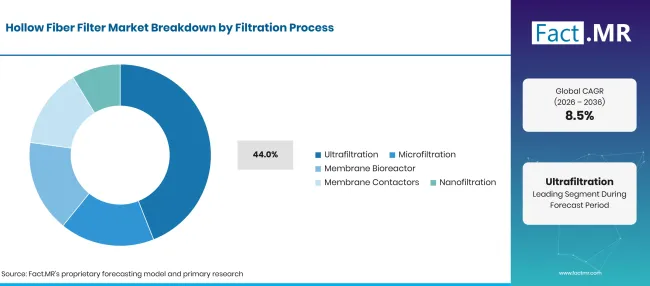
Hollow Fiber Filter Market Breakdown Filtration Process | Source: Fact.MR
Ultrafiltration holds 44.0% of revenue in 2026, equivalent to approximately USD 1.61 billion, as drinking water and wastewater facilities require effective removal of suspended particles and microorganisms. Hollow fiber membranes provide a compact filtration arrangement suited to different treatment capacities.
Why does pressurised inside-out hold the leading configuration share in the Hollow Fiber Filter Market?
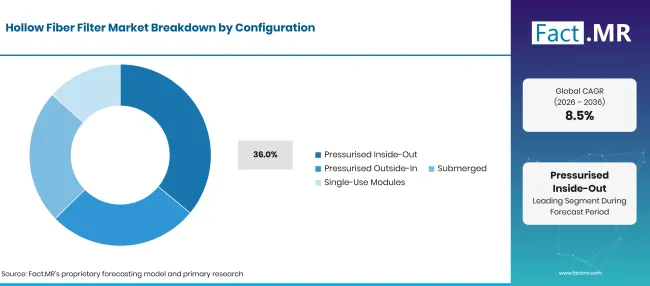
Hollow Fiber Filter Market Breakdown Configuration | Source: Fact.MR
Pressurised inside-out configurations contribute 36.0% of revenue in 2026, approximately USD 1.32 billion, as feedwater passes through the hollow fiber lumen before filtration across the membrane wall. DuPont's Inge Multibore technology demonstrates this configuration in commercial ultrafiltration. Water treatment operators examine feedwater turbidity, membrane fouling, backwash effectiveness and pressure requirements when evaluating module suitability.
Hollow Fiber Filter Market: Drivers, Restraints & Trends
Drivers:
Demand for hollow fiber filters is increasing as municipalities and industries expand wastewater treatment, water reuse and desalination pretreatment. Biopharmaceutical manufacturers also require membrane filtration for biologics processing. Suppliers are developing systems that improve separation efficiency, water quality and processing reliability.
Restraints:
Membrane fouling, frequent cleaning and energy consumption can increase operating expenses for hollow fiber filtration systems. Conventional filtration technologies also offer cost advantages in selected applications. Manufacturers are improving membrane durability, backwashing efficiency and cleaning procedures to maintain filtration performance.
Trend: Water Reuse and Desalination Pretreatment:
Water utilities are incorporating hollow fiber ultrafiltration before reverse osmosis to remove suspended particles and reduce downstream membrane fouling. These systems support wastewater reclamation and desalination operations. Equipment suppliers are refining membrane modules to improve pretreatment reliability and cleaning efficiency.
Trend: Single-Use Biopharma Modules:
Biopharmaceutical manufacturers are adopting single-use hollow fiber filtration systems to simplify production changeovers and reduce cleaning validation requirements. Repligen offers hollow fiber tangential flow filtration technologies for bioprocessing. Suppliers are developing disposable flow paths that support process flexibility and contamination control.
Hollow Fiber Filter Market Analysis by Key Country
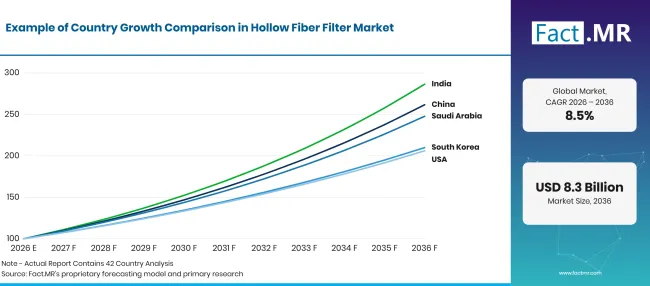
Hollow Fiber Filter Market Growth Index | Source: Fact.MR
| Country | CAGR (2026-2036) |
|---|---|
| India | 11.1% |
| China | 10.1% |
| Saudi Arabia | 9.5% |
| South Korea | 7.7% |
| United States | 7.5% |
Source: Fact.MR analysis.
Why is India the fastest-growing market for hollow fiber filters?
Demand for hollow fiber filters in India carries an 11.1% CAGR through 2036, the fastest among the five countries.
Urban wastewater treatment expansion and improvements in drinking water infrastructure create opportunities for membrane filtration suppliers. As of 9 February 2026, projects approved under AMRUT 2.0 included 6,650 MLD of sewage treatment capacity and 1,932 MLD of recycle and reuse capacity.
What shapes hollow fiber filters purchases in China?
Sales of hollow fiber filters in China are forecast to advance at a 10.1% CAGR through 2036, above the global rate of 8.5%.
Extensive wastewater recycling programs are creating opportunities for ultrafiltration technologies. In May 2026, China's Ministry of Housing and Urban-Rural Development reported that cities used more than 22 billion cubic meters of recycled water in 2025. Domestic membrane manufacturers support local supply and equipment development.
What is driving hollow fiber filters demand in Saudi Arabia?
Demand for hollow fiber filters in Saudi Arabia is set to increase at a 9.5% CAGR through 2036, exceeding the global rate of 8.5%.
Water scarcity places considerable importance on desalination and treated wastewater reuse. In February 2026, the Saudi Water Authority reported that Eastern Province desalination capacity had reached 3 million cubic meters per day after three production plants entered service.
What is shaping hollow fiber filters demand in South Korea?
Demand for hollow fiber filters in South Korea reflects a 7.7% CAGR through 2036, below the global rate of 8.5%.
Biopharmaceutical manufacturing creates specialized requirements for filtration, including cell harvesting and product concentration using suitable membrane systems. Samsung Biologics reported in 2026 that its Bio Campus I plants were fully utilized and that Bio Campus II in Songdo, which added Plant 5 in 2025, would be extended with Plants 6 to 8 by 2032, demonstrating activity across the domestic biotechnology sector.
Why is growth slower for hollow fiber filters in the United States?
Sales of hollow fiber filters in the United States are expected to rise at a 7.5% CAGR through 2036, the slowest among the five countries.
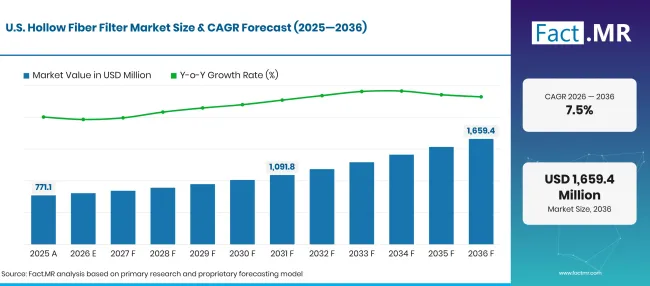
Hollow Fiber Filter Market Forecast Usa | Source: Fact.MR
Established municipal treatment infrastructure creates continuing opportunities for membrane replacement and system modernization. In April 2026, the Environmental Protection Agency introduced its Water Reuse Action Plan 2.0 to encourage wider use of treated wastewater.
Competitive Landscape for Hollow Fiber Filter Market
Competition in the hollow fiber filter market centers on membrane durability, filtration efficiency and the ability to support large water treatment installations. Toray Industries competes through PVDF hollow fiber ultrafiltration modules designed for chemical resistance and mechanical strength. DuPont offers IntegraTec membranes for municipal and industrial water treatment, while Veolia supplies ZeeWeed systems for wastewater treatment and reuse. Asahi Kasei differentiates its MICROZA portfolio through membrane materials, system engineering and operational support. Kovalus Separation Solutions, formerly Koch Separation Solutions, competes through specialized membrane technologies.
Recent competition increasingly emphasizes membrane upgrades and reduced operating expenses. DuPont expanded global availability of its IntegraTec XTP ultrafiltration modules, while Toray developed advanced membranes targeting lower fouling and improved treatment efficiency.
Recent Developments
- In April 2026, Toray announced its F-HFUG ultrafiltration membrane series for wastewater reuse, featuring a nominal pore size of 0.005 micrometers.
- In April 2026, DuPont launched Inge ultrafiltration modules with integrated pre-filter technology, combining debris removal and membrane filtration within one housing.
Key Players in Hollow Fiber Filter Market
Key companies operating in the Hollow Fiber Filter Market include Toray Industries, DuPont, Veolia, Asahi Kasei, and Kovalus Separation Solutions.
- Toray Industries
- DuPont
- Veolia
- Asahi Kasei
- Kovalus Separation Solutions
Bibliography
- DuPont. (2026, April 7). DuPont launches ultrafiltration modules with integrated pre-filter.
- DuPont. (2025, October 9). DuPont™ IntegraTec™ XTP 100 IG ultrafiltration modules now available globally.
- Asahi Kasei Corporation. (2025, July 16). Asahi Kasei’s Microza® hollow fiber membrane for filtration and separation receives Gold rating in EcoVadis sustainability assessment. Asahi Kasei Corp.
- Toray Industries, Inc. (2025, November 17). Toray subsidiary becomes first in Saudi Arabia to integrate reverse osmosis membrane fabrication through assembly with new desalination-focused facility.
- Saudi Water Authority. (2026, February 6). Saudi Water Authority raises Eastern Region desalination capacity to 3 million m³ per day.
- U.S. Environmental Protection Agency. (2026, April 16). Water Reuse Action Plan 2.0.
- Ministry of Housing and Urban Affairs, Government of India. (2026). AMRUT 2.0 approved projects: Water supply, sewerage, treatment and treated wastewater reuse projects.
- Pharma Manufacturing. (2026, August 3). Samsung Biologics’ 2026 growth strategy on track with full plant utilization.
- Veolia Water Technologies. (2026). The community of communes Albères-Côte Vermeille-Illibéris and Veolia inaugurate France’s largest treated wastewater reuse installation.
- Toray Industries, Inc. (2026, April 27). Toray to launch lower-biofouling ultrafiltration membrane module with one of the industry's smallest nominal pore sizes, at just 0.005 micrometers.
- Xinhua. (2026, May 14). China’s 2025 urban recycled water utilization exceeds 22 billion cubic meters.
- Indian Infrastructure. (2026, March 10). Significant progress gets mapped under AMRUT.
Segmentation
Scope of Report
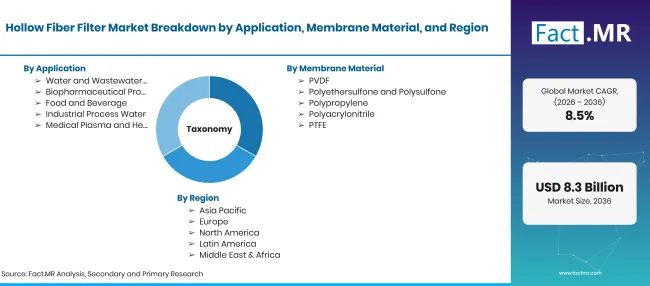
Hollow Fiber Filter Market Taxonomy 1 | Source: Fact.MR
| Items | Values |
|---|---|
| Quantitative Units (2026) | USD 3.67 Billion |
| Application | Water and wastewater treatment, Biopharmaceutical processing, Food and beverage, Industrial process water, Medical plasma and hemofiltration |
| Membrane Material | PVDF, Polyethersulfone and polysulfone, Polypropylene, Polyacrylonitrile, PTFE |
| Filtration Process | Ultrafiltration, Microfiltration, Membrane bioreactor, Membrane contactors, Nanofiltration |
| Configuration | Pressurised inside-out, Pressurised outside-in, Submerged, Single-use modules |
| Regions Covered | North America, Latin America, Europe, Asia Pacific, Middle East & Africa |
| Countries Covered | India, China, Saudi Arabia, South Korea, United States, and other countries |
| Key Companies Profiled | Toray Industries, DuPont, Veolia, Asahi Kasei, Kovalus Separation Solutions |
| Additional Attributes | Dollar revenue in the Hollow Fiber Filter Market is segmented by application, membrane material, filtration process and configuration and region. |
Source: Fact.MR analysis.
Hollow Fiber Filter Market by Segments
-
Application
- Water and wastewater treatment
- Biopharmaceutical processing
- Food and beverage
- Industrial process water
- Medical plasma and hemofiltration
-
Membrane Material
- PVDF
- Polyethersulfone and polysulfone
- Polypropylene
- Polyacrylonitrile
- PTFE
-
Filtration Process
- Ultrafiltration
- Microfiltration
- Membrane bioreactor
- Membrane contactors
- Nanofiltration
-
Configuration
- Pressurised inside-out
- Pressurised outside-in
- Submerged
- Single-use modules
-
Region:
- North America
- United States
- Canada
- Mexico
- Europe
- Germany
- United Kingdom
- France
- Italy
- Spain
- Rest of Europe
- Asia Pacific
- China
- India
- Japan
- South Korea
- Australia and New Zealand
- Rest of Asia Pacific
- Latin America
- Brazil
- Argentina
- Rest of Latin America
- Middle East & Africa
- Saudi Arabia
- Other GCC Countries
- South Africa
- Rest of Middle East & Africa
- North America
Table of Contents
Key Takeaways
- Market Size and CAGR
- Top Growth Driver
- Fastest Growing Segment
- Leading Region
- Key Companies
- Emerging Opportunities

