- Market Value (2025): USD 15.9 Bn
- Estimated Value (2026): USD 18.6 Bn
- Forecast Value (2036): USD 91.8 Bn
- CAGR (2026-2036): 17.3%
What is the AI Generated Content Market forecast to be worth by 2036?
USD 18.6 billion in 2026 to USD 91.8 billion by 2036, at 17.3% CAGR.
- The AI Generated Content Market crossed a valuation of USD 15.9 billion in 2025, reflecting enterprise pilots moving into paid team deployments.
- Demand is projected to increase from USD 18.6 billion in 2026 to USD 91.8 billion by 2036 across business content workflows.
- The market is forecast to record a 17.3% CAGR from 2026 to 2036, supported by marketing teams and operations groups embedding generation inside recurring work.
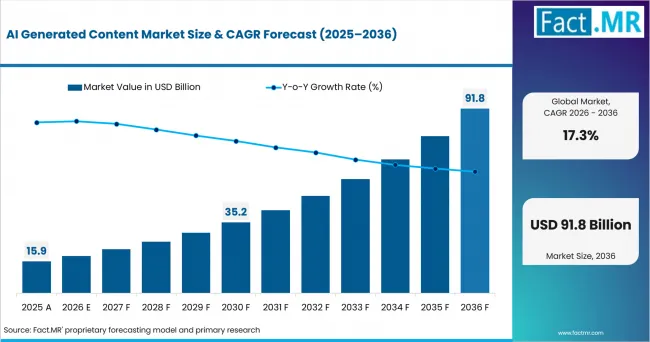
Ai Generated Content Market Market Value Analysis | Source: Fact.MR
What are the defining numbers behind AI Generated Content Market growth?
USD 73.2 billion absolute opportunity by 2036, led by Software and Cloud across BFSI demand.
- Demand Drivers in the Market
- Marketing operations teams need brand-controlled generation because ungoverned prompts create rework and inconsistent claims across campaign channels.
- Enterprise operations teams need permission-aware connectors so generated outputs draw from approved business context without exposing restricted information.
- Compliance teams need traceable review controls while transparency rules increase scrutiny of generated text and synthetic media used in public communication.
- Product teams need multimodal output systems shaped by reuse across documents and presentations while related campaign assets share approved context.
- Key Segments Analyzed
- By Component: Software is expected to account for 35.8% share in 2026, supported by bundled creation and governance features inside recurring workflows.
- By Deployment: Cloud is projected to garner 44.3% share in 2026, due to rapid feature delivery and shared access across distributed teams.
- By Organization Size: SMEs is anticipated to record 50.6% share in 2026, owing to packaged subscriptions that reduce integration work before first use.
- By Application: Workflow Automation is estimated to hold 43.4% share in 2026, shaped by repeatable content tasks that connect generation to review steps.
- By End Use: BFSI is forecast to capture 25.8% share in 2026, attributable to document-heavy operations and strict control requirements around customer communication.
- Analyst Opinion at Fact.MR
- Shambhu Nath Jha, Senior Analyst at Fact.MR, states, “Enterprise content teams are treating governance as part of creation instead of a review step added after publication. Adoption is expected to favor platforms that connect approved business context to clear permissions and visible output history. Providers should combine multimodal creation with brand controls and human review checkpoints that fit existing production teams.”
- Strategic Implications
- Chief marketing officers should map high-volume content tasks before licensing broad platform access across teams and external agency partners.
- Chief information officers should test connector permissions and retention settings before allowing generated outputs to draw from internal repositories.
- Compliance teams should define review thresholds for customer-facing material before automated publishing routes move generated content into regulated channels.
- Procurement heads should compare governance controls and workflow fit alongside output quality before consolidating separate generation tools into enterprise agreements.
Canva introduced Canva AI 2.0 in April 2026 and added conversational design alongside fully layered editable output from a single prompt. The release links generation to brand intelligence and business connectors so content teams manage more of the production path inside one platform.
India is projected to record 19.1% CAGR during the forecast period, supported by a growing trained workforce and broader enterprise experimentation. China is anticipated to post 18.4% CAGR by 2036, driven by rapid consumer familiarity and a deep domestic model ecosystem. Australia is estimated to register 17.1% CAGR over the assessment period, shaped by widening business use across service-heavy industries. The United Kingdom is forecast to expand at 16.8% CAGR between 2026 and 2036, attributable to broader company adoption and governance work. The United States is expected to grow at 16.6% CAGR across the forecast, reinforced by enterprise deployment across information and financial services.
How does the AI Generated Content Market break down by segment?
Software is projected to account for 35.8% share; Cloud is projected to hold 44.3% share.
Which Component dominates?
Software is projected to account for 35.8% share in 2026
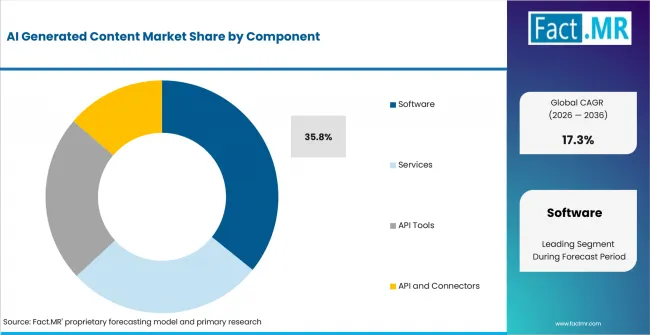
Ai Generated Content Market Analysis By Component | Source: Fact.MR
Software is expected to account for 35.8% share in 2026, supported by enterprise teams seeking one interface for creation and review. Services remain relevant during workflow mapping and policy design because internal teams often lack implementation depth. API Tools and connector offerings extend generation into internal products and established work systems that support recurring enterprise content production. In April 2026, Adobe unveiled Firefly AI Assistant as a conversational interface that orchestrates multi-step workflows across creative applications. The release gives software vendors a clear route from isolated generation into governed creative production and broader content workflows.
What leads the Deployment segment?
Cloud is estimated to garner 44.3% share in 2026
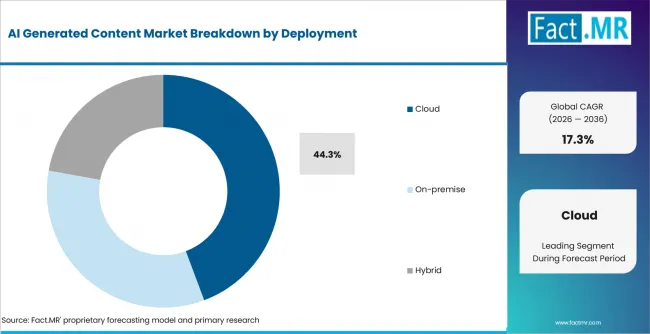
Ai Generated Content Market Analysis By Deployment | Source: Fact.MR
Cloud is anticipated to capture 44.3% share in 2026 due to frequent capability releases and simpler access for distributed teams. On-premise deployment remains relevant where institutions require strict data residency and controlled model access across internal hosting environments. Hybrid arrangements serve organizations that keep sensitive context locally while using hosted generation services for less restricted tasks. In January 2026, Eurostat reported that 52.74% of EU enterprises purchased cloud computing services during 2025. Existing cloud procurement routes are expected to shorten qualification for content platforms that fit identity and access policies.
How does Organization Size shape demand?
SME is anticipated to record 50.6% share in 2026
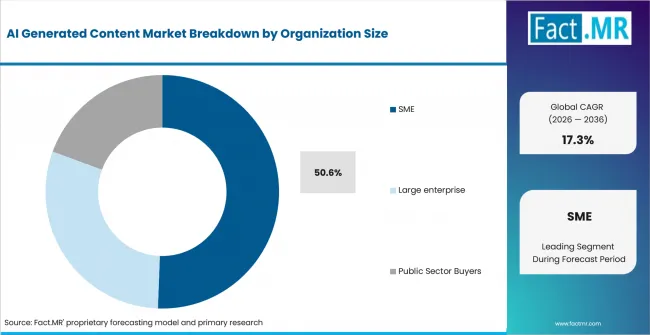
Ai Generated Content Market Analysis By Organization Size | Source: Fact.MR
SME is forecast to represent 50.6% share in 2026, supported by packaged tools that give smaller teams access without dedicated model engineering groups. Large enterprises focus more heavily on permission design and procurement controls before deployment expands across departments. Public sector buyers require transparency documentation and record-handling controls before generated content enters public communication. In November 2025, the OECD reported that 30.7% of surveyed SMEs used generative AI across seven countries. Simpler setup is expected to keep smaller firms commercially relevant even when individual contracts remain below enterprise account values.
What supports Workflow Automation within Application?
Workflow Automation is estimated to hold 43.4% share in 2026
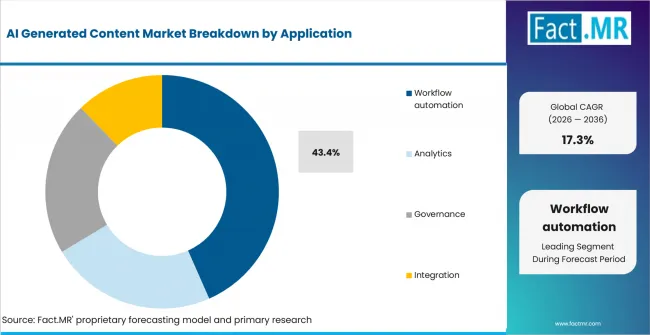
Ai Generated Content Market Analysis By Application | Source: Fact.MR
Workflow Automation is projected to hold 43.4% share in 2026, driven by content teams seeking repeatable movement from brief to draft and approval. Analytics remains connected to performance review because teams compare generated variants against campaign outcomes across active distribution channels. Governance applications focus on policy checks and traceability before generated outputs enter public channels or regulated customer communication routes. In June 2026, Eurostat reported that 34.70% of AI-using EU enterprises applied AI to marketing or sales activities during 2025. Commercial use is forecast to deepen when generation connects directly to knowledge management systems and approved business context.
Which End Use segment records the primary share?
BFSI is forecast to capture 25.8% share in 2026
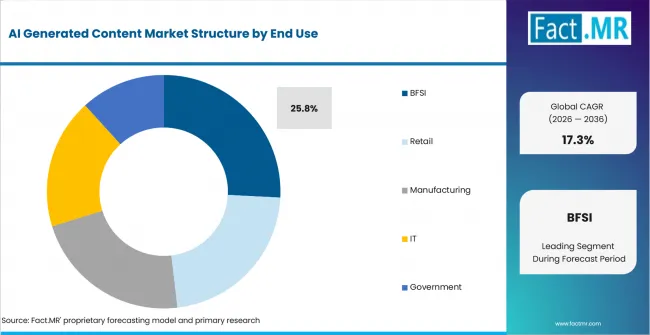
Ai Generated Content Market Analysis By End Use | Source: Fact.MR
BFSI is estimated to account for 25.8% share in 2026 owing to strict review requirements around customer communication. Retail teams use generated product content across active sales channels while Manufacturing and IT groups rely on technical content and internal knowledge workflows. In May 2026, the U.S. Census Bureau reported 33.9% AI use among Finance and Insurance businesses as of May 3. Established governance teams are anticipated to support wider content use where audit history and human approval remain visible.
What is accelerating AI Generated Content Market adoption, and what is holding it back?
Enterprise workflow embedding drives adoption; copyright uncertainty and data-control risk restrain enterprise qualification across regulated accounts.
Drivers Impact Analysis
| Driver | (~) % Impact on CAGR | Geographic Relevance | Impact Timeline |
|---|---|---|---|
| Enterprise workflow embedding | +2.4% | North America and Europe | Medium term (2-4 years) |
| Multimodal content production | +2.0% | North America and Europe | Medium term (2-4 years) |
| SME access to packaged tools | +1.7% | India, United Kingdom and Australia | Medium term (2-4 years) |
| Cloud delivery and API integration | +1.5% | North America and Asia Pacific | Short term (<= 2 years) |
| Governance and provenance controls | +1.1% | Europe and North America | Short term (<= 2 years) |
Source: Fact.MR analysis. Updated Jul 9, 2026
- Enterprise workflow embedding: Content teams are moving generation into recurring work paths that begin with approved context and end with review. In November 2025, the OECD reported that 65% of SME generative AI users saw improved employee performance. Adoption is expected to favor platforms that reduce handoffs without hiding approval history from managers.
- Multimodal content production: Marketing teams increasingly need text and visual output from a shared brief instead of separate prompt sessions. In June 2026, Eurostat reported that 9.55% of EU enterprises used AI for image and audiovisual generation during 2025. Investment is projected to continue around systems that keep assets editable after initial generation and preserve production context.
- SME access to packaged tools: Smaller companies gain usable generation through subscriptions that require little model engineering before deployment. In November 2025, the OECD reported that generative AI use among surveyed SMEs had increased 40% from the previous year. Demand is anticipated to widen where brand rules and approval controls are included without lengthy implementation projects.
- Cloud delivery and API integration: Hosted platforms shorten access to model updates while connectors move generated content into established business systems. In April 2026, Jasper AI introduced API task endpoints and MCP support that place marketing agents inside external tools and workflows. Enterprise use is estimated to expand where familiar interfaces reduce training needs and identity controls remain consistent.
- Governance and provenance controls: Regulated teams need visible marking and review rules before generated content reaches customers or the public. In June 2026, the European Commission published its AI-generated content transparency code ahead of Article 50 obligations applying from August 2026. Platform qualification is forecast to place more weight on traceability and detection support during the assessment period.
Opportunity Impact Analysis
| Opportunity | (~) % Impact on CAGR | Geographic Relevance | Impact Timeline |
|---|---|---|---|
| Governed brand content systems | +1.0% | Europe and North America | Medium term (2-4 years) |
| Multilingual video localization | +0.8% | Asia Pacific and Europe | Medium term (2-4 years) |
| Workflow APIs and connectors | +0.7% | North America and Asia Pacific | Medium term (2-4 years) |
| Education and public governance tools | +0.5% | Europe, India and Australia | Long term (>= 4 years) |
Source: Fact.MR analysis. Updated Jul 9, 2026
- Governed brand content systems: Enterprises need faster asset production without losing tone controls and approval ownership across distributed teams. In September 2025, UNESCO reported that 19% of surveyed higher education institutions had formal AI policies in place. Many institutions were still drafting guidance, creating room for policy-aware creation tools that support visible review controls. Opportunity is expected to broaden for platforms that make enforcement rules visible inside the creation interface.
- Multilingual video localization: Training and communication teams need repeatable video updates across regions where reshooting content adds production time. In October 2025, Synthesia introduced its 3.0 platform with interactive video workflows and dubbing support. Demand is projected to favor systems that localize speech and presentation while retaining approved source material.
- Workflow APIs and connectors: Enterprise accounts need generation inside existing work systems so staff avoid copying restricted context between disconnected tools. In May 2026, the U.S. Census Bureau reported that about 42% of Information-sector businesses expected AI use during the following six months. Integration demand is anticipated to rise where procurement teams evaluate permissions at each connector boundary before broader workflow access is approved.
- Education and public governance tools: Public institutions need policy-aware drafting tools that retain review evidence before generated material becomes part of official communication. India’s Press Information Bureau reported more than 337,000 FutureSkills PRIME completions in October 2025 based on records through August 2025. Demand is estimated to develop where workforce training and content controls are purchased together instead of treated as separate programs.
Restraints Impact Analysis
| Restraint | (~) % Impact on CAGR | Geographic Relevance | Impact Timeline |
|---|---|---|---|
| Copyright and legal uncertainty | -1.2% | Europe and North America | Short term (<= 2 years) |
| Data privacy and permission risk | -1.0% | North America and Europe | Medium term (2-4 years) |
| Skills and workflow redesign gap | -0.8% | Europe and Asia Pacific | Medium term (2-4 years) |
| Verification and provenance cost | -0.6% | North America and Europe | Medium term (2-4 years) |
Source: Fact.MR analysis. Updated Jul 9, 2026
- Copyright and legal uncertainty: Legal teams hesitate when training-data questions and output ownership remain difficult to explain within procurement reviews. In November 2025, the OECD reported that 54% of surveyed non-adopting SMEs cited copyright or legal concerns. Adoption is forecast to remain selective where providers cannot document model policies and enterprise usage terms clearly.
- Data privacy and permission risk: Generated content workflows often draw context from repositories that contain customer information or internal documents. In June 2026, Eurostat reported that 48.83% of EU enterprises considering AI cited privacy concerns among reasons for non-use during 2025. Platform expansion is expected to slow where access controls are separate from the systems that supply source context.
- Skills and workflow redesign gap: A usable model does not remove the need for teams to define prompts and review ownership across recurring tasks. In June 2026, Eurostat reported that 70.89% of EU enterprises considering AI cited lack of expertise among reasons for non-use during 2025. Adoption is projected to favor packaged workflows that reduce configuration work while keeping human responsibility explicit.
- Verification and provenance cost: High-volume generation creates extra review work when teams cannot identify source history or synthetic media status quickly. In July 2025, the European Commission published the General-Purpose AI Code of Practice to support transparency and copyright compliance under the AI Act. Demand is anticipated to concentrate around systems that make review evidence easier to retain and inspect.
Which countries are scaling AI Generated Content Market fastest?
India 19.1%; China 18.4%; Australia 17.1%; United Kingdom 16.8%; United States 16.6%; Germany 16.3%; Japan 16.0%
AI Generated Content Market is segmented into North America, Europe, Asia Pacific, Latin America, and the Middle East and Africa.
| Country | CAGR |
|---|---|
| India | 19.1% |
| China | 18.4% |
| Australia | 17.1% |
| United Kingdom | 16.8% |
| United States | 16.6% |
| Germany | 16.3% |
| Japan | 16.0% |
Source: Fact.MR analysis. Updated Jul 9, 2026
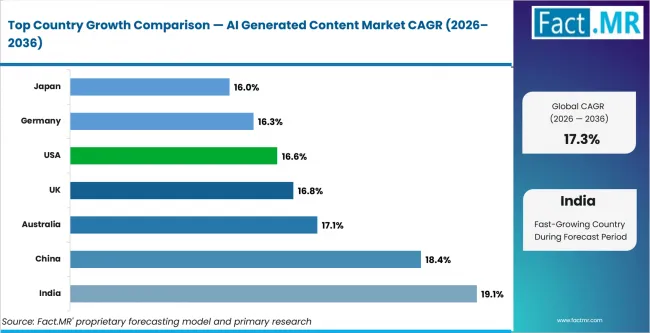
Ai Generated Content Market Cagr Analysis By Country | Source: Fact.MR
Why is India building a stronger implementation base?
19.1% CAGR, driven by workforce training and wider enterprise experimentation programs.
India is turning workforce depth into practical implementation capacity for content generation across service delivery and enterprise operations. In October 2025, the Press Information Bureau reported that 320,000 candidates had trained in AI and Big Data Analytics by August 2025. The market is projected to record a 19.1% CAGR during the forecast period owing to stronger local delivery capabilities and broader enterprise experimentation. Implementation partners can use this talent base to combine generation tools with review controls across varied client workflows.
How does China's user scale support market expansion?
18.4% CAGR, supported by broad user familiarity and extensive domestic model supply capacity.
A vast consumer testing base gives Chinese platforms unusual scope to refine language generation and media applications before wider enterprise rollout. In February 2026, China’s State Council information service reported 602 million generative AI users by December 2025. The market is anticipated to post an 18.4% CAGR by 2036 as user familiarity expands beside a dense domestic model ecosystem. Providers can convert large-scale experimentation into enterprise opportunities by adapting proven consumer capabilities for governed business content workflows.
Where is Australia finding new adoption opportunities?
17.1% CAGR, attributable to wider business adoption across service industries.
Service-heavy business activity makes Australia a practical market for content tools that support communication and knowledge-intensive operating tasks. In June 2026, the Australian Bureau of Statistics reported AI use among 12% of businesses during 2024-25. Demand is estimated to register a 17.1% CAGR over the assessment period due to broader adoption across media and professional services. Commercial traction improves where platforms connect drafting and visual production with cloud systems already embedded in daily business processes.
Why are governance requirements strengthening the United Kingdom outlook?
16.8% CAGR, shaped by company adoption and active governance work.
Governance readiness is becoming a defining part of United Kingdom adoption as businesses formalize controls around generated internal and external content. In April 2026, the Office for National Statistics reported that 26% of UK businesses used at least one AI technology in late March 2026. Demand is forecast to expand at a 16.8% CAGR between 2026 and 2036 alongside wider company adoption and active governance programs. Vendors gain relevance by supporting approval workflows and documented review practices across teams with different content responsibilities.
What gives the United States an enterprise-scale advantage?
16.6% CAGR, reinforced by enterprise use in information and financial services.
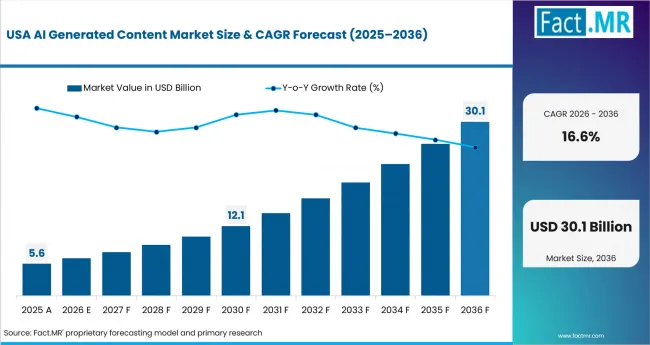
Ai Generated Content Market Country Value Analysis | Source: Fact.MR
Enterprise software depth gives the United States a strong base for moving content generation from individual assistance into coordinated production environments. In May 2026, the U.S. Census Bureau reported AI use among 37% of firms with at least 250 employees during the period ending May 3. The market is expected to grow at a 16.6% CAGR across the forecast horizon because larger organizations already manage complex software procurement and deployment structures. Platform vendors can expand account value by embedding generation services within governed workflows shared across multiple business functions.
Who leads the AI Generated Content Market?
Adobe and Midjourney strengthen creative-content coverage.
OpenAI competes through ChatGPT Business and its API platform across writing and wider content workflows, while Adobe connects Firefly generation to Creative Cloud production. Midjourney focuses on image creation and released V8.1 in April 2026 with faster rendering and HD image support. These providers compete on output range and workflow fit, while enterprise procurement teams compare permissions and commercial controls before moving generation into recurring production.
Stability AI competes through image models and enterprise deployment options, while Jasper AI focuses on governed marketing workflows. Canva links conversational generation to editable design production, and Cohere supports text generation inside enterprise applications through its Command family. Anthropic extends Claude across business content and design workflows. Competition is forecast to depend on governance depth and workflow integration, reinforced by rising interest in human-verified content certification services for publishing controls.
Which companies are the key providers?
OpenAI, Adobe, Midjourney, Stability AI, Jasper AI, Canva, Cohere, and Anthropic.
- OpenAI
- Adobe
- Midjourney
- Stability AI
- Jasper AI
- Canva
- Cohere
- Anthropic
Bibliography
- Australian Bureau of Statistics. (2026, June 25). Characteristics of Australian business, 2024–25 financial year. Australian Bureau of Statistics.
- Adobe. (2026, April 15). Adobe ushers in a new era of creativity with new creative agent and generative AI innovations in Adobe Firefly. Adobe.
- Anthropic. (2026, April 17). Introducing Claude Design by Anthropic Labs. Anthropic.
- Canva. (2026, April 15). Introducing Canva AI 2.0: Reimagining how the world creates. Canva.
- Cohere. (2025, December 10). Building trust in AI: Cohere’s approach to AI governance. Cohere.
- European Commission. (2025, July 10). The General-Purpose AI Code of Practice. European Commission.
- European Commission. (2026, June 10). Code of Practice on Transparency of AI-Generated Content. European Commission.
- Eurostat. (2026, January 13). Cloud computing: Statistics on the use by enterprises. European Commission.
- Eurostat. (2026, June 2). Use of artificial intelligence in enterprises. European Commission.
- Jasper. (2026, April 7). What’s new in March 2026. Jasper.
- Midjourney. (2026, April 30). Version documentation: V8.1. Midjourney.
- Office for National Statistics. (2026, April 2). Business insights and impact on the UK economy: 2 April 2026. Office for National Statistics.
- OpenAI. (2026, April 8). The next phase of enterprise AI. OpenAI.
- OpenAI. (2025, September 30). Sora 2 is here. OpenAI.
- Organisation for Economic Co-operation and Development. (2025, November 5). Generative AI and the SME workforce. OECD Publishing.
- Press Information Bureau. (2025, October 12). Transforming India with AI. Government of India.
- Stability AI. (2026, May 20). Core models. Stability AI.
- State Council of the People’s Republic of China. (2026, February 5). China’s internet user base hits 1.125 billion as AI adoption surges. State Council of the People’s Republic of China.
- Synthesia. (2025, October 1). With Synthesia 3.0, the next era of video is here. Synthesia.
- U.S. Census Bureau. (2026, May 26). Large firms with at least 20 employees are the biggest AI users. U.S. Census Bureau.
- UNESCO. (2025, September 2). UNESCO survey: Two-thirds of higher education institutions have or are developing guidance on AI use. UNESCO.
This Report Addresses
- The report provides strategic intelligence on AI-generated content across Component and Deployment choices that shape enterprise production workflows.
- Country analysis evaluates India and China alongside Australia while the United Kingdom and United States complete the growth comparison.
- Competitive analysis profiles OpenAI and Adobe alongside Midjourney and Stability AI, followed by Jasper AI, Canva, Cohere and Anthropic.
- Component assessment covers Software and Services alongside API Tools and connector offerings that support different deployment paths.
- Application assessment covers Workflow Automation and Analytics alongside Governance and Integration requirements across recurring content operations.
What does the AI Generated Content Market cover?
Text generation and image creation alongside video production and audio synthesis platforms used across business content workflows.
The AI Generated Content Market covers platforms that generate or transform business content from prompts and approved enterprise context. Coverage includes software subscriptions and implementation services alongside APIs that embed generation inside work systems, including governance functions that directly control generated output inside creation and publishing workflows.
The market differs from the broader artificial intelligence software category because commercial value is tied to content creation and transformation. General model infrastructure sold without a content workflow remains outside the boundary defined for commercial content production platforms. Conventional analytics tools are also excluded when they do not generate or materially transform business content.
What is included in the scope?
AI-generated content systems used in governed enterprise creation and publishing workflows across repeatable business operations.
Included scope covers Software and Services that generate text or media for recurring business use across enterprise content teams. API Tools and connector offerings place generation inside existing products or work systems used by enterprise teams. Cloud and On-premise deployment are covered alongside Hybrid arrangements that separate sensitive context from hosted generation services. The analysis evaluates SMEs and Large Enterprises, while Public Sector Buyers remain part of the organization structure. Applications span Workflow Automation and Analytics alongside Governance and Integration requirements that shape recurring content production and review. End-use coverage includes BFSI and Retail alongside Manufacturing and IT, while Government completes the buyer structure.
What is excluded from the scope?
General-purpose AI infrastructure and non-generative analytics software used without content creation functions are outside the defined scope.
The scope excludes graphics processors and cloud compute sold without a content-generation service attached to the commercial offer. Conventional automation systems and business intelligence platforms are excluded when they only move data or produce dashboards without generating business content. Consumer-only filters and entertainment tools remain outside the boundary, along with model-training services that lack a content-generation product.
How was the analysis built?
120+ sources, 40+ company portfolios, 25+ countries, 20+ interviews.
- Primary Research:
- Primary research includes interviews with AI content platform providers, generative AI developers, digital marketing leaders, content strategists and enterprise technology decision-makers. It also covers input from publishers, media companies, advertising agencies, SEO specialists and content operations teams involved in deploying AI-generated content solutions across commercial applications.
- Desk Research:
- Desk research reviews official digital economy statistics, artificial intelligence policy updates, generative AI platform portfolios, company product announcements and technology adoption studies. Industry reports, technical publications, developer documentation and enterprise case studies are also assessed to evaluate market developments and competitive positioning.
- Market-Sizing and Forecasting:
- Forecasting uses AI software adoption trends, content creation volumes, enterprise spending on marketing technologies, subscription-based platform usage and automation deployment across major industries. Models consider demand for text, image, audio and video generation solutions alongside advancements in large language models, content personalization and workflow automation.
- Data Validation and Update Cycle:
- Forecasts are validated through provider checks and industry interviews that test assumptions on platform adoption, content generation demand and enterprise implementation trends. Portfolio mapping, end-user assessment and stakeholder feedback help confirm market direction, while ongoing reviews of product launches, technology developments and regulatory updates support forecast revisions.
Segmentation
What is the report’s scope and coverage?
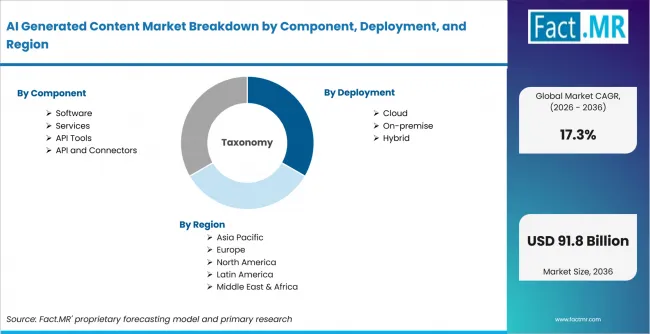
Ai Generated Content Market Breakdown By Component, Deployment, And Region | Source: Fact.MR
| Attribute | Details |
|---|---|
| Quantitative Units | USD Billion |
| Market Definition | Software platforms, services and integration tools that generate or transform business content across text, image, video and audio workflows. |
| Component | Software; Services; API Tools; API and Connectors |
| Deployment | Cloud; On-premise; Hybrid |
| Organization Size | SME; Large Enterprise; Public Sector Buyers |
| Application | Workflow Automation; Analytics; Governance; Integration |
| End Use | BFSI; Retail; Manufacturing; IT; Government |
| Regions Covered | North America; Europe; Asia Pacific; Latin America; Middle East and Africa |
| Countries Covered | United States; Canada; United Kingdom; Germany; France; Italy; Spain; India; China; Japan; South Korea; Australia; Brazil; Mexico; Argentina; Chile; UAE; Saudi Arabia; South Africa |
| Key Companies Profiled | OpenAI; Adobe; Midjourney; Stability AI; Jasper AI; Canva; Cohere; Anthropic |
| Forecast Period | 2026 to 2036 |
| Approach | Hybrid top-down and bottom-up analysis using enterprise AI adoption, content workflow activity, paid cloud use, platform attachment rates, modality mix, renewal cycles, governance requirements and provider validation. |
Source: Fact.MR analysis. Updated Jul 9, 2026
How is the market segmented?
-
By Component :
- Software
- Services
- API Tools
- API and Connectors
-
By Deployment :
- Cloud
- On-premise
- Hybrid
-
By Organization Size :
- SME
- Large Enterprise
- Public Sector Buyers
-
By Application :
- Workflow Automation
- Analytics
- Governance
- Integration
-
By End Use :
- BFSI
- Retail
- Manufacturing
- IT
- Government
-
By Region :
- North America
- United States
- Canada
- Europe
- United Kingdom
- Germany
- France
- Italy
- Spain
- Asia Pacific
- India
- China
- Japan
- South Korea
- Australia
- Latin America
- Brazil
- Mexico
- Argentina
- Chile
- Middle East & Africa
- UAE
- Saudi Arabia
- South Africa
- North America
Frequently Asked Questions
Which Component is projected to account for the primary share?
Which Deployment model is estimated to garner the primary share?
Which Organization Size is anticipated to record the primary share?
Which Application is estimated to hold the primary share?
Which End Use is forecast to capture the primary share?
How quickly is India expected to expand?
What rate is anticipated for China?
What growth rate is estimated for Australia?
How is the United Kingdom outlook forecast?
What pace is expected in the United States?
What is the main commercial adoption driver?
What most slows platform qualification?
Why does Workflow Automation carry commercial weight?
Why are regulated enterprise teams commercially relevant?
Who worked on this report


Preview the report firsthand - request a free sample
Free SampleGet the brochure for pricing and purchase details
Download PDF