- Market Value (2025): USD 344.7 Mn
- Estimated Value (2026): USD 392.1 Mn
- Forecast Value (2036): USD 1422.0 Mn
- CAGR (2026-2036): 13.8%
What is the AI Infant Wellness Monitors Market forecast to be worth by 2036?
USD 392.1 million in 2026 to USD 1422.0 million by 2036 at a 13.8% CAGR.
- As per Fact.MR analysis, the AI infant wellness monitors market was valued at USD 344.7 million in 2025.
- Demand is projected to grow from USD 392.1 million in 2026 to USD 1422.0 million by 2036.
- The forecast records a 13.8% CAGR from 2026 to 2036 as caregivers increasingly consider connected monitoring and AI-enabled wellness insights.
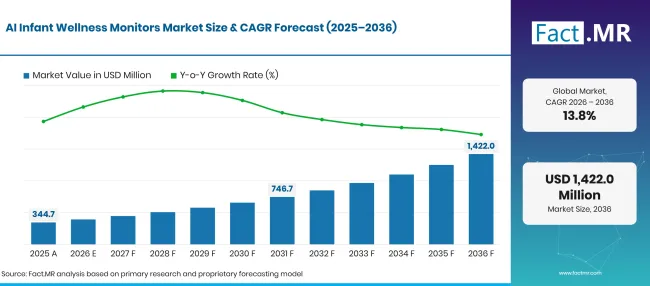
Ai Infant Wellness Monitors Forecast Global | Source: Fact.MR
| Year | Basis | Market Value (USD million) |
|---|---|---|
| 2025 | Actual | 344.7 |
| 2026 | Estimate | 392.1 |
| 2036 | Forecast | 1422.0 |
| CAGR 2026 to 2036 | Forecast period | 13.8% |
Source: Fact.MR analysis. Updated Nov 9, 2026
What are the defining numbers behind AI Infant Wellness Monitors Market growth?
USD 1,029.9 million absolute opportunity between 2026 and 2036.
Demand Drivers in the Market
- Growing attention to infant health monitoring has driven the market growth. Caregivers are showing greater interest in monitoring infant wellness indicators at home. The U.S. Centers for Disease Control and Prevention reported 3,628,934 live births in 2024, with 10.41% of births classified as preterm and 8.52% as low birthweight [1].
- Increasing demand for connected nursery systems has raised the demand for the AI infant wellness monitors. Parents are increasingly considering connected cameras and wearable devices that provide mobile alerts and accessible monitoring information. AI-enabled platforms can combine sleep observations with movement tracking and other wellness indicators to help caregivers review changes over time.
- Advancement in AI-based image processing has created lucrative opportunity for the growth of the market. Improvements in computer vision and machine learning are enabling camera-based systems to identify selected infant movements and sleep patterns. These capabilities support non-contact monitoring and can reduce the need for wearable sensors in certain applications.
- Greater availability of wearable monitoring devices supports the growth of the market. Compact sensors and connected accessories can measure selected indicators such as pulse rate and oxygen saturation. These products are expanding the range of home-based infant wellness monitoring options.
- Integration of cloud-based data processing has driven the market over forecast period. Cloud platforms allow monitoring information to be transferred to mobile applications for alerts and historical review. This can improve accessibility for parents and other authorized caregivers.
Key Segments Analyzed
- By Infant Monitoring Parameter: Respiratory Motion will account for 25.0% of the market in 2026, reflecting demand for monitoring breathing-related movement.
- By Device Form Factor: Portable Accessory leads with a 27.4% share in 2026, supported by demand for compact monitoring devices that can be used around the home.
- By Data Processing: Cloud AI is projected to capture 32.3% of the market in 2026 as connected monitoring platforms use cloud infrastructure for data analysis and notifications.
- By Sales Channel: B2B / Institutional channels will hold a 26.7% share in 2026
Analyst Opinion at Fact.MR
Shambhu Nath Jha, Principal Consultant at Fact.MR, states, “The AI infant wellness monitors market is positioned for growth as parents increasingly seek connected solutions that provide better visibility into infant sleep patterns, movement, crying behavior and surrounding environmental conditions. The integration of artificial intelligence with cameras, wearable sensors and contactless monitoring technologies is transforming conventional baby monitors into intelligent infant-care platforms.”
Strategic Implications
- Manufacturers should clearly explain the monitoring parameters covered by each product and distinguish general wellness tracking from medical diagnosis. Providing transparent information about sleep patterns and movement tracking alongside breathing-related alerts and environmental monitoring capabilities can help parents understand product functionality and make informed purchasing decisions.
- Technology developers need to improve sensor accuracy and data consistency while minimizing false alerts caused by routine infant movements or changes in sleeping positions. Investing in advanced signal processing and AI algorithms can improve monitoring reliability and help caregivers receive more meaningful notifications without unnecessary interruptions.
- Digital platform providers must strengthen data privacy and access controls for information collected from infants and shared with caregivers. Implementing secure data storage and encrypted communication alongside user authentication and parental access permissions can reduce unauthorized access risks and strengthen consumer confidence in connected infant monitoring platforms.
South Korea is projected to record the fastest growth at a 16.9% CAGR through 2036. The USA is set to advance at 15.5%, followed closely by China at 15.4%. Japan is forecast to grow at 14.2%, while Germany is expected to record a 12.8% CAGR.
How does the AI Infant Wellness Monitors Market break down by segment?
Fact.MR finds that Respiratory Motion leads Infant Monitoring Parameter at 25.0%; Portable Accessory leads Device Form Factor at 27.4%; Cloud AI leads Data Processing at 32.3%; and B2B / Institutional leads Sales Channel at 26.7%.
Which Infant Monitoring Parameter dominates?
Respiratory Motion is set to hold a 25.0% share in 2026.
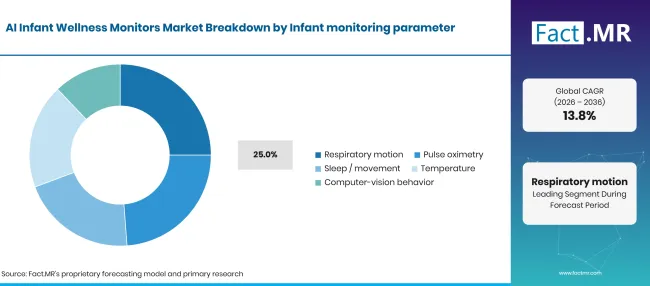
Ai Infant Wellness Monitors Breakdown Infant Monitoring Parameter | Source: Fact.MR
| Infant Monitoring Parameter | Share (2026) |
|---|---|
| Respiratory Motion (Leading segment) | 25.0% |
| Other segments combined | 75.0% |
| Total | 100.0% |
Source: Fact.MR analysis. Updated Nov 9, 2026
Respiratory motion monitoring provides caregivers with information about an infant's breathing-related movement. Camera-based systems and wearable sensors can capture these movements through different approaches. Demand depends on monitoring accuracy and the ability to provide timely alerts without creating unnecessary notifications. Pulse oximetry and temperature monitoring address different wellness parameters, while sleep and movement tracking can provide additional information about routine activity.
What leads the Device Form Factor segment?
Portable Accessory is set to represent 27.4% share in 2026.
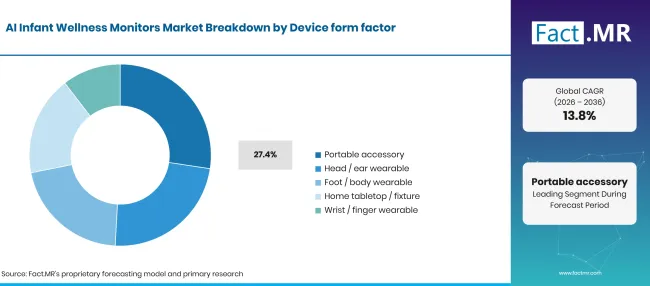
Ai Infant Wellness Monitors Breakdown Device Form Factor 1 | Source: Fact.MR
| Device Form Factor | Share (2026) |
|---|---|
| Portable Accessory (Leading segment) | 27.4% |
| Other segments combined | 72.6% |
| Total | 100.0% |
Source: Fact.MR analysis. Updated Nov 9, 2026
Portable accessories offer flexibility for caregivers who want to monitor infants across different rooms or during routine movement around the home. Wearable devices positioned on the foot or body provide another approach to collecting selected physiological measurements. Home tabletop and fixture-based systems generally use cameras or fixed sensors to observe sleep and movement. Product selection depends on ease of use and the type of information being monitored.
How does Data Processing shape demand?
Cloud AI is likely to account for 32.3% share in 2026.
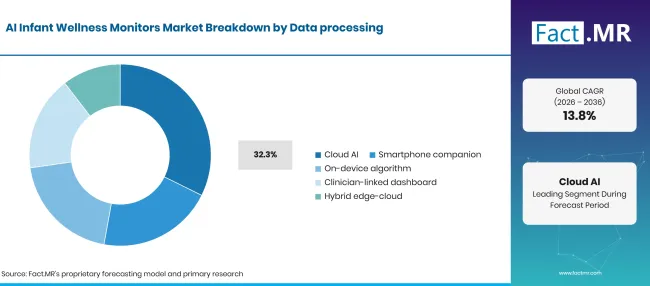
Ai Infant Wellness Monitors Breakdown Data Processing | Source: Fact.MR
| Data Processing | Share (2026) |
|---|---|
| Cloud AI (Leading segment) | 32.3% |
| Other segments combined | 67.7% |
| Total | 100.0% |
Source: Fact.MR analysis. Updated Nov 9, 2026
Cloud AI platforms can process monitoring information and deliver notifications through connected applications. Hybrid edge-cloud systems combine local processing with cloud-based data management, while on-device algorithms can support functions that require immediate responses. Smartphone companion systems provide an interface for caregivers to review monitoring information. Clinician-linked dashboards serve a different purpose by supporting information access in professional care settings.
Which Sales Channel leads the market?
B2B / Institutional is set to account for 26.7% share in 2026.
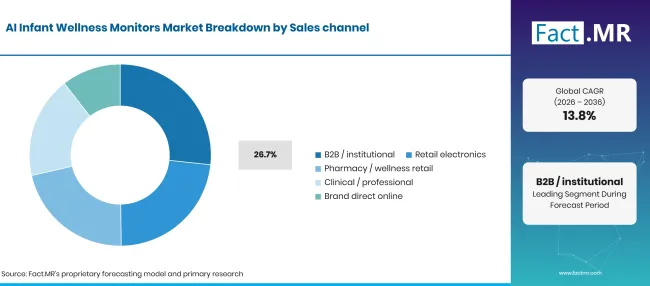
Ai Infant Wellness Monitors Breakdown Sales Channel | Source: Fact.MR
| Sales Channel | Share (2026) |
|---|---|
| B2B / Institutional (Leading segment) | 26.7% |
| Other segments combined | 73.3% |
| Total | 100.0% |
Source: Fact.MR analysis. Updated Nov 9, 2026
B2B and institutional channels can support sales by hospitals and other professional care organizations where monitoring equipment is selected for defined care requirements. Retail electronics outlets provide access to consumer monitoring devices, while pharmacies and wellness retailers serve caregivers seeking health-oriented products. Brand-direct online sales allow manufacturers to explain product features and offer connected services. Channel performance depends on product positioning and the level of customer support required.
What is accelerating AI Infant Wellness Monitors Market adoption, and what is holding it back?
Growing interest in connected infant wellness tracking and AI-enabled alerts supports demand, while product costs and concerns about data reliability can limit adoption.
Drivers Impact Analysis
| DRIVER | (~) % IMPACT ON CAGR | GEOGRAPHIC RELEVANCE | IMPACT TIMELINE |
|---|---|---|---|
| Rising caregiver interest in infant wellness monitoring | +1.0% | North America, Asia | Short term (≤ 2 years) |
| Expansion of connected nursery and smart home systems | +0.9% | Global | Medium term (2–4 years) |
| Advancements in AI-based infant movement detection | +0.7% | North America, Asia | Medium term (2–4 years) |
| Increasing availability of wearable monitoring devices | +0.5% | Global | Short term (≤ 2 years) |
| Integration of cloud-based wellness analytics | +0.4% | Global | Long term (≥ 4 years) |
Source: Fact.MR analysis. Updated Nov 9, 2026
Opportunity Impact Analysis
| OPPORTUNITY | (~) % IMPACT ON CAGR | GEOGRAPHIC RELEVANCE | IMPACT TIMELINE |
|---|---|---|---|
| Improved accuracy in respiratory motion tracking | +0.8% | Global | Medium term (2–4 years) |
| Development of non-contact monitoring platforms | +0.6% | North America, Europe | Medium term (2–4 years) |
| Integration with connected healthcare platforms | +0.5% | Americas, Asia | Long term (≥ 4 years) |
| Expansion of privacy-focused on-device processing | +0.4% | Global | Short term (≤ 2 years) |
Source: Fact.MR analysis. Updated Nov 9, 2026
Restraints Impact Analysis
| RESTRAINT | (~) % IMPACT ON CAGR | GEOGRAPHIC RELEVANCE | IMPACT TIMELINE |
|---|---|---|---|
| High upfront cost of advanced monitoring systems | -0.8% | Global | Short term (≤ 2 years) |
| False alerts and inconsistent sensor readings | -0.6% | Global | Medium term (2–4 years) |
| Data privacy and cybersecurity concerns | -0.5% | North America, Europe | Short term (≤ 2 years) |
| Limited clinical acceptance of consumer wellness readings | -0.4% | Global | Medium term (2–4 years) |
Source: Fact.MR analysis. Updated Nov 9, 2026
Which countries are scaling the AI Infant Wellness Monitors Market through 2036?
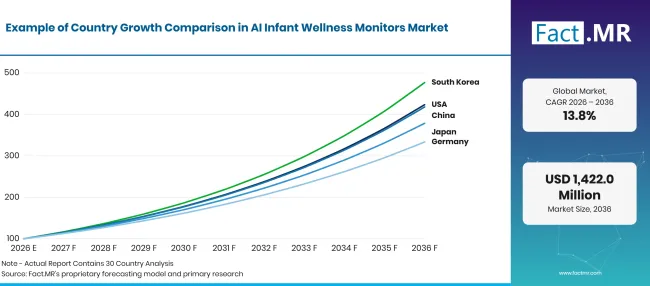
Ai Infant Wellness Monitors Growth Index | Source: Fact.MR
| Country | CAGR (2026–2036) |
|---|---|
| South Korea | 16.9% |
| USA | 15.5% |
| China | 15.4% |
| Japan | 14.2% |
| Germany | 12.8% |
Source: Fact.MR analysis. Updated Nov 9, 2026
What is driving growth in South Korea?
16.9% CAGR, supported by a recovering birth trend and interest in connected consumer technology.
South Korea recorded 254,500 live births in 2025, representing a 6.8% increase from 2024, according to preliminary government statistics released in February 2026 [2]. The increase in births provides a larger near-term pool of potential users for infant wellness products. Manufacturers can focus on compact monitoring devices and connected applications that provide accessible information to caregivers.
What is supporting growth in the USA?
15.5% CAGR, led by demand for connected home monitoring and a large annual birth cohort.
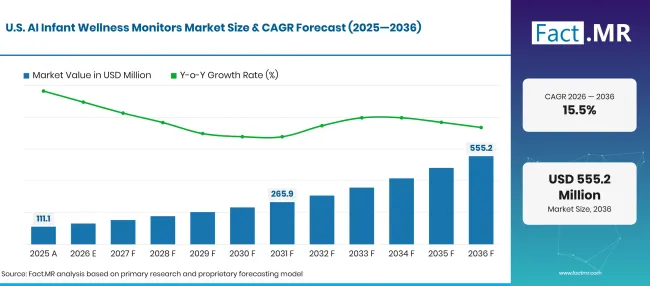
Ai Infant Wellness Monitors Forecast Usa | Source: Fact.MR
The CDC reported 3.63 million live births in the United States in 2024. It also reported that 10.41% of births were preterm and 8.52% were classified as low birthweight. These highlights the scale of the infant population and selected health considerations that influence caregiver interest in wellness information. Product providers can emphasize reliable measurements and clear communication of device limitations.
How is China developing the AI Infant Wellness Monitors Market?
15.4% CAGR, backed by a large infant population and opportunities for connected consumer products.
China recorded 7.92 million births in 2025, according to its National Bureau of Statistics [3]. Although the annual birth count declined from 2024, the country's large population provides a substantial potential customer base. Urban households and digitally connected consumers offer opportunities for camera-based monitoring and wearable wellness devices. Manufacturers need to consider affordability and local distribution when expanding product availability.
What factors are supporting market growth in Japan?
14.2% CAGR, shaped by demand for convenient home monitoring and connected infant care products.
Japan recorded 671,270 births in 2025, according to final vital statistics released by the Ministry of Health, Labour and Welfare in September 2026 [4]. Although the number of births declined from the previous year, demand for infant monitoring products can be supported by households seeking convenient ways to review sleep and movement patterns. Companies should focus on easy-to-use products and dependable customer support.
What is supporting market development in Germany?
12.8% CAGR, driven by demand for connected household products and interest in infant wellness information.
Germany recorded 654,241 live births in 2025, according to the Federal Statistical Office [5]. Parents seeking additional information about infant sleep and movement can consider connected camera systems and wearable monitors. Suppliers should communicate how products collect and process information while maintaining clear distinctions between consumer wellness features and medical monitoring.
Who leads the AI Infant Wellness Monitors Market?
Fact.MR identifies Owlet Baby Care Inc., Nanit, Philips Avent, CuboAi and Sense-U among the companies participating in the AI infant wellness monitoring landscape.
Owlet offers wearable monitoring through its Dream Sock platform, which tracks pulse rate and oxygen saturation alongside sleep and movement information. The FDA granted De Novo authorization for Dream Sock on November 8, 2023, as an over-the-counter infant pulse-rate and oxygen-saturation monitor. This applies to the specified product and its intended use [6]. Nanit provides camera-based monitoring with breathing-motion tracking and sleep insights. Its system uses computer vision and algorithms to interpret movement patterns captured by the camera. [6]. Nanit provides camera-based monitoring with breathing-motion tracking and sleep insights. Its system uses computer vision and algorithms to interpret movement patterns captured by the camera.
Philips Avent participates through its Premium Connected Baby Monitor with SenseIQ technology. The system analyzes movement and breathing patterns and provides sleep-related information. CuboAi offers AI-enabled camera monitoring with covered-face and rollover detection. Its platform also provides sleep analytics and alerts through a connected application. Sense-U offers wearable monitoring products that track abdominal movement and sleep position alongside temperature-related information. Its devices provide app-based alerts and sleep analysis.
Competition in this market depends on the monitoring parameters offered and the reliability of the underlying technology. Camera-based providers emphasize non-contact observation and computer vision, while wearable device providers focus on measurements collected through sensors positioned on the infant. Companies need to communicate product capabilities accurately and address privacy and usability requirements.
Which companies are covered?
Key companies include Owlet Baby Care Inc.; Nanit; Philips Avent; CuboAi; and Sense-U.
- Owlet Baby Care Inc.
- Nanit
- Philips Avent
- CuboAi
- Sense-U
Bibliography
- [1] Centers for Disease Control and Prevention. (n.d.). FastStats: Infant health.
- [2] Ministry of Data and Statistics, Republic of Korea. (2026, February 25). Preliminary Results of Birth and Death Statistics in 2025.
- [3] National Bureau of Statistics of China. (2026, February 28). Statistical Communiqué of the People’s Republic of China on the 2025 National Economic and Social Development.
- [4] Ministry of Health, Labour and Welfare, Japan. (2026, September 30).Vital Statistics of Japan 2025: Final Data Summary].
- [5] Statistisches Bundesamt (Destatis). (2026, July 1). Total fertility rate drops to 1.32 children per woman in 2025.
- [6] U.S. Food and Drug Administration. (2023, November 8). Dream Sock: De Novo classification decision (DEN220091).
- Dream with Health Notifications: Who Should Use the Dream Sock.
- [7] U.S. Food and Drug Administration. (2025, September 16). Do not use unauthorized infant devices for monitoring vital signs: FDA safety communication.
This Report Answers
- The report examines how AI infant wellness monitors are used to track selected infant wellness parameters.
- Segment analysis compares monitoring parameters and device form factors alongside data processing approaches.
- Country analysis discusses the USA, China, Japan, Germany and South Korea using official demographic statistics.
- The competitive overview profiles Owlet Baby Care Inc., Nanit, Philips Avent, CuboAi and Sense-U.
- The report compares cloud-based analytics and on-device processing alongside connected smartphone platforms.
What does the AI Infant Wellness Monitors Market cover?
The market covers connected devices and integrated platforms designed to monitor selected infant wellness indicators. Products may use wearable sensors or camera-based systems to capture respiratory motion and sleep activity alongside pulse oximetry or temperature information. Data processing capabilities include cloud AI and on-device algorithms as well as smartphone-connected monitoring applications.
What is included in the scope?
Included products combine infant monitoring hardware with software or data-processing capabilities that support wellness tracking and caregiver notifications.
The scope covers portable accessories and wearable devices alongside home-based camera systems and connected monitoring platforms. Revenue attribution should include only products and services that meet the defined market boundary.
What is excluded from the scope?
The analysis excludes conventional audio-only baby monitors without wellness tracking or AI-enabled processing.
General-purpose home security cameras and standalone smartphones are outside the product boundary. Hospital-grade monitoring equipment used exclusively for clinical diagnosis or treatment should be excluded unless the market methodology explicitly includes those systems. Routine pediatric consultations and unrelated healthcare services are also outside the defined market.
How Was the Analysis Built?
The analysis draws on 120+ sources, 35+ company portfolios, 25+ countries, and more than 20 industry interviews.
- Primary Research: Primary research includes discussions with manufacturers, service providers, technology developers, distributors, end users, and subject-matter experts. These conversations examine purchasing priorities, product adoption, operational challenges, approval requirements, competitive positioning, and the factors that influence wider market acceptance.
- Desk Research: Desk research covers government statistics, regulatory publications, company filings, trade data, technical studies, industry associations, standards, public policy, and other authoritative sources. Every source used in the analysis is documented in the bibliography.
- Market Sizing and Forecasting: Market estimates combine historical performance, demand indicators, pricing and volume trends, segment shares, company participation, country-level growth, adoption patterns, investment activity, and barriers to market expansion.
- Data Validation and Update Cycle: Findings are validated by comparing primary interviews with public data, company activity, regulatory changes, trade patterns, and industry developments. Regular updates review new product launches, capacity changes, partnerships, approvals, and shifts in commercial adoption.
Segmentation
What is the report's scope and coverage?
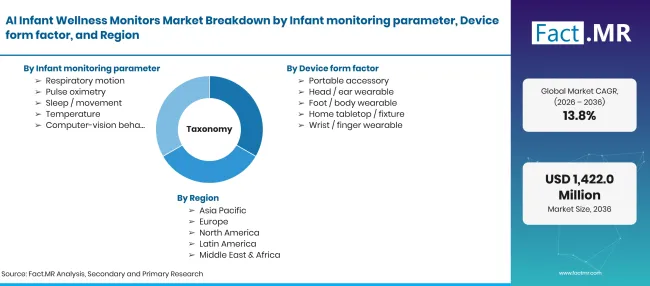
Ai Infant Wellness Monitors Taxonomy | Source: Fact.MR
| Attribute | Details |
|---|---|
| Quantitative Units | USD million |
| Market Definition | The AI Infant Wellness Monitors Market comprises connected devices and digital platforms that use cameras, wearable sensors and other monitoring technologies to collect and analyze infant wellness data. These solutions apply artificial intelligence and data processing to track selected indicators such as sleep patterns, movement, crying behavior and environmental conditions while providing caregivers with real-time updates, alerts and monitoring insights through connected applications. |
| Infant Monitoring Parameter | Respiratory Motion; Pulse Oximetry; Sleep / Movement; Temperature; Computer-Vision Behavior |
| Device Form Factor | Portable Accessory; Head / Ear Wearable; Foot / Body Wearable; Home Tabletop / Fixture; Wrist / Finger Wearable |
| Data Processing | Cloud AI; Smartphone Companion; On-device Algorithm; Clinician-linked Dashboard; Hybrid Edge-cloud |
| Sales Channel | B2B / Institutional; Retail Electronics; Pharmacy / Wellness Retail; Clinical / Professional; Brand Direct Online |
| Regions Covered | North America; Latin America; Western Europe; Eastern Europe; East Asia; South Asia & Pacific; Middle East & Africa |
| Countries Covered | USA; China; Japan; Germany; South Korea |
| Companies Profiled | Owlet Baby Care Inc.; Nanit; Philips Avent; CuboAi; Sense-U |
| Forecast Period | 2026 to 2036 |
| Approach | Market segmentation and scenario-based analysis supported by company portfolio reviews and official demographic statistics |
Source: Fact.MR analysis. Updated Nov 9, 2026
How is the market segmented?
-
By Infant Monitoring Parameter
- Respiratory Motion
- Pulse Oximetry
- Sleep / Movement
- Temperature
- Computer-Vision Behavior
-
By Device Form Factor
- Portable Accessory
- Head / Ear Wearable
- Foot / Body Wearable
- Home Tabletop / Fixture
- Wrist / Finger Wearable
-
By Data Processing
- Cloud AI
- Smartphone Companion
- On-device Algorithm
- Clinician-linked Dashboard
- Hybrid Edge-cloud
-
By Sales Channel
- B2B / Institutional
- Retail Electronics
- Pharmacy / Wellness Retail
- Clinical / Professional
- Brand Direct Online
-
By Region
- North America
- Latin America
- Western Europe
- Eastern Europe
- East Asia
- South Asia & Pacific
- Middle East & Africa
Frequently Asked Questions
How big is the AI Infant Wellness Monitors Market in 2026?
The AI infant wellness monitors market is projected to record a 13.8% CAGR over the forecast period.
Which infant monitoring parameter has the largest share?
Which device form factor leads?
Which data processing category leads?
Which sales channel has the largest share?
Which country is expected to grow fastest?
Which companies are covered?
Who worked on this report


Preview the report firsthand - request a free sample
Free SampleGet the brochure for pricing and purchase details
Download PDF