- Base Value(2025): 210.4 Mn
- Estimated Value(2026): 236.3 Mn
- Forecast Value (2036): 753.7 Mn
- CAGR (2026 - 2036): 12.3%
AI RFID Portals Market Overview, Growth Outlook, and Forecast by Fact.MR
- In 2025, the AI RFID Portals Market was valued at USD 210.4 million.
- Based on market estimates, demand for AI RFID portals is projected to grow to USD 236.3 million in 2026 and USD 753.7 million by 2036.
- The market is expected to expand at a CAGR of 12.3% during the forecast period.
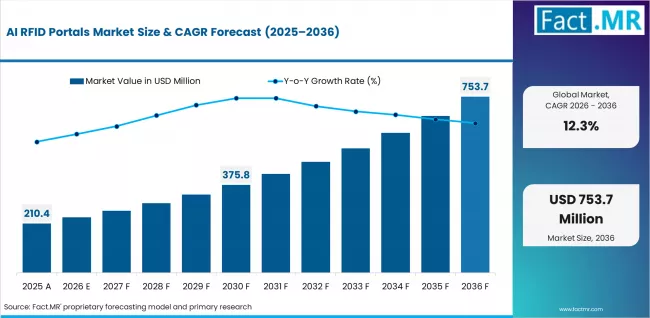
Ai Rfid Portals Market Value Analysis | Source: Fact.MR
Summary of the AI RFID Portals Market
- Market Snapshot
- In 2025, the size of the global AI RFID Portals Market was about USD 210.4 million.
- The market is expected to grow from USD 236.3 million in 2026 to an estimated USD 753.7 million by 2036.
- The AI RFID Portals Market is expected to grow at a CAGR of 12.3% during the forecast period.
- The market is expected to generate an absolute dollar opportunity of around USD 517.4 million from 2026 to 2036.
- Key growth markets during the forecast period are India (13.4% CAGR), China (13.2% CAGR), and the U.K. (13.1% CAGR), driven by rapid warehouse automation, expansion of smart logistics infrastructure, and increasing investments in AI-powered supply chain technologies.
- Demand and Growth Drivers
- The demand for real-time inventory visibility and automated asset tracking in warehouses and distribution centers are driving the market growth of AI RFID portals.
- Rising focus on warehouse automation and supply chain efficiency is leading to rapid penetration of AI-enabled RFID portal systems across the logistics and retail sectors.
- Growing development of e-commerce fulfillment networks is driving the demand for high-speed RFID tunnel systems for inbound/outbound shipment verification and parcel tracking.
- The increasing burden to mitigate human errors, inventory loss, and operational inefficiency is driving the demand of smart RFID gate infrastructure.
- Innovations in AI-based filtering, machine learning analytics, and RFID + computer vision integration are delivering better read accuracy, operational intelligence, and tracking efficiency.
- Rising investments on Industry 4.0, smart factories, connected logistics ecosystem are significantly contributing towards the growth of the market.
- Product and Segment View
- RFID Tunnel Systems account for 40.2% share in the system type segment, driven by their high-speed tracking capabilities and strong adoption across warehouse and logistics operations.
- Fixed AI RFID Portals hold 34.7% share, supported by increasing deployment in permanent inventory tracking and dock door automation infrastructure.
- Fixed Infrastructure RFID Gates account for 33.1% share in the installation type segment, owing to growing investments in automated warehouse and distribution center infrastructure.
- Integrated Conveyor-Based RFID Systems represent 28.9% share, driven by rising demand for automated parcel verification and conveyor tracking applications.
- Warehouse Inbound/Outbound Tracking contributes 24.0% share in the application segment, benefiting from increasing demand for shipment visibility and real-time goods movement monitoring.
- Geography and Competitive Outlook
- The Asia Pacific region holds a significant growth share in the AI RFID Portals Market owing to a growing number of e-commerce logistics, warehouse automation, and smart manufacturing facilities.
- Rapid growth in China and India is propelled by growing investments in intelligent supply chain solutions, automated DCs, and Industry 4.0 programs.
- North America and Europe are also substantially contributing to the growth owing to increasing adoption of AI-based inventory visibility solutions, intelligent retail automation, and sophisticated logistics tracking solutions.
- Major players in the AI RFID Portals Market are Zebra Technologies, Impinj Inc., Honeywell International Inc., SICK AG, Avery Dennison Corporation, and Checkpoint Systems.
- Analyst Opinion
- Shambhu Nath Jha, Principal Consultant at Fact.MR, says “The AI RFID Portals Market is increasingly driven by rapid warehouse automation, growing demand for real-time inventory visibility, and rising adoption of intelligent supply chain tracking systems. Market growth is being supported by increasing deployment of AI-enabled RFID portals, expansion of e-commerce logistics infrastructure, and advancements in machine learning-based analytics and RFID + computer vision integration across retail, logistics, manufacturing, and healthcare sectors.
AI RFID Portals Market — At a Glance
| Attribute | Details |
|---|---|
| Market Value 2025 | USD 210.4 Million |
| Market Value 2026 | USD 236.3 Million |
| Market Value 2036 | USD 753.7 Million |
| Absolute Dollar Opportunity | USD 517.4 Million |
| Total Growth | 218.96% |
| CAGR | 12.30% |
| Growth Multiple | 3.2x |
| Key Demand Theme | Rising demand for warehouse automation, real-time inventory visibility, AI-powered tracking systems, supply chain optimization, and smart logistics infrastructure |
| Leading System Type | RFID Tunnel Systems |
| System Type Share | 40.20% |
| Leading Installation Type | Fixed Infrastructure RFID Gates |
| Installation Type Share | 33.1% |
| Leading Technology | Passive RFID Portals |
| Technology Share | 28.9% |
| Leading Application | Warehouse Inbound/Outbound Tracking |
| Application Share | 24.0% |
| Leading End-Use Industry | E-commerce & Retail |
| End-Use Industry Share | 26.9% |
| Key Growth Regions | East Asia, South Asia & Pacific, North America |
| Key Companies | Zebra Technologies, Honeywell International Inc., Impinj Inc., SICK AG, Avery Dennison Corporation, Checkpoint Systems |
| Segmentation by System Type | RFID Tunnel Systems, Fixed AI RFID Portals, Hybrid AI RFID Systems |
| Segmentation by Installation Type | Fixed Infrastructure RFID Gates, Integrated Conveyor-Based RFID Systems, Modular Plug-and-Play RFID Portals, Retrofit RFID Portal Solutions |
| Segmentation by Technology | Passive RFID Portals, Active RFID Portals, UHF RFID Portal Systems, AI-Enabled RFID Portals, RFID + Computer Vision Integrated Systems |
| Segmentation by Application | Warehouse Inbound/Outbound Tracking, Inventory Visibility & Tracking, Dock Door Automation, Parcel & Package Verification, Cross-Docking Operations, Supply Chain Traceability, Theft & Loss Prevention Systems |
| Segmentation by End-Use Industry | E-commerce & Retail, Logistics & 3PL Warehousing, Manufacturing, Automotive & Industrial Production, Pharmaceuticals & Healthcare, Aviation & Defense Logistics, Food & Beverage Supply Chains |
| Segmentation by Region | North America, Latin America, East Asia, South Asia & Pacific, Western Europe, Eastern Europe, Middle East & Africa |
Source: Fact.MR analysis. Updated May 8, 2026
Key Growth Drivers, Constraints, and Opportunities
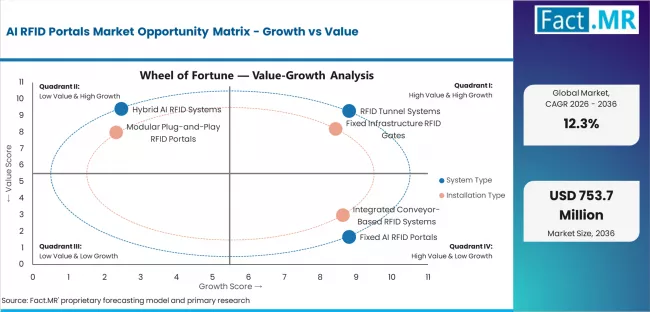
Ai Rfid Portals Market Opportunity Matrix Growth Vs Value | Source: Fact.MR
Key Factors Driving Growth
- The growing usage of intelligent warehouse management systems, smart logistics infrastructure, and real-time inventory synchronization solutions among others is bolstering demand for AI based RFID portals in retail, logistics, manufacturing, and healthcare industries.
- The need to minimize manual errors in inventory, shipment accuracy, and administrative burden is boosting adoption of AI-based RFID portal solutions.
- Increasing developments of e-commerce fulfillment centers and distribution networks are driving the demand for automated inbound/outbound tracking and parcel validation technologies.
- Higher adoption of AI analytics, machine learning based filtering processes, computer vision technologies, warehouse management systems (WMS), and other advanced technologies is fostering the innovation intelligent and connected RFID solutions.
- An increase in investments in Industry 4.0 and smart factories digital supply chain transformation, and other related programmers is also expected to significantly contribute to the growth of this market globally.
| Growth Driver | Demand Impact | Time Horizon | Key Impact Area | Fact.MR Insight |
|---|---|---|---|---|
| Rapid expansion of e-commerce fulfillment centers and warehouse automation | High | Short–Mid Term | Supply chain automation adoption | Increasing online retail volumes and automated distribution center expansion are driving strong demand for AI RFID portals for real-time inventory visibility and shipment tracking. |
| Rising focus on reducing inventory errors and improving operational efficiency | High | Short–Mid Term | Inventory accuracy & productivity optimization | Enterprises are increasingly deploying AI-enabled RFID portals to automate tracking, reduce manual scanning dependency, and improve warehouse throughput efficiency. |
| Growth in AI-integrated logistics and smart supply chain infrastructure | High | Short–Mid Term | Intelligent tracking & operational visibility | Increasing integration of machine learning analytics, ERP/WMS connectivity, and RFID-enabled automation is accelerating deployment of intelligent RFID portal systems. |
| Advancements in RFID + computer vision and edge AI technologies | Medium-High | Mid–Long Term | Technology innovation & system optimization | Integration of computer vision, anomaly detection, and edge AI processing is improving read accuracy, parcel verification, and automated workflow orchestration capabilities. |
Source: Fact.MR analysis. Updated May 8, 2026
Key Market Constraints
- The high upfront costs of deployment and the integration with the infrastructure of AI RFID portal systems may be discouraging factors for small to medium-sized businesses.
- Organizations may experience challenges in implementing the solutions owing to complex integration requirements with existing warehouse management systems (WMS), ERP systems, and industrial automation systems.
- Metals, liquids, and dense industrial environments can cause RFID signal interference and lead to read errors and potential system downtime in some applications.
- The continued maintenance, software upgrades, and reliance on a skilled workforce could add to increasing operational costs for the end users.
Key Opportunity Areas
- The boom in ecommerce Fulfillment centers, smart warehouses, and automated logistic hubs is propelling the demand for AI-enabled RFID tracking infrastructure.
- Increasing penetration of AI analytics, computer vision integration, and edge AI processing is creating new opportunities for autonomous and intelligent RFID portal solutions.
- Enhanced pressure on supply chain traceability, anti-counterfeiting and inventory security is prompting retail, pharma-based, and manufacturing-based industries to opt for sophisticated RFID monitoring solutions.
- Growing investments in Industry 4.0, connected factories, and digital supply chain transformation are expected to offer ample growth opportunities for integrated AI RFID portal solution worldwide.
Segment-wise Analysis of the AI RFID Portals Market
- RFID Tunnel Systems account for 40.2% share of the system type segment in 2026, driven by their high-speed tracking capabilities, superior read accuracy, and extensive deployment across warehouse automation and logistics operations.
- Fixed Infrastructure RFID Gates hold 33.1% share of the installation type segment in 2026, supported by growing investments in permanent smart warehouse infrastructure and automated dock door monitoring systems.
- Passive RFID Portals represent 28.9% share of the technology segment in 2026, owing to their cost-effectiveness, scalability, and widespread adoption across retail, logistics, and industrial inventory tracking applications.
The market for the AI RFID Portals is divided into system type, installation type, technology, application, end-use industry, and region.
Which System Type Segment Topped the AI RFID Portals Market?
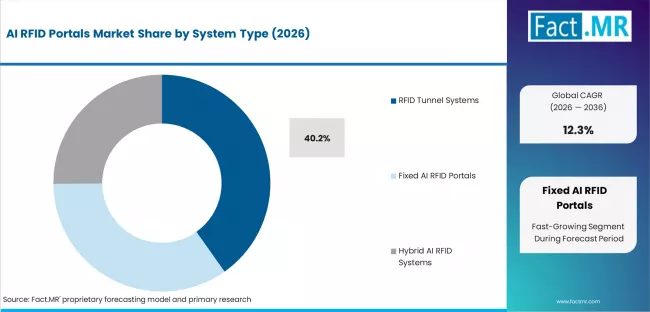
Ai Rfid Portals Market Analysis By System Type | Source: Fact.MR
The AI RFID Portals Market is forecast to be dominated by RFID Tunnel Systems by 2026, holding a 40.2% market share. Such dominance is attributed to their ability to scan at high speed with better accuracy in tracking through inventory, implementation and wide acceptance in warehouse automation, logistics and high volume order fulfillment.
Which Installation Type Segment Accounts for the Highest Share in the Market?
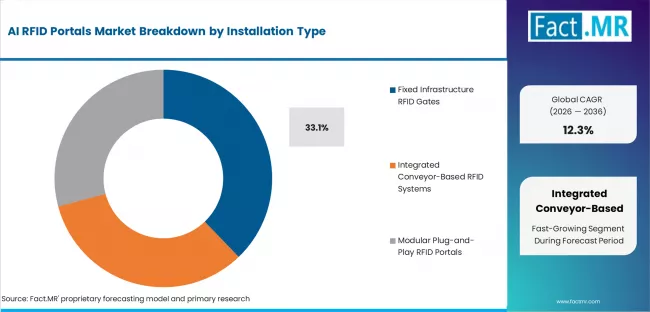
Ai Rfid Portals Market Analysis By Installation Type | Source: Fact.MR
The Fixed Infrastructure RFID Gates segment is anticipated to dominate by installation type, with a 33.1% share in 2026. This can be attributed to rising investments in the fixed warehouse automation infrastructure, dock door monitoring systems, and real time inventory tracking applications.
Which Technology Segment Leads the Market?
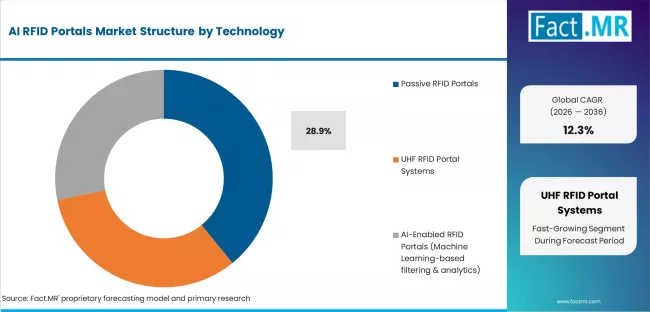
Ai Rfid Portals Market Analysis By Technology | Source: Fact.MR
Passive RFID Portals dominate the market with a 28.9% share in 2026, driven by their cost-effectiveness, scalability, and widespread implementation across retail, logistics, and industrial supply chain environments.
Which Application Segment Holds the Largest Share in the Market?
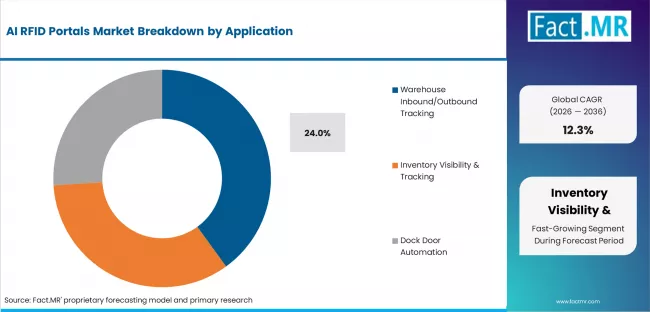
Ai Rfid Portals Market Analysis By Application | Source: Fact.MR
Warehouse Inbound/Outbound Tracking accounts for the highest share at 24.0% in 2026, supported by rising demand for automated shipment verification, real-time goods movement monitoring, and intelligent dock management solutions.
Which End-Use Industry Segment Leads the Market?
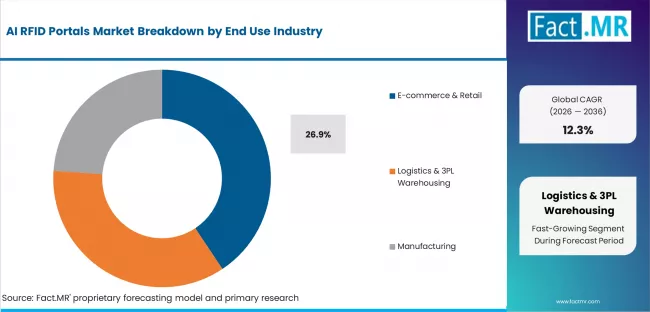
Ai Rfid Portals Market Analysis By End Use Industry | Source: Fact.MR
E-commerce & Retail is expected to be the leading end-use industry segment, accounting for 26.9% share in 2026. This is driven by rapid expansion of online fulfillment operations, increasing warehouse automation, and growing adoption of AI-enabled inventory visibility systems.
Which Region Offers Strong Growth Opportunities in the Market?
East Asia and South Asia & Pacific are expected to offer strong growth opportunities during the forecast period, supported by increasing investments in smart logistics infrastructure, warehouse automation technologies, and Industry 4.0 adoption across China, India, Japan, and Southeast Asian countries.
Regional Outlook Across Key Markets
- India is estimated to grow at 13.4%, with rapid warehouse automation, growing e-commerce fulfillment capacity, and increasing use of AI-based logistics systems.
- The U.S. growth rate is predicted as 11.7%, on the back of robust smart warehouse infrastructure, retail automation, and intelligent supply chain tracking solutions deployment.
- China is predicted to grow at 13.2%, driven by manufacturing automation, logistics digitization, and growing financial commitment in smart warehousing solutions.
- Germany is expected to expand at 12.3% due to increasing adoption of Industry 4.0, automated manufacturing plants, and smart logistic systems.
.webp "Top Country Growth Comparison Ai Rfid Portals Market Cagr (2026 2036)")
Top Country Growth Comparison Ai Rfid Portals Market Cagr (2026 2036) | Source: Fact.MR
CAGR Table
| Country | CAGR (%) |
|---|---|
| U.S. | 11.7% |
| China | 13.2% |
| Germany | 12.3% |
| India | 13.4% |
| Japan | 12.1% |
| U.K. | 13.1% |
| S. Korea | 12.5% |
Source: Fact.MR analysis. Updated May 8, 2026
Source: Fact.MR (FMR) analysis, based on proprietary forecasting model and primary research.
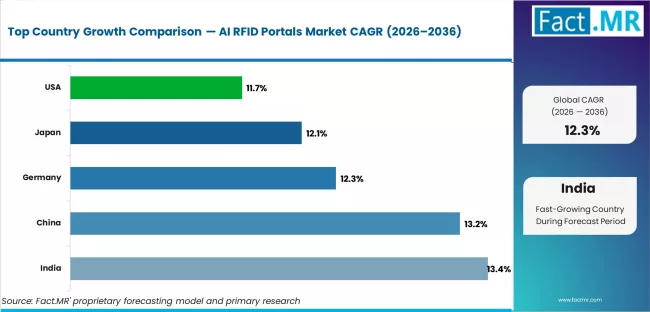
Ai Rfid Portals Market Cagr Analysis By Country | Source: Fact.MR
North America – The Intelligent Warehouse Automation Hub
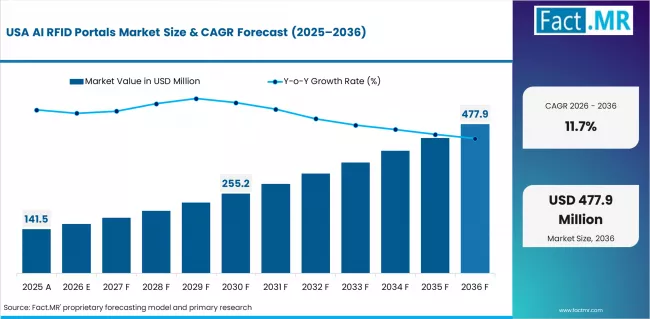
Ai Rfid Portals Market Country Value Analysis | Source: Fact.MR
North America is a technologically advanced region in the AI RFID portals market, owing to the high penetration of warehouse automation, intelligent inventory management systems, and smart logistics infrastructure. Large companies are also focusing on AI based RFID tracking and real-time inventory visibility and integrated supply chain automation solutions. The region has a focus on operational efficiency; ERP/WMS integration; and automation in fulfillment.
- U.S.: Demand for AI RFID portals in the U.S. is projected to rise at 11.7% CAGR through 2036.
Western Europe – The Industry 4.0 & Supply Chain Traceability Market
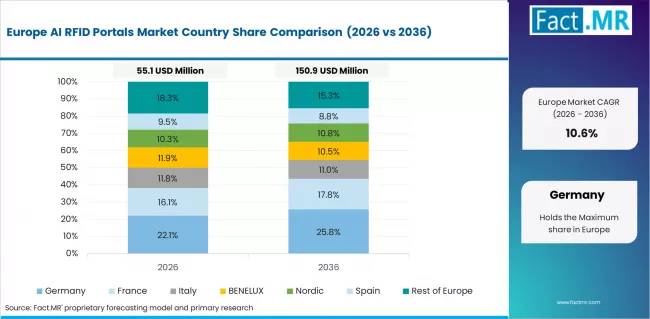
Ai Rfid Portals Market Europe Country Market Share Analysis, 2026 & 2036 | Source: Fact.MR
Western Europe is a mature market, focusing on the adoption of Industry 4.0, supply chain traceability, and intelligent manufacturing systems. A growing number of enterprises are turning to AI-enabled RFID portals to help them automate monitoring of their warehouses, track industrial and logistics operations subject to compliance requirements. The region has a strong focus on smart factory automation and visibility in operations.
- Germany: Demand for AI RFID portals in Germany is projected to rise at 12.3% CAGR through 2036.
- U.K.: Demand for AI RFID portals in the U.K. is projected to rise at 13.1% CAGR through 2036.
East Asia – The Smart Manufacturing & Logistics Automation Powerhouse
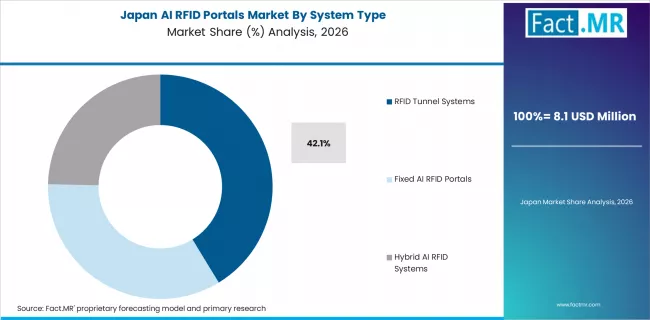
Ai Rfid Portals Market Japan Market Share Analysis By System Type | Source: Fact.MR
East Asia is a major hub for smart manufacturing, industrial automation, and intelligent logistics infrastructure. Rapid expansion of e-commerce fulfillment networks, robotics integration, and AI-driven warehouse systems is accelerating deployment of AI RFID portals across the region. Companies are investing heavily in automated tracking technologies and smart supply chain ecosystems.
- China: Demand for AI RFID portals in China is projected to rise at 13.2% CAGR through 2036.
- Japan: Demand for AI RFID portals in Japan is projected to rise at 12.1% CAGR through 2036.
- South Korea: Demand for AI RFID portals in South Korea is projected to rise at 12.5% CAGR through 2036.
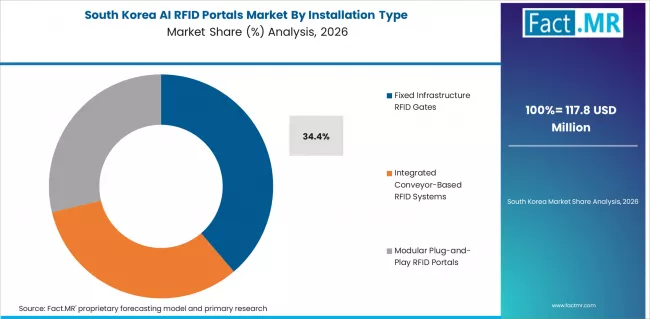
Ai Rfid Portals Market South Korea Market Share Analysis By Installation Type | Source: Fact.MR
South Asia & Pacific – The Fastest-Growing Smart Logistics Market
South Asia & Pacific is emerging as the fastest-growing regional market due to rapid warehouse automation, expanding e-commerce infrastructure, and increasing adoption of AI-powered inventory visibility systems. Global and regional technology providers are strengthening deployment capabilities to support growing demand for intelligent logistics and fulfillment automation solutions.
- India: Demand for AI RFID portals in India is projected to rise at 13.4% CAGR through 2036.
Latin America – The Emerging Warehouse Digitization Market
Latin America represents a developing AI RFID portals market supported by increasing investments in retail logistics modernization, warehouse digitization, and automated inventory tracking systems. Companies are expanding regional partnerships and supply chain automation capabilities to strengthen operational efficiency across emerging economies.
- Brazil: Demand for AI RFID portals in Brazil is projected to witness steady growth through 2036, supported by increasing logistics automation investments.
Middle East & Africa – The Expanding Smart Infrastructure Region
The Middle East & Africa is an emerging market benefiting from rising investments in logistics infrastructure, industrial automation, and smart warehousing technologies. Expansion of distribution centers and modernization of supply chain operations are creating new opportunities for AI-enabled RFID tracking and intelligent inventory management systems.
- KSA: Demand for AI RFID portals in KSA is projected to experience stable growth through 2036, driven by increasing smart logistics and industrial development initiatives.
Fact.MR’s analysis of the AI RFID Portals Market provides a comprehensive regional outlook covering North America, Western Europe, East Asia, South Asia & Pacific, Latin America, and Middle East & Africa. Readers can access country-wise insights, warehouse automation trends, supply chain digitization patterns, and AI-enabled RFID adoption dynamics shaping both mature and emerging industrial markets.
Competitive Benchmarking and Company Positioning
Leading Companies Shaping the AI RFID Portals Market
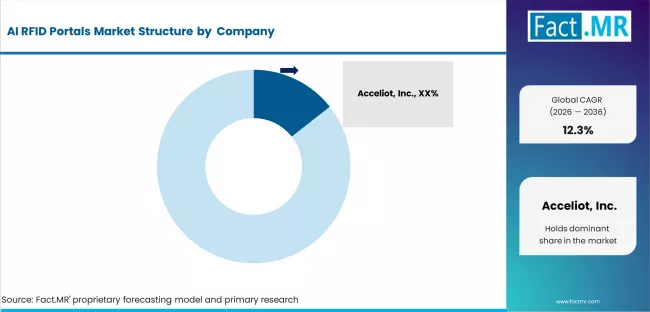
Ai Rfid Portals Market Analysis By Company | Source: Fact.MR
The global AI RFID portals market is characterized as having a medium level of market concentration, which with key players like Zebra Technologies, Impinj Inc., Honeywell International Inc., Avery Dennison Corporation, SICK AG,Check Point system, amongst others holding a significant share. Competition is based on inventory tracking precision, AI-driven analytics, system scalability, and integration with WAH (warehouse automation) and ERP/WMS SaaS models. Top vendors have significant investment in RFID network infrastructure, Real-time Inventory visibility, and intelligent supply chain automation solutions across retail, logistics, manufacturing, and healthcare. Regional and specialist players compete through tailored deployment options and vertical-specific solutions, while low-cost RFID portal systems for medium-sized warehouse and industrial environments are also available. Sourcing Enterprise buyers are increasingly opting for multi-vendor sourcing to enhance their operational flexibility and mitigate risk of dependency.
Recent Industry Developments
- Acceliot Introduces Smart Space Portal for AI-Powered Warehouse Automation (2025)
- Acceliot introduced the Smart Space Portal, an AI-powered RFID portal platform designed to improve warehouse automation, dock door intelligence, and real-time inventory visibility. The solution integrates AI analytics, RFID infrastructure, and intelligent workflow orchestration to enhance shipment verification, asset tracking, and operational efficiency across logistics and fulfillment environments.
- Zebra Technologies Showcases Intelligent Automation Solutions for Smart Logistics Operations (2025)
- Zebra Technologies showcased advanced intelligent automation solutions at Automate 2025, featuring AI-enabled RFID systems, machine vision technologies, and warehouse automation platforms. The showcased solutions are designed to improve inventory visibility, automated tracking accuracy, and operational efficiency across manufacturing, logistics, and distribution center operations.
- FineLine & Zebra Technologies Partner to Expand RFID-Enabled Fulfillment Automation Solutions (2025)
- FineLine Technologies partnered with Zebra Technologies to showcase RFID-enabled shipment tracking, inventory visibility, and fulfillment automation solutions at ProMat 2025. The collaboration focuses on improving warehouse efficiency, automated parcel verification, and intelligent logistics tracking across retail and distribution operations.
- Impinj Highlights Next-Generation RAIN RFID Solutions for Smart Retail and Logistics (2025)
- Impinj showcased advanced RAIN RFID solutions during NRF 2025 focused on inventory visibility, intelligent retail operations, and logistics automation. The technologies support AI-enabled RFID ecosystems designed to improve tracking accuracy, supply chain transparency, and automated warehouse management capabilities.
- Honeywell Evaluates Strategic Alternatives for Warehouse Workflow and Automation Business (2025)
- Honeywell announced evaluation of strategic alternatives for its Productivity Solutions and Services and Warehouse and Workflow Solutions businesses. The move is aimed at strengthening the company’s focus on warehouse automation, intelligent workflow technologies, and RFID-enabled logistics infrastructure supporting industrial automation and supply chain optimization.
- Qualcomm Launches Enterprise Mobile Processor with Integrated RFID Capabilities (2025)
- Qualcomm launched the world’s first enterprise mobile processor with fully integrated RFID capabilities, designed for logistics, warehouse automation, retail tracking, and industrial inventory management applications. The processor enhances edge AI processing, real-time RFID tracking, and intelligent enterprise mobility solutions across connected supply chain environments.
Leading Companies Shaping the AI RFID Portals Market
- Acceliot, Inc.
- Zebra Technologies
- RF KonSys AI Gate
- Cykeo Information Technology Co.
- Seshaasai
Sources and Research References
- [1] Acceliot, “Acceliot Introduces Smart Space Portal for AI-Powered Warehouse Automation”, October 2025
- [2] Zebra Technologies, “Zebra Technologies Showcases New Intelligent Automation Solutions at Automate 2025”, May 2025
- [3] FineLine Technologies, “FineLine & Zebra Technologies Partner to Showcase RFID Solutions at ProMat 2025”, March 2025
- [4] Impinj, “RAIN RFID at NRF 2025: Discover Cutting-Edge Solutions with Impinj”, January 2025
- [5] Honeywell, “Honeywell To Evaluate Strategic Alternatives For Productivity Solutions And Services And Warehouse And Workflow Solutions Businesses”, July 2025
- [6] Qualcomm, “Qualcomm Launches World’s First Enterprise Mobile Processor with Fully Integrated RFID Capabilities”, August 2025
AI RFID Portals Market Definition
The AI RFID Portals Market includes a smart RFID based gateway solution that allows to track, monitor and authenticate the tagged products, assets, pallets, and shipments all over the warehouses, logistics facilities, retail stores and industrial environments. These solutions integrate RFID readers and antennas with AI analytics and in some cases computer vision technology, to provide real-time inventory visibility, automated loading dock door monitoring, package verification, and supply chain transparency. AI RFID portals find their applications in e-commerce & retail, logistics & 3PL warehousing, manufacturing, automotive & industrial production, pharmaceuticals & healthcare, aviation & defense logistics, and food & beverage supply chain management.
AI RFID Portals Market Inclusions
This report includes its assessment on global and regional AI RFID Portals Market size for the period 2026–2036. The study provides an analysis of the market based on system type, installation type, technology, application, and end-use industry. Moreover, the report includes pricing analysis, growth trends, future outlook, emerging trends in warehouse automation and intelligent supply chain tracking and competitive analysis of the best AI RFID portal provider in retail, logistics, manufacturing, healthcare and industrial sectors.
AI RFID Portals Market Exclusions
This does not cover standalone RFID tags, handheld RFID readers, barcode scanners, GPS tracking solutions or general warehouse management systems that don’t have a direct integration with the AI RFID portal infrastructure. It also does not include traditional non-AI RFID gates, passive inventory labelling systems, or general industrial automation platforms that lack portal based tracking. Unless they pertain directly to the deployment and operation of the AI RFID portal, 3rd party consulting, custom software integration services, and unrelated IoT monitoring systems are not within scope.
AI RFID Portals Market Research Methodology
- Primary Research
- In order to capture the live demand trends and technology adoption dynamics, we conducted interviews with the manufacturers of AI RFID portals, the providers of RFID technology, the warehouse automation companies, the logistics providers, the retail supply-chain managers, and the industrial automation experts in the main end-use industries.
- Desk Research
- The size of the market, including industry trends and the competitive environment were confirmed by reviews of company 10-K reports, presentations to investors, RFID industry reports, trade association information, supply chain automation reports, and information on publicly accessible smart warehouse infrastructure.
- Market-Sizing and Forecasting
- An estimation and forecast of the market metrics was determined through a hybrid approach using bottom-up processes (company revenues, RFID portal deployments, pricing analysis, and technology adoption rates) and top-down processes (warehouse-use automation spending, logistics infrastructure growth, and regional supply chain digitization trends).
- Data Validation and Update Cycle
- All market estimates and forecasts have been arrived at through the process of data triangulation, where primary and secondary research has been supplemented with expert interviews. The data was periodically updated with industry advancement, progress in AI and RFID technologies, automation investment trends and with macroeconomic indicators relevant to the logistics, retail, and industrial automation sectors.
Segmentation
Scope of Analysis
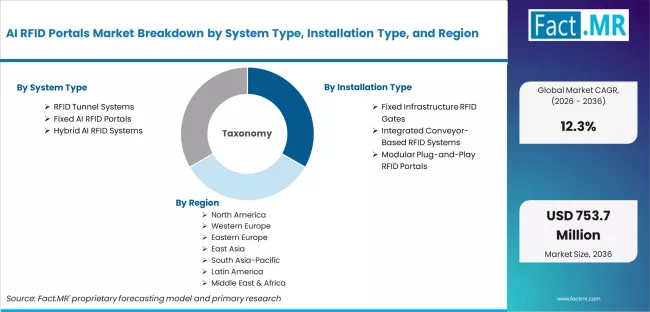
Ai Rfid Portals Market Breakdown By System Type, Installation Type, And Region | Source: Fact.MR
Parameter |
Details |
|---|---|
| Quantitative Units | USD 210.4 Million (2025) to USD 753.7 Million (2036), at a CAGR of 12.3% |
| Market Definition | The AI RFID Portals Market covers intelligent RFID-based portal systems designed for automated inventory tracking, shipment verification, asset monitoring, and supply chain visibility across warehouses, logistics facilities, retail stores, manufacturing plants, and industrial environments. These systems integrate RFID readers, AI analytics, machine learning-based filtering, computer vision technologies, edge AI processing, and ERP/WMS connectivity to support real-time tracking, warehouse automation, dock door monitoring, and intelligent logistics operations. |
| Regions Covered | North America, Eastern Europe, Western Europe, East Asia, South Asia Pacific, Latin America, Middle East & Africa |
| Countries Covered | USA, Canada, UK, Germany, China, Japan, India, South Korea, Brazil, Saudi Arabia, UAE, and 20+ countries |
| Key Companies | Zebra Technologies, Impinj Inc., Honeywell International Inc., Avery Dennison Corporation, SICK AG, Checkpoint Systems |
| Forecast Period | 2026 to 2036 |
| Approach | Hybrid demand-side and top-down methodology based on growth in warehouse automation, e-commerce fulfillment infrastructure, intelligent logistics systems, supply chain digitization, and adoption of AI-enabled inventory visibility solutions, validated through primary interviews with RFID portal manufacturers, warehouse automation providers, logistics operators, retail supply chain companies, industrial automation firms, and AI technology solution providers across key regions. |
Source: Fact.MR analysis. Updated May 8, 2026
Analysis by System Type, Installation Type, Technology, Application, End-Use Industry, and Region
-
AI RFID Portals Market by System Type
- Fixed AI RFID Portals
- Dock Door RFID Gates
- Warehouse Entry/Exit Gates
- RFID Tunnel Systems
- Conveyor-based RFID Tunnels
- High-speed Parcel Scanning Tunnels
- Hybrid AI RFID Systems
- RFID + Computer Vision Gates
- AI-enabled Smart Tracking Portals
- Fixed AI RFID Portals
-
AI RFID Portals Market by Technology
- Passive RFID Portals
- Active RFID Portals
- UHF RFID Portal Systems
- AI-Enabled RFID Portals
- RFID + Computer Vision Integrated Systems
-
AI RFID Portals Market by Application
- Warehouse Inbound/Outbound Tracking
- Dock Door Automation
- Inventory Visibility & Tracking
- Parcel & Package Verification
- Cross-Docking Operations
- Theft & Loss Prevention Systems
- Supply Chain Traceability
-
AI RFID Portals Market by End-Use Industry
- E-commerce & Retail
- Logistics & 3PL Warehousing
- Manufacturing
- Automotive & Industrial Production
- Pharmaceuticals & Healthcare
- Aviation & Defense Logistics
- Food & Beverage Supply Chains
-
AI RFID Portals Market by Installation Type
- Fixed Infrastructure RFID Gates
- Modular Plug-and-Play RFID Portals
- Integrated Conveyor-Based RFID Systems
- Retrofit RFID Portal Solutions
-
AI RFID Portals Market by Region
-
North America
- USA
- Canada
- Mexico
- Latin America
- Brazil
- Chile
- Rest of LATAM
- East Asia
- China
- Japan
- South Korea
- Taiwan
- South Asia & Pacific
- India
- Singapore
- Australia
- ASEAN
- Western Europe
- Germany
- France
- U.K.
- Italy
- Spain
- BENELUX
- Nordic
- Rest of Western Europe
- Eastern Europe
- Poland
- Hungary
- Czech Republic
- Balkan & Baltics
- Rest of Eastern Europe
- Middle East and Africa
- Kingdom of Saudi Arabia
- United Arab Emirates
- South Africa
- Rest of Middle East and Africa
-
Frequently Asked Questions
How large is the demand for AI RFID Portals in the global market in 2025?
What will be the market size of AI RFID Portals in the global market by 2036?
What is the expected demand growth for AI RFID Portals in the global market between 2026 and 2036?
Which system type segment is expected to dominate the market?
How significant is the growth outlook for India in this market?
Which company is identified as a leading player in the AI RFID Portals Market?
Who worked on this report


Preview the report firsthand - request a free sample
Free SampleGet the brochure for pricing and purchase details
Download PDF