AI Kiosk Market Size, Share, Growth and Forecast (2026 - 2036)

The AI Kiosk Market is segmented by Offerings, Kiosk Type, Interaction Mode, Display Size, Application, Installation Type, End-Use Industry, and Region. Forecast for 2026 to 2036.

Fact.MR is of the opinion that the long-term competitive advantage in the AI kiosks market will shift from hardware manufacturing toward ownership of the AI interaction layer, where conversational intelligence, real-time analytics, and personalized customer engagement capabilities will become the primary drivers of enterprise value creation.

AI Kiosk Market Forecast and Outlook by Fact.MR

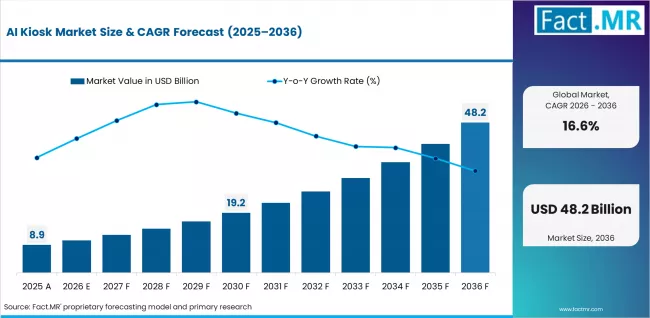
  • In 2025, the AI kiosks market was valued at USD 8.9 billion. Based on Fact.MR' analysis, demand for AI kiosks is estimated to grow to USD 10.4 billion in 2026 and USD 48.2 billion by 2036.
  • Fact.MR projects a CAGR of 16.6% during the forecast period.
Ai Kiosk Market  Value Analysis

The AI kiosks market is projected to create an absolute dollar opportunity of USD 37.8 billion between 2026 and 2036. This represents a transformational growth trajectory rather than incremental expansion, driven by accelerating enterprise investments in conversational AI, retail automation, smart customer engagement platforms, and edge AI infrastructure. Growth momentum is expected to remain strong due to increasing labor optimization needs and digital transformation initiatives, although factors such as high deployment costs, cybersecurity compliance requirements, AI integration complexity, and data privacy regulations may moderate adoption across certain industries and regions.

Summary of the AI Kiosk Market

  • Market Snapshot
    • Global AI kiosks market revenue stood at USD 10.4 billion in 2026 and is forecast to reach USD 48.2 billion by 2036.
    • At a 16.6% CAGR from 2026 to 2036, this market is set to expand ~4.63x in value, adding USD 37.8 billion in absolute opportunity.
    • Growth is being driven by increasing adoption of AI-powered self-service systems across retail, hospitality, healthcare, and transportation sectors.
    • Rising demand for automated customer engagement and operational efficiency is reinforcing deployment of AI-enabled kiosks.
    • Integration of computer vision, natural language processing, and intelligent analytics is accelerating kiosk modernization initiatives.
  • Demand and Growth Drivers
    • Increasing adoption of self-service and contactless interaction technologies
    • Rising demand for AI-driven customer engagement solutions
    • Expansion of digital transformation initiatives across retail and service industries
    • Growing deployment of intelligent kiosks for operational automation
    • Need for solutions that provide:
      • Automated customer interaction
      • Faster service and transaction processing
      • Real-time analytics and personalization
      • Enhanced operational efficiency
  • Product and Segment View
    • Hardware holds 62% of component share in 2026, emerging as the leading segment.
    • Touch-based interaction systems account for 46% of interaction system share in 2026, positioning them as the dominant segment.
    • 20–32 inches display size kiosks represent 41% of display size share in 2026, reflecting primary deployment preference.
    • Automated ordering applications hold 24% of application share in 2026, indicating leading adoption concentration.
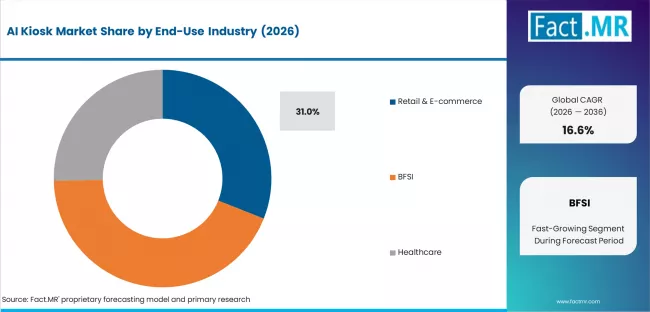
    • Retail & e-commerce account for 31% of end-use industry share in 2026, supported by increasing deployment of self-service retail technologies.
  • Geography and Competitive Outlook
    • Growth is supported across North America, Europe, Asia Pacific
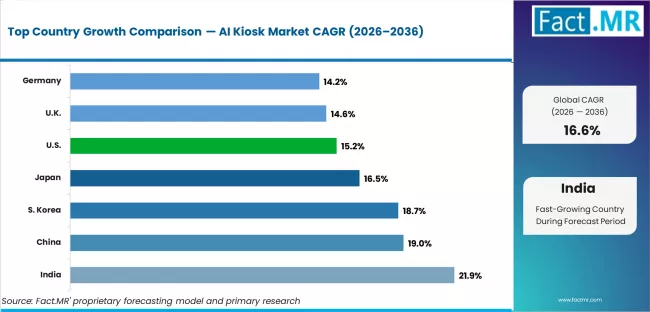
    • Key growth markets and CAGR: U.S. 15.2%, China 19.0%, Germany 14.2%, U.K. 14.6%, Japan 16.5%, S. Korea 18.7%, India 21.9%
    • Market expansion is closely tied to:
      • Increasing deployment of AI-driven self-service systems
      • Expansion of digital retail and smart customer engagement solutions
      • Rising investment in automation and intelligent interface technologies
    • Key companies active in this market include: NCR Corporation, Diebold Nixdorf, Kiosk Information Systems, Fujitsu, Advantech, Meridian Kiosks, Samsung Electronics, and others
  • Analyst Opinion
    • Shambhu Nath Jha, Principal Consultant at Fact.MR, opines, ‘Leaders at CXOs level would realize that in the future, competitive edge within the AI kiosks market will be more about owning AI-powered customer engagement solutions rather than deploying hardware.

AI Kiosks Market — At a Glance

Attribute Details
Market Value 2026 USD 10.4 billion
Market Value 2036 USD 48.2 billion
Absolute Dollar Opportunity 2026–2036 USD 37.8 billion
Total Growth 2026–2036 363.46%
CAGR 2026–2036 16.6%
Growth Multiple ~4.63x
Key Demand Theme Increasing adoption of AI-powered self-service and customer interaction systems
Leading Segment by Offerings (2026) Hardware
Segment Share (2026) 62%
Leading Segment by Interaction System (2026) Touch-Based Interaction Systems
Segment Share (2026) 46%
Leading Segment by Display Size (2026) 20–32 Inches
Segment Share (2026) 41%
Leading Segment by Application (2026) Automated Ordering Applications
Segment Share (2026) 24%
Leading Segment by End-Use Industry (2026) Retail & E-commerce
Segment Share (2026) 31%
Key Growth Regions North America, Europe, Asia Pacific
Country CAGRs U.S. 15.2%, China 19.0%, Germany 14.2%, U.K. 14.6%, Japan 16.5%, S. Korea 18.7%, India 21.9%
Top Companies NCR Corporation, Diebold Nixdorf, Kiosk Information Systems, Fujitsu, Advantech, Meridian Kiosks, Samsung Electronics, and others
Segmentation by Offerings Hardware, Software, Services
Segmentation by Kiosk Type Self-Service Kiosks, Information Kiosks, Ticketing Kiosks, Payment Kiosks, Wayfinding Kiosks, Check-in / Check-out Kiosks, and others
Segmentation by Interaction Mode Touch-Based Interaction Systems, Voice-Based Systems, Gesture Recognition Systems, Hybrid Systems
Segmentation by Display Size Below 20 Inches, 20–32 Inches, Above 32 Inches
Segmentation by Application Automated Ordering Applications, Ticketing & Check-In, Information & Navigation, Payment & Banking, Healthcare Assistance, Others
Segmentation by End-Use Industry Retail & E-commerce, Hospitality, Healthcare, BFSI, Transportation, Government, Others
Segmentation by Region North America, Latin America, Europe, Asia Pacific, Middle East & Africa

Drivers, Restraints, and Opportunities
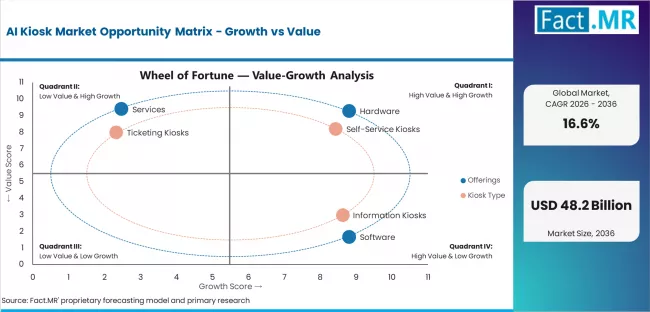
Ai Kiosk Market Opportunity Matrix Growth Vs Value

According to Fact.MR analysts, the AI kiosks market is in a stage where it is witnessing rapid growth, transitioning from being part of conventional self-service systems to become intelligent systems based on AI technology that helps in interacting with customers through their interface. Market size has been possible for today because of the increasing adoption of retail automation, labor efficiency measures, digital payments systems, and customer experience transformation among enterprises. Traditionally, the adoption had been limited to transaction-based kiosks, however, the development in conversational AI, computer vision, and edge computing has resulted in fast adoption within retail, banking, healthcare, airport, and smart city spaces.

The AI Kiosk market is currently experiencing a transition from traditional rule-based self-service kiosks to more advanced systems using artificial intelligence software that can engage in conversation, analyze in real-time, and assist customers in a more personalized way. The demand for simple information and transactional kiosks is now decreasing in developed regions as businesses seek solutions that provide tangible returns on investment and improve customer experience. Growth in the market is now expected to be driven by generative AI kiosks, biometric kiosks, and edge AI solutions.

This transformation is also impacting pricing dynamics. Intelligent AI kiosks cost more, on average, owing to the incorporation of AI processing, computer vision technology, cloud computing, and software-as-a-service solutions. Despite having lower deployment rates compared to conventional kiosks, increased software revenue and service-based income streams have led to a massive boost in market value gains.

  • Conversational Automation: With labor costs increasing and the need for efficiency becoming more critical in retail, hospitality, and transportation, companies are shifting from traditional self-service terminals to AI-powered conversational kiosks that support multilingual capabilities, personalized recommendations, and immediate assistance to customers.
  • Regulatory AI Governance: The new AI regulations and laws, such as the EU AI Act and GDPR, have a considerable impact on the deployment of kiosks that employ facial recognition, behavioral analysis, and biometric verification features. Vendors in the AI industry are now paying special attention to edge computing, cyber security, and data consent management.
  • Asia-Pacific Expansion: East Asia and South Asia & Pacific are two of the fastest-growing regions in the market due to the rapid development of digital infrastructure, smart retail solutions, and public sector automation projects in China, India, Japan, and other countries in the region. The high rate of urbanization and the increasing popularity of digital payments contribute to the penetration of AI kiosks.

Segmental Analysis

AI Kiosk Market Analysis by Offerings
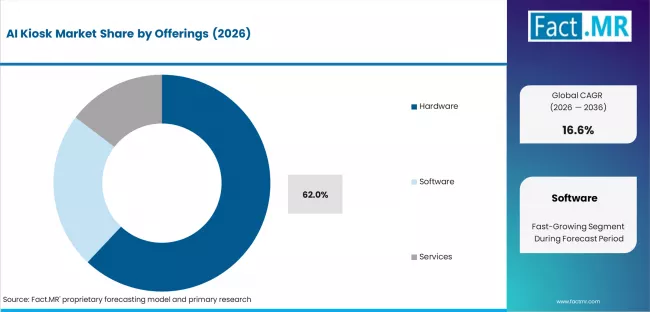
Ai Kiosk Market Analysis By Offerings

According to the AI kiosks market report by Fact.MR, the hardware consumption share for 2026 is predicted at 62%. The importance of hardware is still significant since it involves huge investment in interactive display screens, artificial intelligence processor, biometric technology, cameras, payment system, and edge computing solution. Organizations are increasingly emphasizing hardware upgrades for real-time AI operation, high-quality customer engagement, and robustness during installation across several industries such as retail, financial institutions, healthcare, and transportation sectors.

AI Kiosk Market Analysis by Kiosk Type
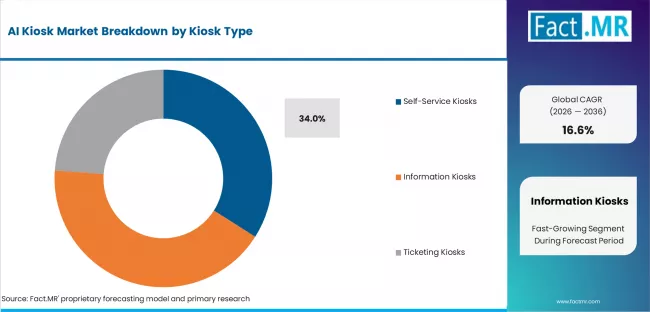
Ai Kiosk Market Analysis By Kiosk Type

The usage of self-service kiosks in terms of AI kiosks market share is expected to account for 34% in 2026 according to the report by Fact.MR. Self-service kiosks are currently leading the market because of their extensive use in retail stores, fast food chains, banks, airports, and hospitals for activities like placing orders, making payments, check-ins, and customer services. The use of kiosks enables companies to automate operations without having to rely too much on human labor.

AI Kiosk Market Analysis by Interaction Mode
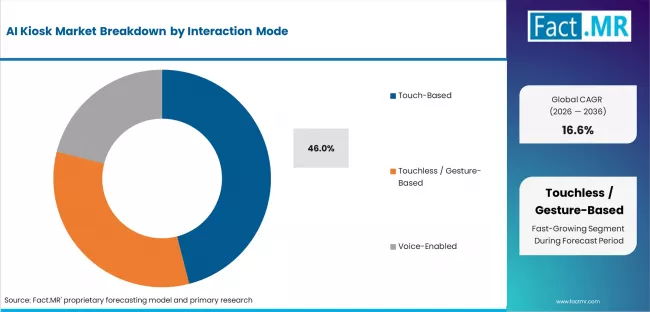
Ai Kiosk Market Analysis By Interaction Mode

According to the Fact.MR report on the AI kiosks market, it is predicted that usage of touch interaction systems will contribute 46% share in 2026. The preference for touch kiosks remains significant because of their already installed base, ease of implementation, and user-friendliness in sectors like retail, banking, transport, and hospitality. While there has been a growing interest in contactless and speech kiosks, touch kiosks remain more favorable for high-frequency transactional purposes owing to cost-effectiveness and efficiency of use.

AI Kiosk Market Analysis by Display Size
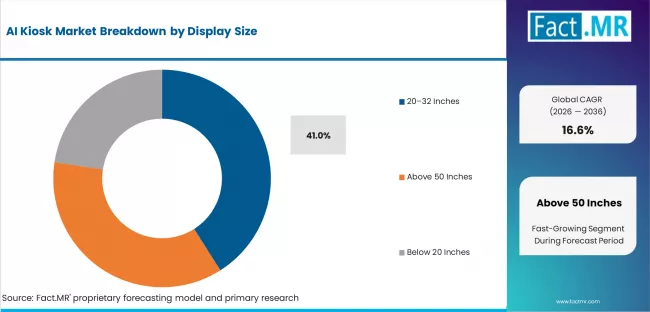
Ai Kiosk Market Analysis By Display Size

According to the Fact.MR research findings, usage of AI kiosks with 20–32 inches screen sizes will account for 41% of the total market in 2026. Such kiosks are dominant since they have the right combination of visibility, space optimization, and installation cost. The choice of mid-size screens by companies stems from their ability to facilitate interactive features including artificial intelligence, digital payments, and customer engagement applications despite being installed as either wall-mounted or stand-alone machines.

AI Kiosk Market Analysis by Application
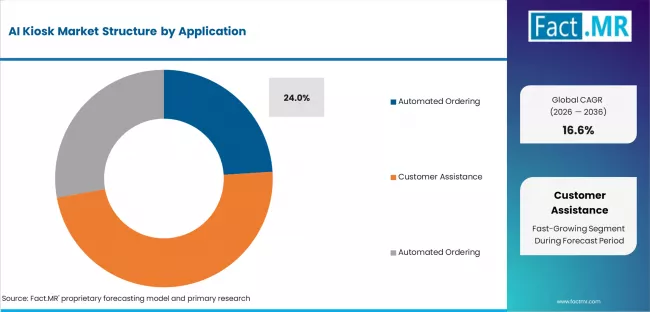
Ai Kiosk Market Analysis By Application

The Fact.MR's AI kiosks market report states that the use of automated ordering systems is expected to take up to 24% of the market by 2026. Automated ordering continues to be the major segment among AI applications owing to its extensive adoption in quick service restaurants, retail stores, and the hospitality industry. The usage of AI ordering kiosks helps in speeding up the transaction process and also assists in optimizing labor productivity.

AI Kiosk Market Analysis by End-Use Industry
Ai Kiosk Market Analysis By End Use Industry

As per the AI kiosks market report by Fact.MR, the share of consumption in retail & e-commerce will be accounted for 31% by 2026. This segment is highly dominant owing to fast adoption of self-checkout machines, AI order kiosks, personal advertising software, and customer engagement devices in supermarkets, quick-service restaurants, and shopping complexes. The reason behind dominance of this end-user category lies in its huge transaction volume, positive return-on-investment from automation, and rising need for seamless omnichannel customer interactions.

Regional Analysis

Geographies included in this report include North America, Latin America, Western Europe, Eastern Europe, East Asia, South Asia & Pacific, and Middle East & Africa. Regional analysis will focus on assessing demands from various countries, usage of AI by businesses, existing infrastructure for AI deployment, and industry-specific growth prospects. The complete report will also cover regional attractiveness analysis.

Top Country Growth Comparison Ai Kiosk Market Cagr (2026 2036)

Country CAGR
U.S. 15.2%
China 19.0%
Germany 14.2%
U.K. 14.6%
Japan 16.5%
S. Korea 18.7%
India 21.9%

Source: Fact.MR (Fact.MR) analysis, based on proprietary forecasting model and primary research
Ai Kiosk Market Cagr Analysis By Country

North America AI Kiosk Market

The continent is referred to as “the innovation hub of intelligent self-service automation worldwide” in the AI kiosks market, with enterprise-wide artificial intelligence adoption, superior technological digital environment, and use of customer engagement technologies being the key reasons behind that. The company NCR Voyix has a robust competitive edge because of its widespread self-service ecosystem within the retail and hospitality sectors, while KIOSK Information Systems offers custom solutions in kiosk manufacturing. The company Diebold Nixdorf continues to be influential in banking and retail automated solutions.

  • U.S.: Demand for AI kiosks in the U.S. is projected to rise at 15.2% CAGR through 2036. Growth is being driven by expanding deployment of biometric and AI-enabled self-service systems across airports, retail chains, healthcare facilities, and public sector infrastructure. The Transportation Security Administration (TSA) accelerated biometric screening and digital identity verification initiatives through multiple airport deployments and innovation programs between March 2024 and January 2025, strengthening adoption of intelligent kiosk systems in transportation security environments. In addition, the U.S. Department of Homeland Security released its AI roadmap in March 2024 to expand AI-enabled operational technologies across public infrastructure and transportation ecosystems, further supporting long-term enterprise investments in AI-enabled self-service platforms.
  • Canada: Market expansion is being supported by federal digital modernization programs, public sector AI adoption initiatives, and growing investment in secure automated citizen service delivery systems. The Treasury Board of Canada launched the country’s first Artificial Intelligence Strategy for the Federal Public Service in March 2025, following AI-focused consultations and funding commitments announced in September 2024, encouraging wider deployment of AI-enabled service automation infrastructure.

Europe AI Kiosk Market
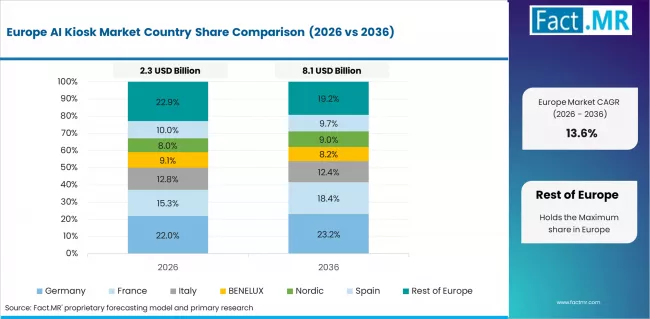
Ai Kiosk Market Europe Country Market Share Analysis, 2026 & 2036

The region of Europe acts as the “benchmark for global regulation of responsible AI-enabled automation” in the AI kiosks industry, based on their strict data privacy regulations, development of smart cities, and digital infrastructure projects. Diebold Nixdorf continues to retain a formidable market position by offering intelligent banking and retail automation services in key regions of Europe. Pyramid Computer GmbH is known for its ability to manufacture customized self-service and quick service restaurant kiosks. Glory Global Solutions also enjoys a powerful market position in retail and financial automation systems that utilize AI for cash management and payments.

  • Germany: Demand for AI kiosks in Germany is projected to rise at 14.2% CAGR through 2036, driven by strong industrial automation capabilities, smart retail transformation, and increasing deployment of intelligent self-service systems across transportation and public infrastructure environments. Enterprises are increasingly investing in AI-enabled customer interaction technologies to improve operational efficiency and digital service delivery.
  • U.K.: AI kiosk demand in the U.K. is expected to grow at 14.6% CAGR through 2036 due to rising adoption of contactless customer engagement technologies across retail, hospitality, banking, and transportation sectors. Growing enterprise focus on automation, digital payments, and customer experience enhancement continues to support widespread deployment of AI-powered self-service platforms.
  • France: Demand for AI kiosks in France is supported by smart city initiatives, digital modernization programs, and increasing adoption of intelligent retail and transportation infrastructure. Businesses are increasingly leveraging AI-enabled kiosks to optimize customer interaction, reduce service delays, and strengthen automated service delivery capabilities.

East Asia AI Kiosk Market
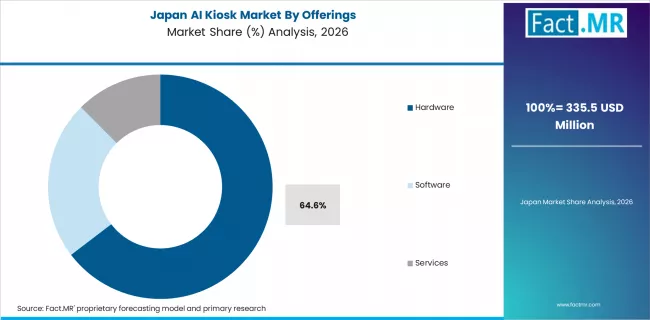
Ai Kiosk Market Japan Market Share Analysis By Offerings

The region of East Asia acts as the “scale-up center for global intelligent retail and smart infrastructure automation” within the market of AI kiosks, thanks to high digital adoption, developed electronics manufacturing ecosystems, and substantial investments made into smart commerce. The firm of Fujitsu Limited enjoys a robust market position due to the deployment of AI-enabled retail and transportation kiosks. On the other hand, Samsung Electronics uses its technological capabilities to promote smart commerce ecosystems in order to increase the use of interactive kiosks. Hyosung TNS enjoys a robust market position through intelligent banking kiosks.

  • China: Demand for AI kiosks in China is projected to rise at 19.0% CAGR through 2036, driven by large-scale smart retail expansion, rapid digital payment adoption, and aggressive investments in AI-enabled public infrastructure. The country’s strong electronics manufacturing ecosystem and smart city initiatives continue to accelerate deployment of intelligent self-service platforms across transportation, retail, and urban commercial environments.
  • Japan: AI kiosk demand in Japan is expected to grow at 16.5% CAGR through 2036 due to rising labor shortages, aging demographics, and strong enterprise focus on service automation. Retailers, transportation operators, and hospitality providers are increasingly deploying AI-powered kiosks to improve operational efficiency, multilingual customer support, and contactless service delivery.
  • South Korea: Demand for AI kiosks in South Korea is forecast to expand at 18.7% CAGR through 2036, supported by advanced digital infrastructure, widespread cashless payment adoption, and strong consumer acceptance of automated technologies. High deployment rates across quick-service restaurants, smart retail stores, and transportation hubs continue to strengthen the country’s position in intelligent self-service automation.

Fact.MR's analysis of the AI kiosks market consists of country-wise assessment across North America, Latin America, Europe, East Asia, South Asia & Pacific, and the Middle East & Africa. Readers can find detailed insights on regional demand trends, AI adoption patterns, industry-specific deployment opportunities, competitive benchmarking, pricing dynamics, regulatory developments, and long-term growth outlook across major global markets.

Competitive Benchmarking and Company Positioning
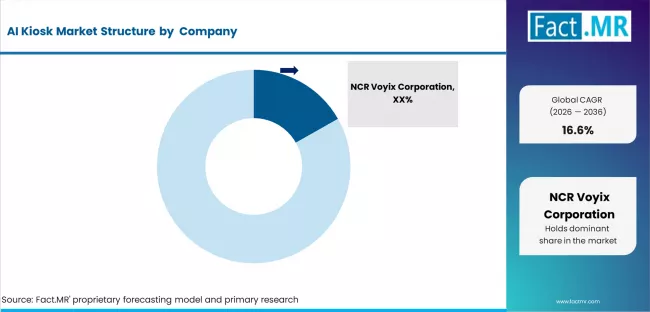
Ai Kiosk Market Analysis By Company

The market is moderately fragmented, with global technology vendors, kiosk makers, software firms, and systems integrators competing within application segments. Leading firms control only a moderate percentage of the market, but the basis of competition is shifting away from price to include software functionality, systems integration skills, and services.

Such companies as NCR Voyix, Diebold Nixdorf, and Fujitsu enjoy structural advantages like well-established enterprise connections, comprehensive software ecosystems, broad deployment capacity, and robust post-sale support systems. Edge AI, cloud integration, and customized enterprise solutions make vendors better positioned for large-scale implementations.

Major buyers in large corporations generally keep multivendor sourcing systems to ensure that their dependence on any particular supplier does not increase. Hence, even as the market becomes more demanding, there is equilibrium regarding price because customers value lifecycle costs, cybersecurity requirements, software scalability, and service reliability over hardware costs.

Leading Companies Shaping the Market

  • NCR Voyix Corporation
  • Diebold Nixdorf
  • Zebra Technologies
  • Advantech Co., Ltd.
  • KIOSK Information Systems
  • Glory Global Solutions
  • Meridian Kiosks
  • Olea Kiosks Inc.
  • Embross
  • Hyosung TNS
  • Fujitsu Limited
  • Samsung Electronics
  • Other prominent players

Recent Developments

  • Samsung Electronics – AI-Powered Enterprise Ecosystem Expansion (May 2026)
    • Samsung expanded its enterprise AI ecosystem strategy through new Business Experience Studios focused on AI-powered displays, connected infrastructure, and intelligent customer interaction solutions across retail, banking, healthcare, and hospitality sectors. [1]
  • NCR Voyix – AI-Powered Scanless Self-Checkout Launch (January 2026)
    • NCR Voyix unveiled an AI-accelerated suite of applications under its VOYIX platform designed to improve retail operations, customer engagement, and intelligent self-service automation across enterprise environments. [2]
  • Fujitsu – NVIDIA AI Infrastructure Partnership Expansion (October 2025)
    • Fujitsu expanded its collaboration with NVIDIA to develop full-stack AI infrastructure and physical AI integration technologies aimed at enterprise automation and intelligent operational systems. [3]
  • Zebra Technologies – Enterprise AI and Computer Vision Solution Launch (February 2025)
    • Zebra Technologies launched new AI-powered computer vision and intelligent automation solutions aimed at strengthening real-time customer analytics, retail automation, and workforce optimization capabilities. [4]
  • NCR Voyix – AI-Powered Scanless Self-Checkout Launch (January 2025)
    • NCR Voyix introduced AI-enabled scanless self-checkout systems utilizing computer vision technology to automate retail checkout processes and reduce inventory shrinkage risks. [5]

Sources and Research References

  • [1] Samsung Electronics, “Samsung Expands Enterprise Play with AI-Powered Ecosystems”, May 2026
  • [2] NCR Voyix, “NCR Voyix Unveils AI-Accelerated Suite of Applications Under the VOYIX Platform”, January 2026
  • [3] Fujitsu, “Fujitsu Expands Collaboration with NVIDIA for AI Infrastructure and Physical AI”, October 2025
  • [4] Zebra Technologies, “Zebra Technologies Introduces New AI Solutions to Empower Retail Frontline Operations”, February 2025
  • [5] NCR Voyix, “NCR Voyix AI-Powered Self-Checkout System Targets C-Stores”, January 2025

AI Kiosk Market Definition

AI Kiosk Market includes self-service machines that employ technologies like artificial intelligence, computer vision, speech recognition, and data analysis in order to serve their customers in an automated way. The applications of the self-service machines include operations related to check-out, ticketing, booking, making payments, assisting customers, and managing visitors. In contrast to traditional self-service machines, these AI-enabled machines can offer personalized services to customers, interpret voice commands of users, conduct behavior analysis of the customers, and work efficiently by processing real-time data. The target markets for these AI kiosks include retail, hospitality, financial sector, healthcare, transportation, and smart city sectors.

AI Kiosk Market Inclusion

The AI kiosks market analysis report covers the anticipated size of the Global and Regional AI kiosks Market by 2026-2036. It includes a breakdown of the market by product, type of kiosk, AI technology, deployment mode, use case application, and end use industry with detailed assessment of regional trends in uptake, competition, pricing and cost benefits related to implementation, and regulations affecting the industry. Other assessments covered include trends in adoption of Edge AI technology, return on investment benchmarks, changing interactions between customers and businesses, and opportunity assessments.

AI Kiosk Market Exclusion

The scope of investigation does not include any of the interactive kiosks which are not driven by artificial intelligence and are purely run on rule-based software without the presence of any machine learning, computer vision, conversational AI, or analytics modules. It does not cover any individual digital signage devices, ATMs that do not have any intelligent automation capabilities, vending machines without artificial intelligence, nor does it cover any consumer electronic devices like tablets or smart displays.

AI Kiosk Market Research Methodology

  • Primary Research
    • The research company Fact.MR held discussions with AI kiosk vendors, systems integrators, software developers, experts in retail automation, IT consultants, and enterprise customers from retail, banking, healthcare, and transportation verticals for validation of key findings of the market study.
  • Desk Research
    • Sources for the research include company annual reports, investment briefs, regulatory publications, technical white papers, trade association reports, government digital infrastructure documents, and industry enterprise automation statistics.
  • Market-Sizing and Forecasting
    • For the purposes of this study, Fact.MR adopted a mixed-market modeling methodology that involved both bottom-up revenue analysis and top-down expenditure analysis regarding automation and artificial intelligence adoption by companies.
  • Data Validation and Update Cycle
    • The market estimate was confirmed by triangulation using data from interviews, financial statements, regional demand, and adoption history. The forecasts are periodically updated based on changes in AI spending, regulations, and business automation initiatives.

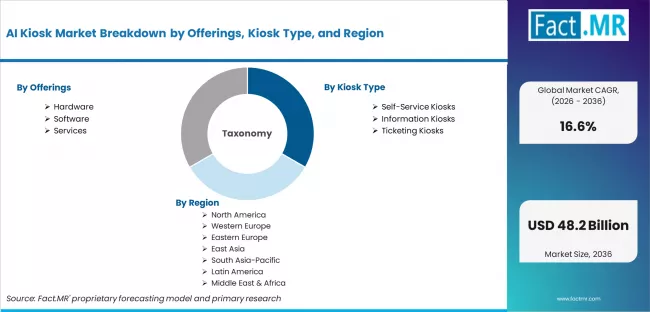
AI Kiosk Market Taxonomy

Ai Kiosk Market Breakdown By Offerings, Kiosk Type, And Region

Parameter Details
Quantitative Units USD 8.9 billion in 2025 to USD 48.2 billion in 2036, at a CAGR of 16.6%
Market Definition Yard ramps are portable or fixed loading platforms used to bridge the height gap between ground level and trucks, containers, railcars, or loading docks for forklift and cargo movement during industrial loading and unloading operations.
Segments Covered Offerings, Kiosk Type, Interaction Mode, Display Size, Application, Installation Type, End Use Industry
Regions Covered North America, Latin America, Western Europe, Eastern Europe, East Asia, South Asia & Pacific, Middle East & Africa
Countries Covered U.S., China, Germany, Japan, India, U.K., France, Brazil, and 30 others
Key Companies NCR Voyix Corporation, Diebold Nixdorf, Zebra Technologies, Advantech Co., Ltd., KIOSK Information Systems, Glory Global Solutions
Forecast Period 2026 – 2036
Approach Hybrid market approach combining bottom-up revenue analysis, deployment tracking, enterprise adoption trends, and top

Segment-wise Analysis

  • AI Kiosk Market Segmented By Offering

    • Hardware:
      • Interactive Displays
      • Cameras & Vision Systems
      • Processors & Edge AI Chips
      • Sensors (Motion, Thermal, Proximity, Biometric)
      • Printers & Scanners
      • Payment & POS Modules
      • Audio Systems (Speakers, Microphones)
      • Connectivity Modules
    • Software:
      • AI Analytics Software
      • Computer Vision Software
      • Natural Language Processing (NLP) Platforms
      • Facial Recognition Software
      • Recommendation & Personalization Engines
      • Remote Monitoring & Device Management
      • Cybersecurity Software
      • Operating Systems & Middleware
    • Services:
      • Consulting & Design
      • System Integration & Deployment
      • Managed Services
      • Maintenance & Support
      • AI Model Training & Optimization
  • AI Kiosk Market Segmented By Kiosk Type:

    • Self-Service Kiosks
    • Information Kiosks
    • Ticketing Kiosks
    • Payment Kiosks
    • Wayfinding Kiosks
    • Check-in / Check-out Kiosks
    • Retail Ordering Kiosks
    • Smart Vending Kiosks
    • Healthcare Service Kiosks
    • Interactive Advertising Kiosks
  • AI Kiosk Market Segmented By Interaction Mode

    • Touch-Based
    • Touchless / Gesture-Based
    • Voice-Enabled
    • Biometric-Enabled
    • Mobile-Integrated Interaction
  • AI Kiosk Market Segmented By Display Size:

    • Below 20 Inches
    • 20–32 Inches
    • 33–50 Inches
    • Above 50 Inches
  • AI Kiosk Market Segmented By Application:

    • Customer Assistance
    • Automated Ordering
    • Digital Payments
    • Visitor Management
    • Queue Management
    • Identity Verification
    • Ticketing & Reservation
    • Advertising & Promotions
    • Employee Self-Service
    • Telemedicine & Remote Consultation
  • AI Kiosk Market Segmented By Installation Type:

    • Indoor
    • Outdoor
  • AI Kiosk Market Segmented By End-Use Industry:

    • Retail & E-commerce
    • Smart Stores
    • QSRs & Food Chains
    • Shopping Malls
    • BFSI
    • Banks
    • Insurance Branches
    • ATMs & Smart Banking
    • Healthcare
    • Hospitals
    • Clinics
    • Pharmacies
    • Transportation & Logistics
    • Airports
    • Railway Stations
    • Metro Stations
    • Smart Parking
    • Hospitality
    • Hotels
    • Entertainment Venues
    • Government & Smart Cities
    • Education
    • Corporate & Offices
    • Telecommunications
    • Manufacturing & Industrial Facilities

- Frequently Asked Questions -

How large is the AI kiosks market currently?

The AI kiosks market was valued at USD 8.9 billion in 2025, driven by increasing adoption of intelligent self-service systems across retail, banking, healthcare, and transportation sectors.

What will the AI kiosks market size be by 2036?

Fact.MR estimates the AI kiosks market will reach USD 48.2 billion by 2036 as enterprises increasingly invest in conversational AI, automation, and customer engagement technologies.

What is the expected CAGR of the AI kiosks market during the forecast period?

The AI kiosks market is projected to expand at a CAGR of 16.6% during the 2026 to 2036 forecast period due to strong demand for AI-enabled automation and smart customer interaction platforms.

What will be the market value of AI kiosks in 2026?

Demand for AI kiosks is estimated to grow to USD 10.4 billion in 2026, supported by expanding deployment across retail automation, smart banking, and transportation infrastructure.

Which kiosk type segment is poised to lead the AI kiosks market?

Self-service kiosks are expected to remain the leading kiosk type segment in 2026, accounting for 34% share due to strong adoption across quick-service restaurants, retail stores, airports, and healthcare facilities.

How significant is the hardware segment in the AI kiosks market?

The hardware segment is projected to hold 52% share in 2026 as enterprises continue investing in interactive displays, AI processors, biometric systems, and edge computing infrastructure for intelligent kiosk deployments.

Table of Content

  1. AI Kiosk Market – Executive Summary
  2. Market Overview
    • Market Definition & Introduction
    • Market Taxonomy & Research Scope
  3. Global AI Kiosk Market Demand (in Value or Size in US$ Mn) Analysis 2021-2025 and Forecast, 2026–2036
    • Historical Market Value (US$ Mn) Analysis, 2021-2025
    • Current and Future Market Value (US$ Mn) Projections, 2026–2036
      • Y-o-Y Growth Trend Analysis
      • Absolute $ Opportunity Analysis
  4. Market Background and Foundational Data Points
    • Number of AI Kiosk Installations (Units)
    • Average Selling Price (USD/Unit)
    • Annual Software Subscription Revenue (USD/Year)
    • Average Revenue per Kiosk Deployment (USD/Deployment)
    • Enterprise Deployment Volume (Deployments/Year)
    • Installed Base Growth Rate (%)
    • AI Penetration in Interactive Kiosks (%)
    • Average Replacement Cycle (Years)
    • Annual Maintenance & Managed Service Revenue (USD/Unit/Year)
    • Average Transaction Volume per Kiosk (Transactions/Day)
    • Edge AI Hardware Cost per System (USD/Unit)
    • Digital Advertising Revenue per Kiosk (USD/Unit/Month)
    • Regional Installed Base Distribution
      • North America
      • Europe
      • Asia Pacific
      • Latin America
      • Middle East & Africa
    • Installed Base by End-use Industry
      • Food & Beverage
      • Pharmaceuticals
      • Personal Care & Cosmetics
      • Chemicals & Industrial
      • Others
    • Trade Scenario, 2025
      • Imports and Export Analysis
        • By Region
        • By Country
    • Investment in AI Kiosk, By Region
    • Start-up Ecosystem Analysis, 2021-2025
    • AI Kiosk Market Opportunity Assessment
      • Total Available Market (US$ Mn)
      • Serviceable Addressable Market (US$ Mn)
      • Serviceable Obtainable Market (US$ Mn)
    • Porter’s Five Forces and PESTEL Analysis
    • Investment Feasibility Analysis
    • Macro-Economic Factors & Forecast Factors - Relevance & Impact
    • Industry Value and Supply Chain Analysis
      • List of Key Channel Partners
      • Profit Margin & Operating Margin at Each Node of Supply Chain.
      • Notes on Value Added at Each Node in the Value Chain
      • Factors Influencing Value Chain
    • Market Dynamics
      • Drivers
      • Restraints
      • Opportunity Analysis
    • Key Regulations & Certifications
  5. AI Kiosk Market Analysis 2021-2025 and Forecast 2026–2036, By Offerings
    • Introduction / Key Findings
    • Historical Market Size (US$ Mn) Trend Analysis by Offerings, 2021-2025
    • Current and Future Market Size (US$ Mn) Analysis and Forecast by Offerings, 2026-2036
      • Hardware
        • Interactive Displays
        • Cameras & Vision Systems
        • Processors & Edge AI Chips
        • Sensors (Motion, Thermal, Proximity, Biometric)
        • Printers & Scanners
        • Payment & POS Modules
        • Audio Systems (Speakers, Microphones)
        • Connectivity Modules
      • Software
        • AI Analytics Software
        • Computer Vision Software
        • Natural Language Processing (NLP) Platforms
        • Facial Recognition Software
        • Recommendation & Personalization Engines
        • Remote Monitoring & Device Management
        • Cybersecurity Software
        • Operating Systems & Middleware
      • Services
        • Consulting & Design
        • System Integration & Deployment
        • Managed Services
        • Maintenance & Support
        • AI Model Training & Optimization
    • Market Attractiveness Analysis by Offerings
  6. AI Kiosk Market Analysis 2021-2025 and Forecast 2026–2036, By Kiosk Type
    • Introduction / Key Findings
    • Historical Market Size (US$ Mn) Trend Analysis by Kiosk Type, 2021-2025
    • Current and Future Market Size (US$ Mn) Analysis and Forecast by Kiosk Type, 2026-2036
      • Self-Service Kiosks
      • Information Kiosks
      • Ticketing Kiosks
      • Payment Kiosks
      • Wayfinding Kiosks
      • Check-in / Check-out Kiosks
      • Retail Ordering Kiosks
      • Smart Vending Kiosks
      • Healthcare Service Kiosks
      • Interactive Advertising Kiosks
    • Market Attractiveness Analysis by Kiosk Type
  7. AI Kiosk Market Analysis 2021-2025 and Forecast 2026–2036, By Interaction Mode
    • Introduction / Key Findings
    • Historical Market Size (US$ Mn) Trend Analysis by Interaction Mode, 2021-2025
    • Current and Future Market Size (US$ Mn) Analysis and Forecast by Interaction Mode, 2026-2036
      • Touch-Based
      • Touchless / Gesture-Based
      • Voice-Enabled
      • Biometric Enabled
      • Mobile-Integrated Interaction
    • Market Attractiveness Analysis by Interaction Mode
  8. AI Kiosk Market Analysis 2021-2025 and Forecast 2026–2036, By Display Size
    • Introduction / Key Findings
    • Historical Market Size (US$ Mn) Trend Analysis by Display Size, 2021-2025
    • Current and Future Market Size (US$ Mn) Analysis and Forecast by Display Size, 2026-2036
      • Below 20 Inches
      • 20–32 Inches
      • 33–50 Inches
      • Above 50 Inches
    • Market Attractiveness Analysis by Display Size
  9. AI Kiosk Market Analysis 2021-2025 and Forecast 2026–2036, By Application
    • Introduction / Key Findings
    • Historical Market Size (US$ Mn) Trend Analysis by Application, 2021-2025
    • Current and Future Market Size (US$ Mn) Analysis and Forecast by Application, 2026-2036
      • Customer Assistance
      • Automated Ordering
      • Digital Payments
      • Visitor Management
      • Queue Management
      • Identity Verification
      • Ticketing & Reservation
      • Advertising & Promotions
      • Employee Self-Service
      • Telemedicine & Remote Consultation
    • Market Attractiveness Analysis by Application
  10. AI Kiosk Market Analysis 2021-2025 and Forecast 2026–2036, By Installation Type
    • Introduction / Key Findings
    • Historical Market Size (US$ Mn) Trend Analysis by Installation Type, 2021-2025
    • Current and Future Market Size (US$ Mn) Analysis and Forecast by Installation Type, 2026-2036
      • Indoor
      • Outdoor
    • Market Attractiveness Analysis by Installation Type
  11. AI Kiosk Market Analysis 2021-2025 and Forecast 2026–2036, By End-User Industry
    • Introduction / Key Findings
    • Historical Market Size (US$ Mn) Trend Analysis by End-User Industry, 2021-2025
    • Current and Future Market Size (US$ Mn) Analysis and Forecast by End-User Industry, 2026-2036
      • Retail & E-commerce
        • Smart Stores
        • QSRs & Food Chains
        • Shopping Malls
      • BFSI
        • Banks
        • Insurance Branches
        • ATMs & Smart Banking
      • Healthcare
        • Hospitals
        • Clinics
        • Pharmacies
      • Transportation & Logistics
        • Airports
        • Railway Stations
        • Metro Stations
        • Smart Parking
      • Hospitality
        • Hotels
        • Entertainment Venues
      • Government & Smart Cities
      • Education
      • Corporate & Offices
      • Telecommunications
      • Manufacturing & Industrial Facilities
    • Market Attractiveness Analysis by End-User Industry
  12. Global AI Kiosk Market Analysis and Forecast, by Region
    • Introduction / Key Findings
    • Historical Market Size (US$ Mn) Trend Analysis by Region, 2021-2025
    • Current and Future Market Size (US$ Mn) Analysis and Forecast by Region, 2026-2036
      • North America
      • Latin America
      • Western Europe
      • Eastern Europe
      • East Asia
      • South Asia & Pacific
      • Middle East & Africa
    • Market Attractiveness Analysis by Region
  13. North America AI Kiosk Market Analysis and Forecast
    • Introduction / Key Findings
    • Historical Market Size (US$ Mn) Trend Analysis by Market Taxonomy, 2021-2025
    • Current and Future Market Size (US$ Mn) Analysis & Forecast by Market Taxonomy, 2026-2036
    • By Country
      • United States
      • Canada
      • Mexico
    • By Taxonomy
    • Market Attractiveness Analysis By Country & Taxonomy
    • Market Trends
    • Key Market Participants – Intensity Mapping
    • Drivers and Restraints - Impact Analysis
  14. Latin America AI Kiosk Market Analysis and Forecast
    • Introduction / Key Findings
    • Historical Market Size (US$ Mn) Trend Analysis by Market Taxonomy, 2021-2025
    • Current and Future Market Size (US$ Mn) Analysis & Forecast by Market Taxonomy, 2026-2036
    • By Country
      • Brazil
      • Chile
      • Rest of LATAM
    • By Taxonomy
    • Market Attractiveness Analysis By Country & Taxonomy
    • Market Trends
    • Key Market Participants – Intensity Mapping
    • Drivers and Restraints - Impact Analysis
  15. Western Europe AI Kiosk Market Analysis and Forecast
    • Introduction / Key Findings
    • Historical Market Size (US$ Mn) Trend Analysis by Market Taxonomy, 2021-2025
    • Current and Future Market Size (US$ Mn) Analysis & Forecast by Market Taxonomy, 2026-2036
    • By Country
      • Germany
      • Italy
      • France
      • United Kingdom
      • Spain
      • BENELUX
      • Nordics
      • Rest of Western Europe
    • By Taxonomy
    • Market Attractiveness Analysis By Country & Taxonomy
    • Market Trends
    • Key Market Participants – Intensity Mapping
    • Drivers and Restraints - Impact Analysis
  16. Eastern Europe AI Kiosk Market Analysis and Forecast
    • Introduction / Key Findings
    • Historical Market Size (US$ Mn) Trend Analysis by Market Taxonomy, 2021-2025
    • Current and Future Market Size (US$ Mn) Analysis & Forecast by Market Taxonomy, 2026-2036
    • By Country
      • Russia
      • Hungary
      • Poland
      • Balkan & Baltics
      • Rest of Eastern Europe
    • By Taxonomy
    • Market Attractiveness Analysis By Country & Taxonomy
    • Market Trends
    • Key Market Participants – Intensity Mapping
    • Drivers and Restraints - Impact Analysis
  17. East Asia AI Kiosk Market Analysis and Forecast
    • Introduction / Key Findings
    • Historical Market Size (US$ Mn) Trend Analysis by Market Taxonomy, 2021-2025
    • Current and Future Market Size (US$ Mn) Analysis & Forecast by Market Taxonomy, 2026-2036
    • By Country
      • China
      • Japan
      • South Korea
    • By Taxonomy
    • Market Attractiveness Analysis By Country & Taxonomy
    • Market Trends
    • Key Market Participants – Intensity Mapping
    • Drivers and Restraints - Impact Analysis
  18. South Asia & Pacific AI Kiosk Market Analysis and Forecast
    • Introduction / Key Findings
    • Historical Market Size (US$ Mn) Trend Analysis by Market Taxonomy, 2021-2025
    • Current and Future Market Size (US$ Mn) Analysis & Forecast by Market Taxonomy, 2026-2036
    • By Country
      • India
      • ASEAN
      • Australia & New Zealand
      • Rest of South Asia & Pacific
    • By Taxonomy
    • Market Attractiveness Analysis By Country & Taxonomy
    • Market Trends
    • Key Market Participants – Intensity Mapping
    • Drivers and Restraints - Impact Analysis
  19. Middle East & Africa AI Kiosk Market Analysis and Forecast
    • Introduction / Key Findings
    • Historical Market Size (US$ Mn) Trend Analysis by Market Taxonomy, 2021-2025
    • Current and Future Market Size (US$ Mn) Analysis & Forecast by Market Taxonomy, 2026-2036
    • By Country
      • Kingdom of Saudi Arabia
      • Other GCC Countries
      • Turkiye
      • South Africa
      • Other African Union
    • By Taxonomy
    • Market Attractiveness Analysis By Country & Taxonomy
    • Market Trends
    • Key Market Participants – Intensity Mapping
    • Drivers and Restraints - Impact Analysis
  20. Country-level AI Kiosk Market Analysis and Forecast
    • Introduction
    • Market Value Proportion Analysis, By Key Countries
    • Global Vs. Country Growth Comparison
      • United States AI Kiosk Market Analysis
        • Market Size (US$ Mn) Analysis by Market Taxonomy, 2021–2036
        • By Offerings
        • By Kiosk Type
        • By Interaction Mode
        • By Display Size
        • By Application
        • By Installation Type
        • By End-Use Industry
        • Canada AI Kiosk Market Analysis
        • Mexico AI Kiosk Market Analysis
        • Brazil AI Kiosk Market Analysis
        • Chile AI Kiosk Market Analysis
        • Germany AI Kiosk Market Analysis
        • France AI Kiosk Market Analysis
        • Italy AI Kiosk Market Analysis
        • Spain AI Kiosk Market Analysis
        • United Kingdom AI Kiosk Market Analysis
        • BENELUX AI Kiosk Market Analysis
        • Nordics AI Kiosk Market Analysis
        • Poland AI Kiosk Market Analysis
        • Russia AI Kiosk Market Analysis
        • Hungary AI Kiosk Market Analysis
        • Balkan & Baltics AI Kiosk Market Analysis
        • China AI Kiosk Market Analysis
        • Japan AI Kiosk Market Analysis
        • South Korea AI Kiosk Market Analysis
        • India AI Kiosk Market Analysis
        • ASEAN AI Kiosk Market Analysis
        • ANZ AI Kiosk Market Analysis
        • KSA AI Kiosk Market Analysis
        • Other GCC Countries AI Kiosk Market Analysis
        • South Africa AI Kiosk Market Analysis
        • Turkiye AI Kiosk Market Analysis
    • AI Kiosk Market Structure Analysis
      • Market Analysis by Tier of Companies
      • Market Concentration
      • Market Share Analysis of Top Players
      • Market Space for New Brands and Dollar Opportunity
      • Market Presence Analysis
        • Regional Footprint of Players
        • Product Footprint by Players
    • AI Kiosk Competition Analysis
      • Competition Dashboard
      • Pricing Analysis by Competition
      • Competition Benchmarking
      • Competition Deep Dive
        • NCR Voyix Corporation
          • Overview
          • Product Portfolio
          • Sales Footprint
          • Key Developments
          • SWOT Analysis
          • Strategy Overview
          • Key Financials
        • Diebold Nixdorf
        • Zebra Technologies
        • Advantech Co., Ltd.
        • KIOSK Information Systems
        • Glory Global Solutions
        • Meridian Kiosks
        • Olea Kiosks Inc.
        • Embross
        • Hyosung TNS
        • Fujitsu Limited
        • Samsung Electronics
        • Other Prominent Players
    • Primary insights
    • Assumptions & Acronyms Used
    • Research Methodology & Data Sources

List Of Table

  • Table 1: Global Market Value (USD Mn) Forecast by Region, 2021 to 2036
  • Table 2: Global Market Value (USD Mn) Forecast by Offerings, 2021 to 2036
  • Table 3: Global Market Value (USD Mn) Forecast by Kiosk Type, 2021 to 2036
  • Table 4: Global Market Value (USD Mn) Forecast by Interaction Mode, 2021 to 2036
  • Table 5: Global Market Value (USD Mn) Forecast by Display Size, 2021 to 2036
  • Table 6: Global Market Value (USD Mn) Forecast by Application, 2021 to 2036
  • Table 7: Global Market Value (USD Mn) Forecast by Installation Type, 2021 to 2036
  • Table 8: Global Market Value (USD Mn) Forecast by End Use Industry, 2021 to 2036
  • Table 9: North America Market Value (USD Mn) Forecast by Country, 2021 to 2036
  • Table 10: North America Market Value (USD Mn) Forecast by Offerings, 2021 to 2036
  • Table 11: North America Market Value (USD Mn) Forecast by Kiosk Type, 2021 to 2036
  • Table 12: North America Market Value (USD Mn) Forecast by Interaction Mode, 2021 to 2036
  • Table 13: North America Market Value (USD Mn) Forecast by Display Size, 2021 to 2036
  • Table 14: North America Market Value (USD Mn) Forecast by Application, 2021 to 2036
  • Table 15: North America Market Value (USD Mn) Forecast by Installation Type, 2021 to 2036
  • Table 16: North America Market Value (USD Mn) Forecast by End Use Industry, 2021 to 2036
  • Table 17: Latin America Market Value (USD Mn) Forecast by Country, 2021 to 2036
  • Table 18: Latin America Market Value (USD Mn) Forecast by Offerings, 2021 to 2036
  • Table 19: Latin America Market Value (USD Mn) Forecast by Kiosk Type, 2021 to 2036
  • Table 20: Latin America Market Value (USD Mn) Forecast by Interaction Mode, 2021 to 2036
  • Table 21: Latin America Market Value (USD Mn) Forecast by Display Size, 2021 to 2036
  • Table 22: Latin America Market Value (USD Mn) Forecast by Application, 2021 to 2036
  • Table 23: Latin America Market Value (USD Mn) Forecast by Installation Type, 2021 to 2036
  • Table 24: Latin America Market Value (USD Mn) Forecast by End Use Industry, 2021 to 2036
  • Table 25: Western Europe Market Value (USD Mn) Forecast by Country, 2021 to 2036
  • Table 26: Western Europe Market Value (USD Mn) Forecast by Offerings, 2021 to 2036
  • Table 27: Western Europe Market Value (USD Mn) Forecast by Kiosk Type, 2021 to 2036
  • Table 28: Western Europe Market Value (USD Mn) Forecast by Interaction Mode, 2021 to 2036
  • Table 29: Western Europe Market Value (USD Mn) Forecast by Display Size, 2021 to 2036
  • Table 30: Western Europe Market Value (USD Mn) Forecast by Application, 2021 to 2036
  • Table 31: Western Europe Market Value (USD Mn) Forecast by Installation Type, 2021 to 2036
  • Table 32: Western Europe Market Value (USD Mn) Forecast by End Use Industry, 2021 to 2036
  • Table 33: Eastern Europe Market Value (USD Mn) Forecast by Country, 2021 to 2036
  • Table 34: Eastern Europe Market Value (USD Mn) Forecast by Offerings, 2021 to 2036
  • Table 35: Eastern Europe Market Value (USD Mn) Forecast by Kiosk Type, 2021 to 2036
  • Table 36: Eastern Europe Market Value (USD Mn) Forecast by Interaction Mode, 2021 to 2036
  • Table 37: Eastern Europe Market Value (USD Mn) Forecast by Display Size, 2021 to 2036
  • Table 38: Eastern Europe Market Value (USD Mn) Forecast by Application, 2021 to 2036
  • Table 39: Eastern Europe Market Value (USD Mn) Forecast by Installation Type, 2021 to 2036
  • Table 40: Eastern Europe Market Value (USD Mn) Forecast by End Use Industry, 2021 to 2036
  • Table 41: East Asia Market Value (USD Mn) Forecast by Country, 2021 to 2036
  • Table 42: East Asia Market Value (USD Mn) Forecast by Offerings, 2021 to 2036
  • Table 43: East Asia Market Value (USD Mn) Forecast by Kiosk Type, 2021 to 2036
  • Table 44: East Asia Market Value (USD Mn) Forecast by Interaction Mode, 2021 to 2036
  • Table 45: East Asia Market Value (USD Mn) Forecast by Display Size, 2021 to 2036
  • Table 46: East Asia Market Value (USD Mn) Forecast by Application, 2021 to 2036
  • Table 47: East Asia Market Value (USD Mn) Forecast by Installation Type, 2021 to 2036
  • Table 48: East Asia Market Value (USD Mn) Forecast by End Use Industry, 2021 to 2036
  • Table 49: South Asia and Pacific Market Value (USD Mn) Forecast by Country, 2021 to 2036
  • Table 50: South Asia and Pacific Market Value (USD Mn) Forecast by Offerings, 2021 to 2036
  • Table 51: South Asia and Pacific Market Value (USD Mn) Forecast by Kiosk Type, 2021 to 2036
  • Table 52: South Asia and Pacific Market Value (USD Mn) Forecast by Interaction Mode, 2021 to 2036
  • Table 53: South Asia and Pacific Market Value (USD Mn) Forecast by Display Size, 2021 to 2036
  • Table 54: South Asia and Pacific Market Value (USD Mn) Forecast by Application, 2021 to 2036
  • Table 55: South Asia and Pacific Market Value (USD Mn) Forecast by Installation Type, 2021 to 2036
  • Table 56: South Asia and Pacific Market Value (USD Mn) Forecast by End Use Industry, 2021 to 2036
  • Table 57: Middle East & Africa Market Value (USD Mn) Forecast by Country, 2021 to 2036
  • Table 58: Middle East & Africa Market Value (USD Mn) Forecast by Offerings, 2021 to 2036
  • Table 59: Middle East & Africa Market Value (USD Mn) Forecast by Kiosk Type, 2021 to 2036
  • Table 60: Middle East & Africa Market Value (USD Mn) Forecast by Interaction Mode, 2021 to 2036
  • Table 61: Middle East & Africa Market Value (USD Mn) Forecast by Display Size, 2021 to 2036
  • Table 62: Middle East & Africa Market Value (USD Mn) Forecast by Application, 2021 to 2036
  • Table 63: Middle East & Africa Market Value (USD Mn) Forecast by Installation Type, 2021 to 2036
  • Table 64: Middle East & Africa Market Value (USD Mn) Forecast by End Use Industry, 2021 to 2036

List Of Figures

  • Figure 1: Global Market Pricing Analysis
  • Figure 2: Global Market Value (USD Mn) Forecast 2020–2035
  • Figure 3: Global Market Value Share and BPS Analysis by Offerings, 2026 and 2036
  • Figure 4: Global Market Y-o-Y Growth Comparison by Offerings, 2026 to 2036
  • Figure 5: Global Market Attractiveness Analysis by Offerings
  • Figure 6: Global Market Value Share and BPS Analysis by Kiosk Type, 2026 and 2036
  • Figure 7: Global Market Y-o-Y Growth Comparison by Kiosk Type, 2026 to 2036
  • Figure 8: Global Market Attractiveness Analysis by Kiosk Type
  • Figure 9: Global Market Value Share and BPS Analysis by Interaction Mode, 2026 and 2036
  • Figure 10: Global Market Y-o-Y Growth Comparison by Interaction Mode, 2026 to 2036
  • Figure 11: Global Market Attractiveness Analysis by Interaction Mode
  • Figure 12: Global Market Value Share and BPS Analysis by Display Size, 2026 and 2036
  • Figure 13: Global Market Y-o-Y Growth Comparison by Display Size, 2026 to 2036
  • Figure 14: Global Market Attractiveness Analysis by Display Size
  • Figure 15: Global Market Value Share and BPS Analysis by Application, 2026 and 2036
  • Figure 16: Global Market Y-o-Y Growth Comparison by Application, 2026 to 2036
  • Figure 17: Global Market Attractiveness Analysis by Application
  • Figure 18: Global Market Value Share and BPS Analysis by Installation Type, 2026 and 2036
  • Figure 19: Global Market Y-o-Y Growth Comparison by Installation Type, 2026 to 2036
  • Figure 20: Global Market Attractiveness Analysis by Installation Type
  • Figure 21: Global Market Value Share and BPS Analysis by End Use Industry, 2026 and 2036
  • Figure 22: Global Market Y-o-Y Growth Comparison by End Use Industry, 2026 to 2036
  • Figure 23: Global Market Attractiveness Analysis by End Use Industry
  • Figure 24: Global Market Value (USD Mn) Share and BPS Analysis by Region, 2026 and 2036
  • Figure 25: Global Market Y-o-Y Growth Comparison by Region, 2026 to 2036
  • Figure 26: Global Market Attractiveness Analysis by Region
  • Figure 27: North America Market Incremental $ Opportunity, 2026 to 2036
  • Figure 28: Latin America Market Incremental $ Opportunity, 2026 to 2036
  • Figure 29: Western Europe Market Incremental $ Opportunity, 2026 to 2036
  • Figure 30: Eastern Europe Market Incremental $ Opportunity, 2026 to 2036
  • Figure 31: East Asia Market Incremental $ Opportunity, 2026 to 2036
  • Figure 32: South Asia and Pacific Market Incremental $ Opportunity, 2026 to 2036
  • Figure 33: Middle East & Africa Market Incremental $ Opportunity, 2026 to 2036
  • Figure 34: North America Market Value Share and BPS Analysis by Country, 2026 and 2036
  • Figure 35: North America Market Value Share and BPS Analysis by Offerings, 2026 and 2036
  • Figure 36: North America Market Y-o-Y Growth Comparison by Offerings, 2026 to 2036
  • Figure 37: North America Market Attractiveness Analysis by Offerings
  • Figure 38: North America Market Value Share and BPS Analysis by Kiosk Type, 2026 and 2036
  • Figure 39: North America Market Y-o-Y Growth Comparison by Kiosk Type, 2026 to 2036
  • Figure 40: North America Market Attractiveness Analysis by Kiosk Type
  • Figure 41: North America Market Value Share and BPS Analysis by Interaction Mode, 2026 and 2036
  • Figure 42: North America Market Y-o-Y Growth Comparison by Interaction Mode, 2026 to 2036
  • Figure 43: North America Market Attractiveness Analysis by Interaction Mode
  • Figure 44: North America Market Value Share and BPS Analysis by Display Size, 2026 and 2036
  • Figure 45: North America Market Y-o-Y Growth Comparison by Display Size, 2026 to 2036
  • Figure 46: North America Market Attractiveness Analysis by Display Size
  • Figure 47: North America Market Value Share and BPS Analysis by Application, 2026 and 2036
  • Figure 48: North America Market Y-o-Y Growth Comparison by Application, 2026 to 2036
  • Figure 49: North America Market Attractiveness Analysis by Application
  • Figure 50: North America Market Value Share and BPS Analysis by Installation Type, 2026 and 2036
  • Figure 51: North America Market Y-o-Y Growth Comparison by Installation Type, 2026 to 2036
  • Figure 52: North America Market Attractiveness Analysis by Installation Type
  • Figure 53: North America Market Value Share and BPS Analysis by End Use Industry, 2026 and 2036
  • Figure 54: North America Market Y-o-Y Growth Comparison by End Use Industry, 2026 to 2036
  • Figure 55: North America Market Attractiveness Analysis by End Use Industry
  • Figure 56: Latin America Market Value Share and BPS Analysis by Country, 2026 and 2036
  • Figure 57: Latin America Market Value Share and BPS Analysis by Offerings, 2026 and 2036
  • Figure 58: Latin America Market Y-o-Y Growth Comparison by Offerings, 2026 to 2036
  • Figure 59: Latin America Market Attractiveness Analysis by Offerings
  • Figure 60: Latin America Market Value Share and BPS Analysis by Kiosk Type, 2026 and 2036
  • Figure 61: Latin America Market Y-o-Y Growth Comparison by Kiosk Type, 2026 to 2036
  • Figure 62: Latin America Market Attractiveness Analysis by Kiosk Type
  • Figure 63: Latin America Market Value Share and BPS Analysis by Interaction Mode, 2026 and 2036
  • Figure 64: Latin America Market Y-o-Y Growth Comparison by Interaction Mode, 2026 to 2036
  • Figure 65: Latin America Market Attractiveness Analysis by Interaction Mode
  • Figure 66: Latin America Market Value Share and BPS Analysis by Display Size, 2026 and 2036
  • Figure 67: Latin America Market Y-o-Y Growth Comparison by Display Size, 2026 to 2036
  • Figure 68: Latin America Market Attractiveness Analysis by Display Size
  • Figure 69: Latin America Market Value Share and BPS Analysis by Application, 2026 and 2036
  • Figure 70: Latin America Market Y-o-Y Growth Comparison by Application, 2026 to 2036
  • Figure 71: Latin America Market Attractiveness Analysis by Application
  • Figure 72: Latin America Market Value Share and BPS Analysis by Installation Type, 2026 and 2036
  • Figure 73: Latin America Market Y-o-Y Growth Comparison by Installation Type, 2026 to 2036
  • Figure 74: Latin America Market Attractiveness Analysis by Installation Type
  • Figure 75: Latin America Market Value Share and BPS Analysis by End Use Industry, 2026 and 2036
  • Figure 76: Latin America Market Y-o-Y Growth Comparison by End Use Industry, 2026 to 2036
  • Figure 77: Latin America Market Attractiveness Analysis by End Use Industry
  • Figure 78: Western Europe Market Value Share and BPS Analysis by Country, 2026 and 2036
  • Figure 79: Western Europe Market Value Share and BPS Analysis by Offerings, 2026 and 2036
  • Figure 80: Western Europe Market Y-o-Y Growth Comparison by Offerings, 2026 to 2036
  • Figure 81: Western Europe Market Attractiveness Analysis by Offerings
  • Figure 82: Western Europe Market Value Share and BPS Analysis by Kiosk Type, 2026 and 2036
  • Figure 83: Western Europe Market Y-o-Y Growth Comparison by Kiosk Type, 2026 to 2036
  • Figure 84: Western Europe Market Attractiveness Analysis by Kiosk Type
  • Figure 85: Western Europe Market Value Share and BPS Analysis by Interaction Mode, 2026 and 2036
  • Figure 86: Western Europe Market Y-o-Y Growth Comparison by Interaction Mode, 2026 to 2036
  • Figure 87: Western Europe Market Attractiveness Analysis by Interaction Mode
  • Figure 88: Western Europe Market Value Share and BPS Analysis by Display Size, 2026 and 2036
  • Figure 89: Western Europe Market Y-o-Y Growth Comparison by Display Size, 2026 to 2036
  • Figure 90: Western Europe Market Attractiveness Analysis by Display Size
  • Figure 91: Western Europe Market Value Share and BPS Analysis by Application, 2026 and 2036
  • Figure 92: Western Europe Market Y-o-Y Growth Comparison by Application, 2026 to 2036
  • Figure 93: Western Europe Market Attractiveness Analysis by Application
  • Figure 94: Western Europe Market Value Share and BPS Analysis by Installation Type, 2026 and 2036
  • Figure 95: Western Europe Market Y-o-Y Growth Comparison by Installation Type, 2026 to 2036
  • Figure 96: Western Europe Market Attractiveness Analysis by Installation Type
  • Figure 97: Western Europe Market Value Share and BPS Analysis by End Use Industry, 2026 and 2036
  • Figure 98: Western Europe Market Y-o-Y Growth Comparison by End Use Industry, 2026 to 2036
  • Figure 99: Western Europe Market Attractiveness Analysis by End Use Industry
  • Figure 100: Eastern Europe Market Value Share and BPS Analysis by Country, 2026 and 2036
  • Figure 101: Eastern Europe Market Value Share and BPS Analysis by Offerings, 2026 and 2036
  • Figure 102: Eastern Europe Market Y-o-Y Growth Comparison by Offerings, 2026 to 2036
  • Figure 103: Eastern Europe Market Attractiveness Analysis by Offerings
  • Figure 104: Eastern Europe Market Value Share and BPS Analysis by Kiosk Type, 2026 and 2036
  • Figure 105: Eastern Europe Market Y-o-Y Growth Comparison by Kiosk Type, 2026 to 2036
  • Figure 106: Eastern Europe Market Attractiveness Analysis by Kiosk Type
  • Figure 107: Eastern Europe Market Value Share and BPS Analysis by Interaction Mode, 2026 and 2036
  • Figure 108: Eastern Europe Market Y-o-Y Growth Comparison by Interaction Mode, 2026 to 2036
  • Figure 109: Eastern Europe Market Attractiveness Analysis by Interaction Mode
  • Figure 110: Eastern Europe Market Value Share and BPS Analysis by Display Size, 2026 and 2036
  • Figure 111: Eastern Europe Market Y-o-Y Growth Comparison by Display Size, 2026 to 2036
  • Figure 112: Eastern Europe Market Attractiveness Analysis by Display Size
  • Figure 113: Eastern Europe Market Value Share and BPS Analysis by Application, 2026 and 2036
  • Figure 114: Eastern Europe Market Y-o-Y Growth Comparison by Application, 2026 to 2036
  • Figure 115: Eastern Europe Market Attractiveness Analysis by Application
  • Figure 116: Eastern Europe Market Value Share and BPS Analysis by Installation Type, 2026 and 2036
  • Figure 117: Eastern Europe Market Y-o-Y Growth Comparison by Installation Type, 2026 to 2036
  • Figure 118: Eastern Europe Market Attractiveness Analysis by Installation Type
  • Figure 119: Eastern Europe Market Value Share and BPS Analysis by End Use Industry, 2026 and 2036
  • Figure 120: Eastern Europe Market Y-o-Y Growth Comparison by End Use Industry, 2026 to 2036
  • Figure 121: Eastern Europe Market Attractiveness Analysis by End Use Industry
  • Figure 122: East Asia Market Value Share and BPS Analysis by Country, 2026 and 2036
  • Figure 123: East Asia Market Value Share and BPS Analysis by Offerings, 2026 and 2036
  • Figure 124: East Asia Market Y-o-Y Growth Comparison by Offerings, 2026 to 2036
  • Figure 125: East Asia Market Attractiveness Analysis by Offerings
  • Figure 126: East Asia Market Value Share and BPS Analysis by Kiosk Type, 2026 and 2036
  • Figure 127: East Asia Market Y-o-Y Growth Comparison by Kiosk Type, 2026 to 2036
  • Figure 128: East Asia Market Attractiveness Analysis by Kiosk Type
  • Figure 129: East Asia Market Value Share and BPS Analysis by Interaction Mode, 2026 and 2036
  • Figure 130: East Asia Market Y-o-Y Growth Comparison by Interaction Mode, 2026 to 2036
  • Figure 131: East Asia Market Attractiveness Analysis by Interaction Mode
  • Figure 132: East Asia Market Value Share and BPS Analysis by Display Size, 2026 and 2036
  • Figure 133: East Asia Market Y-o-Y Growth Comparison by Display Size, 2026 to 2036
  • Figure 134: East Asia Market Attractiveness Analysis by Display Size
  • Figure 135: East Asia Market Value Share and BPS Analysis by Application, 2026 and 2036
  • Figure 136: East Asia Market Y-o-Y Growth Comparison by Application, 2026 to 2036
  • Figure 137: East Asia Market Attractiveness Analysis by Application
  • Figure 138: East Asia Market Value Share and BPS Analysis by Installation Type, 2026 and 2036
  • Figure 139: East Asia Market Y-o-Y Growth Comparison by Installation Type, 2026 to 2036
  • Figure 140: East Asia Market Attractiveness Analysis by Installation Type
  • Figure 141: East Asia Market Value Share and BPS Analysis by End Use Industry, 2026 and 2036
  • Figure 142: East Asia Market Y-o-Y Growth Comparison by End Use Industry, 2026 to 2036
  • Figure 143: East Asia Market Attractiveness Analysis by End Use Industry
  • Figure 144: South Asia and Pacific Market Value Share and BPS Analysis by Country, 2026 and 2036
  • Figure 145: South Asia and Pacific Market Value Share and BPS Analysis by Offerings, 2026 and 2036
  • Figure 146: South Asia and Pacific Market Y-o-Y Growth Comparison by Offerings, 2026 to 2036
  • Figure 147: South Asia and Pacific Market Attractiveness Analysis by Offerings
  • Figure 148: South Asia and Pacific Market Value Share and BPS Analysis by Kiosk Type, 2026 and 2036
  • Figure 149: South Asia and Pacific Market Y-o-Y Growth Comparison by Kiosk Type, 2026 to 2036
  • Figure 150: South Asia and Pacific Market Attractiveness Analysis by Kiosk Type
  • Figure 151: South Asia and Pacific Market Value Share and BPS Analysis by Interaction Mode, 2026 and 2036
  • Figure 152: South Asia and Pacific Market Y-o-Y Growth Comparison by Interaction Mode, 2026 to 2036
  • Figure 153: South Asia and Pacific Market Attractiveness Analysis by Interaction Mode
  • Figure 154: South Asia and Pacific Market Value Share and BPS Analysis by Display Size, 2026 and 2036
  • Figure 155: South Asia and Pacific Market Y-o-Y Growth Comparison by Display Size, 2026 to 2036
  • Figure 156: South Asia and Pacific Market Attractiveness Analysis by Display Size
  • Figure 157: South Asia and Pacific Market Value Share and BPS Analysis by Application, 2026 and 2036
  • Figure 158: South Asia and Pacific Market Y-o-Y Growth Comparison by Application, 2026 to 2036
  • Figure 159: South Asia and Pacific Market Attractiveness Analysis by Application
  • Figure 160: South Asia and Pacific Market Value Share and BPS Analysis by Installation Type, 2026 and 2036
  • Figure 161: South Asia and Pacific Market Y-o-Y Growth Comparison by Installation Type, 2026 to 2036
  • Figure 162: South Asia and Pacific Market Attractiveness Analysis by Installation Type
  • Figure 163: South Asia and Pacific Market Value Share and BPS Analysis by End Use Industry, 2026 and 2036
  • Figure 164: South Asia and Pacific Market Y-o-Y Growth Comparison by End Use Industry, 2026 to 2036
  • Figure 165: South Asia and Pacific Market Attractiveness Analysis by End Use Industry
  • Figure 166: Middle East & Africa Market Value Share and BPS Analysis by Country, 2026 and 2036
  • Figure 167: Middle East & Africa Market Value Share and BPS Analysis by Offerings, 2026 and 2036
  • Figure 168: Middle East & Africa Market Y-o-Y Growth Comparison by Offerings, 2026 to 2036
  • Figure 169: Middle East & Africa Market Attractiveness Analysis by Offerings
  • Figure 170: Middle East & Africa Market Value Share and BPS Analysis by Kiosk Type, 2026 and 2036
  • Figure 171: Middle East & Africa Market Y-o-Y Growth Comparison by Kiosk Type, 2026 to 2036
  • Figure 172: Middle East & Africa Market Attractiveness Analysis by Kiosk Type
  • Figure 173: Middle East & Africa Market Value Share and BPS Analysis by Interaction Mode, 2026 and 2036
  • Figure 174: Middle East & Africa Market Y-o-Y Growth Comparison by Interaction Mode, 2026 to 2036
  • Figure 175: Middle East & Africa Market Attractiveness Analysis by Interaction Mode
  • Figure 176: Middle East & Africa Market Value Share and BPS Analysis by Display Size, 2026 and 2036
  • Figure 177: Middle East & Africa Market Y-o-Y Growth Comparison by Display Size, 2026 to 2036
  • Figure 178: Middle East & Africa Market Attractiveness Analysis by Display Size
  • Figure 179: Middle East & Africa Market Value Share and BPS Analysis by Application, 2026 and 2036
  • Figure 180: Middle East & Africa Market Y-o-Y Growth Comparison by Application, 2026 to 2036
  • Figure 181: Middle East & Africa Market Attractiveness Analysis by Application
  • Figure 182: Middle East & Africa Market Value Share and BPS Analysis by Installation Type, 2026 and 2036
  • Figure 183: Middle East & Africa Market Y-o-Y Growth Comparison by Installation Type, 2026 to 2036
  • Figure 184: Middle East & Africa Market Attractiveness Analysis by Installation Type
  • Figure 185: Middle East & Africa Market Value Share and BPS Analysis by End Use Industry, 2026 and 2036
  • Figure 186: Middle East & Africa Market Y-o-Y Growth Comparison by End Use Industry, 2026 to 2036
  • Figure 187: Middle East & Africa Market Attractiveness Analysis by End Use Industry
  • Figure 188: Global Market – Tier Structure Analysis
  • Figure 189: Global Market – Company Share Analysis

AI Kiosk Market