- Base Value(2025): 0.5 Bn
- Estimated Value(2026): 0.6 Bn
- Forecast Value (2036): 5.6 Bn
- CAGR (2026 - 2036): 23%
Direct Air Capture Sorbent Market Forecast and Outlook by Fact.MR
In 2025, the global direct air capture sorbent market was valued at USD 0.5 billion. Based on Fact.MR analysis, demand for direct air capture sorbents is estimated to grow to USD 0.6 billion in 2026 and USD 5.6 billion by 2036. Fact.MR projects a CAGR of 23% during the forecast period.
Between 2026 and 2036, the market is expected to create USD 5.0 billion in new opportunity. Growth is transformational, not incremental. Demand is driven by national net-zero commitments, carbon credit market expansion, and DOE and EU-backed DAC commercial scale-up funding. Sorbent replacement cost reduction and regeneration cycle extension remain the primary variables limiting faster adoption at commercial DAC project economics.
From 2026 and 2036, the market is projected to generate approximately USD 5.0 billion in incremental opportunity, reflecting a phase of transformational growth. Expansion is being driven by national net-zero commitments, the development of carbon credit markets, and significant funding support from the U.S. Department of Energy and European programmes aimed at scaling direct air capture (DAC) technologies. However, the pace of commercial adoption remains closely tied to reductions in sorbent replacement costs and improvements in regeneration cycle durability, which are critical to achieving sustainable project economics.
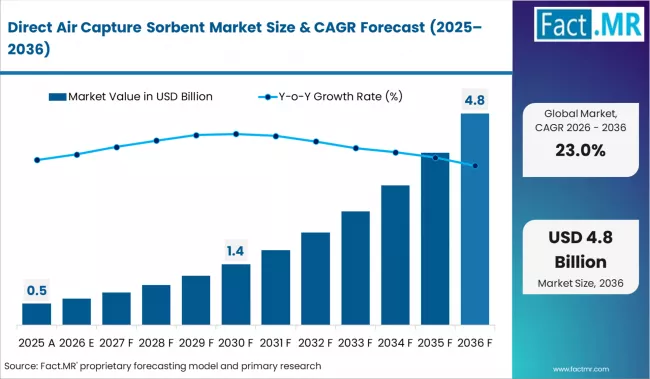
Direct Air Capture Sorbent Market Market Value Analysis | Source: Fact.MR
| Metric | Value |
|---|---|
| Estimated Value in 2026 | USD 0.6 billion |
| Forecast Value in 2036 | USD 5.6 billion |
| Forecast CAGR (2026 to 2036) | 23% |
Source: Fact.MR analysis. Updated Mar 30, 2026
Country-level growth trends reflect variations in policy support, funding intensity, and carbon market maturity. The United States leads with a projected CAGR of 26.3% through 2036, supported by the DOE’s USD 3.5 billion DAC Hub programme and IRA 45Q incentives. The United Kingdom follows at 25.0%, driven by UKRI and BEIS-funded initiatives and North Sea cluster investments. Canada records 24.3% growth through its carbon credit framework and Alberta-based sequestration hubs. Germany is expected to grow at 23.8%, supported by EU Innovation Fund financing and Carbon Contracts for Difference, while China records 22.0%, driven by state-backed pilot programmes. Key structural constraints across mature markets include high sorbent production costs, energy-intensive regeneration processes, and uncertainty around long-term carbon credit pricing beyond 2030.
Summary of Direct Air Capture Sorbent Market
- Market Definition
- The market covers solid, liquid, and hybrid CO₂-binding chemical sorbents used in direct air capture systems for carbon removal and utilisation, supplied to DAC project developers, power operators, and industrial carbon compliance customers globally.
- Demand Drivers
- The US DOE’s USD 3.5 billion DAC Hub programme is funding commercial-scale sorbent procurement at Stratos and Project Bison sites, generating structured multi-year supply requirements for qualified sorbent manufacturers.
- EU Carbon Contracts for Difference mechanisms enabled in 2024 are de-risking DAC project economics in Germany and the Netherlands, accelerating commercial sorbent procurement timelines beyond pilot phase.
- Canada’s federal Clean Fuel Regulation carbon credit market is incentivising oil sands operators in Alberta to contract DAC sorbent supply for compliance-grade carbon removal verification.
- Key Segments Analyzed
- By Product Type: Solid Sorbentsotb lead with approximately 62% share in 2026, driven by lower regeneration energy requirements and superior cycle durability over liquid alternatives.
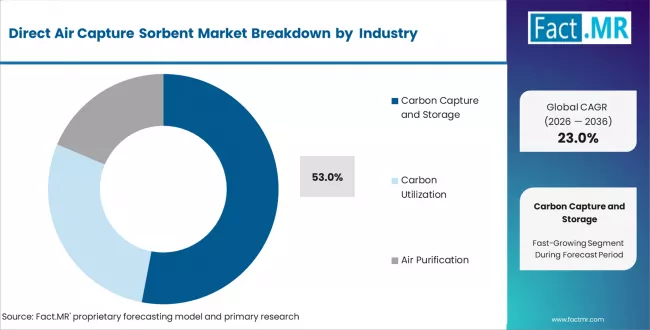
- By Application: Carbon Capture and Storage leads at approximately 53% share in 2026, reflecting geological storage project pipeline dominance over utilisation applications.
- By Geography: The USA leads at 26.3% CAGR, driven by DOE DAC Hub funding and IRA 45Q carbon capture credit incentives.
- Analyst Opinion at FACT.MR
- Shambhu Nath Jha, Principal Consultant at Fact.MR, opines, ‘CXOs in energy and industrial sectors are prioritising sorbent performance. Regeneration durability and cost per tonne captured are critical factors. Procurement decisions are increasingly cost-driven. Developers must secure validated multi-cycle sorbent supply. Without this, achieving commercial financing by 2036 will be difficult.’
- Strategic Implications
- Secure long-term amine and alkali sorbent supply to reduce risk and support financing.
- Invest in solid sorbent durability and cycle life validation for commercial access.
- Develop local supply in the US and Canada to meet domestic procurement requirements.
- Methodology
- Based on sorbent volumes and pricing, validated with 2024–2025 data.
- Uses DOE, UKRI, EU, and NDRC programme data for demand analysis.
- Forecasts include carbon credit trends, DAC pipeline, and scale-up insights.
Segmental Analysis Direct Air Capture Sorbent Market
Direct Air Capture Sorbent Market Analysis by Product Type

Direct Air Capture Sorbent Market Analysis By Product Type | Source: Fact.MR
Based on FACT.MR’s direct air capture sorbent market report, Solid Sorbents are estimated to hold 62% share in 2026. Solid sorbents dominate because they offer lower regeneration temperatures, reduced energy consumption per cycle, and superior durability across thousands of adsorption-desorption cycles. These properties directly improve DAC project economics versus liquid alternatives.
- Climeworks Expansion: Climeworks commissioned its Mammoth DAC plant in Iceland in May 2024, the world’s largest at 36,000 tonne CO₂ per year capacity, utilising solid amine sorbent technology developed in-house. The project demonstrated commercial-scale solid sorbent performance data for the first time, advancing the supplier qualification landscape. [1]
- Heirloom Technology Development: Heirloom Carbon Technologies advanced its limestone-based solid sorbent mineralisation DAC process in 2024, completing process validation at its Louisiana facility. The approach uses calcium carbonate cycling as a low-cost solid sorbent alternative to synthetic amines. [2]
- Solid Sorbent Trend: DOE’s 2024 DAC programme RFI identified solid sorbent regeneration cycle durability as the primary supplier qualification criterion. Project developers specified minimum 5,000-cycle validated performance for commercial procurement, excluding liquid amine suppliers from most commercial project tenders. [3]
Direct Air Capture Sorbent Market Analysis by Application
Direct Air Capture Sorbent Market Analysis By Application | Source: Fact.MR
Based on FACT.MR’s direct air capture sorbent market report, Carbon Capture and Storage holds 53% share in 2026. Geological storage applications dominate because permanent sequestration satisfies the highest-value carbon removal credit standards and meets corporate and government net-zero compliance requirements that utilisation pathways cannot fully address.
- 1PointFive CCS Investment: 1PointFive advanced Project Bison, a 5 million tonne per year DAC-to-geological storage project in Wyoming in 2024, under DOE DAC Hub co-funding. The project specified large-volume solid sorbent supply contracts as a precondition for financial close, generating structured procurement demand. [4]
- Carbon Utilisation Development: Carbyon developed modular DAC sorbent panels for CO₂-to-synthetic fuel utilisation applications in 2024, targeting industrial carbon utilisation customers seeking certified CO₂ feedstock from direct air sources. The product targets offtake from e-fuel producers in Europe. [5]
- CCS Procurement Trend: Geological storage project pipelines in the USA and Canada dominated DAC sorbent procurement in 2024. DOE-funded projects required ICVCM-compliant carbon removal verification, which geological storage satisfies more readily than utilisation, sustaining CCS application volume leadership. [6]
Drivers, Restraints, and Opportunities
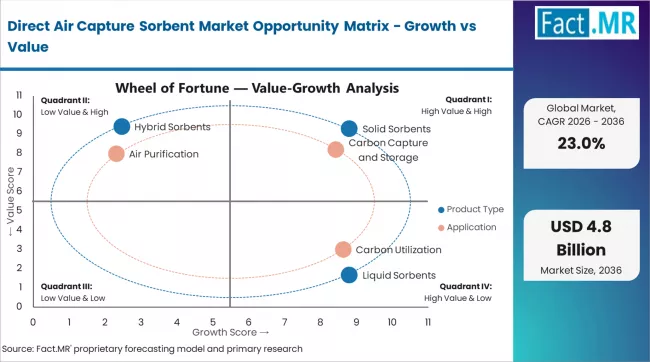
Direct Air Capture Sorbent Market Opportunity Matrix Growth Vs Value | Source: Fact.MR
FACT.MR notes the market has moved from research to early commercial stage, valued at USD 0.5 billion in 2025. Growth is driven by net-zero mandates, DOE and EU funding, and rising demand for high-quality carbon removal credits.
The market shows a clear shift in technology. Liquid amine sorbents are declining due to high energy use and replacement costs. Solid sorbents are gaining share due to lower regeneration energy and longer cycle life. Premium solid formats support revenue growth despite limited project scale.
- US DOE DAC Hub Investment: The USD 3.5 billion funding is accelerating large-scale DAC project deployment and creating long-term, structured sorbent supply agreements. It also establishes early commercial pricing benchmarks and reduces financing risk for project developers.
- EU Carbon Contracts for Difference: Guaranteed CO₂ pricing under CCfD provides revenue certainty, enabling developers to commit to multi-year sorbent procurement contracts and support large-scale project bankability.
- Voluntary Carbon Market Shift: The shift toward high-quality DAC credits is increasing corporate willingness to pay premium prices, improving project economics and expanding sorbent demand across commercial DAC pipelines.
Regional Analysis
The direct air capture sorbent market is analysed across North America, Europe, Asia Pacific, Latin America, and Middle East and Africa, covering 40+ key countries with distinct demand profiles shaped by national carbon removal policy, government direct project funding, and voluntary carbon market maturity. The full report offers market attractiveness analysis by region and country.
.webp "Top Country Growth Comparison Direct Air Capture Sorbent Market Cagr (2026 2036)")
Top Country Growth Comparison Direct Air Capture Sorbent Market Cagr (2026 2036) | Source: Fact.MR
| Country | CAGR (2026 to 2036) |
|---|---|
| USA | 26.3% |
| UK | 25.0% |
| Canada | 24.3% |
| Germany | 23.8% |
| China | 22.0% |
Source: Fact.MR analysis. Updated Mar 30, 2026
Source: Fact.MR (FACT.MR) analysis, based on proprietary forecasting model and primary research
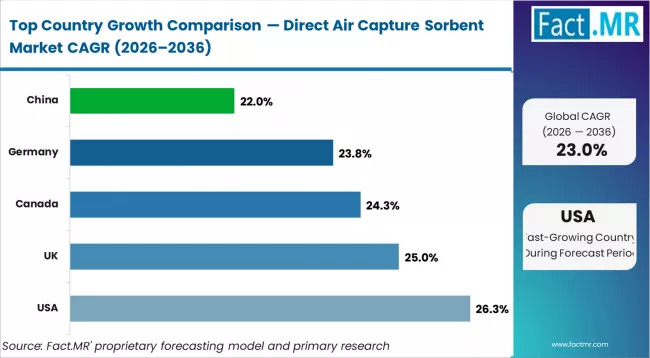
Direct Air Capture Sorbent Market Cagr Analysis By Country | Source: Fact.MR
North America Direct Air Capture Sorbent Market
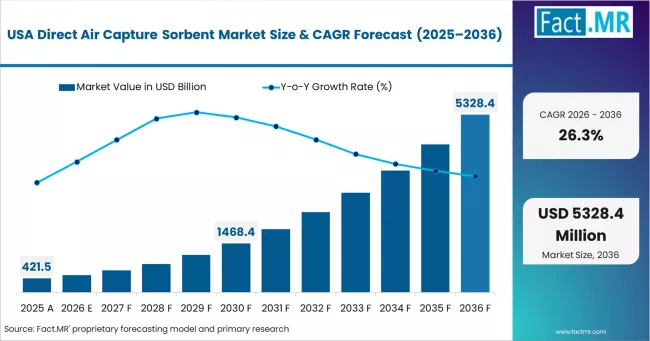
Direct Air Capture Sorbent Market Country Value Analysis | Source: Fact.MR
North America is the most advanced and largest market for DAC sorbents, supported by strong federal funding, policy incentives, and a mature project pipeline. Leading players such as Clime works, 1PointFive, and Heirloom are driving deployment, with DOE partnerships providing long-term procurement visibility and accelerating commercial scale-up.
- USA: The USA is projected to grow at 26.3% CAGR through 2036. Growth is driven by the DOE’s USD 3.5 billion DAC Hub programme and IRA 45Q tax credits, which significantly improve project economics. Large-scale projects such as Stratos and Project Bison are establishing structured, long-term sorbent procurement frameworks. Additional DOE-backed projects are expanding the supplier qualification pipeline, supporting sustained demand growth.
- Canada: Canada is projected to grow at 24.3% CAGR through 2036. Growth is supported by compliance-driven carbon credit markets and Alberta’s carbon sequestration hubs. Federal tax incentives and Carbon Engineering’s vertically integrated DAC development are strengthening domestic sorbent supply chains and procurement commitments.
FACT.MR covers the USA, Canada, and Mexico, including funding mechanisms, tax incentives, and procurement trends.
Europe Direct Air Capture Sorbent Market
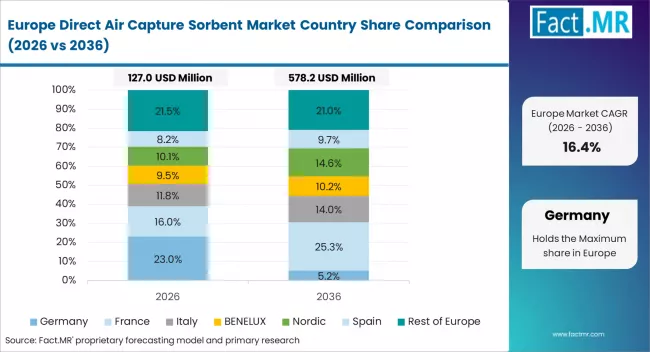
Direct Air Capture Sorbent Market Europe Country Market Share Analysis, 2026 & 2036 | Source: Fact.MR
Europe is a policy-driven market, defined by strong regulatory frameworks such as the EU Innovation Fund and Carbon Contracts for Difference. Demand is supported by industrial decarbonisation mandates and structured carbon pricing mechanisms. Emerging companies such as Mission Zero Technologies, Carbyon, and Skytree are advancing commercial deployment.
- UK: The UK is projected to grow at 25.0% CAGR through 2036. Growth is driven by UKRI funding programmes and long-term carbon removal contracts that provide revenue certainty. Investments in North Sea storage clusters are also supporting DAC deployment and defining sorbent procurement timelines.
- Germany: Germany is projected to grow at 23.8% CAGR through 2036. Growth is supported by EU Innovation Fund financing and CCfD mechanisms, which guarantee carbon removal pricing and enable multi-year procurement agreements. Industrial players are advancing solid sorbent technologies for large-scale deployment.
FACT.MR covers Germany, UK, France, and Europe, including regulatory frameworks, funding, and procurement trends.
Asia Pacific Direct Air Capture Sorbent Market
Asia Pacific is an emerging but fast-growing market, driven primarily by government-funded pilot projects and national carbon neutrality goals. Unlike Western markets, demand is less driven by voluntary carbon markets and more by state-directed programmes and research initiatives.
- China: China is projected to grow at 22.0% CAGR through 2036. Growth is supported by NDRC-led pilot zones and national research funding for sorbent development, including amine and advanced material systems. Domestic supplier qualification and state-backed procurement frameworks are shaping the early-stage market structure.
FACT.MR covers China, Japan, South Korea, India, ASEAN, and ANZ, including government funding, pilot deployment, and technology development trends.
Competitive Aligners for Market Players
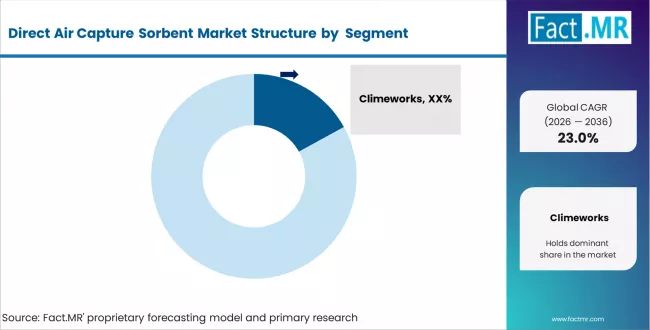
Direct Air Capture Sorbent Market Analysis By Company | Source: Fact.MR
The direct air capture (DAC) sorbent market is still at an early commercial stage and remains highly fragmented. No single supplier dominates, and competition is driven more by technology performance than by scale. Key factors include regeneration cycle durability, CO₂ capture efficiency at low ambient concentrations, and the ability to manufacture sorbents at scale. Companies such as Climeworks, Heirloom Carbon Technologies, and Mission Zero Technologies are leading the market by focusing on differentiated technologies and integrating directly with DAC project development rather than competing on volume alone.
A major advantage in this market comes from vertical integration. Companies like Climeworks develop and use their own proprietary solid sorbents, allowing them to generate unique performance data that is not accessible to competitors. Similarly, Carbon Engineering, now part of Occidental Petroleum, benefits from an in-house sorbent supply aligned with its large-scale DAC projects. This integrated approach limits opportunities for independent sorbent suppliers, as project developers often prefer proven, internally validated solutions. At the same time, large DAC developers and government programmes are actively managing supply risk.
Projects funded under initiatives like the DOE DAC Hub require multiple qualified sorbent suppliers to ensure reliability and continuity. This reduces dependence on any single provider while still creating stable demand for those that meet strict performance criteria. As a result, pricing power tends to remain with companies offering advanced, high-performance solid sorbents, particularly where regeneration efficiency and long cycle life cannot be easily replicated by standard amine-based materials.
Key Players
- Climeworks
- Carbon Engineering
- Global Thermostat
- Heirloom Carbon Technologies
- Mission Zero Technologies
- Carbyon
- Verdox
- Carbon Clean
- Skytree
- AspiraDAC
- Sustaera
Scope of Report

Direct Air Capture Sorbent Market Breakdown By Product Type, Application, And Region | Source: Fact.MR
| Attribute | Details |
|---|---|
| Quantitative Units | USD 0.6 billion (2026) to USD 5.6 billion (2036), at a CAGR of 23% |
| Market Definition | Market include solid, liquid, and hybrid CO₂-binding sorbent materials used in direct air capture systems for carbon removal, geological storage, and utilisation, supplied to DAC project developers, power operators, and industrial carbon compliance customers globally. |
| Product Type Segmentation | Solid Sorbents, Liquid Sorbents, Hybrid Sorbents |
| Application Segmentation | Carbon Capture and Storage, Carbon Utilization, Air Purification, Others |
| End-Use Industry Segmentation | Power Generation, Oil & Gas, Industrial, Commercial, Others |
| Material Type Segmentation | Amine-Based, Alkali-Based, Metal-Organic Frameworks, Zeolites, Others |
| Application Coverage | Geological CO₂ storage from DAC, CO₂-to-synthetic fuel utilisation, industrial residual emission offsetting, commercial building air purification, and government-funded carbon removal credit generation. |
| Regions Covered | North America, Europe, Asia Pacific, Latin America, Middle East and Africa |
| Countries Covered | USA, Canada, Mexico, Germany, UK, France, Italy, Spain, Nordic, BENELUX, China, Japan, South Korea, India, ASEAN, Australia and New Zealand, Brazil, Argentina, Chile, Saudi Arabia, GCC, Turkey, South Africa, Rest of MEA |
| Key Companies Profiled | Climeworks, Carbon Engineering, Global Thermostat, Heirloom Carbon Technologies, Mission Zero Technologies, Carbyon, Verdox, Carbon Clean, Skytree, AspiraDAC, Sustaera |
| Forecast Period | 2026 to 2036 |
| Approach | Hybrid top-down and bottom-up model using DAC project-level sorbent volume estimates, average sorbent prices by material type, government programme procurement data, carbon credit market forecasts, and primary interviews with DAC project engineers and sorbent procurement managers. |
Source: Fact.MR analysis. Updated Mar 30, 2026
Direct Air Capture Sorbent Market by Segments
-
By Product Type:
- Solid Sorbents
- Liquid Sorbents
- Hybrid Sorbents
-
By Application:
- Carbon Capture and Storage
- Carbon Utilization
- Air Purification
- Others
-
By End-Use Industry:
- Power Generation
- Oil & Gas
- Industrial
- Commercial
- Others
-
By Material Type:
- Amine-Based
- Alkali-Based
- Metal-Organic Frameworks
- Zeolites
- Others
-
By Region:
-
North America
- United States
- Canada
- Mexico
-
Latin America
- Brazil
- Mexico
- Argentina
- Chile
- Rest of Latin America
-
Western Europe
- Germany
- United Kingdom
- France
- Italy
- Spain
- Nordic Countries
- BENELUX
- Rest of Western Europe
-
Eastern Europe
- Russia
- Poland
- Hungary
- Balkan and Baltic
- Rest of Eastern Europe
-
East Asia
- China
- Japan
- South Korea
-
South Asia and Pacific
- India
- ASEAN
- Australia and New Zealand
- Rest of South Asia and Pacific
-
Middle East and Africa
- Kingdom of Saudi Arabia
- Other GCC Countries
- Turkey
- South Africa
- Rest of Middle East and Africa
-
Bibliography
- [1] Climeworks AG. (2024). Mammoth Direct Air Capture Plant Commissioning: 36,000 Tonne CO₂ Per Year Commercial Facility in Hellisheidi, Iceland Using Solid Amine Sorbent Technology. May 2024. climeworks.com
- [2] Heirloom Carbon Technologies. (2024). Louisiana Commercial Pilot Process Validation: Limestone-Based Solid Sorbent Mineralisation DAC System Scale-Up and Performance Data Release. Q3 2024. heirloomcarbon.com
- [3] US Department of Energy, Office of Clean Energy Demonstrations. (2024). DAC Hub Programme Phase 2 Sorbent Supplier Qualification Requirements: Solid Sorbent Minimum Cycle Durability Standards and Performance Validation Criteria. 2024. energy.gov
- [4] 1PointFive / Occidental Petroleum. (2024). Project Bison DAC Hub Application: 5 Million Tonne Per Year Wyoming Geological Storage Direct Air Capture Project Sorbent Supply Procurement Framework. 2024. 1pointfive.com
- [5] Carbyon BV. (2024). Modular DAC Sorbent Panel Development for CO₂-to-Synthetic Fuel Utilisation Applications Targeting E-Fuel Producers in Europe. 2024. carbyon.com
- [6] Integrity Council for the Voluntary Carbon Market. (2024). Core Carbon Principles Assessment Framework Update: DAC Carbon Removal Credit Quality Classification and Buyer Tier Designation for Geological Storage Applications. 2024. icvcm.org
This Report Addresses
- Strategic intelligence on DAC sorbent demand across DOE DAC Hub commercial procurement, EU Innovation Fund and CCfD-financed European deployments, UK UKRI-backed scale-up, Canada Clean Fuel Regulation-driven oil sands compliance demand, and China NDRC carbon neutrality pilot investment.
- Market forecast from USD 0.6 billion in 2026 to USD 5.6 billion by 2036 at a CAGR of 23%.
- Growth opportunity mapping across solid sorbent commercial scale-up, US IRA 45Q-eligible DAC geological storage projects, UK BEIS commercial demonstrator programme procurement, Germany CCfD-anchored industrial DAC deployment, and China state-directed DAC demonstration.
- Segment-wise analysis by product type (solid, liquid, hybrid), application (CCS, utilisation, air purification, others), end-use industry (power, oil and gas, industrial, commercial, others), and material type (amine-based, alkali-based, MOF, zeolites, others).
- Regional outlook covering North America DOE-and-IRA-driven commercial leadership, Europe CCfD-and-Innovation-Fund-financed deployment, and Asia Pacific government-directed carbon neutrality pilot investment.
- Competitive landscape of Climeworks, Carbon Engineering, Heirloom Carbon Technologies, Mission Zero Technologies, Carbyon, Verdox, Carbon Clean, Skytree, and AspiraDAC covering sorbent technology differentiation, cycle performance data, and project-integrated procurement positioning.
- Regulatory impact analysis covering US IRA 45Q DAC credit mechanics, EU Carbon Contracts for Difference, UK BEIS Demonstrator Programme, and ICVCM Core Carbon Principles DAC credit quality designation.
- Report delivery in PDF, Excel datasets, and presentation formats supported by primary interviews, DOE and UKRI programme data, sorbent manufacturer revenue disclosures, and carbon credit market procurement records.
Market Definition
The direct air capture sorbent market includes solid, liquid, and hybrid materials used to capture CO₂ directly from ambient air. These sorbents operate through adsorption–regeneration cycles and are used by DAC developers, energy companies, and industrial operators.
Direct Air Capture Sorbent Market Inclusions
Covers global and regional market size from 2026 to 2036 by product type and application. Includes solid, liquid, and hybrid sorbents used in carbon storage, utilisation, and air purification across key industries.
Direct Air Capture Sorbent Market Exclusions
Excludes amine scrubbing for point-source capture, DAC equipment, and CO₂ infrastructure. Focus is only on sorbent materials used in direct air capture systems.
Direct Air Capture Sorbent Market Research Methodology
-
Primary Research: nterviews with DAC sorbent developers, project engineers, and procurement managers at energy companies and carbon removal programme operators across key markets.
-
Desk Research : Analysis of DOE, UKRI, EU Innovation Fund, and NDRC DAC programme databases and company disclosures from 2024 to 2025.
-
Market-Sizing and Forecasting: Hybrid model integrating top-down revenue estimates from sorbent supplier disclosures with bottom-up project-level volume forecasts by product type and end-use industry.
-
Data Validation and Update Cycle: Validated using sorbent manufacturer revenues, DAC project procurement data, and government programme databases with regular annual updates.
Frequently Asked Questions
How large is the global direct air capture sorbent market in 2025?
What will the market size be by 2036?
What is the expected CAGR from 2026 to 2036?
Which product type segment is poised to lead the market?
Which application segment holds the largest share?
How significant is North America in the global direct air capture sorbent market?
What defines competitiveness in this market?
Why is the market highly fragmented?
Who are the leading players?
What gives companies a competitive edge?
Why is vertical integration important?
How do project developers manage supplier risk?
Why are solid sorbents gaining traction?
What limits third-party suppliers?
Who worked on this report


Preview the report firsthand - request a free sample
Free SampleGet the brochure for pricing and purchase details
Download PDF