- Base Value(2025): 828.5 Mn
- Estimated Value(2026): 860 Mn
- Forecast Value (2036): 1.25 Bn
- CAGR (2026 - 2036): 3.8%
Air Hoist Market Forecast 2026 to 2036
In 2025, the air hoist market was valued at USD 828.5 million. Based on Fact MR's analysis, demand for air hoists is estimated to grow to USD 860 million in 2026 and USD 1,249 million by 2036. FMR projects a CAGR of 3.8% during the forecast period.
The absolute dollar growth from 2026 to 2036 is USD 389 million. This growth is driven by the increasing adoption of air hoists in industries such as manufacturing, automotive, and construction, where their efficiency in lifting heavy loads with minimal power consumption is crucial. However, challenges such as fluctuating raw material prices and the need for more advanced and automated hoisting solutions could limit growth in some regions.
India leads with a CAGR of 4.9%, supported by rapid industrial growth and the increasing adoption of advanced lifting solutions. Indonesia follows with a 4.6% CAGR, driven by expanding manufacturing and construction sectors. Vietnam grows at 4.4%, supported by rising industrialization and automation needs. Saudi Arabia grows at 4.2%, fueled by the demand for efficient lifting solutions in infrastructure projects. Mexico grows at 4.0%, benefiting from increasing industrial production. Brazil experiences a 3.8% growth rate, while the USA shows slower growth at 2.4%, reflecting a mature market. Germany shows the slowest growth at 2.0%, driven by a stable and established demand for air hoists in industrial applications.
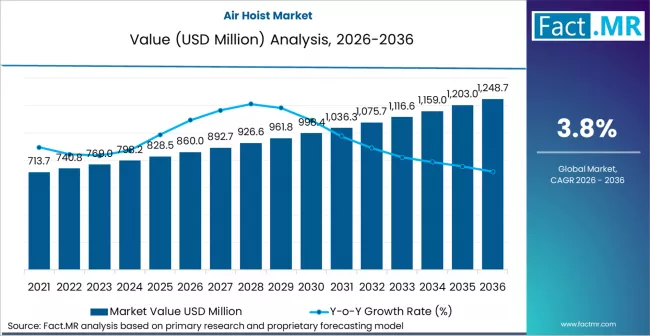
Air Hoist Market Market Value Analysis | Source: Fact.MR
Air Hoist Market Definition
The Air Hoist Market refers to the production and sale of lifting equipment powered by compressed air, designed to raise, lower, or position heavy loads safely and efficiently. Air hoists use pneumatic motors and gear trains, making them suitable for environments where electrical devices pose a fire or spark risk, such as chemical plants, refineries, shipyards, and mining sites. Their primary function is to support material handling, assembly, and maintenance operations. Key end users include manufacturing facilities, construction sites, logistics centers, and industrial service providers requiring reliable lifting solutions.
Market Inclusions
This report covers global and regional market sizes for air hoists with a defined forecast period. It includes segment breakdowns by product type (chain air hoist, lever air hoist, trolley‑mounted hoist), lifting capacity range, and application (manufacturing, construction, oil and gas, transportation). End users such as industrial facilities, OEMs, and service providers are analyzed. Pricing trends, component supply dynamics, and trade flow data are also included to reflect overall market dynamics.
Market Exclusions
The scope excludes electric, hydraulic, and manual hoists unless integrated with air‑powered systems. It omits unrelated lifting equipment such as cranes, jacks, and pulleys not powered by compressed air. Niche lifting devices used exclusively in non‑industrial or consumer applications are not covered.
Research Methodology
- Primary Research: Interviews were conducted with product engineers, OEM procurement specialists, and industrial end users.
- Desk Research: Data was sourced from industry reports, manufacturing statistics, and trade association publications.
- Market‑Sizing and Forecasting: A hybrid model was used, combining top‑down industrial lifting demand estimates with bottom‑up shipment and revenue data.
- Data Validation and Update Cycle: Findings were validated through expert review and aligned with recent production, trade, and sales figures, with periodic updates.
Air Hoist Market Summary
-
Air Hoist Market Definition
- The Air Hoist Market focuses on lifting equipment powered by compressed air, designed to raise, lower, or position heavy loads efficiently and safely. These hoists utilize pneumatic motors and gear systems, making them ideal for environments where electrical equipment is not safe, such as in chemical plants, refineries, and shipyards. Their primary role is in material handling, assembly, and maintenance operations. Key industries using air hoists include manufacturing, construction, automotive, and logistics, where reliable lifting systems are essential for operational efficiency and safety.
-
Demand Drivers in the Market
- Industrial Growth and Automation: The increasing demand for lifting equipment across industries like manufacturing, automotive, and construction is fueling the air hoist market. The growth of automation and industrial projects is driving the need for efficient, safe, and reliable hoisting systems.
- Safety and Efficiency Requirements: Air hoists are particularly valued in hazardous environments due to their non-electrical operation, reducing the risk of sparks or explosions. Their efficiency in lifting heavy loads with minimal power consumption is essential for industries seeking to improve productivity.
- Demand for Energy-Efficient Solutions: With rising emphasis on energy-saving technologies, air hoists, particularly pneumatic chain hoists, are being increasingly preferred for their energy efficiency and durability in various industrial applications.
- Regulatory Standards for Workplace Safety: Industrial safety codes and regulations, such as ISO 12100, are pushing the adoption of certified hoisting systems that meet defined safety and performance criteria, further driving the demand for reliable and high-performing air hoists.
-
Key Segments Analyzed in the FMR Report
- Hoist Type: Pneumatic chain hoists are projected to dominate the market, owing to their reliability, ease of maintenance, and ability to handle heavy loads efficiently in industrial applications.
- Capacity: Hoists with a 1-3 tons lifting capacity are expected to lead the market due to their suitability for medium-duty tasks across a wide range of industries.
- End Use: The manufacturing sector is expected to be the largest end-user, followed by sectors like shipbuilding and oil & gas, where hoisting and lifting of heavy loads are crucial for operations.
-
Analyst Opinion at FMR
- FactMR analysts predict that, "The air hoist market will continue its steady growth, driven by the increasing demand for reliable, energy-efficient lifting solutions across industrial sectors, particularly in emerging markets with a focus on automation and efficiency."
-
Strategic Implications/Executive Takeaways
- Focus on Safety and Energy Efficiency: Manufacturers should prioritize developing hoists that meet industrial safety standards and offer energy-efficient solutions for lifting heavy loads.
- Expand Offerings for Emerging Markets: Companies should consider expanding their market presence in rapidly developing regions such as India, Indonesia, and Vietnam, where industrial growth and infrastructure projects are driving the need for advanced hoisting systems.
- Enhance Product Offerings with Automation: As industries continue to adopt automation, integrating smart features such as load monitoring and automatic adjustments into air hoists will enhance their value proposition.
- Invest in Robust and Low-Maintenance Designs: Air hoists that offer high reliability, durability, and low maintenance requirements will continue to be in demand, especially in industries with high operational uptime expectations.
-
Methodology
- Primary Research: Interviews were conducted with engineers, procurement specialists, and end-users to understand market trends, challenges, and specific needs related to air hoisting systems.
- Desk Research: Data was sourced from industry reports, manufacturing statistics, and trade publications to complement primary research findings.
- Market Sizing and Forecasting: The market forecast was developed using a hybrid top-down and bottom-up approach, validated through expert insights and industry benchmarks to provide accurate predictions for the market’s growth.
Segmental Analysis
Air Hoist Market Analysis by Hoist Type
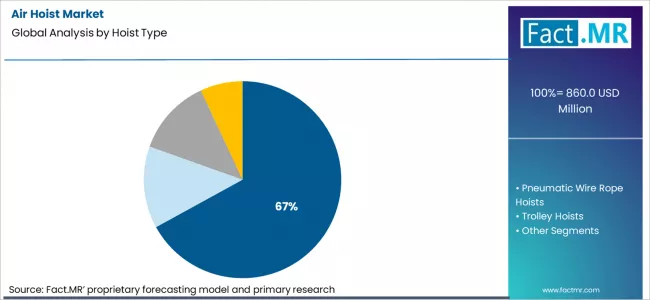
Air Hoist Market Analysis By Hoist Type | Source: Fact.MR
- Market Overview: Pneumatic chain hoists are expected to capture 67% of the air hoist market by 2026. Pneumatic chain hoists are widely used in industries that require efficient, high-power lifting equipment for heavy loads. Their reliability, ease of maintenance, and ability to operate in hazardous environments make them a preferred choice in sectors like manufacturing, automotive, and construction.
- Demand Drivers:
- Power and Efficiency: Pneumatic chain hoists are highly favored for their ability to lift heavy loads with smooth and controlled operations. They are essential in applications where precise lifting and handling of materials are critical, such as in assembly lines and warehouses.
- Ease of Use and Maintenance: Chain hoists are relatively easy to operate and maintain, making them highly cost-effective for businesses that need reliable lifting solutions with minimal downtime.
- Safety and Versatility: Pneumatic chain hoists are ideal for use in environments where electrical equipment may pose safety hazards, such as in explosive atmospheres. Their pneumatic operation makes them versatile and safe in a wide range of industries, further driving their demand.
Air Hoist Market Analysis by Capacity
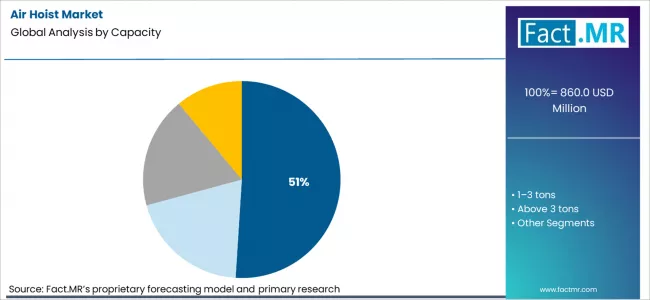
Air Hoist Market Analysis By Capacity | Source: Fact.MR
- Market Overview: 1-3 tons capacity is projected to hold 51% of the market share by 2026. This range is ideal for many industrial applications where lifting capacities of 1 to 3 tons are commonly required. Air hoists in this range are used for medium-duty lifting tasks in a variety of sectors such as manufacturing, logistics, and maintenance.
- Demand Drivers:
- Wide Range of Industrial Applications: Hoists with a 1-3 tons lifting capacity are frequently used in industries such as automotive, manufacturing, and construction, where medium-weight loads are handled regularly. This makes them an essential tool for lifting heavy equipment and materials.
- Energy Efficiency and Cost-Effectiveness: The 1-3 tons range offers a good balance between power, energy consumption, and cost, making it an attractive option for businesses that need reliable lifting equipment for daily operations without excessive operational costs.
- Increasing Demand for Precision in Lifting: As industries continue to focus on operational efficiency and safety, air hoists in the 1-3 tons capacity range are crucial for ensuring precise, controlled lifting of materials without risking damage to the load or hoist itself.
Air Hoist Market Drivers, Restraints, and Opportunities
FMR analysts observe that the air hoist market is a mature, utility‑dependent segment anchored in industrial and construction lifting applications where compressed air power offers durability and safety advantages over electric alternatives. Historically, pneumatic hoists were preferred in environments with spark risk or where electrical infrastructure is limited, creating structural demand tied to manufacturing, mining, and shipbuilding sectors. The 2026 valuation reflects this reality, with baseline demand supported by ongoing industrial activity and maintenance cycles that rely on robust lifting solutions.
While demand for basic chain and lever hoists remains significant in cost‑sensitive settings, advanced air hoists with enhanced controls, precise speed regulation, and integrated safety features are gaining share. These higher‑value units carry elevated per‑unit pricing, contributing to net market value growth even as overall unit volumes align with industrial investment and retrofit activity. The market exists because reliable load handling directly affects workplace safety, productivity, and compliance with equipment standards.
- Industrial Productivity Demand: Manufacturers and maintenance teams adopt advanced air hoists to improve load control, reduce cycle time, and increase operational uptime versus basic pneumatic or manual alternatives.
- Regulatory & Safety Standards: Industrial safety codes and directives such as ISO 12100 general safety principles and local lifting device standards push adoption of certified hoisting systems with defined safety and performance criteria.
- Regional Industrial Dynamics: In Asia‑Pacific and North America, strong manufacturing and construction sectors drive higher uptake of advanced air hoists, while basic units remain prevalent in smaller or cost‑sensitive markets.
Regional Analysis
The market analysis covers key global regions, including South Asia and Pacific, Middle East & Africa, Latin America, North America, and Western Europe. It is segmented geographically, with specific market dynamics for each region. The full report provides a detailed market attractiveness analysis.
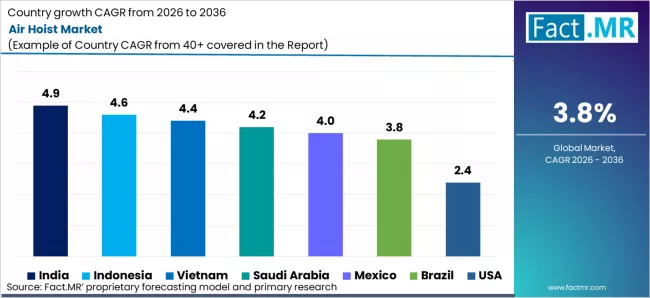
Air Hoist Market Cagr Analysis By Country | Source: Fact.MR
| Country | CAGR (2026-2036) |
|---|---|
| India | 4.9% |
| Indonesia | 4.6% |
| Vietnam | 4.4% |
| Saudi Arabia | 4.2% |
| Mexico | 4.0% |
| Brazil | 3.8% |
| USA | 2.4% |
| Germany | 2.0% |
Source: Fact.MR analysis. Updated Feb 21, 2026
Source: Fact MR (FMR) analysis, based on proprietary forecasting model and primary research.
South Asia and Pacific:
South Asia and Pacific are "key growing markets" for air hoists, with increasing industrialization and a growing demand for lifting equipment in countries like India, Indonesia, and Vietnam.
- India: Demand for air hoists in India is projected to rise at 4.9% CAGR through 2036. India’s expanding industrial base and growing demand for lifting equipment in sectors like manufacturing and construction continue to drive the market.
- Indonesia: Demand for air hoists in Indonesia is projected to rise at 4.6% CAGR through 2036. The growing manufacturing sector and increased focus on automation contribute to market growth for air hoists.
- Vietnam: Demand for air hoists in Vietnam is projected to rise at 4.4% CAGR through 2036. Vietnam’s industrial growth and rising demand for efficient lifting solutions support steady market growth.
Middle East & Africa:
In the Middle East, particularly Saudi Arabia, demand for air hoists is driven by industrial growth and increasing investments in infrastructure and manufacturing sectors.
- Saudi Arabia: Demand for air hoists in Saudi Arabia is projected to rise at 4.2% CAGR through 2036. Saudi Arabia’s industrial and infrastructure expansion and growing need for reliable lifting systems continue to support demand for air hoists.
Latin America:
In Latin America, particularly Mexico and Brazil, the demand for air hoists is driven by the growth of manufacturing industries and infrastructure development.
- Mexico: Demand for air hoists in Mexico is projected to rise at 4.0% CAGR through 2036. Mexico’s growing industrial base and increased investments in manufacturing contribute to market growth.
- Brazil: Demand for air hoists in Brazil is projected to rise at 3.8% CAGR through 2036. Brazil’s expanding manufacturing sector and focus on automation in construction and mining industries continue to support the adoption of air hoists.
North America:
In North America, the USA continues to be a significant market for air hoists, supported by industrial demand for lifting equipment in sectors like manufacturing, automotive, and construction.
- USA: Demand for air hoists in the U.S. is projected to rise at 2.4% CAGR through 2036. The USA’s strong industrial sector and focus on enhancing lifting efficiency continue to drive demand for air hoists.
Western Europe:
In Western Europe, Germany remains a key market for air hoists, driven by industrial growth and increasing adoption of lifting equipment in manufacturing processes.
- Germany: Demand for air hoists in Germany is projected to rise at 2.0% CAGR through 2036. Germany’s advanced industrial sector and increased demand for lifting equipment in manufacturing continue to support the market for air hoists.
Fact MR's analysis of the air hoist market in South Asia and Pacific, Middle East & Africa, Latin America, North America, and Western Europe consists of country-wise assessments that include India, Indonesia, Vietnam, Saudi Arabia, Mexico, Brazil, the USA, and Germany. Readers can find detailed trends, regulatory updates, and company-specific investments shaping the market’s growth in these countries.
How Are Key Players Competing in the Air Hoist Market?
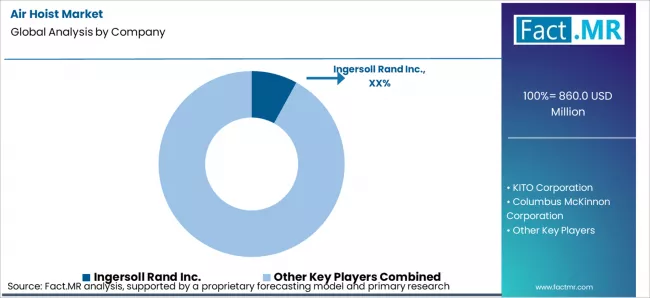
Air Hoist Market Analysis By Company | Source: Fact.MR
The air hoist market is evolving with Ingersoll Rand Inc. and KITO Corporation leading the charge, focusing on providing reliable, energy-efficient hoists that cater to industries like manufacturing, construction, and logistics. Columbus McKinnon Corporation and its brand Yale Hoists are prominent with a strong emphasis on hoists designed for both high performance and ease of operation. J.D. Neuhaus GmbH & Co. KG offers specialized air hoists tailored to heavy-duty applications, while Harrington Hoists, Inc. and Red Rooster Lifting Ltd. provide solutions with advanced safety features and durability. Konecranes Plc and Terex Corporation continue to innovate by integrating automation and ergonomic solutions into their hoist systems, ensuring improved productivity and operator safety. The market is increasingly focused on automation, energy efficiency, and enhanced load capacity, with key players leveraging technological advancements to gain a competitive edge.
Recent Industry Developments
- IMO (International Maritime Organization) | SOLAS Regulation II-1/3-13 | January 2026 The IMO’s mandatory safety requirements for on-board lifting appliances enter into force on January 1, 2026. This affects all air hoists and cranes on vessels with a safety construction certificate. To comply, equipment must undergo annual thorough examinations and load testing every 5 years, with no exemptions for appliances installed prior to 2026 unless they meet strict "Factual Statement" criteria.
- OSHA (Occupational Safety and Health Administration) | 1926.554 Standard Enforcement | January 2026 OSHA has reinforced its 2026 enforcement of standard 1926.554 (Overhead Hoists), specifically targeting air supply safety. The updated guidance mandates that all air hoses supplying hoists must be positively connected (using safety clips or whip-checks) to prevent accidental disconnection, and operators must be positioned clear of the load at all times during operation.
- ISO (International Organization for Standardization) | ISO/DIS 13849-2:2026 | February 2026 The newly published Draft International Standard (DIS) 13849-2:2026 focuses on the safety-related parts of control systems. This is critical for the 2026 air hoist market as it defines "proven safety principles" for the entire machine lifecycle, forcing manufacturers to standardize how pneumatic controls respond to emergency stops and pressure loss.
Key Players of the Air Hoist Market
- Ingersoll Rand Inc.
- KITO Corporation
- Columbus McKinnon Corporation
- J.D. Neuhaus GmbH & Co. KG
- Harrington Hoists, Inc.
- Konecranes Plc
- Red Rooster Lifting Ltd.
- Terex Corporation (Demag Cranes & Components GmbH)
- Columbus McKinnon Corporation (Yale Hoists)
Report Scope
| Metric | Value |
|---|---|
| Quantitative Units | USD 860 million (2026) to USD 1,249 million (2036), at a CAGR of 3.8% |
| Market Definition | The Air Hoist Market includes hoisting equipment used for lifting heavy loads in various industries, providing efficient and safe handling for manufacturing, oil & gas, and shipyard applications. |
| By Hoist Type | Pneumatic Chain Hoists, Pneumatic Wire Rope Hoists, Trolley Hoists, Other |
| By Capacity | Up to 1 ton, 1-3 tons, Above 3 tons, Other |
| By End Use | Manufacturing & Assembly, Shipyards & Marine, Oil & Gas, Others |
| By Sales Channel | Industrial Distributors, Direct OEM Sales, Rental Channels, Other |
| Regions Covered | North America, Latin America, Europe, East Asia, South Asia, Oceania, Middle East and Africa |
| Countries Covered | United States, Canada, Mexico, Brazil, Argentina, Germany, France, United Kingdom, Italy, Spain, China, India, Japan, South Korea, Indonesia, Australia, and 40+ countries |
| Key Companies Profiled | Ingersoll Rand Inc., KITO Corporation, Columbus McKinnon Corporation, J.D. Neuhaus GmbH & Co. KG, Harrington Hoists, Inc., Konecranes Plc, Red Rooster Lifting Ltd., Terex Corporation (Demag Cranes & Components GmbH), Columbus McKinnon Corporation (Yale Hoists) |
| Forecast Period | 2026 to 2036 |
| Approach | Hybrid top-down and bottom-up market modeling validated through primary interviews with manufacturers and supported by trade data benchmarking and market research. |
Source: Fact.MR analysis. Updated Feb 21, 2026
Bibliographies
- International Maritime Organization. (2023). Amendments to SOLAS chapter II-1 introducing mandatory requirements for shipboard lifting appliances and anchor handling winches (Regulation II-1/3-13), effective 1 January 2026. International Maritime Organization.
- International Organization for Standardization. (2023). ISO 13849-1:2023 Safety of machinery-Safety-related parts of control systems-Part 1: General principles for design. International Organization for Standardization.
- Occupational Safety and Health Administration. (2025). 29 CFR 1926.554-Overhead hoists. U.S. Department of Labor.
- Columbus McKinnon Corporation. (2025). Pneumatic (air) hoists and lifting systems for industrial material handling (Yale Hoists). Columbus McKinnon Corporation.
- Harrington Hoists, Inc. (2025). Pneumatic (air) hoists and lifting equipment for industrial environments. Harrington Hoists, Inc.
- Ingersoll Rand Inc. (2025). Pneumatic (air) hoists for industrial lifting applications. Ingersoll Rand Inc.
Segmentation
Air Hoist Market Key Segments
-
By Hoist Type :
- Pneumatic Chain Hoists
- Pneumatic Wire Rope Hoists
- Trolley Hoists
- Other
-
By Capacity :
- Up to 1 ton
- 1-3 tons
- Above 3 tons
- Other
-
By End Use :
- Manufacturing & Assembly
- Shipyards & Marine
- Oil & Gas
- Others
-
By Sales Channel :
- Industrial Distributors
- Direct OEM Sales
- Rental Channels
- Other
-
Region :
- North America
- USA
- Canada
- Mexico
- Europe
- Germany
- UK
- France
- Italy
- Spain
- Nordic Countries
- BENELUX
- Rest of Europe
- Asia Pacific
- China
- Japan
- South Korea
- India
- Australia
- Rest of Asia Pacific
- Latin America
- Brazil
- Argentina
- Rest of Latin America
- Middle East and Africa
- Kingdom of Saudi Arabia
- United Arab Emirates
- South Africa
- Rest of Middle East and Africa
- Other Regions
- Oceania
- Central Asia
- Other Markets
- North America
Frequently Asked Questions
How large is the demand for Air Hoists in the global market in 2026?
What will be the market size of Air Hoists in the global market by 2036?
What is the expected demand growth for Air Hoists in the global market between 2026 and 2036?
Which hoist type is expected to dominate the market?
Which region is expected to show the highest growth rate for Air Hoists?
How significant is the growth outlook for Indonesia in this market?
What is the growth outlook for the United States in this report?
What is the growth forecast for Saudi Arabia in the Air Hoists market?
Which European market is highlighted in this analysis?
Which company is identified as a leading player in the Air Hoists market?
What are Air Hoists used for?
What does the Air Hoists market include in this report?
How is the market forecast developed in this report?
What is meant by the Air Hoists market in this report?
Who worked on this report


Preview the report firsthand - request a free sample
Free SampleGet the brochure for pricing and purchase details
Download PDF