- Market Value (2025): USD 4.41 Bn
- Estimated Value (2026): USD 4.68 Bn
- Forecast Value (2036): USD 8.4 Bn
- CAGR (2026-2036): 6.0%
What is the Airbag Gas Generator Market forecast to be worth by 2036?
Fact.MR forecasts growth from USD 4.7 billion in 2026 to USD 8.4 billion by 2036, at a 6.0% CAGR.
- The market was valued at USD 4.41 billion in 2025.
- Annual revenue is estimated at USD 4.68 billion in 2026 and projected at USD 8.4 billion in 2036.
- The 6.0% CAGR outlook reflects a widening range of airbag applications and continuing demand from vehicle production and replacement channels.
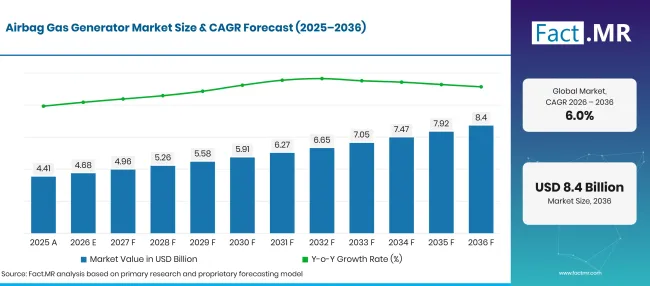
Factmr Airbag Gas Generator Market Forecast Global | Source: Fact.MR
| Year | Basis | Market Value (USD billion) |
|---|---|---|
| 2025 | Actual | 4.41 |
| 2026 | Estimate | 4.68 |
| 2036 | Forecast | 8.4 |
| CAGR 2026 to 2036 | Forecast period | 6.0% |
Source: Fact.MR analysis. Updated Oct 23, 2026
What are the defining numbers behind Airbag Gas Generator Market growth?
The market adds USD 3.7 billion in annual value between 2026 and 2036. Pyrotechnic generators hold 58.3% of the 2026 product mix, while passenger cars account for 64.5% of application demand.
- Demand Drivers in the Market
- The extension of side and curtain airbags creates a broader range of generator specifications. Daicel distinguishes driver, passenger and other airbag applications within its inflator portfolio. [2] Fact.MR expects suppliers to benefit when they can serve several positions within an awarded vehicle programme while maintaining the correct fit for each module.
- A restraint supplier must sustain component supply throughout a vehicle production programme. Autoliv describes both component manufacturing and module assembly within its operations. [1] For independent generator producers, access to an assembler's nominated supply base can create repeat business. Capacity decisions consequently depend on customer awards and production schedules as well as the general direction of vehicle demand.
- New restraint designs can change generator content within an individual module. ZF LIFETEC describes a pre-crash side-airbag concept with two inflators in one assembly. [9] Such configurations create a possible additional component sale, although adoption depends on the vehicle programme. Fact.MR expects application-led development to matter more than assuming a uniform increase in generators across every model.
- Replacement demand creates a separate commercial route after the original vehicle sale. Suppliers serving that route need accurate compatibility information and dependable distribution. Fact.MR expects authorized assembly sourcing to retain value where repairers must establish the identity of a safety-critical part. This favors firms able to support the service transaction after the component leaves their factory.
- Key Segments Analyzed
- By Product Type: Pyrotechnic Gas Generators account for 58.3% of the market in 2026, alongside hybrid and cold gas alternatives.
- By Application: Passenger Cars hold 64.5% of demand, with commercial and off-highway vehicles forming the other application groups.
- By Sales Channel: Original Equipment Manufacturer supply represents 72.1% of sales, making vehicle programme nomination the principal commercial route.
- Analyst Opinion at Fact.MR
- Shambhu Nath Jha, Sr. Consultant, Fact.MR
- The most attractive inflator contracts will come from programmes in which restraint content and engineering requirements increase together. Adding another airbag position creates a possible unit sale, while accommodating a wider range of occupants can change the generator specification. Suppliers should assess both effects before committing capacity. The replacement channel has different economics: reliable identification and authorized sourcing determine whether the product can reach a legitimate repair. A broad vehicle parc alone does not establish an addressable pool for interchangeable inflators.
- Strategic Implications
- Generator manufacturers should organize bids around the airbag position and module requirements. A clear application proposal gives the buyer a more useful comparison than a catalogue organized only by generator technology. It also identifies where an existing production family can support the award.
- Module integrators should involve generator suppliers when the restraint brief changes. Decisions associated with occupant classification systems can influence the required deployment strategy. Agreeing the component interfaces early can reduce the amount of rework carried into a later production phase.
- Companies considering new capacity should connect investment to nominated customers and the designs those customers require. A line with an attractive theoretical volume has limited value if the relevant programmes need another product family or begin production later than expected.
- Aftermarket suppliers should make compatibility records and source identification part of the offer. Repair networks need to determine which complete assembly belongs in a vehicle. Service availability and clear documentation can make an approved replacement easier to procure without relying on visual similarity.
Brazil leads the five country forecasts at 7.7%, followed by Germany at 7.4%. The United Kingdom is expected to grow at 6.2%, Japan at 5.6% and the United States at 4.4%. These markets present different commercial priorities: revised assessment programmes influence new-vehicle specifications, while established service networks create a separate need for correctly identified replacement assemblies.
How does the Airbag Gas Generator Market break down by segment?
The leading 2026 segments are Pyrotechnic Gas Generators at 58.3%, Passenger Cars at 64.5% and Original Equipment Manufacturer supply at 72.1%.
Why do pyrotechnic gas generators retain the largest product share?
Pyrotechnic Gas Generators account for 58.3% of the product mix in 2026.
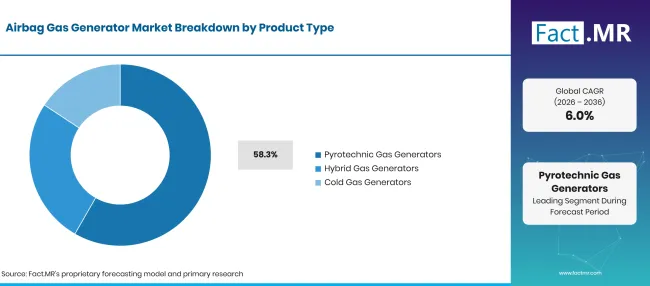
Factmr Airbag Gas Generator Market Breakdown Product Type | Source: Fact.MR
| Product Type | Share (2026) |
|---|---|
| Pyrotechnic Gas Generators | 58.3% |
| Other segments combined | 41.7% |
| Total | 100.0% |
Source: Fact.MR analysis. Updated Oct 23, 2026
The pyrotechnic segment has a substantial base of established designs to serve. Daicel lists this technology for driver inflators and alongside hybrid alternatives for passenger and other positions. [2] The customer's choice depends on the completed airbag requirement. A technology label alone does not establish which generator should be used in a particular vehicle.
Fact.MR expects existing pyrotechnic families to retain business where their package and deployment characteristics meet the programme brief. Hybrid and cold gas products have scope where a different configuration is justified. Installations such as automotive knee airbags require attention to the available space and the intended restraint task. Suppliers can protect a nomination by resolving that application requirement while keeping manufacturing and supply practical.
How do passenger cars account for most application demand?
Passenger Cars represent 64.5% of application demand in 2026.
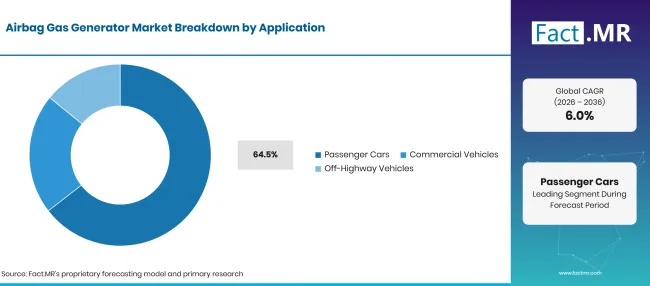
Factmr Airbag Gas Generator Market Breakdown Application | Source: Fact.MR
| Application | Share (2026) |
|---|---|
| Passenger Cars | 64.5% |
| Other segments combined | 35.5% |
| Total | 100.0% |
Source: Fact.MR analysis. Updated Oct 23, 2026
Several restraint positions can sit within one passenger-car programme. A manufacturer may therefore change generator procurement when it revises the airbag package, even without increasing vehicle output. Fact.MR expects this content effect to support demand alongside new vehicle production. The opportunity for a particular supplier depends on the designs selected and whether it participates as a component producer or through an integrated module business.
Commercial and off-highway vehicles require their own assessment of cabin layout and intended use. A supplier should not transfer a passenger-car configuration into those applications simply because a generator has a suitable physical size. For a business serving several vehicle categories, the practical objective is to reuse manufacturing capabilities where possible while maintaining distinct application responsibilities. That approach can broaden the customer base without obscuring what each programme is buying.
Why does original equipment supply command 72.1% of sales?
Original Equipment Manufacturer supply holds 72.1% of sales in 2026.
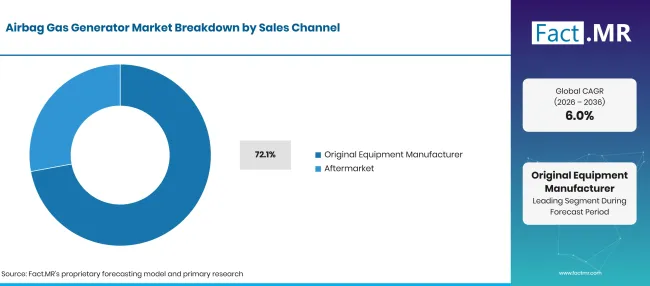
Factmr Airbag Gas Generator Market Breakdown Sales Channel | Source: Fact.MR
| Sales Channel | Share (2026) |
|---|---|
| Original Equipment Manufacturer | 72.1% |
| Aftermarket | 27.9% |
| Total | 100.0% |
Source: Fact.MR analysis. Updated Oct 23, 2026
An OEM programme gives the generator supplier a defined module specification and a production schedule. Early engineering access can be valuable because the component is selected before serial purchasing begins. Once nominated, the supplier must support the agreement through changes in volumes and product revisions. Fact.MR expects reliable execution of those obligations to remain central to repeat awards.
The relationship to airbag harnesses illustrates the wider integration task. The generator operates within an electrical and physical arrangement agreed for the vehicle, so the interfaces matter alongside the component itself. Aftermarket suppliers face a different buying process and must establish exact replacement compatibility. Their opportunity is strongest when a repairer can procure the approved assembly through a clear and dependable service route.
What is accelerating Airbag Gas Generator Market adoption, and what is holding it back?
The main growth opportunity comes from restraint designs that require additional or more specialized inflators. The main constraint is the time and cost needed to move a change into an accepted production system. Fact.MR expects this to favor suppliers that can support application engineering as well as manufacturing. A new component must resolve an identifiable customer requirement before its technical promise becomes recurring revenue.
Purchasers will also weigh the cost of retaining a satisfactory existing design against the benefit of a new configuration. Programme timing can leave a supplier funding development before a vehicle reaches production. This creates a practical distinction between a promising concept and a contract that can support factory investment. Firms should preserve room for customer revisions while avoiding capacity commitments based on unawarded business.
Drivers Impact Analysis
| DRIVER | (~) % IMPACT ON CAGR | GEOGRAPHIC RELEVANCE | IMPACT TIMELINE |
|---|---|---|---|
| Wider occupant-size coverage in new restraint programmes | +0.7% | Germany, United Kingdom and export platforms | 2026–2030 |
| Broader side and curtain protection across passenger cars | +0.6% | Brazil and Asia Pacific | 2026–2032 |
| Additional application-specific inflators within established platforms | +0.3% | Germany, Japan and United States | 2027–2034 |
| Consistent procurement through long vehicle production programmes | +0.4% | Global OEM supply networks | 2026–2036 |
| Greater preference for traceable genuine replacement assemblies | +0.2% | United States and organized repair channels | 2026–2029 |
Source: Fact.MR analysis. Updated Oct 23, 2026
Opportunity Impact Analysis
| OPPORTUNITY | (~) % IMPACT ON CAGR | GEOGRAPHIC RELEVANCE | IMPACT TIMELINE |
|---|---|---|---|
| Inflator variants for adaptive and multistage restraint designs | +0.8% | Germany, Japan and premium global platforms | 2027–2035 |
| Compact generators for additional airbag installation positions | +0.5% | United States, United Kingdom and East Asia | 2027–2033 |
| Local capacity backed by awarded vehicle programmes | +0.3% | Brazil and South Asia | 2026–2032 |
| Documented replacement supply through approved service networks | +0.2% | United States, Europe and Japan | 2026–2030 |
Source: Fact.MR analysis. Updated Oct 23, 2026
Restraints Impact Analysis
| RESTRAINT | (~) % IMPACT ON CAGR | GEOGRAPHIC RELEVANCE | IMPACT TIMELINE |
|---|---|---|---|
| Lengthy acceptance of generator changes within complete restraint systems | -0.6% | Global OEM programmes | 2026–2036 |
| Cost pressure favoring retained designs over specification upgrades | -0.4% | High-volume passenger car platforms | 2026–2031 |
| Quality liabilities and greater scrutiny of replacement provenance | -0.3% | United States and Europe | 2026–2030 |
| Uneven vehicle programme timing and customer concentration | -0.2% | Regional production hubs | 2027–2034 |
Source: Fact.MR analysis. Updated Oct 23, 2026
Which countries are shaping Airbag Gas Generator Market demand through 2036?
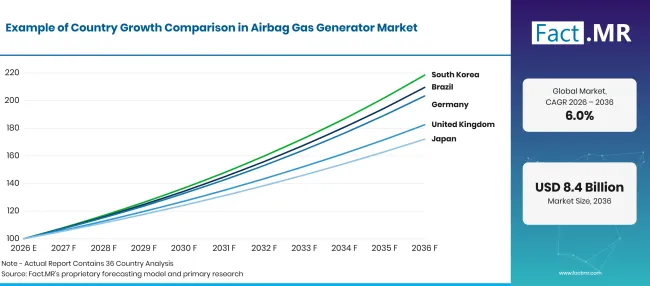
Factmr Airbag Gas Generator Market Growth Index | Source: Fact.MR
| Country | CAGR (2026–2036) |
|---|---|
| Germany | 7.4% |
| Brazil | 7.7% |
| United States | 4.4% |
| United Kingdom | 6.2% |
| Japan | 5.6% |
Source: Fact.MR analysis. Updated Oct 23, 2026
Where can German restraint programmes create generator opportunities?
Germany is forecast to record a 7.4% CAGR, with application development central to the opportunity.
Technical proximity can matter before a generator reaches serial supply. Autoliv's 2025 annual report identifies its Dachau operation as supporting customer applications and airbag platform development with a full-scale test laboratory. [1] For component suppliers, this illustrates the engineering setting in which a proposed generator has to earn acceptance. A commercial bid needs to address the vehicle programme's restraint brief and the work required to integrate the component.
Fact.MR expects a broad product family to be useful where customers develop several seating or trim arrangements. The supplier still needs to manage the added variants without weakening delivery performance. German programme opportunities are therefore best assessed against a defined development schedule and a realistic production award. A successful prototype has commercial value when it can be carried into repeat supply at the required quality and cost.
How do Brazil's revised side-impact assessments affect purchasing?
Brazil leads the profiled countries with a forecast CAGR of 7.7% through 2036.
Latin NCAP's 2026–2029 protocol uses more severe side and pole-impact assessments and adds greater attention to rear-seat protection. [5] Those changes provide a specific engineering issue for vehicles sold in Brazil. A generator proposal has to fit the airbag selected for that task and the cost of introducing the completed assembly. Fact.MR sees scope for suppliers that can help manufacturers revise restraints without creating an unnecessarily complex set of components.
Regional support can be useful when a model is sold across several Latin American markets. The same commercial programme may need to balance a common vehicle architecture with differing equipment choices. Suppliers should understand which versions are included in the award before committing production. Consumer safety ratings influence vehicle positioning, but the assessment programme does not prescribe a particular generator technology for every manufacturer.
Why is replacement provenance a distinct issue in the United States?
The United States market is expected to expand at a 4.4% CAGR.
NHTSA's September 2026 replacement-inflator guidance explains that suspect aftermarket equipment may not be tied to a vehicle's identification number, so a recall lookup alone cannot establish whether it is present. The agency also distinguishes the affected equipment from genuine replacements installed during Takata recalls. [7] The purchasing implication is a stronger need to identify the actual assembly and its source before a repair is completed.
Fact.MR expects documented compatibility to remain valuable for suppliers serving dealers and independent repair networks. Catalogue breadth has limited commercial value when the installer cannot establish that a part belongs in the vehicle. Original equipment contracts remain the main demand route. Service opportunities should be assessed against approved replacement activity and dependable distribution, rather than applying a broad assumption to the entire vehicle parc.
What gives a new inflator a stronger business case in the United Kingdom?
The United Kingdom is forecast to grow at a 6.2% CAGR, with restraint specification upgrades contributing to the outlook.
Euro NCAP's 2026 programme broadens crash protection assessment across occupant body sizes and uses physical and virtual tests. [3] For UK-facing vehicle programmes, that gives engineering teams more cases to address when selecting a restraint arrangement. Fact.MR expects the clearest generator opportunities where a proposed design contributes to an identified occupant or installation requirement and the customer can justify the cost of introducing it.
Purchasing teams will need to understand which variants can be carried across a vehicle family. A dedicated generator can be commercially sensible for a particular module, while another application may continue with an established design. Suppliers that enter those discussions early can align development work with the actual production brief. The benefit comes from a credible system contribution and a manageable supply agreement, not an unsupported assumption that every newer component deserves a premium.
How does Japan connect inflator selection with its assessment programme?
Japan is expected to achieve a 5.6% CAGR between 2026 and 2036.
NASVA's FY2025 material lists revised full-frontal, offset-frontal and side-collision procedures dated April 14, 2025. [6] These provide a defined assessment setting for domestic vehicle programmes. Generator suppliers need to work with the airbag assembly and its intended position within the vehicle. The acceptance of a component rests on the resulting restraint performance, rather than its category name in a product catalogue.
Fact.MR sees opportunities where a suitable design can serve domestic programmes and related export platforms. Specification differences still have to be managed, but unnecessary component proliferation can make production and service support more difficult. Close coordination between generator manufacturing and module engineering is commercially useful in that setting. The supplier's offer should explain which application it resolves and how the product can be supported over the life of the programme.
Who participates in the Airbag Gas Generator Market?
The competitive field includes specialist generator manufacturers and integrated restraint suppliers. Daicel offers inflator families for several airbag positions, while Joyson Safety Systems lists pyrotechnic, stored-gas and hybrid products. [2] [4] Autoliv manufactures inflators and also operates airbag assembly activities. [1] These business models affect whether the customer is sourcing a component, a module or broader application support.
ZF LIFETEC participates through inflator and airbag development, including its published dual-inflator side-airbag concept. [9] Toyoda Gosei is relevant through module integration: in December 2025 it introduced a front center airbag designed to support itself without relying on the center console. [8] That development changes the integration task around the restraint.
Fact.MR expects programme access and supply execution to influence competitive outcomes. Customers need to compare each supplier's role within the restraint package before comparing prices. A module integrator and a component producer may participate in the same vehicle programme without competing for every purchasing decision. The most durable relationships should be those that can accommodate product revisions, production changes and service requirements after the initial nomination.
Which companies are the key providers?
Key companies profiled include Autoliv, Inc.; Daicel Corporation; Joyson Safety Systems; ZF LIFETEC; and Toyoda Gosei Co., Ltd. (through airbag module integration).
- Autoliv, Inc.
- Daicel Corporation
- Joyson Safety Systems
- ZF LIFETEC
- Toyoda Gosei Co., Ltd., through airbag module integration
Bibliography
- [1] Autoliv, Inc. (2026, February 19). Annual report 2025.
- [2] Daicel Corporation (n.d.). Inflator.
- [3] Euro NCAP (2025, November 26). Euro NCAP announces 2026 protocol changes to tackle modern driving risks.
- [4] Joyson Safety Systems (n.d.). Inflators.
- [5] Latin NCAP (2025, November 21). Latin NCAP announces update to its assessment protocol.
- [6] National Agency for Automotive Safety and Victims' Aid (2025). Vehicle safety performance 2025 and testing methods.
- [7] National Highway Traffic Safety Administration (2026, September 3). Deadly air bag inflator replacements: What to know.
- [8] Toyoda Gosei Co., Ltd. (2025, December 17). Toyoda Gosei develops new self-supporting front center airbag.
- [9] ZF LIFETEC (n.d.). Pre-crash dual stage side airbag.
This Report Answers
- How application requirements influence the choice between pyrotechnic, hybrid and cold gas generators.
- Why passenger-car programmes account for the largest pool of generator demand.
- Where additional restraint positions and revised module designs can create new component opportunities.
- How country assessment programmes and replacement-channel requirements shape purchasing.
- Which capabilities distinguish generator manufacturers from airbag module integrators.
What does the Airbag Gas Generator Market cover?
The market covers generators that provide inflation gas for vehicle airbags. Analysis follows product selection, vehicle applications and sales channels across original equipment programmes and relevant replacement activity. It considers component producers and airbag integrators where their activities directly affect generator procurement. Revenue refers to the generator component within the stated market boundary.
What is included in the scope?
The scope includes pyrotechnic, hybrid and cold gas generators for passenger cars, commercial vehicles and off-highway vehicles. It covers original equipment supply and replacement sales associated with airbag assemblies, together with country demand and application-specific product development. Forecasts address market revenue rather than the complete value of the vehicle or restraint system.
What is excluded from the scope?
Seatbelt pretensioner generators, battery disconnect devices and unrelated industrial gas generation are excluded. Standalone airbag fabrics, harnesses, sensors and control electronics are outside the component boundary. Non-automotive inflation products and the portions of complete airbag assembly revenue unrelated to the generator are also excluded.
How Was the Analysis Built?
The analysis draws on 120+ sources, 35+ company portfolios, 25+ countries, and more than 20 industry interviews.
- Primary Research: Primary research includes discussions with manufacturers, service providers, technology developers, distributors, end users, and subject-matter experts. These conversations examine purchasing priorities, product adoption, operational challenges, approval requirements, competitive positioning, and the factors that influence wider market acceptance.
- Desk Research: Desk research covers government statistics, regulatory publications, company filings, trade data, technical studies, industry associations, standards, public policy, and other authoritative sources. Every source used in the analysis is documented in the bibliography.
- Market Sizing and Forecasting: Market estimates combine historical performance, demand indicators, pricing and volume trends, segment shares, company participation, country-level growth, adoption patterns, investment activity, and barriers to market expansion.
- Data Validation and Update Cycle: Findings are validated by comparing primary interviews with public data, company activity, regulatory changes, trade patterns, and industry developments. Regular updates review new product launches, capacity changes, partnerships, approvals, and shifts in commercial adoption.
Segmentation
What is the report’s scope and coverage?
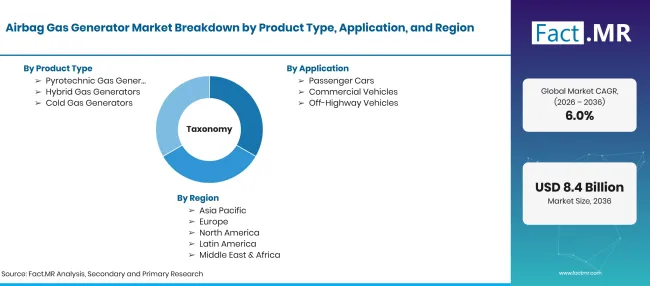
Factmr Airbag Gas Generator Market Taxonomy | Source: Fact.MR
| Attribute | Details |
|---|---|
| Quantitative Units | USD 4.7 billion in 2026 to USD 8.4 billion by 2036 at a 6.0% CAGR |
| Market Definition | Generators that provide inflation gas within vehicle airbag assemblies |
| Product Type | Pyrotechnic Gas Generators; Hybrid Gas Generators; Cold Gas Generators |
| Application | Passenger Cars; Commercial Vehicles; Off-Highway Vehicles |
| Sales Channel | Original Equipment Manufacturer; Aftermarket |
| Regions Covered | North America; Latin America; Western Europe; Eastern Europe; East Asia; South Asia & Pacific; Middle East & Africa |
| Countries Covered | Germany; Brazil; United States; United Kingdom; Japan |
| Companies Profiled | Autoliv; Daicel; Joyson Safety Systems; ZF LIFETEC; Toyoda Gosei |
| Forecast Period | 2026 to 2036 |
| Approach | Assessment of generator technology, airbag applications, procurement channels, country demand and documented supplier activity |
Source: Fact.MR analysis. Updated Oct 23, 2026
How is the market segmented?
-
By Product Type
- Pyrotechnic Gas Generators
- Hybrid Gas Generators
- Cold Gas Generators
-
By Application
- Passenger Cars
- Commercial Vehicles
- Off-Highway Vehicles
-
By Sales Channel
- Original Equipment Manufacturer
- Aftermarket
-
By Region
- North America
- Latin America
- Western Europe
- Eastern Europe
- East Asia
- South Asia & Pacific
- Middle East & Africa
Frequently Asked Questions
How big is the airbag gas generator market in 2026?
What value and growth rate are forecast through 2036?
Which product type leads the market?
Which application and sales channel have the largest shares?
Which companies participate in airbag gas generator supply?
Who worked on this report


Preview the report firsthand - request a free sample
Free SampleGet the brochure for pricing and purchase details
Download PDF